[55:8] Do Not Transgress the Law: Which Law? What Kind of Law?
A 19-section reflection centered on Quran 55:8, exploring divine law, mizan, justice, balance, truthful testimony, monotheism, religious authority, and submission to GOD.
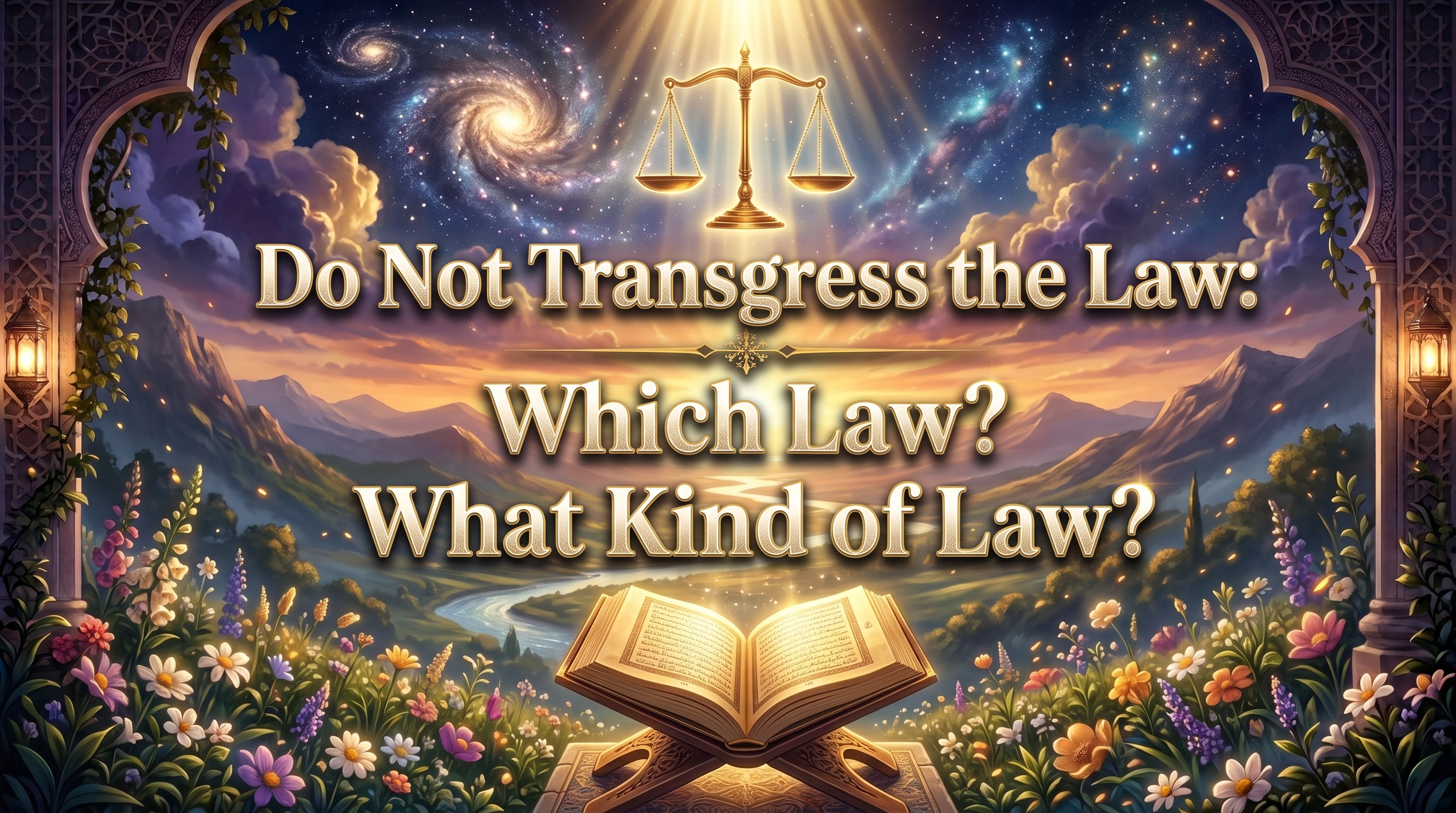
[55:8] Do Not Transgress the Law: Which Law? What Kind of Law?
A Nineteen-Part Reflection on Quran 55:8
Author: Berk KÖKSAL
Date: October 15, 2026
Location: Mersin
Verse
55:8
أَلَّا تَطْغَوْا۟ فِى ٱلْمِيزَانِ
*You shall not transgress the law. *
Yasayı çiğnemeyin.
Source: kuranteyit.com
Introduction
Greetings. Peace be upon you.
“You shall not transgress the law.” The command in 55:8 is concise. But which law? Whose law? A rule made by a government? A principle of justice? The precise order of creation? A scale used in trade? I do not think every one of these questions can be answered with the same degree of certainty simply by repeating the word “law.” But I do know that isolating 55:8 from its neighbors would hide something essential.
Verse 55:7 speaks of the sky and the establishment of the law. Verse 55:9 calls for justice and warns against violating the law. Elsewhere, the Quran connects scripture, truth, law, testimony, and fair measure. My purpose in this article is to consider these verses together and to reflect, sincerely and carefully, on what bearing witness to the oneness of GOD means for knowledge, justice, truthful speech, and submission in a person’s life.
In Mizan: Mixing, Mastering, and Measure in the Quran, I approached measure through years of composing and producing music. This time I want to stay with the question of authority. Can I recognize a boundary without claiming to know every detail beyond it? Can I honor the law described in the verse without elevating my own interpretation into law?
Summary:
1. Do Not Transgress the Law: Looking First at My Own Limits
55:8 — You shall not transgress the law.
2. Who Established the Law? A Question That Begins with the Sky
55:7 — He constructed the sky and established the law.
3. Can the Law Be Understood Apart from Justice?
55:9 — You shall establish justice; do not violate the law.
4. The Calculation of the Sun and the Responsibility of the Human Being
55:5 — The sun and the moon are perfectly calculated.
55:6 — The stars and the trees prostrate.
5. The Teacher, the Creator, and the Gift of Discernment
55:1 — The Most Gracious.
55:2 — Teacher of the Quran.
55:3 — Creator of the human beings.
55:4 — He taught them how to distinguish.
6. The Earth Does Not Belong to Me Alone
55:10 — He created the earth for all creatures.
55:13 — (O humans and jinns,) which of your Lord’s marvels can you deny?
7. Scripture, Truth, and the Law
42:17 — GOD is the One who sent down the scripture, to deliver the truth and the law. For all that you know, the Hour (Day of Judgment) may be very close.
8. Human Beings Are to Uphold Justice
57:25 — We sent our messengers supported by clear proofs, and we sent down to them the scripture and the law, that the people may uphold justice. And we sent down the iron, wherein there is strength, and many benefits for the people. All this in order for GOD to distinguish those who would support Him and His messengers, on faith. GOD is Powerful, Almighty.
9. Whom Do I Turn to as a Source of Law?
6:114 — Shall I seek other than GOD as a source of law, when He has revealed to you this book fully detailed?* Those who received the scripture recognize that it has been revealed from your Lord, truthfully. You shall not harbor any doubt.
6:115 — The word of your Lord is complete,* in truth and justice. Nothing shall abrogate His words. He is the Hearer, the Omniscient.
10. Justice, Doing Good, and Devotion to GOD Alone
16:90 — GOD advocates justice, charity, and regarding the relatives. And He forbids evil, vice, and transgression. He enlightens you, that you may take heed.
7:29 — Say, “My Lord advocates justice, and to stand devoted to Him alone at every place of worship. You shall devote your worship absolutely to Him alone. Just as He initiated you, you will ultimately go back to Him.”
11. Full Measure: Where Does Another Person’s Right Begin?
6:152 — You shall not touch the orphans’ money except in the most righteous manner, until they reach maturity. You shall give full weight and full measure when you trade, equitably. We do not burden any soul beyond its means. You shall be absolutely just when you bear witness, even against your relatives. You shall fulfill your covenant with GOD. These are His commandments to you, that you may take heed.
17:35 — You shall give full measure when you trade, and weigh equitably. This is better and more righteous.
12. Demanding Everything, Giving Less: The Quiet Language of Cheating
83:1 — Woe to the cheaters.
83:2 — Who demand full measure when receiving from the people.
83:3 — But when giving them the measures or weights, they cheat.
83:4 — Do they not know that they will be resurrected?
83:5 — On a tremendous day?
83:6 — That is the day when all people will stand before the Lord of the universe.
13. Trust, Judgment, and the Measure Distorted by Bribery
4:58 — GOD commands you to give back anything the people have entrusted to you. If you judge among the people, you shall judge equitably. The best enlightenment indeed is what GOD recommends for you. GOD is Hearer, Seer.
2:188 — You shall not take each others’ money illicitly, nor shall you bribe the officials to deprive others of some of their rights illicitly, while you know.
14. Whether the Person Is Close to Me or Opposed to Me
4:135 — O you who believe, you shall be absolutely equitable, and observe GOD, when you serve as witnesses, even against yourselves, or your parents, or your relatives. Whether the accused is rich or poor, GOD takes care of both. Therefore, do not be biased by your personal wishes. If you deviate or disregard (this commandment), then GOD is fully Cognizant of everything you do.
5:8 — O you who believe, you shall be absolutely equitable, and observe GOD, when you serve as witnesses. Do not be provoked by your conflicts with some people into committing injustice. You shall be absolutely equitable, for it is more righteous. You shall observe GOD. GOD is fully Cognizant of everything you do.
15. Testimony, Oneness, and Truthful Speech
3:18 — GOD bears witness that there is no god except He, and so do the angels and those who possess knowledge. Truthfully and equitably, He is the absolute god; there is no god but He, the Almighty, Most Wise.
33:70 — O you who believe, reverence GOD and utter only the correct utterances.
16. Speaking Without Knowledge Can Distort the Measure
17:36 — You shall not accept any information, unless you verify it for yourself. I have given you the hearing, the eyesight, and the brain, and you are responsible for using them.
2:169 — He only commands you to commit evil and vice, and to say about GOD what you do not know.
17. The Boundary Between Explaining Revelation and Decreeing Religious Law
42:21 — They follow idols who decree for them religious laws never authorized by GOD. If it were not for the predetermined decision, they would have been judged immediately. Indeed, the transgressors have incurred a painful retribution.*
9:31 — They have set up their religious leaders and scholars as lords,* instead of GOD. Others deified the Messiah, son of Mary. They were all commanded to worship only one god. There is no god except He. Be He glorified, high above having any partners.
18. Learning Without Taking Human Beings as Lords
3:79 — Never would a human being whom GOD blessed with the scripture and prophethood say to the people, “Idolize me beside GOD.” Instead, (he would say), “Devote yourselves absolutely to your Lord alone,” according to the scripture you preach and the teachings you learn.
3:80 — Nor would he command you to idolize the angels and the prophets as lords. Would he exhort you to disbelieve after becoming submitters?
39:3 — Absolutely, the religion shall be devoted to GOD alone. Those who set up idols beside Him say, “We idolize them only to bring us closer to GOD; for they are in a better position!” GOD will judge them regarding their disputes. GOD does not guide such liars, disbelievers.
19. Even the Smallest Right Has Weight
21:47 — We will establish the scales of justice on the Day of Resurrection. No soul will suffer the least injustice. Even the equivalent of a mustard seed will be accounted for. We are the most efficient reckoners.
54:49 — Everything we created is precisely measured.
1. Do Not Transgress the Law: Looking First at My Own Limits
Verse
55:8 — You shall not transgress the law.
Reflection on the Verse
When I encounter 55:8, I encounter a command before I encounter an explanation. It sounds direct. Yet the first thing that rises in my mind is a question: Which law? If I rush to supply an answer, I may commit an error within the very act of explaining the warning. I may take a conclusion that belongs to me and make it sound as if GOD Himself has declared it.
So I want to begin with a restraint that is uncomfortable for a writer. I will not pretend to know every detail that this short verse does not state. A boundary is presented, and I am told not to cross it. Before asking how other people cross that boundary, I have to ask how easily I move the boundary when something I want lies on the other side of it.
The verse does not, on its own, set out every law of nature, every rule of a modern state, or the complete judgment for every private dispute. That is not a weakness in the verse; it is a limit on what I can honestly claim about it. I can take the command seriously without disguising an interpretation as a revelation. Perhaps the first place where I need to observe a measure is the measure of my own speech about the Quran.
Verse references: 55:8.
2. Who Established the Law? A Question That Begins with the Sky
Verse
55:7 — He constructed the sky and established the law.
Reflection on the Verse
Verse 55:7 brings the construction of the sky and the establishment of the law into the same sentence. I find the pairing striking. Before I speak about what the law requires of me, the verse directs me toward the One who established it. Its source does not begin with my preferences, my family’s customs, a popular opinion, or a leader’s reputation.
Still, I must not turn that thought into an unlimited claim. The word “law” can make me think of courts, constitutions, regulations, and public authorities. Verse 55:7 does not identify every human law as divinely approved. Nor does it list the physical formulas by which the heavens operate. It presents the sky and the law together without supplying an exhaustive theory of either.
What I find here is a question of position. I can write rules for a project, build a reliable system, or help settle a disagreement. These actions can have value. But they cannot make me the origin of the authority described in 55:7. I am not standing where the law is established. I am standing before what has been established, trying to understand my responsibility to it. “Which law?” becomes a more demanding question once I ask, “Who has the authority to establish it?”
Verse references: 55:7.
3. Can the Law Be Understood Apart from Justice?
Verse
55:9 — You shall establish justice; do not violate the law.
Reflection on the Verse
The following verse, 55:9, gives the closest and most important context for 55:8. The warning not to transgress is immediately followed by a command to establish justice and not violate the law. I cannot honestly leave justice outside the discussion. The sequence itself refuses to let the law remain an impressive but empty word.
It is easy to admire justice. People with opposing interests can all say that they stand for it. The harder question comes when justice threatens something I possess: money, status, pride, the approval of those close to me, or a conclusion I have already published. Will I still care about fairness if it costs me an advantage? Will I correct an error when the error favors my own side?
I do not read 55:9 as a complete legal code. The verse supplies a responsibility, not all the procedural details needed for every case. That is why I need to bring other relevant verses alongside it. Yet the immediate three-verse movement is already clear enough to challenge me: the law is established in 55:7, transgression is prohibited in 55:8, and justice is to be upheld in 55:9. If I defend the word “law” while excusing injustice, I have failed to listen to the verse beside it.
Verse references: 55:9.
4. The Calculation of the Sun and the Responsibility of the Human Being
Verse
55:5 — The sun and the moon are perfectly calculated.
55:6 — The stars and the trees prostrate.
Reflection on the Verse
Verses 55:5 and 55:6 speak of the sun and moon being calculated, and of the stars and trees prostrating. When I reach the reference to the sky and the law in 55:7, I sense that these verses are drawing my attention to a created order rather than a universe centered on human whim. But I want to distinguish what the passage says from everything it makes me think about. It does not give me the formulas of astronomy, and I should not pretend it does.
In music production I work with timing, intervals, and proportions. A small shift can disturb the way a whole arrangement moves. Such experiences have made me attentive to relationships between parts. Yet my experience in the studio is only an analogy. The discipline of aligning instruments is not evidence that a particular physical law is hidden in a Quranic sentence.
What matters to me is the humility the sequence invites. I inhabit a world I did not construct. Even when I understand some of its patterns, I have not become their author. I cannot draw a direct moral command from every physical regularity I observe. But I can let 55:5-8 interrupt my habit of treating my preferences as the measure of all things. The human being is not the center of the whole simply because the human being can calculate some of its parts.
Verse references: 55:5, 55:6.
5. The Teacher, the Creator, and the Gift of Discernment
Verse
55:1 — The Most Gracious.
55:2 — Teacher of the Quran.
55:3 — Creator of the human beings.
55:4 — He taught them how to distinguish.
Reflection on the Verse
I return to the beginning of the sura: graciousness, the Teacher of the Quran, the creation of human beings, and the teaching of discernment. These statements appear before 55:7-9. That order matters to my reflection, not because it solves every question about chronology or creation, but because I read the warning about transgression in a context that also speaks of teaching and distinguishing.
In my earlier article, Mizan: Mixing, Mastering, and Measure in the Quran, I reflected on measure through my experience with sound. Here I find myself returning to the question behind the instrument and the scale: can I distinguish what a verse actually states from what I want the verse to mean? The existence of a measure does not excuse me from learning how carefully I should approach it.
Verse 55:4 does not tell me that every judgment I make is infallible. The fact that discernment is taught is not proof that I have already mastered it. If anything, it makes me more responsible for admitting where my understanding ends. When I say, “This is the law,” am I pointing to the text, or smuggling in the preferences of the interpreter? The difference can be small in presentation and enormous in consequence.
Verse references: 55:1, 55:2, 55:3, 55:4.
6. The Earth Does Not Belong to Me Alone
Verse
55:10 — He created the earth for all creatures.
55:13 — (O humans and jinns,) which of your Lord’s marvels can you deny?
Reflection on the Verse
The earth is created for all creatures, says 55:10. I keep returning to the breadth of that expression. After considering law and justice, I meet a reminder that the earth is not merely an extension of my own plans. Other lives exist within the world I use, build upon, and sometimes alter. The question about the Lord’s marvels in 55:13 makes my sense of ownership feel even less absolute.
I do not claim that 55:10 supplies a detailed modern environmental code or a complete set of property regulations. It does not. What it does is unsettle the assumption that I may treat everything around me as though only my needs count. Justice cannot be reduced to whatever is convenient to the person who happens to control a resource.
There are days when I see the world through lists of tasks, deadlines, projects, and responsibilities. I am grateful for the ability to organize them. But organization can make my own concerns look like the entire horizon. Verse 55:10 widens that horizon. The thought is not that I now know all the rights and needs of every creature. It is that I have been warned against seeing a shared creation through an exclusively private claim.
Verse references: 55:10, 55:13.
7. Scripture, Truth, and the Law
Verse
42:17 — GOD is the One who sent down the scripture, to deliver the truth and the law. For all that you know, the Hour (Day of Judgment) may be very close.
Reflection on the Verse
Verse 42:17 is particularly important to the question I am asking. Scripture, truth, and the law appear together. This is not a reason to treat every opinion I hold as divine legislation. It is a reason to take seriously the connection between what is revealed, what is true, and what ought not to be transgressed.
One danger in studying scripture is the temptation to collapse these categories into my own certainty. I may discover a fact and assume that I therefore have authority to issue a command. I may find an interpretation persuasive and begin treating disagreement with that interpretation as rebellion against GOD. But the distance between understanding a text and claiming to speak with its authority must remain visible.
The verse also speaks of the Hour possibly being close. This changes the urgency of the inquiry for me. I can argue about definitions for years; that does not excuse unjust action today. The study of law should not become a shelter from the responsibility to live truthfully. I want the search for meaning to make me more cautious in judgment and more faithful in action, not simply more confident in debate.
Verse references: 42:17.
8. Human Beings Are to Uphold Justice
Verse
57:25 — We sent our messengers supported by clear proofs, and we sent down to them the scripture and the law, that the people may uphold justice. And we sent down the iron, wherein there is strength, and many benefits for the people. All this in order for GOD to distinguish those who would support Him and His messengers, on faith. GOD is Powerful, Almighty.
Reflection on the Verse
In 57:25 I find messengers, clear proofs, scripture, and the law joined to an explicit purpose: people are to uphold justice. The point that holds my attention is that human beings are given a role. Justice is not presented merely as something to admire from a distance. It is something to be maintained among people.
Iron is also mentioned in this verse, along with strength and benefits. That makes me think about what happens when power enters the picture. Having strength cannot, by itself, establish that a person is right. Nor does the usefulness of an instrument prove that every use of it is just. I do not want to stretch the mention of iron into a theory about every form of technology. But I can ask what I do with power entrusted to my hands.
I can amplify a voice in a studio. I can place a certain conclusion at the top of a software interface. I can design terms for a business arrangement. None of these examples is a literal explanation of iron in 57:25. They are ways in which I recognize the moral question raised by the verse’s emphasis on justice. Do I use the reach, influence, or strength available to me to protect fairness, or to make my own position difficult to challenge? The law should not become a decorative word attached to power.
Verse references: 57:25.
9. Whom Do I Turn to as a Source of Law?
Verse
6:114 — Shall I seek other than GOD as a source of law, when He has revealed to you this book fully detailed?* Those who received the scripture recognize that it has been revealed from your Lord, truthfully. You shall not harbor any doubt.
6:115 — The word of your Lord is complete,* in truth and justice. Nothing shall abrogate His words. He is the Hearer, the Omniscient.
Reflection on the Verse
The question posed in 6:114 turns “Whose law?” into a question of source. The verse refers to GOD as the source of law and to the detailed revelation of the book. Verse 6:115 describes the completion of GOD’s word in truth and justice. Read together, they make me think not only about the content of a rule, but about whose authority I am claiming when I state it.
I know how easy it is to begin a study with a preferred conclusion and then select the words that make the conclusion sound inevitable. If I take truth and justice seriously, I must be willing to test the parts of my own reading that I most want to keep. A successful argument is not necessarily a faithful reading; winning an argument cannot be the measure of whether I understood the verse.
These verses do not make me the person who can resolve every legal dispute without uncertainty. Recognizing GOD as the source of law does not turn my explanation into the source. I should distinguish the statement of scripture, the connection I draw from several verses, and the application I propose for a particular situation. They can be related without being identical. The distinction protects the very authority I say I am honoring.
Verse references: 6:114, 6:115.
10. Justice, Doing Good, and Devotion to GOD Alone
Verse
16:90 — GOD advocates justice, charity, and regarding the relatives. And He forbids evil, vice, and transgression. He enlightens you, that you may take heed.
7:29 — Say, “My Lord advocates justice, and to stand devoted to Him alone at every place of worship. You shall devote your worship absolutely to Him alone. Just as He initiated you, you will ultimately go back to Him.”
Reflection on the Verse
Verse 16:90 brings justice together with charity and concern for relatives, and it forbids evil and transgression. Verse 7:29 places justice beside wholehearted devotion to GOD alone. Together, they keep me from treating justice as a slogan detachable from either human relationships or worship.
There is a difference between saying that I value fairness and behaving fairly when a relative’s interest is at stake. There is a difference between giving generously when it will be noticed and doing what is right without an audience. The verses do not erase these human struggles. They make it harder for me to hide them behind religious language.
I find the connection with devotion to GOD alone especially demanding. If I act fairly only to be praised, what happens when no one praises me? If I respect another person’s rights only when I expect a reward, what happens when I stand to gain by doing the opposite? Justice cannot be stable if I adjust its meaning every time the benefit moves from one side to another. The measure must challenge my desires, not be quietly rewritten by them.
Verse references: 16:90, 7:29.
11. Full Measure: Where Does Another Person’s Right Begin?
Verse
6:152 — You shall not touch the orphans’ money except in the most righteous manner, until they reach maturity. You shall give full weight and full measure when you trade, equitably. We do not burden any soul beyond its means. You shall be absolutely just when you bear witness, even against your relatives. You shall fulfill your covenant with GOD. These are His commandments to you, that you may take heed.
17:35 — You shall give full measure when you trade, and weigh equitably. This is better and more righteous.
Reflection on the Verse
In 6:152 the commands relating to full weight, just testimony, and faithfulness to the covenant appear within one verse. Verse 17:35 also speaks directly about giving full measure in trade. I find this concreteness necessary. It is tempting to imagine justice only as a subject for judges and scholars, while the daily transactions through which people lose or receive their due seem too ordinary to deserve attention.
As someone who works with commerce, I know how reassuring numbers can appear. A quantity, a price, a delivery date, and an invoice are all precise on a screen. Yet precision does not create honesty. A perfectly formatted document can still conceal an unfair term. A technically correct calculation can still be built around a misleading description.
I am not claiming that these verses list every modern commercial practice I have in mind. Their commands lead me to examine my own practices. When I supply something, do I deliver what I led the other person to expect? When I calculate an amount, would I accept the same method if our positions were reversed? The law I am trying to understand becomes tangible here: not in an impressive definition, but in whether another person receives what is rightfully due.
Verse references: 6:152, 17:35.
12. Demanding Everything, Giving Less: The Quiet Language of Cheating
Verse
83:1 — Woe to the cheaters.
83:2 — Who demand full measure when receiving from the people.
83:3 — But when giving them the measures or weights, they cheat.
83:4 — Do they not know that they will be resurrected?
83:5 — On a tremendous day?
83:6 — That is the day when all people will stand before the Lord of the universe.
Reflection on the Verse
The opening of Sura 83 shows a painfully recognizable pattern: the person who insists on receiving the full measure but reduces the measure when giving to others. The asymmetry is ordinary enough to be frightening. I can recognize this form of dishonesty without needing a complicated philosophical system.
I might demand punctuality from someone else and expect endless patience for my own delays. I may insist that my own work be paid fairly while treating another person’s labor as something to minimize. These are analogies I draw from the behavior described in 83:2-3; I do not present them as new commands written in the verse. They matter because they reveal how easily I can create two standards while believing I have only one.
The next verses turn toward resurrection and the day when people stand before the Lord of the universe. Suddenly the small commercial imbalance no longer looks trivial. The presence or absence of an observer today does not settle whether my action is just. I want to remember this in the ordinary exchanges that make up a life. The question is simple and difficult: Is the measure I insist on receiving the same measure I am willing to give?
Verse references: 83:1, 83:2, 83:3, 83:4, 83:5, 83:6.
13. Trust, Judgment, and the Measure Distorted by Bribery
Verse
4:58 — GOD commands you to give back anything the people have entrusted to you. If you judge among the people, you shall judge equitably. The best enlightenment indeed is what GOD recommends for you. GOD is Hearer, Seer.
2:188 — You shall not take each others’ money illicitly, nor shall you bribe the officials to deprive others of some of their rights illicitly, while you know.
Reflection on the Verse
Verse 4:58 speaks of returning what is entrusted and judging equitably between people. Verse 2:188 warns against illicitly taking the wealth of others and bribing officials to deprive people of their rights. These statements bring another dimension into the question of law. The existence of a procedure, an office, or an official signature does not automatically establish that an outcome is just.
Wrongdoing does not always look like an open act of theft. It can be dressed in authoritative language and made to look like a regular process. The warning about bribery makes me cautious about equating technical compliance with moral righteousness. But that same caution prevents me from accusing every official or institution without evidence. Justice requires care when criticizing an injustice as well as when confronting it.
I also think about trust in my own work. Someone may entrust me with money, time, creative work, or a decision. The verse speaks directly about returning entrusted things; I reflect on the broader responsibility of not using another person’s trust against them. To occupy a position of responsibility is not to become its owner in an unlimited sense. The law cannot be protected by people who treat entrusted authority as private property.
Verse references: 4:58, 2:188.
14. Whether the Person Is Close to Me or Opposed to Me
Verse
4:135 — O you who believe, you shall be absolutely equitable, and observe GOD, when you serve as witnesses, even against yourselves, or your parents, or your relatives. Whether the accused is rich or poor, GOD takes care of both. Therefore, do not be biased by your personal wishes. If you deviate or disregard (this commandment), then GOD is fully Cognizant of everything you do.
5:8 — O you who believe, you shall be absolutely equitable, and observe GOD, when you serve as witnesses. Do not be provoked by your conflicts with some people into committing injustice. You shall be absolutely equitable, for it is more righteous. You shall observe GOD. GOD is fully Cognizant of everything you do.
Reflection on the Verse
Verse 4:135 asks for justice even when the testimony is against oneself or close relatives. Verse 5:8 warns that conflict with other people must not provoke injustice. Together they expose two temptations: favoring someone because I love them and harming someone because I resent them.
Both temptations can disguise themselves as virtues. Defending someone close may feel like loyalty. Harshness toward someone who has wronged me may feel like strength. But loyalty is not a license to distort a judgment, and anger is not a reliable scale. I cannot remove every feeling from life, nor do the verses tell me to stop caring about people. They ask that my feelings not decide what is just.
When I remember 55:9, the demand to establish justice has a sharper edge. I am not merely called to be kind to those I like. I must be prepared to acknowledge a right belonging to someone I oppose and a fault belonging to someone I love. That may be one of the most difficult forms of submission. It asks me to place the measure beyond my alliances, including alliances with my own previous opinions.
Verse references: 4:135, 5:8.
15. Testimony, Oneness, and Truthful Speech
Verse
3:18 — GOD bears witness that there is no god except He, and so do the angels and those who possess knowledge. Truthfully and equitably, He is the absolute god; there is no god but He, the Almighty, Most Wise.
33:70 — O you who believe, reverence GOD and utter only the correct utterances.
Reflection on the Verse
Verse 3:18 places testimony to the oneness of GOD beside knowledge and justice. This matters deeply to me. Testimony is not a performance of certainty. It carries a claim about what is true, and so it makes me responsible for the fairness and accuracy of my words. Verse 33:70 brings that responsibility into the ordinary act of speaking.
A headline can travel farther than the article beneath it. A short statement about religion can be repeated by people who have never checked its source. When I write as if an interpretation is an indisputable command, I may lend it a weight it has not earned. The temptation to sound authoritative is strongest precisely when my argument still needs examination.
In my earlier reflection on Mizan, I considered what happens when one sound is made too dominant within a mix. Here I consider a similar danger in public speech. A microphone can make my voice louder; it cannot make the statement true. Software can make a claim appear prominent; prominence is not evidence. If I wish to bear witness truthfully, I must let accuracy and justice matter more than the force of my presentation.
Verse references: 3:18, 33:70.
16. Speaking Without Knowledge Can Distort the Measure
Verse
17:36 — You shall not accept any information, unless you verify it for yourself. I have given you the hearing, the eyesight, and the brain, and you are responsible for using them.
2:169 — He only commands you to commit evil and vice, and to say about GOD what you do not know.
Reflection on the Verse
Verse 17:36 places responsibility on me to verify information for myself. Verse 2:169 warns against saying about GOD what one does not know. These verses are directly relevant to the question in my title. The question “Which law?” gives me no permission to invent an answer and then announce it under divine authority.
Even careful research can go wrong. I can find a root and import every possible dictionary meaning into a single verse. I can notice that a word is repeated and assume that its surrounding circumstances are identical every time. I can mistake the number of sources I have read for the strength of a conclusion. The discipline of verification includes the courage to say that the text supports less than I had hoped.
In Rashad Khalifa’s Authorized English Translation, 55:8 uses the word “law”; the Turkish translation of the Authorized English Translation presents its Turkish counterpart. The relation is important to my study, but it does not turn me into a legislator. I must continue to distinguish a quoted verse from a lexical observation, an inference, and a personal application. That distinction is not a technical inconvenience. It is an expression of respect for truth.
Verse references: 17:36, 2:169.
17. The Boundary Between Explaining Revelation and Decreeing Religious Law
Verse
42:21 — They follow idols who decree for them religious laws never authorized by GOD. If it were not for the predetermined decision, they would have been judged immediately. Indeed, the transgressors have incurred a painful retribution.*
9:31 — They have set up their religious leaders and scholars as lords,* instead of GOD. Others deified the Messiah, son of Mary. They were all commanded to worship only one god. There is no god except He. Be He glorified, high above having any partners.
Reflection on the Verse
Verse 42:21 warns about religious laws decreed without GOD’s authorization. Verse 9:31 describes the danger of setting up religious leaders and scholars as lords. Together these verses make me ask whether someone can claim to defend divine law while quietly giving divine authority to a human rule.
I am not compelled to treat everyone who teaches religion as an enemy. People can study carefully and help others. But there is a distinction between offering an explanation that can be examined and imposing a judgment in GOD’s name without authority to do so. Neither learning nor popularity erases that distinction. Nor does my own sincerity guarantee that I have not crossed it.
As someone involved in building tools for Quran research, I encounter this problem in another form. It is easy for an interface to attach a confident label to an interpretation. The screen can look official even when the reasoning is incomplete. I do not want a program I create to conceal the difference between source and explanation. My work can help people investigate; it cannot inherit GOD’s authority. If the law is GOD’s, then even its defender must know where the defender’s own voice ends.
Verse references: 42:21, 9:31.
18. Learning Without Taking Human Beings as Lords
Verse
3:79 — Never would a human being whom GOD blessed with the scripture and prophethood say to the people, “Idolize me beside GOD.” Instead, (he would say), “Devote yourselves absolutely to your Lord alone,” according to the scripture you preach and the teachings you learn.
3:80 — Nor would he command you to idolize the angels and the prophets as lords. Would he exhort you to disbelieve after becoming submitters?
39:3 — Absolutely, the religion shall be devoted to GOD alone. Those who set up idols beside Him say, “We idolize them only to bring us closer to GOD; for they are in a better position!” GOD will judge them regarding their disputes. GOD does not guide such liars, disbelievers.
Reflection on the Verse
Verses 3:79-80 describe the boundary between a person entrusted with scripture and the danger of being treated as an object of devotion. Verse 39:3 raises the question of intermediaries that people set up in the hope of drawing closer to GOD. These are important companions to 55:8, because human beings can cross a boundary not only in money or judgment, but also in allegiance.
Learning from another person is not the same thing as making that person a lord. I can be grateful for a careful researcher, a faithful messenger, or a helpful teacher. I can honor the effort behind a useful explanation. But I should not allow gratitude to become a surrender of my responsibility to examine what is said. Nor should I seek to make others dependent upon me by presenting my interpretation as the only permissible voice.
There is also a quieter authority I must watch: my own ego. I can become so attached to a conclusion that I no longer listen when evidence challenges it. At that moment I have made my previous opinion unusually difficult to correct. I do not use these verses as permission to judge the inward faith of everyone who disagrees with me. I use them to keep my devotion directed toward GOD alone and my human judgments open to examination.
Verse references: 3:79, 3:80, 39:3.
19. Even the Smallest Right Has Weight
Verse
21:47 — We will establish the scales of justice on the Day of Resurrection. No soul will suffer the least injustice. Even the equivalent of a mustard seed will be accounted for. We are the most efficient reckoners.
54:49 — Everything we created is precisely measured.
Reflection on the Verse
Verse 21:47 speaks of the scales of justice on the Day of Resurrection and of even the smallest amount being accounted for. Verse 54:49 speaks of the precise measure of created things. These statements are not identical, and I do not combine them into a mathematical formula about judgment. One addresses accountability and justice; the other leads me to consider measure in creation. Their different contexts matter.
I can recognize a great injustice from a distance and still overlook a small injustice within reach of my own hand. I can promise and delay, calculate in my favor, praise an opinion merely because its author is influential, or write more confidently about a verse than my evidence permits. These are applications I reflect upon, not a list that I claim the two verses themselves enumerate.
I began with the question “Which law?” I end with a clearer center and a more modest sense of what I know. The sequence of 55:7-9 connects the law established by GOD to the prohibition of transgression and the establishment of justice. Verses 42:17 and 57:25 relate law to scripture and the work of justice among people. Other verses lead me to test that responsibility in my trade, testimony, judgments, truthful speech, and allegiance. But I cannot honestly claim that every difficult application has been settled. My first obligation is not to pronounce a verdict on everyone else. It is to stop adjusting the measure whenever the measure turns toward me.
Verse references: 21:47, 54:49.
On the Arabic Roots of the Words
In 55:7-9, ٱلْمِيزَانَ (al-mīzān) appears in the account of establishing the law and in the warnings surrounding it. The word belongs to the و-ز-ن (w-z-n) root family, associated with weighing, weight, and measure. In 55:9, ٱلْوَزْنَ (al-wazn) belongs to the same family. Rashad Khalifa’s Authorized English Translation uses “law” in 55:8; the Turkish translation of the Authorized English Translation uses “yasa.” The relationship with weighing and measure invites close consideration of the command to establish justice in the next verse. It does not authorize me to replace the wording of the Authorized English Translation with a preferred alternative.
The form تَطْغَوْا۟ (taṭghaw) in 55:8 is related to the ط-غ-ي (ṭ-gh-y) root family, associated with exceeding limits and transgression. In 55:9, بِٱلْقِسْطِ (bil-qisṭ) belongs to ق-س-ط (q-s-ṭ), associated with fairness and equity, while تُخْسِرُوا۟ (tukhsirū) belongs to خ-س-ر (kh-s-r), associated with loss or causing a reduction. Verse 6:115 uses عَدْلًا (ʿadlan), related to the ع-د-ل (ʿ-d-l) family of justice and equity.
The roots help me notice relationships; they do not erase context. A root can have a range of usages without every possible meaning being present in a particular sentence. Linguistic analysis does not grant me the power to issue divine rulings. What I can reasonably observe here is a cluster of ideas—measure, not exceeding a boundary, justice, and not diminishing what is due. What I cannot claim is that this observation by itself settles the details of every modern law or every difficult human dispute.
Verse references: 55:7, 55:8, 55:9, 6:115.
Other Claims
Some readings of 55:8 may emphasize the physical order suggested by the reference to the sky in 55:7. That connection deserves attention. Yet the immediate instruction in 55:9 to establish justice raises the question of whether a purely physical account is sufficient. Other approaches understand the passage chiefly through fair weighing in commerce, supported by passages such as 6:152, 11:85, and 83:1-3. That interpretation identifies a concrete aspect of the language, but whether it exhausts the passage is another question.
Some readers may identify “law” with the entire body of modern civil legislation. Others may react by rejecting any discussion of human legal arrangements in the presence of divine authority. Verses 6:114 and 42:21 raise serious questions about the source and authorization of religious law, while 4:58 speaks about human beings judging equitably. I do not think these passages permit a quick, universal endorsement or dismissal of every human legal system.
Historical, traditional, and sectarian commentaries may also give different weight to cosmic balance, commercial scales, moral equity, or final accountability when discussing mīzān. Each may illuminate a possible aspect; none should be smuggled into the verse as though an interpretation were the text itself. These approaches remain outside the foundation of my reflection. I return instead to the words and connections that the verses themselves allow me to consider.
Conclusion
I began with a word that seemed simple: law. The more I considered 55:8 alongside the verses around it, the less willing I became to detach that word from justice. In 55:7 the law is established by GOD. In 55:8 transgression is forbidden. In 55:9 justice is to be established and the law is not to be violated. This three-verse sequence provides the clearest immediate answer to the question in the title: the law here is not merely a measure that I am free to bend according to my convenience. Its source is attributed to GOD, and human responsibility is bound to the prohibition of transgression and the obligation of justice.
Verses 42:17 and 57:25 reinforce the connection of law with scripture and the establishment of justice. Verses 6:114-115 make me attentive to the source and truthfulness of judgment. The commercial passages challenge me to give a full measure. Verses 4:135 and 5:8 refuse to let affection or conflict decide justice. Verses 3:18 and 33:70 bring truthfulness and testimony into view. Verses 42:21 and 9:31 keep my attention on the danger of allowing human authority to occupy GOD’s place.
None of these connections entitles me to claim that I have solved every application of the law with infallible certainty. I cannot turn the order of the heavens into an unarguable scientific formula, the demand for justice into a complete legal code of my own design, or devotion to GOD into devotion to a human interpreter. The verses teach me to seek a direction and to respect the limits of my own knowledge at the same time.
For me, not transgressing the law therefore becomes more than reciting a prohibition. It means trying to preserve the same measure when I receive and when I give. It means respecting the rights of people close to me and those opposed to me. It means being willing to say that I do not know. It means keeping GOD’s words distinct from the conclusions I draw about them.
Perhaps the question I most need to carry forward is this: if everyone around me agreed with me, would I still correct myself when I discovered that I was wrong? If I take 55:8 seriously, the first measure I must refuse to bend is the one already in my own hands.
Note
2:32 — They said, “Be You glorified, we have no knowledge, except that which You have taught us. You are the Omniscient, Most Wise.”
The Turkish translation of the Authorized English Translation:
2:32 — Onlar, “Sana yücelik olsun. Senin bize öğrettiğinden başka bizim hiçbir bilgimiz yok. Sen Her Şeyi Bilensin, En Bilgesin.” dediler.
GOD knows best.
Source: kuranteyit.com
Discover
Related Articles
Quran Reflections
Mizan: Mixing, Mastering, and Measure in the Quran
A reflection on mizan, measure, justice, not transgressing limits, the order in creation, looking again and again, and how the experience of balance in music production mirrors human life through Ar-Rahman 55:7-9, Al-Qamar 54:49, and Al-Mulk 67:3-4.
Read article
Quran Reflections
[2:166] Leaders and Followers: Whom Are the Leaders Following?
A 19-section Quran reflection centered on 2:166, Satan's deceptive leadership, leaders who are themselves followers, the limits of Satan's influence, religious authority, testimony, justice, monotheism, and human responsibility.
Read article
Quran Reflections
[55:2] Who Is the Teacher of the Quran? Who Teaches the Quran?
A 19-section reflection centered on Quran 55:2, exploring the true Teacher of the Quran, the source of knowledge, divine guidance, the messenger’s role, reflection, truthfulness, monotheism, and the limits of human religious authority.
Read article