Mizan: Mixing, Mastering, and Measure in the Quran
A reflection on mizan, measure, justice, not transgressing limits, the order in creation, looking again and again, and how the experience of balance in music production mirrors human life through Ar-Rahman 55:7-9, Al-Qamar 54:49, and Al-Mulk 67:3-4.

A Reflection on Verses 55:7-9, 54:49, and 67:3-4
Author: Berk KÖKSAL
Date: 03.08.2026
Location: Mersin
Verse
1:1 — In the name of GOD, Most Gracious, Most Merciful.*
Introduction
Greetings. Peace be upon you.
The journey that begins after the first note of a musical work is written often does not end when the final note is recorded. Through composition, arrangement, orchestration, recording, sound design, editing, mixing, and mastering, I return to the same work again and again. I raise one sound, then realize that it masks another. I think I have beautified a frequency, only to hear that the whole has become tiring. An intervention I make to render an instrument more impressive can change the center of the work without my noticing.
Balance in a mix does not mean bringing everything to the same level. A children’s choir and a bass guitar, a whisper and a drum, or a solo voice and an orchestra do not need to be equally loud. Balance means that each element is heard in a way appropriate to its role in the work. Sometimes a sound needs to be raised, sometimes reduced, and sometimes muted entirely. Giving an element its due does not mean giving it unlimited space.
At the mastering stage, I look not only at the balance within the track itself, but also at the relationship it will establish with the outside world. How will the work sound on different systems? If it is compressed too much in order to appear powerful, will it lose its breath? As loudness increases, will details become smaller? Will an intervention that seems impressive for a moment become tiring over a long listen?
I do not want to reduce these verses to the concepts of mixing and mastering. Mizan in the Quran is not an audio-engineering technique. Yet years of experience in the studio with balance, excess, masking, space, proportion, and repeated checking help me hear more concretely the questions these verses direct toward my life.
Summary:
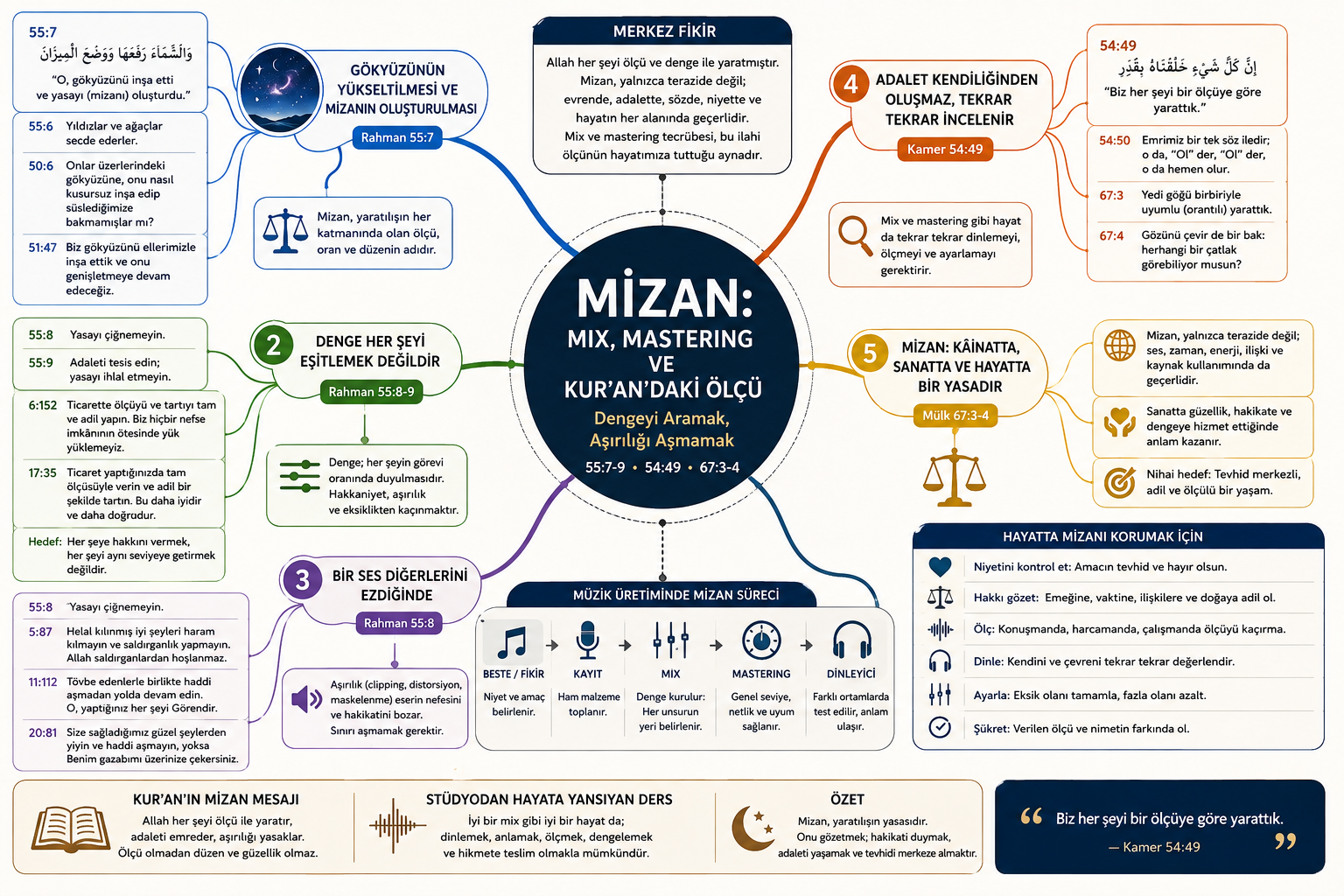
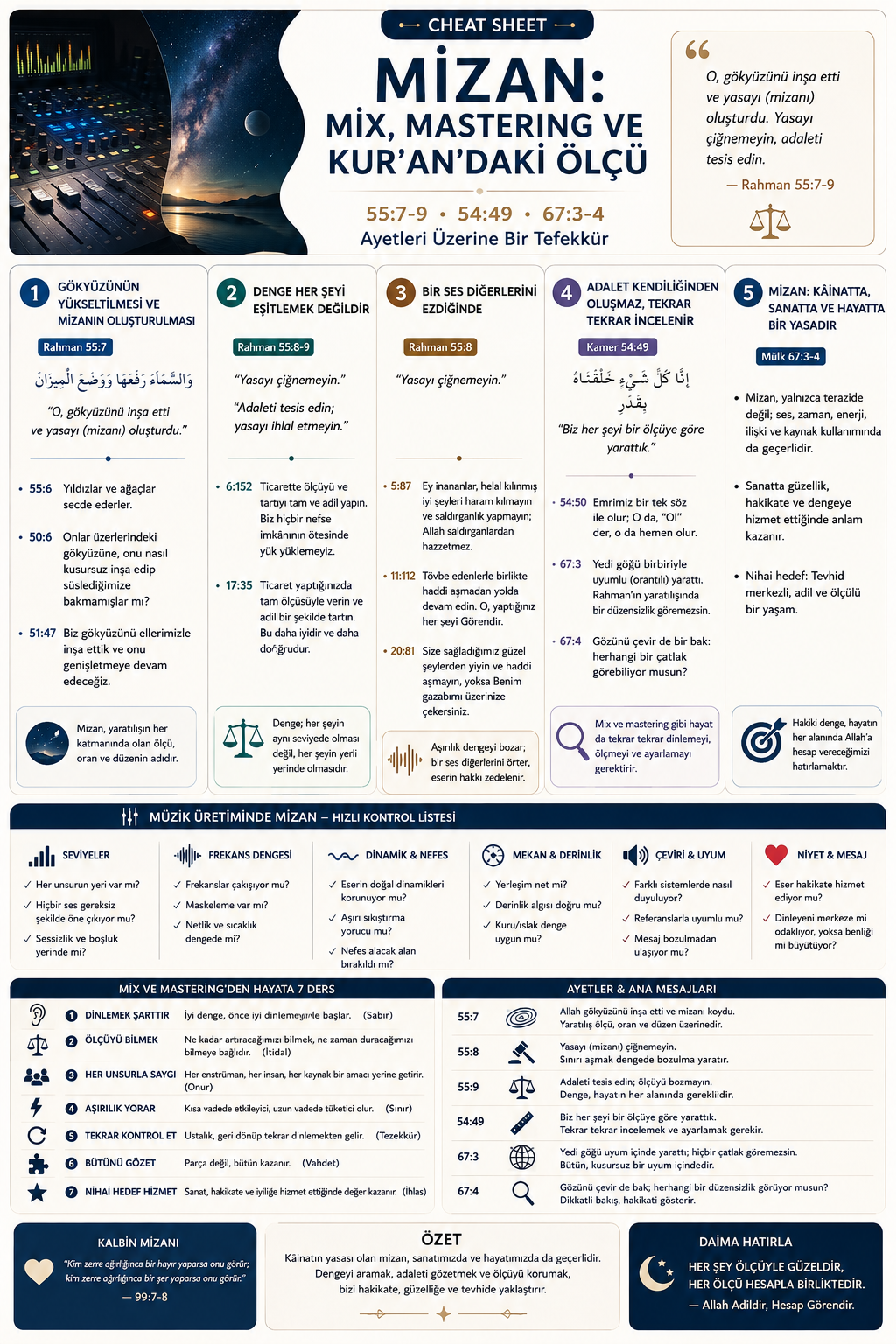
1. The Raising of the Sky and the Establishment of Mizan
55:7
وَالسَّمَاءَ رَفَعَهَا وَوَضَعَ الْمِيزَانَ
He constructed the sky and established the law.
He constructed the sky and established the law.
55:6 — The stars and the trees prostrate.
50:6 — Have they not looked at the sky above them, and how we constructed it flawlessly and adorned it?
51:47 — We constructed the sky with our hands, and we will continue to expand it.
2. Balance Does Not Mean Making Everything Equal
55:8 — Do not transgress the law.
55:9 — You shall establish justice; do not violate the law.
6:152 — When you trade, you shall give full weight and full measure, equitably. We do not burden any soul beyond its means. When you bear witness, you shall be absolutely equitable, even against your relatives.
17:35 — Give full measure when you trade, and weigh equitably. This is better and more righteous.
3. When One Sound Crushes the Others
55:8 — Do not transgress the law.
5:87 — O you who believe, do not prohibit the good things made lawful by GOD, and do not aggress; GOD does not love the aggressors.
11:112 — Therefore, continue on the path you have been commanded to follow, together with those who repent with you, and do not transgress. He is Seer of everything you do.
20:81 — Eat from the good things we provided for you, and do not transgress, lest you incur My wrath.
4. Justice Does Not Arise by Itself: It Must Be Established
55:9 — You shall establish justice; do not violate the law.
7:29 — Say, “My Lord advocates justice, and that you stand devoted absolutely to Him alone at every place of worship.”
16:90 — GOD advocates justice, charity, and regarding the rights of relatives. And He forbids evil, vice, and transgression.
21:47 — We will establish the scales of justice on the Day of Resurrection. No soul will suffer the least injustice. Even the equivalent of a mustard seed will be accounted for.
5. Full Measure and Cheating: Looking Powerful Versus Being Right
11:84 — “Do not cheat when you measure or weigh.”
11:85 — “O my people, you shall give full measure and full weight, equitably. Do not cheat people out of their rights, and do not roam the earth corruptingly.”
26:181 — “You shall give full measure when you trade; do not cheat.”
26:182 — “Weigh with an equitable scale.”
26:183 — “Do not cheat people out of their rights, and do not roam the earth corruptingly.”
83:1 — Woe to the cheaters.
6. Everything We Created Is Precisely Measured
54:49 — Everything we created is precisely measured.
13:8 — Everything He does is perfectly measured.
15:21 — There is nothing that we do not possess in infinite amounts. But we send it down in precise measure.
23:18 — We send down water from the sky in precise measure, then we store it in the ground.
25:2 — He created everything in precise measure; He designed everything exactly.
7. More Is Not Always Richer
42:27 — If GOD increased the provision for His servants, they would transgress on earth. Therefore, He sends it in exact measure to whomever He wills. He is fully Cognizant of His servants and Seer of them.
15:21 — There is nothing that we do not possess in infinite amounts. But we send it down in precise measure.
20:81 — Eat from the good things we provided for you, and do not transgress.
54:49 — Everything we created is precisely measured.
8. Layers and Wholeness
67:3 — He created seven universes in layers. You do not see any imperfection in the creation of the Most Gracious. Keep looking; do you see any flaw?
23:17 — We created above you seven universes in layers, and we are never unaware of a single creature therein.
41:12 — Thus He completed the seven universes in two days, and set the laws for every universe.
65:12 — GOD created seven universes and the same number of earths. The commands flow among them.
9. Looking Again and Again: The Ethics of Checking
67:4 — Look again and again; your eyes will return humbled and defeated.
67:3 — Keep looking; do you see any flaw?
10:36 — Most of them follow nothing but conjecture, and conjecture is no substitute for the truth.
50:6 — Have they not looked at the sky above them, and how we constructed it flawlessly and adorned it?
10. Mixing and Mastering: Internal Balance and External Relationship
6:152 — When you trade, you shall give full weight and full measure, equitably. We do not burden any soul beyond its means.
17:35 — Give full measure when you trade, and weigh equitably. This is better and more righteous.
21:47 — We will establish the scales of justice on the Day of Resurrection. No soul will suffer the least injustice.
55:9 — You shall establish justice; do not violate the law.
11. Raising Everything Is Not Power
17:110 — Do not utter your Contact Prayers too loudly, nor secretly; use a moderate tone.
55:8 — Do not transgress the law.
55:9 — You shall establish justice; do not violate the law.
31:19 — Walk humbly and lower your voice.
12. Solo Production and the Danger of Trusting One's Own Scale
12:76 — Above every knowledgeable one, there is one who is more knowledgeable.
17:37 — Do not walk proudly on earth—you can neither bore through the earth, nor can you be as tall as the mountains.
53:32 — Do not claim purity for yourselves; He knows best who is righteous.
67:4 — Look again and again; your eyes will return humbled and defeated.
13. How Loud Is the Artist Identity?
17:44 — The seven universes, the earth, and everyone in them glorify Him. There is nothing that does not glorify Him, but you do not understand their glorification.
55:6 — The stars and the trees prostrate.
2:165 — Those who believe love GOD the most.
40:66 — “I am commanded to submit to the Lord of the universe.”
14. Not Reducing Mizan to a Music Technique
55:7 — He constructed the sky and established the law.
55:8 — Do not transgress the law.
55:9 — You shall establish justice; do not violate the law.
6:115 — The word of your Lord is complete, in truth and justice. Nothing shall abrogate His words.
15. On the Arabic Roots of the Words
55:7 — He constructed the sky and established the law.
55:8 — Do not transgress the law.
55:9 — You shall establish justice; do not violate the law.
54:49 — Everything we created is precisely measured.
67:3 — He created seven universes in layers. You do not see any imperfection in the creation of the Most Gracious. Keep looking; do you see any flaw?
67:4 — Look again and again; your eyes will return humbled and defeated.
Other Claims
55:7 — He constructed the sky and established the law.
55:8 — Do not transgress the law.
55:9 — You shall establish justice; do not violate the law.
54:49 — Everything we created is precisely measured.
67:3 — You do not see any imperfection in the creation of the Most Gracious.
Conclusion
55:7 — He constructed the sky and established the law.
55:8 — Do not transgress the law.
55:9 — You shall establish justice; do not violate the law.
54:49 — Everything we created is precisely measured.
67:3 — He created seven universes in layers. You do not see any imperfection in the creation of the Most Gracious. Keep looking; do you see any flaw?
67:4 — Look again and again; your eyes will return humbled and defeated.
21:47 — We will establish the scales of justice on the Day of Resurrection. No soul will suffer the least injustice.
1. The Raising of the Sky and the Establishment of Mizan
Verse
55:7
وَالسَّمَاءَ رَفَعَهَا وَوَضَعَ الْمِيزَانَ
He constructed the sky and established the law.
He constructed the sky and established the law.
Source: kuranteyit.com
55:6 — The stars and the trees prostrate.
50:6 — Have they not looked at the sky above them, and how we constructed it flawlessly and adorned it?
51:47 — We constructed the sky with our hands, and we will continue to expand it.
Reflection on the Verse
In 55:7, the raising of the sky and the establishment of mizan meet in the same sentence. In the translation I use, mizan is rendered as “law.” This choice makes me think that mizan is not merely an aesthetic balance or a pleasing symmetry. Creation is not a random collection; it is a whole bound to the measure and order established by GOD.
When I try to build the wholeness of a work in the studio, I do not actually create anything from nothing. I use the hearing ability GOD created, matter, vibration, time, and the human voice. Even the most complex production takes place within possibilities that have already been created.
This distinction calls me to humility. I am not the one who constructed the sky. I am not the one who brought sound into existence, enabled the ear to hear, or made proportions possible. I am only a servant making limited choices among what has been given to me.
2. Balance Does Not Mean Making Everything Equal
Verse
55:8 — Do not transgress the law.
55:9 — You shall establish justice; do not violate the law.
6:152 — When you trade, you shall give full weight and full measure, equitably. We do not burden any soul beyond its means. When you bear witness, you shall be absolutely equitable, even against your relatives.
17:35 — Give full measure when you trade, and weigh equitably. This is better and more righteous.
Reflection on the Verse
The word balance can sometimes be understood as averaging every extreme, giving everything an equal amount of space, or never taking a strong position on anything. Yet the mizan in 55:8-9 is mentioned together with justice. Justice is not making everything equal; it is giving everything its due.
The same is true in mixing. If I bring every channel to the same level, I do not obtain a balanced work. Some elements need to be in front, some behind, and some audible only at a particular moment. Giving less space to an instrument may not be an injustice to it; it may mean giving it the place appropriate to its role in the work.
Mizan teaches me not to reduce everything, but not to enlarge anything beyond what it deserves.
3. When One Sound Crushes the Others
Verse
55:8 — Do not transgress the law.
5:87 — O you who believe, do not prohibit the good things made lawful by GOD, and do not aggress; GOD does not love the aggressors.
11:112 — Therefore, continue on the path you have been commanded to follow, together with those who repent with you, and do not transgress. He is Seer of everything you do.
20:81 — Eat from the good things we provided for you, and do not transgress, lest you incur My wrath.
Reflection on the Verse
One of the problems I encounter most often in a mix is a single element covering the others. A sound may be beautiful, powerful, and impressive on its own. But when it is raised too much, it occupies the space of other sounds. The problem is not the existence of that sound, but that it exceeds its boundary.
Excess often does not begin with the growth of something bad. It can also begin when something good or lawful loses its own limit. 5:87 tells us not to prohibit good things while also forbidding aggression. This shows two directions of measure: not unnecessarily narrowing the space GOD has opened, and not allowing our own desire to overflow into the space of others.
No matter how beautiful a channel sounds on its own, when it crushes the other channels it stops serving the mix.
4. Justice Does Not Arise by Itself: It Must Be Established
Verse
55:9 — You shall establish justice; do not violate the law.
7:29 — Say, “My Lord advocates justice, and that you stand devoted absolutely to Him alone at every place of worship.”
16:90 — GOD advocates justice, charity, and regarding the rights of relatives. And He forbids evil, vice, and transgression.
21:47 — We will establish the scales of justice on the Day of Resurrection. No soul will suffer the least injustice. Even the equivalent of a mustard seed will be accounted for.
Reflection on the Verse
In 55:9, justice is not left merely as a praised value; it is commanded to be established. This verb makes me think that justice does not arise by itself. Preserving measure requires conscious effort from the human being.
A mix does not balance itself either. If I open all the recordings and leave them without intervention, I cannot assume that the elements will naturally settle into the places they deserve. Recording conditions, microphone distances, performance intensity, and frequency density differ. Balance requires listening, deciding, and sometimes correcting.
This thought forces me to look at my own life. My own voice, my own project, and my own expectations naturally feel closer to me. If I place them at the center without questioning them, I may not simply be “being myself”; I may be tilting the scale in my own favor.
5. Full Measure and Cheating: Looking Powerful Versus Being Right
Verse
11:84 — “Do not cheat when you measure or weigh.”
11:85 — “O my people, you shall give full measure and full weight, equitably. Do not cheat people out of their rights, and do not roam the earth corruptingly.”
26:181 — “You shall give full measure when you trade; do not cheat.”
26:182 — “Weigh with an equitable scale.”
26:183 — “Do not cheat people out of their rights, and do not roam the earth corruptingly.”
83:1 — Woe to the cheaters.
Reflection on the Verse
The verses about measure and weight do not ask only for technical accuracy. They say that deficient measure deprives other people of their rights. A small adjustment in the scale can turn into an invisible injustice.
In music production too, a gap can form between presentation and reality. We may think a track is stronger simply because it sounds louder. An over-compressed recording may seem impressive in the first seconds, but because its dynamic range has been reduced, it can become tiring over time. Brightness can be perceived as detail, density as richness, and loudness as emotional power.
I am not calling a technical choice a moral fraud directly. Different genres can involve different aesthetic decisions. Yet in my own production I need to ask this question: Am I revealing the true strength of the work, or merely covering its weakness with appearance?
6. Everything We Created Is Precisely Measured
Verse
54:49 — Everything we created is precisely measured.
13:8 — Everything He does is perfectly measured.
15:21 — There is nothing that we do not possess in infinite amounts. But we send it down in precise measure.
23:18 — We send down water from the sky in precise measure, then we store it in the ground.
25:2 — He created everything in precise measure; He designed everything exactly.
Reflection on the Verse
54:49 declares the measure of creation. The verse says not merely that some great systems, but that “everything” is created with measure. This expression makes me think that existence is not a random heap of excess and deficiency.
In a musical work, measure is not only tempo or loudness. Duration, number of repetitions, space, density, entry point, and ending are all part of measure. The same melody can be impressive when played once and tiring when repeated too much. A correct sound can damage the work if it enters at the wrong moment.
In my life too, I may want every possibility to be unlimited: more time, more listeners, more money, more production, and more influence. But 54:49 reminds me that quantity alone is not a blessing. Unmeasured increase can turn into the loss of order.
7. More Is Not Always Richer
Verse
42:27 — If GOD increased the provision for His servants, they would transgress on earth. Therefore, He sends it in exact measure to whomever He wills. He is fully Cognizant of His servants and Seer of them.
15:21 — There is nothing that we do not possess in infinite amounts. But we send it down in precise measure.
20:81 — Eat from the good things we provided for you, and do not transgress.
54:49 — Everything we created is precisely measured.
Reflection on the Verse
42:27 says that abundance does not necessarily improve a person. An unlimited increase in provision can lead to transgression. This verse makes me question the assumed connection between “more” and “better.”
In an arrangement, adding another layer is easy. A new pad, another guitar, another percussion part, another vocal, or another effect may make the work seem richer at first. But every addition takes space from another element. After a while there can be many things in the work, yet no clear direction for the listener to hold onto.
If excess damages wholeness, subtraction is not loss. When I remove an unnecessary layer from a mix, less music does not necessarily remain; sometimes the real music is heard for the first time.
8. Layers and Wholeness
Verse
67:3 — He created seven universes in layers. You do not see any imperfection in the creation of the Most Gracious. Keep looking; do you see any flaw?
23:17 — We created above you seven universes in layers, and we are never unaware of a single creature therein.
41:12 — Thus He completed the seven universes in two days, and set the laws for every universe.
65:12 — GOD created seven universes and the same number of earths. The commands flow among them.
Reflection on the Verse
In 67:3, layers and flawlessness are mentioned together. Multiplicity does not turn into disorder. Each layer is distinct from the others, yet not disconnected from the whole.
But there is a fundamental difference between human production and GOD’s creation. My work can contain flaws. In fact, that is why I listen to it again and again. I cannot use 67:3 as proof of the perfection of my own music. The verse speaks about the creation of the Most Gracious; it does not sanctify the artist’s product.
Still, the verse’s invitation to look can give a measure to my ethics of production. Is there unnecessary conflict among the layers? Is one element preventing another from performing its role? Is wholeness made only of a powerful surface, or are the internal relationships sound as well?
9. Looking Again and Again: The Ethics of Checking
Verse
67:4 — Look again and again; your eyes will return humbled and defeated.
67:3 — Keep looking; do you see any flaw?
10:36 — Most of them follow nothing but conjecture, and conjecture is no substitute for the truth.
50:6 — Have they not looked at the sky above them, and how we constructed it flawlessly and adorned it?
Reflection on the Verse
67:3-4 tells the human being to look, and then to look again. This call does not demand blind admiration. It allows examination, questioning, and renewed observation. Yet at the end of repeated looking, the human being encounters his own limitation.
The subject of 67:3-4 is not my work. The verse declares the flawlessness of the creation of the Most Gracious. When I look at my own work again and again, the conclusion should not be “I too must be flawless,” but “My perception and production are limited.”
Looking again is not only searching for defects. It is admitting that my own eye can be mistaken.
10. Mixing and Mastering: Internal Balance and External Relationship
Verse
6:152 — When you trade, you shall give full weight and full measure, equitably. We do not burden any soul beyond its means.
17:35 — Give full measure when you trade, and weigh equitably. This is better and more righteous.
21:47 — We will establish the scales of justice on the Day of Resurrection. No soul will suffer the least injustice.
55:9 — You shall establish justice; do not violate the law.
Reflection on the Verse
Although mixing and mastering often seem like continuations of the same process, they carry different responsibilities. In mixing I establish the relationships within the work itself. Which sound will be in front, which will remain behind, which space will be left empty, and how will the movement of the track be preserved?
In mastering, I look at the relationship of the finished mix with the outside world. How will the track stand beside other works? Will it preserve its essence under different listening conditions? Can it be transmitted without losing its strength within technical limits?
A mix may sound very beautiful in my own studio, but if it falls apart on another system, I may have judged only according to my own environment. In the same way, a thought can seem reasonable only within my own circle while ignoring the rights and conditions of other people.
11. Raising Everything Is Not Power
Verse
17:110 — Do not utter your Contact Prayers too loudly, nor secretly; use a moderate tone.
55:8 — Do not transgress the law.
55:9 — You shall establish justice; do not violate the law.
31:19 — Walk humbly and lower your voice.
Reflection on the Verse
Loudness has an impressive power in sound production. When the same recording is played slightly louder, it can initially be perceived as fuller and better. For this reason, the desire to raise everything forms easily.
17:110 describes a moderate tone for the Contact Prayers, neither very loud nor secret. I am not turning this verse into mixing technique. Yet I think it shows that sound itself can also have a moral measure. Being loud is not always being more sincere, more powerful, or closer to GOD.
Raising everything is not power. Being able to leave some things in their proper place is power.
12. Solo Production and the Danger of Trusting One’s Own Scale
Verse
12:76 — Above every knowledgeable one, there is one who is more knowledgeable.
17:37 — Do not walk proudly on earth—you can neither bore through the earth, nor can you be as tall as the mountains.
53:32 — Do not claim purity for yourselves; He knows best who is righteous.
67:4 — Look again and again; your eyes will return humbled and defeated.
Reflection on the Verse
Handling composition, arrangement, recording, editing, mixing, and mastering by myself gives me great freedom. I can carry an idea from beginning to end within the same intention. But the same situation creates an important risk: every decision passes through the same ear, the same habits, and the same self.
When I listen to my own work for a long time, I cannot look at it merely as a listener. I know how much effort I spent on each section, what a particular sound means to me, and why I left a certain flaw in place. Instead of making my hearing more objective, this knowledge can sometimes veil it.
Solo production does not mean possessing the only scale. Even if I am both the person who made the work and the one evaluating it, ultimate correctness does not consist of my taste alone.
13. How Loud Is the Artist Identity?
Verse
17:44 — The seven universes, the earth, and everyone in them glorify Him. There is nothing that does not glorify Him, but you do not understand their glorification.
55:6 — The stars and the trees prostrate.
2:165 — Those who believe love GOD the most.
40:66 — “I am commanded to submit to the Lord of the universe.”
Reflection on the Verse
While producing music, I make many decisions in my own name. I determine the character of the sound, the duration of the work, the direction of the arrangement, and its final form. This process can strengthen my identity as an artist. Expressions such as “my sound,” “my style,” and “my work” naturally multiply.
This reality can bring the volume of artist identity to the proper level. I do not need to silence my identity completely. I can use the talent, experience, and personal language I have been given. But I cannot place these at the center of the glorification of GOD.
There is nothing wrong with telling people about my name, cover image, production story, or technical labor. But if the artist remains in the listener’s mind more than GOD does, I need to look honestly at myself.
14. Not Reducing Mizan to a Music Technique
Verse
55:7 — He constructed the sky and established the law.
55:8 — Do not transgress the law.
55:9 — You shall establish justice; do not violate the law.
6:115 — The word of your Lord is complete, in truth and justice. Nothing shall abrogate His words.
Reflection on the Verse
My experience with mixing and mastering helps me think about mizan. But I need to preserve the boundary of the analogy. The verses were not sent down to teach audio engineering. Equating mizan with frequency balance, stereo space, or loudness would narrow the scope of the verse.
The fact that a verse seems relevant to me does not mean it is only about my profession. I should not narrow the Quran according to my own identity.
This warning matters. A person can turn a profession or idea he loves into the center of the verses. A musician may begin to see music in every verse, a programmer systems in every verse, and a manager authority in every verse.
15. On the Arabic Roots of the Words
Verse
55:7 — He constructed the sky and established the law.
55:8 — Do not transgress the law.
55:9 — You shall establish justice; do not violate the law.
54:49 — Everything we created is precisely measured.
67:3 — He created seven universes in layers. You do not see any imperfection in the creation of the Most Gracious. Keep looking; do you see any flaw?
67:4 — Look again and again; your eyes will return humbled and defeated.
Reflection on the Verse
Root analysis helps us see the semantic field of the word mizan, yet it still does not reduce the whole verse to a single dictionary equivalent.
The word ٱلْمِيزَانَ (al-mizan) in 55:7 is related to the root و-ز-ن (Waw-Zay-Nun). It carries the fields of weight, scale, and measure. Rendering it as “law” in the translation being used emphasizes the order-establishing dimension of measure. I retain the word “mizan” in the English title so as not to limit it merely to a physical scale or merely to musical balance.
The word خَاسِئًا (khasian) is related to the root خ-س-أ (Kha-Sin-Hamza) and opens toward the field of being driven back, humbled, or defeated; حَسِيرٌ (hasir), related to the root ح-س-ر (Ha-Sin-Ra), opens toward being weary and exhausted. Human perception recognizes its own limit before creation.
Other Claims
Verse
55:7 — He constructed the sky and established the law.
55:8 — Do not transgress the law.
55:9 — You shall establish justice; do not violate the law.
54:49 — Everything we created is precisely measured.
67:3 — You do not see any imperfection in the creation of the Most Gracious.
Reflection on the Verse
One approach may say that the word mizan is translated directly here as “law,” and therefore relating it to the concept of “balance” is not correct. I remain faithful to the “law” choice in the translation I use. At the same time, because the same sequence of verses includes expressions concerning weighing, justice, and not diminishing, I think reflecting on measure and fairness is consistent with the flow of the text. Still, this is not a claim that mizan technically means audio balance.
Another approach may argue that linking music production with the verses is a forced analogy. This objection is important. The purpose of the article is not to explain the historical or linguistic meaning of the verses through mixing and mastering. It is to describe the moral questions that my own professional experience awakens when placed before the verses.
The destination of this article is not a particular mixing recipe. It is an effort to weigh my production and my life before the verses.
Conclusion
Verse
55:7 — He constructed the sky and established the law.
55:8 — Do not transgress the law.
55:9 — You shall establish justice; do not violate the law.
54:49 — Everything we created is precisely measured.
67:3 — He created seven universes in layers. You do not see any imperfection in the creation of the Most Gracious. Keep looking; do you see any flaw?
67:4 — Look again and again; your eyes will return humbled and defeated.
21:47 — We will establish the scales of justice on the Day of Resurrection. No soul will suffer the least injustice.
Reflection on the Verse
Mixing and mastering have taught me a great deal about balance. But mizan in the Quran reaches far beyond the techniques I have learned.
67:3-4 calls us to look again and again. This call teaches me both care and humility. I cannot simply trust my first impression and move on; yet I also cannot expect divine flawlessness from my own work. I check, correct, and in the end accept that I am limited.
For this reason, the faders on a mixing console make me think not only about sounds, but also about the things I magnify within myself.
Note
2:32 — They said, “Be You glorified. We have no knowledge, except that which You have taught us. You are the Omniscient, Most Wise.”
GOD knows best.
Source: kuranteyit.com
Discover
Related Articles

Quran Reflections
Music and Remembrance
A reflection on glorifying the name of the Lord, remembrance, sound, art, tawhid, truthful speech, justice, and submission through Al-A'la 87:1.
Read article
Quran Reflections
True Wealth According to the Quran: Material Wealth or Not Being Rich?
A 19-part reflection centered on Al-Baqarah 2:247, exploring wealth, material possessions, poverty, provision, justice, charity, Qarun, trade, temporary worldly blessings, closeness to GOD, and true gain.
Read article
Quran Reflections
Gratitude: Are We Truly Grateful, or Are We Deceiving Ourselves?
A deep reflection centered on Al-Baqarah 2:152, on remembering, gratitude, ingratitude, accountability for blessings, righteousness, monotheism, knowledge, justice, submission, and testing one's own claim of gratitude before the verses.
Read article