Not Trading Away the Revelations for a Cheap Price: The Commercialization of Digital Religion
A reflection through Al-Baqarah 2:41 and 2:79, At-Tawbah 9:9, and An-Nahl 16:95 on turning religious content into economic value through attention, views, followers, memberships, advertising, and user data; and on revenue, message, labor, distortion, and digital responsibility.

A Reflection on Verses 2:41, 2:79, 9:9, and 16:95
Author: Berk KÖKSAL
Date: 07.08.2026
Location: Mersin
Verse
1:1 — In the name of GOD, Most Gracious, Most Merciful.*
Greetings. Peace be upon you.
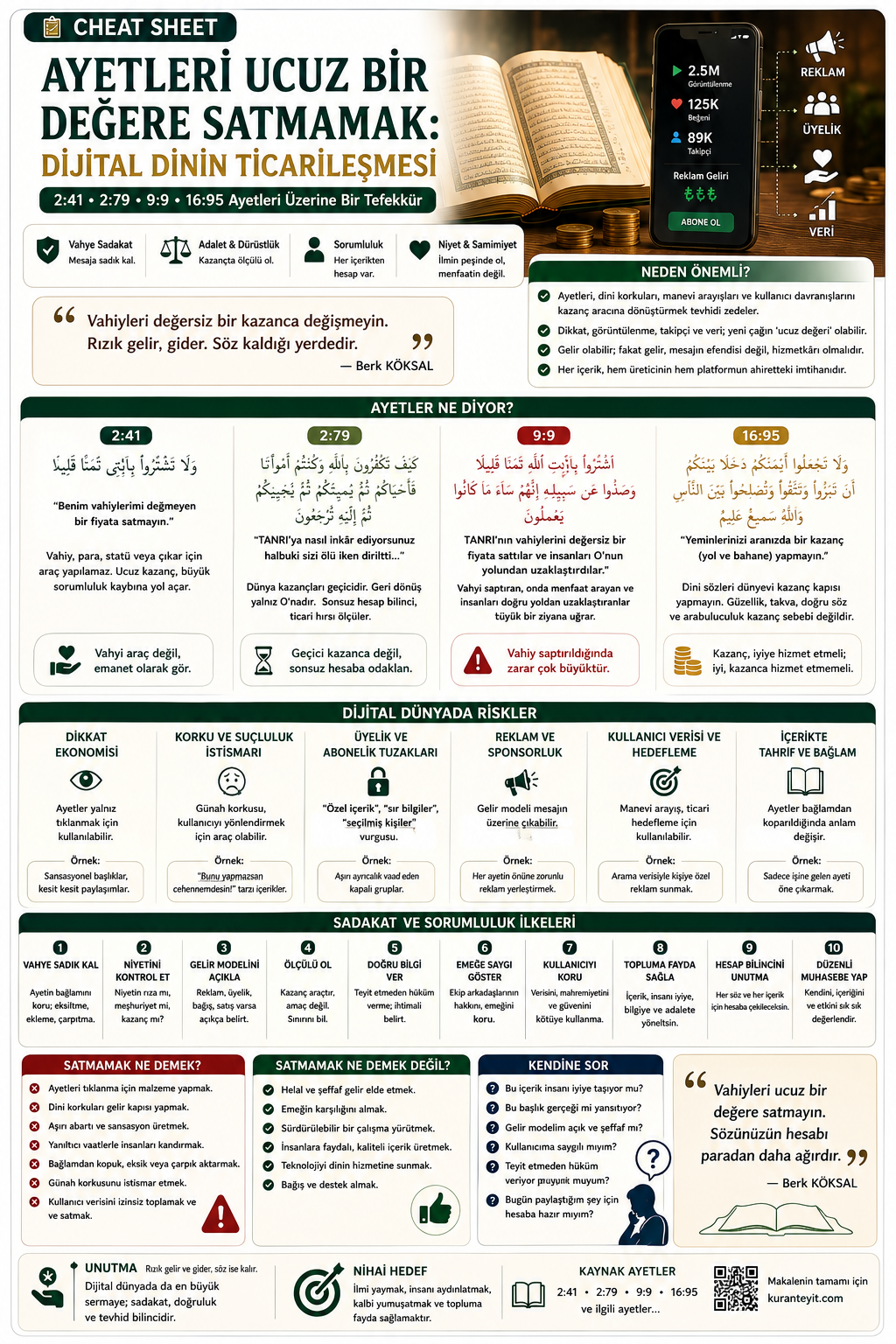
The purpose of this article is not to produce a new and definitive ruling that no income may ever be earned in return for religious work. The main purpose is to honestly question when the relationship between revenue and message breaks down in digital religious content; and when verses, religious fears, spiritual searches, and user behavior are turned into instruments of profit.
Introduction
Producing religious content today no longer means only writing a book, giving a sermon, or teaching in a classroom. An explanation of a verse can become a short video. A reflection can become a social media post. A comparison of Quran translations can be presented in a mobile app. A dhikr recording can be released on music platforms. A talk can generate revenue from ads, memberships, donations, sponsorships, or user data.
Digital publishing has costs. Servers, domain names, software development, design, recording, cameras, microphones, editing, translation, editorial work, accessibility, and security all require labor. It is understandable that work into which people put their time, knowledge, and productive effort may need a sustainable return.
My decision not to use advertising or behavioral analytics while developing Kuranteyit makes this question more than theoretical for me. As a platform developer, I have to face this reality: The moment I organize verses, translations, searches, notes, and people’s spiritual curiosities inside a product, I am building not only a technical architecture but also an economic and ethical one.
The commercialization of digital religion does not begin only at the payment screen. Sometimes it begins with the first word of the headline.
Summary:
1. Is a Cheap Price Only Money?
2:41
وَءَامِنُوا۟ بِمَآ أَنزَلْتُ مُصَدِّقًا لِّمَا مَعَكُمْ وَلَا تَكُونُوٓا۟ أَوَّلَ كَافِرٍۭ بِهِۦ وَلَا تَشْتَرُوا۟ بِـَٔايَٰتِى ثَمَنًا قَلِيلًا وَإِيَّٰىَ فَٱتَّقُونِ
You shall believe in what I have revealed herein, confirming what you have; do not be the first to reject it. Do not trade away My revelations for a cheap price, and observe Me.
You shall believe in what I have revealed herein, confirming what you have; do not be the first to reject it. Do not trade away My revelations for a cheap price, and observe Me.
2. Does Revenue Serve the Message, or Does the Message Serve Revenue?
16:95 — Do not cheapen your oaths before GOD. What GOD possesses is far better for you, if you only knew.
16:96 — What you possess runs out, but what GOD possesses lasts forever. We will surely reward those who steadfastly persevere; we will recompense them for their righteous works.
3. What Happens to a Verse in the Attention Economy?
9:9 — They traded away GOD's revelations for a cheap price. Consequently, they repulsed the people from His path. Miserable indeed is what they did!
4. When a Sensational Headline Comes Before the Verse
2:42 — Do not mix the truth with falsehood, nor shall you conceal the truth knowingly.
5. When Fear and Anger Become Instruments of Profit
49:11 — O you who believe, no people shall ridicule other people, for they may be better than they. Nor shall any women ridicule other women, for they may be better than they. Nor shall you mock one another, or make fun of your names. Evil indeed is the reversion to wickedness after attaining faith. Anyone who does not repent after this, these are the transgressors.
6. Putting Religious Content Behind a Paywall
3:187 — GOD took a covenant from those who received the scripture: “You shall proclaim it to the people, and never conceal it.” But they disregarded it behind their backs and traded it away for a cheap price. What a miserable trade.
7. Is User Data a New Form of Payment?
49:12 — O you who believe, avoid any suspicion, for even a little suspicion is sinful. Do not spy on one another, nor backbite one another; this is as abominable as eating the flesh of your dead brother. You would certainly abhor this. Observe GOD. GOD is Redeemer, Most Merciful.
8. Follower Count Is Not a Measure of Being Right
6:116 — If you obey the majority of people on earth, they will divert you from the path of GOD. They follow only conjecture; they only guess.
9. Can an Algorithm Become a New Religious Editor?
39:18 — They are the ones who examine all words, then follow the best. These are the ones whom GOD has guided; these are the ones who possess intelligence.
10. The Weight of Saying “This Is What GOD Revealed”
2:79 — Therefore, woe to those who distort the scripture with their own hands, then say, “This is what GOD has revealed,” seeking a cheap material gain. Woe to them for such distortion, and woe to them for their illicit gains.
11. Does Sponsorship or a Brand Relationship Change the Message?
5:8 — O you who believe, you shall be absolutely equitable for the sake of GOD; you shall testify justly. Do not be provoked by your conflicts with some people into committing injustice. You shall be absolutely equitable, for it is more righteous. Observe GOD. GOD is fully Cognizant of everything you do.
12. Religious Labor and Sustainability: Is Receiving Compensation Always Selling?
28:26 — One of the two women said, “O my father, hire him. The best person you can hire is one who is strong and honest.”
13. Is Being Ad-Free in Kuranteyit a Marketing Promise or an Ethical Boundary?
2:224 — Do not subject GOD's name to your casual swearing, that you may appear righteous and reverent, or to attain credibility among the people. GOD is Hearer, Knower.
14. Commercialization Boundaries for a Religious Digital Product
6:152 — You shall not touch the orphans' money except in the most righteous manner, until they reach maturity. You shall give full weight and full measure when you trade, equitably. We do not burden any soul beyond its means. When you give testimony, you shall be absolutely equitable, even against your relatives. You shall fulfill your covenant with GOD. These are His commandments to you, that you may take heed.
15. Short-Term Gain and Long-Term Trust
16:95 — Do not cheapen your oaths before GOD. What GOD possesses is far better for you, if you only knew.
16:96 — What you possess runs out, but what GOD possesses lasts forever. We will surely reward those who steadfastly persevere; we will recompense them for their righteous works.
16. On the Arabic Roots of Words
2:41 — You shall believe in what I have revealed herein, confirming what you have; do not be the first to reject it. Do not trade away My revelations for a cheap price, and observe Me.
2:79 — Therefore, woe to those who distort the scripture with their own hands, then say, “This is what GOD has revealed,” seeking a cheap material gain. Woe to them for such distortion, and woe to them for their illicit gains.
9:9 — They traded away GOD's revelations for a cheap price. Consequently, they repulsed the people from His path. Miserable indeed is what they did!
16:95 — Do not cheapen your oaths before GOD. What GOD possesses is far better for you, if you only knew.
Other Claims
2:41 — You shall believe in what I have revealed herein, confirming what you have; do not be the first to reject it. Do not trade away My revelations for a cheap price, and observe Me.
2:79 — Therefore, woe to those who distort the scripture with their own hands, then say, “This is what GOD has revealed,” seeking a cheap material gain. Woe to them for such distortion, and woe to them for their illicit gains.
9:9 — They traded away GOD's revelations for a cheap price. Consequently, they repulsed the people from His path. Miserable indeed is what they did!
16:95 — Do not cheapen your oaths before GOD. What GOD possesses is far better for you, if you only knew.
Conclusion
2:41 — You shall believe in what I have revealed herein, confirming what you have; do not be the first to reject it. Do not trade away My revelations for a cheap price, and observe Me.
2:79 — Therefore, woe to those who distort the scripture with their own hands, then say, “This is what GOD has revealed,” seeking a cheap material gain. Woe to them for such distortion, and woe to them for their illicit gains.
9:9 — They traded away GOD's revelations for a cheap price. Consequently, they repulsed the people from His path. Miserable indeed is what they did!
16:95 — Do not cheapen your oaths before GOD. What GOD possesses is far better for you, if you only knew.
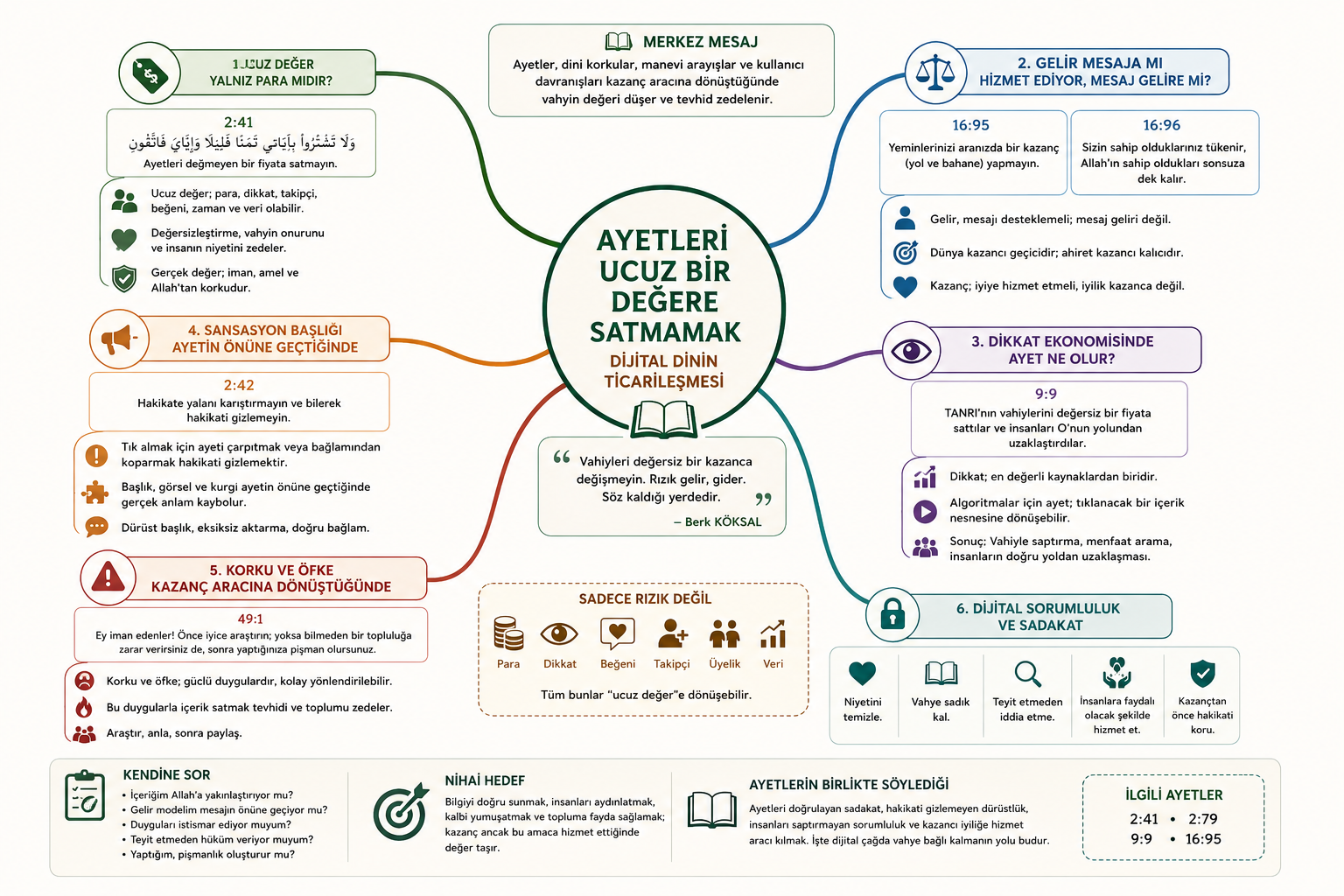
1. Is a Cheap Price Only Money?
Verse
2:41
وَءَامِنُوا۟ بِمَآ أَنزَلْتُ مُصَدِّقًا لِّمَا مَعَكُمْ وَلَا تَكُونُوٓا۟ أَوَّلَ كَافِرٍۭ بِهِۦ وَلَا تَشْتَرُوا۟ بِـَٔايَٰتِى ثَمَنًا قَلِيلًا وَإِيَّٰىَ فَٱتَّقُونِ
You shall believe in what I have revealed herein, confirming what you have; do not be the first to reject it. Do not trade away My revelations for a cheap price, and observe Me.
You shall believe in what I have revealed herein, confirming what you have; do not be the first to reject it. Do not trade away My revelations for a cheap price, and observe Me.
Source: kuranteyit.com
Reflection on the Verse
When I first hear the phrase “a cheap price,” money comes directly to mind. A person using verses for material gain is a serious and visible example. But the idea of price can be understood more broadly.
For this reason, not trading away the verses for a cheap value is not completed simply by saying, “I did not take money in return for a verse.” I also have to ask:
Did I reduce the meaning, context, or moral weight of the verse for the sake of visibility?
Sometimes the “cheap price” is group loyalty. A verse is used like a seal confirming the view of the circle to which one belongs. The aspect of that same verse that questions one’s own side is left unseen.
2. Does Revenue Serve the Message, or Does the Message Serve Revenue?
Verse
16:95 — Do not cheapen your oaths before GOD. What GOD possesses is far better for you, if you only knew.
16:96 — What you possess runs out, but what GOD possesses lasts forever. We will surely reward those who steadfastly persevere; we will recompense them for their righteous works.
Reflection on the Verse
For a religious work to generate revenue and for it to surrender to revenue are not the same thing.
A piece of music is released. There are costs for recording, instruments, studio time, and distribution.
If a platform says that it directs a person toward GOD while continually trying to keep that person inside itself, service and dependency may have become mixed together.
3. What Happens to a Verse in the Attention Economy?
Verse
9:9 — They traded away GOD’s revelations for a cheap price. Consequently, they repulsed the people from His path. Miserable indeed is what they did!
Reflection on the Verse
One of the most valuable things in the digital economy is attention. As long as a person remains on the screen, ads can be shown, subscriptions can be sold, data can be collected, and the platform can grow.
If every question leads to a payment screen, a person may begin to think that religious knowledge belongs only to those who have money.
If a religious app or piece of content aims not to make the user dependent on itself but to help the user understand the message and live rightly, sometimes it should send the person away from the screen.
4. When a Sensational Headline Comes Before the Verse
Verse
2:42 — Do not mix the truth with falsehood, nor shall you conceal the truth knowingly.
Reflection on the Verse
In digital content, a headline is a doorway. A person usually approaches the content first through the headline. For that reason, a headline is not merely a marketing space; it is the first sentence of testimony.
Sensationalism in religious content can appear in several forms. Sentences such as “The hidden truth nobody tells you” or “Everyone who reads this verse will have their life changed” generate curiosity; but if the headline promises a certainty that is not present in the content, it misleads the person.
If the context of a verse is complex but the headline gives a single sensational conclusion, uncertainty is concealed.
5. When Fear and Anger Become Instruments of Profit
Verse
49:11 — O you who believe, no people shall ridicule other people, for they may be better than they. Nor shall any women ridicule other women, for they may be better than they. Nor shall you mock one another, or make fun of your names. Evil indeed is the reversion to wickedness after attaining faith. Anyone who does not repent after this, these are the transgressors.
Reflection on the Verse
Fear and anger are among the emotions that spread most quickly on digital platforms. When a person sees a threat, they stop, click, share, and choose a side.
Fear can be part of a serious warning about the Hereafter and responsibility. Anger can be a conscientious response to oppression. It would not be right to declare these emotions entirely wrong.
When anger is converted into sales, the humanity of the other side becomes invisible. One person’s mistake is loaded onto an entire group. Mockery, insult, and humiliation generate engagement. Followers write harsher comments to prove that they are “one of us.”
6. Putting Religious Content Behind a Paywall
Verse
3:187 — GOD took a covenant from those who received the scripture: “You shall proclaim it to the people, and never conceal it.” But they disregarded it behind their backs and traded it away for a cheap price. What a miserable trade.
Reflection on the Verse
Paid content does not, by itself, mean selling the truth. Printing books, preparing education, providing consultancy, developing software, or creating art involves labor and cost.
Completely rejecting the earning of income from religious work can also create problems. Such an approach may result in only those with financial means being able to produce over the long term. Labor becomes invisible, and quality and security become unsustainable.
What is behind a paywall may be the product of labor. But the word of GOD should not be presented as though it were the private property of the producer.
7. Is User Data a New Form of Payment?
Verse
49:12 — O you who believe, avoid any suspicion, for even a little suspicion is sinful. Do not spy on one another, nor backbite one another; this is as abominable as eating the flesh of your dead brother. You would certainly abhor this. Observe GOD. GOD is Redeemer, Most Merciful.
Reflection on the Verse
An app may be free, but the user can pay with something else: Their data.
The user pays no money. The app appears “free.” But the person’s spiritual behavior enters the advertising system.
For this reason, the absence in Kuranteyit of developer-owned advertising or behavioral analytics, the absence of account creation, and the fact that notes are not sent to the developer’s server are not merely technical simplicity. They are a boundary against turning the user’s spiritual search into a revenue model.
8. Follower Count Is Not a Measure of Being Right
Verse
6:116 — If you obey the majority of people on earth, they will divert you from the path of GOD. They follow only conjecture; they only guess.
Reflection on the Verse
These numbers create a sign of trust in the human mind. The thought “If this many people watch it, it must be true” can arise easily.
Whichever verse the crowd uses for its own superiority, the aspect of that verse that questions the self is left silent.
Treating follower count as a measure of being right can become a form of selling the verse for the applause of the crowd.
9. Can an Algorithm Become a New Religious Editor?
Verse
39:18 — They are the ones who examine all words, then follow the best. These are the ones whom GOD has guided; these are the ones who possess intelligence.
Reflection on the Verse
An algorithm can function like an invisible editor deciding which content appears before the user. But its purpose is not to select the truth. Most often, its purpose is to predict the user’s interest, increase engagement, or serve the platform’s goals.
The user is continuously shown religious content that confirms their own view. They do not see different translations, opposing views, or criticism of their own side.
Adapting to the algorithm may be a technical skill. Surrendering to the algorithm is a loss of moral direction.
10. The Weight of Saying “This Is What GOD Revealed”
Verse
2:79 — Therefore, woe to those who distort the scripture with their own hands, then say, “This is what GOD has revealed,” seeking a cheap material gain. Woe to them for such distortion, and woe to them for their illicit gains.
Reflection on the Verse
For example, an explanation generated by artificial intelligence should not be presented as “This is the definitive meaning of the verse.”
In an app like Kuranteyit, the boundaries of translation, root information, topical connections, and experimental thematic suggestions should be shown clearly. The system should not speak as though it were an authority issuing rulings.
The verse text and the app’s explanation should be visually separated.
11. Does Sponsorship or a Brand Relationship Change the Message?
Verse
5:8 — O you who believe, you shall be absolutely equitable for the sake of GOD; you shall testify justly. Do not be provoked by your conflicts with some people into committing injustice. You shall be absolutely equitable, for it is more righteous. Observe GOD. GOD is fully Cognizant of everything you do.
Reflection on the Verse
Sponsorship can cover the cost of production. A useful project may not be possible without support. For this reason, I cannot declare all sponsorship wrong with a single judgment.
But in religious content, the sponsor relationship can create visible and invisible pressures.
A company should not determine the data policy merely because it finances the app.
12. Religious Labor and Sustainability: Is Receiving Compensation Always Selling?
Verse
28:26 — One of the two women said, “O my father, hire him. The best person you can hire is one who is strong and honest.”
Reflection on the Verse
Receiving fair compensation for this labor is not automatically the same thing as selling the verses for a cheap value.
On the contrary, the expectation of unpaid labor can create certain problems.
Being against commercialization does not mean rejecting every economic arrangement. It means placing the message, the human being, and conscience above the measure of the market.
13. Is Being Ad-Free in Kuranteyit a Marketing Promise or an Ethical Boundary?
Verse
2:224 — Do not subject GOD’s name to your casual swearing, that you may appear righteous and reverent, or to attain credibility among the people. GOD is Hearer, Knower.
Reflection on the Verse
For an app to say that it is “ad-free,” “privacy-friendly,” or “independent” creates trust. But these statements can also become marketing tools.
For me, the absence of developer-owned advertising and behavioral analytics in Kuranteyit should not become a slogan used to present the app as superior. This choice should not be used to belittle others.
An ethical boundary is not a policy text written once. It is tested again with every new feature.
14. Commercialization Boundaries for a Religious Digital Product
Verse
6:152 — You shall not touch the orphans’ money except in the most righteous manner, until they reach maturity. You shall give full weight and full measure when you trade, equitably. We do not burden any soul beyond its means. When you give testimony, you shall be absolutely equitable, even against your relatives. You shall fulfill your covenant with GOD. These are His commandments to you, that you may take heed.
Reflection on the Verse
When developing a religious digital product, relying on good intentions alone is not enough. Intentions can change over time; the team can grow; economic pressure can increase. For this reason, boundaries should be written into the architecture and the working principles.
Do not criticize only the commercialization of others. Count your own brand, reputation, and authority as part of the price as well.
These principles are not a list of definitive religious rulings. They are ethical questions I ask myself while developing a digital product.
15. Short-Term Gain and Long-Term Trust
Verse
16:95 — Do not cheapen your oaths before GOD. What GOD possesses is far better for you, if you only knew.
16:96 — What you possess runs out, but what GOD possesses lasts forever. We will surely reward those who steadfastly persevere; we will recompense them for their righteous works.
Reflection on the Verse
But the long-term cost appears later.
For this reason, the cost of manipulation for short-term gain is not only personal brand. It can also affect people’s courage to approach the verse.
Or a free human being who bears their own responsibility before GOD?
16. On the Arabic Roots of Words
Verse
2:41 — You shall believe in what I have revealed herein, confirming what you have; do not be the first to reject it. Do not trade away My revelations for a cheap price, and observe Me.
2:79 — Therefore, woe to those who distort the scripture with their own hands, then say, “This is what GOD has revealed,” seeking a cheap material gain. Woe to them for such distortion, and woe to them for their illicit gains.
9:9 — They traded away GOD’s revelations for a cheap price. Consequently, they repulsed the people from His path. Miserable indeed is what they did!
16:95 — Do not cheapen your oaths before GOD. What GOD possesses is far better for you, if you only knew.
Reflection on the Verse
Some of the roots in these verses help me think of the issue of “selling” not merely as a commercial transaction, but as an exchange of values and a moral choice.
The root ك-ت-ب (Kef-Te-Be) is associated with the semantic field of writing and recording. In 2:79, the fact that people write with their own hands is especially emphasized. Today, writing is not done only with a pen; code, screen text, artificial-intelligence output, and algorithmic summaries are also human-made writing.
The root ي-د-ي (Ya-Dal-Ya) means hand. The phrase “with their own hands” makes responsibility visible. The produced text, the designed interface, and the revenue model that is built are works of the human hand. Saying “the algorithm did it” does not completely remove responsibility; there is a human being who chose and used the algorithm.
Other Claims
Verse
2:41 — You shall believe in what I have revealed herein, confirming what you have; do not be the first to reject it. Do not trade away My revelations for a cheap price, and observe Me.
2:79 — Therefore, woe to those who distort the scripture with their own hands, then say, “This is what GOD has revealed,” seeking a cheap material gain. Woe to them for such distortion, and woe to them for their illicit gains.
9:9 — They traded away GOD’s revelations for a cheap price. Consequently, they repulsed the people from His path. Miserable indeed is what they did!
16:95 — Do not cheapen your oaths before GOD. What GOD possesses is far better for you, if you only knew.
Reflection on the Verse
One view may argue that these verses concern specific historical communities and cannot be applied to contemporary digital content. The direct context of the verses concerns serious historical violations related to revelation and covenant. This article does not present them as though “using advertising is the direct technical equivalent of 2:41.” What it does is use the principle in the verses—not exchanging truth for temporary gain—as a basis for reflection on contemporary digital production.
Some may say that earning money from religious content is entirely wrong. Labor, production, and infrastructure carry real costs. The claim of this article is not that the mere existence of revenue is automatically wrong. It questions the point at which revenue changes the message, exploits fear, turns the user into a data product, or attributes human interpretation to GOD.
Some may say that thinking about one’s own livelihood corrupts the intention of a religious content producer. A person can both think about earning a living and try to serve rightly. Intention is not one-dimensional. What matters is recognizing conflicts of interest and not subordinating the message to self-interest.
Conclusion
Verse
2:41 — You shall believe in what I have revealed herein, confirming what you have; do not be the first to reject it. Do not trade away My revelations for a cheap price, and observe Me.
2:79 — Therefore, woe to those who distort the scripture with their own hands, then say, “This is what GOD has revealed,” seeking a cheap material gain. Woe to them for such distortion, and woe to them for their illicit gains.
9:9 — They traded away GOD’s revelations for a cheap price. Consequently, they repulsed the people from His path. Miserable indeed is what they did!
16:95 — Do not cheapen your oaths before GOD. What GOD possesses is far better for you, if you only knew.
Reflection on the Verse
2:79 shows the weight of attributing something produced by human hands to GOD and combining this with gain. Today the human hand produces not only with a pen, but also with code, video, artificial intelligence, apps, and algorithms.
Religious work needs to be sustainable. Labor may receive compensation. A developer, writer, artist, translator, and researcher has to sustain a life.
For me, the absence of advertising and behavioral analytics in Kuranteyit, the absence of account creation, and the fact that notes are not sent to the developer’s server are practical expressions of this responsibility. But these choices are not medals of superiority. They are boundaries that need to be protected again with every new feature, cost, and growth decision.
Note
2:32 — They said, “Be You glorified. We have no knowledge, except that which You have taught us. You are the Omniscient, Most Wise.”
31:27 — If all the trees on earth were made into pens, and the ocean supplied the ink, augmented by seven more oceans, the words of GOD would not run out. GOD is Almighty, Most Wise.
This article does not claim to derive direct and detailed technical rulings about advertising, subscriptions, paid education, or digital revenue models from verses 2:41, 2:79, 9:9, and 16:95. It uses the warnings in these verses—not to exchange revelation and covenant for an unworthy return, not to attribute what human hands produce to GOD, and not to turn people away from GOD’s path for temporary benefit—as a basis for reflection on the economic and ethical structure of digital religious content.
The legitimacy of a revenue model should be considered together with intention, method, transparency, content accuracy, user rights, data use, and the results it produces. This text is not legal, financial, or religious fatwa.
GOD knows best.
Source: kuranteyit.com
Discover
Related Articles
Quran Reflections
What Did the Stones Do? A Reflection on Hell, the Dissolution of Mountains, the Development of the Self, and the Petrified Mind
A deep reflection centered on Al-Baqarah 2:24 about people and stones as the fuel of Hell; the crumbling of the mountain in the story of Moses, GOD's physical presence, the transformation of the earth, the development of the self, those who remain immobile, petrified minds, idols, and responsibility.
Read article
Quran Reflections
True Wealth According to the Quran: Material Wealth or Not Being Rich?
A 19-part reflection centered on Al-Baqarah 2:247, exploring wealth, material possessions, poverty, provision, justice, charity, Qarun, trade, temporary worldly blessings, closeness to GOD, and true gain.
Read article
Quran Reflections
Gratitude: Are We Truly Grateful, or Are We Deceiving Ourselves?
A deep reflection centered on Al-Baqarah 2:152, on remembering, gratitude, ingratitude, accountability for blessings, righteousness, monotheism, knowledge, justice, submission, and testing one's own claim of gratitude before the verses.
Read article