Is Comparing Quran Translations Doubt or Responsibility?
A personal reflection on understanding Rashad Khalifa's authorized English translation, the birth of Kuranteyit, the responsibility of verification, the limits of digital tools, and turning research into action through Az-Zumar 39:18, Al-Isra 17:36, and Muhammad 47:24.

Is Comparing Quran Translations Doubt or Responsibility?
A Reflection on the Authorized Translation, Kuranteyit, and Personal Responsibility
Author: Berk KÖKSAL
Date: 05.08.2026
Location: Mersin
Verse
1:1 — In the name of GOD, Most Gracious, Most Merciful.*
Greetings. Peace be upon you.
The primary aim of this article is to consider the verses together with other related verses and to express, in a sincere and profound way, what bearing witness to the oneness of GOD means in human life in terms of knowledge, justice, truthfulness, and submission.
Introduction
At the outset of this article, I want to state my own position of faith clearly. I have accepted the English text presented by Rashad Khalifa as the authorized translation that came through GOD’s Messenger of the Covenant. I am certain of its correctness. For this reason, I did not develop Kuranteyit in order to place another religious authority against that translation or to keep reopening the question of its correctness.
Kuranteyit was first born for my wife and me. Our aim was to understand the authorized English translation better and to be able to examine Turkish renderings, word connections, relationships among verses, and root information in a more organized way. At first it was like a personal workbench. But as the project developed, the needs, content, and responsibility grew; over time it became a structure larger than us.
Today I have also completed Kuranteyit’s Android application. The application is currently in the approval process. If the process proceeds as planned, GOD willing, it will be available to Android users in about a week. I do not see this development as merely technical progress. Reaching more people requires speaking more carefully and carrying the responsibility of every choice more seriously.
For me, therefore, the main question is no longer “Which translation should I accept as the authority?” The text on which I rely in matters of faith is clear. The real question is this: How carefully can I understand the authorized translation I have accepted without inserting my own desire and habits between myself and the text?
Summary:
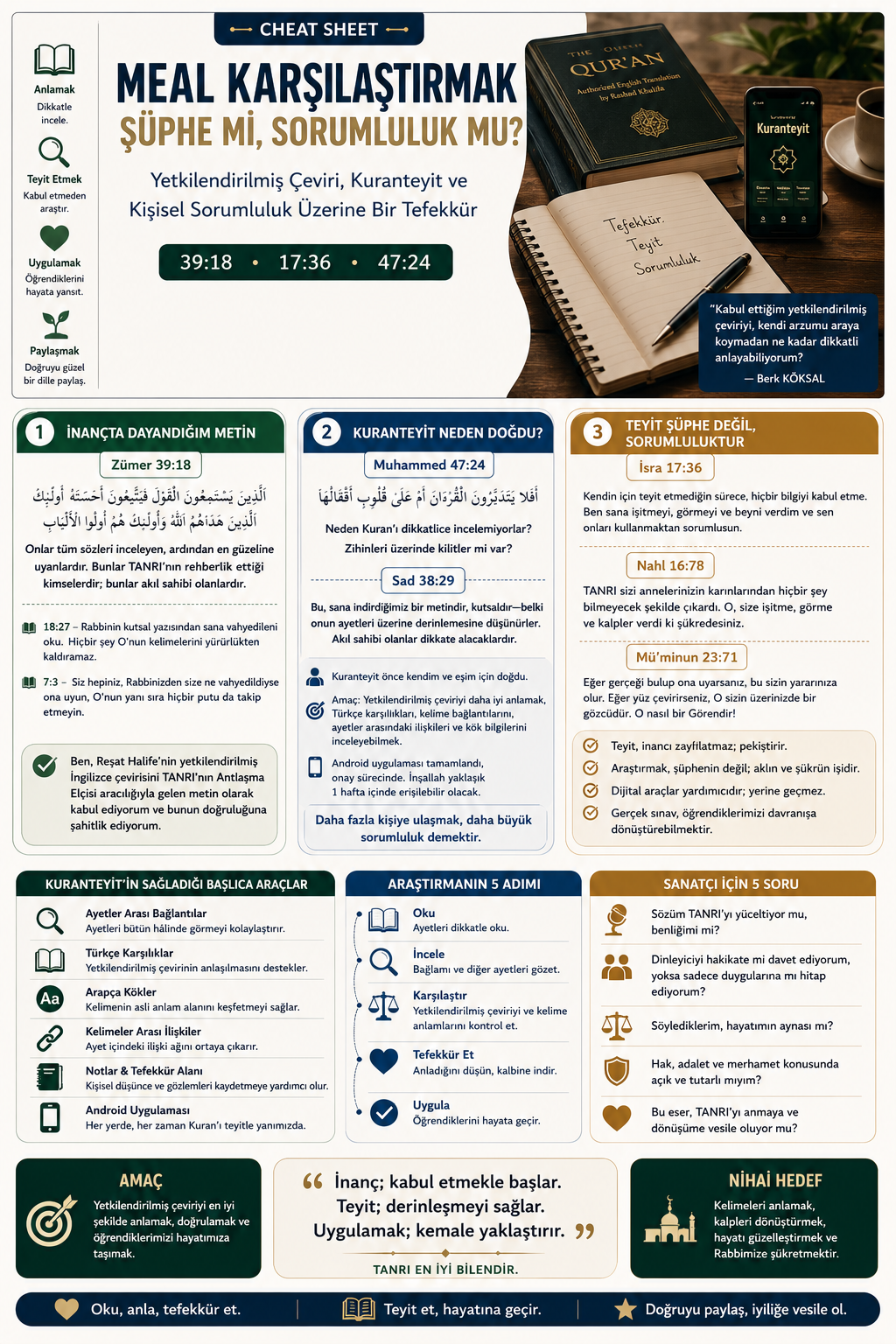
1. The Text on Which I Rely in Faith
39:18
ٱلَّذِينَ يَسْتَمِعُونَ ٱلْقَوْلَ فَيَتَّبِعُونَ أَحْسَنَهُۥٓ أُو۟لَٰٓئِكَ ٱلَّذِينَ هَدَىٰهُمُ ٱللَّهُ وَأُو۟لَٰٓئِكَ هُمْ أُو۟لُوا۟ ٱلْأَلْبَٰبِ
They are the ones who examine all words, then follow the best. These are the ones whom GOD has guided; these are the ones who possess intelligence.
They are the ones who examine all words, then follow the best. These are the ones whom GOD has guided; these are the ones who possess intelligence.
18:27 — You shall recite what is revealed to you of your Lord's scripture. Nothing shall abrogate His words, and you shall not find any other source beside it.
7:3 — You shall all follow what is revealed to you from your Lord; do not follow any idols beside Him. Rarely do you take heed.
2. Why Was Kuranteyit Born?
47:24 — Why do they not study the Quran carefully? Do they have locks on their minds?
38:29 — This is a scripture that we sent down to you, that is sacred—perhaps they reflect on its verses. Those who possess intelligence will take heed.
3. Verification Is Not Doubt, but Responsibility
17:36 — You shall not accept any information, unless you verify it for yourself. I have given you the hearing, the eyesight, and the brain, and you are responsible for using them.
16:78 — GOD brought you out of your mothers' bellies knowing nothing, and He gave you the hearing, the eyesight, and the brains, that you may be appreciative.
4. The Place of the Authorized Translation and Other Translations
6:115 — The word of your Lord is complete, in truth and justice.* Nothing shall abrogate His words. He is the Hearer, the Omniscient.
3:7 — He sent down to you this scripture, containing straightforward verses—which constitute the essence of the scripture—as well as multiple-meaning or allegorical verses. Those who harbor doubts in their hearts will pursue the multiple-meaning verses to create confusion, and to extract a certain meaning. No one knows the true meaning thereof except GOD and those well founded in knowledge. They say, “We believe in this—all of it comes from our Lord.” Only those who possess intelligence will take heed.
5. What Can Software Do, and What Can It Not Do?
2:272 — You are not responsible for guiding anyone. GOD is the only one who guides whoever chooses (to be guided). Whatever charity you give is for your own good. Whatever charity you give shall be for the sake of GOD. Whatever charity you give will be repaid to you, without the least injustice.
17:36 — You shall not accept any information, unless you verify it for yourself. I have given you the hearing, the eyesight, and the brain, and you are responsible for using them.
6. The Measure I Learned from Music
17:35 — Give full measure when you trade, and weigh equitably. This is better and more righteous.
5:100 — Proclaim: “The bad and the good are not the same, even if the abundance of the bad may impress you. You shall reverence GOD, O you who possess intelligence, that you may succeed.”
7. When the Project Became Larger Than Us
13:11 — Shifts (of angels) take turns, staying with each one of you—they are in front of you and behind you. They stay with you and guard you in accordance with GOD's commands. Thus, GOD does not change the condition of any people unless they themselves decide to change. If GOD wills any hardship for any people, no force can stop it. For they have none beside Him as Lord and Master.
6:155 — This too is a blessed scripture that we have revealed; you shall follow it and lead a righteous life, that you may attain mercy.
8. The Android Application and Growing Responsibility
17:36 — You shall not accept any information, unless you verify it for yourself. I have given you the hearing, the eyesight, and the brain, and you are responsible for using them.
17:53 — Tell My servants to treat one another in the best possible manner, for the devil will always try to drive a wedge between them. Surely, the devil is man's most ardent enemy.
9. Where Research Turns into Conduct
6:155 — This too is a blessed scripture that we have revealed; you shall follow it and lead a righteous life, that you may attain mercy.
22:77 — O you who believe, you shall bow down, prostrate, worship your Lord, and work righteousness, that you may succeed.
2:285 — The messenger has believed in what was sent down to him from his Lord, and so did the believers. They believe in GOD, His angels, His scripture, and His messengers: “We make no distinction among any of His messengers.” They say, “We hear, and we obey.* Forgive us, our Lord. To You is the ultimate destiny.”
10. On the Arabic Roots of the Words
39:18 — They are the ones who examine all words, then follow the best. These are the ones whom GOD has guided; these are the ones who possess intelligence.
17:36 — You shall not accept any information, unless you verify it for yourself. I have given you the hearing, the eyesight, and the brain, and you are responsible for using them.
47:24 — Why do they not study the Quran carefully? Do they have locks on their minds?
Other Claims
39:18 — They are the ones who examine all words, then follow the best. These are the ones whom GOD has guided; these are the ones who possess intelligence.
17:36 — You shall not accept any information, unless you verify it for yourself. I have given you the hearing, the eyesight, and the brain, and you are responsible for using them.
47:24 — Why do they not study the Quran carefully? Do they have locks on their minds?
Conclusion
39:18 — They are the ones who examine all words, then follow the best. These are the ones whom GOD has guided; these are the ones who possess intelligence.
17:36 — You shall not accept any information, unless you verify it for yourself. I have given you the hearing, the eyesight, and the brain, and you are responsible for using them.
6:155 — This too is a blessed scripture that we have revealed; you shall follow it and lead a righteous life, that you may attain mercy.
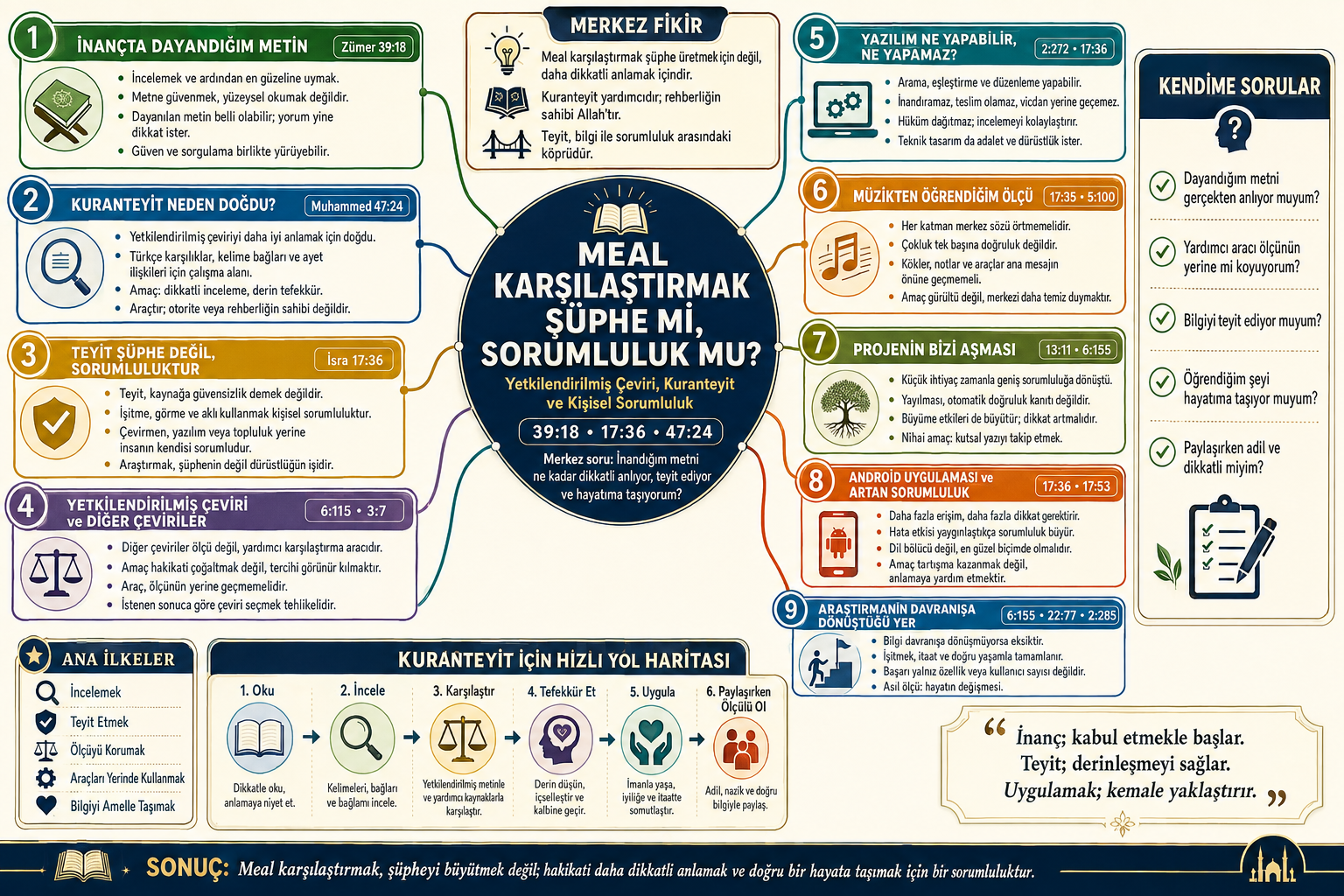
1. The Text on Which I Rely in Faith
Verse
39:18
ٱلَّذِينَ يَسْتَمِعُونَ ٱلْقَوْلَ فَيَتَّبِعُونَ أَحْسَنَهُۥٓ أُو۟لَٰٓئِكَ ٱلَّذِينَ هَدَىٰهُمُ ٱللَّهُ وَأُو۟لَٰٓئِكَ هُمْ أُو۟لُوا۟ ٱلْأَلْبَٰبِ
They are the ones who examine all words, then follow the best. These are the ones whom GOD has guided; these are the ones who possess intelligence.
They are the ones who examine all words, then follow the best. These are the ones whom GOD has guided; these are the ones who possess intelligence.Source: kuranteyit.com
18:27 — You shall recite what is revealed to you of your Lord’s scripture. Nothing shall abrogate His words, and you shall not find any other source beside it.
7:3 — You shall all follow what is revealed to you from your Lord; do not follow any idols beside Him. Rarely do you take heed.
Reflection on the Verse
In 39:18, examining and following are not separated from one another. The words are examined, then the best is followed. I do not read this verse merely as a call to endless comparison. At the end of examination there is an orientation, trust, and following.
For me, this orientation became concrete in accepting the authorized English translation presented by Rashad Khalifa. I state this not as a temporary working assumption, but as an acceptance I am certain is correct in matters of faith. Yet this certainty does not mean that every reading of mine, every Turkish sentence I form, and every interpretation I make is automatically correct.
It is possible to be certain of the text on which I rely while questioning my own understanding at the same time. In fact, I believe responsibility begins precisely here. Trusting the text does not permit me to read it superficially. On the contrary, it requires me to be more careful before the word I trust.
2. Why Was Kuranteyit Born?
Verse
47:24 — Why do they not study the Quran carefully? Do they have locks on their minds?
38:29 — This is a scripture that we sent down to you, that is sacred—perhaps they reflect on its verses. Those who possess intelligence will take heed.
Reflection on the Verse
At the beginning of Kuranteyit, there was no thought of building a large platform. First of all, my wife and I needed a workspace where we could understand the authorized translation we were reading more carefully. When we opened a verse, we wanted to see the English text, Turkish renderings, word relationships, and related verses in a more organized way.
This need was directly connected to the call for careful study in 47:24. Merely reading a text and dwelling on it are not the same thing. Sometimes a word is right before our eyes, yet because of our habits we do not truly see it. Sometimes we think we understand a sentence, but when it is placed beside another verse, a deeper aspect of its meaning opens.
Kuranteyit is not an authority that opens these locks by itself. It does not take the key out of the person’s hand. It is only a study tool that helps a person remain with the verse longer, see connections, and slow down hasty conclusions.
3. Verification Is Not Doubt, but Responsibility
Verse
17:36 — You shall not accept any information, unless you verify it for yourself. I have given you the hearing, the eyesight, and the brain, and you are responsible for using them.
16:78 — GOD brought you out of your mothers’ bellies knowing nothing, and He gave you the hearing, the eyesight, and the brains, that you may be appreciative.
Reflection on the Verse
Verification does not always mean distrust of the source. Sometimes verification is being honest about our own understanding. I can be certain of the correctness of the authorized English translation and still have misunderstood a word, missed the emphasis of a sentence, or narrowed its Turkish rendering according to my own habit.
17:36 reminds me that using hearing, sight, and the brain is a personal responsibility. I cannot completely transfer this responsibility to a translator, software, a religious leader, or a community. Accepting a text as correct does not mean repeating it without thinking.
For me, the “verification” in the name Kuranteyit means exactly this. It is not judging the authorized text by another authority; it is testing for myself whether I have heard correctly what I heard, whether I have really seen what I saw, and whether the conclusion I reached is connected to the verses.
4. The Place of the Authorized Translation and Other Translations
Verse
6:115 — The word of your Lord is complete, in truth and justice.* Nothing shall abrogate His words. He is the Hearer, the Omniscient.
3:7 — He sent down to you this scripture, containing straightforward verses—which constitute the essence of the scripture—as well as multiple-meaning or allegorical verses. Those who harbor doubts in their hearts will pursue the multiple-meaning verses to create confusion, and to extract a certain meaning. No one knows the true meaning thereof except GOD and those well founded in knowledge. They say, “We believe in this—all of it comes from our Lord.” Only those who possess intelligence will take heed.
Reflection on the Verse
The fact that different Turkish translations appear in Kuranteyit does not mean, for me, that all translations have the same authority. In matters of faith, my measure is Rashad Khalifa’s authorized English translation. Other translations can help me see which Turkish word has been chosen for an expression, which explanatory element has been added to a sentence, or which direction of meaning has been emphasized.
The purpose of this comparison is not to multiply truth. It is to make human choice visible. Seeing the same English expression rendered in Turkish in different ways can help the reader recognize the limits of his own language. In this way, instead of making the Turkish sentence itself absolute, I can return again to the text on which I rely.
The sensitive line here is this: The auxiliary tool must not replace the measure. Comparison may make understanding easier for me; but if it turns into choosing translations until I find the conclusion I want, I would be following my own desire under the appearance of research.
5. What Can Software Do, and What Can It Not Do?
Verse
2:272 — You are not responsible for guiding anyone. GOD is the only one who guides whoever chooses (to be guided). Whatever charity you give is for your own good. Whatever charity you give shall be for the sake of GOD. Whatever charity you give will be repaid to you, without the least injustice.
17:36 — You shall not accept any information, unless you verify it for yourself. I have given you the hearing, the eyesight, and the brain, and you are responsible for using them.
Reflection on the Verse
Software can search quickly, match words, place verses side by side, and organize large amounts of information. Artificial intelligence can also suggest similarities, classify texts, and speed up research. But none of these can believe, submit, or bear moral responsibility.
Kuranteyit should not claim to guide on behalf of the user. Its task is not to distribute rulings, but to facilitate examination. No matter how advanced the application becomes, it should not place itself between GOD and the human being as a new mandatory intermediary.
This boundary is at the center of my responsibility as a developer. What I highlight on the screen, which explanation I make the default, and how I display uncertainty can influence the user’s thinking. Technical design is therefore not a neutral field; it requires justice, clarity, and honesty.
6. The Measure I Learned from Music
Verse
17:35 — Give full measure when you trade, and weigh equitably. This is better and more righteous.
5:100 — Proclaim: “The bad and the good are not the same, even if the abundance of the bad may impress you. You shall reverence GOD, O you who possess intelligence, that you may succeed.”
Reflection on the Verse
For years I have worked with composition, arrangement, guitar, recording, sound design, mixing, and mastering. While working within layers of rock, metal, symphonic, and cinematic sound, I learned this: The fact that one element is powerful does not mean that it should cover the whole. Every sound needs to be in the right place and at the right measure.
I am not reducing 17:35 to music technique. Yet the call to measure and justice in the verse finds a strong counterpart in my professional experience. If a supporting layer covers the main melody in a mix, the work becomes blurred. Likewise, if root information, other translations, notes, or software features move ahead of the authorized text, the tool exceeds its purpose.
Abundance is not, by itself, truth either. Hundreds of translations, thousands of links, or an impressive interface may not make truth clearer when the measure is lost. Sometimes what matters is not increasing the noise, but hearing the central word more cleanly.
7. When the Project Became Larger Than Us
Verse
13:11 — Shifts (of angels) take turns, staying with each one of you—they are in front of you and behind you. They stay with you and guard you in accordance with GOD’s commands. Thus, GOD does not change the condition of any people unless they themselves decide to change. If GOD wills any hardship for any people, no force can stop it. For they have none beside Him as Lord and Master.
6:155 — This too is a blessed scripture that we have revealed; you shall follow it and lead a righteous life, that you may attain mercy.
Reflection on the Verse
Kuranteyit began as a small need for my wife and me. But as it developed, new features, new questions, and the possibility of use by other people emerged. At some point, the project stopped being merely our personal study routine; it became a responsibility larger than us.
I do not see this growth as automatic proof of correctness or divine approval. The spread of a project does not show that every decision in it is right. On the contrary, reaching more people can magnify the effect of mistakes as well.
13:11 makes me think about the connection between change and human decision and effort. Noticing a need is not enough; one must work, correct, and take responsibility. 6:155 reminds me of the ultimate aim of that work: not the software itself, but following the scripture and leading a righteous life.
8. The Android Application and Growing Responsibility
Verse
17:36 — You shall not accept any information, unless you verify it for yourself. I have given you the hearing, the eyesight, and the brain, and you are responsible for using them.
17:53 — Tell My servants to treat one another in the best possible manner, for the devil will always try to drive a wedge between them. Surely, the devil is man’s most ardent enemy.
Reflection on the Verse
I have completed Kuranteyit’s Android application, and it is currently going through the store approval process. If the process proceeds normally, GOD willing, the application will be usable on Android devices in about a week.
This sentence may look like a technical announcement, but for me it also has a moral side. An error that remains on a desktop screen or within personal use does not have the same effect as an error that reaches many phones. As reach grows, so does the responsibility to check, explain, and correct.
17:53 also reminds me that the language used with users matters. Kuranteyit should not become a space that hardens disputes, belittles people, or divides them into camps according to translation names. The purpose is not to defeat someone, but to help people understand the verse more carefully.
9. Where Research Turns into Conduct
Verse
6:155 — This too is a blessed scripture that we have revealed; you shall follow it and lead a righteous life, that you may attain mercy.
22:77 — O you who believe, you shall bow down, prostrate, worship your Lord, and work righteousness, that you may succeed.
2:285 — The messenger has believed in what was sent down to him from his Lord, and so did the believers. They believe in GOD, His angels, His scripture, and His messengers: “We make no distinction among any of His messengers.” They say, “We hear, and we obey.* Forgive us, our Lord. To You is the ultimate destiny.”
Reflection on the Verse
Building an application, classifying verses, or comparing translations is not an end in itself. If research does not turn into conduct, the accumulation of knowledge can become a new burden that enlarges the ego.
6:155 mentions following and leading a righteous life together. In 2:285, hearing is completed by obedience. For this reason, I cannot measure Kuranteyit’s success only by user numbers, technical features, or time spent on the screen. The real issue is whether the verse produces more truthful speech, more just conduct, and more conscious submission in the person.
This measure first points toward me. As the person developing the software, I cannot call others to examine while postponing the requirements of the verse in my own life. As the tool grows, my responsibility does not shrink.
10. On the Arabic Roots of the Words
Verse
39:18 — They are the ones who examine all words, then follow the best. These are the ones whom GOD has guided; these are the ones who possess intelligence.
17:36 — You shall not accept any information, unless you verify it for yourself. I have given you the hearing, the eyesight, and the brain, and you are responsible for using them.
47:24 — Why do they not study the Quran carefully? Do they have locks on their minds?
Reflection on the Verse
In 39:18, the field of hearing and attentive listening is related to the root س م ع (Sin-Mim-Ayn); speech and utterance to ق و ل (Qaf-Waw-Lam); what is beautiful and good to ح س ن (Ha-Sin-Nun); guidance to ه د ي (Ha-Dal-Ya); and sound intellect, essence, and comprehension to ل ب ب (Lam-Ba-Ba). The movement of the verse is not merely hearing a sound that reaches the ear. There is examining the words, turning toward the best, and forming a connection with guidance.
In 17:36, knowledge ع ل م (Ayn-Lam-Mim) is mentioned together with hearing س م ع (Sin-Mim-Ayn) and seeing ب ص ر (Ba-Sad-Ra). The direction of “following” in the verse is connected with the root ق ف و (Qaf-Fa-Waw). This combination makes me think that knowledge is not an abstract claim: hearing, seeing, and mental responsibility must work together.
In 47:24, deep reflection is connected with د ب ر (Dal-Ba-Ra), while a lock is connected with ق ف ل (Qaf-Fa-Lam). The reflection here suggests more than moving over the surface of the word; it requires thinking about what lies behind the word, its outcome, and its place within the whole.
Root information is valuable for this reason, but it is not a ruling by itself. Seeing the field of meaning of a root does not make the sentence structure of the verse or its relationship with other verses unnecessary. In Kuranteyit, roots should open a door; they should not give the impression that they determine the entire meaning behind the door by themselves.
Other Claims
Verse
39:18 — They are the ones who examine all words, then follow the best. These are the ones whom GOD has guided; these are the ones who possess intelligence.
17:36 — You shall not accept any information, unless you verify it for yourself. I have given you the hearing, the eyesight, and the brain, and you are responsible for using them.
47:24 — Why do they not study the Quran carefully? Do they have locks on their minds?
Reflection on the Verse
One approach may argue that a person who accepts an authorized translation should never look at other translations. I do not see this as necessary. I use other translations not to determine the measure, but to notice Turkish choices and to understand the English text on which I rely more carefully.
Another approach may argue that the expression “authorized translation” gives too much authority to a human translation. It is clear that there are different religious, historical, and sectarian assessments regarding the acceptance of Rashad Khalifa as GOD’s Messenger of the Covenant. This article does not claim to resolve all of those debates. I am speaking here without hiding my own position of faith: I accept the English text presented by Rashad Khalifa as the authorized translation and I am certain of its correctness.
Another claim might be that Kuranteyit’s growth or publication in the Android store proves the project’s religious correctness. I draw no such conclusion. Technical approval, user numbers, or widespread use are not measures of spiritual correctness. They only widen the field of responsibility.
Finally, some may expect the software to give the user ready-made conclusions. In my view, this expectation carries the danger of weakening the personal responsibility stated in 17:36. The best thing Kuranteyit can do is not believe on behalf of a person, but help that person use his own hearing, sight, and brain more carefully.
Conclusion
Verse
39:18 — They are the ones who examine all words, then follow the best. These are the ones whom GOD has guided; these are the ones who possess intelligence.
17:36 — You shall not accept any information, unless you verify it for yourself. I have given you the hearing, the eyesight, and the brain, and you are responsible for using them.
6:155 — This too is a blessed scripture that we have revealed; you shall follow it and lead a righteous life, that you may attain mercy.
Reflection on the Verse
For me, comparing Quran translations is not doubting the correctness of the authorized English translation. The text on which I rely in matters of faith is clear. Comparison is an auxiliary method I use to understand that text more carefully in Turkish, test my own interpretation, and see where human choices enter the process.
Kuranteyit first developed with this understanding for my wife and me. Then the project grew, became larger than us, and turned into a broader responsibility. The Android application’s approval process is another new stage of this path. Yet even when the platform changes, the basic measure should not change: Software is an aid; guidance belongs to GOD. A tool can present information; hearing, thinking, believing, following, and leading a righteous life are the responsibility of the human being.
In music, every layer’s place and measure must be determined carefully in order to preserve the center of a work. I try to carry the same sensitivity into Kuranteyit. Root information, translation comparison, artificial intelligence, and software features should become tools that help us hear the main message more cleanly, not layers that cover it.
In the end, the issue is not how many translations I have seen, how many links I have opened, or how many features I have developed. The issue is whether I follow the best word I have heard, and whether the truth I have accepted finds a counterpart in my life.
Note
2:32 — They said, “Be You glorified. We have no knowledge, except that which You have taught us. You are the Omniscient, Most Wise.”
7:33 — Say, “My Lord prohibits only evil deeds, whether obvious or hidden, sins, unjustified aggression, setting up beside GOD powerless idols, and saying about GOD what you do not know.”
GOD knows best.
Source: kuranteyit.com
Discover
Related Articles
Quran Reflections
Can Artificial Intelligence Explain the Quran? An Information Tool and the Responsibility of Understanding
A reflection through verses Al-Isra 17:36, Az-Zumar 39:18, Muhammad 47:24, and Al-Araf 7:33 on artificial intelligence, access to information, verification, careful study of the Quran, testimony, guidance, moral responsibility, and the limits of religious authority.
Read article
Quran Reflections
Finding Is One Thing, Understanding Is Another: The Verse in the Age of Search Engines
A reflection through Muhammad 47:24, Sad 38:29, Az-Zumar 39:18, and Al-Isra 17:36 on the difference between accessing a verse and understanding it in the age of search engines; keywords, context, selective reading, approximate matching, translation differences, verification, and responsibility in action.
Read article
Quran Reflections
How Can Tawhid Be Distorted by a Single Word? One GOD or 'Highest of the High'?
A deep reflection through Al-Baqarah 2:255 and 15 verses in which the same translation pattern recurs, examining the difference between "Most High" and "Highest of the High"; tawhid, translation fidelity, verification, testimony, speaking about GOD without knowledge, grammar, intercession, sovereignty, and religious authority.
Read article