Gratitude: Are We Truly Grateful, or Are We Deceiving Ourselves?
A deep reflection centered on Al-Baqarah 2:152, on remembering, gratitude, ingratitude, accountability for blessings, righteousness, monotheism, knowledge, justice, submission, and testing one's own claim of gratitude before the verses.
Gratitude: Are We Truly Grateful, or Are We Deceiving Ourselves?
- A reflection on 2:152 and the verses related to gratitude *
Author: Berk KÖKSAL
Date: 22.08.2026
Location: Mersin
Verse
1:1 — In the name of GOD, Most Gracious, Most Merciful.*
Introduction
Peace. Peace be upon you.
Gratitude is one of those words through which a person can easily form a favorable opinion of themselves. Saying “thanks” after receiving a blessing, rejoicing that a difficult period has passed, remembering what we have, or thanking GOD at the end of a prayer can all be sincere. Yet once the word settles comfortably on my tongue, another danger begins: assuming that the word I say automatically describes the reality I live.
This is where my real question begins. Am I grateful, or do I merely believe that I am a grateful person? These may not be the same thing. While my tongue thanks GOD, I may attribute the entire achievement to myself. I may call something given to me a blessing and then turn it into a means of superiority over someone else. I may turn to GOD in hardship, only to forget the Source when ease returns. I may even turn the word “gratitude” into a comforting expression I use to avoid confronting myself.
Previously, in The Wonders of Your Lord: Learning to See Within Blessings We Cannot Count, I reflected on noticing blessings; in Silent Dhikr: Does Remembrance Continue After the Sound Ends?, on whether remembrance continues beyond visible moments; and in The Weight of Witnessing, on the weight of confirming spoken truth through one’s life. In this article, those paths meet in the same question: Where in my life is what I call gratitude actually confirmed? All of my previous writings can be found here.
The primary purpose of this article is to consider the verses together with other related verses, and to express in a sincere and deep way what witnessing the oneness of GOD means in human life in terms of knowledge, justice, truthfulness, and submission.
I am not trying here to measure the gratitude of others. The safest field the verses give me is to test my own claim. I cannot know with certainty what is in another person’s heart, but I can notice the distance between my own words and my actions. I want to approach the sentence “I am grateful” not as a declaration of a completed result, but as a question that must continually be asked again.
This is why 2:152 stands at the center. The verse does not leave gratitude by itself; it places it beside remembrance and sets it against ingratitude. To me, this short sentence feels like a doorway that opens gratitude from emotion into memory, from memory into action, and from action into responsibility.
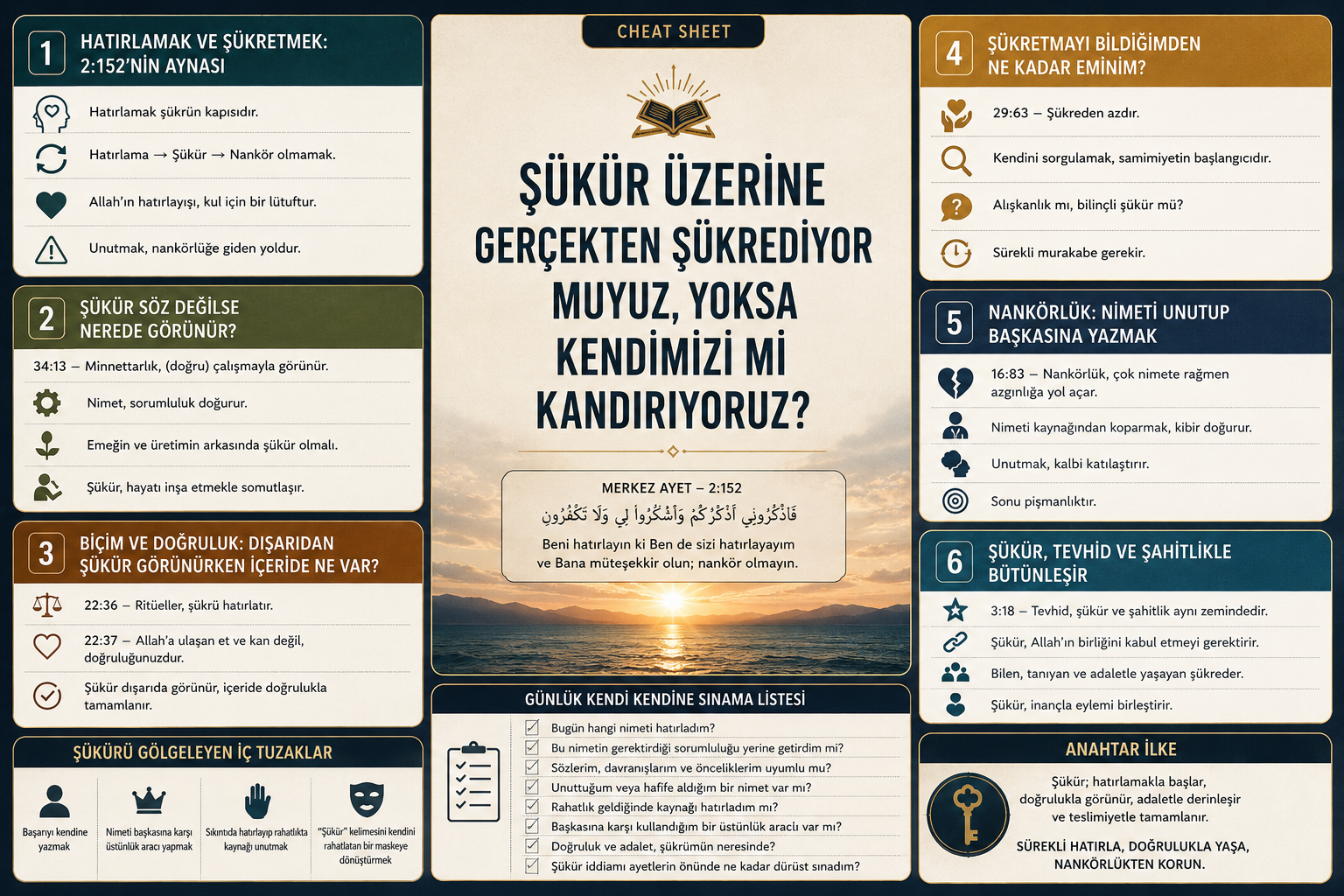
Summary:
1. Remembering and Being Grateful: The Mirror of 2:152
2:152
فَٱذْكُرُونِىٓ أَذْكُرْكُمْ وَٱشْكُرُوا۟ لِى وَلَا تَكْفُرُونِ
You shall remember Me, that I may remember you, and be thankful to Me; do not be unappreciative.
Remember Me, that I may remember you, and be thankful to Me; do not be unappreciative.
2. If Gratitude Is Not Merely Words, Where Does It Appear?
34:13 — They made for him anything he wanted—niches, statues, deep pools, and heavy cooking pots. O family of David, work (righteousness) to show your appreciation. Only a few of My servants are appreciative.
3. Form and Righteousness: What Is Inside When Gratitude Appears Outwardly?
22:36 — The animal offerings are among the rites decreed by GOD for your own good.* You shall mention GOD’s name on them while they are standing in line. Once they are offered for sacrifice, you shall eat therefrom, and feed the poor and the needy. This is why We subdued them for you, that you may show your appreciation.
22:37 — Neither their meat, nor their blood reaches GOD. What reaches Him is your righteousness. He subdued them for you, so that you may show your appreciation by glorifying GOD for guiding you. Give good news to the charitable.
4. How Certain Am I That I Know How to Be Grateful?
27:19 — He smiled and laughed at her statement,* and said, “My Lord, direct me to be appreciative of the blessings You have bestowed upon me and upon my parents, and to do the righteous works that please You. Admit me by Your mercy into the company of Your righteous servants.”
5. If Gratitude Is Not Something GOD Needs, Whom Does It Change?
31:12 — We have endowed Luqmaan with wisdom: “You shall be appreciative of GOD.” Whoever is appreciative is appreciative for his own good. As for those who turn unappreciative, GOD is in no need of anything; He is Praiseworthy.
6. Is a Blessing a Reward or a Test?
27:40 — The one who possessed knowledge from the book said, “I can bring it to you before you blink your eye.” When he saw it settled before him, he said, “This is a blessing from my Lord, to test me whether I am appreciative or unappreciative. Whoever is appreciative is appreciative for his own good, and whoever is unappreciative, my Lord is in no need of him, Most Honorable.”
7. Turning Gratitude Into a Formula for Gain
14:7 — Your Lord has decreed: “The more you thank Me, the more I give you.” But if you turn unappreciative, then My retribution is severe.
8. Remembering in Hardship and Forgetting in Ease
16:53 — Any blessing you enjoy is from GOD. Yet, whenever you incur any adversity you immediately implore Him.
16:54 — Yet, as soon as He relieves your adversity, some of you revert to idol worship.
9. Hearing, Sight, and the Brain: The Responsibility of Using a Blessing
16:78 — GOD brought you out of your mothers’ bellies knowing nothing, and He gave you hearing, eyesight, and brains, that you may be appreciative.
17:36 — You shall not accept any information unless you verify it for yourself. I have given you the hearing, the eyesight, and the brain, and you are responsible for using them.
11. Gratitude, Monotheism, and the Limits of Authority
39:66 — Therefore, worship GOD alone and be grateful.
9:31 — They have taken their religious leaders and scholars as lords* instead of GOD. Others also deified the Messiah, son of Mary. All of them were commanded to worship one god. There is no god except Him. Glory be to Him; He is far above having any partner.
12. Gratitude, Testimony, Knowledge, and Justice
3:18 — GOD bears witness that there is no god except Him, and the angels and those possessing knowledge bear the same witness. In truth and justice, He is the absolute God; there is no god except Him, the Almighty, the Most Wise.
13. While Proclaiming the Blessing, Am I Proclaiming Myself?
93:11 — Proclaim the blessing your Lord has bestowed upon you.
33:70 — O you who believe, have deep reverence for GOD and speak only truthful words.
14. Being Grateful Without Erasing Human Effort
36:35 — This is so that it may provide them with fruits and allow them to produce whatever they need with their own hands. Will they be grateful?
15. How Do I Treat Blessings I Cannot Count as Though They Were My Right?
16:18 — If you try to count GOD’s blessings, you will not be able to encompass them. GOD is Forgiving, Most Merciful.
14:34 — And He gives you every kind of thing you ask of Him. If you try to count GOD’s blessings, you can never encompass them. Indeed, the human being transgresses and is ungrateful.
16. Gratitude Is Not a Mood, but a Direction with Accountability
76:3 — We showed him both paths; then he is either grateful or ungrateful.
102:8 — Then, on that day, you will be questioned about the blessings you enjoyed.
17. On the Arabic Roots of the Words
2:152 — Remember Me so that I may remember you, and be grateful to Me; do not be ungrateful.
34:13 — They made for him whatever he wanted—wall niches, statues, deep pools, and heavy cooking pots. O family of David, work righteousness to show your gratitude. Only a few of My servants are grateful.
27:40 — The one who possessed knowledge from the Book said, “I can bring it to you before you blink.” When he saw it placed before him, he said, “This is a blessing from my Lord, testing me with it to reveal whether I am grateful or ungrateful. Whoever is grateful is grateful for his own good, and whoever is ungrateful—my Lord is in need of no one, the Most Honorable.”
102:8 — Then, on that day, you will be questioned about the blessings you enjoyed.
18. Gratitude and Not Dispersing the Source of the Blessing
35:3 — O people, remember GOD’s blessings upon you. Is there any creator other than GOD who provides for you from the heavens and the earth? There is no other god beside Him. How can you turn away?
39:66 — Therefore, worship GOD alone and be grateful.
3:18 — GOD bears witness that there is no god except Him, and the angels and those possessing knowledge bear the same witness. In truth and justice, He is the absolute God; there is no god except Him, the Almighty, the Most Wise.
19. Verifying the Claim of Gratitude: How Do I Test Myself?
17:36 — Do not accept any information unless you verify it for yourself. I have given you hearing, sight, and the brain, and you are responsible for using them.
34:13 — They made for him whatever he wanted—wall niches, statues, deep pools, and heavy cooking pots. O family of David, work righteousness to show your gratitude. Only a few of My servants are grateful.
102:8 — Then, on that day, you will be questioned about the blessings you enjoyed.
Other Claims
14:7 — Your Lord decreed: “The more you thank Me, the more I will give you.” But if you turn to ingratitude, then My punishment is severe.
34:13 — They made for him whatever he wanted—wall niches, statues, deep pools, and heavy cooking pots. O family of David, work righteousness to show your gratitude. Only a few of My servants are grateful.
9:31 — They have taken their religious leaders and scholars as lords* instead of GOD. Others also deified the Messiah, son of Mary. All of them were commanded to worship one god. There is no god except Him. Glory be to Him; He is far above having any partner.
Conclusion
2:152 — Remember Me so that I may remember you, and be grateful to Me; do not be ungrateful.
34:13 — They made for him whatever he wanted—wall niches, statues, deep pools, and heavy cooking pots. O family of David, work righteousness to show your gratitude. Only a few of My servants are grateful.
27:40 — The one who possessed knowledge from the Book said, “I can bring it to you before you blink.” When he saw it placed before him, he said, “This is a blessing from my Lord, testing me with it to reveal whether I am grateful or ungrateful. Whoever is grateful is grateful for his own good, and whoever is ungrateful—my Lord is in need of no one, the Most Honorable.”
102:8 — Then, on that day, you will be questioned about the blessings you enjoyed.
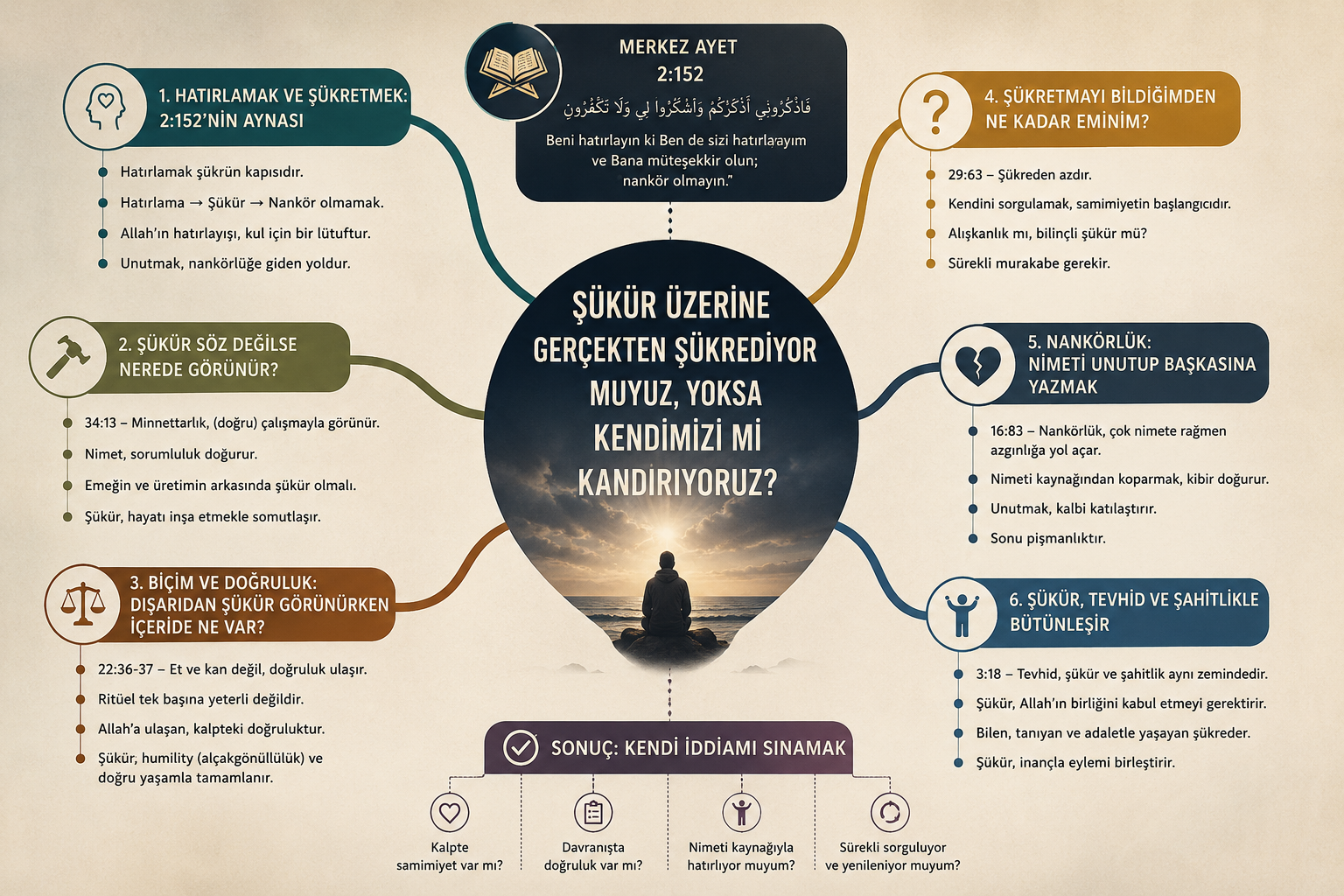
1. Remembering and Being Grateful: The Mirror of 2:152
Verse
2:152
فَٱذْكُرُونِىٓ أَذْكُرْكُمْ وَٱشْكُرُوا۟ لِى وَلَا تَكْفُرُونِ
You shall remember Me, that I may remember you, and be thankful to Me; do not be unappreciative.
Remember Me so that I may remember you, and be grateful to Me; do not be ungrateful.
Source: kuranteyit.com
Reflection on the Verse
The first thing that stops me in 2:152 is the call to remember that comes before gratitude. It says, “Remember Me,” and then, “Be grateful to Me.” This order makes me think that gratitude is not merely a feeling of joy that arises when I encounter a blessing. Gratitude may begin with keeping the source of the blessing in the right place in my mind.
Forgetting happens very quietly. When something remains in my life for a long time, I can stop seeing it as something that has been given and begin to regard it as my natural right. If health continues, it is easy to take health for granted; if water flows, to take water for granted; if I can work, to take the ability to work for granted; if I am loved, to take love for granted. What is even more difficult is that when success comes, I may forget all the conditions that made that result possible and begin the entire story with myself.
This is exactly where the word “gratitude” may fail to save me. My tongue may give thanks while my mind claims ownership. I may say, “Thanks be to GOD,” and then immediately explain everything as the result of my own intelligence, discipline, or decisions. The fact that the verse ends with “do not be ungrateful” disturbs this comfort. Since gratitude and ingratitude are placed opposite one another within the same sentence, it matters in which direction a person finds himself.
For this reason, I do not want to measure my gratitude merely by the number of words I say. Whom do I remember when success comes? When an opportunity is taken away from me, do I regard it as though it had always been an obligatory right that belonged to me? When people’s appreciation increases, does the source of the blessing fade into the background of my mind? Each of these questions becomes a way of examining my own memory before 2:152.
Perhaps the first sign that I am deceiving myself is that I can speak of gratitude while forgetting the Giver. The verse first teaches me to remember. Gratitude finds its true direction within that remembrance.
Verse reference: 2:152.
2. If Gratitude Is Not Just Words, Where Does It Appear?
Verse
34:13 — They made for him whatever he wanted—wall niches, statues, deep pools, and heavy cooking pots. O family of David, work righteousness to show your gratitude. Only a few of My servants are grateful.
Reflection on the Verse
34:13 uses an expression about gratitude that does not allow me to remain comfortable: “work righteousness to show your gratitude.” Here, gratitude is connected with a visible response. Gratitude does not remain merely a feeling that I claim exists within me; it stands beside work directed toward righteousness.
Before this verse, the question I need to ask myself changes. Instead of asking, “Do I say I am grateful?” I begin asking, “Where is my gratitude visible?” If I have been given time, how do I use it? If I have been given knowledge, does that knowledge make me more honest, or more arrogant? If I have received an opportunity, do I use it only to enlarge myself, or does it have a consequence in my relationship with righteousness?
The statement at the end of the verse, “Only a few of My servants are grateful,” also makes it difficult for a person to be easily confident about his own gratitude. I do not want to use this sentence to divide others into “the grateful” and “the ungrateful.” On the contrary, it lowers the high score I may give myself. The word gratitude may be common, but the verse makes me think that gratitude is not a light claim.
Sometimes using a religious word frequently can create the feeling that the reality expressed by that word has already taken place within me. Yet 34:13 asks that not only the tongue, but also work directed toward righteousness, be taken into account. If there is a great distance between my claim of gratitude and what I do, I cannot close that distance with a sentence of thanks.
For me, the difficult question of the verse is this: Is what I think demonstrates my gratitude truly righteousness, or is it merely appearing to be a grateful person?
Verse reference: 34:13.
3. Form and Righteousness: What Is Inside When Gratitude Is Visible on the Outside?
Verse
22:36 — The animal offerings are among the rites GOD has decreed for your own good.* Mention GOD’s name over them as they stand in rows. When they are offered as sacrifices, eat from them and feed the poor and the needy as well. He subdued them for you for this reason, so that you may show your gratitude.
22:37 — Neither their meat nor their blood reaches GOD. What reaches Him is your righteousness. He subdued them for you so that you may glorify GOD for guiding you and thereby show your gratitude. Give good news to the charitable.
Reflection on the Verse
22:36–37 draws a very clear distinction between outward form and inward righteousness. There is a ritual, there is mentioning the name of GOD, there is sharing; but 22:37 suddenly introduces another standard at the center: “Neither their meat nor their blood reaches GOD. What reaches Him is your righteousness.”
This sentence makes me think that, in gratitude as well, form cannot replace substance. Saying “Thanks be to GOD” is a form. Mentioning GOD’s name is a visible act. Publicly announcing a blessing is also visible. All of these may be sincere, but the existence of outward signs does not automatically prove that the inner direction is right.
A person can easily convince himself here. I prayed, therefore I surrendered. I gave thanks, therefore I am grateful. I used GOD’s name, therefore what I did must be right. Yet 22:37 brings the righteousness behind the outward appearance into question. It does not reject form; it shows what must stand at the center of form.
For this reason, gratitude is not a matter of religious aesthetics for me. How beautifully a sentence is spoken, how spiritual a post appears, or how emotionally moving an atmosphere feels cannot, by themselves, be sufficient measures. If righteousness is being damaged, the outward appearance of gratitude can hide me from my own reality.
In order not to deceive myself, sometimes I need to silence the words for a moment and look behind them: Did I truly become more righteous after this blessing? Did I remember sharing, measure, and responsibility? Or did I return to my old center once the ritual was complete?
Verse references: 22:36–37.
4. How Certain Am I That I Know How to Be Grateful?
Verse
27:19 — He smiled and laughed at her words* and said, “My Lord, direct me to be grateful for the blessings You have bestowed upon me and my parents, and to do righteous works that please You. By Your mercy, admit me among Your righteous servants.”
Reflection on the Verse
The prayer in 27:19 makes me think that gratitude is not an automatic quality. Someone who recognizes blessings says, “My Lord, direct me … to be grateful.” There is no self-assured spiritual proclamation in this sentence; there is a request to be guided.
Sometimes I can assume that the moment I notice a blessing, I have completed the task of gratitude. Yet the verse places gratitude and being directed “to do righteous works that please You” within the same prayer. Recognizing the blessing may be a beginning, but what that awareness turns into also matters.
It is easy to ask for more opportunities. More knowledge, a broader field of work, better financial conditions, a larger audience, more powerful tools… But how often do I also make this prayer: Direct me to become someone who can use what You have given correctly? When I ask for the blessing, do I also ask for the moral responsibility of the blessing?
This question becomes especially heavy in moments of success. When a person obtains something, he may feel rewarded; yet the direction in which that thing will carry him is still unknown. This is why 27:19 seems important to me in asking for gratitude together with righteous action.
Rather than being overly certain that I know how to be grateful, it feels more honest to acknowledge that I need to be directed toward gratitude. Perhaps one way a person can avoid deceiving himself is by refusing to regard his spiritual condition as complete.
Verse reference: 27:19.
5. If Gratitude Is Not Something GOD Needs, Whom Does It Change?
Verse
31:12 — We endowed Luqman with wisdom: “Be grateful to GOD.” Whoever is grateful is grateful for his own good. As for those who become ungrateful, GOD is in need of nothing; He is the Praiseworthy.
Reflection on the Verse
31:12 clearly states that gratitude does not fulfill a need of GOD. The one who is grateful is grateful for his own good, while in the face of ingratitude GOD is in need of nothing. This sentence changes the way I look at gratitude. Gratitude is not giving GOD something He lacks; it is about correcting my relationship with reality.
In that case, showing off becomes even more meaningless. Other people seeing me as grateful, spiritual, or surrendered does not add anything to GOD. Nor does applause for my expressions of gratitude. If gratitude is for my own good, then the real change should appear within me.
So what changes? Does my sense of ownership become more measured? Do I stop attributing success entirely to myself? When I lose something, can I move away from thinking that the entire order of things owes it to me? While appreciating the people who help me, do I avoid forgetting the ultimate source?
It is also striking that the verse mentions gratitude in the context of wisdom given to Luqman. Knowledge and gratitude are not distant from one another. A person may learn many things and still consider himself self-sufficient. Wisdom may deepen when knowledge, instead of enlarging the ego, brings a person closer to his own limits and to the source of the blessing.
Gratitude does not change GOD. If it is real, it should change me. For me, this sentence is one of the simplest ways to test my own claim of gratitude.
Verse reference: 31:12.
6. Is a Blessing a Reward or a Test?
Verse
27:40 — The one who possessed knowledge from the Book said, “I can bring it to you before you blink.” When he saw it placed before him, he said, “This is a blessing from my Lord, testing me with it to reveal whether I am grateful or ungrateful. Whoever is grateful is grateful for his own good, and whoever is ungrateful—my Lord is in need of no one, the Most Honorable.”
Reflection on the Verse
27:40 makes it difficult for me to read a blessing as a certificate of success. When a great opportunity appears, the first statement is, “This is a blessing from my Lord,” but immediately afterward the same blessing is described as a test that reveals gratitude or ingratitude.
Blessing and test in the same sentence.
This is a very important correction for me. A person can easily interpret success as automatic proof that GOD is pleased with him. Yet the verse presents the giving of a blessing not as the end of the test, but as the test itself. The fact that an opportunity has been given to me does not yet mean that I have used that opportunity correctly.
Money may increase while my gratitude decreases. Knowledge may grow while arrogance grows with it. People’s attention may increase while the center silently shifts toward the ego. A project may grow while the clean intention that existed at the beginning shrinks. I cannot say from the outside that any of these things have definitely happened to a particular person. But 27:40 clearly shows me that a blessing can be a test that reveals a person’s direction.
Before this verse, the sentence “A blessing came, therefore I must be on the right path” is not enough. The real questions begin after the blessing arrives: To whom did I attribute it? How did I use it? Did the power I was given turn into an unjust sense of superiority over others? Did gratitude increase, or did possessiveness?
One of the most subtle forms of deceiving myself may be confusing having a blessing with having gratitude. The blessing may have been given. Gratitude is still a question waiting for an answer.
Verse reference: 27:40.
7. Turning Gratitude into a Formula for Gain
Verse
14:7 — Your Lord decreed: “The more you thank Me, the more I will give you.” But if you turn to ingratitude, then My punishment is severe.
Reflection on the Verse
14:7 carries a clear promise: the verse establishes a direct relationship between gratitude and increase. Yet there is also the possibility that I may turn this relationship into a calculation for my own benefit. The moment I think, “If I want to receive more, I should be more grateful,” gratitude that appears externally directed toward GOD can once again become a technique serving my own gain.
The verse says, “I will give you more,” but within this sentence there is no detailed list stating that what will be given must always mean only money, visible success, or material abundance. For this reason, I do not think it is right to turn the promise of the verse into a specific prosperity formula.
The more difficult question is this: If I do not see the increase I expected, would I still want to remain on the path of gratitude? Is the Giver at the center of my gratitude, or the new things that may be given? If the continuation of my gratitude depends constantly on receiving greater worldly returns, then I need to reconsider my intention.
This does not mean diminishing the promise of the verse. On the contrary, it means refusing to reduce the promise to the language of my own bargaining. When I turn my relationship with GOD into a transaction of “I say this, and in return I receive that,” the word gratitude may remain, but its direction can change.
For me, 14:7 is both hope and warning. While accepting the relationship between gratitude and increase, I need to learn not to turn gratitude into a trick for obtaining more.
Verse reference: 14:7.
8. Remembering in Hardship and Forgetting in Ease
Verse
16:53 — Every blessing you enjoy is from GOD. Yet whenever hardship touches you, you immediately cry out to Him.
16:54 — Nevertheless, as soon as He relieves your hardship, some of you return to idol worship.
Reflection on the Verse
16:53 begins very clearly: “Every blessing you enjoy is from GOD.” Then it shows the movement of the human being in hardship: immediately crying out to Him. 16:54 then describes how, after the hardship is removed, some people return to idol worship.
The transition between these two verses particularly makes me think. Human beings often recognize their weakness in moments of crisis. When something moves beyond our control, prayer can become more real, need more obvious, and arrogance quieter. But when the problem is resolved, the old self can return very quickly.
For this reason, I do not want to mistake intense turning toward GOD during a crisis for permanent surrender. Perhaps an important part of the test begins after the hardship has passed. When work improves, when fear about health decreases, when a debt is paid, when the awaited news arrives, when life returns to normal—is GOD still remembered?
In the article Silent Remembrance, I had asked whether remembrance continues when the sound disappears. The question here is similar: Does remembrance continue when the hardship is removed? If I seek my Lord in the storm but, when the sea becomes calm, attribute the captaincy entirely to myself, I need to look again into my claim of gratitude.
A blessing can sometimes be a subtler test than deprivation. Deprivation makes my dependence visible, while abundance can make me feel as though I am in control. Gratitude is tested by not forgetting the source within this illusion.
Verse references: 16:53–54.
9. Hearing, Sight, and the Brain: The Responsibility of Using a Blessing
Verse
16:78 — GOD brought you out of your mothers’ wombs knowing nothing and gave you hearing, sight, and the brain so that you may be grateful.
17:36 — Do not accept any information unless you verify it for yourself. I have given you hearing, sight, and the brain, and you are responsible for using them.
Reflection on the Verse
16:78 says that the human being comes into the world knowing nothing and connects hearing, sight, and the brain with gratitude. 17:36 brings those same faculties into the realm of responsibility: Do not accept information without verification; you are responsible for using hearing, sight, and the brain.
When I consider these two verses together, gratitude opens into a meaning broader than merely giving thanks for the existence of these organs. What happens if I am grateful for my eyes but surrender my gaze to prejudice? If I say I am grateful for my ears but listen only to what I want to hear? If I thank GOD for my brain but hand over my responsibility to think to a group, a person, or an algorithm?
Appreciating the value of a blessing may also involve how I use it. This is where 17:36 becomes weighty. My haste regarding information can produce injustice toward other people. Passing on what I hear without verifying it, turning what I see into a judgment by removing it from context, presenting what I think as certain knowledge—each of these touches the moral dimension of my relationship with the faculties I have been given.
In Not Accepting Without Verification and Is Comparing Quran Translations Doubt or Responsibility?, I had considered research to be a personal responsibility. From the perspective of gratitude, I return to the same place: If there is accountability for the hearing, sight, and brain that have been given, then using them may also be considered part of gratitude.
Saying, “My eyes can see, thank GOD,” is beautiful. But what I look at with my eyes, how I look, and what I say about what I see also matter. A blessing is not merely something I possess; it is an opportunity whose responsibility I carry.
Verse references: 16:78, 17:36.
10. Knowing That I Do Not Know in the Face of Visible and Hidden Blessings
Verse
31:20 — Do you not see that GOD has placed everything in the heavens and on the earth at your service and has showered His blessings upon you—visible and hidden? Yet some people argue about GOD without knowledge, without guidance, and without an enlightening scripture.
Reflection on the Verse
31:20 speaks of “visible and hidden” blessings within the same sentence and then mentions people who argue about GOD without knowledge. This combination makes me think that I need to establish a careful relationship between gratitude and the limits of knowledge.
Visible blessings are easier to name. Water, health, the ability to work, loved ones, time, the power to learn, a moment of safety… Hidden blessings remind me that my field of vision is limited. The verse does not individually state which event corresponds to which hidden blessing.
For this reason, I cannot speak on behalf of GOD about every loss, delay, or pain I experience and say, “This is definitely a hidden blessing, and this is its reason.” Such a judgment would fill in knowledge the verse has not given me. Gratitude does not mean being able to explain everything. Sometimes honestly admitting that I do not know is also a way of respecting my limits when speaking about GOD.
A person can easily become excessively certain while using spiritual language. He may think he knows the hidden reason behind every event, understands why GOD did something to a particular person, or can read the definite divine message behind a specific outcome. Because 31:20 reminds us of blessings while also pointing to arguing without knowledge, it pulls me away from this comfort.
Gratitude does not have to cover uncertainty with false explanations. The sentence “I do not know why I am experiencing this, but I know that my knowledge is limited” can also carry an honest surrender.
Verse reference: 31:20.
11. Gratitude, Monotheism, and the Limits of Authority
Verse
39:66 — Therefore, worship GOD alone and be grateful.
9:31 — They have taken their religious leaders and scholars as lords* instead of GOD. Others also deified the Messiah, son of Mary. All of them were commanded to worship one god. There is no god except Him. Glory be to Him; He is far above having any partner.
Reflection on the Verse
39:66 keeps the address of gratitude clear: “worship GOD alone and be grateful.” This expression teaches me not to separate gratitude from monotheism. There may be people who serve as means through which goodness reaches my life, but the ultimate source of the blessing must not be dispersed.
A teacher may teach me something, a doctor may help me, a friend may stand beside me in a difficult moment, a team may help a project grow. Diminishing human effort and goodness is not gratitude. Thanking them is not wrong either. But when I place the means and the source in the same position, the measure can become distorted.
9:31 gives a severe warning about taking religious leaders and scholars as lords instead of GOD. I do not derive from this verse the conclusion “listen to no one and learn from no one”; the verse does not say this. But I see very clearly the boundary of not turning any human being into an absolute religious authority alongside GOD.
Gratitude can also be tested here. While feeling thankful to someone who helped me in a religious matter, do I begin to equate that person’s words with the word of GOD? Because of the opportunities a community provides me, do I begin measuring truth according to that community’s approval? Does thanking a person create a debt of unconditional submission to that person?
In Should a Quran App Make Rulings? The Boundary Between Tool and Authority, I had tried to distinguish the tool from the source. Gratitude should preserve the same distinction: appreciate the one who helps, but do not change the center of worship and ultimate gratitude.
Verse references: 39:66, 9:31.
12. Gratitude, Testimony, Knowledge, and Justice
Verse
3:18 — GOD bears witness that there is no god except Him, and the angels and those possessing knowledge bear the same witness. In truth and justice, He is the absolute God; there is no god except Him, the Almighty, the Most Wise.
Reflection on the Verse
3:18 brings testimony, knowledge, and justice together within monotheism. GOD bears witness to His own oneness; the angels and those who possess knowledge also bear witness. The verse also contains the phrase “In truth and justice” and declares GOD to be the Almighty, the Most Wise.
While thinking about gratitude, the importance of this verse appears to me here: Saying to whom I am grateful also carries a testimony about who the ultimate source and authority is. When 2:152 says, “Be grateful to Me,” 3:18 clarifies the place of that “Me” within monotheism.
If my testimony remains only on my tongue, my life may say something else. While saying that GOD is Almighty, I may place all my trust in human power. While saying He is the Most Wise, I may make my own interests the final measure instead of clear guidance. While bearing witness to His oneness, I may give human authorities a position that belongs to GOD.
Justice also seems impossible to separate from gratitude. If the power or opportunity I have been given is being used to wrong another person, saying that I attribute the blessing to GOD does not cleanse that injustice. Words of gratitude cannot become a covering over unjust behavior.
In The Weight of Testimony, the question I asked returns here once more: Does my life confirm what I say? If gratitude is also a form of testimony, then my decisions may show how real that testimony actually is.
Verse reference: 3:18.
13. While Proclaiming the Blessing, Am I Proclaiming Myself?
Verse
93:11 — Proclaim the blessing your Lord has bestowed upon you.
33:70 — O you who believe, have deep reverence for GOD and speak only truthful words.
Reflection on the Verse
93:11 calls us to proclaim the blessing. 33:70 calls us to speak only truthful words. When I consider these two verses together, I see a subtle boundary between gratitude and narrative: I do not have to hide the blessing, but while speaking about it I may place myself at the center.
When speaking about an achievement, I may say, “Thanks be to GOD,” and then build the rest of the story entirely around my own superiority. GOD’s name appears at the beginning of the sentence, but I remain the hero of the story. In such a case, the word gratitude can become an opening line that presents the ego in a more acceptable form.
On the other hand, false humility is not truthful speech either. If I truly worked, I do not have to say that I did not. If I made an effort, I do not have to erase that effort. Truthful speech requires placing both effort and the opportunities that were given in their proper places.
I worked; but I did not create the body that enables me to work. I learned; but I came into the world knowing nothing. I produced; but I did not establish the order within which production is possible. Other people helped me; I cannot erase them either. This balance requires both not enlarging the ego while proclaiming the blessing and not diminishing reality.
If proclaiming the blessing turns into proclaiming myself, I may have redirected 93:11 toward my own self-advertisement. The standard of truthful speech in 33:70 weighs me again here.
Verse references: 93:11, 33:70.
14. Being Grateful Without Erasing Human Effort
Verse
36:35 — This is so that it may provide them with fruits and allow them to produce whatever they need with their own hands. Will they be grateful?
Reflection on the Verse
36:35 makes room for human beings producing with their own hands and immediately afterward asks, “Will they be grateful?” This question makes the relationship between gratitude and effort more balanced for me.
Being grateful does not mean erasing human effort. When I produce music, I truly work; recording, arrangement, mixing, and decisions require effort. When developing software, I truly think, search for errors, and rewrite. Erasing a person’s real effort can also distort reality.
But the reality of effort does not remove the source of the opportunities that make that effort possible. I did not originate the hands with which I work, the mind with which I think, time, the physical order, or life itself. The beauty of 36:35 is precisely here: while making room for “producing with their own hands,” it connects the question to gratitude.
For this reason, I want to avoid both extremes. On one side is possessiveness saying, “I did everything.” On the other side is a false self-diminishment that erases genuine human effort. The verse opens a space capable of holding both realities at once: The human being produces and is still called to be grateful.
Gratitude does not devalue effort. It prevents effort from being made absolute. What falls to me is to honestly acknowledge the work I have done while not forgetting the greater blessing that made it possible.
Verse reference: 36:35.
15. How Do I Treat Blessings I Cannot Count as Though They Were My Right?
Verse
16:18 — If you try to count GOD’s blessings, you will not be able to encompass them. GOD is Forgiving, Most Merciful.
14:34 — And He gives you every kind of thing you ask of Him. If you try to count GOD’s blessings, you can never encompass them. Indeed, the human being transgresses and is ungrateful.
Reflection on the Verse
16:18 and 14:34 draw attention to the same limitation: If we try to count GOD’s blessings, we cannot encompass them. This expression shows not only the multitude of blessings but also the limits of my own awareness.
How many of the conditions that make up a single day can I truly count? Being able to wake up, breathe, remember, speak, walk, learn something, the hundreds of processes in the body that I do not notice, the unseen effort of others, dangers I never encountered… As the list grows, I realize how small a portion I can actually name.
And then, within this uncountable structure, how easy it is to say about a single success, “I did this entirely myself.” A person knows the visible part of his own story; he does not know most of the invisible conditions. Yet despite this, he can develop a feeling of absolute ownership over the result.
This is why the mention at the end of 14:34 that the human being is transgressing and ungrateful feels so heavy. It is easy to direct this expression outward; when I turn it toward myself, I notice how quickly I treat what I have as a natural entitlement.
Perhaps gratitude deepens when, while trying to count, I realize that I cannot. I cannot name every blessing; but knowing that I live within a field of goodness I cannot encompass may draw my ego toward a more measured place.
Verse references: 16:18, 14:34.
16. Gratitude Is Not a Mood, but a Direction with Accountability
Verse
76:3 — We showed him both paths; then he is either grateful or ungrateful.
102:8 — Then, on that day, you will be questioned about the blessings you enjoyed.
Reflection on the Verse
76:3 presents gratitude and ingratitude as two different directions. 102:8 states that blessings will one day be questioned. These two verses make it difficult for me to think of gratitude merely as a temporary feeling.
Feelings change. One morning I may feel intense gratitude for the beauty of life, and later the same day I may become angry over a small inconvenience. If gratitude were only about feeling good, it would be difficult to find a stable measure within these fluctuations.
In the verses, however, there is direction and accountability. The statement “either grateful or ungrateful” suggests an orientation; the statement “you will be questioned about the blessings” makes what we do with what has been given more serious.
For this reason, it is not enough to ask myself only, “Do I feel grateful?” What did I do with my time? How did I use my knowledge? With what morality did I carry money, health, voice, attention, trust, and human relationships? While enjoying the blessing, did I forget its accountability?
102:8 feels to me like a verse that cuts through the romantic side of gratitude. A blessing is beautiful, but it is not merely enjoyment. It also carries responsibility. If I do not want to deceive myself, I need to look at my choices as much as my feelings.
Verse references: 76:3, 102:8.
17. On the Arabic Roots of the Words
Verse
2:152 — Remember Me so that I may remember you, and be grateful to Me; do not be ungrateful.
34:13 — They made for him whatever he wanted—wall niches, statues, deep pools, and heavy cooking pots. O family of David, work righteousness to show your gratitude. Only a few of My servants are grateful.
27:40 — The one who possessed knowledge from the Book said, “I can bring it to you before you blink.” When he saw it placed before him, he said, “This is a blessing from my Lord, testing me with it to reveal whether I am grateful or ungrateful. Whoever is grateful is grateful for his own good, and whoever is ungrateful—my Lord is in need of no one, the Most Honorable.”
102:8 — Then, on that day, you will be questioned about the blessings you enjoyed.
Reflection on the Verse
Root analysis does not replace the verse and does not by itself produce a new ruling. Here, I use the roots only to see more carefully the relationships that the verses themselves have already established. In particular, the words gratitude, remembrance, ingratitude, work, testing, and blessing are connected within the same field of thought.
The expression فَٱذْكُرُونِىٓ (fadhkuruni) in 2:152 is associated with the root field ذ-ك-ر (Dhal-Kaf-Ra). It carries the sense of remembering and mentioning. The expression وَٱشْكُرُوا۟ (washkuru) later in the same verse belongs to the root field ش-ك-ر (Shin-Kaf-Ra). In the translation, it appears as “be grateful.” Thus, within the structure of the verse itself, remembering and being grateful stand side by side.
At the end of the same sentence appears تَكْفُرُونِ (takfurun). This word is connected to the root field ك-ف-ر (Kaf-Fa-Ra) and is rendered in the translation of 2:152 as “do not be ungrateful.” Here, I am not reducing the root to a single English word in every verse; I am simply observing the clear opposition in this verse: being grateful and not becoming ungrateful.
In 34:13, شُكْرًا (shukran) is again connected with the root ش-ك-ر (Shin-Kaf-Ra). In the same verse, ٱعْمَلُوٓا۟ (i’malu) opens into the root field ع-م-ل (Ayn-Mim-Lam) and appears in the translated text as “work.” This combination makes the connection between gratitude, work, and righteousness visible even at the linguistic level.
In 27:40, the expression لِيَبْلُوَنِىٓ (liyabluwani) is associated with the root field ب-ل-و (Ba-Lam-Waw); in the translation, it appears as “testing me with it.” In the same verse, ءَأَشْكُرُ (a-ashkuru) and أَكْفُرُ (akfuru) are placed opposite one another. The fact that a blessing serves as a test revealing the human being between gratitude and ingratitude is evident not only in interpretation but also in the verbal structure of the verse.
In the field of blessing, فَضْلِ (fadli) in 27:40 carries connotations of grace and favor, while ٱلنَّعِيمِ (an-na’im) in 102:8 opens into the field of blessing and living in enjoyment. The roots and word forms are different, so I do not mechanically reduce all of them to a single English concept. Their common point is that they call the human being to reflect on his relationship with what has been given.
These roots do not provide me with a ready-made “theory of gratitude.” The clear translations of the verses already show the direction. The roots merely help me hear this movement more carefully: Remember, be grateful, do not turn toward ingratitude, work righteousness, do not forget that the blessing also tests you, and carry accountability for what has been given.
Verse references: 2:152, 34:13, 27:40, 102:8.
18. Gratitude and Not Dispersing the Source of the Blessing
Verse
35:3 — O people, remember GOD’s blessings upon you. Is there any creator other than GOD who provides for you from the heavens and the earth? There is no other god beside Him. How can you turn away?
39:66 — Therefore, worship GOD alone and be grateful.
3:18 — GOD bears witness that there is no god except Him, and the angels and those possessing knowledge bear the same witness. In truth and justice, He is the absolute God; there is no god except Him, the Almighty, the Most Wise.
Reflection on the Verse
35:3 asks me to look directly at the source of the blessing: “Is there any creator other than GOD who provides for you from the heavens and the earth?” Then comes the statement of monotheism: “There is no other god beside Him.” 39:66 joins the same direction to worship and gratitude.
Here, gratitude is not merely “I received something, so I gave thanks.” It is a matter of truth concerning the source. To what center do I connect the good things in my life? While acknowledging the real roles of people, institutions, the market, technology, or my own effort, do I disperse the ultimate source of creation and provision?
When a tool is very impressive, there can be a tendency to see it as the source. Technology speeds up my work, a company provides opportunities, a person opens a door, a community offers support. It would not be right to pretend that none of these exist. But 35:3 takes me to the deeper question: Who is the source of the order that allows all these means to exist?
3:18 establishes this direction as testimony. There is no god except Him. Gratitude may be one of the everyday tests of the testimony of monotheism. If I say that I connect the blessing to GOD while making other powers absolute, a crack forms between my words and my allegiance.
In order not to deceive myself, I need to draw the map of the blessing correctly. Not belittling the means, but not turning the means into the source. Not denying effort, but not placing effort in the position of creation. Gratitude may mean seeing reality in all its parts without dispersing the true address of goodness.
Verse references: 35:3, 39:66, 3:18.
19. Verifying the Claim of Gratitude: How Do I Test Myself?
Verse
17:36 — Do not accept any information unless you verify it for yourself. I have given you hearing, sight, and the brain, and you are responsible for using them.
34:13 — They made for him whatever he wanted—wall niches, statues, deep pools, and heavy cooking pots. O family of David, work righteousness to show your gratitude. Only a few of My servants are grateful.
102:8 — Then, on that day, you will be questioned about the blessings you enjoyed.
Reflection on the Verse
The question at the beginning of this article eventually becomes a question of verification: How do I know that I am grateful? While 17:36 says not to accept unverified information, I also want to consider this principle as a way of testing my own spiritual claim. When I say, “I am a grateful person,” what evidence am I relying on?
If I look only at the words on my tongue, the conclusion is easy. If I look only at my feelings, it is easy again. But 34:13 connects working righteousness with demonstrating gratitude, while 102:8 reminds us of accountability for blessings. These two verses make a comfortable judgment about myself more difficult.
I leave myself with three questions. Do I remember? Can I keep the source in my mind while the blessing continues? Does it turn into righteousness? Does my gratitude touch my decisions, my words, and my behavior toward others? Do I think about accountability? Do I merely use what has been given, or do I also question what I am using it for?
These questions are not a measure of perfection. A person may forget, make mistakes, and recognize his error afterward. The issue is not to give myself the secure identity of being “one of the grateful,” but to remain open to being re-examined before the verses.
Perhaps this is the most important way not to deceive myself about gratitude: not treating my own beautiful words as evidence. To consider my words together with my actions, my actions together with righteousness, and the blessing together with its accountability.
Verse references: 17:36, 34:13, 102:8.
Other Claims
Verse
14:7 — Your Lord decreed: “The more you thank Me, the more I will give you.” But if you turn to ingratitude, then My punishment is severe.
34:13 — They made for him whatever he wanted—wall niches, statues, deep pools, and heavy cooking pots. O family of David, work righteousness to show your gratitude. Only a few of My servants are grateful.
9:31 — They have taken their religious leaders and scholars as lords* instead of GOD. Others also deified the Messiah, son of Mary. All of them were commanded to worship one god. There is no god except Him. Glory be to Him; He is far above having any partner.
Reflection on the Verse
Different religious and intellectual approaches to gratitude have been developed. One of them divides gratitude into layers such as recognizing the blessing with the heart, thanking with the tongue, and responding through action. Such a classification may carry certain parallels with 34:13 connecting gratitude with working righteousness and 93:11 connecting it with proclaiming the blessing. Still, I do not use this three-part scheme as a binding definition placed above the verses; for me, the expressions of the verses themselves remain the primary measure.
The statement in 14:7, “I will give you more,” can also be interpreted in different ways. Some approaches may understand this increase specifically in terms of material abundance and visible worldly blessings. Other approaches may consider a broader field of increase. Since the verse does not list every form of increase one by one in this sentence, it would not be cautious to establish a definite material-result formula on behalf of GOD.
There are also approaches that reduce gratitude merely to positive thinking or a psychological technique for feeling better. The psychological effects of gratitude practices in human life can be discussed separately, but in the verses considered here, the direction of gratitude is not limited to making a person feel good. In 2:152 there is remembering GOD; in 34:13, working righteousness; in 39:66, worshipping GOD alone and being grateful; and in 102:8, accountability for the blessing. All of these exist within the same field.
In terms of religious authority, some traditions may grant scholars or religious leaders broad explanatory authority regarding how gratitude should be practiced. Benefiting from knowledge and taking a human being as a lord in place of GOD are not the same thing. For me, 9:31 preserves this boundary. A person may teach me something true and I may thank him; but I cannot change the ultimate address of gratitude and worship.
Mentioning these different claims does not determine the main direction of the article. For me, the common call of the verses is simpler: Remember GOD, be grateful to Him, work righteousness, do not forget that the blessing may test you, and do not place human words in the position of GOD’s word.
Verse references: 14:7, 34:13, 9:31; for connection: 2:152, 39:66, 93:11, 102:8.
Conclusion
Verse
2:152 — Remember Me so that I may remember you, and be grateful to Me; do not be ungrateful.
34:13 — They made for him whatever he wanted—wall niches, statues, deep pools, and heavy cooking pots. O family of David, work righteousness to show your gratitude. Only a few of My servants are grateful.
27:40 — The one who possessed knowledge from the Book said, “I can bring it to you before you blink.” When he saw it placed before him, he said, “This is a blessing from my Lord, testing me with it to reveal whether I am grateful or ungrateful. Whoever is grateful is grateful for his own good, and whoever is ungrateful—my Lord is in need of no one, the Most Honorable.”
102:8 — Then, on that day, you will be questioned about the blessings you enjoyed.
Reflection on the Verse
I return to the question with which I began: Are we truly grateful, or are we deceiving ourselves?
In the face of these verses, I cannot easily answer with “yes.” Even about myself, I do not want to comfortably declare, “I am truly a grateful person.” 34:13 says that very few of the servants are grateful. 27:40 shows that even a blessing can be a test revealing gratitude and ingratitude. 102:8 ultimately brings accountability for the blessing.
Yet the verses do not leave me only in doubt. They give direction. 2:152 brings remembrance, gratitude, and staying away from ingratitude together in the same sentence. 34:13 asks that gratitude become visible through working righteousness. 27:40 brings an awareness of being tested instead of intoxication with success when a blessing arrives. 102:8 reminds us that what has been given is not merely enjoyment but also responsibility.
For this reason, gratitude is no longer merely a sentence of thanks for me. It is the morality of remembrance. Connecting the source of the blessing to the right place. Not making human effort absolute while also not denying it. Not forgetting GOD when hardship passes. Not using the opportunities given to me to wrong others. If knowledge has been given, being truthful. If power has been given, not losing justice. If a person has helped me, appreciating that person without putting him in the place of GOD.
The ways of deceiving myself have also become more visible. I may say the word gratitude while forgetting. I may proclaim myself while proclaiming the blessing. I may treat success as a certificate of approval. I may turn gratitude into a bargain for receiving more. I may put outward form in the place of righteousness. I may produce spiritual certainties about events I do not understand. None of these are automatically corrected merely by a beautiful sentence of thanks.
For this reason, the measure I want to leave myself regarding gratitude is not an identity, but a series of questions:
Do I remember?
Do I truly attribute the blessing to GOD?
Am I working righteousness?
Do the opportunities I have been given make me more just, more truthful, and more responsible?
When the blessing increases, does my ego grow or does my gratitude?
Does my direction change when the hardship passes?
Do I remember that I carry accountability for what has been given?
I cannot say that I answer all these questions perfectly every day. That is not the purpose of the article anyway. Its purpose is not to give myself the label of “a grateful person.” On the contrary, it is to learn not to trust that label too much. If gratitude is not a sentence spoken once and completed, it may be a direction that a person must verify again and again throughout life.
When I return to 2:152, the simplicity of the verse feels more powerful than the entire article:
“Remember Me…”
Perhaps gratitude begins exactly here.
By not forgetting.
And by trying not to contradict with my life what I claim to remember.
Verse references: 2:152, 34:13, 27:40, 102:8; also 14:7, 16:53–54, 16:78, 17:36, 22:36–37, 27:19, 31:12, 31:20, 36:35, 39:66, 3:18, 9:31, 33:70, 35:3, 76:3, 93:11, 14:34, 16:18.
Note
2:32 — They said, “Glory be to You. We have no knowledge except what You have taught us. You are the All-Knowing, the Most Wise.”
GOD knows best.
Source: kuranteyit.com
Discover
Related Articles
Quran Reflections
Deep Reverence: Remembering, Faithfulness to the Covenant, and Turning to GOD Alone
A comprehensive reflection centered on Al-Baqarah 2:40 on deep reverence, remembering blessings, faithfulness to the covenant, monotheism, testimony, knowledge, justice, truthful speech, submission, the limits of religious authority, inward orientation in privacy, awareness of accountability, and devotion to GOD alone.
Read article
Quran Reflections
What Did the Stones Do? A Reflection on Hell, the Dissolution of Mountains, the Development of the Self, and the Petrified Mind
A deep reflection centered on Al-Baqarah 2:24 about people and stones as the fuel of Hell; the crumbling of the mountain in the story of Moses, GOD's physical presence, the transformation of the earth, the development of the self, those who remain immobile, petrified minds, idols, and responsibility.
Read article
Quran Reflections
True Wealth According to the Quran: Material Wealth or Not Being Rich?
A 19-part reflection centered on Al-Baqarah 2:247, exploring wealth, material possessions, poverty, provision, justice, charity, Qarun, trade, temporary worldly blessings, closeness to GOD, and true gain.
Read article