Can Artificial Intelligence Explain the Quran? An Information Tool and the Responsibility of Understanding
A reflection through verses Al-Isra 17:36, Az-Zumar 39:18, Muhammad 47:24, and Al-Araf 7:33 on artificial intelligence, access to information, verification, careful study of the Quran, testimony, guidance, moral responsibility, and the limits of religious authority.
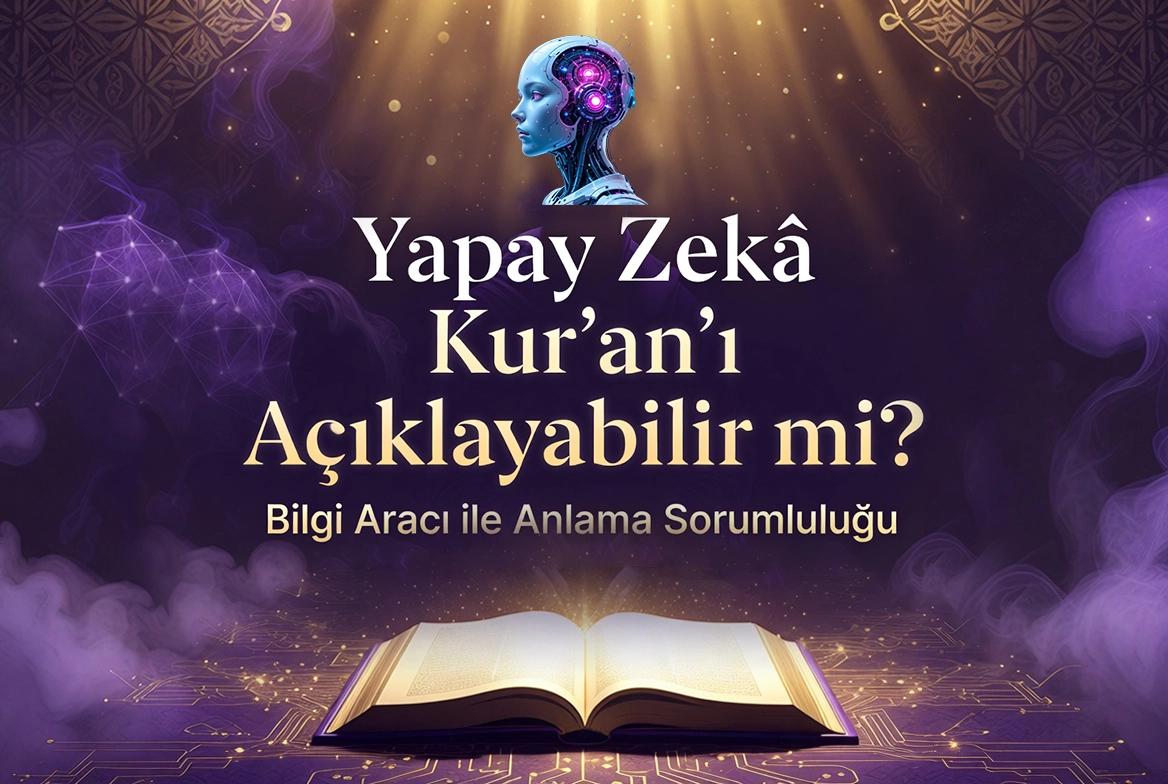
A Reflection on Verses 17:36, 39:18, 47:24, and 7:33
Author: Berk KÖKSAL
Date: 02.08.2026
Location: Mersin
Verse
1:1 — In the name of GOD, Most Gracious, Most Merciful.*
Introduction
Peace. Peace be upon you.
Artificial intelligence is rapidly changing the way human beings access information. Tasks that once required long searches, placing many sources side by side, and reading them repeatedly can now be done within seconds. A system can classify words, compare translations, find similar sentences, and suggest connections that a person may not notice at first glance.
The experimental artificial-intelligence translation area I included in Kuranteyit was born from this idea. But for me, clearly stating that this area is not a live chat system, an official translation, a fatwa, or a definitive interpretation is not a technical detail. It is an ethical requirement related to the tool knowing its own limits.
Artificial intelligence can assist human hearing, seeing, and research. But it cannot remove from the human being the responsibility in 17:36. It can place all statements side by side, but it cannot, as a moral subject, make the decision in 39:18 to “follow the best.” It can analyze the words of the Quran, but it cannot live in place of a human being the careful study asked for in 47:24. It can construct sentences about GOD, but it cannot guard through its own conscience the boundary set by 7:33.
For me, the real question is this: It is not how beautifully artificial intelligence can speak about the Quran; can the human being see what is absent behind that speech?
Summary:
1. Producing Information and Possessing Knowledge Are Not the Same
17:36
وَلَا تَقْفُ مَا لَيْسَ لَكَ بِهِۦ عِلْمٌ إِنَّ ٱلسَّمْعَ وَٱلْبَصَرَ وَٱلْفُؤَادَ كُلُّ أُو۟لَٰٓئِكَ كَانَ عَنْهُ مَسْـُٔولًا
You shall not accept any information, unless you verify it for yourself. I have given you the hearing, the eyesight, and the brain, and you are responsible for using them.
Do not accept any information unless you verify it for yourself. I have given you hearing, eyesight, and the brain, and you are responsible for using them.
17:35 — When you trade, give full measure and weigh equitably. This is better and more righteous.
17:37 — Do not walk proudly on earth—you can neither bore through the earth nor be as tall as the mountains.
2. Hearing, Sight, and the Brain: A Tool That Does Not Replace the Blessing
16:78 — GOD brought you out of your mothers' wombs knowing nothing, and He gave you hearing, eyesight, and the brain so that you may be appreciative.
23:78 — He is the One who granted you hearing, eyesight, and brains. Rarely are you appreciative.
32:9 — He shaped him and blew into him from His spirit. And He gave you hearing, eyesight, and brains; rarely are you appreciative.
67:23 — Say, “He is the One who initiated you and granted you hearing, eyes, and brains. Rarely are you appreciative.”
3. Responsibility Cannot Be Transferred: The Model Is Not Accountable
2:134 — That was a community from the past. They are responsible for what they earned, and you are responsible for what you earn. You are not responsible for anything they did.
2:139 — Say, “Do you argue with us about GOD, when He is our Lord and your Lord? We are responsible for our deeds, and you are responsible for your deeds. We are devoted to Him alone.”
4:85 — Whoever mediates a good deed receives a share of its credit, and whoever mediates an evil deed incurs a share of its burden. GOD controls all things.
11:35 — If they say, “He fabricated this story,” then say, “If I fabricated it, then I am responsible for my crime, and I am innocent of any crime you commit.”
4. Examining All Words and Following the Best
39:18
They are the ones who examine all words, then follow the best. These are the ones whom GOD has guided; these are the ones who possess intelligence.
They are the ones who examine all words, then follow the best. These are the ones whom GOD has guided; these are the ones who possess intelligence.
39:17 — As for those who abandon all idol worship and devote themselves totally to GOD alone, they have deserved happiness. Give good news to My servants.
5:100 — Proclaim: “The bad and the good are not the same, even if the abundance of the bad may impress you. Therefore, reverence GOD, O you who possess intelligence, that you may succeed.”
5. Artificial Intelligence and Possessing Intelligence Are Not the Same Thing
2:269 — He grants wisdom to whomever He wills, and whoever attains wisdom has attained a great blessing. Only those who possess intelligence will take heed.
3:7 — He sent down to you this scripture, containing straightforward verses—which constitute the essence of the scripture—as well as multiple-meaning or allegorical verses. Those who harbor doubts in their hearts pursue the multiple-meaning verses to create confusion and extract a certain meaning. No one knows their true meaning except GOD and those well founded in knowledge. They say, “We believe in this—all of it comes from our Lord.” Only those who possess intelligence will take heed.
3:190 — In the creation of the heavens and the earth, and the alternation of night and day, there are signs for those who possess intelligence.
13:19 — Is one who knows that your Lord's revelations to you are the truth equal to one who is blind? Only those who possess intelligence will take heed.
6. Accessing the Text Versus Studying the Quran Carefully
47:24
Why do they not study the Quran carefully? Do they have locks on their minds?
Why do they not study the Quran carefully? Do they have locks on their minds?
4:82 — Why do they not study the Quran carefully? If it were from other than GOD, they would have found in it numerous contradictions.*
10:39 — Indeed, they rejected it before studying, examining, and understanding it. Those before them did the same. Therefore, note the consequences for the transgressors.
38:29 — This is a scripture that we sent down to you, sacred—perhaps they will reflect deeply on its verses. Those who possess intelligence will take heed.
73:20 — Your Lord knows that you meditate during two-thirds of the night, or half of it, or one-third of it, and so do some of those who believed with you. GOD designed the night and the day, and He knows that you cannot always do this. He has pardoned you. Instead, read as much of the Quran as you can.
7. A New Lock on the Mind: Surrendering to the Ready-Made Answer
47:23 — These are the ones who incurred a curse from GOD; consequently, He rendered them deaf and blind.
47:24 — Why do they not study the Quran carefully? Do they have locks on their minds?
47:25 — Surely, those who slide back after the guidance has been clearly shown to them; the devil has enticed them and distracted them.
2:88 — Some may say, “Our minds are made up!” Rather, it is a curse from GOD, as a consequence of their disbelief, that keeps them from believing, except for a few of them.
8. Language, Translation, and the Boundary of Meaning
26:198 — If we revealed this to people who did not know Arabic.
26:199 — And had him recite it to them in Arabic, they could not have believed in it.
41:44 — If we made it a non-Arabic Quran, they would have said, “Why did it come down in that language?” Whether it is Arabic or non-Arabic, say, “For those who believe, it is a guide and a healing. As for those who disbelieve, they will be deaf and blind to it, as if they are being called from far away.”
7:204 — When the Quran is recited, listen to it and take heed, that you may attain mercy.
9. Statistical Similarity Is Not the Same as Truth
17:36 — Do not accept any information unless you verify it for yourself. I have given you hearing, eyesight, and the brain, and you are responsible for using them.
5:100 — Proclaim: “The bad and the good are not the same, even if the abundance of the bad may impress you. Therefore, reverence GOD, O you who possess intelligence, that you may succeed.”
3:7 — He sent down to you this scripture, containing straightforward verses—which constitute the essence of the scripture—as well as multiple-meaning or allegorical verses. Those who harbor doubts in their hearts pursue the multiple-meaning verses to create confusion and extract a certain meaning.
10. Fast Answers Versus Responsible Reflection
75:16 — Do not move your tongue to rush it.
10:39 — Indeed, they rejected it before studying, examining, and understanding it. Those before them did the same. Therefore, note the consequences for the transgressors.
7:169 — Did they not make a covenant that they would adhere to the scripture and never say about GOD anything but the truth? Did they not study the scripture?
38:29 — This is a scripture that we sent down to you, sacred—perhaps they will reflect deeply on its verses. Those who possess intelligence will take heed.
11. A System That Says What It Does Not Know About GOD
7:33
Say, “My Lord prohibits only evil deeds, be they obvious or hidden, and sins, and unjustifiable aggression, and to set up beside GOD powerless idols, and to say about GOD what you do not know.”
Say, “My Lord prohibits only evil deeds, whether obvious or hidden, sins, unjustifiable aggression, setting up powerless idols beside GOD, and saying about GOD what you do not know.”
7:28 — They commit a gross sin, then say, “We found our parents doing this, and GOD has commanded us to do it.” Say, “GOD never advocates sin. Are you saying about GOD what you do not know?”
2:169 — He only commands you to commit evil and vice, and to say about GOD what you do not know.
3:78 — Among them are those who twist their tongues to imitate the scripture, so that you may think it is from the scripture when it is not, and they claim that it is from GOD when it is not from GOD. Thus, they deliberately fabricate lies and attribute them to GOD.
12. Can Artificial Intelligence Bear Witness?
4:166 — But GOD bears witness concerning what He has revealed to you; He revealed it with His knowledge. And the angels bear witness as well, but GOD suffices as a witness.
2:143 — We thus made you an impartial community, that you may serve as witnesses among the people, and the messenger serves as a witness among you.
2:285 — The messenger believed in what was sent down to him from his Lord, and so did the believers. They believe in GOD, His angels, His scripture, and His messengers: “We make no distinction among any of His messengers.” They say, “We hear and we obey.* Forgive us, our Lord. To You is the ultimate destiny.”
11:14 — If they fail to meet your challenge, then know that this was revealed with GOD's knowledge, and that there is no god except He. Will you then submit?
13. To Whom Does Guidance Belong?
1:6 — Guide us in the right path;
2:120 — Say, “GOD's guidance is the true guidance.”
2:272 — You are not responsible for guiding anyone. GOD is the only One who guides whoever chooses to be guided.
3:73 — Say, “The true guidance is GOD's guidance.”
39:18 — They are the ones who examine all words, then follow the best. These are the ones whom GOD has guided; these are the ones who possess intelligence.
14. How Should Artificial Intelligence Be Used in a Quran Application?
17:35 — When you trade, give full measure and weigh equitably. This is better and more righteous.
17:36 — Do not accept any information unless you verify it for yourself. I have given you hearing, eyesight, and the brain, and you are responsible for using them.
6:69 — The righteous are not responsible for the utterances of these people, but reminding them may help; perhaps they may be saved.
7:33 — Say, “My Lord prohibits only evil deeds, whether obvious or hidden, sins, unjustifiable aggression, setting up powerless idols beside GOD, and saying about GOD what you do not know.”
15. On the Arabic Roots of the Words
17:36 — Do not accept any information unless you verify it for yourself. I have given you hearing, eyesight, and the brain, and you are responsible for using them.
39:18 — They are the ones who examine all words, then follow the best. These are the ones whom GOD has guided; these are the ones who possess intelligence.
47:24 — Why do they not study the Quran carefully? Do they have locks on their minds?
7:33 — Say, “My Lord prohibits only evil deeds, whether obvious or hidden, sins, unjustifiable aggression, setting up powerless idols beside GOD, and saying about GOD what you do not know.”
Other Claims
17:36 — Do not accept any information unless you verify it for yourself. I have given you hearing, eyesight, and the brain, and you are responsible for using them.
39:18 — They are the ones who examine all words, then follow the best. These are the ones whom GOD has guided; these are the ones who possess intelligence.
47:24 — Why do they not study the Quran carefully? Do they have locks on their minds?
7:33 — Say, “My Lord prohibits only evil deeds, whether obvious or hidden, sins, unjustifiable aggression, setting up powerless idols beside GOD, and saying about GOD what you do not know.”
Conclusion
17:36 — Do not accept any information unless you verify it for yourself. I have given you hearing, eyesight, and the brain, and you are responsible for using them.
39:18 — They are the ones who examine all words, then follow the best. These are the ones whom GOD has guided; these are the ones who possess intelligence.
47:24 — Why do they not study the Quran carefully? Do they have locks on their minds?
7:33 — Say, “My Lord prohibits only evil deeds, whether obvious or hidden, sins, unjustifiable aggression, setting up powerless idols beside GOD, and saying about GOD what you do not know.”
2:272 — You are not responsible for guiding anyone. GOD is the only One who guides whoever chooses to be guided.
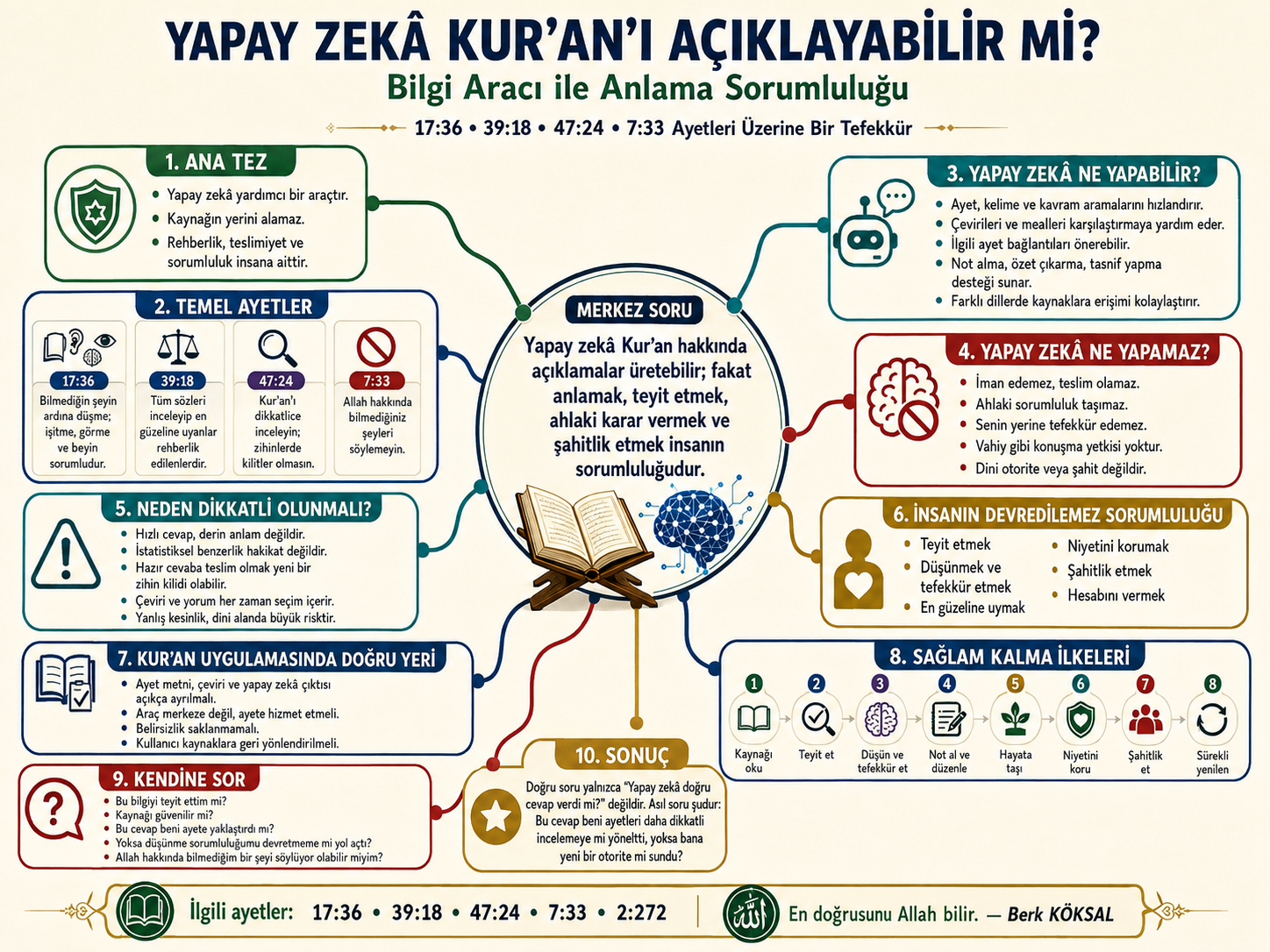
1. Producing Information and Possessing Knowledge Are Not the Same
Verse
17:36
وَلَا تَقْفُ مَا لَيْسَ لَكَ بِهِۦ عِلْمٌ إِنَّ ٱلسَّمْعَ وَٱلْبَصَرَ وَٱلْفُؤَادَ كُلُّ أُو۟لَٰٓئِكَ كَانَ عَنْهُ مَسْـُٔولًا
You shall not accept any information, unless you verify it for yourself. I have given you the hearing, the eyesight, and the brain, and you are responsible for using them.
Do not accept any information unless you verify it for yourself. I have given you hearing, eyesight, and the brain, and you are responsible for using them.
Source: kuranteyit.com
17:35 — When you trade, give full measure and weigh equitably. This is better and more righteous.
17:37 — Do not walk proudly on earth—you can neither bore through the earth nor be as tall as the mountains.
Reflection on the Verse
17:36 commands verification before accepting information and places this duty directly on the human being. The verse does not say, “Let a system you trust verify it on your behalf.” It leaves the responsibility for using hearing, sight, and the brain with the person.
Immediately after the verse comes a warning against arrogance. This connection also carries a distinct meaning in the age of artificial intelligence. When people develop a very powerful tool, they may feel that their mastery over information has grown. Faced with a system that processes billions of words, they may say, “Now we know.” But the scale of data does not remove human limitation.
For me, the proper use is this: artificial intelligence can open a door to research, but it cannot close the door of verification.
2. Hearing, Sight, and the Brain: A Tool That Does Not Replace the Blessing
Verse
16:78 — GOD brought you out of your mothers’ wombs knowing nothing, and He gave you hearing, eyesight, and the brain so that you may be appreciative.
23:78 — He is the One who granted you hearing, eyesight, and brains. Rarely are you appreciative.
32:9 — He shaped him and blew into him from His spirit. And He gave you hearing, eyesight, and brains; rarely are you appreciative.
67:23 — Say, “He is the One who initiated you and granted you hearing, eyes, and brains. Rarely are you appreciative.”
Reflection on the Verse
A human being comes into the world knowing nothing. We learn by hearing, seeing, thinking, and making mistakes. These verses present hearing, sight, and the brain not merely as functional tools, but as blessings given by GOD.
A search system can bring verses before a person, but it cannot give honesty of sight. A model can summarize different views, but it cannot open a heart that rejects the word it does not want to hear. It can produce a translation suggestion, but it does not possess the moral will that allows a human being to recognize personal bias.
Artificial intelligence should not be a master that replaces the brain; it should be a tool that helps the brain be used carefully.
3. Responsibility Cannot Be Transferred: The Model Is Not Accountable
Verse
2:134 — That was a community from the past. They are responsible for what they earned, and you are responsible for what you earn. You are not responsible for anything they did.
2:139 — Say, “Do you argue with us about GOD, when He is our Lord and your Lord? We are responsible for our deeds, and you are responsible for your deeds. We are devoted to Him alone.”
4:85 — Whoever mediates a good deed receives a share of its credit, and whoever mediates an evil deed incurs a share of its burden. GOD controls all things.
11:35 — If they say, “He fabricated this story,” then say, “If I fabricated it, then I am responsible for my crime, and I am innocent of any crime you commit.”
Reflection on the Verse
One of the most fundamental differences between artificial intelligence and a human being is responsibility. A model produces an output, but it does not bear the account of that output as a moral subject. It does not lie with malicious intent because it has no intention. It does not feel remorse because it has no conscience. When it says something correct, it earns no moral credit; when a wrong statement misleads a person, it does not feel the weight of sin as a human being would.
Those who develop an artificial-intelligence system bear responsibility for the data used to train it, the limitations imposed on it, and the warnings shown to users. A developer who adds the system to a Quran application is responsible for the context in which it is presented. The user who reads and shares the output also bears responsibility for the information they accept and spread.
The sentence “Artificial intelligence said it” does not eliminate responsibility. Just as “That is what I was told” does not fully remove the burden of a claim spread without verification, saying “The model answered this way” does not make a person innocent of their own choice.
4. Examining All Words and Following the Best
Verse
39:18 — They are the ones who examine all words, then follow the best. These are the ones whom GOD has guided; these are the ones who possess intelligence.
39:17 — As for those who abandon all idol worship and devote themselves totally to GOD alone, they have deserved happiness. Give good news to My servants.
5:100 — Proclaim: “The bad and the good are not the same, even if the abundance of the bad may impress you. Therefore, reverence GOD, O you who possess intelligence, that you may succeed.”
Reflection on the Verse
39:18 does not regard listening to or examining statements as sufficient by itself. It then speaks of following the best. There is an important difference between these two stages: collecting information and following what is right.
But “following the best” is not merely making a comparison. The phrase carries a responsibility to choose, turn toward, and act. When a person sees the best word, will they follow it even if it goes against their own interest? Will they let go of the view of someone they love? Will they admit that they were wrong? Will they pay the price required by truth?
Artificial intelligence can bring all the statements to the table. The responsibility to follow the best remains in the human heart and human life.
5. Artificial Intelligence and Possessing Intelligence Are Not the Same Thing
Verse
2:269 — He grants wisdom to whomever He wills, and whoever attains wisdom has attained a great blessing. Only those who possess intelligence will take heed.
3:7 — He sent down to you this scripture, containing straightforward verses—which constitute the essence of the scripture—as well as multiple-meaning or allegorical verses. Those who harbor doubts in their hearts pursue the multiple-meaning verses to create confusion and extract a certain meaning. No one knows their true meaning except GOD and those well founded in knowledge. They say, “We believe in this—all of it comes from our Lord.” Only those who possess intelligence will take heed.
3:190 — In the creation of the heavens and the earth, and the alternation of night and day, there are signs for those who possess intelligence.
13:19 — Is one who knows that your Lord’s revelations to you are the truth equal to one who is blind? Only those who possess intelligence will take heed.
Reflection on the Verse
Because we use the phrase “artificial intelligence” in everyday language, it is easy to assume that the system possesses the same kind of intelligence described in the verses. Yet the name we use does not explain the whole reality.
Artificial intelligence may be capable of computation, classification, and language generation. But in the verses, possessing intelligence is not described only in terms of mental processing power. It is mentioned together with wisdom, taking heed, drawing conclusions from signs, recognizing truth, and developing the right attitude toward GOD.
In 3:7, the attitude of those firmly grounded in knowledge appears in the statement, “We believe in this—all of it comes from our Lord.” This attitude is not only about solving meaning; it is also about knowing one’s limits and submitting. Artificial intelligence does not know its limits by itself. Rules such as “state uncertainty when you are not sure” can be given to it, but that is not humility. It is programmed behavior.
6. Accessing the Text Versus Studying the Quran Carefully
Verse
47:24 — Why do they not study the Quran carefully? Do they have locks on their minds?
4:82 — Why do they not study the Quran carefully? If it were from other than GOD, they would have found in it numerous contradictions.*
10:39 — Indeed, they rejected it before studying, examining, and understanding it. Those before them did the same. Therefore, note the consequences for the transgressors.
38:29 — This is a scripture that we sent down to you, sacred—perhaps they will reflect deeply on its verses. Those who possess intelligence will take heed.
73:20 — Your Lord knows that you meditate during two-thirds of the night, or half of it, or one-third of it, and so do some of those who believed with you. GOD designed the night and the day, and He knows that you cannot always do this. He has pardoned you. Instead, read as much of the Quran as you can.
Reflection on the Verse
Finding a verse within seconds is not the same as studying it carefully. Nor does an artificial-intelligence system producing a long explanation about a verse mean that the human being has reflected on it.
The question in 47:24 is directed directly at the human being. Studying the Quran carefully concerns returning to the text, considering verses together with one another, and noticing the locks within one’s own mind.
Artificial intelligence can shorten the path to the text. But it cannot live the duration of reflection in the human being’s place.
7. A New Lock on the Mind: Surrendering to the Ready-Made Answer
Verse
47:23 — These are the ones who incurred a curse from GOD; consequently, He rendered them deaf and blind.
47:24 — Why do they not study the Quran carefully? Do they have locks on their minds?
47:25 — Surely, those who slide back after the guidance has been clearly shown to them; the devil has enticed them and distracted them.
2:88 — Some may say, “Our minds are made up!” Rather, it is a curse from GOD, as a consequence of their disbelief, that keeps them from believing, except for a few of them.
Reflection on the Verse
A lock on the mind is not merely the inability to access information. A person can have access to the verses and still close the mind. One can become excessively attached to one’s own view, ignore evidence one dislikes, or hand the responsibility to think over to an authority.
The statement “Our minds are made up” is a person locking their own thought. In the age of artificial intelligence, a new version of this may be, “The system said so.” The person makes not their own opinion, but the system’s opinion, unchangeable.
The artificial-intelligence feature in a Quran application should not put a new lock on the mind; it should encourage the user to return to the verse again.
8. Language, Translation, and the Boundary of Meaning
Verse
26:198 — If we revealed this to people who did not know Arabic.
26:199 — And had him recite it to them in Arabic, they could not have believed in it.
41:44 — If we made it a non-Arabic Quran, they would have said, “Why did it come down in that language?” Whether it is Arabic or non-Arabic, say, “For those who believe, it is a guide and a healing. As for those who disbelieve, they will be deaf and blind to it, as if they are being called from far away.”
7:204 — When the Quran is recited, listen to it and take heed, that you may attain mercy.
Reflection on the Verse
Translation is a very valuable tool for accessing the Quran. A person who does not know Arabic approaches the meaning of the verses through translation. Yet the translated text and the translator’s choice of meaning are not the same thing as the text itself.
Artificial-intelligence translation makes this reality even more visible. The system can evaluate different equivalents of a word, analyze the linguistic structure of the sentence, and suggest fluent Turkish. Yet every word it chooses carries an interpretation.
Translating a word as “heart,” “mind,” “brain,” or “inner center” can affect how the reader thinks about the verse. Making the syntax of a sentence more natural may bring some emphases forward and move others into the background. This is not unique to artificial intelligence; it is a responsibility carried by all translations. What is different with artificial intelligence is that the translation is produced rapidly and sometimes invisibly.
9. Statistical Similarity Is Not the Same as Truth
Verse
17:36 — Do not accept any information unless you verify it for yourself. I have given you hearing, eyesight, and the brain, and you are responsible for using them.
5:100 — Proclaim: “The bad and the good are not the same, even if the abundance of the bad may impress you. Therefore, reverence GOD, O you who possess intelligence, that you may succeed.”
3:7 — He sent down to you this scripture, containing straightforward verses—which constitute the essence of the scripture—as well as multiple-meaning or allegorical verses. Those who harbor doubts in their hearts pursue the multiple-meaning verses to create confusion and extract a certain meaning.
Reflection on the Verse
Artificial-intelligence systems are powerful at finding similarities. They can identify verses containing the same words, expressions that may share a theme, or sentence patterns that resemble one another.
5:100 says that abundance is not the measure of goodness. From the standpoint of artificial intelligence, the most frequently occurring connection, the most repeated interpretation, or the expression with the highest probability is not automatically the measure of truth either.
Statistical similarity opens a door. It does not issue a verdict of truth.
10. Fast Answers Versus Responsible Reflection
Verse
75:16 — Do not move your tongue to rush it.
10:39 — Indeed, they rejected it before studying, examining, and understanding it. Those before them did the same. Therefore, note the consequences for the transgressors.
7:169 — Did they not make a covenant that they would adhere to the scripture and never say about GOD anything but the truth? Did they not study the scripture?
38:29 — This is a scripture that we sent down to you, sacred—perhaps they will reflect deeply on its verses. Those who possess intelligence will take heed.
Reflection on the Verse
One of the most attractive aspects of artificial intelligence is speed. A person asks, and the system answers immediately. This speed provides great convenience in everyday tasks. But in the field of religious meaning, speed is not always an advantage.
Some questions may have answers that are clearly found in the verses. Other questions require prolonged thought about context, language, other verses, and the person’s own intention. Artificial intelligence may have a tendency to answer in both cases because the system’s task is often not to leave a blank, but to produce a response.
Artificial intelligence can shorten time. But it cannot eliminate the patience required to internalize certain truths.
11. A System That Says What It Does Not Know About GOD
Verse
7:33 — Say, “My Lord prohibits only evil deeds, whether obvious or hidden, sins, unjustifiable aggression, setting up powerless idols beside GOD, and saying about GOD what you do not know.”
7:28 — They commit a gross sin, then say, “We found our parents doing this, and GOD has commanded us to do it.” Say, “GOD never advocates sin. Are you saying about GOD what you do not know?”
2:169 — He only commands you to commit evil and vice, and to say about GOD what you do not know.
3:78 — Among them are those who twist their tongues to imitate the scripture, so that you may think it is from the scripture when it is not, and they claim that it is from GOD when it is not from GOD. Thus, they deliberately fabricate lies and attribute them to GOD.
Reflection on the Verse
The most serious risk of artificial intelligence is not merely that it can produce incorrect information. It is that it can produce incorrect information about GOD and present it in a confident tone.
For this reason, in a Quran application, artificial-intelligence output should never be presented with the same visual weight as the text of revelation. The verse text, translation, human interpretation, and model output should be clearly separated. The user should be able to see at first glance which is the source and which is experimental generation.
The success of an artificial-intelligence feature that speaks about GOD should be measured not by how many answers it gives, but by how well it prevents false certainty where it does not know.
12. Can Artificial Intelligence Bear Witness?
Verse
4:166 — But GOD bears witness concerning what He has revealed to you; He revealed it with His knowledge. And the angels bear witness as well, but GOD suffices as a witness.
2:143 — We thus made you an impartial community, that you may serve as witnesses among the people, and the messenger serves as a witness among you.
2:285 — The messenger believed in what was sent down to him from his Lord, and so did the believers. They believe in GOD, His angels, His scripture, and His messengers: “We make no distinction among any of His messengers.” They say, “We hear and we obey.* Forgive us, our Lord. To You is the ultimate destiny.”
11:14 — If they fail to meet your challenge, then know that this was revealed with GOD’s knowledge, and that there is no god except He. Will you then submit?
Reflection on the Verse
Testimony is not merely repeating a correct sentence. A witness bears responsibility for the words spoken. The witness states what they have seen or know and, when necessary, stands behind that statement.
Artificial intelligence can make correct statements about the Quran. It can say, “There is no god except GOD.” It can quote verses and produce a text explaining monotheism. But these statements are not the model’s testimony.
If a Quran application presents artificial intelligence like a speaking religious person, the user may form an emotional and authority-based relationship with the model. Questions may then be directed not to verses, sources, and responsible human examination, but to a digital personality that always answers.
13. To Whom Does Guidance Belong?
Verse
1:6 — Guide us in the right path;
2:120 — Say, “GOD’s guidance is the true guidance.”
2:272 — You are not responsible for guiding anyone. GOD is the only One who guides whoever chooses to be guided.
3:73 — Say, “The true guidance is GOD’s guidance.”
39:18 — They are the ones who examine all words, then follow the best. These are the ones whom GOD has guided; these are the ones who possess intelligence.
Reflection on the Verse
It may be tempting to use expressions such as “guide,” “spiritual adviser,” or “religious guide” for artificial-intelligence systems. The system answers questions, finds relevant verses, and offers suggestions to the user. From the outside, it may appear to be guiding.
This does not mean that people cannot help one another. A teacher can explain a verse, a friend can remind someone of the right word, and an application can point to relevant sources. But none of these owns guidance.
The task of a Quran application is not to make the user dependent on itself, but to make it easier for the user to return to the source. The ideal tool reduces its own visibility and increases the visibility of the verses.
14. How Should Artificial Intelligence Be Used in a Quran Application?
Verse
17:35 — When you trade, give full measure and weigh equitably. This is better and more righteous.
17:36 — Do not accept any information unless you verify it for yourself. I have given you hearing, eyesight, and the brain, and you are responsible for using them.
6:69 — The righteous are not responsible for the utterances of these people, but reminding them may help; perhaps they may be saved.
7:33 — Say, “My Lord prohibits only evil deeds, whether obvious or hidden, sins, unjustifiable aggression, setting up powerless idols beside GOD, and saying about GOD what you do not know.”
Reflection on the Verse
In light of the measures opened by these verses, I think an artificial-intelligence feature in a Quran application should clearly preserve certain boundaries.
First, the source and the model output should be separated. The Arabic text of the verse, the translation being used, and an explanation generated by artificial intelligence should not be displayed as though they were the same thing. The user should clearly see which text is revelation, which is a human translation, and which is experimental generation.
When artificial intelligence pulls the Quran out from in front of the human being and puts itself at the center, it becomes an authority. When it makes access to the verse easier and shows its own limits, it serves as a tool.
15. On the Arabic Roots of the Words
Verse
17:36 — Do not accept any information unless you verify it for yourself. I have given you hearing, eyesight, and the brain, and you are responsible for using them.
39:18 — They are the ones who examine all words, then follow the best. These are the ones whom GOD has guided; these are the ones who possess intelligence.
47:24 — Why do they not study the Quran carefully? Do they have locks on their minds?
7:33 — Say, “My Lord prohibits only evil deeds, whether obvious or hidden, sins, unjustifiable aggression, setting up powerless idols beside GOD, and saying about GOD what you do not know.”
Reflection on the Verse
A model can list root information, but this data does not remove the context of the verse or the human responsibility to understand.
The word تَقْفُ (taqfu) in 17:36 is related to the root ق-ف-و (Qaf-Fa-Waw). It opens into the semantic field of following and going after. When a person accepts an artificial-intelligence output that they have not verified, they are not merely reading a sentence; they are also increasing the possibility of following it.
The word أَقْفَالُهَا (aqfaluha) is related to the root ق-ف-ل (Qaf-Fa-Lam) and opens into the semantic field of locks. Unquestioning attachment to ready-made answers can itself become a new lock that a person places on their own mind.
Other Claims
Verse
17:36 — Do not accept any information unless you verify it for yourself. I have given you hearing, eyesight, and the brain, and you are responsible for using them.
39:18 — They are the ones who examine all words, then follow the best. These are the ones whom GOD has guided; these are the ones who possess intelligence.
47:24 — Why do they not study the Quran carefully? Do they have locks on their minds?
7:33 — Say, “My Lord prohibits only evil deeds, whether obvious or hidden, sins, unjustifiable aggression, setting up powerless idols beside GOD, and saying about GOD what you do not know.”
Reflection on the Verse
One approach may argue that, because of its vast data capacity, artificial intelligence could be a more impartial and reliable religious explainer than human beings. A system can scan many sources at the same time and, because it has no personal interest, may appear free from certain biases.
Another claim may be that sufficiently advanced artificial intelligence could acquire consciousness and moral responsibility. This possibility can be debated philosophically and technically. But the experimental translation area in Kuranteyit is not presented as a conscious, believing, or accountable subject. A research tool should not be granted religious authority by loading hypothetical qualities onto it.
The conclusion of this article is not to exclude technology. It is to acknowledge what artificial intelligence can do and not conceal what it cannot do.
Conclusion
Verse
17:36 — Do not accept any information unless you verify it for yourself. I have given you hearing, eyesight, and the brain, and you are responsible for using them.
39:18 — They are the ones who examine all words, then follow the best. These are the ones whom GOD has guided; these are the ones who possess intelligence.
47:24 — Why do they not study the Quran carefully? Do they have locks on their minds?
7:33 — Say, “My Lord prohibits only evil deeds, whether obvious or hidden, sins, unjustifiable aggression, setting up powerless idols beside GOD, and saying about GOD what you do not know.”
2:272 — You are not responsible for guiding anyone. GOD is the only One who guides whoever chooses to be guided.
Reflection on the Verse
The cautious answer I reach is this: artificial intelligence can produce explanations about the Quran, but it is not a moral subject that understands the Quran and bears witness to it. It can analyze words, compare translations, suggest connections, and accelerate research. But it cannot believe, submit, carry intention, or account for the result it produces as a human being can.
As a developer, my responsibility is not limited to making artificial intelligence look impressive. I must separate source from generated output, avoid hiding uncertainty, remain open to correcting errors, and avoid moving the user away from their own responsibility.
For me, the right question is no longer only, “Did artificial intelligence give the correct answer?” There is another question: Did this answer lead me to study the verses more carefully, or did it create a new authority to which I could comfortably hand over my responsibility to think?
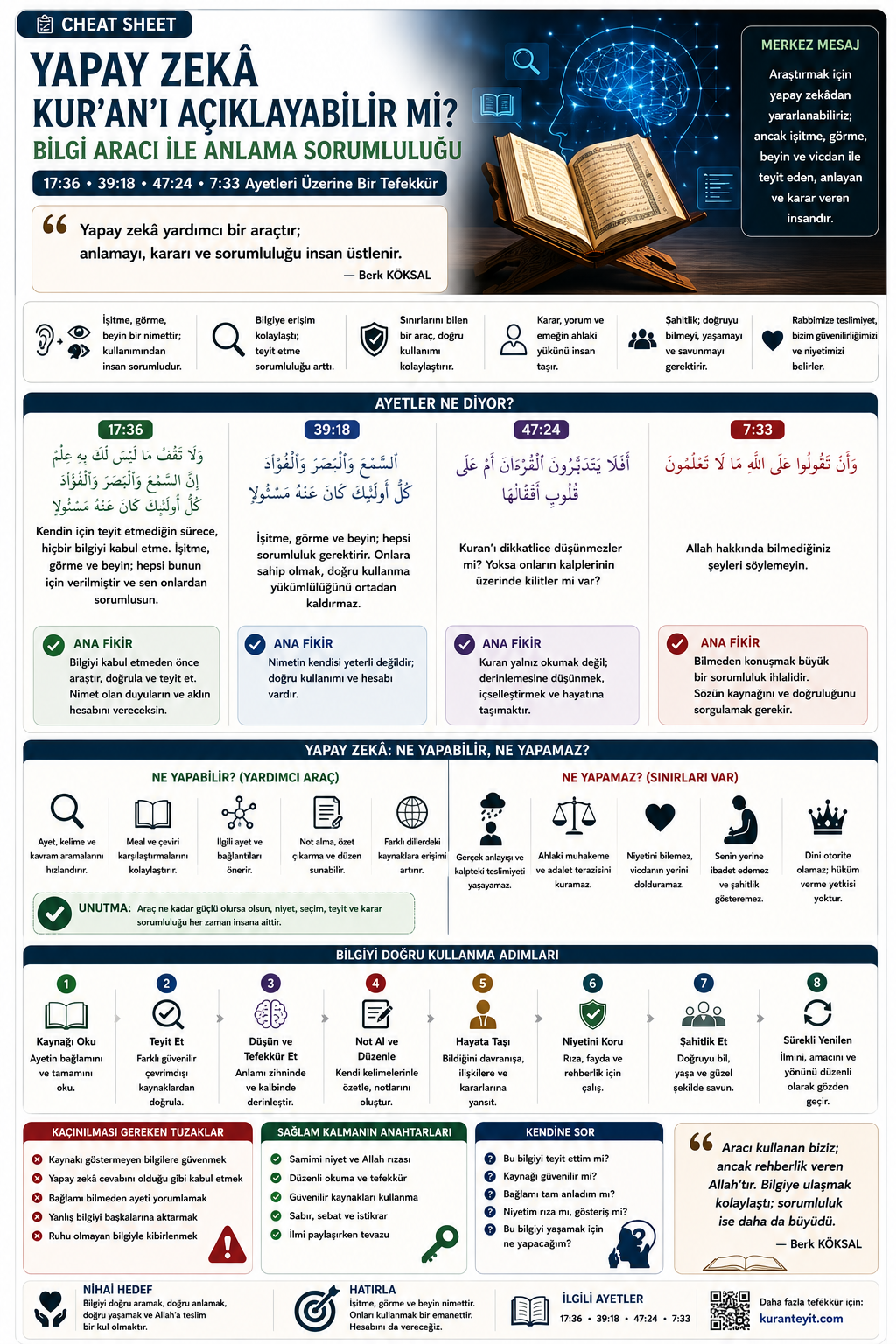
Note
2:32 — They said, “Be You glorified. We have no knowledge except what You have taught us. You are the Omniscient, Most Wise.”
GOD knows best.
Source: kuranteyit.com
Discover
Related Articles
Quran Reflections
Is Comparing Quran Translations Doubt or Responsibility?
A personal reflection on understanding Rashad Khalifa's authorized English translation, the birth of Kuranteyit, the responsibility of verification, the limits of digital tools, and turning research into action through Az-Zumar 39:18, Al-Isra 17:36, and Muhammad 47:24.
Read article
Quran Reflections
Finding Is One Thing, Understanding Is Another: The Verse in the Age of Search Engines
A reflection through Muhammad 47:24, Sad 38:29, Az-Zumar 39:18, and Al-Isra 17:36 on the difference between accessing a verse and understanding it in the age of search engines; keywords, context, selective reading, approximate matching, translation differences, verification, and responsibility in action.
Read article
Quran Reflections
Should a Quran App Issue Rulings? The Boundary Between Tool and Authority
A reflection through Al-A'raf 7:33, An-Nahl 16:116, Al-Isra 17:36, and Al-Hujurat 49:6 on Quran apps, religious authority, the language of halal and haram, verification of information, the developer's responsibility, and the importance of a tool knowing its own limits.
Read article