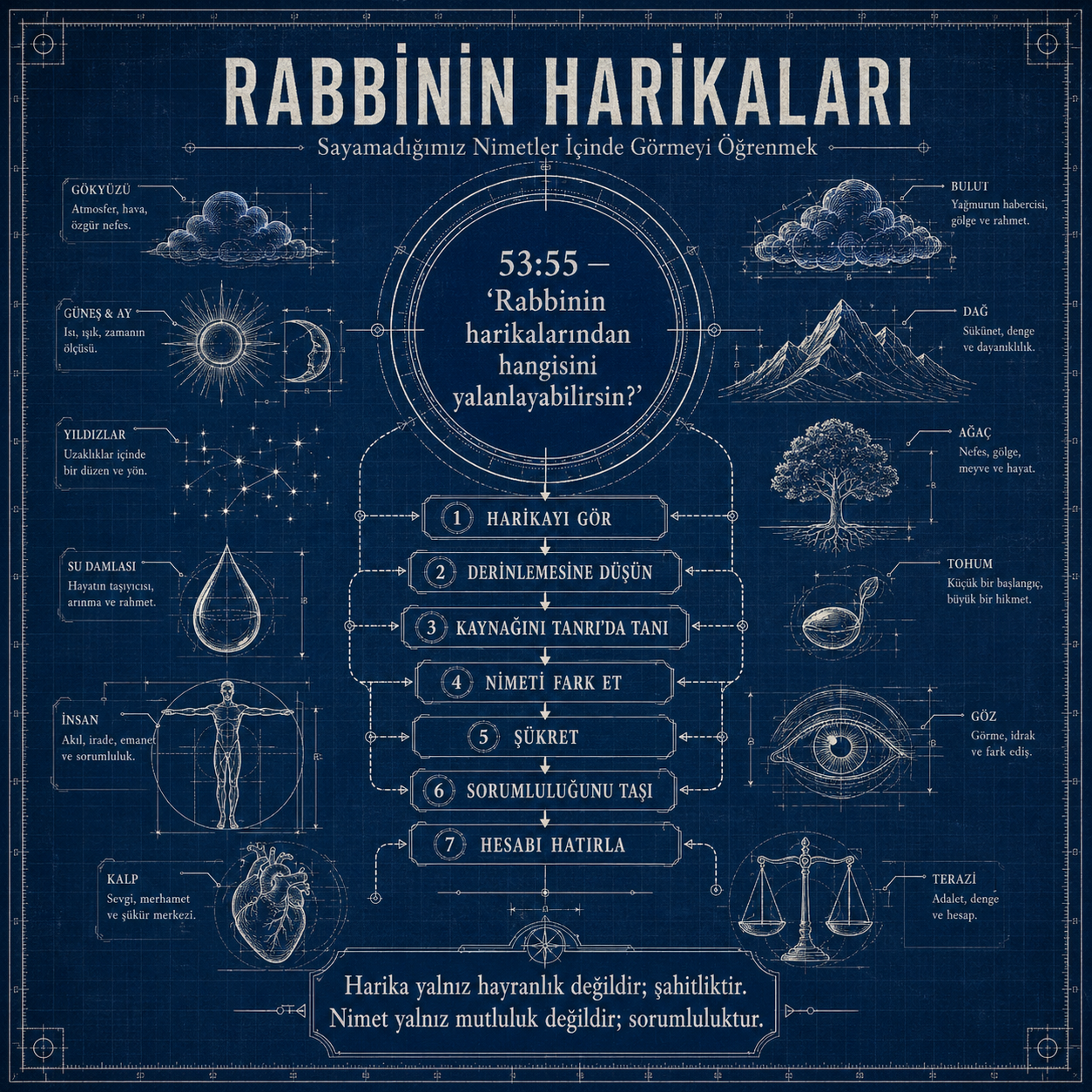
The Wonders of Your Lord: Learning to See Amid Blessings We Cannot Count
A personal and concise reflection centered on An-Najm 53:55, the wonders of your Lord, signs in creation, visible and hidden blessings, water, provision, the heavens, the earth, human creation, gratitude, tawhid, and accountability for blessings.
The Wonders of Your Lord: Learning to See Amid Blessings We Cannot Count
A reflection on 53:55 and verses connected with the wonders of creation
Author: Berk KÖKSAL
Date: 16.08.2026
Location: Mersin
Peace. Peace be upon you.
The main purpose of this article is to consider the verses together with other related verses and, in a sincere and thoughtful way, to explore what bearing witness to the oneness of GOD means in human life in terms of knowledge, justice, truthfulness, and submission.
I notice some blessings only when the possibility of losing them appears. As long as I can breathe, I can live without thinking about breath; while water flows, without thinking about water; while the sun rises every morning, without thinking about the order in the sky. Human beings grow accustomed to what repeats. Perhaps the opposite of wonder is not always absence; sometimes the opposite of wonder is familiarity.
I feel this more clearly when I look at the sea in Mersin. Seeing the same horizon hundreds of times does not make it any less marvelous; it can only dull my way of looking. There is something similar in the studio. When I listen to a track for a long time, my ears become accustomed to certain details. That is why I need to take a break and listen again. When I look at creation, I ask myself the same question: Am I truly seeing, or have I merely become accustomed to it?
This question connects with paths I opened in earlier writings: Mizan: Mixing, Mastering, and Measure in the Quran, The Weight of Testimony, Silent Remembrance: Does Remembering Continue When the Sound Ends?, Is Comparing Quran Translations Doubt or Responsibility?, Finding Is One Thing, Understanding Is Another: Verses in the Age of Search Engines, and Should a Quran App Issue Rulings? The Boundary Between Tool and Authority. In all of them, I returned to the same point: however impressive a tool, image, piece of knowledge, or sound may be, it should not replace a human being’s responsibility to see, think, verify, and answer before GOD.
The short question in 53:55 sets the center of this article: “Which of your Lord’s marvels can you deny?” When I consider the verses together, I see that the marvels are not only the great scenes in the heavens. Water, soil, night, day, sleep, love, the body, language, the ability to work, and the ability to think all belong to the same broad map. So rather than searching here for an extraordinary event, I am trying to learn to see again what stands before me every day.
Summary:
1. Which of Your Lord’s Marvels Can You Deny?
53:55
فَبِأَىِّ ءَالَآءِ رَبِّكَ تَتَمَارَىٰ
Which of your Lord’s marvels can you deny?
Which of your Lord’s marvels can you deny?
2. Seeing the Marvels and Certainty
6:75 — We showed Abraham the marvels of the heavens and the earth, and blessed him with certainty:
6:76 — When the night fell, he saw a shining planet. “Maybe this is my Lord,” he said. When it disappeared, he said, “I do not like (gods) that disappear.”
6:77 — When he saw the moon rising, he said, “Maybe this is my Lord!” When it disappeared, he said, “Unless my Lord guides me, I will be with the strayers.”
6:78 — When he saw the sun rising, he said, “This must be my Lord. This is the biggest.” But when it set, he said, “O my people, I denounce your idolatry.
6:79 — “I have devoted myself absolutely to the One who initiated the heavens and the earth; I will never be an idol worshiper.”
3. Looking Is Not Enough: Thinking Deeply
3:190 — In the creation of the heavens and the earth, and the alternation of night and day, there are signs for those who possess intelligence.
3:191 — They remember GOD* while standing, sitting, and on their sides, and they reflect deeply on the creation of the heavens and the earth: “Our Lord, You did not create all this in vain. Be You glorified. Save us from the retribution of Hell.
4. Proofs Within the Everyday Order
2:164 — In the creation of the heavens and the earth, the alternation of night and day, the ships that roam the ocean for the benefit of the people, the water that GOD sends down from the sky to revive dead land and spread in it all kinds of creatures, the direction of the winds, and the clouds placed between the sky and the earth, there are sufficient proofs for people who understand.
5. A Blessing That Does Not End When We Begin to Count
14:32 — GOD is the One who created the heavens and the earth, and He sends down water from the sky to produce all kinds of fruits for your sustenance. He has committed the ships to serve you on the sea in accordance with His command. He has also committed the rivers to serve you.
14:33 — He has committed the sun and the moon to serve you continuously. He has also committed the night and the day to serve you.
14:34 — And He gives you all kinds of things that you implore Him for. If you count GOD’s blessings, you can never encompass them. Indeed, the human being is transgressing, unappreciative.
6. From the Table to the Stars: A Map of Blessing
16:10 — He sends down water from the sky for you to drink and to grow trees for your benefit.
16:11 — With it, He grows for you crops, olives, date palms, grapes, and all kinds of fruits. This is (sufficient) proof for people who think.
16:12 — And He commits the night and the day, as well as the sun and the moon, to serve you. The stars are also committed by His command. These are (sufficient) proofs for people who understand.
16:13 — And (He created) for you on earth things of various colors. This is (sufficient) proof for people who take heed.
16:14 — And He committed the sea to serve you; from it you eat tender meat and extract jewelry that you wear. And you see the ships roaming it as you seek His bounties for commercial benefits, that you may be appreciative.
16:15 — And He placed stabilizers (mountains) on earth so that it would not tumble with you, as well as rivers and roads so that you may find your way.
16:16 — And natural landmarks, as well as the stars, to be used for navigation.
16:17 — Is the One who creates like one who does not create? Will you now take heed?
16:18 — If you count GOD’s blessings, you cannot encompass them. GOD is Forgiver, Most Merciful.
7. Remembering in Hardship and Forgetting in Ease
16:53 — Every blessing you enjoy is from GOD. Yet whenever any hardship befalls you, you immediately implore Him.
16:54 — Nevertheless, as soon as He relieves your hardship, some of you revert to idol worship.
8. Visible and Hidden Blessings
31:20 — Do you not see that GOD has committed everything in the heavens and the earth to serve you, and has showered you with His blessings—visible and hidden? Yet some people argue about GOD without knowledge, without guidance, and without an enlightening scripture.
9. From Blessing to Tawhid: Who Provides the Sustenance?
35:3 — O people, remember GOD’s blessings upon you. Is there any creator other than GOD who provides for you from the sky and the earth? There is no other god beside Him. How could you deviate?
10. Water Sent Down by Measure, Life Carried Quietly
23:18 — We send down water from the sky in exact measure, then store it in the ground. Certainly, we can allow it to seep away.
23:19 — With it we produce for you gardens of date palms and grapes, all kinds of fruits, and various foods.
23:20 — Also, a tree native to Sinai that produces oil, as well as a relish for the eaters.
23:21 — And the livestock should provide you with a lesson. We give you to drink from their bellies (milk), you obtain other benefits from them, and you use some of them for food.
23:22 — And on them and on the ships you ride.
11. The Human Being Is Also Within the Marvel
30:20 — Among His proofs is that He created you from dust, then you became reproducing humans.
30:21 — Among His proofs is that He created for you spouses from among yourselves so that you may find tranquility and contentment with one another, and He placed love and care in your hearts toward your spouses. In this there are sufficient proofs for people who think.
30:22 — Among His proofs are the creation of the heavens and the earth, and the diversity of your languages and colors. In these there are signs for the knowledgeable.
30:23 — Among His proofs are your sleeping during the night or day and your working in pursuit of His provisions. In this there are sufficient proofs for people who can hear.
30:24 — Among His proofs is that He shows you lightning as a source of both fear and hope, then He sends down water from the sky to revive dead land. In these there are sufficient proofs for people who understand.
30:25 — Among His proofs is that the heaven and the earth stand at His command. Finally, when He calls you out of the earth with a single call, you will immediately come out.
12. From Dead Soil to Orbits
36:33 — A sign for them is the dead land: we revive it and produce from it grains for their food.
36:34 — We grow in it gardens of date palms and vineyards, and cause springs to gush from it.
36:35 — This is to provide them with fruits and allow them to produce with their own hands whatever they need. Will they be appreciative?
36:36 — Glory be to the One who created all kinds of plants from the earth, themselves, and even creatures they do not know.
36:37 — Another sign for them is the night: we withdraw the daylight from it, whereupon they remain in darkness.
36:38 — The sun sets at a specific location according to the design of the Almighty, the Omniscient.
36:39 — We designed the moon to appear in phases until it becomes like an old curved sheath.
36:40 — The sun is never to catch up with the moon—night and day never deviate—each of them is floating in its own orbit.
13. Not to the Sun, but to the One Who Created It
41:37 — Among His proofs are the night and the day, the sun and the moon. Do not prostrate before the sun or the moon; prostrate before GOD who created them, if you truly worship Him alone.
41:38 — If they are too arrogant to do this, those at your Lord’s presence glorify Him night and day without ever tiring.
41:39 — Among His proofs is that you see the land still, then as soon as we shower it with water, it vibrates with life. Surely, the One who revived it can revive the dead. He is Omnipotent.
14. A World Placed at Our Service and Responsibility
45:12 — GOD is the One who committed the sea to serve you, so that ships may roam it according to His laws. You thereby seek His provisions, that you may be appreciative.
45:13 — He committed everything in the heavens and the earth to serve you; all of it is from Him. These are proofs for people who reflect deeply.
15. Signs on Earth and Within Myself
51:20 — The earth is full of signs for those who attain certainty.
51:21 — And in yourselves; can you see?
67:3 — He created seven universes in layers. You do not see any imperfection in the creation of the Most Gracious. Keep looking; do you see any flaw?
67:4 — Look again and again; your eyes will come back dazed and defeated.
16. Proclaiming the Marvel and Bearing Accountability for the Blessing
55:1 — The Most Gracious.
55:2 — Teacher of the Quran.
55:3 — Creator of the human beings.
55:4 — He taught them how to distinguish.
55:5 — The sun and the moon are perfectly calculated.
55:6 — The stars and the trees prostrate.
55:7 — He constructed the sky and established the law.
55:8 — You shall not transgress the law.
55:9 — You shall establish justice; do not violate the law.
55:10 — He created the earth for all creatures.
55:11 — In it are fruits, and date palms with hanging fruits.*
55:12 — Also grains and spices.
55:13 — (O humans and jinn,) which of your Lord’s marvels can you deny?
93:11 — Proclaim the blessing your Lord has bestowed upon you.
102:8 — Then, on that day, you will be questioned about the blessings you enjoyed.
17. On the Arabic Roots of the Words
53:55 — Which of your Lord’s marvels can you deny?
6:75 — We showed Abraham the marvels of the heavens and the earth, and blessed him with certainty:
16:18 — If you count GOD’s blessings, you cannot encompass them. GOD is Forgiver, Most Merciful.
55:13 — (O humans and jinn,) which of your Lord’s marvels can you deny?
18. Other Claims
53:55 — Which of your Lord’s marvels can you deny?
55:13 — (O humans and jinn,) which of your Lord’s marvels can you deny?
16:18 — If you count GOD’s blessings, you cannot encompass them. GOD is Forgiver, Most Merciful.
19. Conclusion
53:55 — Which of your Lord’s marvels can you deny?
16:53 — Every blessing you enjoy is from GOD. Yet whenever any hardship befalls you, you immediately implore Him.
93:11 — Proclaim the blessing your Lord has bestowed upon you.
102:8 — Then, on that day, you will be questioned about the blessings you enjoyed.
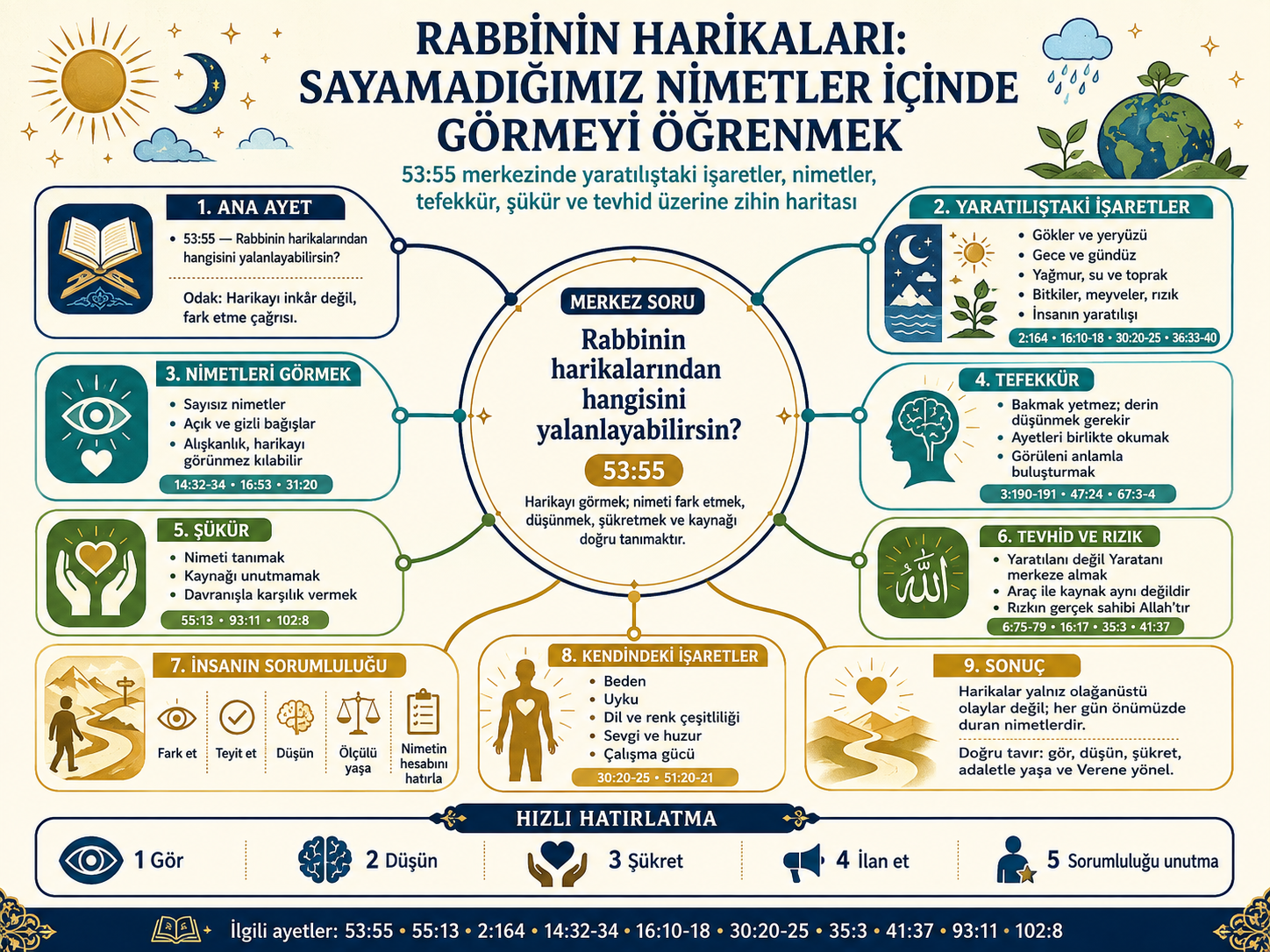
1. Which of Your Lord’s Marvels Can You Deny?
Verse
53:55
فَبِأَىِّ ءَالَآءِ رَبِّكَ تَتَمَارَىٰ
Which of your Lord’s marvels can you deny?
Which of your Lord’s marvels can you deny?
Source: kuranteyit.com
Reflection on the Verse
53:55 calls me to answer directly before constructing a grand theory: Which can you deny? At first I think of the stars, the heavens, and the beginning of life. Then the question comes much closer. The water I drink, a sound I can hear, being able to sleep at night, opening my eyes in the morning, and the presence of the people I love all stand within this question as well.
As a sound engineer, I know that the ear can become accustomed to what it hears continuously. After a while, a small hum can become almost unnoticeable. The blessings that continue without interruption can become invisible in life in the same way. Because breath does not stop, breathing can seem ordinary; because water does not run out, water can seem ordinary; because the mind works, the ability to think can seem ordinary.
In The Weight of Testimony, I reflected that testimony should be confirmed by one’s life. Seeing carries a similar responsibility here. If I count water as a blessing, I should also examine my relationship with waste; if I count time as a blessing, how I spend it; if I count knowledge as a blessing, the distance between me and arrogance. 53:55 is directed not only at my eyes, but at my life.
Verse reference: 53:55.
2. Seeing the Marvels and Certainty
Verse
6:75 — We showed Abraham the marvels of the heavens and the earth, and blessed him with certainty:
6:76 — When the night fell, he saw a shining planet. “Maybe this is my Lord,” he said. When it disappeared, he said, “I do not like (gods) that disappear.”
6:77 — When he saw the moon rising, he said, “Maybe this is my Lord!” When it disappeared, he said, “Unless my Lord guides me, I will be with the strayers.”
6:78 — When he saw the sun rising, he said, “This must be my Lord. This is the biggest.” But when it set, he said, “O my people, I denounce your idolatry.
6:79 — “I have devoted myself absolutely to the One who initiated the heavens and the earth; I will never be an idol worshiper.”
Reflection on the Verse
In 6:75, being shown the marvels and being blessed with certainty appear in the same sentence. Abraham looks at the planet, the moon, and the sun; he sees their greatness, yet when they disappear he does not take them as Lord. So admiration alone is not enough. The direction of the gaze must also be right.
In music, technical achievement can sometimes move in front of the work itself. The listener begins to talk not about the message but only about the power of the production; the tool takes the place of the center it was meant to carry. The question I asked in Whom Does the Microphone Glorify? ZIKR RAP, Words, and Responsibility extends here all the way to creation: Does what impresses me bind me to itself, or direct me to its source?
Scientific explanation can help me understand how an event takes place; technology can make use of that order. I do not belittle these things. But the answer to the question “how” does not automatically erase the question “whose.” In 6:79 the direction is clear: to devote oneself to the One who initiated the heavens and the earth. For me, certainty is not imagining that I know everything; it is refusing to put what is created in the place of GOD.
Verse references: 6:75-79.
3. Looking Is Not Enough: Thinking Deeply
Verse
3:190 — In the creation of the heavens and the earth, and the alternation of night and day, there are signs for those who possess intelligence.
3:191 — They remember GOD* while standing, sitting, and on their sides, and they reflect deeply on the creation of the heavens and the earth: “Our Lord, You did not create all this in vain. Be You glorified. Save us from the retribution of Hell.
Reflection on the Verse
3:190 points to the signs in creation; 3:191 describes the person who reflects deeply on those signs. In this way, the difference between looking and seeing, and between seeing and thinking, opens up. I can record a sunset, share it, and still never consider what that moment is saying to me.
I am struck by the fact that reflection continues while standing, sitting, and lying on one’s side. Remembering GOD is not confined to a special place or a particular state of mind. Sometimes the thought that comes while waiting for a mix to finish, sometimes while walking, sometimes after the studio has fallen silent, can also be part of this remembrance. The inward direction I was seeking in Silent Remembrance: Does Remembering Continue When the Sound Ends? meets reflection on creation here.
The statement “You did not create all this in vain” turns admiration into responsibility. If creation is not in vain, I cannot view my time, body, knowledge, and relationships merely as material to consume. Saying “how beautiful” to beauty is a beginning; the real question is whether the beauty I see changes my direction and my behavior. If it does not, perhaps I looked, but I have not yet seen.
Verse references: 3:190-191.
4. Proofs Within the Everyday Order
Verse
2:164 — In the creation of the heavens and the earth, the alternation of night and day, the ships that roam the ocean for the benefit of the people, the water that GOD sends down from the sky to revive dead land and spread in it all kinds of creatures, the direction of the winds, and the clouds placed between the sky and the earth, there are sufficient proofs for people who understand.
Reflection on the Verse
2:164 places before me the everyday order as a whole field of proofs, from the heavens to the clouds, from ships to water and the revival of dead land. Much of what the verse describes may look “normal” to me today. Yet countless layers—water, soil, season, life, human labor, and transportation—work together before a piece of fruit reaches my table.
Technology can make this journey easier while also making the source invisible. The faucet can make me forget where water comes from, the supermarket shelf can make me forget the soil, and navigation can make me forget the long story of finding one’s way. Modern life does not diminish the blessing, but it can increase in my mind the distance between the blessing and its source.
In Finding Is One Thing, Understanding Is Another: Verses in the Age of Search Engines, I wrote that having a result appear on a screen does not guarantee understanding. Kuranteyit can find a verse and show connections, but it cannot think in place of the human being. Creation is a much larger field of signs standing before me every day. The question I ask myself here is: Is the proof lacking, or is attention lacking?
Verse reference: 2:164.
5. A Blessing That Does Not End When We Begin to Count
Verse
14:32 — GOD is the One who created the heavens and the earth, and He sends down water from the sky to produce all kinds of fruits for your sustenance. He has committed the ships to serve you on the sea in accordance with His command. He has also committed the rivers to serve you.
14:33 — He has committed the sun and the moon to serve you continuously. He has also committed the night and the day to serve you.
14:34 — And He gives you all kinds of things that you implore Him for. If you count GOD’s blessings, you can never encompass them. Indeed, the human being is transgressing, unappreciative.
Reflection on the Verse
After mentioning water, fruit, ships, rivers, the sun, the moon, night, and day, 14:32-34 states that human beings cannot encompass GOD’s blessings. To me, this shows not only a numerical abundance but also the limits of my awareness.
Where could I even begin to count a single day? Waking up, breathing, remembering, speaking, walking, working, noticing a mistake, encountering someone’s mercy… Then come the layers I do not even know: dangers I never encountered, the order silently sustained within my body, wrong paths I was not led into. I cannot fully know all of these.
In music, hundreds of small decisions come together inside a single track; the listener does not hear most of them separately. What I call “today” may likewise be taking place within supports I cannot count. Gratitude, therefore, is not merely a sentence of thanks. It is refusing to see myself as self-sufficient, refusing to regard what I have as an absolute entitlement, and living more humbly before blessings I cannot count.
Verse references: 14:32-34.
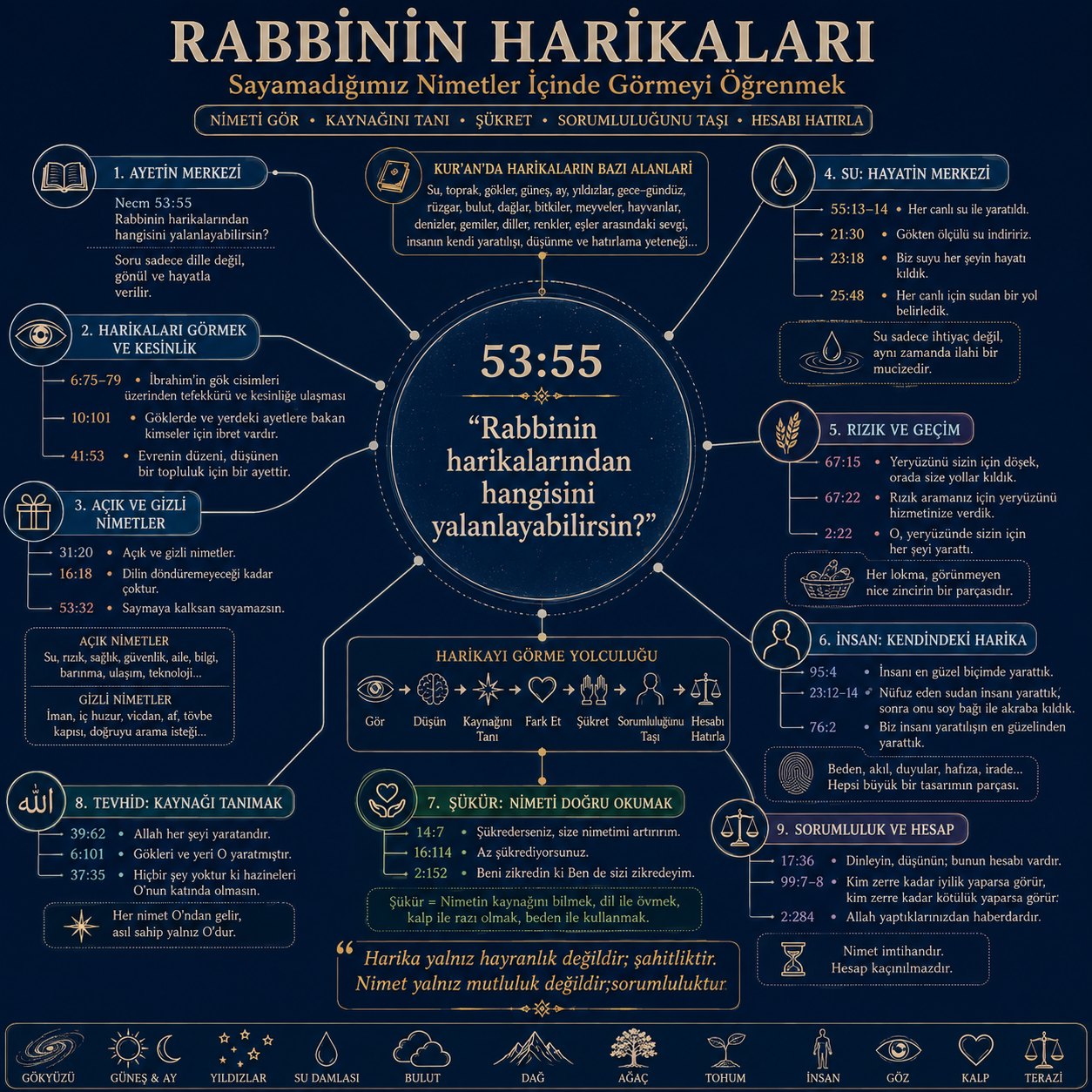
6. From the Table to the Stars: A Map of Blessing
Verse
16:10 — He sends down water from the sky for you to drink and to grow trees for your benefit.
16:11 — With it, He grows for you crops, olives, date palms, grapes, and all kinds of fruits. This is (sufficient) proof for people who think.
16:12 — And He commits the night and the day, as well as the sun and the moon, to serve you. The stars are also committed by His command. These are (sufficient) proofs for people who understand.
16:13 — And (He created) for you on earth things of various colors. This is (sufficient) proof for people who take heed.
16:14 — And He committed the sea to serve you; from it you eat tender meat and extract jewelry that you wear. And you see the ships roaming it as you seek His bounties for commercial benefits, that you may be appreciative.
16:15 — And He placed stabilizers (mountains) on earth so that it would not tumble with you, as well as rivers and roads so that you may find your way.
16:16 — And natural landmarks, as well as the stars, to be used for navigation.
16:17 — Is the One who creates like one who does not create? Will you now take heed?
16:18 — If you count GOD’s blessings, you cannot encompass them. GOD is Forgiver, Most Merciful.
Reflection on the Verse
16:10-18 expands the map of blessing from the table to the stars. Water, trees, crops, fruit, night, day, the sun, the moon, the sea, roads, and signs of direction are mentioned within the same whole. Then a very clear question follows: “Is the One who creates like one who does not create?”
I do not belittle human labor. Engineers design a microphone, factories manufacture it, and I buy and use it. But none of us initiated the metal, the physical order that carries sound, the ability to hear, the mind, or life. We arrange given possibilities within a given universe. Human beings produce, but they are not the Creator.
In Should a Quran App Issue Rulings? The Boundary Between Tool and Authority, I tried to distinguish the tool from the source. The same measure applies here. The market, technology, a company, or human labor may be means through which a blessing reaches me, but they cannot be turned into the ultimate source. Tawhid is not only saying “there is one GOD”; it is also refusing to scatter the source of the good in my life among created things.
Verse references: 16:10-18.
7. Remembering in Hardship and Forgetting in Ease
Verse
16:53 — Every blessing you enjoy is from GOD. Yet whenever any hardship befalls you, you immediately implore Him.
16:54 — Nevertheless, as soon as He relieves your hardship, some of you revert to idol worship.
Reflection on the Verse
16:53 begins with a clear statement: Every blessing we enjoy is from GOD. The difficult part is remembering this not in hardship but in ease. When a person is constricted, dependence becomes visible; when things open up, the feeling of control can quickly return.
I notice small examples of this in my own life. When a project gets stuck, prayer becomes easier. When a solution comes, the feeling that “I handled it” can return very quickly. A health scare makes the fragility of life visible; when the result is good, the old rush can return within a few days.
For this reason, a blessing can sometimes be a subtler test than deprivation. Success, health, money, knowledge, or visibility can close me in on myself when I forget their source. Gratitude, for me, is not only turning to GOD in hardship; it is preserving my direction after the hardship passes.
Verse references: 16:53-54.
8. Visible and Hidden Blessings
Verse
31:20 — Do you not see that GOD has committed everything in the heavens and the earth to serve you, and has showered you with His blessings—visible and hidden? Yet some people argue about GOD without knowledge, without guidance, and without an enlightening scripture.
Reflection on the Verse
31:20 describes blessings as “visible and hidden.” The visible ones are easier to name: water, home, health, work, loved ones, time, and the means I can use. Hidden blessings, however, remind me how limited my field of vision is.
Because the verse does not give a specific list, I cannot definitively label every delay, loss, or difficulty in my life a “hidden blessing.” That would mean saying what the verse does not say. But I can acknowledge that there is a realm I do not see. I often do not know what a decision prevented, what danger never reached me, or what problem my body overcame at a particular moment.
In Not Accepting Without Verification and Can Artificial Intelligence Explain the Quran? The Tool of Knowledge and the Responsibility to Understand, I reflected on the limits of manufacturing certainty. I return to the same humility here: I do not see everything; therefore, I cannot speak as though I can explain everything. The first door the idea of hidden blessings opens for me is learning when to remain silent before what I cannot see.
Verse reference: 31:20.
9. From Blessing to Tawhid: Who Provides the Sustenance?
Verse
35:3 — O people, remember GOD’s blessings upon you. Is there any creator other than GOD who provides for you from the sky and the earth? There is no other god beside Him. How could you deviate?
Reflection on the Verse
35:3 connects the call to remember blessing directly with tawhid: Is there any creator other than GOD who provides from the sky and the earth? Blessing thus ceases to be merely a matter of feeling good; it becomes a matter of recognizing the source correctly.
A client can make a payment, a platform can generate income, a listener can support my work. All of these can be means through which provision reaches me. But the moment I turn the means into the source, my fear changes direction too. If I believe my provision comes only from a client, I may become excessively afraid of losing the client; if I believe it comes only from an algorithm, I may become excessively afraid of becoming invisible.
In Not Trading Away Revelations for a Cheap Price: The Commercialization of Digital Religion, I questioned the boundary between message and income. 35:3 establishes that boundary from within. My responsibility toward people, my labor, and my contracts remain; but I do not transfer the ultimate source to them. Knowing the source of the blessing correctly also corrects the address of fear, not only the address of thanks.
Verse reference: 35:3.
10. Water Sent Down by Measure, Life Carried Quietly
Verse
23:18 — We send down water from the sky in exact measure, then store it in the ground. Certainly, we can allow it to seep away.
23:19 — With it we produce for you gardens of date palms and grapes, all kinds of fruits, and various foods.
23:20 — Also, a tree native to Sinai that produces oil, as well as a relish for the eaters.
23:21 — And the livestock should provide you with a lesson. We give you to drink from their bellies (milk), you obtain other benefits from them, and you use some of them for food.
23:22 — And on them and on the ships you ride.
Reflection on the Verse
In 23:18 I read that water is sent down in exact measure and stored in the earth. Then come the consequences of that water extending into gardens, foods, oil, milk, and transportation. A glass of water is not a simple object standing alone; it is a blessing that quietly carries many layers of life.
In the studio, some elements are not showy, yet they keep the whole structure standing. A clean gain structure may not attract the listener’s attention, but when it breaks down everything is affected. The measure I reflected on in Mizan: Mixing, Mastering, and Measure in the Quran appears here in the sending down and storing of water.
The verse also reminds us that the water could be allowed to seep away. This shows me that the blessing I use is not a guaranteed personal possession. I cannot derive a specific consumption limit from this; the verse does not give such a technical boundary. But I see a clear tension between carelessly using something given by measure and living with gratitude. Even drinking a glass of water can become a quiet remembrance when I remember its source.
Verse references: 23:18-22.
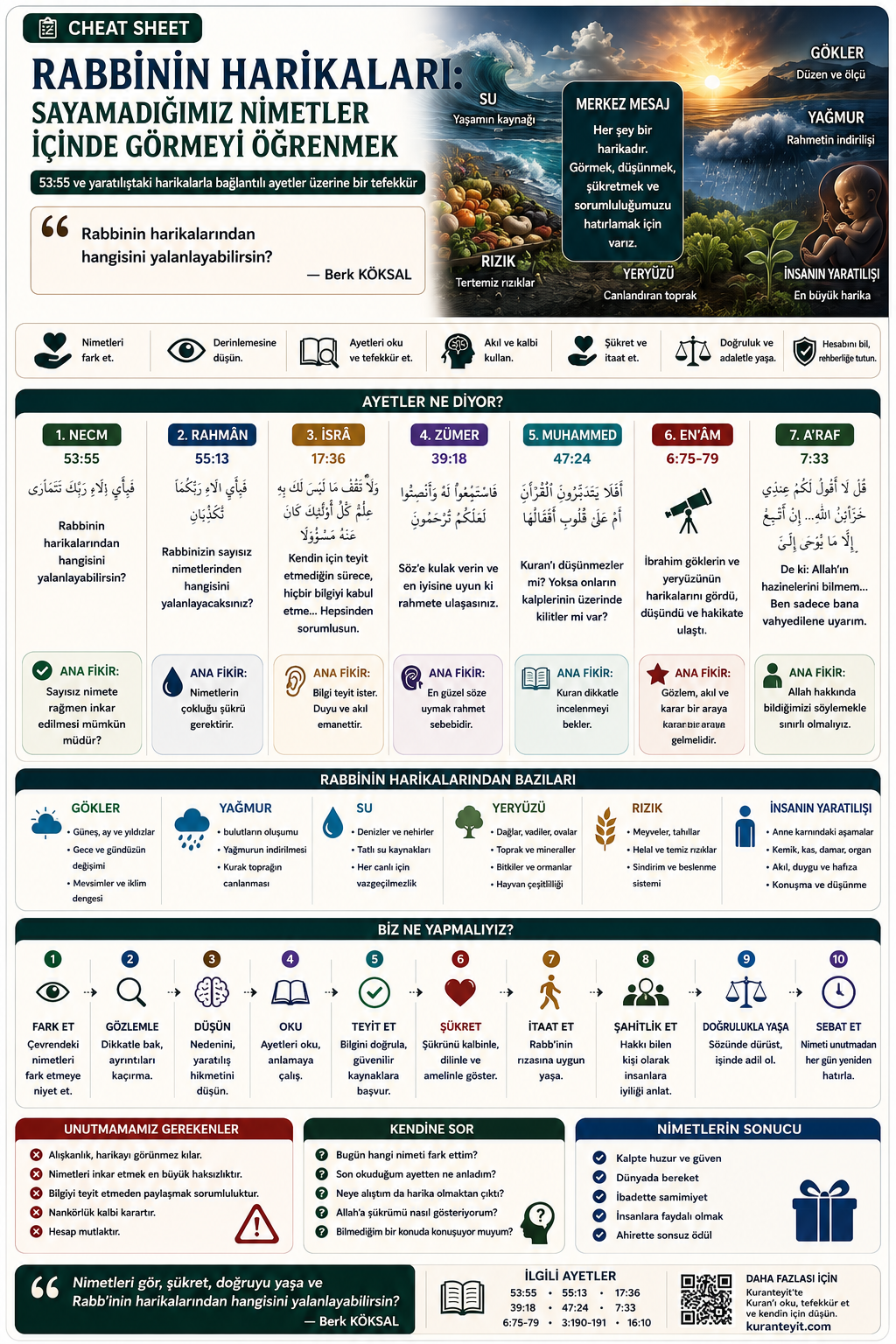
11. The Human Being Is Also Within the Marvel
Verse
30:20 — Among His proofs is that He created you from dust, then you became reproducing humans.
30:21 — Among His proofs is that He created for you spouses from among yourselves so that you may find tranquility and contentment with one another, and He placed love and care in your hearts toward your spouses. In this there are sufficient proofs for people who think.
30:22 — Among His proofs are the creation of the heavens and the earth, and the diversity of your languages and colors. In these there are signs for the knowledgeable.
30:23 — Among His proofs are your sleeping during the night or day and your working in pursuit of His provisions. In this there are sufficient proofs for people who can hear.
30:24 — Among His proofs is that He shows you lightning as a source of both fear and hope, then He sends down water from the sky to revive dead land. In these there are sufficient proofs for people who understand.
30:25 — Among His proofs is that the heaven and the earth stand at His command. Finally, when He calls you out of the earth with a single call, you will immediately come out.
Reflection on the Verse
30:20-25 creates a very broad field, from human creation and tranquility between spouses to the diversity of languages and colors, sleep, work, lightning, and rain. While I search for the marvel far away, the verses bring me back to my own body and everyday life.
As a musician, I am especially struck by the diversity of languages and sounds. Even the way the same emotion gains a different rhythm and timbre in different languages is a richness in itself. When working with the human voice, I often focus on technical details; the verse also calls me to see the human diversity behind the sound as a sign.
The placing of sleep and seeking provision side by side also teaches me measure. I love to work and can spend long hours on a project. But the body is not an unlimited production machine. In Silent Remembrance, I reflected on the space that appears when sound withdraws; here, rest itself appears before me as a proof. If the human being is within the marvel, then the way one treats oneself should also be affected by this awareness.
Verse references: 30:20-25.
12. From Dead Soil to Orbits
Verse
36:33 — A sign for them is the dead land: we revive it and produce from it grains for their food.
36:34 — We grow in it gardens of date palms and vineyards, and cause springs to gush from it.
36:35 — This is to provide them with fruits and allow them to produce with their own hands whatever they need. Will they be appreciative?
36:36 — Glory be to the One who created all kinds of plants from the earth, themselves, and even creatures they do not know.
36:37 — Another sign for them is the night: we withdraw the daylight from it, whereupon they remain in darkness.
36:38 — The sun sets at a specific location according to the design of the Almighty, the Omniscient.
36:39 — We designed the moon to appear in phases until it becomes like an old curved sheath.
36:40 — The sun is never to catch up with the moon—night and day never deviate—each of them is floating in its own orbit.
Reflection on the Verse
36:33-40 moves from the revival of dead soil to grain, gardens, night, the sun, the moon, and orbits. In the middle of all this order, the question turns back to the human being: “Will they be appreciative?” The soil comes alive, the sun moves, but the responsibility to respond remains with me.
36:35 also keeps human labor visible. Human beings produce with their own hands; that is true. But the soil, body, mind, and order within which they can work are given to them; that is also true. Gratitude does not erase labor. It places the possibility and limits of labor in their proper place.
The movement of the sun, moon, night, and day within their own order reminds me of the thought in Mizan: Balance does not mean making everything the same; it means that each element preserves its place. Body, family, work, rest, worship, knowledge, and art carry different functions in my life. When I enlarge one until it covers the others, I can disturb my own orbit.
Verse references: 36:33-40.
13. Not to the Sun, but to the One Who Created It
Verse
41:37 — Among His proofs are the night and the day, the sun and the moon. Do not prostrate before the sun or the moon; prostrate before GOD who created them, if you truly worship Him alone.
41:38 — If they are too arrogant to do this, those at your Lord’s presence glorify Him night and day without ever tiring.
41:39 — Among His proofs is that you see the land still, then as soon as we shower it with water, it vibrates with life. Surely, the One who revived it can revive the dead. He is Omnipotent.
Reflection on the Verse
While 41:37 presents night, day, the sun, and the moon as proofs of GOD, it also sets a very clear boundary at the same time: prostrate not to the sign, but to the One who created it. Because a marvel is impressive, it can correct a person’s direction; for the same reason, it can also lead the person to attach themselves to the wrong place.
I may not prostrate to the sun today, but I can absolutize science, technology, money, art, a leader, a religious figure, or my own mind. Some of these can be useful and powerful. But the greatness of something created does not give it the right to occupy the place that belongs to GOD. The sensitivity to tawhid that I explored in The Weight of Testimony and How Can Tawhid Be Distorted by One Word? One GOD or “Highest of the High”? appears here in the direction itself.
41:39 connects the revival of dead land with resurrection. Rain thus becomes not only a sign of worldly benefit but of a greater truth. The purpose of the marvel is not to make itself sacred. It is to direct me to GOD without leaving me trapped within the marvel itself.
Verse references: 41:37-39.
14. A World Placed at Our Service and Responsibility
Verse
45:12 — GOD is the One who committed the sea to serve you, so that ships may roam it according to His laws. You thereby seek His provisions, that you may be appreciative.
45:13 — He committed everything in the heavens and the earth to serve you; all of it is from Him. These are proofs for people who reflect deeply.
Reflection on the Verse
45:12-13 states that the sea and what is in the heavens and the earth have been placed at human service; then, by saying “all of it is from Him,” it keeps the source clear. My ability to use something does not mean that I am its ultimate owner.
I feel this thought very concretely in technology. The fact that I can build a system does not mean I necessarily should build it. The fact that I can collect data does not justify collecting it. In Privacy in Religious Apps: Is User Data a Trust?, I questioned the difference between technical capability and moral authority. The world may have been placed at our service, but the power to use it does not remove accountability.
I cannot derive a detailed environmental or technology law from these verses. They do not directly state how much a particular tool should be used. Yet three measures stand clearly before me: knowing that the source is GOD, being appreciative, and reflecting deeply. A blessing gives me not only room to act but also an awareness of limits.
Verse references: 45:12-13.
15. Signs on Earth and Within Myself
Verse
51:20 — The earth is full of signs for those who attain certainty.
51:21 — And in yourselves; can you see?
67:3 — He created seven universes in layers. You do not see any imperfection in the creation of the Most Gracious. Keep looking; do you see any flaw?
67:4 — Look again and again; your eyes will come back dazed and defeated.
Reflection on the Verse
51:20-21 turns my gaze in two directions: toward the earth and toward myself. Examining signs in the outside world can be easier. Looking at myself also requires seeing my body, mind, desires, fears, changeability, and mortality.
I do not consciously make my own heart beat. I do not manage the order within my body while I sleep. I cannot stop aging or control every outcome in life. The signs within myself show me my helplessness as much as they show me the marvel. This is necessary not to diminish the self, but to know its proper place.
67:3-4 says, “look again and again.” When I mix, I do not trust a single listen; I listen again on different systems and the next day. Of course, I am not equating my flawed work with divine creation. The similarity that remains for me is the discipline of looking again. As in Is Comparing Quran Translations Doubt or Responsibility?, examining again is not always doubt; sometimes it is responsibility. When habit covers my eyes, I need to look again.
Verse references: 51:20-21, 67:3-4.
16. Proclaiming the Marvel and Bearing Accountability for the Blessing
Verse
55:1 — The Most Gracious.
55:2 — Teacher of the Quran.
55:3 — Creator of the human beings.
55:4 — He taught them how to distinguish.
55:5 — The sun and the moon are perfectly calculated.
55:6 — The stars and the trees prostrate.
55:7 — He constructed the sky and established the law.
55:8 — You shall not transgress the law.
55:9 — You shall establish justice; do not violate the law.
55:10 — He created the earth for all creatures.
55:11 — In it are fruits, and date palms with hanging fruits.*
55:12 — Also grains and spices.
55:13 — (O humans and jinn,) which of your Lord’s marvels can you deny?
93:11 — Proclaim the blessing your Lord has bestowed upon you.
102:8 — Then, on that day, you will be questioned about the blessings you enjoyed.
Reflection on the Verse
The sequence at the beginning of Sura 55 affects me: the Most Gracious, Teacher of the Quran, Creator of the human being, the One who taught discernment, calculated the sun and the moon, established the law and justice, and gave the earth and its food. Then the same question comes: “Which of your Lord’s marvels can you deny?”
This sequence takes blessing beyond material abundance. The teaching of the Quran, the ability to distinguish, and the communication of the measure of justice are blessings too. If money, health, or success increases while the ability to distinguish right from wrong grows weaker, abundance alone may not lead a person to a good place.
93:11 brings a responsibility to proclaim the blessing. The measure I reached in Proclaim: Do Not Conceal the Truth, Tie the Word to GOD applies here as well: the purpose of proclamation is not to enlarge the self, but to make the source visible. Rather than saying only “look what I have,” I should be able to say, “I am not the owner of what has been given to me.”
102:8, meanwhile, reminds me of accountability for all this beauty. If I have the ability to work with sound, what did I use it for? If I have knowledge, time, money, or the ability to develop a platform, with what ethics did I manage it? Accountability for a blessing does not mean rejecting the blessing; it means using it with gratitude, justice, and responsibility.
Verse references: 55:1-13, 93:11, 102:8.
17. On the Arabic Roots of the Words
Verse
53:55 — Which of your Lord’s marvels can you deny?
6:75 — We showed Abraham the marvels of the heavens and the earth, and blessed him with certainty:
16:18 — If you count GOD’s blessings, you cannot encompass them. GOD is Forgiver, Most Merciful.
55:13 — (O humans and jinn,) which of your Lord’s marvels can you deny?
Reflection on the Verse
In Is Comparing Quran Translations Doubt or Responsibility?, I stated that I see root information as a useful research tool, but I do not regard it as an authority that determines the entire meaning of a verse on its own. I preserve the same boundary here. The root of a word, its form in the sentence, and the whole of the verse should be considered together.
The word آلاء / ءَالَاءِ (ālāʾ), translated as “marvels” in 53:55 and 55:13, is associated with the semantic field of blessings, favors, and divine gifts. The rendering “marvels” in the authorized English text and “harikalar” in the Turkish text emphasizes not only benefit but also wonder and reflection. The root ر-ب-ب (Ra-Ba-Ba) in the word رَبّ (Rabb) carries fields of ownership, nurturing, and governance; the fact that the marvels belong to “your Lord” removes them from being an independent spectacle.
The verb تَتَمَارَىٰ (tatamārā) in 53:55 opens through the root م-ر-ي (Mim-Ra-Ya) into the fields of doubt, argument, and dispute. نِعْمَة (ni‘mah) in 16:18 carries, through the root ن-ع-م (Nun-Ayn-Mim), the semantic field of goodness, favor, and blessing. خَلَقَ (khalaqa) in the creation verses, through the root خ-ل-ق (Kha-Lam-Qaf), points to creating and forming; the expression for reflection in 3:191, through the root ف-ك-ر (Fa-Kaf-Ra), points to examining; and ش-ك-ر (Shin-Kaf-Ra) in the field of gratitude recalls recognizing a blessing and responding to it through one’s conduct.
The roots do not give me a new ruling; they help me hear more carefully the path already visible in the verses: see the marvel, connect it to your Lord, recognize it as a blessing, reflect on it, and live with gratitude.
Verse references: 53:55, 6:75, 16:18, 55:13; also 3:191 for reflection and 16:17 for the comparison concerning creation.
18. Other Claims
Verse
53:55 — Which of your Lord’s marvels can you deny?
55:13 — (O humans and jinn,) which of your Lord’s marvels can you deny?
16:18 — If you count GOD’s blessings, you cannot encompass them. GOD is Forgiver, Most Merciful.
Reflection on the Verse
The expression “your Lord’s marvels” may be rendered in different translation traditions as “blessings,” “favors,” or similar terms. In this article, I take as my basis “marvels” in Rashad Khalifa’s authorized English text and “harikalar” in the provided Turkish text. I do not turn other renderings into a measure that changes the central thought.
There are also readings that match verses about creation one-to-one with modern scientific discoveries as “scientific miracles.” Such an approach may arouse curiosity in some people, but my reflection does not depend on it. The verses already present the heavens, the earth, water, the human being, and order openly as signs. The call remains powerful without matching each one to a specific contemporary theory.
There can be different approaches claiming that blessing consists only of material abundance or only of spiritual states. The verses considered here keep the field broader: alongside water and food, knowledge, discernment, love, sleep, and the order in creation are also included in the reflection.
The statement that “everything has been placed at human service” can likewise be interpreted in different ways, with emphasis either on broad permission to use or on responsibility. What the verses state openly is that the means come from GOD and direct us toward appreciation and deep reflection. I do not present detailed environmental, economic, or technological models beyond this as definitive rulings of the verses.
Verse references: 53:55, 55:13, 16:18.
19. Conclusion
Verse
53:55 — Which of your Lord’s marvels can you deny?
16:53 — Every blessing you enjoy is from GOD. Yet whenever any hardship befalls you, you immediately implore Him.
93:11 — Proclaim the blessing your Lord has bestowed upon you.
102:8 — Then, on that day, you will be questioned about the blessings you enjoyed.
Reflection on the Verse
When I return to 53:55, I no longer hear the question only while looking at the sky. When I drink a glass of water, fall asleep, hear a sound, have someone I love beside me, am able to work, or notice a mistake and correct it, the same question confronts me: “Which of your Lord’s marvels can you deny?”
This article brought together at the same center thoughts I had approached from different directions in my earlier work. Mizan made me think that order stands through each element preserving its proper place; The Weight of Testimony that a truth seen must be confirmed through life; and Silent Remembrance that remembrance should continue within when the outer sound withdraws. Here, all of them come together in the responsibility to see blessing and connect it to its source.
Seeing the marvel is not enough. I must not put the created in the place of GOD, must not regard a blessing as the absolute result of my own success, must not forget the source when ease arrives, and must use what has been given within measure. Gratitude, for me, is no longer merely a feeling of thanks; it means knowing the source correctly, not using a blessing to crush someone else, and remembering that I bear accountability for it.
93:11 calls for proclaiming the blessing, but this proclamation should not become an advertisement for the self. 102:8 cuts through all romanticism by stating that we will be questioned about blessings. Sound, knowledge, time, money, health, or the ability to develop a platform… Whatever I have been given carries not only enjoyment, but responsibility.
So the central question I leave for myself is this: Do the things given to me bring me closer to the Giver, or do I become lost among the things given? Water, sky, love, art, knowledge, and technology can all be beautiful in their proper places. But none of them should take the place of my Lord. The truest direction of the marvels should be the one that does not leave me trapped within the marvels.
I cannot encompass, count, or understand all blessings. Yet I can try not to make ordinary what I do see, not to credit success only to myself, not to forget GOD when hardship passes, and to remember that I bear accountability for what has been given to me. Perhaps gratitude begins precisely here.
Verse references: 53:55, 6:75-79, 3:190-191, 16:17, 16:53, 35:3, 41:37, 55:1-13, 93:11, 102:8.
Arabic Roots — Quick Note
- آلاء (Alif-Lam-Alif-Hamza) / ālāʾ: The field of marvels, blessings, and divine gifts.
- ر-ب-ب (Ra-Ba-Ba) / Rabb: Ownership, nurturing, governance, lordship.
- م-ر-ي (Mim-Ra-Ya) / tatamārā: The field of doubt, argument, and dispute.
- ن-ع-م (Nun-Ayn-Mim) / ni‘mah: Blessing, goodness, ease, favor.
- خ-ل-ق (Kha-Lam-Qaf) / khalaqa: To create, to form.
- ف-ك-ر (Fa-Kaf-Ra): To think, to turn the mind over something.
- ش-ك-ر (Shin-Kaf-Ra): To recognize a blessing and respond to it, to be grateful.
Function of the roots: Not to produce a new ruling, but to help understand more carefully the relationship already visible in the verse.
Note
2:32 — They said, “Be You glorified. We have no knowledge except what You have taught us. You are the Omniscient, Most Wise.”
GOD knows best.
Source: kuranteyit.com
Discover
Related Articles
Quran Reflections
Gratitude: Are We Truly Grateful, or Are We Deceiving Ourselves?
A deep reflection centered on Al-Baqarah 2:152, on remembering, gratitude, ingratitude, accountability for blessings, righteousness, monotheism, knowledge, justice, submission, and testing one's own claim of gratitude before the verses.
Read article
Quran Reflections
What Did the Stones Do? A Reflection on Hell, the Dissolution of Mountains, the Development of the Self, and the Petrified Mind
A deep reflection centered on Al-Baqarah 2:24 about people and stones as the fuel of Hell; the crumbling of the mountain in the story of Moses, GOD's physical presence, the transformation of the earth, the development of the self, those who remain immobile, petrified minds, idols, and responsibility.
Read article
Quran Reflections
True Wealth According to the Quran: Material Wealth or Not Being Rich?
A 19-part reflection centered on Al-Baqarah 2:247, exploring wealth, material possessions, poverty, provision, justice, charity, Qarun, trade, temporary worldly blessings, closeness to GOD, and true gain.
Read article