Silent Remembrance: Does Remembrance Continue When the Sound Ends?
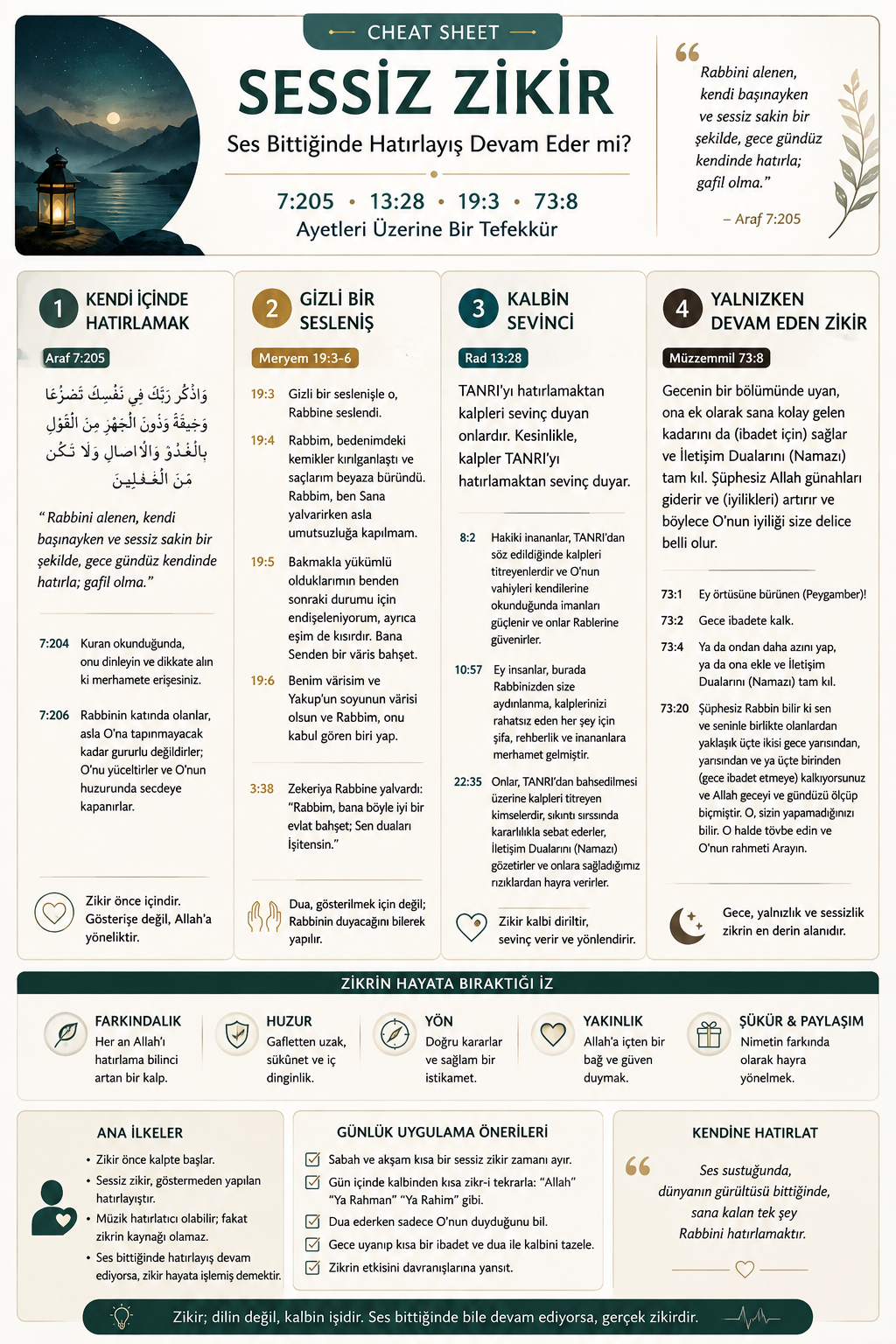
A reflection on silent remembrance, the remembrance of the heart, prayer, closeness, heedlessness, showing off, and the trace remembrance leaves on life, through verses 7:205, 13:28, 19:3, and 73:8.

A Reflection on Verses 7:205, 13:28, 19:3, and 73:8
Author: Berk KÖKSAL
Date: 30.07.2026
Location: Mersin
Verse
1:1 — In the name of GOD, Most Gracious, Most Merciful.*
Introduction
Peace. Peace be upon you.
Sound reaches deeply into a person very quickly. A melody can sometimes open a place that a long explanation cannot. When a word joins with rhythm, it remains in memory; when a name is repeated, it can change the direction of the heart. But sound has another quality as well: it begins and it ends.
As a musician, I know the power of sound. In a work, I can change the atmosphere experienced by the listener by using space, echo, breath, rhythm, and silence. Yet no technique, melody, or arrangement can remember GOD in the human heart on my behalf. I can point toward a door; I cannot decide who will pass through that door or with what intention.
While reflecting on “Music and Remembrance,” I had questioned whether sound could serve remembrance. Now the question turns further inward: What remains when the sound disappears? When the music stops, the gathering disperses, the headphones come off, and a person is left alone, does remembrance continue?
For me, this article centers on a cautious thought: Music may help remembrance, but it cannot be the source of remembrance. Sound may awaken the heart, but it cannot assume the responsibility of keeping it awake. If GOD is remembered only while music is playing, what is being experienced may remain more of a spiritual atmosphere than remembrance itself.
Summary:
1. Remembering Within Yourself
7:205
وَٱذْكُر رَّبَّكَ فِى نَفْسِكَ تَضَرُّعًا وَخِيفَةً وَدُونَ ٱلْجَهْرِ مِنَ ٱلْقَوْلِ بِٱلْغُدُوِّ وَٱلْـَٔاصَالِ وَلَا تَكُن مِّنَ ٱلْغَٰفِلِينَ
You shall remember your Lord within yourself, publicly, privately, and quietly, day and night; do not be unaware.
Remember your Lord within yourself, publicly, when you are alone, and quietly, day and night; do not be heedless.*
7:204 — When the Quran is recited, listen to it and take heed, that you may attain mercy.
7:206 — Those at your Lord’s presence are never too proud to worship Him; they glorify Him and fall prostrate before Him.
2. A Private Call: Prayer Opening in Silence
19:3 — He called upon his Lord with a private call.
19:4 — He said, “My Lord, the bones in my body have become frail and my hair has turned white. My Lord, I have never despaired when I call upon You.
19:5 — “I am concerned about those under my care after me, and my wife is barren. Grant me from You an heir.
19:6 — “Let him be my heir and the heir of Jacob’s family, and my Lord, make him acceptable.”
3:38 — At that moment Zachariah called upon his Lord: “My Lord, grant me such a good child; You are the Hearer of prayers.”
3. The Joy of the Heart: Is Remembrance a Single Emotion?
13:28 — They are the ones whose hearts rejoice in remembering GOD. Certainly, hearts rejoice in remembering GOD.
8:2 — The true believers are those whose hearts tremble when GOD is mentioned, whose faith is strengthened when His revelations are recited to them, and who trust in their Lord.
10:57 — O people, enlightenment has come to you from your Lord, along with healing for everything that troubles your hearts, guidance, and mercy for the believers.
22:35 — They are those whose hearts tremble when GOD is mentioned, who steadfastly persevere during hardship, observe the Contact Prayers (Salat), and give to charity from what We have provided them.
4. From Mentioning the Name to Nearness
73:8 — Mention the name of your Lord in order to draw nearer and nearer to Him.
73:7 — You have plenty of time during the day for other matters.
73:9 — Lord of the east and the west; there is no god except Him. You shall choose Him as your Advocate.
74:7 — Steadfastly remember your Lord.
5. Day and Night: The Continuity of Remembrance
3:41 — He said, “My Lord, give me a sign.” He said, “Your sign is that you will not speak to people for three days except through gestures. Remember your Lord frequently, and reflect night and day.”
3:191 — They remember GOD* while standing, sitting, and lying on their sides, and they reflect deeply on the creation of the heavens and the earth: “Our Lord, You did not create all this in vain. Glory be to You. Protect us from the agony of Hell.
4:103 — Once you complete your Contact Prayer (Salat), remember GOD while standing, sitting, or lying down.* Once the war is over, observe the Contact Prayers (Salat); the Contact Prayers (Salat) are decreed for the believers at specific times.
76:25 — And mention the name of your Lord day and night.
6. Publicly and Privately: Two Forms of Turning, One Center
7:55 — Worship your Lord publicly and when you are alone; He does not love the transgressors.
6:63 — Say, “Who can save you from the darkness of the land or the sea?” You implore Him loudly and secretly: “If He saves us this time, we will be eternally grateful.”
2:274 — Those who give to charity secretly and publicly, night and day, will receive their reward from their Lord; they will have nothing to fear, nor will they grieve.
13:22 — They steadfastly persevere in seeking their Lord, observe the Contact Prayers (Salat), spend secretly and publicly from what We have provided them, and respond to evil with good. They have deserved the best abode.
7. Does Silence End Showing Off?
4:142 — The hypocrites think they are deceiving GOD, but He is the One who leads them on. When they get up for the Contact Prayers (Salat), they get up lazily. This is because they only show off before the people and rarely think of GOD.
2:271 — If you declare your charities, they are still good. But if you keep them anonymous and give them to the poor, this is even better for you and covers more of your sins. GOD is fully Aware of everything you do.
21:49 — They are those who deeply revere their Lord even when alone in their privacy and who are concerned about the Hour.
67:12 — As for those who deeply revere their Lord when alone in their privacy, they have attained forgiveness and a great reward.
8. What Remains When the Sound Ends
7:205 — Remember your Lord within yourself, publicly, when you are alone, and quietly, day and night; do not be heedless.*
13:28 — They are the ones whose hearts rejoice in remembering GOD. Certainly, hearts rejoice in remembering GOD.
73:8 — Mention the name of your Lord in order to draw nearer and nearer to Him.
18:28 — Force yourself to remain with those who worship their Lord night and day, seeking Him alone. Do not turn your eyes away from them in pursuit of the showiness of this world. Do not obey the one whose heart We have made heedless of Our message, who follows his own desires and whose priorities are confused.
9. If Remembrance Does Not Turn into Life
20:14 — “I am GOD; there is no other god beside Me. You shall worship Me alone and observe the Contact Prayers (Salat) to remember Me.
5:91 — The devil wants to provoke animosity and hatred among you through intoxicants and gambling and to distract you from remembering GOD and from observing the Contact Prayers (Salat). Will you then refrain?
13:22 — They steadfastly persevere in seeking their Lord, observe the Contact Prayers (Salat), spend secretly and publicly from what We have provided them, and respond to evil with good. They have deserved the best abode.
2:152 — Remember Me so that I may remember you, and be grateful to Me; do not be ungrateful.
10. Remembering from Within Forgetfulness
18:23 — Do not say that you will do anything in the future,
18:24 — without saying, “If GOD wills.”* If you forget to do this, you shall immediately remember your Lord and say, “May my Lord guide me to do better next time.”
8:45 — O you who believe, when you encounter an army, stand firm and remember GOD frequently so that you may succeed.
38:41 — Remember Our servant Job, when he called upon his Lord: “The devil has afflicted me with hardship and pain.”
68:48 — Steadfastly persevere in carrying out your Lord’s commands. Do not be like the one who called from inside the fish (Jonah).
11. The Name of the Lord and the Boundary of Monotheism
7:180 — To GOD belong the most beautiful names; call upon Him by them, and disregard those who distort His names. They will be requited for their sins.
72:18 — The places of worship belong to GOD; do not call upon anyone beside GOD.
73:9 — Lord of the east and the west; there is no god except Him. You shall choose Him as your Advocate.
87:1 — Glorify the name of your Most High Lord.
12. Remembering GOD Even Without an Audience
35:18 — No soul can carry another soul’s sins. If a soul burdened with sins begs another to carry part of its burden, no other soul can carry any part of it, even if they are relatives. The only people who heed your warnings are those who deeply revere their Lord even when alone in their privacy and observe the Contact Prayers (Salat). Whoever purifies his soul does so for his own good. The final destination is to GOD.
36:11 — You will be heeded only by those who follow this message and deeply revere the Most Gracious—even when they are alone in their privacy. Give them good news of forgiveness and a generous reward.
50:33 — They deeply revered the Most Gracious in their privacy and came wholeheartedly.
67:12 — As for those who deeply revere their Lord when alone in their privacy, they have attained forgiveness and a great reward.
13. On the Arabic Roots of the Words
7:205 — Remember your Lord within yourself, publicly, when you are alone, and quietly, day and night; do not be heedless.*
Other Claims
7:205 — Remember your Lord within yourself, publicly, when you are alone, and quietly, day and night; do not be heedless.*
19:3 — He called upon his Lord with a private call.
13:28 — They are the ones whose hearts rejoice in remembering GOD. Certainly, hearts rejoice in remembering GOD.
73:8 — Mention the name of your Lord in order to draw nearer and nearer to Him.
Conclusion
7:205 — Remember your Lord within yourself, publicly, when you are alone, and quietly, day and night; do not be heedless.*
13:28 — They are the ones whose hearts rejoice in remembering GOD. Certainly, hearts rejoice in remembering GOD.
19:3 — He called upon his Lord with a private call.
73:8 — Mention the name of your Lord in order to draw nearer and nearer to Him.
13:22 — They steadfastly persevere in seeking their Lord, observe the Contact Prayers (Salat), spend secretly and publicly from what We have provided them, and respond to evil with good. They have deserved the best abode.

1. Remembering Within Yourself
Verse
7:205
وَٱذْكُر رَّبَّكَ فِى نَفْسِكَ تَضَرُّعًا وَخِيفَةً وَدُونَ ٱلْجَهْرِ مِنَ ٱلْقَوْلِ بِٱلْغُدُوِّ وَٱلْـَٔاصَالِ وَلَا تَكُن مِّنَ ٱلْغَٰفِلِينَ
You shall remember your Lord within yourself, publicly, privately, and quietly, day and night; do not be unaware.
Remember your Lord within yourself, publicly, when you are alone, and quietly, day and night; do not be heedless.*
Source: kuranteyit.com 7:204 — When the Quran is recited, listen to it and take heed, that you may attain mercy. 7:206 — Those at your Lord’s presence are never too proud to worship Him; they glorify Him and fall prostrate before Him.
Reflection on the Verse
Verse 7:205 does not confine remembrance to a single outward form. Within the verse, public expression, being alone, quietness, night, and day all appear together. Alongside these, a very specific place is indicated: “Remember within yourself.” Remembrance is not merely a word heard from the outside; it is turning one’s inner direction toward the Lord.
This connection is important to me. If remembrance is to continue when the sound ends, what remains should not be merely the trace of an emotion, but a word that has been taken seriously and a direction that has surrendered. If, after the music stops, I behave as though the Quran’s call has also fallen silent, I may have confused the effect of sound with remembrance itself.
Verse 7:205 makes me think of silence not as a sacred technique, but as a space opened to protect oneself from heedlessness. When a person remembers his Lord within himself, he does not need applause, approval, or an external stimulus. Yet the verse does not exclude public turning either. The value of remembrance is understood not from the volume of the sound, but from its direction toward the Lord.
2. A Private Call: Prayer Opening in Silence
Verse
19:3 — He called upon his Lord with a private call.
19:4 — He said, “My Lord, the bones in my body have become frail and my hair has turned white. My Lord, I have never despaired when I call upon You.
19:5 — “I am concerned about those under my care after me, and my wife is barren. Grant me from You an heir.
19:6 — “Let him be my heir and the heir of Jacob’s family, and my Lord, make him acceptable.” 3:38 — At that moment Zachariah called upon his Lord: “My Lord, grant me such a good child; You are the Hearer of prayers.”
Reflection on the Verse
In 19:3, silence does not appear as absence. Zachariah calls upon his Lord “with a private call.” This expression shows that silent remembrance is broader than wordlessness. There is sound, but there is no display. There is prayer, but what makes it valuable is not that others hear it.
One of the statements that affects me most within this prayer is: “I have never despaired when I call upon You.” Silent remembrance is not a practice only for peaceful times. It is also the name of turning toward GOD when the body weakens, when no solution is visible, and when a person reaches the limits of his own means.
When creating a musical work, I can use many tools to intensify emotion. Zachariah’s private call reminds me of this: The value of turning toward GOD does not come from the magnitude of the production. Sometimes a person’s most genuine prayer is quiet enough to be known only by himself and his Lord.
3. The Joy of the Heart: Is Remembrance a Single Emotion?
Verse
13:28 — They are the ones whose hearts rejoice in remembering GOD. Certainly, hearts rejoice in remembering GOD. 8:2 — The true believers are those whose hearts tremble when GOD is mentioned, whose faith is strengthened when His revelations are recited to them, and who trust in their Lord. 10:57 — O people, enlightenment has come to you from your Lord, along with healing for everything that troubles your hearts, guidance, and mercy for the believers. 22:35 — They are those whose hearts tremble when GOD is mentioned, who steadfastly persevere during hardship, observe the Contact Prayers (Salat), and give to charity from what We have provided them.
Reflection on the Verse
Verse 13:28 connects the joy of the heart with remembering GOD. This joy may be one of the most beautiful fruits of remembrance. Yet when viewed together with the other verses, it becomes clear that the heart’s state before GOD is not limited to a single emotion. The heart rejoices, trembles, grows stronger, finds healing, and learns to trust.
Music can produce powerful emotions. A chord change, a choir, or a long silence can make a person shiver. But shivering by itself is not faith; feeling calm by itself is not remembrance. The heart shown by the verses is not merely a heart that feels, but one that trusts, perseveres, observes the Contact Prayers, and gives from what it has been given.
This distinction requires me to be honest about my own work. It may be valuable for a piece to create an intense spiritual atmosphere in the listener, but I should not confuse the source of that atmosphere with its result. The heart’s true joy comes not from the melody, but from the GOD being remembered. If GOD is forgotten when the melody ends, the heart may not have moved beyond the instrument.
4. From Mentioning the Name to Nearness
Verse
73:8 — Mention the name of your Lord in order to draw nearer and nearer to Him. 73:7 — You have plenty of time during the day for other matters. 73:9 — Lord of the east and the west; there is no god except Him. You shall choose Him as your Advocate. 74:7 — Steadfastly remember your Lord.
Reflection on the Verse
Verse 73:8 clearly states the purpose of remembrance: mentioning the name of the Lord is for drawing nearer and nearer to Him. Seen this way, remembrance is not merely the repetition of a word or the spiritual intensity of a particular moment. It is the direction of a person increasingly turning toward GOD.
A person may mention the name of the Lord and then place all his trust in people, institutions, money, or his own ability. If the tongue says GOD while the heart searches for other advocates, the language of nearness has not yet settled into life. Remembrance does not prevent a person from using visible means, but it should prevent him from putting those means in the place of GOD.
A piece of music may remind me of the name of GOD. But the measure of the verse is not how many times I listen to the piece; it is whom this remembrance brings me closer to. If dependence on the music, the artist, or spiritual pleasure increases while submission to GOD does not, the means may have moved ahead of the direction.
5. Day and Night: The Continuity of Remembrance
Verse
3:41 — He said, “My Lord, give me a sign.” He said, “Your sign is that you will not speak to people for three days except through gestures. Remember your Lord frequently, and reflect night and day.” 3:191 — They remember GOD* while standing, sitting, and lying on their sides, and they reflect deeply on the creation of the heavens and the earth: “Our Lord, You did not create all this in vain. Glory be to You. Protect us from the agony of Hell. 4:103 — Once you complete your Contact Prayer (Salat), remember GOD while standing, sitting, or lying down.* Once the war is over, observe the Contact Prayers (Salat); the Contact Prayers (Salat) are decreed for the believers at specific times. 76:25 — And mention the name of your Lord day and night.
Reflection on the Verse
In these verses, remembrance is not confined to a particular place, bodily posture, or brief part of the day. Remembering GOD while standing, sitting, lying down, by night and by day is described. Remembrance continues even after the Contact Prayer has been completed.
This continuity makes silent remembrance easier to understand. A person cannot speak aloud at every moment. While working, walking, caring for someone, or resting, the tongue may be silent. Yet the direction of the heart, gratitude, and the awareness of living in the presence of GOD can continue.
Vocal remembrance begins and ends at a particular time. Silent remembrance may be the trace that time leaves upon the rest of life. True continuity is not that sound never stops, but that when direction is lost, one turns again toward GOD.
6. Publicly and Privately: Two Forms of Turning, One Center
Verse
7:55 — Worship your Lord publicly and when you are alone; He does not love the transgressors. 6:63 — Say, “Who can save you from the darkness of the land or the sea?” You implore Him loudly and secretly: “If He saves us this time, we will be eternally grateful.” 2:274 — Those who give to charity secretly and publicly, night and day, will receive their reward from their Lord; they will have nothing to fear, nor will they grieve. 13:22 — They steadfastly persevere in seeking their Lord, observe the Contact Prayers (Salat), spend secretly and publicly from what We have provided them, and respond to evil with good. They have deserved the best abode.
Reflection on the Verse
The verses do not always set what is public and what is private against one another. Verse 7:55 speaks of turning to the Lord both publicly and when a person is alone. In 6:63, people call upon GOD both loudly and secretly in a moment of danger. Charity and goodness can likewise be done both privately and publicly.
This wholeness makes me think that silent remembrance should not become a new form of superiority established against the claim that vocal remembrance is superior. Likewise, collective and vocal turning does not automatically guarantee sincerity. Both forms gain meaning to the extent that they are directed toward the same center: GOD alone.
For me, the measure is this: When I do it publicly, am I displaying myself to people? When I am alone, do I truly remember GOD? Sound and silence cannot hide the answer to this question.
7. Does Silence End Showing Off?
Verse
4:142 — The hypocrites think they are deceiving GOD, but He is the One who leads them on. When they get up for the Contact Prayers (Salat), they get up lazily. This is because they only show off before the people and rarely think of GOD. 2:271 — If you declare your charities, they are still good. But if you keep them anonymous and give them to the poor, this is even better for you and covers more of your sins. GOD is fully Aware of everything you do. 21:49 — They are those who deeply revere their Lord even when alone in their privacy and who are concerned about the Hour. 67:12 — As for those who deeply revere their Lord when alone in their privacy, they have attained forgiveness and a great reward.
Reflection on the Verse
Verse 4:142 makes the central problem of showing off visible: an outward act performed before people combined with rarely thinking of GOD. The form remains, but the inner direction is lost. A person rises for the Contact Prayer, yet still sees people as the true audience.
Still, silence does not automatically end showing off. A person can also turn silence into an identity of superiority. He may look down on others by saying, “My remembrance is more inward, deeper, purer.” Even without making a display before others, he may construct a spiritual image before his own ego.
When the audience, the gathering, and the applause disappear, the reverence that remains may be a more reliable sign. Yet I should use this not to judge others, but to test my own intention. Silence is not a tool for measuring another person’s sincerity; it is a space in which I can see whom my own heart is seeking.
8. What Remains When the Sound Ends
Verse
7:205 — Remember your Lord within yourself, publicly, when you are alone, and quietly, day and night; do not be heedless.* 13:28 — They are the ones whose hearts rejoice in remembering GOD. Certainly, hearts rejoice in remembering GOD. 73:8 — Mention the name of your Lord in order to draw nearer and nearer to Him. 18:28 — Force yourself to remain with those who worship their Lord night and day, seeking Him alone. Do not turn your eyes away from them in pursuit of the showiness of this world. Do not obey the one whose heart We have made heedless of Our message, who follows his own desires and whose priorities are confused.
Reflection on the Verse
When I work on a musical piece, I think about what kind of space the sound will open in the listener. Which instrument enters when, how much reverberation is used, where the sound rises, and where it withdraws all affect emotion. All of these are part of production. But the real test of remembrance begins where production has no control.
When the piece ends, I am no longer beside the listener. The sound is no longer carrying him. At exactly that moment, the call of 7:205 to “remember within yourself” becomes clearer. Music may gather attention for a while, but another person cannot turn toward GOD within someone else on his behalf.
While creating a work such as Zikr-i Batın, centered on silent and inward remembrance, I need to ask myself this question: Am I using silence only as an aesthetic atmosphere, or am I making room for the name of GOD to be remembered more clearly as sound withdraws? The fact that silence sounds beautiful does not automatically make it remembrance.
9. If Remembrance Does Not Turn into Life
Verse
20:14 — “I am GOD; there is no other god beside Me. You shall worship Me alone and observe the Contact Prayers (Salat) to remember Me. 5:91 — The devil wants to provoke animosity and hatred among you through intoxicants and gambling and to distract you from remembering GOD and from observing the Contact Prayers (Salat). Will you then refrain? 13:22 — They steadfastly persevere in seeking their Lord, observe the Contact Prayers (Salat), spend secretly and publicly from what We have provided them, and respond to evil with good. They have deserved the best abode. 2:152 — Remember Me so that I may remember you, and be grateful to Me; do not be ungrateful.
Reflection on the Verse
Verse 20:14 places remembering GOD alongside the Contact Prayers. Verse 5:91 draws attention to what can distract a person from both. Remembrance here is not a feeling that replaces responsibility; it is an awareness preserved through regular worship.
If I say that I remember GOD while constantly behaving ungratefully, answering evil with greater evil, and refusing to share from what I have been given, my remembrance may not have taken sufficient root in my life. The verses do not give me the authority to judge someone else’s remembrance; they give me the responsibility to compare my own claim with my behavior.
Music may give a person peace for a time. But when remembrance is used only to feel peaceful, it can begin serving the ego. The direction of the verses is broader: the one who remembers GOD is called toward gratitude, perseverance, worship, and goodness.
10. Remembering from Within Forgetfulness
Verse
18:23 — Do not say that you will do anything in the future,
18:24 — without saying, “If GOD wills.”* If you forget to do this, you shall immediately remember your Lord and say, “May my Lord guide me to do better next time.” 8:45 — O you who believe, when you encounter an army, stand firm and remember GOD frequently so that you may succeed. 38:41 — Remember Our servant Job, when he called upon his Lord: “The devil has afflicted me with hardship and pain.” 68:48 — Steadfastly persevere in carrying out your Lord’s commands. Do not be like the one who called from inside the fish (Jonah).
Reflection on the Verse
Verse 18:24 teaches remembrance after forgetfulness. This is a measure that gives me hope regarding remembrance. A person may not remain at the same level of attention at every moment. He may fall into heedlessness, bind his plans to his own will, and forget the guidance of his Lord. But the moment he realizes that he has forgotten, the way back remains open.
Verse 8:45 carries remembrance into moments of conflict and danger. Job calls upon his Lord in hardship and pain. Jonah’s call is also remembered from within distress. These connections show that remembrance does not belong only to quiet rooms and peaceful music.
At some moments, remembering GOD gives a person endurance before it gives peace. The problem may not be solved immediately, but the person perseveres without losing direction. Silence here is not a relaxing emptiness, but an inner space in which one turns toward the Lord amid fear and pain.
11. The Name of the Lord and the Boundary of Monotheism
Verse
7:180 — To GOD belong the most beautiful names; call upon Him by them, and disregard those who distort His names. They will be requited for their sins. 72:18 — The places of worship belong to GOD; do not call upon anyone beside GOD. 73:9 — Lord of the east and the west; there is no god except Him. You shall choose Him as your Advocate. 87:1 — Glorify the name of your Most High Lord.
Reflection on the Verse
Mentioning the name of the Lord is not merely saying beautiful words. Verse 7:180 states that the most beautiful names belong to GOD. Verse 72:18 says that calling must be directed to Him alone. Verse 73:9 calls for choosing Him as Advocate, while 87:1 calls for glorifying the name of the Most High Lord.
Music requires particular care here. Sound can create a powerful bond with the person who produces it. While the listener is moved by the name of GOD, over time he may become attached to the person speaking that name. In such a case, knowingly or unknowingly, the artist may move in front of the direction he was pointing toward.
As an artist, my task is not to make myself the center of the call, but, if possible, to turn the direction toward GOD. My voice changes, ages, and becomes silent. An album is released, listened to, and may be forgotten. Only the Lord is Most High.
12. Remembering GOD Even Without an Audience
Verse
35:18 — No soul can carry another soul’s sins. If a soul burdened with sins begs another to carry part of its burden, no other soul can carry any part of it, even if they are relatives. The only people who heed your warnings are those who deeply revere their Lord even when alone in their privacy and observe the Contact Prayers (Salat). Whoever purifies his soul does so for his own good. The final destination is to GOD. 36:11 — You will be heeded only by those who follow this message and deeply revere the Most Gracious—even when they are alone in their privacy. Give them good news of forgiveness and a generous reward. 50:33 — They deeply revered the Most Gracious in their privacy and came wholeheartedly. 67:12 — As for those who deeply revere their Lord when alone in their privacy, they have attained forgiveness and a great reward.
Reflection on the Verse
A powerful measure repeats across these verses: A person deeply reveres his Lord even when alone in privacy. Remembering GOD where no one sees, appreciates, or directs the person shows that the relationship is not dependent on a human audience.
Verse 35:18 also reminds us of personal responsibility. No one can carry the burden of another soul. A person may participate in the enthusiasm of a group, be moved by an artist’s work, or receive help from a teacher, but he cannot transfer responsibility for his own direction and behavior to someone else.
Remembering GOD even without an audience does not mean that art is worthless. On the contrary, it shows art its proper place. A work may accompany a person, but it cannot remember on his behalf. When the sound falls silent, the Lord is still there. The real question is whether the heart is still turned toward Him.
13. On the Arabic Roots of the Words
Verse
7:205 — Remember your Lord within yourself, publicly, when you are alone, and quietly, day and night; do not be heedless.*
Reflection on the Verse
Roots can open the directions carried by the words remembrance and heedlessness, but they cannot by themselves resolve the living context of the verse.
The word تَضَرُّعًا (tadarru’an) is associated with the root ض-ر-ع (Dad-Ra-Ayn). It suggests imploring with humility and turning while recognizing one’s own weakness. Silence here is not a cold distance; it is the servant knowing his own limits.
When the words are considered together, 7:205 appears broader than a verse that merely teaches quiet speech. Being aware of the Lord, turning inwardly with humility, remaining measured, surrounding time with remembrance, and refusing to surrender to heedlessness all come together in the same call.
Other Claims
Verse
7:205 — Remember your Lord within yourself, publicly, when you are alone, and quietly, day and night; do not be heedless.* 19:3 — He called upon his Lord with a private call. 13:28 — They are the ones whose hearts rejoice in remembering GOD. Certainly, hearts rejoice in remembering GOD. 73:8 — Mention the name of your Lord in order to draw nearer and nearer to Him.
Reflection on the Verse
Different religious approaches have been proposed regarding silent and vocal remembrance. Some approaches consider quiet and inward remembrance safer; some argue that collective and vocal remembrance can unite people in a shared turning. Other approaches maintain that the heart and the tongue should be together.
Each of these views can be explained within its own concepts and traditions. But the clear expressions of the principal verses do not provide a definitive ruling that makes one single method obligatory for all people while invalidating the others. Verse 7:205 mentions public expression, a person turning while alone, and quietness together within the same verse. While 19:3 shows a private call, 6:63 places loud and secret supplication side by side.
Some people may equate silence directly with sincerity and sound with showing off. Verse 4:142 states that showing off is a real danger, but the cause of showing off is not sound itself; it is the intention to be seen by people. A silent practice can also produce arrogance, superiority, and attachment to a method.
Conclusion
Verse
7:205 — Remember your Lord within yourself, publicly, when you are alone, and quietly, day and night; do not be heedless.* 13:28 — They are the ones whose hearts rejoice in remembering GOD. Certainly, hearts rejoice in remembering GOD. 19:3 — He called upon his Lord with a private call. 73:8 — Mention the name of your Lord in order to draw nearer and nearer to Him. 13:22 — They steadfastly persevere in seeking their Lord, observe the Contact Prayers (Salat), spend secretly and publicly from what We have provided them, and respond to evil with good. They have deserved the best abode.
Reflection on the Verse
The cautious answer I can draw from the verses is this: Yes, it can continue; in fact, how deeply remembrance has entered a person often becomes clear when the sound withdraws. Verse 7:205 calls for remembering the Lord within oneself, when alone, and quietly; 19:3 shows a direct turning to the Lord through a private call; 13:28 connects the joy of the heart with remembering GOD; and 73:8 shows the purpose of this remembrance as drawing nearer and nearer to Him.
As a musician, I believe in the power of sound, but I do not want to make that power absolute. Music can touch the heart, but it is not the owner of the heart. A work can call a person to remember GOD, but it cannot remember on that person’s behalf. Once sound has completed its task, it should know how to withdraw.
While reflecting on Zikr-i Batın, this is the most honest measure I can set for myself: Does the sound I create help a person remember GOD even in silence? Does it bind the listener to me and the work, or does it invite an inward direction capable of carrying the name of the Lord even after the means disappears?
Note
2:32 — They said, “Glory be to You. We have no knowledge except what You have taught us. You are the All-Knowing, Most Wise.”
GOD knows best.
Source: kuranteyit.com
Discover
Related Articles

Quran Reflections
Whom Does the Microphone Glorify? ZIKR RAP, Words and Responsibility
A personal reflection on rap, remembrance, truthful speech, integrity between words and actions, defending one's rights, and the artist's responsibility toward the listener through Ash-Shu'ara 26:224-227, Al-Ahzab 33:70, and Al-Isra 17:53.
Read article
Quran Reflections
Can Artificial Intelligence Explain the Quran? An Information Tool and the Responsibility of Understanding
A reflection through verses Al-Isra 17:36, Az-Zumar 39:18, Muhammad 47:24, and Al-Araf 7:33 on artificial intelligence, access to information, verification, careful study of the Quran, testimony, guidance, moral responsibility, and the limits of religious authority.
Read article
Quran Reflections
Music and Remembrance
A reflection on glorifying the name of the Lord, remembrance, sound, art, tawhid, truthful speech, justice, and submission through Al-A'la 87:1.
Read article