Finding Is One Thing, Understanding Is Another: The Verse in the Age of Search Engines
A reflection through Muhammad 47:24, Sad 38:29, Az-Zumar 39:18, and Al-Isra 17:36 on the difference between accessing a verse and understanding it in the age of search engines; keywords, context, selective reading, approximate matching, translation differences, verification, and responsibility in action.
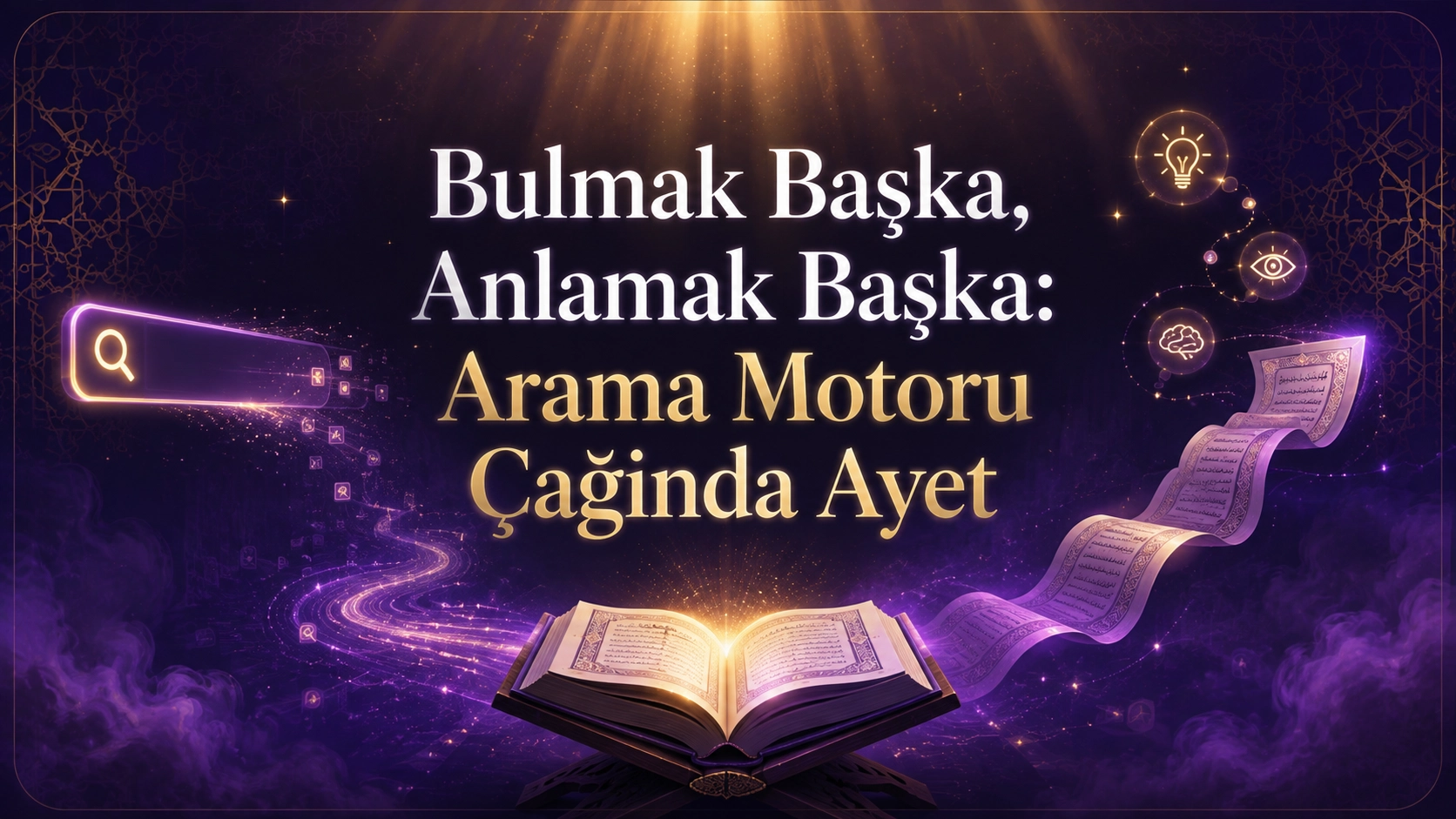
Finding Is One Thing, Understanding Is Another: The Verse in the Age of Search Engines
Author: Berk KÖKSAL
Date: 09.08.2026
Location: Mersin
Verse
1:1 — In the name of GOD, Most Gracious, Most Merciful.*
Greetings. Peace be upon you.
The main purpose of this article is to consider verses together with other related verses and to express, in a sincere and thoughtful way, what bearing witness to the oneness of GOD means in human life in terms of knowledge, justice, truthfulness, and submission.
Introduction
Today I can find a verse within seconds. I type a word, enter a sura or verse number, and with a few taps results appear before me. Technology opens the door to research quickly. But the fact that the door has opened does not mean that I have seen the entire room.
I feel this constantly while developing Kuranteyit. No matter how good the search system is, it cannot purify my intention; it cannot live the context of a verse in my place; it cannot determine what the sentence I found corresponds to in my life. A result may be visible on the screen, but meaning still requires effort, attention, and honesty.
There is a similar misconception in music. When I listen to a frequency in solo, I may hear it very clearly; but I understand its actual role in the piece only when I return to the whole. Finding a verse through a keyword can sometimes be like listening to that frequency in solo. It gives clarity, but not wholeness.
This article continues my earlier reflections on the relationship between tool and authority, translation comparison, artificial intelligence, and verification. The common question is the same: How can I honestly preserve the distance between accessing information and understanding it?
Summary:
1. Studying Carefully: First, the Locks in My Own Mind
47:24
أَفَلَا يَتَدَبَّرُونَ ٱلْقُرْءَانَ أَمْ عَلَىٰ قُلُوبٍ أَقْفَالُهَآ
Why do they not study the Quran carefully? Do they have locks on their minds?
Why do they not study the Quran carefully? Do they have locks on their minds?
2. The Distance Between Finding and Understanding
38:29 — This is a scripture that we sent down to you, that is sacred—perhaps they reflect deeply on its verses. Those who possess intelligence will take heed.
47:24 — Why do they not study the Quran carefully? Do they have locks on their minds?
3. A Keyword Is Not the Complete Map of Truth
38:29 — This is a scripture that we sent down to you, that is sacred—perhaps they reflect deeply on its verses. Those who possess intelligence will take heed.
17:36 — You shall not accept any information, unless you verify it for yourself. I have given you the hearing, the eyesight, and the brain, and you are responsible for using them.
4. Examining All Words, Then Following the Best
39:18 — They are the ones who examine all words, then follow the best. These are the ones whom GOD has guided; these are the ones who possess intelligence.
5. Verification: Seeing It on the Screen Is Not Enough
17:36 — You shall not accept any information, unless you verify it for yourself. I have given you the hearing, the eyesight, and the brain, and you are responsible for using them.
6. The Search-Engine Mind and Impatience
47:24 — Why do they not study the Quran carefully? Do they have locks on their minds?
38:29 — This is a scripture that we sent down to you, that is sacred—perhaps they reflect deeply on its verses. Those who possess intelligence will take heed.
7. Kuranteyit: A Tool That Does Not Think in Place of the Seeker
17:36 — You shall not accept any information, unless you verify it for yourself. I have given you the hearing, the eyesight, and the brain, and you are responsible for using them.
39:18 — They are the ones who examine all words, then follow the best. These are the ones whom GOD has guided; these are the ones who possess intelligence.
8. On the Arabic Roots of Words
47:24 — Why do they not study the Quran carefully? Do they have locks on their minds?
38:29 — This is a scripture that we sent down to you, that is sacred—perhaps they reflect deeply on its verses. Those who possess intelligence will take heed.
17:36 — You shall not accept any information, unless you verify it for yourself. I have given you the hearing, the eyesight, and the brain, and you are responsible for using them.
Other Claims
47:24 — Why do they not study the Quran carefully? Do they have locks on their minds?
38:29 — This is a scripture that we sent down to you, that is sacred—perhaps they reflect deeply on its verses. Those who possess intelligence will take heed.
39:18 — They are the ones who examine all words, then follow the best. These are the ones whom GOD has guided; these are the ones who possess intelligence.
Conclusion
47:24 — Why do they not study the Quran carefully? Do they have locks on their minds?
38:29 — This is a scripture that we sent down to you, that is sacred—perhaps they reflect deeply on its verses. Those who possess intelligence will take heed.
39:18 — They are the ones who examine all words, then follow the best. These are the ones whom GOD has guided; these are the ones who possess intelligence.
17:36 — You shall not accept any information, unless you verify it for yourself. I have given you the hearing, the eyesight, and the brain, and you are responsible for using them.
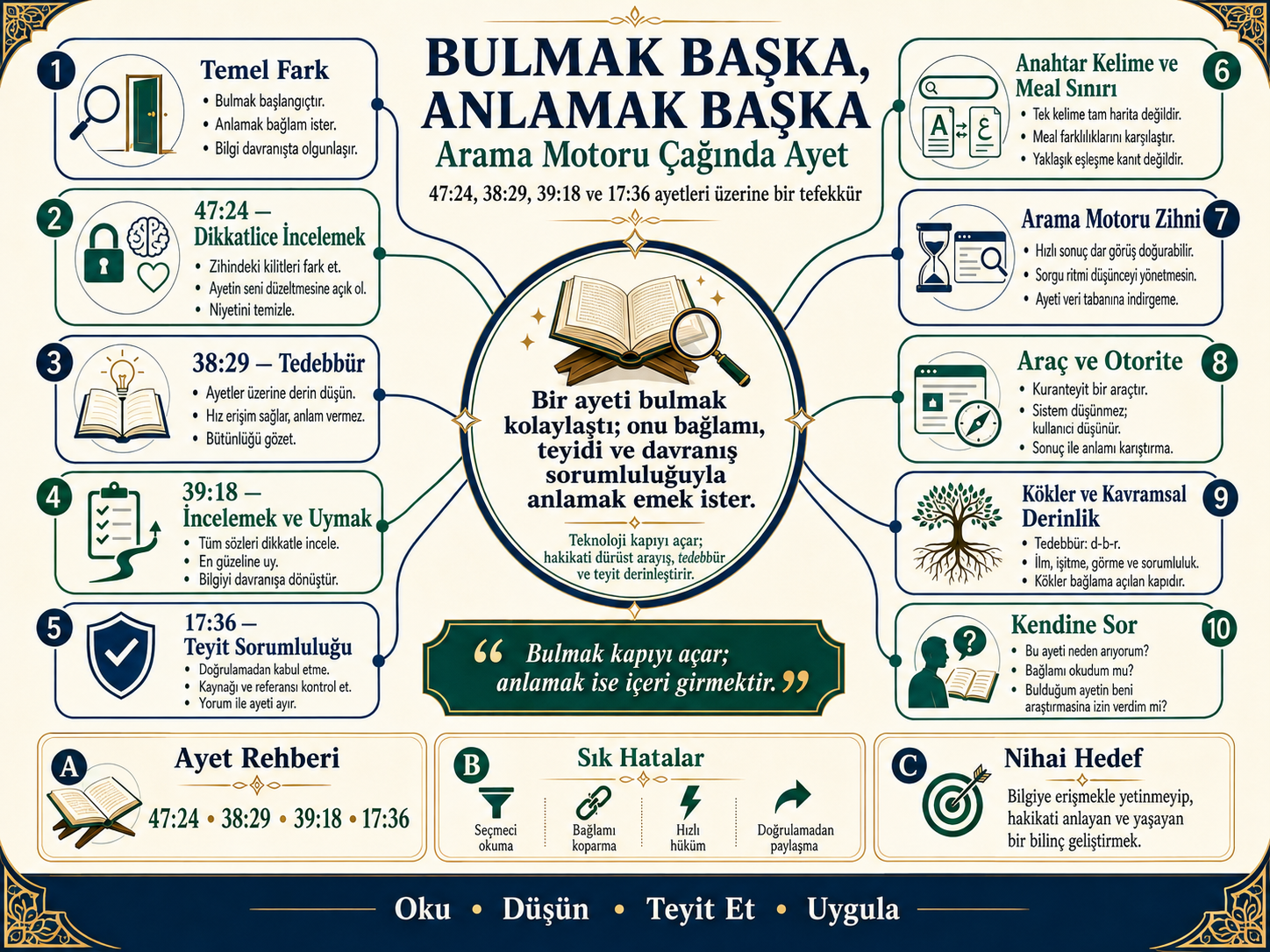
1. Studying Carefully: First, the Locks in My Own Mind
Verse
47:24
أَفَلَا يَتَدَبَّرُونَ ٱلْقُرْءَانَ أَمْ عَلَىٰ قُلُوبٍ أَقْفَالُهَآ
Why do they not study the Quran carefully? Do they have locks on their minds?
Why do they not study the Quran carefully? Do they have locks on their minds?Source: kuranteyit.com
Reflection on the Verse
47:24 does not merely ask me whether the Quran is being read; it also places before me the possibility that there may be locks on the mind. For me, this is an uncomfortable but necessary question. Because sometimes what I am looking for may not be the truth, but a sentence that confirms what I already believe.
The search engine appears neutral here. It searches for whatever I type. But I am the one who chooses the search phrase. If I want to prevail in an argument, I can search only for words that serve my position. Then, because I find many results, I may imagine that I have done research.
For this reason, the first act of verification sometimes begins in my own intention before it begins with the result on the screen: Am I open to allowing the verse to correct me, or am I searching for the verse only to correct someone else?
2. The Distance Between Finding and Understanding
Verse
38:29 — This is a scripture that we sent down to you, that is sacred—perhaps they reflect deeply on its verses. Those who possess intelligence will take heed.
47:24 — Why do they not study the Quran carefully? Do they have locks on their minds?
Reflection on the Verse
38:29 brings deep reflection on the verses to the forefront. This does not mean that speed is worthless. Speed brings me to the text, but it does not eliminate the time required for reflection.
A search result can appear in a few milliseconds. Understanding, however, may require rereading the verse, looking at what comes before and after it, seeing related verses, and giving up my first conclusion. Digital convenience does not make this effort unnecessary.
In the studio, finding the channel alone is not enough for a good mix; I need to hear it together with the other sounds. In Quran research as well, finding the verse is the beginning. Understanding is trying to hear it without severing it from the whole.
3. A Keyword Is Not the Complete Map of Truth
Verse
38:29 — This is a scripture that we sent down to you, that is sacred—perhaps they reflect deeply on its verses. Those who possess intelligence will take heed.
17:36 — You shall not accept any information, unless you verify it for yourself. I have given you the hearing, the eyesight, and the brain, and you are responsible for using them.
Reflection on the Verse
When I search with a Turkish word, I am in fact also searching for the word chosen by a translator. The concept I am looking for may have been translated with a different word in another verse. For this reason, the phrase “no results found” usually means only that a particular query returned no result; it cannot rule that the meaning itself is absent from the Quran.
Approximate matching and AI-assisted suggestions can also broaden research. But similarity is not proof. A verse that a model labels “related” is, for me, a candidate that needs to be examined; it is not the final word.
The honesty of a tool begins with not hiding the limits of its own field of view. Showing the user what was searched, which translation was searched, and by what method the result was found is not merely a technical detail; it is a matter of truthfulness.
4. Examining All Words, Then Following the Best
Verse
39:18 — They are the ones who examine all words, then follow the best. These are the ones whom GOD has guided; these are the ones who possess intelligence.
Reflection on the Verse
The direction 39:18 opens for me is not simply “read many sources.” After examination comes following. Accumulating information should not become a new excuse for endlessly postponing action.
I can open endless tabs. I can look at every opinion and still move no closer to a conclusion. This can become another form of escape. Reflection should stand not only against hasty judgment, but also against endless research used to avoid responsibility.
If I find a word good, I must be willing to live under what it asks of me. Researching a verse is not merely an intellectual collection; it is a willingness to remain open to moral change in direction.
5. Verification: Seeing It on the Screen Is Not Enough
Verse
17:36 — You shall not accept any information, unless you verify it for yourself. I have given you the hearing, the eyesight, and the brain, and you are responsible for using them.
Reflection on the Verse
17:36 ties my relationship with information to personal responsibility. A verse number that looks correct on a screen may be mismatched. A quotation may be incomplete. Commentary may be presented as though it were the verse itself. Artificial intelligence may produce a persuasive but incorrect reference.
For this reason, verification is not a sickness of distrust; it is the responsibility to use the faculties of hearing, seeing, and thinking. One needs to look at the whole verse, see the source, know the translation, and distinguish between the claim and the text.
The most useful feature of Kuranteyit should therefore not be handing down ready-made judgments, but making these paths of verification as visible as possible.
6. The Search-Engine Mind and Impatience
Verse
47:24 — Why do they not study the Quran carefully? Do they have locks on their minds?
38:29 — This is a scripture that we sent down to you, that is sacred—perhaps they reflect deeply on its verses. Those who possess intelligence will take heed.
Reflection on the Verse
A search engine can train me into the habit of “type the question, get the answer.” But the Quran does not always remain within the boundaries of the question I have constructed. Sometimes it places before me something I never asked; sometimes, before giving an answer, it shows me that the question itself was framed incorrectly.
For this reason, I do not want to use the Quran merely as a database of answers. A verse should not be reduced to a fragment that serves my query. Nor should I impose the rhythm of the search box on my thinking.
Just as evaluating an entire piece of music by listening only to its most striking ten seconds would be incomplete, seeing a verse only as the sentence that matches my query may be incomplete as well.
7. Kuranteyit: A Tool That Does Not Think in Place of the Seeker
Verse
17:36 — You shall not accept any information, unless you verify it for yourself. I have given you the hearing, the eyesight, and the brain, and you are responsible for using them.
39:18 — They are the ones who examine all words, then follow the best. These are the ones whom GOD has guided; these are the ones who possess intelligence.
Reflection on the Verse
Kuranteyit can make searching easier, place translations side by side, and show roots and connections. But none of these means believing, deciding, or being accountable in place of the user.
For me, good design is not design that makes the user dependent on the app, but design that teaches the user to read more carefully over time. It should distinguish between result and meaning, exact match and suggestion, verse and commentary.
The more powerful a tool becomes, the more clearly it should explain its own limits. Because trust does not come from claiming to know everything; it comes from honestly showing what it knows and what it does not know.
8. On the Arabic Roots of Words
Verse
47:24 — Why do they not study the Quran carefully? Do they have locks on their minds?
38:29 — This is a scripture that we sent down to you, that is sacred—perhaps they reflect deeply on its verses. Those who possess intelligence will take heed.
17:36 — You shall not accept any information, unless you verify it for yourself. I have given you the hearing, the eyesight, and the brain, and you are responsible for using them.
Reflection on the Verse
The expression for deep reflection in 47:24 and 38:29 is associated with the root د-ب-ر (Dal-Be-Re). Its associations with considering what lies behind something, its outcome, and its direction strengthen for me the idea of looking beyond a surface match. The word qulub in 47:24 is related to the root ق-ل-ب (Qaf-Lam-Ba), while aqfal is related to ق-ف-ل (Qaf-Fa-Lam); the semantic fields of turning and locking make me think of how the mind can both change direction and close itself off.
In 17:36, ilm opens onto the root field ع-ل-م (Ayn-Lam-Mim), hearing onto س-م-ع (Sin-Mim-Ayn), sight onto ب-ص-ر (Ba-Sad-Ra), and mes’ulen, related to responsibility, onto س-أ-ل (Sin-Hamza-Lam). Roots do not solve the meaning of a verse by themselves. But they remind me that search technology should not merely give me a word; it should invite me to investigate the place of that word within sentence, context, and responsibility.
Other Claims
Verse
47:24 — Why do they not study the Quran carefully? Do they have locks on their minds?
38:29 — This is a scripture that we sent down to you, that is sacred—perhaps they reflect deeply on its verses. Those who possess intelligence will take heed.
39:18 — They are the ones who examine all words, then follow the best. These are the ones whom GOD has guided; these are the ones who possess intelligence.
Reflection on the Verse
Some approaches may consider fast searching sufficient for finding the correct verse. Speed increases access, but it does not automatically resolve context, intention, or the boundaries of translation.
Another claim is that if a particular Turkish word does not appear in the Quran, then the concept itself is not there either. This can narrow the relationship between translation and concept too much. The same meaning may be expressed with different words or different sentence structures.
Traditional and expertise-centered approaches may argue that deep study should be left only to scholars. Linguistic and subject-matter expertise can make a major contribution; however, the personal dimension of verification and responsibility in 17:36 seems not to allow a person to delegate hearing, seeing, and thinking entirely. Receiving help and surrendering responsibility are not the same thing.
Conclusion
Verse
47:24 — Why do they not study the Quran carefully? Do they have locks on their minds?
38:29 — This is a scripture that we sent down to you, that is sacred—perhaps they reflect deeply on its verses. Those who possess intelligence will take heed.
39:18 — They are the ones who examine all words, then follow the best. These are the ones whom GOD has guided; these are the ones who possess intelligence.
17:36 — You shall not accept any information, unless you verify it for yourself. I have given you the hearing, the eyesight, and the brain, and you are responsible for using them.
Reflection on the Verse
In the age of search engines, finding a verse has become easier; but that ease has also given me a new responsibility. Greater access does not make understanding automatic.
47:24 places the locks in my mind before me; 38:29 places deep reflection before me; 39:18 places examining words and following the best before me; and 17:36 places the responsibility of verification before me. When I consider these together, the task of search technology is not to declare truth on my behalf, but to open a path so that I can look more carefully.
In music, finding a sound is easy; placing it correctly is difficult. The same is true of finding a verse. I can raise the sentence that appears on my screen according to my anger, fear, or a conclusion I have already reached. Or I can return to the whole and listen to it.
For me, the main question is no longer, “Did I find the verse I was looking for?”
Did I allow the verse I found to search me as well?
Note
2:32 — They said, “Be You glorified. We have no knowledge, except that which You have taught us. You are the Omniscient, Most Wise.”
20:114 — Most Exalted is GOD, the one true King. Do not rush into uttering the Quran before it is revealed to you, and say, “My Lord, increase my knowledge.”
GOD knows best.
Source: kuranteyit.com
Discover
Related Articles
Quran Reflections
Is Comparing Quran Translations Doubt or Responsibility?
A personal reflection on understanding Rashad Khalifa's authorized English translation, the birth of Kuranteyit, the responsibility of verification, the limits of digital tools, and turning research into action through Az-Zumar 39:18, Al-Isra 17:36, and Muhammad 47:24.
Read article
Quran Reflections
Can Artificial Intelligence Explain the Quran? An Information Tool and the Responsibility of Understanding
A reflection through verses Al-Isra 17:36, Az-Zumar 39:18, Muhammad 47:24, and Al-Araf 7:33 on artificial intelligence, access to information, verification, careful study of the Quran, testimony, guidance, moral responsibility, and the limits of religious authority.
Read article
Quran Reflections
How Can Tawhid Be Distorted by a Single Word? One GOD or 'Highest of the High'?
A deep reflection through Al-Baqarah 2:255 and 15 verses in which the same translation pattern recurs, examining the difference between "Most High" and "Highest of the High"; tawhid, translation fidelity, verification, testimony, speaking about GOD without knowledge, grammar, intercession, sovereignty, and religious authority.
Read article