What Did the Stones Do? A Reflection on Hell, the Dissolution of Mountains, the Development of the Self, and the Petrified Mind
A deep reflection centered on Al-Baqarah 2:24 about people and stones as the fuel of Hell; the crumbling of the mountain in the story of Moses, GOD's physical presence, the transformation of the earth, the development of the self, those who remain immobile, petrified minds, idols, and responsibility.
What Did the Stones Do? A Reflection on Hell, the Dissolution of Mountains, the Development of the Self, and the Petrified Mind
Author: Berk KÖKSAL
Date: 15.09.2026
Location: Mersin
The central purpose of this article is to think about the verses together with other related verses, and to express sincerely and deeply what bearing witness to the oneness of GOD means in human life in terms of knowledge, justice, truthfulness, and submission.
Peace. Peace be upon you.
When I first began this article, there was a single question in my mind:
What did the stones do?
Al-Baqarah 2:24 describes the fuel of Hell as “people and stones.” The human part seems relatively easy to understand. A person chooses. Believes or disbelieves. Acts rightly or wrongly. Accepts or rejects the information that reaches them. Develops the self or neglects it. But the stone?
What did the stone do?
Then the issue grew.
When Moses wanted to see GOD, he was told to look at a mountain. When GOD revealed Himself to the mountain, the mountain crumbled. Another verse says that if the Quran were revealed to a mountain, that mountain would tremble and fall apart out of deep reverence for GOD. Other verses say that on Judgment Day the mountains are removed, the earth and mountains are completely crushed, the sky is torn apart, and the present earth is replaced by a new earth.
Then a second question arises:
Could the stones being the fuel of Hell be related not only to stones that humans idolized, but also to the dissolution of this physical universe?
Then a third door opens.
The Quran uses the expression “those who remain immobile” for some people. These people choose not to move; afterward, it is said that their hearts are sealed, they cannot comprehend, and they cannot attain any knowledge.
Another verse says that the human heart can become like rock, or even harder than rock.
Then stone ceases to be merely an object outside us.
At the level of reflection, stone also becomes a powerful mirror for the mind that does not move, the conviction that never changes, the consciousness closed to new information, the person who repeats inherited ideas without ever testing them, and the ego that has absolutized its own interpretation.
And then comes the question of the self.
30:44 says that those who lead a righteous life do so to “strengthen and develop” their own selves. 91:7-10 says that the self is shown what is evil and what is good, that the successful one is the one who saves it, and the unsuccessful one is the one who neglects it.
Perhaps the human journey is essentially this:
Either the self develops, or the person hardens from within.
In this article I will not try to establish a verdict, but to see the limits of these possibilities.
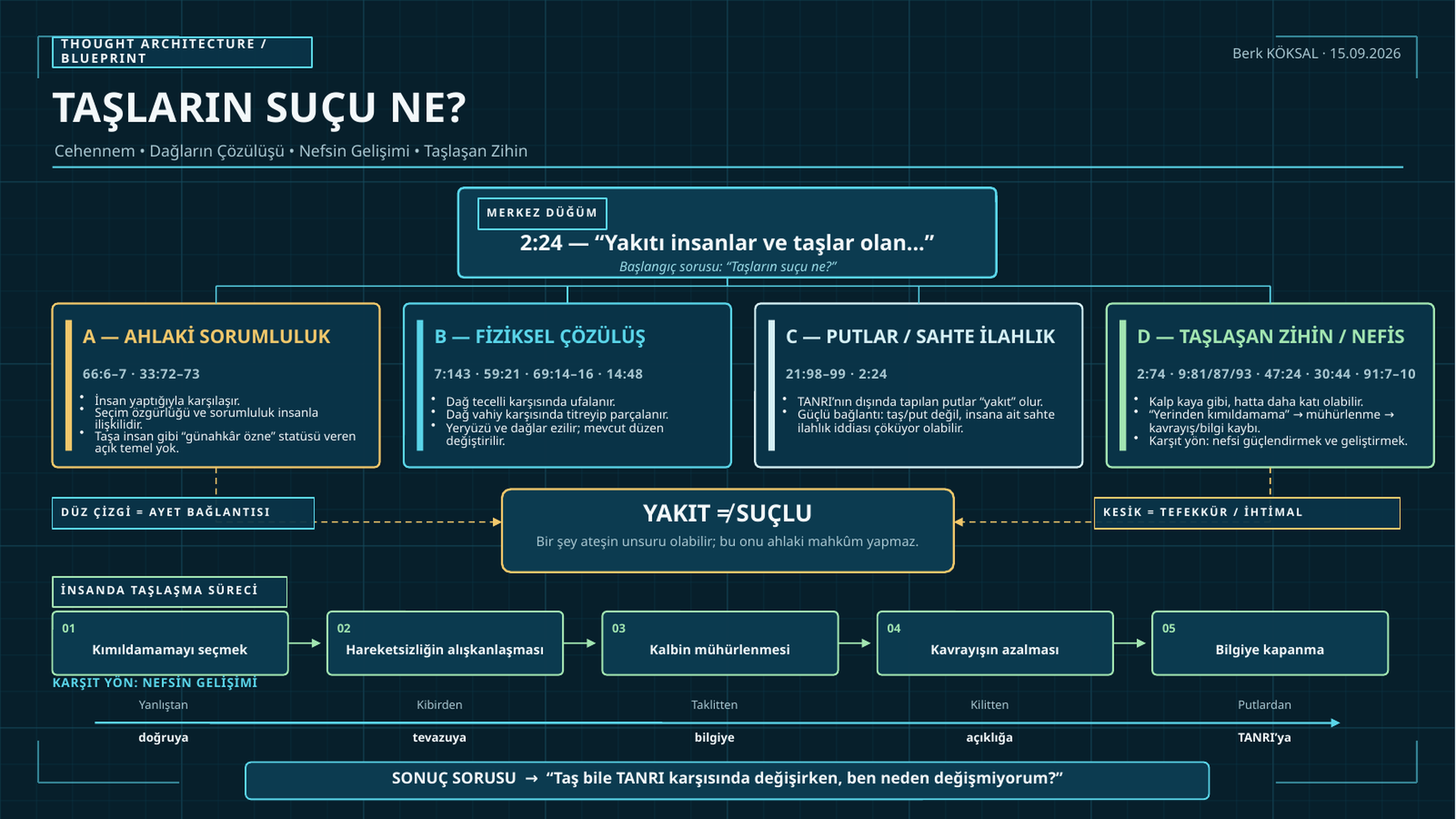
Some ideas rest on strong connections between verses.
Some are only possibilities for reflection.
And some are, on the contrary, limited by the verses themselves.
What matters to me is not to sell possibility as truth, while also not being afraid of the field of thought opened by the verses.
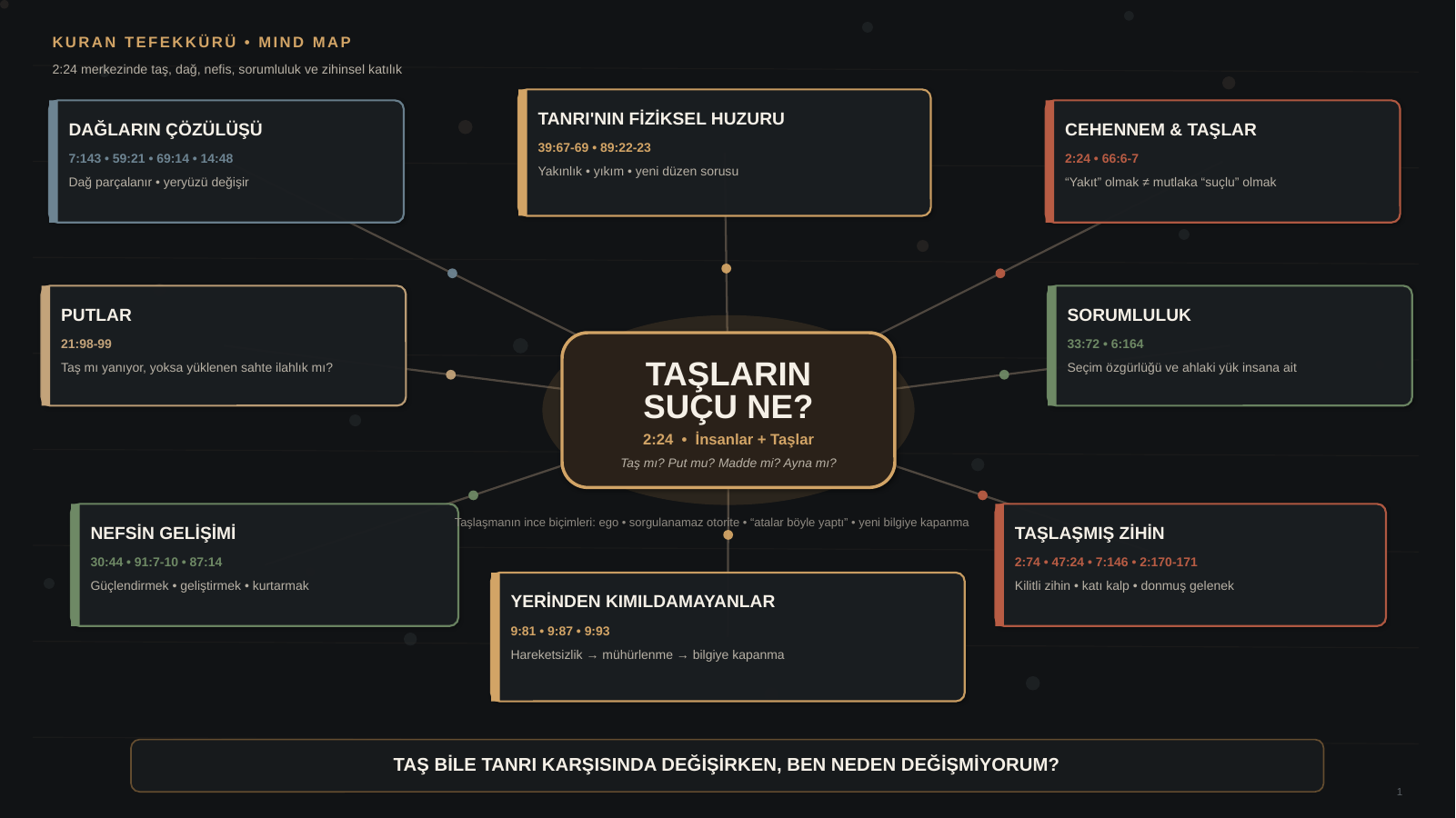
1. The First Knot: Why Are People and Stones Fuel for the Same Fire?
Verse
2:24
Arabic
فَإِن لَّمْ تَفْعَلُوا۟ وَلَن تَفْعَلُوا۟ فَٱتَّقُوا۟ ٱلنَّارَ ٱلَّتِى وَقُودُهَا ٱلنَّاسُ وَٱلْحِجَارَةُ أُعِدَّتْ لِلْكَٰفِرِينَ
English
If you cannot do this—and you can never do this—then beware of the Hellfire, whose fuel is people and rocks; it awaits the disbelievers.
English Translation
If you cannot do this—and you can never do this—then beware of the Hellfire, whose fuel is people and stones; it awaits the disbelievers.
Source: kuranteyit.com
Reflection on the Verse
The most disturbing part of the verse is the expression “people and stones” appearing side by side.
I can understand moral responsibility for the human being.
I cannot understand it for the stone.
But perhaps our first mistake is assuming that two elements appearing in the same sentence are there for the same reason.
The verse:
“People and stones committed the same offense.”
does not say this.
“People and stones are punished in the same way.”
does not say this either.
It says, “whose fuel is people and stones.”
This distinction matters.
For the human being, the same Quran speaks of disbelief, evil, pride, injustice, idolatry, rejection, and the consequences of one’s own deeds. We do not see such a moral record for the stone.
Then we need to distinguish “fuel” from “guilty.”
Something can be part of a fire without being a moral convict.
Something can be in the scene without being the subject of accountability.
For this reason, at the outset I leave these possibilities open:
The stones may be elements of the physical order of Hell.
They may be material idols that people worship beside GOD.
They may be connected to physical matter emerging from the dissolution of this universe or transferred into another order.
Or alongside all these, “stone” may open a powerful door of reflection on inner human hardening.
But I cannot yet say of any of these, “This is definitely what 2:24 means.”
Perhaps the first lesson of the verse is this:
Before I know why the stone is there, I should understand why the human being is being warned.
The command “beware” is directed not to the stone but to the human being.
Verse references: 2:24.
2. Is the Stone Being Punished, or Is It Part of the Order of Hell?
Verse
66:6 — O you who believe, protect yourselves and your families from the Hellfire, whose fuel is people and stones. Guarding it are stern and powerful angels who never disobey GOD; they do whatever they are commanded to do.
66:7 — O you who have disbelieved, do not apologize today. You are only being repaid for what you have done.
Reflection on the Verse
66:6 brings back almost the same expression as 2:24:
People and stones.
But the next verse changes the language of accountability:
“You are only being repaid for what you have done.”
Here accountability is tied to a history of action.
The human being encounters what they did.
The stone is not said to be “repaid for what it did.”
I do not think this is a small difference; it is fundamental.
The stone being in Hell and the human being being punished in Hell do not have to be the same thing.
For this reason, my opening question, “What did the stone do?” may already contain a false assumption.
Perhaps the stone is not guilty.
Perhaps its presence there shows something else.
The helplessness of what humans idolized.
The physical dissolution of the old universe.
An element belonging to the structure of Hell.
Or a comparison that makes us think about how hardened a human being can ultimately become.
66:7 pulls me toward this point:
The reason for moral punishment is what the human being did.
Then I would need another verse before attributing moral guilt to a stone.
So far, I do not see such a verse.
Verse references: 66:6-7.
3. If the Mountain Cannot Endure GOD’s Manifestation, What Can This Universe Endure?
Verse
7:143 — When Moses came at our appointed time and his Lord spoke with him, he said, “My Lord, allow me to look and see You.” He said, “You cannot see Me. Look at that mountain; if it stays in its place, then you can see Me.” Then his Lord revealed Himself to the mountain, causing it to crumble and disintegrate. Moses fell unconscious. When he came to, he said, “Be You glorified. I repent to You, and I am the most convinced believer.”
Reflection on the Verse
This verse completely changed the question of stone for me.
Moses wants to see.
The answer does not end with a direct “no.”
A mountain is shown.
“If it stays in its place…”
The mountain does not stay in its place.
It crumbles and disintegrates.
This scene makes me think about the limitation of physical existence before GOD’s direct manifestation.
Moreover, the section heading in Rashad Khalifa’s Authorized Translation explicitly interprets this as “Our World Cannot Stand GOD’s Physical Presence.”
I need to be very careful here.
The verse does not say, “the entire universe turns into Hell.”
The verse does not say, “the stones of Hell are pieces of this mountain.”
But it shows us an important physical principle:
One of the largest, heaviest, and most solid structures we know as a mountain cannot remain in place before GOD’s manifestation.
Then, when other verses concerning GOD’s physical presence on Judgment Day are read, the question naturally grows:
If a single mountain cannot withstand the manifestation, can this earth remain in the same physical order?
Perhaps the crushing of the mountains, the tearing apart of the sky, and the replacement of the earth in the descriptions of the Hereafter are not independent images.
Perhaps the existing physical order really ends.
Then a new possibility appears for the stones in 2:24:
Could the stones of Hell be related not only to idolized objects, but also to the matter of the physical order that is ending?
I do not know.
But this question no longer seems as far-fetched to me as it once did.
Because the mountain’s dissolution before GOD’s manifestation is directly present in the verse.
Verse references: 7:143.
4. If Even the Quran Is Described as a Weight That Would Shatter a Mountain
Verse
59:21 — If We revealed this Quran to a mountain, you would see it trembling and crumbling out of deep reverence for GOD. We cite these examples for the people, that they may reflect deeply.
Reflection on the Verse
In 7:143, the mountain crumbles through GOD’s manifestation.
In 59:21, the mountain is said to tremble and fall apart before the Quran.
Here the mountain appears before us twice:
In one, GOD revealing Himself.
In the other, the weight of GOD’s revelation.
In both, hardness dissolves.
This is one of the most important reversals in the article for me.
We think of stone as a symbol of “hardness.”
But stone and mountain in the Quran are not absolutely hard before GOD.
The mountain can break.
The mountain can tremble.
The mountain can submit.
In 2:74, rocks crack.
In 34:10, the mountains are told to submit with David.
So real stone itself does not appear as “unchanging” as we imagine.
Who, then, is the one who does not change?
The person who does not change their opinion even when truth arrives.
The person who does not move even after seeing evidence.
The person who does not study the Quran carefully.
The person who locks their heart.
Seen this way, the expression “petrified human being” becomes even harsher.
Because perhaps even real stone is not as rigid before GOD as a human being can be.
Verse references: 7:143, 59:21.
5. The Mountains Are Crushed, the Earth Is Replaced: Could the Stones Have a Physical Dimension?
Verse
69:14 — The earth and the mountains will be carried and crushed; completely crushed.
69:15 — That is the day when the inevitable event will happen.
69:16 — The sky will be torn asunder.
14:48 — The day will come when this earth will be substituted with a new earth, and also the heavens, and everyone will be brought before GOD, the One, the Supreme.
Reflection on the Verse
Now we can take the physical possibility more seriously.
The earth and mountains are crushed.
The sky is torn apart.
The present earth is replaced by another earth.
These images do not speak only of individual death.
There is a cosmic reordering.
What we call a mountain is already made of enormous masses of stone.
The earth is woven from soil, rock, mountains, minerals, and other material elements.
If the present order is crushed, dissolved, and gives way to another order, then the word “stones” should not be reduced only to statues.
Perhaps literal physical stone is present here too.
Perhaps there is the dissolved material of the mountains.
Perhaps the hardness of the old world is carried into another function in the new order.
The verse directly says none of these things.
But I can say this:
In the Quran’s description of the Hereafter, the physical integrity of mountains and the earth is not preserved.
For this reason, connecting the “stones” in the fuel of Hell with this cosmic dissolution becomes a legitimate question for reflection, even if it is not a definitive explanation.
We can also think of it this way:
Soil compresses, hardens, and becomes rock.
Rock rises and becomes mountain.
The mountain breaks apart and returns to particles again.
We see “stone” as fixed because human life is short.
Yet in the Quran’s image of the Hereafter, all the material structures we thought fixed are moving.
Perhaps the presence of “stone” in Hell tells us that even matter is not permanent.
The human being, meanwhile, turns temporary matter into a permanent sacred object.
Perhaps the real irony is here.
Verse references: 14:48, 69:14-16.
6. What Happens to the Earth When GOD Comes?
Verse
39:67 — They can never fathom the greatness of GOD. On the Day of Resurrection, the whole earth is within His fist. In fact, the universes are folded within His right hand.* Be He glorified. He is far above needing any partners.
39:68 — The horn will be blown, whereupon everyone in the heavens and the earth will faint, except those spared by GOD. Then it will be blown once more, whereupon they will all rise up, looking around.*
39:69 — Then the earth will shine with the light of its Lord. The record will be proclaimed, and the prophets and the witnesses will be brought forward. Then everyone will be judged equitably, without the least injustice.
Reflection on the Verse
Here we are no longer talking about only one mountain.
The earth is within GOD’s power.
The universes are folded.
Then the earth shines with the light of its Lord.
In Rashad Khalifa’s footnote to 39:68, there is an interpretation that on the Day of Resurrection people will be resurrected on today’s earth; afterward this earth will be destroyed by GOD’s physical coming, and a new world and new heavens will be created.
This is important because it directly touches part of our new hypothesis:
GOD’s physical presence may make the present world unsustainable.
In 7:143 the mountain shows this on a smaller scale.
The footnote to 39:68 interprets it on the scale of the earth.
And 14:48 already says as a verse that the present earth will be replaced by another.
At this point it is possible to consider the following:
Could the “stones” of Hell be material elements connected to the destruction of the old world?
Could the breaking apart of the mountains, the dissolution of soil and rock structures, the changing of the heavens, and then the separation of people according to their level of development be parts of the same great process?
I do not see an explicit verse that confirms this.
But without going beyond the verses, I can now say this much:
There is a strong connection, established by this Authorized Translation, between GOD’s physical presence and the dissolution of the present material order.
This makes me think that we should not explain the stones only through idols.
Perhaps “stones” has more than one layer of meaning.
Verse references: 7:143, 14:48, 39:67-69.
7. But There Is Also a Possibility in the Opposite Direction: Is Hell Distance from GOD Rather Than Proximity?
Verse
89:22 — And your Lord comes, together with the angels in row after row.
89:23 — On that day, Hell will be brought forward. On that day, the human being will remember—but what remembrance—it will be too late.
19:71 — Every one of you must see it; this is an irrevocable decision of your Lord.
19:72 — Then We rescue the righteous, and leave the transgressors in it, humiliated.
Reflection on the Verse
Here there is a very important balance against our first hypothesis.
In 89:22, the Lord comes.
In 89:23, Hell is brought forward.
At first glance this sequence could be read as “GOD came and Hell formed.”
But Rashad Khalifa’s footnotes propose a different model.
In the footnote to 19:71, it is stated that humans will be resurrected before GOD’s physical coming into our universe; that this condition will be a temporary taste of Hell; and that “the absence of GOD means Hell.” When GOD comes, the righteous are said to be rescued.
In the footnote to 69:17, there is the view that the present earth is full of misery because of its physical distance from GOD, and that in the Hereafter an eighth universe even farther away will be created and called Hell.
This interpretation reverses our first thought.
Perhaps Hell is not a burning caused by physical proximity to GOD.
On the contrary:
It may be an order in which the greatest distance from GOD exists.
This is very important.
Because then two different events are distinguished:
GOD’s coming destroys the present earth.
The righteous are rescued.
Hell, meanwhile, appears as a realm of existence farther from GOD.
Then the question “Why are stones in Hell?” changes form again.
Could they be the material remnants of the old world?
Could they be idols?
Could they be physical fuel of the order of Hell?
We do not know.
But one thing becomes clearer:
We do not have to think of GOD’s presence and the fire of Hell as the same thing.
In fact, the footnotes of the Authorized Translation suggest the opposite.
For this reason, good reflection should not merely generate a new possibility; it should also test its own new possibility against the verses.
Verse references: 19:71-72, 89:22-23.
8. If Idols Are Also Fuel for Hell, Is the Question of Stones Connected to Idols?
Verse
21:98 — You and the idols you worship besides GOD will be fuel for Hell; this is your inevitable destiny.
21:99 — If they were gods, they would not have ended up in Hell. All its inhabitants abide therein forever.
Reflection on the Verse
This remains one of the strongest Quranic connections for the question of stone.
2:24:
People and stones.
21:98:
People and the idols they worship besides GOD.
I am not jumping to the conclusion that “all the stones in 2:24 are idols.”
But the connection is clear.
Idols are fuel for Hell.
Moreover, 21:99 explains their going to Hell less through a logic of punishment and more through the collapse of their false divinity:
“If they were gods, they would not have ended up in Hell.”
This is very powerful.
The object made sacred in this world reveals its own helplessness in the Hereafter.
It cannot even save itself.
It cannot save the one who worshiped it at all.
Perhaps one of the “functions” of the stone in Hell is exactly this:
The burning of the false meaning that the human being loaded onto the stone.
The stone may not be guilty.
There is the human lie about the stone.
“There is divine power in this.”
“This protects me.”
“This intercedes for me.”
“This brings me closer to GOD.”
“One must bow before this.”
Perhaps what burns in the fire, in one sense, is not the stone but the claim of false godhood constructed by the human being.
This is a reflection.
It is not the wording of the verse.
But 21:98-99 provides a serious foundation that supports this thought.
Verse references: 2:24, 21:98-99.
9. If the Stone Is Not Guilty, Who Was Given Responsibility?
Verse
33:72 — We offered the responsibility (freedom of choice) to the heavens and the earth and the mountains, but they refused to bear it and were afraid of it. The human being accepted it; he was transgressing, ignorant.*
33:73 — For GOD will inevitably punish the hypocrite men and hypocrite women, the idol-worshiping men and idol-worshiping women. GOD redeems the believing men and believing women. GOD is Forgiver, Most Merciful.
Reflection on the Verse
This verse is very important for testing the idea, “Could stones be in Hell because they did not develop their selves?”
Because here responsibility and freedom of choice are directly connected to the human being.
They are offered to the heavens, the earth, and the mountains.
They do not accept.
The human being accepts.
Therefore, the moral position of the mountain and the human being is not the same.
In Rashad Khalifa’s footnote to 33:72, there is an interpretation that animals, trees, stars, and similar created beings took advantage of this offer.
Within this framework, I can say the following more confidently:
There is no explicit basis supporting the idea that a stone is guilty because it failed to use freedom of choice like a human being and develop its self.
On the contrary, 33:72 shows that the human being took on a special responsibility.
This creates a very useful distinction.
A stone can respond to GOD.
In 2:74 it can shrink out of deep reverence.
In 59:21 it can tremble.
In 7:143 a mountain can break apart.
In 34:10 the mountains can submit.
But these are not the same thing as the human moral test.
For existence to have a response to GOD is one thing.
To take on freedom of choice and be held accountable for it is another.
For this reason, if a stone is in Hell, thinking of it as a “failed self” does not seem right to me.
Verse references: 33:72-73.
10. Do Stones Have a Self?
Verse
91:7 — The self and the One who created it.
91:8 — Then showed it what is evil and what is good.
91:9 — Successful is the one who redeems it.
91:10 — Failing is the one who neglects it.
Reflection on the Verse
I cannot derive an explicit “yes” from the verses to the question, “Does a stone have a self?”
Nor do I want to construct an explicit “no.”
But the self in 91:7-10 is described within a moral order.
It is shown what is good and what is evil.
There is redemption.
There is neglect.
There is success and failure.
So this is not merely about “being alive,” but moral orientation.
I do not see a verse that says stones were given such a task.
33:72, on the contrary, shows that the human being took on the responsibility of freedom of choice.
For this reason, the thought “stones are destined for Hell because they did not develop their selves” now seems weak to me.
But this idea has taken us somewhere else, somewhere stronger:
What happens if a human being does not develop the self?
Perhaps this is where the real petrification begins.
We need to speak not about the self of the stone, but about the human being’s own self.
Verse references: 33:72, 91:7-10.
11. What Does It Mean to “Grow the Self”?
Verse
30:44 — Whoever disbelieves, disbelieves to the detriment of his own self, while those who lead a righteous life do so to strengthen and develop their own selves.
87:14 — Successful indeed is the one who redeems his self.
87:15 — By remembering the name of his Lord and observing the Contact Prayers (Salat).
Reflection on the Verse
We need to be very careful when saying “grow the self” here.
Because in everyday Turkish, “growing one’s self” could be understood as becoming arrogant.
But the thought used in 30:44 is the opposite:
Strengthening and developing the self.
This is not inflating the ego.
It is not seeing oneself as superior to others.
It is not appearing greater.
The development of the self is a process related to righteousness, submission, remembering GOD, righteous living, charity, patience, and awareness.
In Rashad Khalifa’s footnote to 10:91, it is also stated that believing in GOD is the first step, after which a person must nourish and develop the self through practices of worship.
This creates a powerful contrast with the idea of petrification.
The self either develops.
It grows stronger.
It is redeemed.
Or it is neglected.
Verses such as 6:12 and 6:20 use the expression “those who lose their selves.”
This makes me think of human life not as static, but as a developmental process.
A human being is not merely a fixed entity labeled “good” or “bad.”
Something is happening.
They are moving in a direction.
Either growing inwardly.
Or losing from within.
Then perhaps Hell can also be thought of not only as “a place you are sent because you did wrong things,” but as the ultimate result of a human being failing to develop their own self.
But again, this is for the human being.
Not for the stone.
The stone can be a mirror placed before the human self.
Verse references: 30:44, 87:14-15, 91:7-10.
12. Those Who Remain Immobile: How Does a Human Being Become Petrified?
Verse
9:81 — Those who remained immobile rejoiced in staying behind GOD’s messenger, and hated to strive with their money and their lives in the cause of GOD. They said, “Let us not move in this heat!” Say, “The fire of Hell is much hotter,” if they could only comprehend.
9:87 — They chose to be with those who remain immobile. Consequently, their hearts were sealed, and therefore they do not comprehend.
9:93 — The blame is on those who ask your permission to stay behind, even though they have no excuse. They chose to be with those who remain immobile. Consequently, GOD sealed their hearts, and therefore they cannot attain any knowledge.
Reflection on the Verse
Here “stone” takes on a very different meaning for me.
One of the most obvious images of a stone is that it stays in place.
It does not set out on its own.
It does not change direction on its own.
It does not develop on its own.
The expression used for some people in 9:81 is:
“Those who remain immobile.”
And the same verse speaks of the fire of Hell.
In 9:87, after they choose to remain immobile, it is said that their hearts are sealed and they cannot comprehend.
In 9:93 it is even harsher:
“They cannot attain any knowledge.”
Here I see a powerful spiritual process:
First a person chooses not to move.
Then immobility turns into a habit.
Then the heart is sealed.
Then comprehension diminishes.
Then access to knowledge closes.
Perhaps this is exactly what petrification is.
Not a human body physically sitting down.
But not moving inwardly when truth reaches them.
When new information comes:
“I do not change my mind.”
that is what they say.
When a mistake becomes visible:
“I have known it this way for years.”
that is what they say.
When a verse is shown:
“Our elders did not say this.”
that is what they say.
When evidence comes:
“My sect, group, teacher, family, or circle believes this.”
is how they answer.
At that point the person who “remains immobile” truly resembles a stone.
But what is frightening is this:
Real stone moves before GOD. The human being does not.
The mountain breaks apart.
The rock cracks.
The human being does not abandon the opinion.
Verse references: 9:81, 9:87, 9:93.
13. The Heart Can Be Harder Than Stone
Verse
2:74 — Yet your hearts hardened like rocks, or even harder. For there are rocks from which rivers gush forth. Some crack and yield gentle streams, and other rocks shrink out of deep reverence for GOD. GOD is never unaware of anything you do.
Reflection on the Verse
This verse now moves into the center of the entire article.
The human heart hardens like rock.
Then the verse adds:
“Or even harder.”
So the Quran does not use the hardness of stone as the ultimate hardness of the human being.
On the contrary:
It says that even stone can be softer than a human being.
Water comes out of rock.
Rock cracks.
Rock shrinks out of deep reverence for GOD.
The mountain breaks apart before the manifestation.
If the Quran were revealed to a mountain, the mountain would tremble.
But the human being?
They can see every kind of evidence and still refuse to change.
A striking thought arises here:
When reading the expression “people and stones” in the fuel of Hell, perhaps what I should fear most is not that stone is in Hell, but that the human being can become more stony than stone.
A channel for water can open in stone.
Does one open in my heart?
Stone cracks.
Can my thinking crack?
Stone shrinks out of deep reverence for GOD.
Can I make my ego smaller before truth?
Perhaps the stone’s presence in Hell is not an insult to me, but a mirror.
While I ask, “Why is stone here?” perhaps the Quran may be asking me:
“Are you harder than stone?”
That may be what it is asking.
I am not saying this as the direct explanation of 2:24.
But 2:74 makes this reflection extraordinarily strong.
Verse references: 2:74, 7:143, 59:21.
14. The Petrified Mind: A Locked Mind Does Not Let New Knowledge In
Verse
47:24 — Why do they not study the Quran carefully? Do they have locks on their minds?
7:146 — I will divert from My revelations those who are arrogant on earth, without justification. Consequently, when they see every kind of proof, they will not believe. And when they see the path of guidance, they will not adopt it as their path; but when they see the path of straying, they will adopt it as their path. This is the consequence of their rejecting our proofs and being totally heedless thereof.
Reflection on the Verse
What is a petrified mind?
It is not a mind that knows nothing.
Sometimes, on the contrary, it is a mind that knows a great deal.
But it is a mind that can no longer learn.
47:24 gives the image of locks on the mind.
A locked room.
There is a door.
But it does not open.
New information does not enter.
7:146 goes even further.
“When they see every kind of proof, they will not believe.”
This is different from ignorance.
It is not lack of evidence.
It is immobility before evidence.
This is where what I call the “petrified mind” takes shape.
Having a strong opinion is not petrification.
A person can hold a very strong conviction and change their mind in the face of new evidence.
Petrification is this:
“Whatever you show me, I will not change.”
This is being mentally immobile.
A person may think they are “committed to truth” when in reality they are only committed to their old thought.
This is a very subtle danger.
Because the person may not notice that they are closed.
They think they are steadfast.
But they have hardened.
They think they are faithful.
But they have lost the ability to learn.
They think they have faith.
But they have put their own interpretation ahead of GOD’s word.
Perhaps the most dangerous form of petrification is this:
The person no longer feels that they have become stone.
Verse references: 7:146, 47:24.
15. Petrified Tradition: When Thought Stops Moving
Verse
2:170 — When they are told, “Follow what GOD has revealed herein,” they say, “We only follow what we found our parents doing.” What if their parents did not understand, and were not guided?
2:171 — The example of such disbelievers is that of parrots who repeat what they hear as sounds and calls, without understanding. Deaf, dumb, and blind; they cannot understand.
Reflection on the Verse
When does an idea become petrified?
Not when it is old.
When it becomes unquestionable.
Coming from ancestors does not make an idea wrong.
But when one says, “It must be right because it came from our ancestors,” thought loses its movement.
It is no longer researched.
No longer weighed.
No longer reevaluated before the verse.
It is only carried.
From generation to generation.
Like a heavy rock.
The person continues to carry the idea but never enters into it.
They do not know why they believe.
They only say, “This is how it is among us.”
2:171 gives the image of a creature repeating what it hears without understanding it.
This makes me think of a very powerful concept of “petrified tradition.”
Living tradition can withstand a question.
Petrified tradition fears the question.
Living faith can deepen in the face of new evidence.
Petrified faith sees new evidence as a threat.
Living thought can correct itself.
Petrified thought can reject truth in order to protect itself.
Perhaps this is why “developing the self” and “remaining immobile” are exact opposites.
Development requires movement.
Repentance requires movement.
Learning requires movement.
Admitting that you were wrong requires movement.
Submission sometimes means leaving the place where you stand.
Petrification says:
“I will not move from here.”
That is what it means.
Verse references: 2:170-171, 9:81, 9:87, 9:93.
16. The Subtlest Form of Petrification: Ego and Religious Authority
Verse
45:23 — Have you noted the one whose god is his own ego? Consequently, GOD sends him astray, despite his knowledge, seals his hearing and his mind, and places a veil over his eyes. Who then can guide him after such a decision by GOD? Would you not take heed?
9:31 — They have taken their religious leaders and scholars as lords* instead of GOD. Others deified the Messiah, son of Mary. They were all commanded to worship only one god. There is no god except He. Be He glorified, far above having any partners.
Reflection on the Verse
The petrified mind is not only the problem of an ignorant person.
In 45:23, a person can go astray “despite his knowledge.”
This expression especially makes me think.
Knowledge can move a person.
But if knowledge enters the service of the ego, it can make a person even harder.
“I know.”
“I am never wrong.”
“I have studied this subject for years.”
“Anyone who disagrees with my interpretation is ignorant.”
At this point knowledge ceases to be water.
It becomes a wall.
A stone wall a person builds around themselves.
Religious authority can petrify in a similar way.
A scholar, teacher, or leader can help in reaching knowledge.
But if a person raises them into the position of an ultimate lord beside GOD, living guidance turns into petrified authority.
In earlier versions of this article I thought of the question of idols more through stone statues.
Now I see it more broadly.
Sometimes the idol is not stone.
It is a petrified authority.
The person who cannot be questioned.
The untouchable tradition.
The interpretation that cannot change.
The leader who cannot be proven wrong.
My own ego.
Even this article I wrote can petrify one day if it becomes an “untouchable truth.”
For this reason, the difference between commitment to truth and commitment to my own interpretation must be preserved constantly.
GOD’s word must remain at the center.
Not my reflection.
Verse references: 9:31, 45:23.
17. On the Arabic Roots of the Words
Verse
2:24 — If you cannot do this—and you can never do this—then beware of the Hellfire, whose fuel is people and stones; it awaits the disbelievers.
Reflection on the Verse
Root knowledge does not replace the verse.
Word roots do not produce a hidden doctrine by themselves.
But they can help us see certain distinctions more carefully.
The root field و-ق-ي (Waw-Qaf-Ya) lies behind the expression فَٱتَّقُوا۟ in the verse. The Turkish translation renders it as “beware.” The active addressee of the verse is the human being. The human being is warned. The human being is called to protect himself. The human being can change direction.
The expression وَقُودُهَا from the root field و-ق-د (Waw-Qaf-Dal) is translated as “its fuel.” Fuel is a description of function. It is not a definition of moral guilt. Therefore, the conclusion “everything that is fuel is sinful” does not follow from the root.
The expression ٱلْحِجَارَةُ from the root field ح-ج-ر (Ha-Jim-Ra) means “stones.” We cannot erase the word for the sake of metaphor. The verse really does mention stones. Therefore, saying “the stones are only symbols” would also go too far.
But the same Quran uses the image of a “heart hardened like rock.” Here the associative field of physical stone opens toward spiritual hardness.
For this reason, it may be healthier to keep two levels together:
The stone is real.
But the stone can also force us to think about another truth.
In 2:74, while the hardness of the heart is described through physical rock, the Quran itself already makes this transition.
Finally, ٱلْكَٰفِرِينَ from the root field ك-ف-ر (Kaf-Fa-Ra) identifies the people whom Hell awaits in the verse.
This structure again establishes the same difference:
Stone is mentioned as fuel.
The human being is associated with disbelief.
For this reason, the roots remind me most strongly of this distinction:
Being in Hell and morally deserving Hell are not the same statement.
Verse references: 2:24, 2:74.
18. Other Claims
Verse
2:24 — If you cannot do this—and you can never do this—then beware of the Hellfire, whose fuel is people and stones; it awaits the disbelievers.
21:98 — You and the idols you worship besides GOD will be fuel for Hell; this is your inevitable destiny.
Reflection on the Verse
In this section, separately from the main reflection, I want to mention briefly and cautiously some interpretations that have been proposed throughout history.
In some classical interpretations, the stones in 2:24 have been understood as special sulfur stones that increase the intensity of the fire.
In other classical interpretations, it has been said that the stones are connected to stone idols worshiped beside GOD.
The Quranic basis of the second approach is more visible, because 21:98 explicitly says that idols worshiped besides GOD will be fuel for Hell.
Even so, I still cannot say:
“All the stones in 2:24 are definitely idols.”
I cannot say that.
The same boundary applies to the sulfur-stone view.
2:24 does not tell us what kind of stones they are.
The “cosmic dissolution” possibility I developed in this article is likewise a reflection.
7:143 says that the mountain crumbled through GOD’s manifestation.
69:14 says that the mountains and the earth will be crushed.
14:48 says that the present earth will be replaced by a new one.
The footnote to 39:68 connects this with GOD’s physical coming.
From these, one may consider that the stones could be connected to the dissolution of the old physical order.
But the verse does not say:
“The stones of Hell are pieces of the destroyed mountains.”
It does not say that.
Likewise, the “petrified mind” approach developed in this article should not be presented as an interpretation that erases the literal meaning of stone in 2:24.
2:74 likens the human heart to rock.
9:81, 9:87, and 9:93 speak of people who remain immobile.
47:24 describes mental locks.
These make the reflection on “petrification” strong.
But I still cannot say:
“The word stone in 2:24 actually means only petrified human beings.”
I cannot say that.
Perhaps the healthiest position is not to force all these possibilities into a single explanation.
There may be physical stone.
There may be idols.
It may be an element of the cosmic order.
It may have allegorical resonance.
It may be a mirror for the hardness of the human heart.
A verse can open more than one door of thought.
But an open door is not the same thing as a definitive verdict.
Verse references: 2:24, 2:74, 7:143, 9:81, 9:87, 9:93, 14:48, 21:98-99, 47:24, 69:14-16.
19. Conclusion: Perhaps We Should Ask Not What the Stones Did, but How We Have Become Petrified
Verse
6:164 — Say, “Shall I seek other than GOD as lord, when He is Lord of all things? No soul benefits except from its own works, and no one bears another’s burden. Ultimately, you return to your Lord, then He informs you regarding all your disputes.”
21:108 — Proclaim, “I have been given divine inspiration that your god is one god. Will you then submit?”
21:112 — Say, “My Lord, Your judgment is absolute justice. Our Lord is the Most Gracious; only His help is sought against your claims.”
Reflection on the Verse
I began this article with the question, “What did the stones do?”
Where I have arrived now, that question seems incomplete to me.
Because when I place the verses side by side, several different realities appear at the same time.
First:
The human being carries moral responsibility.
66:7 speaks of being repaid for deeds.
53:38-41 says that every person is responsible for their own works.
6:164 says that no one bears another’s burden.
33:72 shows that the responsibility of freedom of choice is a special burden assumed by the human being.
For this reason, I see no basis for declaring stone sinful like a human being.
Second:
Stone and mountain are not described as beings completely unresponsive before GOD.
2:74 says that rocks shrink out of deep reverence for GOD.
7:143 shows the mountain crumbling through GOD’s manifestation.
59:21 says that if the Quran were revealed to a mountain, it would tremble and fall apart.
34:10 speaks of the mountains submitting together with David.
For this reason, saying “stone has no relation whatsoever to GOD” also seems too definite to me.
Third:
The present physical order is not preserved in the Hereafter.
The mountains are crushed.
The mountains are removed.
The sky is torn apart.
The earth is replaced.
GOD’s physical presence is interpreted as a reality the present world cannot withstand.
For this reason, it is possible to ask whether the stones of Hell have some relationship with cosmic destruction.
But we cannot make this certain.
Fourth:
Idols are explicitly made fuel for Hell.
This greatly strengthens the possibility that the stones may be connected to material objects that humans made sacred.
The stone did not declare itself a god.
The human being raised it.
The stone did not say, “Pray to me.”
The human being prayed to it.
The stone did not say, “I will save you.”
The human being attributed saving power to it.
Perhaps the stone’s presence in Hell does not show the stone’s guilt, but the collapse of the false godhood that the human being loaded onto the stone.
Fifth, and for me the strongest part of this new reflection:
The human being can become harder than stone.
At this point, the subject is no longer examining the stone in Hell.
It turns toward my heart.
In 9:81 there are “those who remain immobile.”
In 9:87, after choosing not to move, their hearts are sealed.
In 9:93, they cannot attain any knowledge.
In 47:24, locks on minds are mentioned.
In 7:146, there is the person who sees every kind of evidence and still does not believe.
In 2:170, there is the person who follows only the way of the ancestors instead of revelation.
In 45:23, there is the person who deifies their own ego and whose mind is sealed despite knowledge.
And 2:74:
Hearts are like rocks.
Even harder.
Here the meaning of stone reverses.
I may have thought of stone for years as “unchangeability.”
But when I look at the verses, real stone changes.
The mountain breaks apart.
Rock cracks.
Water comes out of it.
It shrinks out of deep reverence for GOD.
Perhaps the thing that truly does not change is not stone.
It is human pride.
Perhaps the hard thing is not rock.
It is the mind that says, “I am never wrong.”
Perhaps the thing that does not move is not the mountain.
It is the person who will not move a single inch from an opinion in the face of new information.
Then when I read 2:24, I no longer ask only:
“Why is stone in Hell?”
I also ask:
How petrified have I become?
What do I do when a verse conflicts with my opinion?
Do I change my opinion?
Do I bend the verse?
When new information comes, do I listen?
Or do I become defensive?
Can I accept that a religious leader I deeply love might be wrong?
Can I accept that an interpretation I wrote myself might turn out to be wrong?
Can I weigh again before the Quran a belief inherited from my ancestors?
Can I silence the voice of my ego that says “I know”?
Is my self really developing?
Or while my age, knowledge, circle, and opinions grow, does my self remain in the same place?
This is where 30:44 becomes very powerful for me.
Righteous living is for strengthening and developing the self.
So there is movement in human creation.
There is development.
There is inner growth.
In this sense, faith is not a static label.
It is a journey.
Submission is not a word said once either.
It is the courage to keep moving.
From wrong to right.
From pride to humility.
From imitation to knowledge.
From lockedness to openness.
From idols to GOD.
If a human being does not do this, the body may move while the inside petrifies.
They walk.
They speak.
They read.
They argue.
They teach.
They write articles.
But inside, they may have stood in the same place for years.
Perhaps this is the most dangerous form of being one of “those who remain immobile.”
The person does not notice that they have not moved.
For this reason, the stones of Hell no longer seem to me like merely a detail about Hell.
They feel like a warning.
When I look at the stone, I look at myself.
Stone can break apart before GOD.
Can I break apart?
Water can come out of stone.
Can mercy come out of my heart?
The mountain trembles before the Quran.
Can I still tremble before the Quran?
Or have I become so accustomed to it that even a verse no longer moves me from my place?
Perhaps the greatest danger for a human being, even before committing a sin, is this:
Truth can no longer change them.
Because as long as a person can change, repentance is possible.
Learning is possible.
Return is possible.
Submission is possible.
But when a person builds a stone wall inside and closes every door, no matter how much information comes from outside, it cannot enter.
Perhaps this is exactly why the development of the self matters.
The self must remain alive.
It must grow stronger by turning to GOD.
It must be freed from the weight of its own ego.
It must not petrify.
For this reason, today I read 2:24 differently from when I first read it.
“Whose fuel is people and stones…”
Perhaps the stone is literally stone.
Perhaps an idol.
Perhaps matter from cosmic destruction.
Perhaps a physical element of Hell.
Perhaps alongside all of these, a mirror that makes us think about human hardness.
But regarding why the human being is there, the verses are much clearer.
The human being chooses.
The human being develops the self or neglects it.
The human being moves or chooses not to move.
The human being learns or locks the mind.
The human being submits to GOD alone or takes created things as lords.
And in the end encounters their own work.
Perhaps for this reason I need to change my first question.
Instead of:
“What did the stones do?”
I should ask:
“If even stone changes before GOD, why do I not change?”
This question is much heavier for me.
Because GOD knows the account of the stone.
My responsibility is my own self.
And the final word returns to the same place again:
To GOD alone.
Verse references: 2:24, 2:74, 6:164, 7:143, 9:81, 9:87, 9:93, 14:48, 19:71-72, 21:98-99, 21:108, 21:112, 30:44, 33:72-73, 39:67-69, 45:23, 47:24, 59:21, 66:6-7, 69:14-16, 87:14-15, 89:22-23, 91:7-10.
Note
2:32 — They said, “Be You glorified. We have no knowledge except that which You have taught us. You are the Omniscient, Most Wise.”
GOD knows best.
Source: kuranteyit.com
Discover
Related Articles
Quran Reflections
Gratitude: Are We Truly Grateful, or Are We Deceiving Ourselves?
A deep reflection centered on Al-Baqarah 2:152, on remembering, gratitude, ingratitude, accountability for blessings, righteousness, monotheism, knowledge, justice, submission, and testing one's own claim of gratitude before the verses.
Read article
Quran Reflections
Turning Back on Your Heels: Preserving Your Direction After Guidance
A reflection centered on Al-Baqarah 2:143 on turning back on one's heels, sliding back after guidance, leaving the faith, casting scripture behind one's back, testimony, knowledge, justice, truthfulness, submission, and the limits of religious authority.
Read article
Quran Reflections
Deep Reverence: Remembering, Faithfulness to the Covenant, and Turning to GOD Alone
A comprehensive reflection centered on Al-Baqarah 2:40 on deep reverence, remembering blessings, faithfulness to the covenant, monotheism, testimony, knowledge, justice, truthful speech, submission, the limits of religious authority, inward orientation in privacy, awareness of accountability, and devotion to GOD alone.
Read article