What Is the Heavenly Society? What Is the Dispute in the High Society?
A comprehensive reflection centered on As-Saffat 37:8 and Sad 38:69 about the High Society, the dispute in the heavenly society, the creation of the human being, Satan's pride and rebellion, tawhid, testimony, knowledge, justice, submission, verification, and the limits of religious authority.
What Is the Heavenly Society? What Is the Dispute in the High Society? — A Reflection Through Quran Verses
Author: Berk KÖKSAL
Date: 24 August 2026
Location: Mersin
The primary aim of this article is to consider the verses together with other related verses and to express, in a sincere and profound way, what bearing witness to the oneness of GOD means in human life in terms of knowledge, justice, truthfulness, and submission.
The subject I ask about as the “heavenly society” appears in the text of the verses as the “High Society.” At first, human curiosity begins working very quickly: Who belongs to it? What happened there? What was the dispute about? What does any of this have to do with my life on earth? Yet as I move closer to the subject, I feel that the real test is not merely acquiring information about the unseen. There is a more fundamental question: Can I be content with knowing only what has been disclosed to me, or do I fill the gaps with my own mind and then carry those additions as though they were truth?
This question is not unfamiliar to me. In Not Accepting Without Verification, I reflected that information should be carried not because it is repeated, but to the extent that it has been verified. In Is Comparing Quran Translations Doubt or Responsibility?, I wrote that understanding the text I accept more carefully is more a matter of personal responsibility than a search for authority. In The Weight of Testimony, I saw that bearing witness to the oneness of GOD cannot be separated from knowledge and justice. This article became a continuation of that line of thought into the realm of the unseen.
Sound and software, the two major fields in which I produce, have taught me a similar lesson. As a composer and mix-mastering engineer, I know that raising a single sound too much can change the balance of an entire work. As a software developer and Quran researcher, I also see how an interface, a ranking, or an explanation that looks authoritative can give a person a sense of authority without the person noticing. So when thinking about the High Society and the dispute there, what I most want to guard against is drowning out the verse with my own interpretation. The verse should speak first; my thought should follow it only as far as the verse allows.
All of my previous reflection essays can be found at berkkoksal.com/writings.
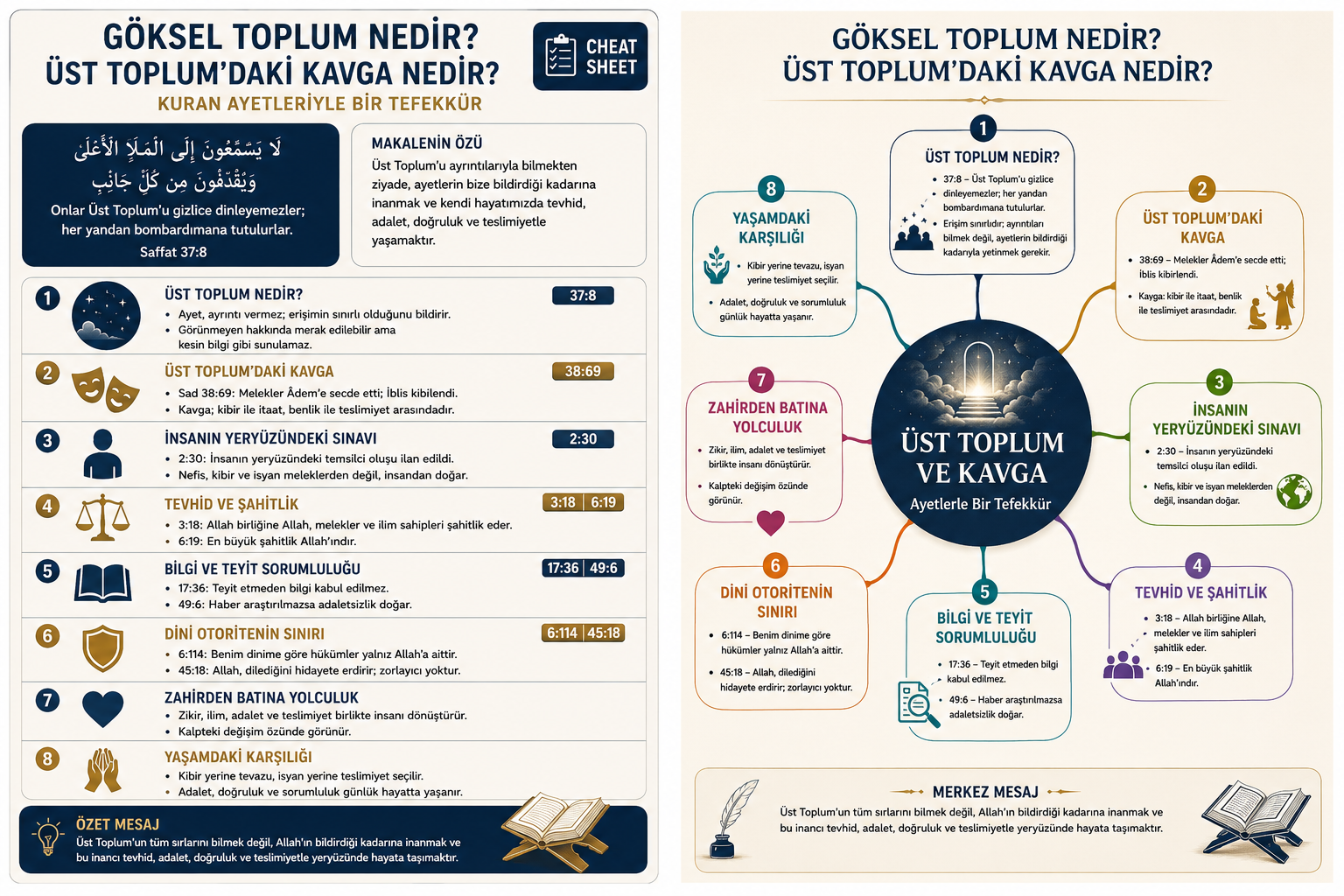
1. The High Society: A Society That Cannot Be Spied Upon
Verse
Arabic — 37:8
لَّا يَسَّمَّعُونَ إِلَى ٱلْمَلَإِ ٱلْأَعْلَىٰ وَيُقْذَفُونَ مِن كُلِّ جَانِبٍ
English — 37:8
They cannot spy on the High Society; they get bombarded from every side.
English — 37:8 - They cannot spy on the High Society; they get bombarded from every side.
Source: kuranteyit.com
Reflection on the Verse
The first thing that makes me stop at 37:8 is that it does not describe the “High Society” in detail. Instead of telling us exactly who occupies which position, the verse shows a boundary: they cannot secretly listen to the High Society. So the first information given to me is not every detail of the unseen, but the fact that access is limited.
For me, this is not merely a detail of cosmology; it is directly an ethic of knowledge. In Not Accepting Without Verification, I reflected that the fact that a statement is repeated many times does not make it true. I see a similar boundary here: the existence of many narratives about the unseen does not turn all of them into knowledge. I can say what 37:8 says; I can be curious about what it does not say, but I cannot present that curiosity as certain knowledge. (37:8)
While developing Kuranteyit, I see how quickly search, linking, and comparison capabilities can give a person the feeling, “I know more.” Yet access and knowledge are not the same thing. An abundance of data is not automatic access to truth. In the case of the High Society this distinction is even sharper: I have no observational device, recording, or human eyewitness testimony in my hands; I have the verse that has been disclosed to me.
For this reason, when I read 37:8, the first attitude that arises in me is reverence before curiosity. Remaining silent where I do not know does not look like a deficiency to me. On the contrary, I feel the measure I reached in Is Comparing Quran Translations Doubt or Responsibility? appearing here in a deeper form: carrying only as much as the source gives is safer than completing what the source does not give with my own sentence. The first lesson of the High Society for me is not to multiply the unseen, but to accept the boundary of knowledge. (37:8)
2. The Source of Knowledge About the Dispute
Verse
38:69 — “I had no knowledge previously, about the feud in the High Society.*
38:70 — “I am inspired that my sole mission is to deliver the warnings to you.”
Reflection on the Verse
The sentence in 38:69 affects me especially because it establishes the limit of knowledge before speaking about the dispute itself: “I had no knowledge previously.” Then 38:70 says that this information is inspired. Thus the first condition for speaking about the dispute is knowing the source of the information. This report is not presented as something discovered through human intuition, tradition, or imagination. (38:69-70)
At this point I return to the question in my essay Can Artificial Intelligence Explain the Quran? The Tool of Knowledge and the Responsibility of Understanding. A tool can find thousands of connections, a person can read texts for years, and a narrative can be constructed in an extremely persuasive way. But persuasiveness is not revelation. Speed is not testimony. The fact that something can be narrated does not mean that it is known. 38:69 reminds me of this distinction very simply.
It is natural for me to look at the verses after 38:69 in order to understand the nature of the dispute. The text immediately takes us to the creation of the human being, the command given to the angels, and Satan’s refusal. Yet here I place a limit on my own mind: the immediate context gives me a strong direction, but I still cannot say that “38:69 by itself describes every detail of the dispute.” What I can do is honestly show the proximity established by the verses.
In The Weight of Testimony, I reflected that every word we speak about GOD actually carries the weight of testimony. I feel the same responsibility regarding the dispute in the High Society. When forming a sentence, I have to ask not only “Is it impressive?” but “Does it really carry only as much as the verse carries?” For me, faith and intellectual humility are inseparable here. (38:69-70)
3. The Immediate Context of the Dispute: Human Being, Angels, and Satan
Verse
38:71 — Your Lord said to the angels, “I am creating a human being from clay.
38:72 — “Once I design him and blow into him from My spirit, you shall fall prostrate before him.”
38:73 — The angels fell prostrate, all of them,
38:74 — except Satan; he refused, and was too arrogant, unappreciative.
Reflection on the Verse
Immediately after the report of the dispute in 38:69, verses 38:71-74 bring the creation of the human being, the command to the angels to prostrate, and Satan’s refusal. This flow of the text does not look like a random neighborhood to me. I see a strong indication that the center of the dispute concerns the attitude taken before GOD’s command. The angels carry out the command; Satan refuses, and the verse explicitly names his arrogance. (38:69, 38:71-74)
What draws my attention here is that before the question of Adam’s personal superiority comes the command of GOD. GOD is the One who gives the command to prostrate. Those who obey are obeying GOD; the one who refuses is refusing GOD’s command. So at the center of the scene is not a hierarchy that sanctifies the human being, but the source of authority.
In Turning Back on One’s Heels: Preserving Direction After Guidance, I asked myself: When people’s approval, an authority, habit, or my own ego conflicts with GOD’s clear guidance, who determines my direction? I see the same question here in a much earlier and more striking form. When the command is clear, does the created being place his own measure ahead of the command, or does he submit?
For this reason, the dispute in the High Society does not remain for me merely a curiosity about an unseen event in the past. It becomes a question of authority that reappears in smaller forms every day on earth. When I make a decision, defend something, exalt a person, or give excessive weight to my own opinion, I face the same basic question: Who has the final word? This is where the verses take me. (38:71-74)
4. The Logic of Pride: “I Am Better Than He”
Verse
38:75 — He said, “O Satan, what prevented you from prostrating before what I created with My own hands? Are you too arrogant? Have you rebelled?”
38:76 — He said, “I am better than he; You created me from fire and created him from clay.”
Reflection on the Verse
In 38:75-76, the language of Satan’s refusal opens up: “I am better than he.” This sentence shows me that pride is not merely an emotional sense of greatness. Pride here establishes a measure, makes a comparison, and then places its own measure above GOD’s command. Satan attributes creation to GOD, yet his knowledge does not lead him to submission. (38:75-76)
This point strongly intersects for me with Mizan: Mix, Mastering, and Measure in the Quran. When I raise a sound too much in the studio, that sound does not become “better” by itself; it often covers other layers and disturbs the balance of the whole. The ego resembles this. When it constantly raises itself, it does not make truth more visible; on the contrary, it can mask other measures. Satan’s sentence “I am better” feels to me like the created self pushing its own fader all the way up.
In Whom Does the Microphone Exalt? ZIKR RAP, Speech, and Responsibility, I reflected that “the microphone amplifies the voice; it does not purify intention.” There is a similar distinction here. Knowledge, power, talent, or difference can give a person an amplifier, but none of these places a person’s measure above GOD’s measure.
So I cannot read 38:76 merely as Satan’s sentence and move on. Quieter forms of “I am better” can live within me too: I know more, I understand more correctly, my method is more reliable, my circle is cleaner, my work is more meaningful… No matter how religious such a sentence may appear, if it carries me away from justice and submission, it is dangerous. The verse calls me not to diagnose another person’s pride first, but to test my own measure. (38:75-76)
5. The Continuing Claim of Rebellion and the Boundary of Sincere Devotion
Verse
38:77 — He said, “Therefore, you must be exiled, you are banished.
38:78 — “You have incurred My condemnation until the Day of Resurrection.”
38:79 — He said, “My Lord, respite me until the Day of Resurrection.”
38:80 — He said, “You are granted a respite.
38:81 — “Until the appointed day.”
38:82 — He said, “I swear by Your majesty that I will mislead them all.
38:83 — “Except Your worshipers who are absolutely devoted to You alone.”
Reflection on the Verse
38:77-83 shows that Satan’s refusal was not a momentary objection. He is expelled, asks for respite, and says that he will mislead people. Yet even within his own statement a limit appears: “Except Your worshipers who are absolutely devoted to You alone.” This expression is very important to me because it places not the strength of the ego, but sincere devotion to GOD opposite the claim of misguidance. (38:77-83)
While producing Neo-Sacred Zikr, I often ask myself this question: When sound, genre, stage, technology, and artist identity are removed, does there remain a direction that truly remembers GOD? In Expressing Tawhid in the Language of the Age: Can Form Change Without Changing the Message?, I reflected that form is a tool while the center is the truth that must not change. In 38:83 this center appears very simply: absolute devotion to GOD alone.
This takes tawhid out of being an abstract sentence for me. Tawhid becomes the inner architecture of my allegiances. When my fear, desire for reputation, people’s applause, approval from a religious circle, an art project, a technology, or my own thought moves ahead of GOD, devotion can fragment. An idol may not always appear to me as a statue; sometimes the need for approval that I cannot let go of can occupy the same place within me.
Satan’s claim is great, but the boundary set by 38:83 creates an even greater inward responsibility. I cannot completely outsource my own choices by saying “I was misled.” Sincere devotion is a direction I have to rebuild continually. As I saw in Deep Reverence: Remembering, Covenant Faithfulness, and Turning to GOD Alone, true reverence is not only a feeling; it is a way of life that preserves the direction of allegiance. (38:77-83)
6. The Source of Knowledge: The Angels’ Question and Awareness of Limits
Verse
2:30 — Recall that your Lord said to the angels, “I am placing a representative (a temporary god) on Earth.” They said, “Will You place therein one who will spread evil and shed blood, while we sing Your praises, glorify You, and uphold Your absolute authority?” He said, “I know what you do not know.”
2:31 — He taught Adam all the names,* then presented them to the angels, saying, “Give Me the names of these, if you are right.”
2:32 — They said, “Be You glorified. We have no knowledge except that which You have taught us. You are the Omniscient, Most Wise.”
2:33 — He said, “O Adam, tell them their names.” When he told them their names, He said, “Did I not tell you that I know the secrets of the heavens and the earth? I know what you declare and what you conceal.”
Reflection on the Verse
The difference between the angels’ question and Satan’s objection in 2:30-33 is very instructive to me. The angels ask; GOD says, “I know what you do not know.” Then Adam is taught the names, and the angels make a very clear statement: “We have no knowledge except that which You have taught us.” (2:30-33)
I do not see submission here as the opposite of asking questions, but humility of knowledge as the opposite of pride. Asking a question is not rebellion in itself. Being able to accept one’s limit after learning what one did not know is, in my view, one of the cleanest forms of knowledge. In Not Accepting Without Verification, I reflected that research is an ethic that protects conscience; here another step is added to that ethic: even after researching, knowing what you still do not know.
This is also one of the risks that concerns me most while developing a research tool such as Kuranteyit. As search results multiply and roots and connections become visible, a person can begin to imagine himself the owner of meaning. Yet the tool merely opens the way before me; it does not give me absolute knowledge. In Should a Quran App Issue Rulings? The Boundary Between Tool and Authority, I therefore considered it important for the tool to know its own limits. The statement of the angels in 2:32 summarizes for me the ethics of the researcher, the developer, and the reader alike.
2:33 says that GOD knows what is declared and what is concealed. This makes me think that truthfulness is not only about the sentence I say outwardly. If I do not know something but want to appear as though I know it, my outward sentence may be polished while my inward intention is corrupted. In The Weight of Testimony, I reflected on why knowledge and justice meet within the same testimony; here I see another side of it: knowledge has value when it exists not to enlarge the ego, but to approach truth more honestly. (2:30-33)
7. The Fine Line Between Submission and Pride
Verse
2:34
We said to the angels, “Fall prostrate before Adam.” They fell prostrate, except Satan; he refused, was too arrogant, and was a disbeliever.
Reflection on the Verse
2:34 sets the scene out very simply: the angels prostrate; Satan refuses, becomes arrogant, and falls into disbelief. The fundamental contrast the verse gives me is not between “the one who knows much” and “the one who knows little,” but between the one who submits when he hears the command and the one who makes his own self the measure. (2:34)
In Mizan, I wrote that I do not see balance as bringing everything to the same level. Giving an element its due does not mean giving it unlimited space. Here I turn that thought toward my own self. My self also has a place in life; thinking, deciding, producing, and questioning are capacities given to me. But giving the self its due is not making it the ultimate authority.
Pride therefore may not always appear in a crude form. Sentences such as “I am only thinking,” “I am only questioning,” or “I only trust my own reason” can be legitimate and healthy. But if in the end I make my own preference untouchable in the face of GOD’s clear guidance, the issue is no longer thinking; it is displacing authority.
I do not understand submission as the erasure of personality. On the contrary, I understand it as honestly knowing where the human being is created and limited. 2:34 makes me think that true freedom does not come from determining everything by myself, but from finding my proper place before the One who created me. (2:34)
8. The Method of Hostility: Ambush on the Straight Path
Verse
7:16 — He said, “Since You have willed that I go astray,* I will ambush them on Your straight path.
7:17 — “I will come to them from before them, from behind them, from their right, and from their left, and You will find most of them unappreciative.”
7:18 — He said, “Get out of there, despised and defeated. Those among them who follow you; I will fill Hell with all of you.
Reflection on the Verse
Satan’s statement in 7:16-17 that he will lie in ambush “on the straight path” makes me think every time. The danger does not exist only outside the path; it can also appear where a person thinks he is on the right path. The expressions front, back, right, and left make me feel that misguidance does not come through only one channel. (7:16-17)
While writing Turning Back on One’s Heels, I realized that the hardest question was not questioning another person’s direction, but questioning my own. It is easy to describe how someone else went astray; seeing when I myself turn back is harder. When people’s approval, a religious authority, habit, fear, interest, or my own ego conflicts with what I know to be right, in which direction do I turn?
7:18 gives me another balance. Satan is described as a real enemy, but not as an independent power rivaling GOD. This matters to me. Underestimating the enemy can be naive; absolutizing him can be another deviation. Tawhid also corrects the center of fear. Satan may call, but sovereignty is not his. (7:18)
In Deep Reverence, I reflected that where a person anchors his deepest fear, hope, and accountability reveals his true direction. The same measure comes into play here. If I give all my attention to Satan’s power and push GOD’s authority into the background, I shift the center even while describing the danger. The verses call me to remain both alert and balanced. (7:16-18)
9. Lies, Appearance, and Human Susceptibility to Deception
Verse
7:20 — Satan whispered to them, in order to reveal their bodies, which were invisible to them. He said, “Your Lord prohibited you from this tree only to prevent you from becoming angels and from attaining eternal existence.”
7:21 — He swore to them, “I am giving you good advice.”
7:22 — He thus duped them with lies. As soon as they tasted the tree, their bodies became visible to them, and they tried to cover themselves with the leaves of Paradise. Their Lord called upon them: “Did I not enjoin you from that tree, and warn you that the devil is your most ardent enemy?”
7:23 — They said, “Our Lord, we have wronged our souls, and unless You forgive us and have mercy on us, we will be losers.”
7:24 — He said, “Go down as enemies of one another. Your habitation and provision shall be on earth for a while.”
Reflection on the Verse
What strikes me most in 7:20-22 is that the lie does not look ugly. Satan does not openly announce his bad intention; on the contrary, he promises a higher mode of existence and permanence, and then swears, “I am giving you good advice.” Deception thus arrives in the language of goodness. (7:20-22)
This returns me, in relation to speech and appearance, to my own productions as well. In Whom Does the Microphone Exalt?, I reflected that a strong slogan, a beautiful production, or a religious word does not automatically purify intention. In the same way, advice that looks good cannot be accepted as truth without testing its source and outcome. The fact that a sentence is impressive does not mean that it is true.
In the digital world this test becomes even more visible. Headlines, videos, short sentences, and algorithmic feeds often give us emotion first and content second. In Not Trading Away Revelations for a Cheap Price: The Commercialization of Digital Religion, I reflected on the danger of a religious message changing form for the sake of visibility, attention, or gain. The appearance of “good advice” in 7:21 makes me ask the same basic question: Am I weighing the word by its appearance, or by its truth?
Yet the part of this account that does not leave me in despair is 7:23. Adam and his spouse say that they wronged their own souls. Satan defends his superiority, while they acknowledge their error. For me, the spiritual difference is precisely here: making a mistake and turning the mistake into a defense of my identity are not the same thing. The door of return opens where I can honestly say “I was wrong” instead of trying to appear right. 7:24 reminds us that this hostility is part of life on earth. (7:23-24)
10. Forgetfulness, Indecision, and Returning to Guidance
Verse
20:115 — We tested Adam in the past, but he forgot, and We found him indecisive.
20:116 — Recall that We said to the angels, “Fall prostrate before Adam.” They fell prostrate, except Satan; he refused.
20:117 — We then said, “O Adam, this is an enemy of you and your wife. Do not let him evict you from Paradise, lest you become miserable.
20:118 — “You are guaranteed never to hunger therein, nor go without clothing.
20:119 — “Nor will you thirst therein, nor suffer from heat.”
20:120 — But Satan whispered to him, saying, “O Adam, let me show you the tree of eternity and a kingship that never ends.”
20:121 — They ate from it, whereupon their bodies became visible to them, and they tried to cover themselves with the leaves of Paradise. Adam thus disobeyed his Lord, and fell.
20:122 — Subsequently, his Lord chose him, redeemed him, and guided him.
20:123 — He said, “Go down therefrom, all of you. You are enemies of one another. When guidance comes to you from Me, anyone who follows My guidance will not go astray, nor suffer any misery.
Reflection on the Verse
The expressions in 20:115, “he forgot” and “We found him indecisive,” do not explain the human fall only through bad intention. Sometimes losing direction begins with forgetting. Sometimes a person does not deny what he knows; he simply fails to carry the weight of what he knows in that moment. Satan then approaches with the promise of eternity and a kingdom that never ends. (20:115-121)
While reading these verses, the image of direction from Turning Back on One’s Heels returns to me. A person does not have to lose all faith in an instant; sometimes a small act of forgetting, a small concession, or a decision called “for now” can slowly change the direction. Turning back often begins not with a great declaration, but with the center quietly shifting.
The words “eternity” and “a kingdom that never ends” in 20:120 touch two powerful human desires: not to lose, and to rule. I cannot read this merely as an ancient scene. As an artist, my wish for the work I produce to endure; as a software developer, my wish for the project I build to grow; as a human being, my wish not to be forgotten—these are understandable feelings. But when these desires move ahead of submission to GOD, the promise of a “kingdom that never ends” can be reconstructed for me in another form.
20:122-123, however, carries great hope for me. After the fall there is choosing, redemption, and guidance. In Deep Reverence, I reflected that faithfulness to the covenant is not merely a promise given in the past, but a direction remembered anew every day. Here too there is a call to follow guidance when it comes. So the main counterpart of the heavenly dispute in my life is less curiosity about what happened in the past and more what I do today when guidance reaches me. (20:122-123)
11. The Danger of Taking Satan and His Descendants as Lords
Verse
18:50 — We said to the angels, “Fall prostrate before Adam.” They fell prostrate, except Satan. He became a jinn, for he disobeyed the command of his Lord.* Will you choose him and his descendants as lords instead of Me, though they are your enemies? What a miserable substitute!
18:51 — I never permitted them to witness the creation of the heavens and the earth, nor their own creation. Nor do I permit the wicked to work in My kingdom.*
Reflection on the Verse
While recounting the scene of prostration, 18:50 turns the question directly toward the human being: “Will you choose him and his descendants as lords instead of Me?” This sentence turns the subject of the dispute into a question of authority for me. Loving something, listening to it, or benefiting from it is not the same thing as taking it as a lord. Lordship concerns ultimate allegiance and determining authority. (18:50)
This verse directly intersects with the central question of Should a Quran App Issue Rulings? The Boundary Between Tool and Authority. While developing Kuranteyit, I reflected that a tool can make research easier, but should not become an office that issues judgments on behalf of the user. No matter how advanced the tool becomes, it should not replace the source. The same principle applies to human beings: a teacher, scholar, writer, artist, messenger, or technology may be useful; but when it becomes a lord in place of GOD, the boundary has been crossed.
18:51 also limits claims to knowledge. A being who was not made a witness to creation cannot claim absolute authority over creation. This reminds me of the distinction between person and message that I emphasized in The Messenger Is the Quran, the Quran Is the Living Messenger. Putting a valuable carrier in front of the message, imprisoning the message’s function within the person, or replacing the source with a tool is a dangerous displacement from the standpoint of tawhid.
As I read this verse, I ask myself: Which voices in my life stop being “consulted” and become “the ones with the final word”? My own mind, my circle, a religious person, a technological system, or my own creations… Each may be useful in its proper place. But when the position of “Lord and Master” is moved elsewhere, even the most useful tool can become a miserable substitute. (18:50-51)
12. Satan’s Admission: He Had No Compelling Power
Verse
14:22
And the devil will say, after the judgment has been issued, “GOD has promised you the truthful promise, and I promised you, but I broke my promise. I had no power over you; I simply invited you, and you accepted my invitation. Therefore, do not blame me, and blame only yourselves. Neither my complaint can help you, nor can your complaint help me. I have disbelieved in your idolizing me. The transgressors have incurred a painful retribution.”
Reflection on the Verse
14:22 narrows the space for escape regarding human responsibility. After judgment, Satan says, “I had no power over you; I simply invited you, and you accepted my invitation.” There is misguidance, there is a call, there is a deceptive promise; but there is no coercive power that completely cancels human will. (14:22)
This verse takes me to an uncomfortable but necessary place: I cannot place my error entirely outside myself. My environment, an algorithm, a leader, culture, fear, or Satan may influence me; but that influence does not remove all responsibility from me. In Can Artificial Intelligence Explain the Quran?, I likewise reflected that no matter how powerful the tool may be, it cannot assume the person’s responsibility in 17:36. Here the same principle appears more broadly: another may issue the invitation, but I am still the one who accepts it.
This perspective also protects me from unnecessary fear. I do not want to think of Satan as a power rivaling GOD. The verse itself says that he had no compelling dominion. The danger is real, but it is not absolute. Responsibility therefore returns to me, and absolute power to GOD.
For me, spiritual maturity means giving up both writing every success entirely to myself and writing every failure entirely outside myself. Seeing my share in my choices also makes repentance more real. Because if I truly chose, I can truly return. 14:22 therefore carries not only accusation, but also the weight of being a moral agent. (14:22)
13. Testimony, Truthfulness, Knowledge, Justice, and Submission
Verse
3:17 — They are steadfast, truthful, submitting, charitable, and meditators at dawn.
3:18 — GOD bears witness that there is no god except Him, and so do the angels and those who possess knowledge. Truthfully and equitably, He is the absolute god; there is no god except Him, the Almighty, Most Wise.
3:19 — The only religion approved by GOD is “Submission.” Ironically, those who have received the scripture are the ones who dispute this fact, despite the knowledge they have received, due to jealousy. For such rejectors of GOD’s revelations, GOD is most strict in reckoning.
Reflection on the Verse
3:17-19 seems to gather all the concepts scattered throughout this article into one center. Steadfastness, truthfulness, submission, charity, and reflection; then testimony to the oneness of GOD, the testimony of the angels and those who possess knowledge, justice, power, and wisdom… and then submission. They appear connected in the same flow as though they are not separate virtues. (3:17-19)
When writing The Weight of Testimony, 3:18 was a verse that remained open for me for a long time. In that essay, I reflected that testimony is not merely a sentence spoken by the mouth; life must also bear witness to that sentence. When I come here from the context of the dispute in the High Society to 3:18, that thought becomes even heavier. Satan did not lack knowledge of GOD’s existence; the issue was how he stood before the truth he knew. Correct knowledge, then, is not enough by itself without correct direction.
As a musician, I know very well that a microphone amplifies sound. As a producer, I also know that good production can make a sentence feel powerful. But the conclusion I reached in Whom Does the Microphone Exalt? applies here as well: volume is not the truthfulness of testimony. A person can say “GOD is one” very powerfully; but if injustice, pride, or taking human beings as lords contradicts that statement, the testimony weakens in his life.
In 3:18, the testimony of those who possess knowledge stands beside being “truthful and equitable.” For me, this shows that knowledge is a responsibility, not a privilege. The more I research, the more I do not gain the right to speak harshly; instead, I carry a greater obligation to be careful. Bearing witness to the oneness of GOD does not mean easily judging others; it means first correcting my own language, measure, and allegiances before that oneness.
Tawhid is therefore not merely a metaphysical sentence for me. It becomes visible in how I use knowledge, for whom I protect justice, at what cost I speak the truth, and at which moment I choose submission over my ego. I feel the earthly moral echo of the dispute in the High Society most strongly here. (3:17-19)
14. The Ethics of Knowledge: Not Accepting Without Verification
Verse
17:36
Do not accept any information unless you verify it for yourself. I have given you the hearing, the eyesight, and the brain, and you are responsible for using them.
Reflection on the Verse
17:36 has become one of the verses I return to frequently in my intellectual life. “Do not accept any information unless you verify it for yourself.” This sentence becomes even weightier when I come to an unseen subject such as the High Society. Here there is a realm a person cannot verify through personal observation; therefore I have to hold even more tightly to the boundary of the revelation disclosed to me as the reliable basis. (17:36)
This was also the starting point of Not Accepting Without Verification: verification is not merely an academic method, but an ethic that protects conscience and language. I cannot automatically turn a claim into knowledge because I like it, because it supports my line of belief, or because someone I trust says it. With the unseen, this responsibility becomes even more important.
In Is Comparing Quran Translations Doubt or Responsibility?, while describing the birth of Kuranteyit, I wrote that the project began first as a kind of study desk for myself and my wife. The aim was not to replace the Authorized Translation I accept with another authority, but to understand it more carefully. I want to preserve the same measure today. A tool should make research easier; it should not hand me a ready-made judgment.
As a software developer, I know how persuasive a user interface can be. When a result is shown at the top, a box is labeled “analysis,” or the system uses highly certain language, a person can trust it without noticing. Yet the feeling of certainty on the screen does not remove the personal responsibility in 17:36. So in every explanation I read, hear, or produce about the High Society, I have to ask myself the same question: Does this really rest on the verse, or am I filling a gap with a beautiful sentence? (17:36)
15. The Limit of Religious Authority: Unauthorized Rulings
Verse
42:21
They follow idols who decree for them religious laws never authorized by GOD. If it were not for a predetermined decision, they would have been judged immediately. Indeed, the transgressors have incurred a painful retribution.*
Reflection on the Verse
42:21 establishes one of the boundaries in religious authority that frightens me most: decreeing religious laws not authorized by GOD. The problem here is not that human beings think or teach about religion; it is turning something not authorized by GOD into a binding religious ruling in GOD’s name. (42:21)
This verse reopens the fundamental question of Should a Quran App Issue Rulings? The Boundary Between Tool and Authority. How easily can software produce expressions such as “halal,” “haram,” “definitive ruling,” or “this is what GOD wants”? Technically, very easily. Ethically, however, the weight is enormous. My ability to write code does not give me authority to legislate in GOD’s name. Likewise, the fact that a person is widely followed, widely read, or recognized as an expert in religion does not turn that person into a source of law above revelation.
In The Messenger Is the Quran, the Quran Is the Living Messenger, I wrote that I see the value of the human messenger in faithfully carrying the message. When the distinction between message and carrier is not preserved, the person can easily move to the center. 42:21 shows me the form this takes in the realm of law and judgment: if the source of authority is GOD, religious authority cannot place itself in that source’s position.
I do not want to produce an easy label here for accusing others. I see myself as the first addressee of this verse. When writing, teaching, developing an app, or speaking about a verse, how clearly do I leave my own interpretation as “interpretation”? Do I turn a possibility into a definitive ruling? Do I use people’s trust in me to say what the verse does not say? For me, religious responsibility begins precisely at this boundary. (42:21)
16. The Danger of Taking Human Beings as Lords
Verse
9:31
They have set up their religious leaders and scholars as lords* in place of GOD. Others deified the Messiah, son of Mary. They were all commanded to worship only one god. There is no god except Him. Be He glorified, far above having any partners.
Reflection on the Verse
9:31 shows the danger of taking human beings as lords directly through religious leaders and scholars. At the end of the verse, the measure is again tawhid: worshiping one god and accepting that there is no god beside Him. The issue is therefore not merely “loving the wrong person,” but enlarging authority until it is moved into GOD’s place. (9:31)
While reading this verse, I remember the sensitivity to language I emphasized in How Can Tawhid Be Distorted by a Single Word? One GOD or ‘Highest of the High’? Tawhid can become blurred not only in grand theories, but through seemingly small displacements. A word, a title, a person, or an institution can quietly occupy more space than it should.
For the same reason, in The Messenger Is the Quran, the Quran Is the Living Messenger, I tried to preserve especially the boundary between the human messenger and the message. Respect for the messenger does not mean turning him into an independent religious authority beside GOD. Respect for a knowledgeable person does not mean making that person an unquestionable lord. Preserving this distinction does not leave the human being alone; it assigns responsibility to the correct place.
In my own life, I know this risk is not limited to other people’s religious leaders. An artist can become an invisible authority for listeners, a writer for readers, and a developer for users. As people’s trust grows, so does the risk that a person forgets his own limit. My task, therefore, is not to place myself at the center, but to leave the source visible as much as possible. A person can be useful; he is not a lord. A tool can be powerful; it does not own the judgment. (9:31)
17. The Arabic Roots of Key Words
Verse
37:8 — They cannot spy on the High Society; they get bombarded from every side.
38:69 — “I had no knowledge previously, about the feud in the High Society.*
3:18 — GOD bears witness that there is no god except Him, and so do the angels and those who possess knowledge. Truthfully and equitably, He is the absolute god; there is no god except Him, the Almighty, Most Wise.
Reflection on the Verse
Some Arabic roots in these verses help me see more carefully how the concepts of “High Society,” “dispute,” “knowledge,” “testimony,” “justice,” and “lordship” connect with one another. But I do not want to use the root as though it were a secret key that replaces the verse. Root information may be a lens that enlarges meaning for me; it is not a new source of revelation.
The expression translated into Turkish as “High Society” in 37:8 and 38:69 is الْمَلَإِ الْأَعْلَىٰ. Mala’, related to the root م ل أ (m-l-ʾ), opens to the semantic field of a group or assembly; a’la, from the root ع ل و (ʿ-l-w), carries the meaning of high or higher. The expression “High Society” therefore carries both the idea of a society and its highness. (37:8; 38:69)
The word for “dispute” in 38:69 is يَخْتَصِمُونَ, based on the root خ ص م (kh-s-m). The root opens to the semantic field of disputing, adversarial conflict, and mutual argument. This makes me think that the dispute carries a real dimension of disagreement; yet the root itself does not tell the whole story of the dispute. For the details, I still have to return to the flow of verses in 38:71-83.
The عِلْم (ʿilm) in the same verse comes from the root ع ل م (ʿ-l-m) and belongs to the field of knowledge. When the emphasis of 38:69, “I had no knowledge,” is placed beside the statement in 2:32, “We have no knowledge except that which You have taught us,” I see the account of the dispute almost surrounded by humility of knowledge.
The شَهِدَ (shahida) in 3:18 comes from the root ش ه د (sh-h-d) and means bearing witness; الْقِسْط (al-qist), through the root ق س ط (q-s-t), carries the meanings of justice and equity. Thus testimony to tawhid stands beside knowledge and justice in the verse’s own sentence. The أَرْبَابًا (arbaban), translated as “lords” in 9:31, is connected through the root ر ب ب (r-b-b) to the field of “lord/master.” Here I feel more clearly why the question of religious authority turns directly into a question of tawhid.
In Is Comparing Quran Translations Doubt or Responsibility? and How Can Tawhid Be Distorted by a Single Word?, I reflected that roots, language, and translation differences are valuable to me only to the extent that they help me read the text more carefully. I preserve the same boundary here. Roots should not rise above the verse; they should make more visible the relationship already present within the verse. (37:8; 38:69; 3:18; 9:31)
18. Other Claims
Verse
38:69 — “I had no knowledge previously, about the feud in the High Society.*
38:71 — Your Lord said to the angels, “I am creating a human being from clay.
38:72 — “Once I design him and blow into him from My spirit, you shall fall prostrate before him.”
38:73 — The angels fell prostrate, all of them,
38:74 — except Satan; he refused, and was too arrogant, unappreciative.
38:75 — He said, “O Satan, what prevented you from prostrating before what I created with My own hands? Are you too arrogant? Have you rebelled?”
38:76 — He said, “I am better than he; You created me from fire and created him from clay.”
Reflection on the Verse
I know that historical and traditional interpretations contain different details about the High Society. One common approach understands the expression “High Society” as the heavenly assembly in which the angels are present. The fact that the address to the angels begins immediately after 38:69 makes this interpretation understandable. Even so, I do not want to forget that the verse itself does not list every member of the High Society one by one. Therefore I do not consider it right to make a ruling such as “it consists definitely and only of these beings.”
Another approach says that the dispute in 38:69 is directly related to Satan’s refusal of the command to prostrate before Adam and his challenge to GOD’s absolute authority. The fact that 38:71-76 follows immediately gives this reading strength. Rashad Khalifa’s footnote to 38:69 likewise states that the feud was triggered by Satan’s challenge to GOD’s absolute authority. I take this explanation into account, but I still do not mix the verse text with the explanatory footnote. The verse reports “the feud in the High Society”; the verses that follow provide a strong context for understanding the nature of the dispute.
In narration-based traditions, “the dispute of the high assembly” has been explained in different ways. I do not carry each of those interpretations into the main structure of this article. The aim of this essay is not to build the most detailed possible picture of the unseen, but to think honestly only as far as the verses in my hands allow.
In How Can Tawhid Be Distorted by a Single Word?, I tried to preserve the boundary between reading intention into a person and showing a difference of meaning in the text. I follow the same method here: I do not reject an interpretation merely because it is traditional, nor do I accept it as certain merely because it is old. I first distinguish what the verse says from how strongly the interpretation rests on the verse. These outside approaches do not determine my main conclusion; they only make differing possibilities of reading visible with caution. (38:69, 38:71-76)
19. Conclusion
Verse
36:60 — O children of Adam, did I not covenant with you that you shall not worship the devil? He is your most ardent enemy.
36:61 — And that you shall worship Me alone? This is the right path.
Reflection on the Verse
When I consider these verses together, the most solid answer I can give to the question of the “heavenly society” is this: the Quran speaks of the “High Society” in 37:8 and 38:69. 37:8 mentions this society in a context closed to satanic secret listening. 38:69 reports that there was a “dispute” there. The immediately following 38:71-83 describes the creation of the human being, the command given to the angels, Satan’s refusal, his pride, his claim of superiority, and his oath to mislead human beings. It can therefore be strongly understood that the dispute concerns obedience and rebellion before GOD’s authority; yet I do not want to narrate details the verse does not state as though they were certain history. (37:8; 38:69-83)
36:60-61 brings this entire great narrative down into my life: do not worship Satan, and worship GOD alone. The dispute here ceases to be a distant cosmic event. It becomes questions about whose word I accept as final, what I take as a lord, which information I carry without verification, how much I enlarge my own self, and how much I submit before truth. (36:60-61)
While writing this article, I saw more clearly that my earlier writings were not separate, disconnected titles. The Weight of Testimony reminds me that tawhid is lived through knowledge and justice; Not Accepting Without Verification that knowledge is personal responsibility; Mizan that measure means not raising something without limit but giving it its proper place; Turning Back on One’s Heels that direction must be preserved after guidance; Should a Quran App Issue Rulings? that tool and authority must not be confused; and Expressing Tawhid in the Language of the Age that even if form changes, the center must not. The dispute in the High Society ties all these questions to a more fundamental place: Where does the created being stand before ultimate authority?
As a composer, guitarist, and producer I work with sound; as a mix-mastering engineer, with balance; as a software developer, with tools; and as a Quran researcher, with connections between words and verses. But perhaps the most valuable lesson all these fields give me is the same: the tool should not replace the source. Sound should not replace truth. Technology should not replace testimony. Knowledge should not replace submission. And the human being should not replace GOD.
For this reason, 3:18 remains one of the central verses of this article for me. Testimony to the oneness of GOD stands beside knowledge and justice. 17:36 shows the responsibility of verification, 42:21 the danger of unauthorized religious rulings, and 9:31 the risk of taking human beings as lords. The measure these verses give together takes tawhid out of being merely a spoken statement of belief and turns it into a way of life that tests all my relationships with authority. (3:17-19; 17:36; 42:21; 9:31)
The deepest reflection I reach before these verses is this: at the center of the dispute lies the possibility that a created self places its own judgment ahead of GOD’s authority. The path opposite this is not to stop thinking, but to know the limits of knowledge, be just, be truthful, verify, recognize pride, and submit to GOD alone. The angels’ statement, “We have no knowledge except that which You have taught us,” is therefore for me not merely a statement about knowledge, but an ethic of servitude. (2:32)
More important than learning every detail of the heavenly society may be recognizing the echo of the heavenly dispute within myself. Every day I choose between the self that says “I am better” and the humility that says “We have no knowledge except that which You have taught us.” Every day I stand between verifying a statement and accepting it easily, between justice and interest, between submission to GOD and taking other lords. At the end of this article, the sentence I tell myself is this: Do not be content with knowing the story of the dispute; continue testing your own direction, your own testimony, and whom you truly accept as Lord.
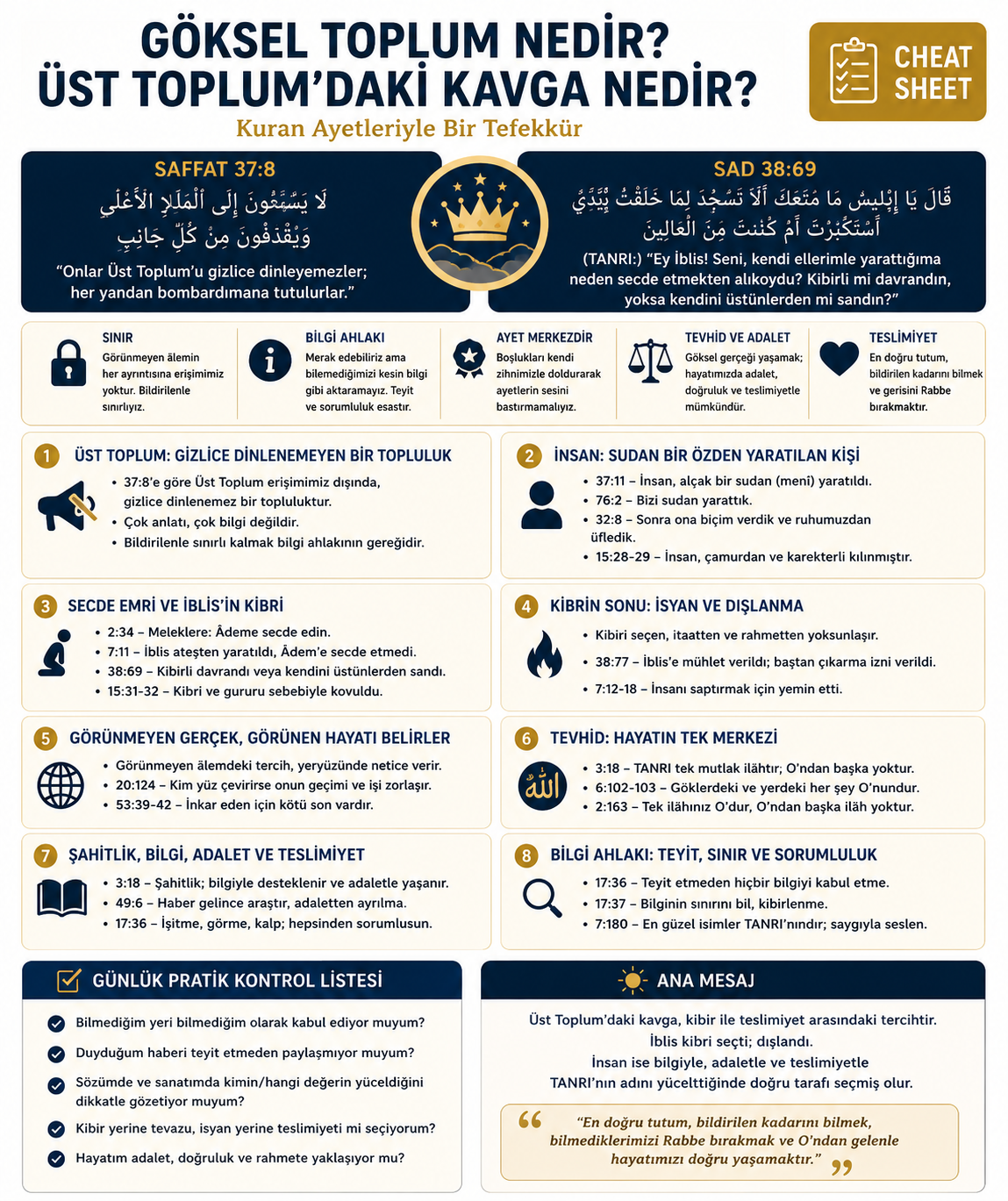
Note
2:32 — They said, “Be You glorified. We have no knowledge except that which You have taught us. You are the Omniscient, Most Wise.”
GOD knows best.
Source: kuranteyit.com
Discover
Related Articles
Quran Reflections
Proclaim: Do Not Conceal the Truth, Tie the Word to GOD
A personal and concise reflection on not concealing the truth, truthful speech, testimony, tawhid, justice, submission, and the limits of religious authority through Al-Baqarah 2:159-160 and the verses gathered under the theme “Proclaim.”
Read article
Quran Reflections
Turning Back on Your Heels: Preserving Your Direction After Guidance
A reflection centered on Al-Baqarah 2:143 on turning back on one's heels, sliding back after guidance, leaving the faith, casting scripture behind one's back, testimony, knowledge, justice, truthfulness, submission, and the limits of religious authority.
Read article
Quran Reflections
Deep Reverence for GOD: Ego, Disrespect, and the Inner Reality of Crossing the Boundary
A reflection through verses Al-Baqarah 2:40, Al-Hujurat 49:1, Sad 38:76, Al-Furqan 25:43, and An-Nazi'at 79:40-41 on deep reverence for GOD, ego, pride, transgression, truthful speech, knowledge, privacy, submission, and the limits of human authority.
Read article