Do Not Accept Without Verifying
A reflection on verifying information, investigating reports, witnessing, justice, personal responsibility, submission, and the limits of human authority through the verses Al-Isra 17:36 and Al-Hujurat 49:6.
- A Reflection on Verses 17:36 and 49:6 *
Author: Berk KÖKSAL
Date: 29.07.2026
Location: Mersin
Verse
1:1 — In the name of GOD, Most Gracious, Most Merciful.*
Introduction
Peace. Peace be upon you.
Sometimes a person believes a statement not because it is true, but because it has been repeated many times. Sometimes we trust the person bringing the news; at other times, because what is said fits our anger or expectations, we do not feel the need to investigate it.
17:36 pulls the human being away from this ease. 49:6 shows that an uninvestigated report is not merely an intellectual mistake; it can turn into injustice toward other people and then into regret. One looks at the inner world of the person, while the other looks at the wound that speech can open within society. Read together, verification ceases to be a dry research method and becomes an ethic that protects conscience, speech, and conduct.
Summary:
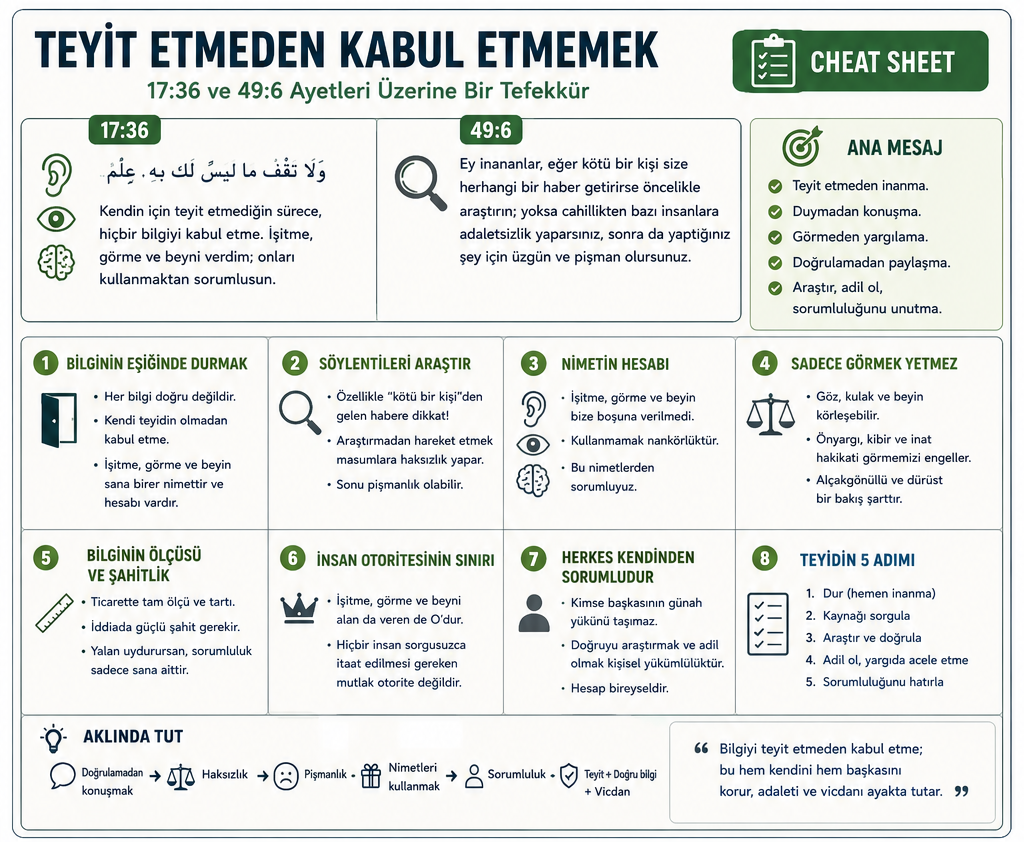
1. Pausing at the Threshold of Information
17:36
وَلَا تَقْفُ مَا لَيْسَ لَكَ بِهِۦ عِلْمٌ إِنَّ ٱلسَّمْعَ وَٱلْبَصَرَ وَٱلْفُؤَادَ كُلُّ أُو۟لَٰٓئِكَ كَانَ عَنْهُ مَسْـُٔولًا
You shall not accept any information, unless you verify it for yourself. I have given you the hearing, the eyesight, and the brain, and you are responsible for using them.
Do not accept any information unless you verify it for yourself. I have given you hearing, eyesight, and the brain, and you are responsible for using them.
2. Investigate Rumors Before Believing Them
49:6 — O you who believe, if a wicked person brings you any news, investigate first, lest you commit injustice against some people out of ignorance, then become sorry and remorseful for what you have done.
3. Hearing, Sight, and the Brain: Accountability for a Blessing
16:78 — GOD brought you out of your mothers' wombs knowing nothing, and He gave you hearing, eyesight, and the brain so that you may be appreciative.
23:78 — He is the One who granted you hearing, eyesight, and brains. Rarely are you appreciative.
32:9 — He shaped him and blew into him from His spirit. And He gave you hearing, eyesight, and brains; rarely are you appreciative.
67:23 — Say, “He is the One who initiated you and granted you hearing, eyes, and brains. Rarely are you appreciative.”
4. Seeing Is Not Enough; the Gaze Must Also Be Honest
7:179 — We have committed multitudes of the jinn and humans to Hell. They have minds with which they do not understand, eyes with which they do not see, and ears with which they do not hear. They are like animals; no, they are far worse—they are totally unaware.
2:88 — Some may say, “Our minds are made up!” Rather, it is a curse from GOD, as a consequence of their disbelief, that keeps them from believing, except for a few of them.
17:37 — Do not walk proudly on earth—you can neither bore through the earth nor be as tall as the mountains.
5. The Measure of Knowledge and the Weight of Testimony
17:35 — When you trade, give full measure and weigh equitably. This is better and more righteous.
24:4 — Those who accuse married women of adultery, then fail to produce four witnesses, shall be flogged with eighty lashes, and no testimony shall ever be accepted from them; they are wicked.
11:35 — If they say, “He fabricated this story,” then say, “If I fabricated it, then I am responsible for my crime, and I am innocent of any crime you commit.”
6. Monotheism and the Limit of Human Authority
6:46 — Say, “What if GOD takes away your hearing and your eyesight and seals your minds; which god other than GOD can restore these to you?” Note how we explain the revelations, and note how they still deviate!
2:139 — Say, “Do you argue with us about GOD, when He is our Lord and your Lord? We are responsible for our deeds, and you are responsible for your deeds. We are devoted to Him alone.”
2:141 — That was a community from the past. They are responsible for what they earned, and you are responsible for what you earn. You are not responsible for anything they did.
7. Hearing, Verifying, and Submitting
2:285 — The messenger believed in what was sent down to him from his Lord, and so did the believers. They believe in GOD, His angels, His scripture, and His messengers: “We make no distinction among any of His messengers.” They say, “We hear and we obey.* Forgive us, our Lord. To You is the ultimate destiny.”
8:20 — O you who believe, obey GOD and His messenger, and do not disregard him while you hear.
8. On the Arabic Roots of the Words
17:36 — Do not accept any information unless you verify it for yourself. I have given you hearing, eyesight, and the brain, and you are responsible for using them.
9. Other Claims
17:36 — Do not accept any information unless you verify it for yourself. I have given you hearing, eyesight, and the brain, and you are responsible for using them.
49:6 — O you who believe, if a wicked person brings you any news, investigate first, lest you commit injustice against some people out of ignorance, then become sorry and remorseful for what you have done.
10. Conclusion
17:36 — Do not accept any information unless you verify it for yourself. I have given you hearing, eyesight, and the brain, and you are responsible for using them.
49:6 — O you who believe, if a wicked person brings you any news, investigate first, lest you commit injustice against some people out of ignorance, then become sorry and remorseful for what you have done.
17:35 — When you trade, give full measure and weigh equitably. This is better and more righteous.
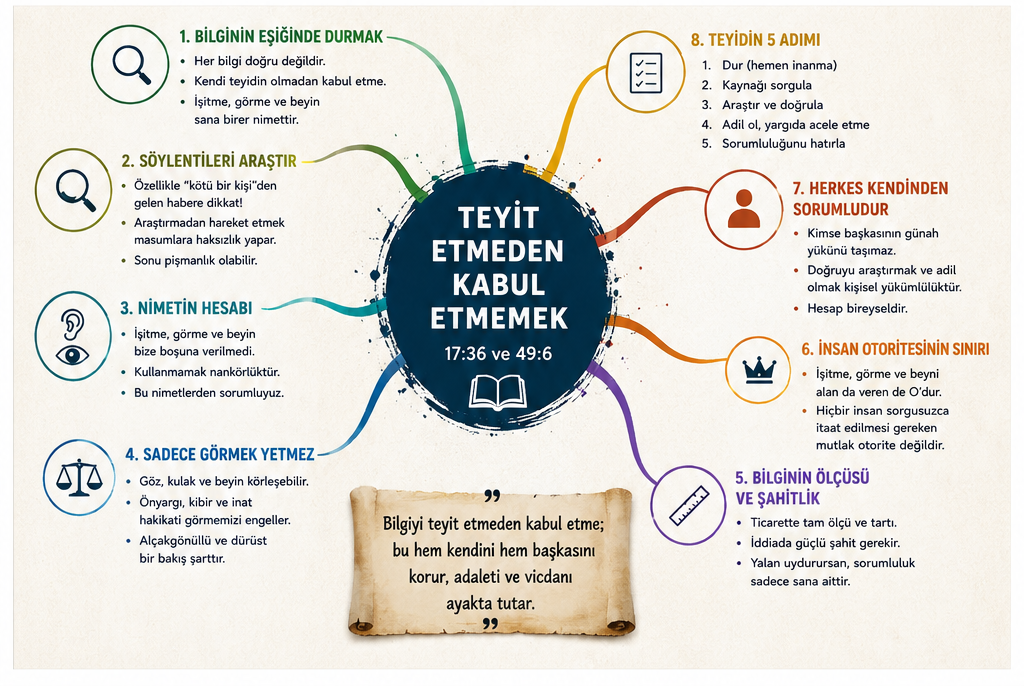
1. Pausing at the Threshold of Information
Verse
17:36
وَلَا تَقْفُ مَا لَيْسَ لَكَ بِهِۦ عِلْمٌ إِنَّ ٱلسَّمْعَ وَٱلْبَصَرَ وَٱلْفُؤَادَ كُلُّ أُو۟لَٰٓئِكَ كَانَ عَنْهُ مَسْـُٔولًا
You shall not accept any information, unless you verify it for yourself. I have given you the hearing, the eyesight, and the brain, and you are responsible for using them.
Do not accept any information unless you verify it for yourself. I have given you hearing, eyesight, and the brain, and you are responsible for using them.
Source: kuranteyit.com
Reflection on the Verse
The first sentence of this verse immediately stops me. Responsibility is not left to someone else. The fact that a statement is widespread, the reputation of the person saying it, or my desire to hear it does not take the place of verification.
Information I accept does not remain silently in my mind. It changes how I see people, affects my decisions, and enters my speech. When I accept false information, I have not merely been mistaken; I also increase the likelihood that I will act according to that falsehood.
Loving the truth is always harder than loving to be proven right.
2. Investigate Rumors Before Believing Them
Verse
49:6 — O you who believe, if a wicked person brings you any news, investigate first, lest you commit injustice against some people out of ignorance, then become sorry and remorseful for what you have done.
Reflection on the Verse
49:6 clearly shows the social consequence of the responsibility to verify in 17:36. An uninvestigated report is not merely a mistaken opinion. It can turn into injustice toward people.
A rumor often arrives as if it were complete information. It contains a name, an event, and a strong claim. The human mind fills in the missing parts on its own. If the person bringing the news speaks angrily, we may become angry as well; if they use the language of victimhood, we may immediately take sides. The verse sets the calmness of investigation against the speed of emotion.
Investigating is not only about protecting myself from false information. It also protects the person being discussed from my haste. In this sense, verification is a form of mercy and justice.
3. Hearing, Sight, and the Brain: Accountability for a Blessing
Verse
16:78 — GOD brought you out of your mothers’ wombs knowing nothing, and He gave you hearing, eyesight, and the brain so that you may be appreciative.
23:78 — He is the One who granted you hearing, eyesight, and brains. Rarely are you appreciative.
32:9 — He shaped him and blew into him from His spirit. And He gave you hearing, eyesight, and brains; rarely are you appreciative.
67:23 — Say, “He is the One who initiated you and granted you hearing, eyes, and brains. Rarely are you appreciative.”
Reflection on the Verse
A human being enters the world knowing nothing. Then we learn to distinguish sounds, recognize faces, and form connections between words. Hearing, sight, and the brain are capacities for learning given by GOD. 17:36 reminds us of our responsibility for these capacities; these verses remind us that they are blessings.
Gratitude is not merely saying “thank you.” Can a person who surrenders hearing to rumor, sight to prejudice, and the brain to imitation be said to have used what was given properly? Listening carefully, not interpreting what one sees too quickly, and refraining from judgment before reaching reliable knowledge may be ways of valuing the blessing.
The phrase “rarely are you appreciative” exposes a human habit. The ability to hear, see, and make sense of things becomes ordinary. Yet the moment I listen to a report, my ear; the moment I speak about it, my tongue; and the moment I pass judgment, my brain all enter the same field of responsibility.
4. Seeing Is Not Enough; the Gaze Must Also Be Honest
Verse
7:179 — We have committed multitudes of the jinn and humans to Hell. They have minds with which they do not understand, eyes with which they do not see, and ears with which they do not hear. They are like animals; no, they are far worse—they are totally unaware.
2:88 — Some may say, “Our minds are made up!” Rather, it is a curse from GOD, as a consequence of their disbelief, that keeps them from believing, except for a few of them.
17:37 — Do not walk proudly on earth—you can neither bore through the earth nor be as tall as the mountains.
Reflection on the Verse
Having open eyes does not mean that a person sees the truth. The ear may hear a sound, yet a person can choose not to let into the mind what they do not want to hear. The brain can process information, yet it can bend evidence in order to protect a conclusion already reached.
The statement “Our minds are made up” may initially sound like firmness. But refusing to change in the face of stronger evidence does not strengthen thought; it closes it. Verification is not changing one’s mind every day, but having the honesty to change in the face of evidence.
The warning against pride in 17:37 also reaches into the realm of knowledge. No matter how much a person learns, they remain limited. When one makes one’s own opinion untouchable, one gives up using the brain that was given freely and honestly.
5. The Measure of Knowledge and the Weight of Testimony
Verse
17:35 — When you trade, give full measure and weigh equitably. This is better and more righteous.
24:4 — Those who accuse married women of adultery, then fail to produce four witnesses, shall be flogged with eighty lashes, and no testimony shall ever be accepted from them; they are wicked.
11:35 — If they say, “He fabricated this story,” then say, “If I fabricated it, then I am responsible for my crime, and I am innocent of any crime you commit.”
Reflection on the Verse
The mention of justice in measure and weight immediately before 17:36 suggests a powerful connection. Just as giving short measure in material trade is injustice, reducing the evidence when transmitting information and presenting uncertainty as certainty also distorts the measure of speech.
24:4 shows that human dignity cannot be damaged by arbitrary words. 11:35, meanwhile, tells us that a person bears responsibility for their own words. Saying “This is what I was told” does not completely remove the weight of a falsehood I spread without investigating it.
Truthfulness is not merely refraining from lying. It is also expressing the limits of what one knows accurately and not presenting uncertainty as though it were certain.
6. Monotheism and the Limit of Human Authority
Verse
6:46 — Say, “What if GOD takes away your hearing and your eyesight and seals your minds; which god other than GOD can restore these to you?” Note how we explain the revelations, and note how they still deviate!
2:139 — Say, “Do you argue with us about GOD, when He is our Lord and your Lord? We are responsible for our deeds, and you are responsible for your deeds. We are devoted to Him alone.”
2:141 — That was a community from the past. They are responsible for what they earned, and you are responsible for what you earn. You are not responsible for anything they did.
Reflection on the Verse
If the true owner of hearing, sight, and the mind is GOD, knowledge should not make a human being absolute. Being knowledgeable does not grant a person unlimited authority to speak on behalf of GOD. A person who knows that even the means of knowing do not belong to them speaks more carefully.
A person may want to hand over the burden of thinking to past communities, religious leaders, or scholars. Yet the verses state that accountability cannot be transferred. Learning from people is one thing; turning their word into an absolute ruling that needs no verification is another.
The statement “We are devoted to Him alone” in 2:139 determines the direction. Devotion belongs to GOD. No human being can think or give account in another person’s place. Forgetting our own responsibility by taking shelter behind an authority can raise that person to a position higher than they should occupy.
7. Hearing, Verifying, and Submitting
Verse
2:285 — The messenger believed in what was sent down to him from his Lord, and so did the believers. They believe in GOD, His angels, His scripture, and His messengers: “We make no distinction among any of His messengers.” They say, “We hear and we obey.* Forgive us, our Lord. To You is the ultimate destiny.”
8:20 — O you who believe, obey GOD and His messenger, and do not disregard him while you hear.
Reflection on the Verse
17:36 teaches verification, while 2:285 teaches us to say, “We hear and we obey.” These are not opposites. Verification is a responsibility before human statements and claims to knowledge. Submission is the honest response to guidance from GOD.
This balance protects against two dangers. The first is accepting religious claims without investigation. The second is turning investigation into an excuse for disobedience by endlessly postponing what is clear.
Verification is not meant to produce endless hesitation, but to enable a confident turn toward what is true. Genuine submission does not leave a person thoughtless; it directs the hearing, sight, and brain given to them toward GOD by using each in its proper place.
8. On the Arabic Roots of the Words
Verse
17:36 — Do not accept any information unless you verify it for yourself. I have given you hearing, eyesight, and the brain, and you are responsible for using them.
Reflection on the Verse
Root analysis does not replace the verse and does not alter Rashad Khalifa’s Authorized Translation; it only helps us reflect on the field of meaning opened by the Arabic expression.
The word تَقْفُ (taqfu) is related to the root ق-ف-و (Qaf-Fa-Waw). It opens into the semantic field of following and going after something. When a person accepts false information, they often proceed to follow it.
The word مَسْـُٔولًا (mas’ulan) is related to the root س-أ-ل (Sin-Hamza-Lam); it opens into the field of asking and being questioned. Hearing, sight, and the brain are not tools without accountability.
9. Other Claims
Verse
17:36 — Do not accept any information unless you verify it for yourself. I have given you hearing, eyesight, and the brain, and you are responsible for using them.
49:6 — O you who believe, if a wicked person brings you any news, investigate first, lest you commit injustice against some people out of ignorance, then become sorry and remorseful for what you have done.
Reflection on the Verse
Different interpretations have been proposed regarding 17:36. Some approaches read the verse as a general moral command not to follow what one does not know. Others connect it with rumor and testimony. Rashad Khalifa’s Authorized English Translation places particular emphasis on not accepting information that has not been verified.
Regarding 49:6, it may also be debated whether the verse is limited only to reports brought by certain kinds of people. The explicit wording of the verse commands investigation of news brought by a wicked person. One cannot conclude from this that every report is equally doubtful; but neither can it be said that trust completely removes the responsibility to investigate.
The primary measure is the verses themselves: information should be verified, reports should be investigated, and people should not be treated unjustly because of ignorance.
10. Conclusion
Verse
17:36 — Do not accept any information unless you verify it for yourself. I have given you hearing, eyesight, and the brain, and you are responsible for using them.
49:6 — O you who believe, if a wicked person brings you any news, investigate first, lest you commit injustice against some people out of ignorance, then become sorry and remorseful for what you have done.
17:35 — When you trade, give full measure and weigh equitably. This is better and more righteous.
Reflection on the Verse
17:36 calls the human being to remain alert, humble, and responsible before information. 49:6 shows the consequence of that responsibility in human relationships. An uninvestigated report can turn into a judgment made in ignorance, and that judgment can turn into injustice.
Read together, these two verses show that verification is not merely a matter of personal accuracy. It is an ethic that protects another person’s rights. Not immediately believing a rumor means protecting the person being discussed from our own haste.
The question I need to ask myself is no longer only, “Is this report true?” There is another question: “Whom might I wrong by believing this report?”
Note
2:32 — They said, “Be You glorified. We have no knowledge except what You have taught us. You are the Omniscient, Most Wise.”
GOD knows best.
Source: kuranteyit.com
Discover
Related Articles

Quran Reflections
Should a Quran App Issue Rulings? The Boundary Between Tool and Authority
A reflection through Al-A'raf 7:33, An-Nahl 16:116, Al-Isra 17:36, and Al-Hujurat 49:6 on Quran apps, religious authority, the language of halal and haram, verification of information, the developer's responsibility, and the importance of a tool knowing its own limits.
Read article
Quran Reflections
Finding Is One Thing, Understanding Is Another: The Verse in the Age of Search Engines
A reflection through Muhammad 47:24, Sad 38:29, Az-Zumar 39:18, and Al-Isra 17:36 on the difference between accessing a verse and understanding it in the age of search engines; keywords, context, selective reading, approximate matching, translation differences, verification, and responsibility in action.
Read article
Quran Reflections
Is Comparing Quran Translations Doubt or Responsibility?
A personal reflection on understanding Rashad Khalifa's authorized English translation, the birth of Kuranteyit, the responsibility of verification, the limits of digital tools, and turning research into action through Az-Zumar 39:18, Al-Isra 17:36, and Muhammad 47:24.
Read article