Privacy in Religious Apps: Is User Data a Trust?
A reflection on digital privacy, permission, data minimization, local storage, religious search history, private notes, and the developer's responsibility of trust through Al-Hujurat 49:12, An-Nur 24:27, and An-Nur 24:58.

A Reflection on Verses 49:12, 24:27, and 24:58
Author: Berk KÖKSAL
Date: 06.08.2026
Location: Mersin
Verse
1:1 — In the name of GOD, Most Gracious, Most Merciful.*
Introduction
Greetings. Peace be upon you.
Our phones are no longer merely communication devices. For many people, the phone is a personal room where a diary, library, desk, family album, private conversations, health searches, fears, hopes, and sometimes prayers never shared with anyone else all exist in the same place.
Is the user’s data a resource available to me, or is it an entrusted space I have not been given permission to approach?
If a religious app is trying to bring a person closer to GOD while unnecessarily collecting that person’s most sensitive searches, it may contradict its own purpose.
In this article, I will try to reflect on whether the phone has become a new personal room, why religious searches carry a special sensitivity, the difference between permission and informed consent, data minimization, local storage, advertising and analytics systems, children’s privacy education, and the ethical principles by which an app such as Kuranteyit might be designed.
Summary:
1. Is the Phone a New Personal Room?
24:27
يَٰٓأَيُّهَا ٱلَّذِينَ ءَامَنُوا۟ لَا تَدْخُلُوا۟ بُيُوتًا غَيْرَ بُيُوتِكُمْ حَتَّىٰ تَسْتَأْنِسُوا۟ وَتُسَلِّمُوا۟ عَلَىٰٓ أَهْلِهَا ذَٰلِكُمْ خَيْرٌ لَّكُمْ لَعَلَّكُمْ تَذَكَّرُونَ
O you who believe, do not enter homes other than yours without permission from their inhabitants, and without greeting them. This is better for you, that you may take heed.
O you who believe, do not enter homes other than yours without permission from their inhabitants, and without greeting them. This is better for you, that you may take heed.
24:28 — If you find no one in them, do not enter until you obtain permission. If you are told, “Go back,” then you must go back. This is purer for you. GOD is fully aware of everything you do.
2. Permission Is Not Merely Pressing a Button
24:27 — O you who believe, do not enter homes other than yours without permission from their inhabitants, and without greeting them. This is better for you, that you may take heed.
24:28 — If you find no one in them, do not enter until you obtain permission. If you are told, “Go back,” then you must go back. This is purer for you. GOD is fully aware of everything you do.
3. The Fine Line Between Spying and Analytics
49:12
O you who believe, you shall avoid any suspicion, for even a little bit of suspicion is sinful. You shall not spy on one another, nor shall you backbite one another; this is as abominable as eating the flesh of your dead brother. You certainly abhor this. You shall observe GOD. GOD is Redeemer, Most Merciful.
O you who believe, you shall avoid any suspicion, for even a little bit of suspicion is sinful. You shall not spy on one another, nor shall you backbite one another; this is as abominable as eating the flesh of your dead brother. You certainly abhor this. You shall observe GOD. GOD is Redeemer, Most Merciful.
4. What Does a Person's Verse Search History Reveal?
49:12 — O you who believe, you shall avoid any suspicion, for even a little bit of suspicion is sinful. You shall not spy on one another, nor shall you backbite one another; this is as abominable as eating the flesh of your dead brother. You certainly abhor this. You shall observe GOD. GOD is Redeemer, Most Merciful.
11:5 — Indeed, they conceal their innermost thoughts as though they could prevent Him from knowing them. In fact, even when they cover themselves with their clothes, He knows all their secrets and declarations. He knows the innermost thoughts.
5. Private Notes: User Data or a Journal of Conscience?
24:27 — O you who believe, do not enter homes other than yours without permission from their inhabitants, and without greeting them. This is better for you, that you may take heed.
24:58 — O you who believe, permission must be requested by your servants and the children who have not attained puberty (before entering your rooms). This is to be done in three instances—before the Dawn Prayer, at noon when you change your clothes to rest, and after the Night Prayer. These are three private times for you. At other times, it is not wrong for you or them to mingle with one another. GOD thus clarifies the revelations for you. GOD is Omniscient, Most Wise.
6. Privacy Does Not Disappear with Familiarity
24:58
O you who believe, permission must be requested by your servants and the children who have not attained puberty (before entering your rooms). This is to be done in three instances—before the Dawn Prayer, at noon when you change your clothes to rest, and after the Night Prayer. These are three private times for you. At other times, it is not wrong for you or them to mingle with one another. GOD thus clarifies the revelations for you. GOD is Omniscient, Most Wise.
O you who believe, permission must be requested by your servants and the children who have not attained puberty (before entering your rooms). This is to be done in three instances—before the Dawn Prayer, at noon when you change your clothes to rest, and after the Night Prayer. These are three private times for you. At other times, it is not wrong for you or them to mingle with one another. GOD thus clarifies the revelations for you. GOD is Omniscient, Most Wise.
7. Data Minimization: Not Asking for What Is Not Needed
24:27 — O you who believe, do not enter homes other than yours without permission from their inhabitants, and without greeting them. This is better for you, that you may take heed.
49:12 — O you who believe, you shall avoid any suspicion, for even a little bit of suspicion is sinful. You shall not spy on one another, nor shall you backbite one another; this is as abominable as eating the flesh of your dead brother. You certainly abhor this. You shall observe GOD. GOD is Redeemer, Most Merciful.
8. Local Storage: Leaving the Data in the User's Room
24:27 — O you who believe, do not enter homes other than yours without permission from their inhabitants, and without greeting them. This is better for you, that you may take heed.
24:58 — O you who believe, permission must be requested by your servants and the children who have not attained puberty (before entering your rooms). This is to be done in three instances—before the Dawn Prayer, at noon when you change your clothes to rest, and after the Night Prayer. These are three private times for you. At other times, it is not wrong for you or them to mingle with one another. GOD thus clarifies the revelations for you. GOD is Omniscient, Most Wise.
9. Advertising, Behavioral Profiles, and the Commerce of Spiritual Attention
49:12 — O you who believe, you shall avoid any suspicion, for even a little bit of suspicion is sinful. You shall not spy on one another, nor shall you backbite one another; this is as abominable as eating the flesh of your dead brother. You certainly abhor this. You shall observe GOD. GOD is Redeemer, Most Merciful.
2:224 — Do not use GOD's name in your casual oaths merely to appear righteous and reverent, or to gain credibility among the people. GOD is Hearer, Knower.
10. Security and Privacy Are Not the Same Thing
24:27 — O you who believe, do not enter homes other than yours without permission from their inhabitants, and without greeting them. This is better for you, that you may take heed.
49:12 — O you who believe, you shall avoid any suspicion, for even a little bit of suspicion is sinful. You shall not spy on one another, nor shall you backbite one another; this is as abominable as eating the flesh of your dead brother. You certainly abhor this. You shall observe GOD. GOD is Redeemer, Most Merciful.
11. Third-Party Libraries: Invisible Guests Brought into the Home
24:27 — O you who believe, do not enter homes other than yours without permission from their inhabitants, and without greeting them. This is better for you, that you may take heed.
24:28 — If you find no one in them, do not enter until you obtain permission. If you are told, “Go back,” then you must go back. This is purer for you. GOD is fully aware of everything you do.
12. Teaching Children Privacy
24:58 — O you who believe, permission must be requested by your servants and the children who have not attained puberty (before entering your rooms). This is to be done in three instances—before the Dawn Prayer, at noon when you change your clothes to rest, and after the Night Prayer. These are three private times for you. At other times, it is not wrong for you or them to mingle with one another. GOD thus clarifies the revelations for you. GOD is Omniscient, Most Wise.
24:59 — When the children reach puberty, they must ask permission (before entering) just as the adults before them asked permission (before entering). GOD thus explains His revelations to you. GOD is Omniscient, Most Wise.
13. Privacy Is Not Absolute Secrecy
24:58 — O you who believe, permission must be requested by your servants and the children who have not attained puberty (before entering your rooms). This is to be done in three instances—before the Dawn Prayer, at noon when you change your clothes to rest, and after the Night Prayer. These are three private times for you. At other times, it is not wrong for you or them to mingle with one another. GOD thus clarifies the revelations for you. GOD is Omniscient, Most Wise.
24:29 — You commit no error by entering uninhabited houses in which there are belongings of yours. GOD knows everything you reveal and everything you conceal.
14. Principles of Trust for a Religious App
49:12 — O you who believe, you shall avoid any suspicion, for even a little bit of suspicion is sinful. You shall not spy on one another, nor shall you backbite one another; this is as abominable as eating the flesh of your dead brother. You certainly abhor this. You shall observe GOD. GOD is Redeemer, Most Merciful.
24:27 — O you who believe, do not enter homes other than yours without permission from their inhabitants, and without greeting them. This is better for you, that you may take heed.
24:58 — O you who believe, permission must be requested by your servants and the children who have not attained puberty (before entering your rooms). This is to be done in three instances—before the Dawn Prayer, at noon when you change your clothes to rest, and after the Night Prayer. These are three private times for you. At other times, it is not wrong for you or them to mingle with one another. GOD thus clarifies the revelations for you. GOD is Omniscient, Most Wise.
15. The Developer's Ethics of Choosing Not to Know
49:12 — O you who believe, you shall avoid any suspicion, for even a little bit of suspicion is sinful. You shall not spy on one another, nor shall you backbite one another; this is as abominable as eating the flesh of your dead brother. You certainly abhor this. You shall observe GOD. GOD is Redeemer, Most Merciful.
7:33 — Say, “My Lord prohibits only evil deeds, be they obvious or hidden, and sins, and unjustifiable aggression, and to set up beside GOD powerless idols, and to say about GOD what you do not know.”
16. On the Arabic Roots of the Words
49:12 — O you who believe, you shall avoid any suspicion, for even a little bit of suspicion is sinful. You shall not spy on one another, nor shall you backbite one another; this is as abominable as eating the flesh of your dead brother. You certainly abhor this. You shall observe GOD. GOD is Redeemer, Most Merciful.
24:27 — O you who believe, do not enter homes other than yours without permission from their inhabitants, and without greeting them. This is better for you, that you may take heed.
24:58 — O you who believe, permission must be requested by your servants and the children who have not attained puberty (before entering your rooms). This is to be done in three instances—before the Dawn Prayer, at noon when you change your clothes to rest, and after the Night Prayer. These are three private times for you. At other times, it is not wrong for you or them to mingle with one another. GOD thus clarifies the revelations for you. GOD is Omniscient, Most Wise.
Other Claims
49:12 — O you who believe, you shall avoid any suspicion, for even a little bit of suspicion is sinful. You shall not spy on one another, nor shall you backbite one another; this is as abominable as eating the flesh of your dead brother. You certainly abhor this. You shall observe GOD. GOD is Redeemer, Most Merciful.
24:27 — O you who believe, do not enter homes other than yours without permission from their inhabitants, and without greeting them. This is better for you, that you may take heed.
24:58 — O you who believe, permission must be requested by your servants and the children who have not attained puberty (before entering your rooms). This is to be done in three instances—before the Dawn Prayer, at noon when you change your clothes to rest, and after the Night Prayer. These are three private times for you. At other times, it is not wrong for you or them to mingle with one another. GOD thus clarifies the revelations for you. GOD is Omniscient, Most Wise.
Conclusion
49:12 — O you who believe, you shall avoid any suspicion, for even a little bit of suspicion is sinful. You shall not spy on one another, nor shall you backbite one another; this is as abominable as eating the flesh of your dead brother. You certainly abhor this. You shall observe GOD. GOD is Redeemer, Most Merciful.
24:27 — O you who believe, do not enter homes other than yours without permission from their inhabitants, and without greeting them. This is better for you, that you may take heed.
24:58 — O you who believe, permission must be requested by your servants and the children who have not attained puberty (before entering your rooms). This is to be done in three instances—before the Dawn Prayer, at noon when you change your clothes to rest, and after the Night Prayer. These are three private times for you. At other times, it is not wrong for you or them to mingle with one another. GOD thus clarifies the revelations for you. GOD is Omniscient, Most Wise.
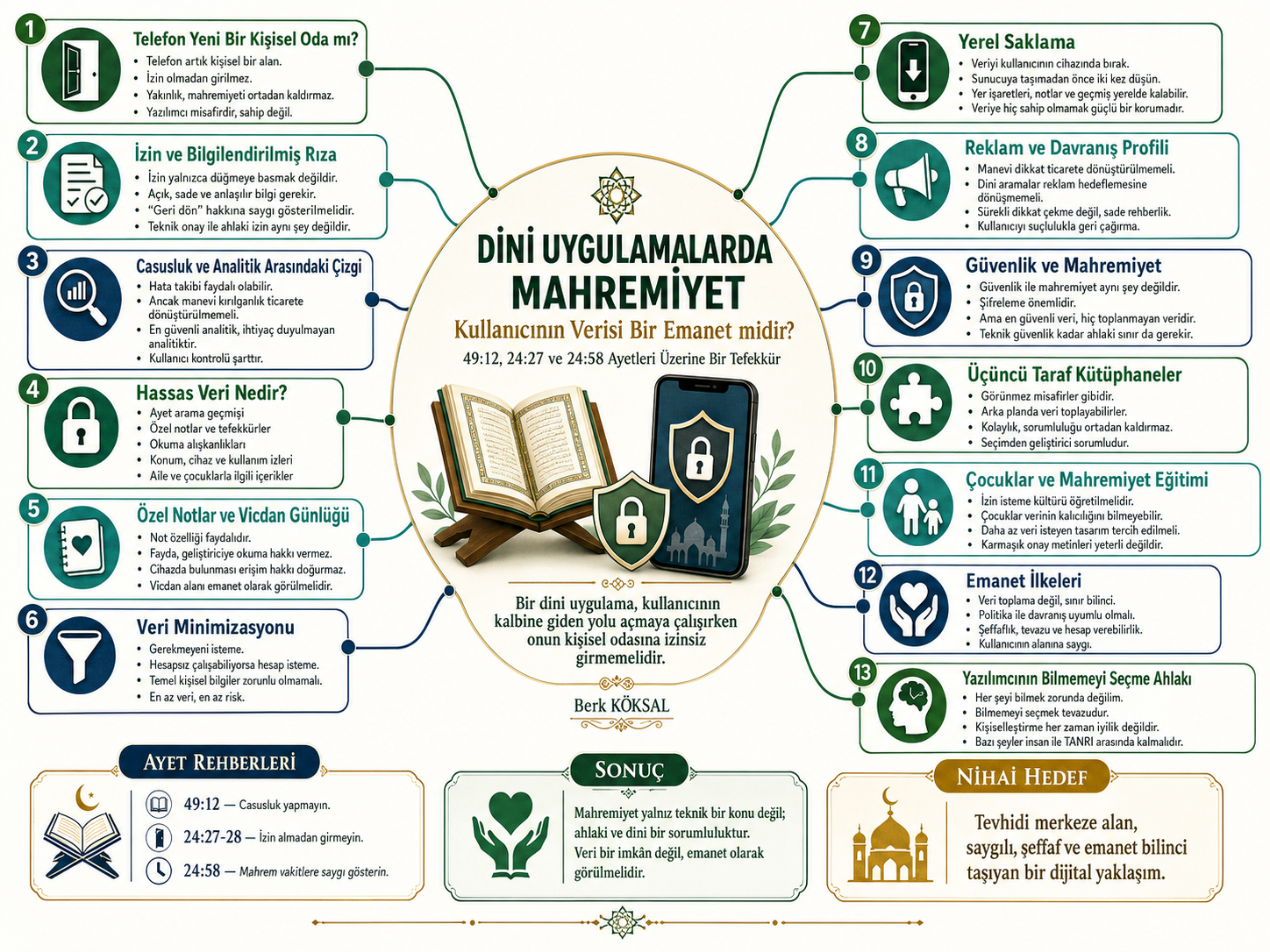
1. Is the Phone a New Personal Room?
Verse
24:27
يَٰٓأَيُّهَا ٱلَّذِينَ ءَامَنُوا۟ لَا تَدْخُلُوا۟ بُيُوتًا غَيْرَ بُيُوتِكُمْ حَتَّىٰ تَسْتَأْنِسُوا۟ وَتُسَلِّمُوا۟ عَلَىٰٓ أَهْلِهَا ذَٰلِكُمْ خَيْرٌ لَّكُمْ لَعَلَّكُمْ تَذَكَّرُونَ
O you who believe, do not enter homes other than yours without permission from their inhabitants, and without greeting them. This is better for you, that you may take heed.
O you who believe, do not enter homes other than yours without permission from their inhabitants, and without greeting them. This is better for you, that you may take heed.Source: kuranteyit.com
24:28 — If you find no one in them, do not enter until you obtain permission. If you are told, “Go back,” then you must go back. This is purer for you. GOD is fully aware of everything you do.
Reflection on the Verse
24:27 speaks of the etiquette of entering a physical home. Another person’s space is not somewhere one may enter simply because its door can be opened. Even if the resident is not there, that person’s right over the home continues. Familiarity, curiosity, or good intentions do not remove the requirement of permission.
Does a Quran reading or comparison app need the user’s contacts? Does it need location? Does it need continuous microphone access? If core functions can be offered without a user account, why ask for a name and phone number?
If the phone is the new personal room, the developer’s authority is not that of someone who owns the key. It is that of a guest for whom the user temporarily opens the door for a specific purpose.
2. Permission Is Not Merely Pressing a Button
Verse
24:27 — O you who believe, do not enter homes other than yours without permission from their inhabitants, and without greeting them. This is better for you, that you may take heed.
24:28 — If you find no one in them, do not enter until you obtain permission. If you are told, “Go back,” then you must go back. This is purer for you. GOD is fully aware of everything you do.
Reflection on the Verse
In the digital world, “permission” is often reduced to a checkbox. The user presses “I agree” without reading a long text, and the system can treat this as sufficient permission for every kind of data processing.
But ethical permission and technical consent are not the same thing.
If an app hides the purposes for which it uses data behind incomprehensible legal language, has it really knocked on the door?
3. The Fine Line Between Spying and Analytics
Verse
49:12 — O you who believe, you shall avoid any suspicion, for even a little bit of suspicion is sinful. You shall not spy on one another, nor shall you backbite one another; this is as abominable as eating the flesh of your dead brother. You certainly abhor this. You shall observe GOD. GOD is Redeemer, Most Merciful.
Reflection on the Verse
Analytics systems can help us understand how an app is being used. Knowing which screen crashes, which feature does not work, or on which devices errors occur can provide real benefit. It would therefore be wrong to call every technical measurement “spying.”
It would be a grave contradiction for a religious app to turn people’s spiritual vulnerability into commercial classification. While a user is trying to turn toward GOD, the app should not turn that person’s weak moment into advertising targeting, behavioral prediction, or a third-party profiling system.
The safest analytics in a religious app is analytics that is not needed at all. When there is a genuine need, it should be limited to the least detail possible, with clear information and user control.
4. What Does a Person’s Verse Search History Reveal?
Verse
49:12 — O you who believe, you shall avoid any suspicion, for even a little bit of suspicion is sinful. You shall not spy on one another, nor shall you backbite one another; this is as abominable as eating the flesh of your dead brother. You certainly abhor this. You shall observe GOD. GOD is Redeemer, Most Merciful.
11:5 — Indeed, they conceal their innermost thoughts as though they could prevent Him from knowing them. In fact, even when they cover themselves with their clothes, He knows all their secrets and declarations. He knows the innermost thoughts.
Reflection on the Verse
The search box looks small. Yet sometimes a person writes the biggest question of his life into that small space.
Search history in a religious app may appear to be an ordinary usage record. In some cases, however, it can become a map of a person’s spiritual and moral life.
A religious app should see search records not as an “engagement opportunity,” but as traces belonging to a person’s inner room.
5. Private Notes: User Data or a Journal of Conscience?
Verse
24:27 — O you who believe, do not enter homes other than yours without permission from their inhabitants, and without greeting them. This is better for you, that you may take heed.
24:58 — O you who believe, permission must be requested by your servants and the children who have not attained puberty (before entering your rooms). This is to be done in three instances—before the Dawn Prayer, at noon when you change your clothes to rest, and after the Night Prayer. These are three private times for you. At other times, it is not wrong for you or them to mingle with one another. GOD thus clarifies the revelations for you. GOD is Omniscient, Most Wise.
Reflection on the Verse
A note written under a verse may not be merely an academic annotation. A person may leave a message there for his own life.
Offering a notes feature in a religious app can be useful. The user records a thought, returns to the verse, and sees how that thought changes over time. But a useful feature does not give the developer the right to read it.
The fact that an app exists on a device also does not give it the right to access the user’s journal of conscience.
6. Privacy Does Not Disappear with Familiarity
Verse
24:58 — O you who believe, permission must be requested by your servants and the children who have not attained puberty (before entering your rooms). This is to be done in three instances—before the Dawn Prayer, at noon when you change your clothes to rest, and after the Night Prayer. These are three private times for you. At other times, it is not wrong for you or them to mingle with one another. GOD thus clarifies the revelations for you. GOD is Omniscient, Most Wise.
Reflection on the Verse
24:58 makes me think that privacy is not limited to strangers. Even among people who live in the same home, know one another, and share daily life, there are times when permission is required.
This principle matters in the digital world. A user may open the app every day. The user may trust the app. The same account may have been used for months. This familiarity does not create a right for the app to monitor every behavior.
Digital privacy is contextual as well. When a user presses a button to share a verse, moving to a sharing screen is normal. But sending the user’s entire reading history to the sharing system is outside that context.
7. Data Minimization: Not Asking for What Is Not Needed
Verse
24:27 — O you who believe, do not enter homes other than yours without permission from their inhabitants, and without greeting them. This is better for you, that you may take heed.
49:12 — O you who believe, you shall avoid any suspicion, for even a little bit of suspicion is sinful. You shall not spy on one another, nor shall you backbite one another; this is as abominable as eating the flesh of your dead brother. You certainly abhor this. You shall observe GOD. GOD is Redeemer, Most Merciful.
Reflection on the Verse
Data minimization is not merely a technical term used by security specialists. It begins with a simple ethical question:
If an app can work without an account, not asking for an account is data minimization.
Kuranteyit’s approach of not creating accounts and not asking for basic personal information is therefore important. This choice seeks a positive answer to the question: “Can a service be provided without knowing the user?”
8. Local Storage: Leaving the Data in the User’s Room
Verse
24:27 — O you who believe, do not enter homes other than yours without permission from their inhabitants, and without greeting them. This is better for you, that you may take heed.
24:58 — O you who believe, permission must be requested by your servants and the children who have not attained puberty (before entering your rooms). This is to be done in three instances—before the Dawn Prayer, at noon when you change your clothes to rest, and after the Night Prayer. These are three private times for you. At other times, it is not wrong for you or them to mingle with one another. GOD thus clarifies the revelations for you. GOD is Omniscient, Most Wise.
Reflection on the Verse
Local storage means keeping data on the user’s device. This approach is not perfect in every situation; the device can be lost, damaged, or taken over by someone else. But the developer never possessing the data provides an important privacy advantage.
Local storage is an honest answer to the question: “Does this data have to exist in my system?”
For religious notes, bookmarks, and reading history, this approach is especially valuable. If the user’s device is that person’s digital room, leaving the data in that room means not carrying it into the developer’s house.
9. Advertising, Behavioral Profiles, and the Commerce of Spiritual Attention
Verse
49:12 — O you who believe, you shall avoid any suspicion, for even a little bit of suspicion is sinful. You shall not spy on one another, nor shall you backbite one another; this is as abominable as eating the flesh of your dead brother. You certainly abhor this. You shall observe GOD. GOD is Redeemer, Most Merciful.
2:224 — Do not use GOD’s name in your casual oaths merely to appear righteous and reverent, or to gain credibility among the people. GOD is Hearer, Knower.
Reflection on the Verse
Advertising is not necessarily immoral in itself. Transparent advertising models that cover the cost of a service without distorting its context can be imagined. But in religious apps, the form of advertising, the method of data-based targeting, and its effect on spiritual attention must be evaluated carefully.
The current design approach of Kuranteyit includes no developer-owned advertising or behavioral analytics system. This is therefore not merely a preference for a simple interface. It is an effort to keep the user’s space of reflection away from commercial surveillance.
A religious app should not be designed to capture a person’s attention constantly. Increasing the number of notifications, building daily streaks, creating fear of loss, and pulling users back through guilt should not be presented as spiritual growth.
10. Security and Privacy Are Not the Same Thing
Verse
24:27 — O you who believe, do not enter homes other than yours without permission from their inhabitants, and without greeting them. This is better for you, that you may take heed.
49:12 — O you who believe, you shall avoid any suspicion, for even a little bit of suspicion is sinful. You shall not spy on one another, nor shall you backbite one another; this is as abominable as eating the flesh of your dead brother. You certainly abhor this. You shall observe GOD. GOD is Redeemer, Most Merciful.
Reflection on the Verse
A system can be highly secure and still violate privacy.
For this reason, a technical security checklist alone is not enough when developing a religious app. An ethical data map is also needed.
The safest data in a religious app is data it never collects.
11. Third-Party Libraries: Invisible Guests Brought into the Home
Verse
24:27 — O you who believe, do not enter homes other than yours without permission from their inhabitants, and without greeting them. This is better for you, that you may take heed.
24:28 — If you find no one in them, do not enter until you obtain permission. If you are told, “Go back,” then you must go back. This is purer for you. GOD is fully aware of everything you do.
Reflection on the Verse
An app consists of more than code written by its own developer. Third-party libraries may be used for crash reporting, notifications, advertising, sessions, fonts, analytics, storage, and sharing.
These libraries are like invisible guests. When users download the app, they may think they are relating only to the developer; yet in the background, other systems may receive device information or usage data.
Technical convenience does not transfer privacy responsibility to the third party. Saying “the library does it” does not release the developer from ethical responsibility. The developer is the one who chose that library, added it to the app, and presented it to the user.
12. Teaching Children Privacy
Verse
24:58 — O you who believe, permission must be requested by your servants and the children who have not attained puberty (before entering your rooms). This is to be done in three instances—before the Dawn Prayer, at noon when you change your clothes to rest, and after the Night Prayer. These are three private times for you. At other times, it is not wrong for you or them to mingle with one another. GOD thus clarifies the revelations for you. GOD is Omniscient, Most Wise.
24:59 — When the children reach puberty, they must ask permission (before entering) just as the adults before them asked permission (before entering). GOD thus explains His revelations to you. GOD is Omniscient, Most Wise.
Reflection on the Verse
24:58 includes teaching children the boundary of privacy. A child cannot enter every room at every time on the assumption that “we are family anyway.” The child learns to ask permission. This education shows that privacy is not shame, but respect.
Teaching children privacy has become even more difficult in the digital world. A child may not understand what app permissions mean. The child may not grasp the permanence of sharing photos, voice, location, and messages. The child may not think about who can see notes written in a religious app.
Applications designed for children, or that children may use, should therefore request less data. It is not enough to leave responsibility to a child through complex consent texts.
13. Privacy Is Not Absolute Secrecy
Verse
24:58 — O you who believe, permission must be requested by your servants and the children who have not attained puberty (before entering your rooms). This is to be done in three instances—before the Dawn Prayer, at noon when you change your clothes to rest, and after the Night Prayer. These are three private times for you. At other times, it is not wrong for you or them to mingle with one another. GOD thus clarifies the revelations for you. GOD is Omniscient, Most Wise.
24:29 — You commit no error by entering uninhabited houses in which there are belongings of yours. GOD knows everything you reveal and everything you conceal.
Reflection on the Verse
Privacy does not mean that every piece of data must remain secret under every condition. 24:58 distinguishes particular times as private while accepting normal movement at other times. 24:29 likewise distinguishes uninhabited spaces that have a purpose of use.
These distinctions make me think of privacy not as limitless closure, but as a boundary formed through purpose and context.
The user may choose to share his own data. What matters is that the choice belongs to the user.
14. Principles of Trust for a Religious App
Verse
49:12 — O you who believe, you shall avoid any suspicion, for even a little bit of suspicion is sinful. You shall not spy on one another, nor shall you backbite one another; this is as abominable as eating the flesh of your dead brother. You certainly abhor this. You shall observe GOD. GOD is Redeemer, Most Merciful.
24:27 — O you who believe, do not enter homes other than yours without permission from their inhabitants, and without greeting them. This is better for you, that you may take heed.
24:58 — O you who believe, permission must be requested by your servants and the children who have not attained puberty (before entering your rooms). This is to be done in three instances—before the Dawn Prayer, at noon when you change your clothes to rest, and after the Night Prayer. These are three private times for you. At other times, it is not wrong for you or them to mingle with one another. GOD thus clarifies the revelations for you. GOD is Omniscient, Most Wise.
Reflection on the Verse
I do not derive a software standard directly from these verses. But drawing on the ethics of boundaries and permission they teach, I adopt the following principles for a religious app:
It is not enough to say “We do not collect data”; network traffic, dependencies, and error logs must also be checked.
If the privacy policy and the app’s behavior differ, the real truth is the behavior.
15. The Developer’s Ethics of Choosing Not to Know
Verse
49:12 — O you who believe, you shall avoid any suspicion, for even a little bit of suspicion is sinful. You shall not spy on one another, nor shall you backbite one another; this is as abominable as eating the flesh of your dead brother. You certainly abhor this. You shall observe GOD. GOD is Redeemer, Most Merciful.
7:33 — Say, “My Lord prohibits only evil deeds, be they obvious or hidden, and sins, and unjustifiable aggression, and to set up beside GOD powerless idols, and to say about GOD what you do not know.”
Reflection on the Verse
Technology encourages human beings to know. More data promises more accurate prediction, better personalization, and higher engagement.
Choosing not to know is not avoiding responsibility. It is acknowledging that the user’s space does not belong to me.
When developing a religious app, humility can begin with this sentence:
I do not need to know this about the user. Sometimes it is good not to be able to measure and predict everything; some things between a person and GOD should remain outside the app.
16. On the Arabic Roots of the Words
Verse
49:12 — O you who believe, you shall avoid any suspicion, for even a little bit of suspicion is sinful. You shall not spy on one another, nor shall you backbite one another; this is as abominable as eating the flesh of your dead brother. You certainly abhor this. You shall observe GOD. GOD is Redeemer, Most Merciful.
24:27 — O you who believe, do not enter homes other than yours without permission from their inhabitants, and without greeting them. This is better for you, that you may take heed.
24:58 — O you who believe, permission must be requested by your servants and the children who have not attained puberty (before entering your rooms). This is to be done in three instances—before the Dawn Prayer, at noon when you change your clothes to rest, and after the Night Prayer. These are three private times for you. At other times, it is not wrong for you or them to mingle with one another. GOD thus clarifies the revelations for you. GOD is Omniscient, Most Wise.
Reflection on the Verse
The roots of some words in these three verses help me think more clearly about privacy as not merely secrecy, but an ethic of boundaries and relationships.
The root ب-ي-ت (Ba-Ya-Ta) is associated with the home and the place where one spends the night. The home is where a person withdraws from the outside and returns to his own order. The metaphor of the phone as a personal room grows from this field of meaning; but this metaphor is not the direct technical meaning of the verse, only a contemporary reflection.
Root information does not replace context here either. The whole meaning of a verse should not be reduced to a single word root. Roots are signs that deepen reflection, not definitive technological rulings.
Other Claims
Verse
49:12 — O you who believe, you shall avoid any suspicion, for even a little bit of suspicion is sinful. You shall not spy on one another, nor shall you backbite one another; this is as abominable as eating the flesh of your dead brother. You certainly abhor this. You shall observe GOD. GOD is Redeemer, Most Merciful.
24:27 — O you who believe, do not enter homes other than yours without permission from their inhabitants, and without greeting them. This is better for you, that you may take heed.
24:58 — O you who believe, permission must be requested by your servants and the children who have not attained puberty (before entering your rooms). This is to be done in three instances—before the Dawn Prayer, at noon when you change your clothes to rest, and after the Night Prayer. These are three private times for you. At other times, it is not wrong for you or them to mingle with one another. GOD thus clarifies the revelations for you. GOD is Omniscient, Most Wise.
Reflection on the Verse
One view may argue that 24:27 and 24:58 concern physical homes only and cannot be applied to digital privacy. The direct context of the verses is indeed physical homes, rooms, and the etiquette of permission. This article does not present them as explicit rulings about technology. What it does is use the ethics of boundaries and permission in the verses as a basis for reflection on contemporary digital space.
Another claim may be that user data in religious apps is no different from data in other apps. Technically, many data types are the same; but religious searches and private notes can reveal a person’s faith, conscience, and areas of vulnerability. Greater sensitivity may therefore be necessary.
The claim of this article is not to reject technology. Nor is it to make religious apps less powerful. It is to use power with a responsibility that recognizes limits.
Conclusion
Verse
49:12 — O you who believe, you shall avoid any suspicion, for even a little bit of suspicion is sinful. You shall not spy on one another, nor shall you backbite one another; this is as abominable as eating the flesh of your dead brother. You certainly abhor this. You shall observe GOD. GOD is Redeemer, Most Merciful.
24:27 — O you who believe, do not enter homes other than yours without permission from their inhabitants, and without greeting them. This is better for you, that you may take heed.
24:58 — O you who believe, permission must be requested by your servants and the children who have not attained puberty (before entering your rooms). This is to be done in three instances—before the Dawn Prayer, at noon when you change your clothes to rest, and after the Night Prayer. These are three private times for you. At other times, it is not wrong for you or them to mingle with one another. GOD thus clarifies the revelations for you. GOD is Omniscient, Most Wise.
Reflection on the Verse
I cannot answer this question through technical agreements alone. Data is not made of abstract numbers. Behind the data is a human being.
Kuranteyit’s approach of not requiring an account; not requesting a name, phone number, location, or contacts; storing notes on the device instead of sending them to the developer’s server; and using no developer-owned advertising or behavioral analytics system is therefore not merely a product decision for me.
A religious app, while trying to open the way to a person’s heart, should not enter that person’s private room without permission.
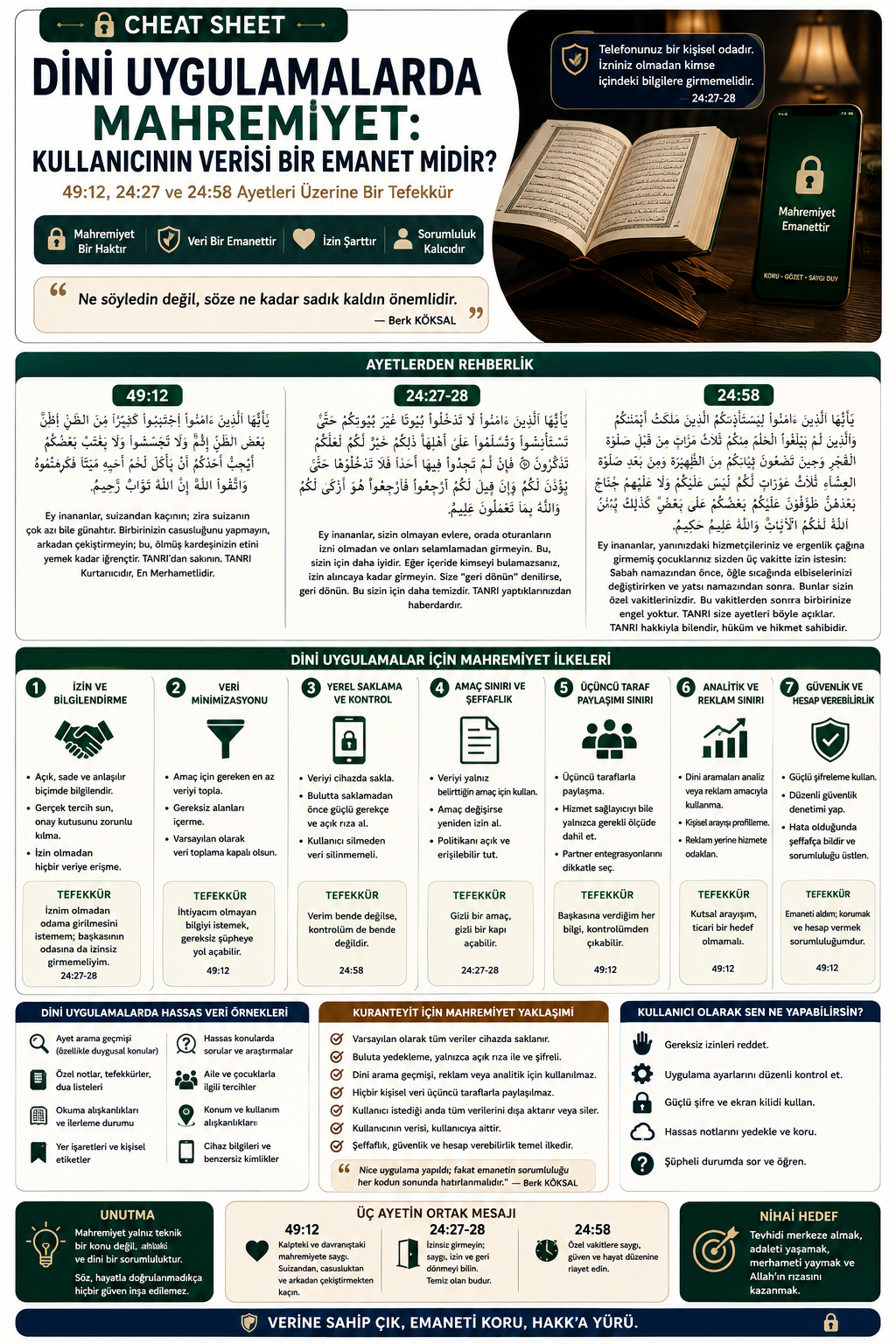
Note
2:32 — They said, “Be You glorified. We have no knowledge except that which You have taught us. You are the Omniscient, Most Wise.”
This article does not claim to derive direct technical software rulings from verses 49:12, 24:27, and 24:58. It uses the principles in those verses—refraining from investigating what is hidden, asking permission, and respecting private times—for an ethical reflection on digital privacy.
GOD knows best.
Source: kuranteyit.com
Discover
Related Articles
Quran Reflections
Do You Really Trust GOD? The Word of Trust, the Obsession with Control, and the Hard Test of Submission
A severe and deep reflection through Al-Imran 3:122 and verses related to trusting GOD; on trust, submission, monotheism, the obsession with control, precaution, provision, steadfastness, religious authority, the danger of taking people as lords, and what it means in human life to see GOD as sufficient.
Read article
Quran Reflections
Should a Quran App Issue Rulings? The Boundary Between Tool and Authority
A reflection through Al-A'raf 7:33, An-Nahl 16:116, Al-Isra 17:36, and Al-Hujurat 49:6 on Quran apps, religious authority, the language of halal and haram, verification of information, the developer's responsibility, and the importance of a tool knowing its own limits.
Read article
Quran Reflections
Not Trading Away the Revelations for a Cheap Price: The Commercialization of Digital Religion
A reflection through Al-Baqarah 2:41 and 2:79, At-Tawbah 9:9, and An-Nahl 16:95 on turning religious content into economic value through attention, views, followers, memberships, advertising, and user data; and on revenue, message, labor, distortion, and digital responsibility.
Read article