Proclaim: Do Not Conceal the Truth, Tie the Word to GOD
A personal and concise reflection on not concealing the truth, truthful speech, testimony, tawhid, justice, submission, and the limits of religious authority through Al-Baqarah 2:159-160 and the verses gathered under the theme “Proclaim.”
Proclaim: Do Not Conceal the Truth, Tie the Word to GOD
A reflection on 2:159-160 and the verses under the theme “Proclaim”
Author: Berk KÖKSAL
Date: 20.08.2026
Location: Mersin
Greetings. Peace be upon you.
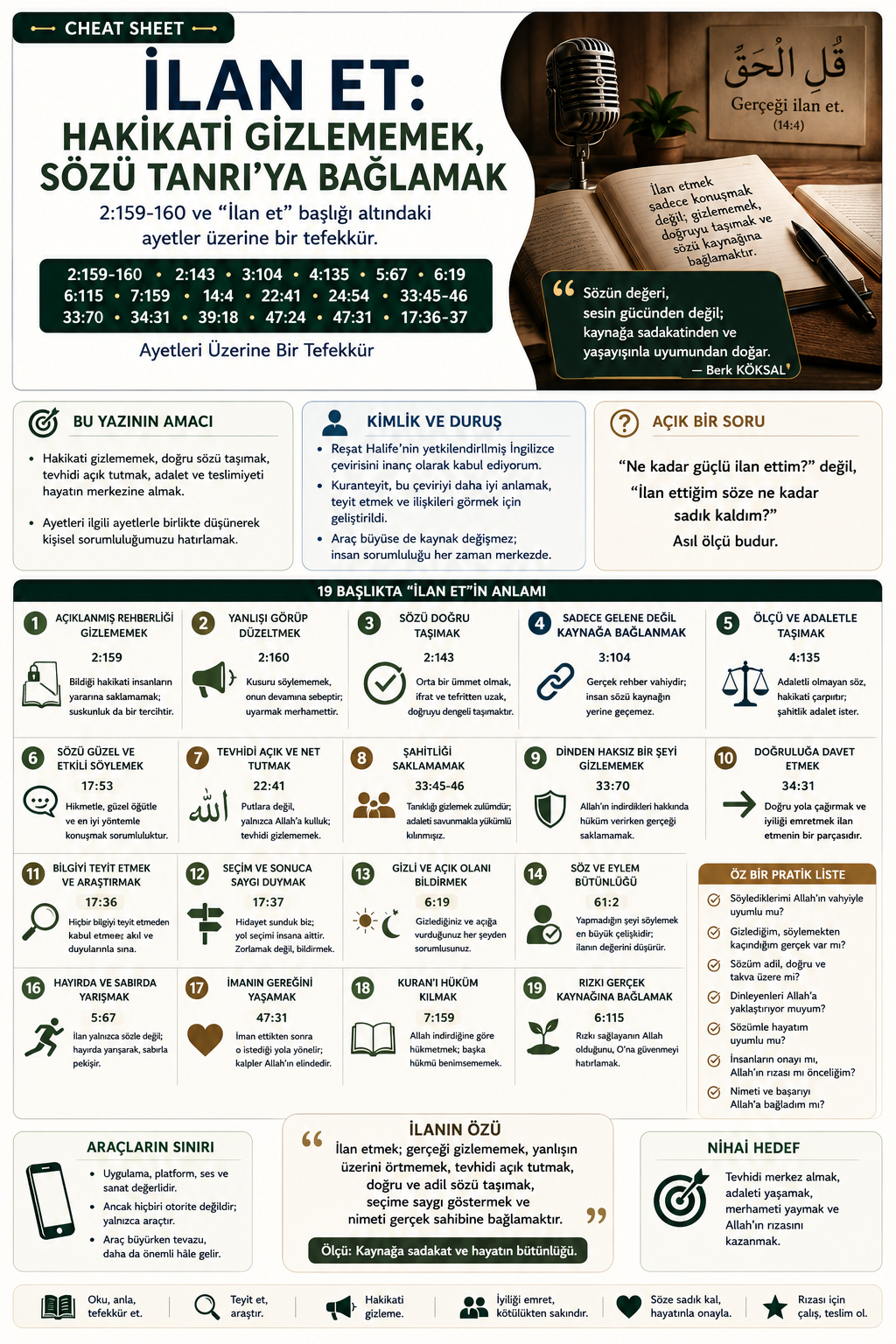
The primary aim of this article is to consider the verses together with other related verses and to express, in a sincere and profound way, what bearing witness to the oneness of GOD means in human life in terms of knowledge, justice, truthfulness, and submission.
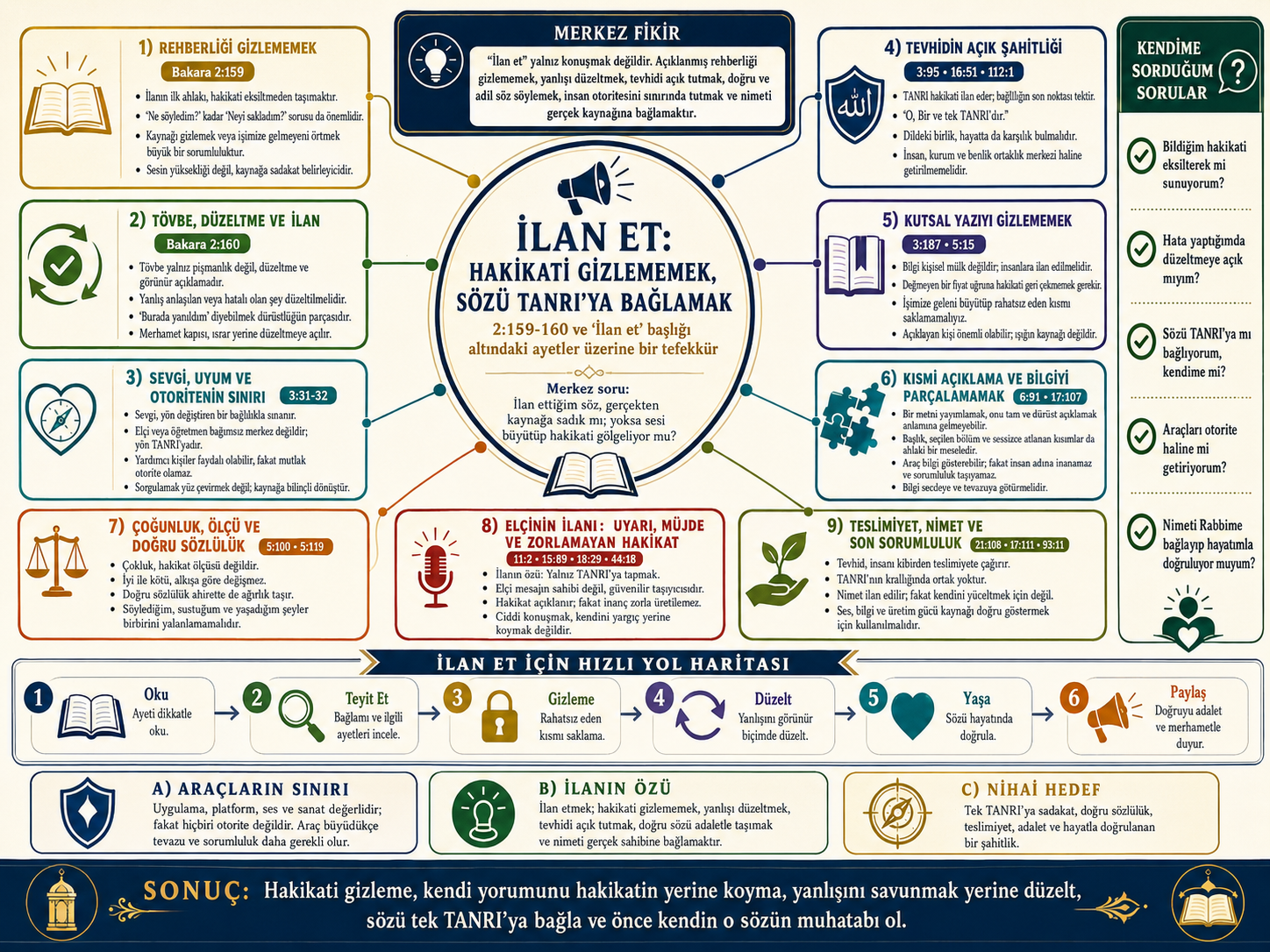
At first glance, the expression “Proclaim” may suggest nothing more than speaking loudly. Yet when I read these verses together, I see a broader responsibility: not concealing revealed guidance, correcting what is wrong, keeping tawhid clear, carrying the word truthfully and justly, keeping human authority within its proper limits, and attributing blessings to their true source.
This subject continues questions I opened in earlier writings: The Weight of Testimony, Is Comparing Quran Translations Doubt or Responsibility?, Mizan: Mix, Mastering, and Measure in the Quran, Whom Does the Microphone Exalt? ZIKR RAP, Speech, and Responsibility, Should a Quran App Issue Rulings? The Boundary Between Tool and Authority, and Expressing Tawhid in the Language of the Age: Can Form Change Without Changing the Message? In all of them I kept returning to the same point: no matter how powerful a tool, person, voice, or interpretation may be, it should not replace the source or a person’s own responsibility. All of my previous writings can be found here.
As a musician, writer, and developer of Kuranteyit, I have to think not only about what a statement says, but also about how it is brought forward. A microphone can amplify a voice, an interface can foreground an interpretation, and a headline can make an idea appear more certain than it really is. For me, then, the central question is not “How powerfully did I proclaim it?” but “How faithfully did I remain to what I proclaimed?”
Summary:
In this article I approach the call to “proclaim” not merely as speaking, but as refusing to conceal, correcting, being truthful, protecting tawhid, keeping human authority within its limits, respecting choice, and attributing blessing to GOD. The measure I reach at the end of nineteen sections is simple: the value of proclamation comes not from the power of the voice, but from fidelity to the source and from the person who proclaims being willing to live under the weight of his own words.
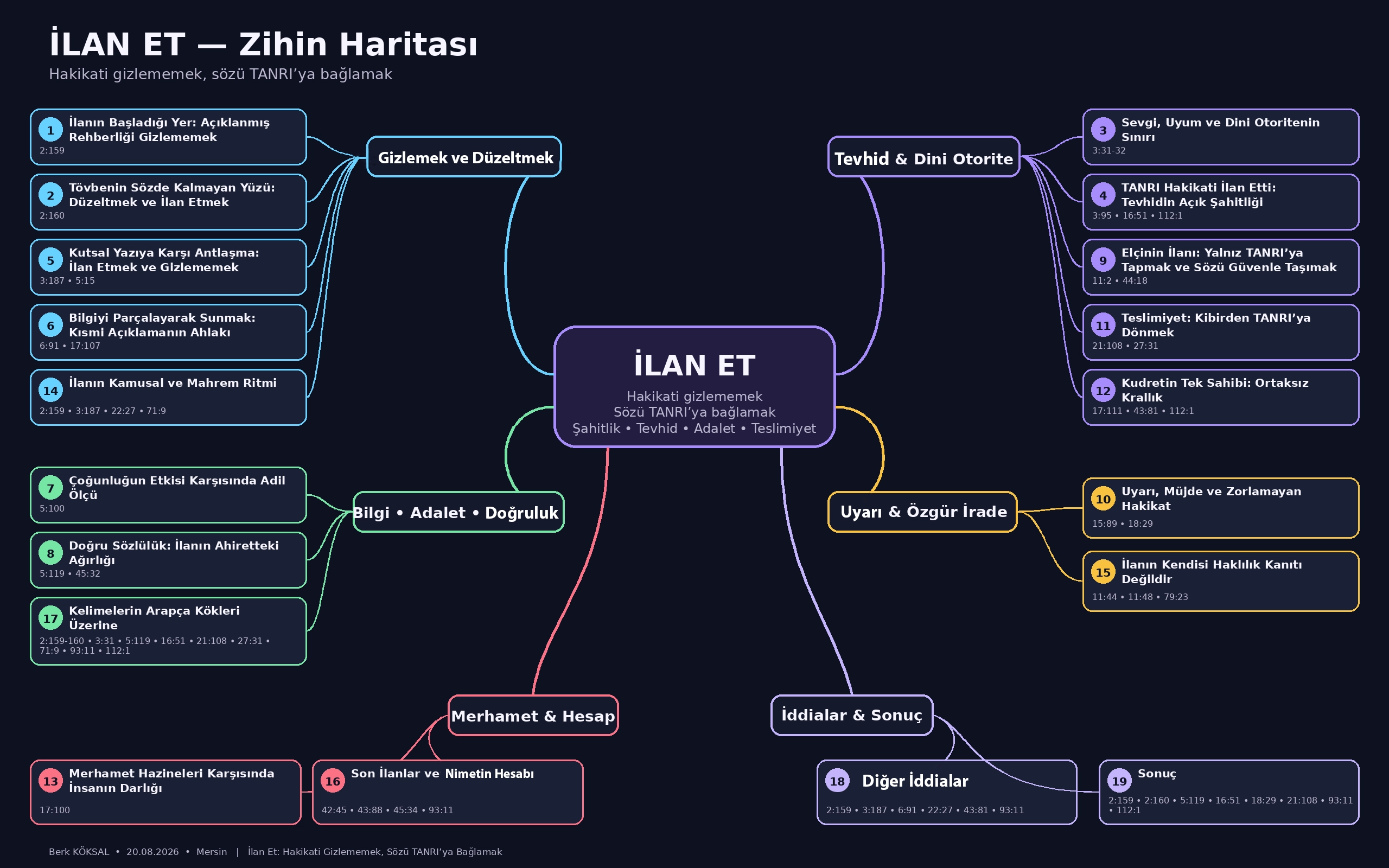
1. Where Proclamation Begins: Not Concealing Revealed Guidance
Verse
2:159
إِنَّ ٱلَّذِينَ يَكْتُمُونَ مَآ أَنزَلْنَا مِنَ ٱلْبَيِّنَٰتِ وَٱلْهُدَىٰ مِنۢ بَعْدِ مَا بَيَّنَّٰهُ لِلنَّاسِ فِى ٱلْكِتَٰبِ أُو۟لَٰٓئِكَ يَلْعَنُهُمُ ٱللَّهُ وَيَلْعَنُهُمُ ٱللَّٰعِنُونَ
Those who conceal our revelations and guidance, after proclaiming them for the people in the scripture, are condemned by GOD; they are condemned by all the condemners.
Those who conceal Our revelations and guidance after they have been proclaimed for the people in the scripture are condemned by GOD; they are also condemned by all the condemners.Source: kuranteyit.com
Reflection on the Verse
2:159 opens the word “proclaim” for me first not as a call to speak, but as a responsibility not to conceal. In The Weight of Testimony, I reflected that testimony is given not only with the tongue but also with a person’s life. Here the same measure extends even to my silence: saying a true sentence does not make me wholly truthful if I hide the part that does not serve my interests.
In the face of this verse, I need to ask myself not only “What did I say?” but also “What did I leave out?” Yet refusing to conceal does not mean presenting my own interpretation as revelation. The responsibility of verification that I emphasized in Is Comparing Quran Translations Doubt or Responsibility? applies here as well: the boundary between the verse and my inference must remain visible.
For me, the first ethic of proclamation is not volume, but fidelity to the source. The truth is not my property. While trying to carry it without reducing it according to the expectations of my circle, my anger, or my fear, I first need to see what I am covering up in my own conscience.
Verse reference: 2:159.
2. The Side of Repentance That Does Not Remain in Words: Correcting and Proclaiming
Verse
2:160 — As for those who repent, reform themselves, and proclaim, I redeem them. I am the Redeemer, Most Merciful.
Reflection on the Verse
2:160 does not allow the weight of the previous verse to close into despair. Repenting, reforming oneself, and proclaiming come one after another. This sequence makes me think that an error is not completed merely by an inward feeling of regret.
If something I published, a statement I made, or a tool I developed caused misunderstanding, the correction should also be visible. Sometimes the most truthful sentence is not a long defense: “I was wrong here; this is what is correct.” That is not putting oneself on display, but lifting the veil from the truth.
Admitting an error does not have to diminish credibility. The real problem is protecting an error for the sake of reputation. The mercy stated at the end of the verse reminds me of this: error is possible, but persistence in error is not necessary.
Verse reference: 2:160.
3. Love, Following, and the Limit of Religious Authority
Verse
3:31 — Proclaim: “If you love GOD, you shall follow me.” GOD will then love you and forgive your sins. GOD is Forgiver, Most Merciful.
3:32 — Proclaim: “Obey GOD and the messenger.” If they turn away, GOD does not love the disbelievers.
Reflection on the Verse
3:31 does not leave love of GOD as a feeling alone; it makes that love something tested through following and conduct. Saying that I love is easy. The real question is whether that love changes my direction.
In 3:32, obedience to GOD and obedience to the messenger are mentioned together. I do not see the messenger here as an independent center that closes people in upon himself; the direction is toward GOD. In Should a Quran App Issue Rulings? The Boundary Between Tool and Authority, I tried to distinguish the tool from the source. The same care is necessary with people in the religious sphere: a teacher, writer, or leader may be helpful, but cannot assume an absolute authority that the verse has not granted.
In the face of these verses, I ask myself: Am I truly seeking GOD’s call, or the approval of a person speaking in GOD’s name? Questioning and turning away are not the same thing. Returning to the source can be conscious commitment; fleeing because something weighs heavily on my ego is something else.
Verse references: 3:31-32.
4. GOD Proclaimed the Truth: The Clear Testimony of Tawhid
Verse
3:95 — Say: “GOD has proclaimed the truth: You shall follow Abraham’s religion—monotheism. He never was an idol worshiper.”
16:51 — GOD has proclaimed: “Do not worship two gods; there is only one god. You shall reverence Me alone.”
112:1 — Proclaim, “He is the One and only GOD.
Reflection on the Verse
In these verses, the source of truth is explicitly tied to GOD. Abraham’s monotheism, the command not to worship two gods, and the proclamation “He is the One and only GOD” all point to the same center: the final point of allegiance cannot be divided.
In How Can Tawhid Be Distorted by a Single Word? One GOD or ‘Highest of the High’?, I examined how even a seemingly small change in the language of tawhid can blur meaning. Here too I see that tawhid is not merely saying the right word. If I distribute my fear, hope, and final authority of judgment among many centers, the unity on my tongue is not fully reflected in my life.
Tawhid is not a sentence of superiority over others. My own interpretation cannot become an untouchable center either. To say “He is the One and only GOD” requires keeping people and institutions in their proper place while also withdrawing my own ego from any claim to partnership.
Verse references: 3:95, 16:51, 112:1.
5. The Covenant Toward Scripture: Proclaiming and Not Concealing
Verse
3:187 — GOD took a covenant from those who received the scripture: “You shall proclaim it to the people and never conceal it.” But they disregarded it behind their backs, and traded it away for a cheap price. What a miserable trade.
5:15 — O people of the scripture, our messenger has come to you to proclaim for you many things you have concealed in the scripture, and to pardon many other transgressions you have committed. A beacon has come to you from GOD, and a profound scripture.
Reflection on the Verse
3:187 speaks of proclaiming scripture to people in the language of covenant. This makes me think that religious knowledge is not private property. A person can read, research, and explain, but cannot become the owner of the source.
In Not Trading Away Revelations for a Cheap Price: The Commercialization of Digital Religion, I did not limit the question of a “cheap price” to money alone. Here too, reputation, approval from one’s circle, status, or fear of losing followers can become a price paid for pushing part of the truth into the background. I do not present this as a definitive list, but as a question the verse directs toward my own life.
For me, the everyday meaning is simple: while explaining a text, I should not enlarge what serves me and hide what makes me uncomfortable. When criticizing someone, I should not select only what counts against them; when defending myself, I should not select only what favors me. The person who explains may be important, but is not the source of the light.
Verse references: 3:187, 5:15.
6. Presenting Knowledge in Pieces: The Ethics of Partial Disclosure
Verse
6:91 — They never valued GOD as He should be valued. Thus, they said, “GOD does not reveal anything to any human being.” Say, “Who then revealed the scripture that Moses brought, with light and guidance for the people?” You put it down on paper to proclaim it, while concealing a great deal of it. You were taught what you and your parents never knew. Say, “GOD (is the One who revealed it),” then leave them playing in their heedlessness.
17:107 — Proclaim: “Believe in it, or do not believe in it.” When it is recited to those who possess knowledge from the previous scriptures, they fall down on their chins, prostrating.
Reflection on the Verse
In 6:91, putting scripture down on paper and concealing much of it appear in the same verse. This image shows that making a text visible does not by itself amount to openness. A headline, the section selected, or the continuation silently omitted can create concealment even within a published text.
While developing Kuranteyit and writing Is Comparing Quran Translations Doubt or Responsibility?, one of the points I emphasized was this: accessing information and understanding it are not the same thing. A tool can show the verse, but it cannot think, believe, or bear responsibility on behalf of the user.
In 17:107, knowledge leads to prostration. That is a powerful measure for me. If knowledge makes me more unquestionable, there is a problem; if it helps me see my place before GOD more accurately, it gains value. I think religious knowledge carries two trusts: not diminishing it, and not appropriating it as my own.
Verse references: 6:91, 17:107.
7. A Just Measure in the Face of the Majority’s Influence
Verse
5:100 — Proclaim: “The bad and the good are not the same, even if the abundance of the bad may impress you. You shall reverence GOD, O you who possess intelligence, that you may succeed.”
Reflection on the Verse
5:100 openly acknowledges that abundance can influence a person, but states that good and bad do not change according to numbers. A statement that is widely heard, widely shared, or defended by a crowd does not therefore become truth on its own.
In Mizan: Mix, Mastering, and Measure in the Quran, I explained that I do not understand balance as setting every sound to the same level. Raising one channel too much can cover the whole work. Here too, when numbers and visibility take control of the measure, the distinction between good and bad can become blurred.
The verse does not warn me only against the majority; it also does not turn being in the minority into an automatic certificate of correctness. Saying “We are few, therefore we are right” can be another form of pride in numbers. My test is to remain tied not to applause or the feeling of being alone, but to reverence for GOD and a just measure.
Verse reference: 5:100.
8. Truthfulness: The Weight of Proclamation in the Hereafter
Verse
5:119 — GOD will proclaim: “This is a day when the truthful will be saved by their truthfulness.” They have deserved gardens with flowing streams. They abide therein forever. GOD is pleased with them, and they are pleased with Him. This is the greatest triumph.
45:32 — When it was proclaimed that GOD’s promise is the truth and that the Hour is inevitable, you said, “We do not know what the Hour is! We are full of conjecture about it; we are not certain.”
Reflection on the Verse
5:119 does not leave truthfulness as a temporary virtue of communication; it connects it with salvation. For me, therefore, truthfulness is not merely that individual sentences are correct. What I say, what I leave unsaid, and what I do should not contradict one another.
In Whom Does the Microphone Exalt? ZIKR RAP, Speech, and Responsibility, I said that the microphone amplifies the voice but does not purify intention. The same measure applies to religious speech. Accurately conveying a verse is valuable; but if I direct that verse only at others while excluding myself, the distance between speech and life grows.
45:32 also makes me think about the boundary between knowledge and conjecture. I should not speak as though I know what I do not know. At the same time, constantly producing uncertainty in order to evade a clear responsibility is not truthful either. The question I ask myself is: Does the religious word I proclaim bind me as well?
Verse references: 5:119, 45:32.
9. The Messenger’s Proclamation: Worshiping GOD Alone and Carrying the Word Trustworthily
Verse
11:2 — Proclaiming: “You shall not worship except GOD. I come to you from Him as both a warner and a bearer of good news.
44:18 — Proclaiming: “Servants of GOD, listen to me. I am a trustworthy messenger sent to you.”
Reflection on the Verse
In 11:2, the essence of the proclamation is clear: worship none but GOD. The messenger does not place himself at the center of this worship; he states his task as warner and bearer of good news. This distinction is decisive for me in understanding the limits of religious authority: the messenger is not the owner of the message, but its trustworthy carrier.
In 44:18, people are addressed as “servants of GOD.” This expression does not allow any teacher or leader to treat people as his own property. An app, a book, a work of art, or a person may be helpful, but cannot take over a person’s personal responsibility before GOD.
The presence of both warning and good news is also important. A language that produces only fear can conceal the merciful side of the message, while a language that only comforts can conceal the weight of responsibility. When I speak, am I attaching people to myself, or awakening them to their own responsibility before GOD?
Verse references: 11:2, 44:18.
10. Warning, Good News, and Truth Without Coercion
Verse
15:89 — And proclaim: “I am the manifest warner.”
18:29 — Proclaim: “This is the truth from your Lord,” then let whoever wishes believe, and whoever wishes disbelieve. We have prepared for the transgressors a fire that will completely surround them. When they cry for help, they will be given a liquid like concentrated acid that scalds the faces. What a miserable drink! What a miserable destiny!
Reflection on the Verse
15:89 emphasizes that the warning is manifest. Truth should be carried not through a foggy language of superiority, but through a word whose source and limits are clear.
In 18:29, after truth is attributed to the Lord, the human being is asked to face his own choice. I understand from this that proclamation is not coercion. The warning should not be hidden, but the decision to believe cannot be made on behalf of another person. The seriousness of the consequence does not make choice insignificant; on the contrary, it makes responsibility personal.
In Expressing Tawhid in the Language of the Age: Can Form Change Without Changing the Message?, I reflected that form may change while the center must not. Here too, tone of voice, medium, and mode of expression may change; truth should not be bent, and the person addressed should not be diminished. For me, mature proclamation means speaking seriously without putting myself in the place of the judge.
Verse references: 15:89, 18:29.
11. Submission: Turning from Pride to GOD
Verse
21:108 — Proclaim: “I have been divinely inspired that your god is one god. Will you then submit?”
27:31 — “Proclaiming: ‘Do not be arrogant; come to me as submitters.’ ”
Reflection on the Verse
21:108 completes the knowledge of GOD’s oneness with a direct question: “Will you then submit?” Tawhid therefore does not remain a mental assent alone; it asks for a response that changes a person’s direction.
In 27:31, pride and submission stand opposite one another. Pride is not merely thinking oneself superior. Recognizing the truth yet holding back in order to preserve one’s position, habit, or interest can also be a form of pride. For me, one concrete test of submission is being able to admit and correct my error when necessary.
This submission does not mean surrendering my personality to another human being. The direction is to the one GOD. Being freed from people’s applause, threats, and absolutized authority does not reduce responsibility; it makes responsibility clearer. “Everyone did it this way” or “My leader said so” can no longer be the final refuge.
Verse references: 21:108, 27:31.
12. The Sole Possessor of Power: A Kingdom Without Partners
Verse
17:111 — And proclaim: “Praise be to GOD, who has never begotten a son, nor does He have a partner in His kingship, nor does He need any ally out of weakness,” and magnify Him constantly.
43:81 — Proclaim: “If the Most Gracious truly had a son, I would still be the foremost worshiper.”
112:1 — Proclaim, “He is the One and only GOD.
Reflection on the Verse
17:111 proclaims that GOD has not begotten a son, has no partner in His kingdom, and has no need for an ally because of weakness. These expressions separate divine power from the order of need that belongs to created beings.
I do not want to isolate 43:81 and force it toward different conclusions. In this group of verses there is the explicit rejection in 17:111 and the proclamation of unity in 112:1. As I did in How Can Tawhid Be Distorted by a Single Word?, I find it safer to read a sentence within the clear wholeness of tawhid.
If there is no partner in GOD’s kingdom, no human being can be presented as a partner in sacred rule. A messenger may be trustworthy, a teacher knowledgeable, a ruler responsible; but none gains independent absoluteness. To magnify GOD is not only to praise Him with the tongue, but also not to absolutize other powers in my life.
Verse references: 17:111, 43:81, 112:1.
13. Human Narrowness Before the Treasures of Mercy
Verse
17:100 — Proclaim: “If you possessed my Lord’s treasures of mercy, you would withhold them out of fear that you might exhaust them. The human being is stingy.”
Reflection on the Verse
17:100 states that if human beings possessed the treasures of mercy, they would withhold them out of fear that they might run out. The verse makes me think about how the fear of scarcity can constrict not only our relationship with possessions, but also our relationship with speech and knowledge.
Truth, guidance, or knowledge is not my private treasure. If I want people to return to me for every answer, I can make them dependent on me instead of bringing them closer to the source. One aspect of the commercialization issue I questioned in Not Trading Away Revelations for a Cheap Price was precisely this: Does the message serve, or does it become a means of keeping people attached?
Generosity does not mean speaking without measure. If my knowledge is limited, I must learn to remain silent; if I clearly know something true, I must learn not to hide it for the sake of interest. Proclaiming sometimes means letting go of control over the word: I remain faithful to the source; I leave the outcome and the treasures of mercy to GOD.
Verse reference: 17:100.
14. The Public and Private Rhythm of Proclamation
Verse
2:159 — Those who conceal Our revelations and guidance after they have been proclaimed for the people in the scripture are condemned by GOD; they are also condemned by all the condemners.
3:187 — GOD took a covenant from those who received the scripture: “You shall proclaim it to the people and never conceal it.” But they disregarded it behind their backs, and traded it away for a cheap price. What a miserable trade.
22:27 — “And proclaim to the people that they shall observe the sacred pilgrimage of Hajj.* They will come to you walking or by various means of transportation bearing the fatigue of the journey. They will come from the farthest locations.”
71:9 — “Then I proclaimed to them publicly, and I also spoke to them privately.
Reflection on the Verse
In 22:27, a specific call is openly announced to the people. In 71:9, proclaiming aloud and speaking privately appear side by side. These two directions show me that carrying truth cannot be reduced to a single volume or a single setting.
Some statements require public clarity. Turning truth into private property accessible only with the approval of a closed circle does not fit the responsibility not to conceal in 2:159 and 3:187. Yet not every person can think in the midst of a crowd. Speaking privately may require carrying the same truth while seeing the question and vulnerability of the person addressed.
In Expressing Tawhid in the Language of the Age, I reflected on the boundary between form and message. Here too the form may change; the source does not. An article may be public and still remain sincere enough to speak to one person’s conscience. A private conversation, however, should not turn into a different truth shaped by the interests of a closed circle.
Verse references: 2:159, 3:187, 22:27, 71:9.
15. Proclamation Itself Is Not Proof of Being Right
Verse
11:44 — It was proclaimed: “O earth, swallow your water,” and “O sky, cease.” The water then subsided; the judgment was fulfilled. The ship finally rested on the hills of Judea.* Then it was proclaimed: “The transgressors have perished.”
11:48 — It was proclaimed: “O Noah, disembark with peace and blessings upon you and upon nations to come from your companions. As for other nations to come from your descendants, We will bless them for a while, then commit them to painful retribution.”
79:23 — He gathered and proclaimed.
Reflection on the Verse
In 11:44 and 11:48, proclamation is connected with fulfilled divine judgment. 79:23, meanwhile, reports an act of gathering and proclaiming. Seeing these side by side teaches me an important distinction: proclamation by itself is not proof of being right.
A large hall, a powerful microphone, a high follower count, or an interface that appears certain does not make a statement more true. In Whom Does the Microphone Exalt? and Should a Quran App Issue Rulings?, I returned through different tools to the same boundary: powerful presentation cannot replace the source.
A person should not clothe his own interpretation in divine certainty. The attitude “I said it, therefore it is true” turns religious speech into an instrument of the ego. My task is not to put my voice in place of truth, but to show the source, state the limits of my own inference, and avoid acting as though I own the judgment.
Verse references: 11:44, 11:48, 79:23.
16. Final Proclamations and the Reckoning of Blessings
Verse
42:45 — You will see them facing it, humiliated and disgraced, looking while trying to avoid looking. Those who believed will proclaim: “The real losers are those who lost themselves and their families on the Day of Resurrection. The transgressors have incurred endless retribution.”
43:88 — It will be proclaimed: “My Lord, these people do not believe.”
45:34 — It will be proclaimed: “Today We forget you, just as you forgot the meeting of this day. Your abode is the hellfire, and you will have no helpers.
93:11 — Proclaim the blessing your Lord has bestowed upon you.
Reflection on the Verse
42:45 reminds me that things that appear to be gain today may be proclaimed as real loss on the Day of Resurrection. The measure of this world is not the final measure. A person can gain much outwardly while losing himself and his family.
43:88 shows me the limit of the one who proclaims. Truth can be stated clearly and different ways can be tried, but another person’s faith cannot be manufactured. 45:34 says that temporary helpers will disappear at the end. This makes me think that I should not turn people or institutions into my final security.
93:11, alongside these grave scenes, commands the proclamation of blessing. Proclaiming blessing is not praising myself, but recognizing its source. Whatever voice, time, knowledge, or productive capacity I have been given, if I turn it into a display case for my ego, the direction is distorted. Gratitude is to remember the owner of the blessing correctly and to use the blessing responsibly.
Verse references: 42:45, 43:88, 45:34, 93:11.
17. On the Arabic Roots of the Words
Verse
2:159 — Those who conceal Our revelations and guidance after they have been proclaimed for the people in the scripture are condemned by GOD; they are also condemned by all the condemners.
2:160 — As for those who repent, reform themselves, and proclaim, I redeem them. I am the Redeemer, Most Merciful.
3:31 — Proclaim: “If you love GOD, you shall follow me.” GOD will then love you and forgive your sins. GOD is Forgiver, Most Merciful.
5:119 — GOD will proclaim: “This is a day when the truthful will be saved by their truthfulness.” They have deserved gardens with flowing streams. They abide therein forever. GOD is pleased with them, and they are pleased with Him. This is the greatest triumph.
16:51 — GOD has proclaimed: “Do not worship two gods; there is only one god. You shall reverence Me alone.”
21:108 — Proclaim: “I have been divinely inspired that your god is one god. Will you then submit?”
27:31 — “Proclaiming: ‘Do not be arrogant; come to me as submitters.’ ”
71:9 — “Then I proclaimed to them publicly, and I also spoke to them privately.
93:11 — Proclaim the blessing your Lord has bestowed upon you.
112:1 — Proclaim, “He is the One and only GOD.
Reflection on the Verse
In Is Comparing Quran Translations Doubt or Responsibility?, I stated that I regard root information as a useful research tool, but not as an authority that by itself determines the whole meaning of a verse. I preserve the same caution here. The root of a word, its form in the sentence, and the verse as a whole must be considered together.
The word يَكْتُمُونَ (yektumûne) in 2:159 connects through the root ك-ت-م (Kaf-Te-Mim) to the field of concealing and hiding; in the same verse, ٱلْبَيِّنَاتِ (el-beyyinâti) and بَيَّنَّاهُ (beyyennâhu) connect through ب-ي-ن (Be-Ya-Nun) (b-y-n) to clarity and making something distinct. The بَيَّنُوا (beyyenû) of 2:160 continues this movement back toward clarity. Repentance thus appears not only as inward regret, but as a correction that makes what was hidden visible again.
The word قُلْ (qul) in 3:31 carries, through the root ق-و-ل (Qaf-Waw-Lam), the call to speak and communicate. The أَعْلَنتُ (a’lentu) of 71:9 connects through ع-ل-ن (Ayn-Lam-Nun) to open proclamation; the فَحَدِّثْ (fahaddith) of 93:11 connects through ح-د-ث (Ha-Dal-Tha) to speaking of the blessing. The الصَّادِقِينَ (es-sâdikîne) and صِدْقُهُمْ (sidquhum) of 5:119 connect through ص-د-ق (Sad-Dal-Qaf) to truthfulness; the expressions of submission in 21:108 and 27:31 recall through س-ل-م (Sin-Lam-Mim) the field of turning and submission.
The أَحَدٌ (ahadun) of 112:1 and وَاحِدٌ (wahidun) of 16:51, within their respective sentences, proclaim the oneness of GOD that admits no partner. When the roots are considered together, the path becomes simple: concealment is left behind, clarity is established, speech is guarded by truthfulness, and the whole movement turns in submission toward the one GOD.
Verse references: 2:159-160, 3:31, 5:119, 16:51, 21:108, 27:31, 71:9, 93:11, 112:1.
18. Other Claims
Verse
2:159 — Those who conceal Our revelations and guidance after they have been proclaimed for the people in the scripture are condemned by GOD; they are also condemned by all the condemners.
3:187 — GOD took a covenant from those who received the scripture: “You shall proclaim it to the people and never conceal it.” But they disregarded it behind their backs, and traded it away for a cheap price. What a miserable trade.
6:91 — They never valued GOD as He should be valued. Thus, they said, “GOD does not reveal anything to any human being.” Say, “Who then revealed the scripture that Moses brought, with light and guidance for the people?” You put it down on paper to proclaim it, while concealing a great deal of it. You were taught what you and your parents never knew. Say, “GOD (is the One who revealed it),” then leave them playing in their heedlessness.
22:27 — “And proclaim to the people that they shall observe the sacred pilgrimage of Hajj.* They will come to you walking or by various means of transportation bearing the fatigue of the journey. They will come from the farthest locations.”
43:81 — Proclaim: “If the Most Gracious truly had a son, I would still be the foremost worshiper.”
93:11 — Proclaim the blessing your Lord has bestowed upon you.
Reflection on the Verse
In historical interpretations of 2:159 and 3:187, it may be said that the warning is addressed primarily to particular communities or scholars who possessed knowledge of scripture. Other readings may argue for a broader moral principle applying to anyone who knowingly conceals clear guidance. Without setting a definitive ruling about scope in this article, I have focused on the explicit contrast in the verses between concealing and proclaiming.
The expression in 6:91 about putting something down on paper while concealing much of it may be explained through specific historical practices. My contemporary connection to publishing and selective visibility is not a claim that the verse directly legislates about digital techniques; it is only a moral question the verse opens for me.
Through 3:31-32, some institutional or sectarian approaches may read obedience to the messenger as a broader model for later religious authorities. Other approaches may argue that this authority is limited to the messenger’s mission. The main line of this article is not to settle that debate definitively, but to think together about the messenger’s role in directing people toward GOD and the limits of human authority.
22:27 directly concerns announcing the sacred Hajj pilgrimage. Different grammatical explanations may be offered for the conditional statement in 43:81. In this article, I considered it within the clear line of unity in 16:51, 17:111, and 112:1. The scope of the blessing in 93:11 may likewise be interpreted in different ways. These differences do not determine the main conclusion; that conclusion rests on the line the verses clearly establish regarding non-concealment, truthfulness, tawhid, submission, and responsibility.
Verse references: 2:159, 3:31-32, 3:187, 6:91, 16:51, 17:111, 22:27, 43:81, 93:11, 112:1.
19. Conclusion
Verse
2:159 — Those who conceal Our revelations and guidance after they have been proclaimed for the people in the scripture are condemned by GOD; they are also condemned by all the condemners.
2:160 — As for those who repent, reform themselves, and proclaim, I redeem them. I am the Redeemer, Most Merciful.
5:119 — GOD will proclaim: “This is a day when the truthful will be saved by their truthfulness.” They have deserved gardens with flowing streams. They abide therein forever. GOD is pleased with them, and they are pleased with Him. This is the greatest triumph.
16:51 — GOD has proclaimed: “Do not worship two gods; there is only one god. You shall reverence Me alone.”
18:29 — Proclaim: “This is the truth from your Lord,” then let whoever wishes believe, and whoever wishes disbelieve. We have prepared for the transgressors a fire that will completely surround them. When they cry for help, they will be given a liquid like concentrated acid that scalds the faces. What a miserable drink! What a miserable destiny!
21:108 — Proclaim: “I have been divinely inspired that your god is one god. Will you then submit?”
93:11 — Proclaim the blessing your Lord has bestowed upon you.
112:1 — Proclaim, “He is the One and only GOD.
Reflection on the Verse
When I return to 2:159, the first meaning the word “proclaim” leaves with me is not speaking, but not concealing. I must not obscure revealed guidance for the sake of my interest, fear, or allegiance; I must not mix the verse with my interpretation; I must carry what is true honestly rather than selectively.
2:160 also leaves the door of return open alongside that responsibility. If I have made a mistake, repentance, correction, and proclamation should complete one another. Instead of hiding behind something I published before, correcting it when necessary is for me not weakness, but part of submission.
This article brings together in one place many lines that I treated separately in earlier work. The Weight of Testimony reminded me that speech must be confirmed by life; Is Comparing Quran Translations Doubt or Responsibility? that verification is personal responsibility; Mizan that measure cannot be surrendered to numbers and volume; and Whom Does the Microphone Exalt? that powerful speech does not automatically purify intention. Here all these questions converge in the call to “proclaim.”
Tawhid is at the center of this whole. GOD proclaims the truth; only He is worshiped; He is the One and only GOD; He has no partner in His kingdom. The messenger may therefore be a trustworthy carrier, but he is not the center of worship. A teacher, scholar, writer, artist, app, or institution may be useful, but none can take over a person’s accountability before GOD.
Knowledge should make me more careful, not more arrogant. Justice requires not allowing the influence of the majority to erase the difference between good and bad. Truthfulness carries the account not only of what I say, but also of what I leave unsaid and how I live. Speaking the truth openly is not the seizure of another person’s will: I do not conceal the warning, but I do not put myself in the place of the judge.
The question of 21:108 finally turns directly toward me: “Will you then submit?” I too am the addressee of my own writing. Bringing what I conceal into the open, correcting my error, keeping human authorities within their limits, attributing blessing to my Lord, and trying to live under the word I speak are all part of my test of submission.
93:11 commands the proclamation of blessing. The voice, knowledge, time, and capacity to produce that I have been given should be used not to enlarge myself, but to point correctly to the source. If a day will come when it is proclaimed that the truthful are saved by their truthfulness, I should try today to build a life that can stand behind the words I speak.
In the end, the sentence I tell myself is this: Do not conceal the truth, do not put your own interpretation in place of truth, correct your error instead of defending it, tie the word to the one GOD, and first become the addressee of that word yourself.
Verse references: 2:159-160, 3:31-32, 3:95, 3:187, 5:15, 5:100, 5:119, 6:91, 11:2, 11:44, 11:48, 15:89, 16:51, 17:100, 17:107, 17:111, 18:29, 21:108, 22:27, 27:31, 42:45, 43:81, 43:88, 44:18, 45:32, 45:34, 71:9, 79:23, 93:11, 112:1.
Note
2:32 — They said, “Be You glorified. We have no knowledge except that which You have taught us. You are the Omniscient, Most Wise.”
93:11 Proclaim the blessing your Lord has bestowed upon you.
GOD knows best.
Source: kuranteyit.com
Discover
Related Articles

Quran Reflections
Turning Back on Your Heels: Preserving Your Direction After Guidance
A reflection centered on Al-Baqarah 2:143 on turning back on one's heels, sliding back after guidance, leaving the faith, casting scripture behind one's back, testimony, knowledge, justice, truthfulness, submission, and the limits of religious authority.
Read article
Quran Reflections
True Wealth According to the Quran: Material Wealth or Not Being Rich?
A 19-part reflection centered on Al-Baqarah 2:247, exploring wealth, material possessions, poverty, provision, justice, charity, Qarun, trade, temporary worldly blessings, closeness to GOD, and true gain.
Read article
Quran Reflections
What Is the Heavenly Society? What Is the Dispute in the High Society?
A comprehensive reflection centered on As-Saffat 37:8 and Sad 38:69 about the High Society, the dispute in the heavenly society, the creation of the human being, Satan's pride and rebellion, tawhid, testimony, knowledge, justice, submission, verification, and the limits of religious authority.
Read article