True Wealth According to the Quran: Material Wealth or Not Being Rich?
A 19-part reflection centered on Al-Baqarah 2:247, exploring wealth, material possessions, poverty, provision, justice, charity, Qarun, trade, temporary worldly blessings, closeness to GOD, and true gain.

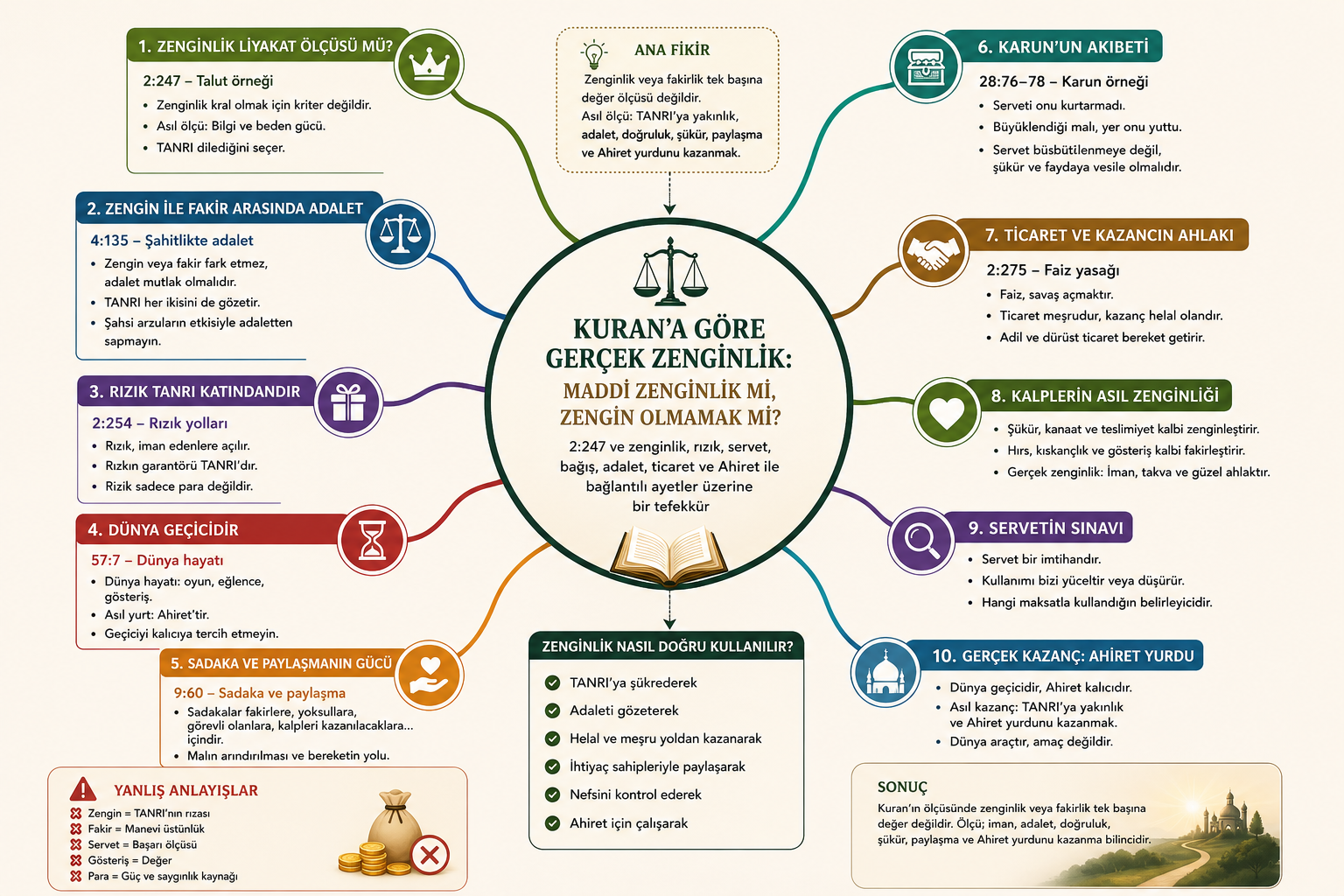
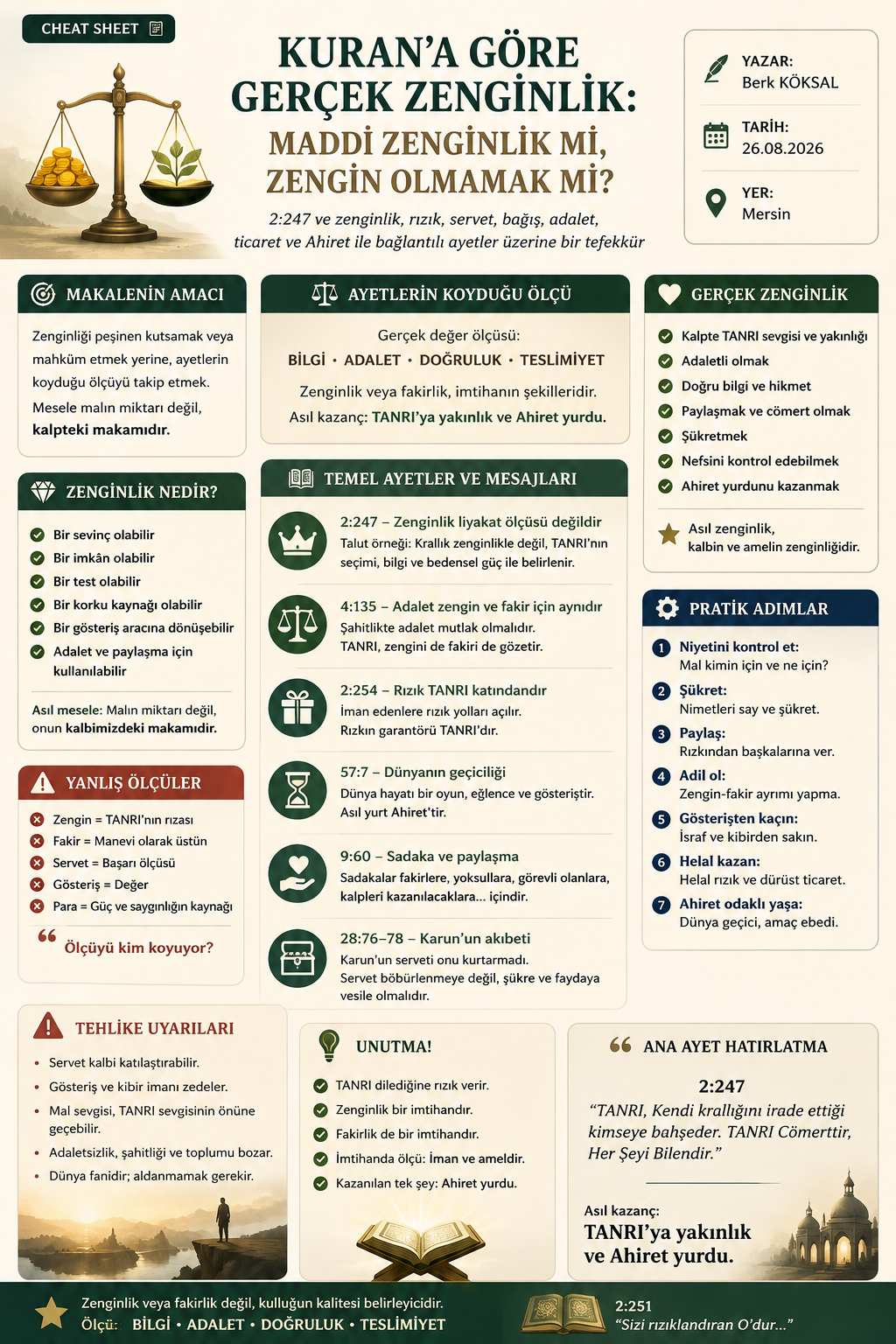
True Wealth According to the Quran:
Material Wealth or Not Being Rich?
A reflection on 2:247 and verses related to wealth, provision, possessions, charity, justice, trade, and the Hereafter
Author: Berk KÖKSAL
Date: 26.08.2026
Location: Mersin
Verse
1:1 — In the name of GOD, Most Gracious, Most Merciful.*
Introduction
Peace. Peace be upon you.
When I think about wealth, a very old yet still living question stands before me: Does possessing many things really mean being better off? Is an increase in material means a sign that GOD is pleased with a person? Conversely, does having little property make a person spiritually more valuable? Or are we framing the question incorrectly from the very beginning?
For me, this subject is not only about money. What I think about a person’s wealth also reveals how I measure success, whom I respect, whom I regard as powerful, and what I pursue. Money can provide real power within life. It can change a great deal in terms of housing, education, health, security, time, freedom of movement, and the ability to produce. It would not be realistic to deny this. But does the reality of material power mean that a person’s value before GOD is determined by the same measure?
The main purpose of this article is to consider the verses together with other relevant verses and to express, in a sincere and deep way, what bearing witness to the oneness of GOD means in human life in terms of knowledge, justice, truthfulness, and submission.
This question meets the issue of justice and knowledge that I considered in The Weight of Testimony, the relationship between money and the religious message that I questioned in Not Trading Away Revelations for a Cheap Price: The Commercialization of Digital Religion, and the limits of human authority that I discussed in How Can Tawhid Be Distorted by One Word? One GOD or “Highest of the High”? at the same point: Who sets the measure?
Wealth is not outside this question either. In this article, rather than sanctifying or condemning material wealth in advance, I will try to follow the measure established by the verses. The picture the Quran places before me seems deeper than a one-sentence conclusion such as “wealth is good” or “poverty is good.” Property can be a joy, a means, a test, a source of fear, a tool of display, or something used for justice and sharing. The main issue is not only how much I possess, but what position what I possess occupies in my heart.
Summary:
1. Is Wealth a Measure of Merit?
2:247
وَقَالَ لَهُمْ نَبِيُّهُمْ إِنَّ ٱللَّهَ قَدْ بَعَثَ لَكُمْ طَالُوتَ مَلِكًا قَالُوٓا۟ أَنَّىٰ يَكُونُ لَهُ ٱلْمُلْكُ عَلَيْنَا وَنَحْنُ أَحَقُّ بِٱلْمُلْكِ مِنْهُ وَلَمْ يُؤْتَ سَعَةً مِّنَ ٱلْمَالِ قَالَ إِنَّ ٱللَّهَ ٱصْطَفَىٰهُ عَلَيْكُمْ وَزَادَهُۥ بَسْطَةً فِى ٱلْعِلْمِ وَٱلْجِسْمِ وَٱللَّهُ يُؤْتِى مُلْكَهُۥ مَن يَشَآءُ وَٱللَّهُ وَٰسِعٌ عَلِيمٌ
Their prophet said to them, “GOD has appointed Taloot (Saul) to be your king.” They said, “How can he have kingship over us when we are more worthy of kingship than he; he is not even rich?” He said, “GOD has chosen him over you, and has blessed him with an abundance in knowledge and in body.” GOD grants His kingship to whomever He wills. GOD is Bounteous, Omniscient.
Their prophet said to them, “GOD has appointed Taloot (Saul) to be your king.” They said, “How can he have kingship over us when we are more worthy of kingship than he; he is not even rich?” He said, “GOD has chosen him over you and has blessed him with an abundance in knowledge and in body.” GOD grants His kingship to whomever He wills. GOD is Bounteous, Omniscient.
2. Justice Between Rich and Poor: The Measure of Testimony
4:135 — O you who believe, you shall be absolutely equitable when you serve as witnesses, even against yourselves, or your parents, or your relatives, and observe GOD. Whether the accused is rich or poor, GOD takes care of both. Therefore, do not be biased by your personal wishes. If you deviate or disregard this commandment, GOD is fully Cognizant of everything you do.
2:177 — Righteousness is not turning your faces toward the east or the west. The righteous are those who believe in GOD, the Last Day, the angels, the scripture, and the prophets; they give their money cheerfully to the relatives, the orphans, the needy, the traveling alien, the beggars, and to free the slaves; they observe the Contact Prayers (Salat) and give the obligatory charity (Zakat); they keep their word whenever they make a promise; and they steadfastly persevere in the face of persecution, hardship, and war. These are the truthful; these are the righteous.
3. More Money, More Power, and Greater Closeness to GOD?
34:35 — They also said, “We are more powerful, with more money and children, and we will not be punished.”
34:36 — Say, “My Lord is the One who controls all provisions; He grants the provisions to whomever He wills, or reduces them, but most people do not know.”
34:37 — It is neither your money nor your children that bring you closer to us. Only those who believe and lead a righteous life will receive their reward manyfold for their works. They will live in perfect peace in the abode of Paradise.
4. Is Wealth a Reward, or a Test?
8:28 — You should know that your money and your children are a test, and that GOD possesses a great recompense.
64:15 — Your money and children are a test, while GOD possesses a great recompense.
5. When a Human Being Feels Self-Sufficient Because He Is Rich
96:6 — Indeed, the human transgresses.
96:7 — When he becomes rich.
92:8 — But the one who is stingy, though he is rich.
92:9 — And disbelieves in the scripture.
92:10 — We will direct him toward misery.
92:11 — His money cannot help him when he falls.
6. Who Is Absolutely Rich?
31:26 — Everything in the heavens and the earth belongs to GOD. GOD is the Most Rich, the Most Praiseworthy.
47:38 — You are invited to spend in the cause of GOD, but some of you become stingy. The stingy ones are stingy toward their own souls. GOD is Rich, while you are poor.
A warning to the Arabs* If you turn away, He will substitute other people in your place, and they will not be like you.
7. Both Wealth and Poverty Are Within the Order of Provision
53:48 — He is the One who makes you rich or poor.
93:8 — He found you poor and made you rich.
8. Does Abundance Mean Honor and Constraint Mean Humiliation?
89:15 — When the human is tested by his Lord through blessings and joy, he says, “My Lord is generous toward me.”
89:16 — But if He tests him through a reduction in provisions, he says, “My Lord is humiliating me!”
89:17 — Wrong! You brought this upon yourselves by failing to regard the orphan's right.
89:18 — And by failing to advocate charity toward the poor.
89:19 — And by consuming the inheritance of helpless orphans.
89:20 — And by loving money too much.
9. Qarun: Could Wealth's Most Dangerous Sentence Be “I Did This”?
28:76 — Qarun was one of Moses' people; he betrayed them and oppressed them. We gave him so many treasures that their keys were almost too heavy for even the strongest group to carry. His people said to him, “Do not be so arrogant; GOD does not love the arrogant.
28:77 — “Use the provisions GOD has bestowed upon you to seek the abode of the Hereafter, without neglecting your share in this world. Be charitable, just as GOD has been charitable toward you. Do not continue corrupting the earth. GOD does not love the corruptors.”
28:78 — He said, “I attained all this because of my own brilliant intelligence.” Did he not realize that GOD had annihilated before him generations far stronger and more numerous than he? Those transgressors who were annihilated were not asked about their crimes.
28:79 — One day, he came out before his people in all his splendor. Those who preferred this worldly life said, “Oh, we wish we possessed what Qarun has attained. He is indeed very fortunate.”
28:80 — As for those blessed with knowledge, they said, “Woe to you, GOD's recompense is far better for those who believe and lead a righteous life.” None attain this except the steadfast.
10. Temporary Wealth and Lasting Hope
18:46 — Money and children are the joys of this life, but righteous works provide an eternal recompense from your Lord and a much better hope.
57:20 — Know that this worldly life is no more than play and amusement, boasting among you, and accumulating money and children. It is like abundant rain that produces plants and pleases the disbelievers. Then the plants turn into useless dry hay and are blown away by the wind. In the Hereafter there is either severe retribution, or forgiveness and approval from GOD. This worldly life is no more than a temporary illusion.
11. There Is a Moment When Money Cannot Help
26:88 — On that day, neither money nor children can help.
26:89 — Only those who come to GOD wholeheartedly will be saved.
12. The Ethics of Charity Matters as Much as Its Amount
2:263 — Kind words and compassion are better than a charity followed by insult. GOD is Rich, Clement.
2:264 — O you who believe, do not nullify your charities by reproach and insult, like the one who spends his money to show off while disbelieving in GOD and the Last Day. His example is like a rock covered with a thin layer of soil; as soon as heavy rain falls, it washes away the soil, leaving it a useless rock. They gain nothing from their efforts. GOD does not guide the disbelieving people.
2:265 — The example of those who give their money seeking GOD's pleasure, from sincere conviction, is like a garden on high fertile ground; when heavy rain falls, it produces twice as much crop. If no heavy rain falls, a drizzle is sufficient. GOD is Seer of everything you do.
2:267 — O you who believe, give from the good things you earn and from what we produce for you from the earth. Do not select the bad among them to give away, things you yourselves would not accept unless your eyes were closed. You should know that GOD is Rich, Praiseworthy.
13. Is Increasing Wealth the Same as Real Gain?
34:39 — Say, “My Lord is the One who controls all provisions. He increases the provisions for whomever He chooses among His servants, or reduces them. Whatever you spend in the cause of GOD, He will reward you for it. He is the Best Provider.”
30:39 — Usury practiced to increase some people's wealth gains nothing at GOD. But if you give to charity seeking GOD's pleasure, these are the ones who receive their recompense manyfold.
14. Fear of Poverty and Responsibility According to Means
2:268 — The devil promises you poverty and commands you to commit evil, while GOD promises you forgiveness and grace from Him. GOD is Bounteous, Omniscient.
65:7 — The rich husband shall provide support according to his means, and the poor husband shall provide according to the means GOD has bestowed upon him. GOD does not burden any soul beyond what He has given it. GOD will provide ease after hardship.
15. When Trade Makes One Forget GOD
24:37 — They are people whose business or trade does not distract them from remembering GOD; they observe the Contact Prayers (Salat), give the obligatory charity (Zakat), and remain conscious of the day when minds and eyes will be horrified.
24:38 — GOD will surely reward them for their good works and shower them with His grace. GOD provides for whomever He wills without limit.
63:9 — O you who believe, do not let your money and your children distract you from remembering GOD. Those who do this are the losers.
16. Money, Religious Authority, and the Danger of Taking Human Beings as Lords
9:31 — They have set up their religious leaders and scholars as lords* instead of GOD. Others deified the Messiah, son of Mary. They were all commanded to worship only one god. There is no other god beside Him. Be He glorified, far above having any partners.
9:34 — O you who believe, many religious leaders and preachers take the people's money illicitly and repel from the path of GOD. Those who hoard gold and silver and do not spend them in the cause of GOD; promise them a painful retribution.
17. Could GOD's Grace and Mercy Be Better Than Wealth?
10:58 — Say, “Let them rejoice in GOD's grace and mercy.” This is far better than any wealth they can accumulate.
3:157 — If you are killed in the cause of GOD, or die, forgiveness and mercy from GOD are far better than anything they hoard.
18. Why Can Worldly Adornments Not Be the Ultimate Measure of Value?
43:33 — If it were not that all people might become one disbelieving community, we would have granted everyone who disbelieves in the Most Gracious mansions with silver roofs and stairways upon which they could climb.
43:34 — Their mansions would have impressive doors and luxurious furnishings.
43:35 — Also many ornaments. All these are merely temporary commodities of this lower life. The Hereafter—for the righteous—is far better at your Lord.
19. On the Arabic Roots of the Words
2:247 — Their prophet said to them, “GOD has appointed Taloot (Saul) to be your king.” They said, “How can he have kingship over us when we are more worthy of kingship than he; he is not even rich?” He said, “GOD has chosen him over you and has blessed him with an abundance in knowledge and in body.” GOD grants His kingship to whomever He wills. GOD is Bounteous, Omniscient.
31:26 — Everything in the heavens and the earth belongs to GOD. GOD is the Most Rich, the Most Praiseworthy.
47:38 — You are invited to spend in the cause of GOD, but some of you become stingy. The stingy ones are stingy toward their own souls. GOD is Rich, while you are poor.
A warning to the Arabs* If you turn away, He will substitute other people in your place, and they will not be like you.
34:39 — Say, “My Lord is the One who controls all provisions. He increases the provisions for whomever He chooses among His servants, or reduces them. Whatever you spend in the cause of GOD, He will reward you for it. He is the Best Provider.”
92:8 — But the one who is stingy, though he is rich.
Other Claims
89:15 — When the human is tested by his Lord through blessings and joy, he says, “My Lord is generous toward me.”
89:16 — But if He tests him through a reduction in provisions, he says, “My Lord is humiliating me!”
34:37 — It is neither your money nor your children that bring you closer to us. Only those who believe and lead a righteous life will receive their reward manyfold for their works. They will live in perfect peace in the abode of Paradise.
65:7 — The rich husband shall provide support according to his means, and the poor husband shall provide according to the means GOD has bestowed upon him. GOD does not burden any soul beyond what He has given it. GOD will provide ease after hardship.
Conclusion
2:247 — Their prophet said to them, “GOD has appointed Taloot (Saul) to be your king.” They said, “How can he have kingship over us when we are more worthy of kingship than he; he is not even rich?” He said, “GOD has chosen him over you and has blessed him with an abundance in knowledge and in body.” GOD grants His kingship to whomever He wills. GOD is Bounteous, Omniscient.
31:26 — Everything in the heavens and the earth belongs to GOD. GOD is the Most Rich, the Most Praiseworthy.
18:46 — Money and children are the joys of this life, but righteous works provide an eternal recompense from your Lord and a much better hope.
26:88 — On that day, neither money nor children can help.
26:89 — Only those who come to GOD wholeheartedly will be saved.
1. Is Wealth a Measure of Merit?
Verse
2:247
وَقَالَ لَهُمْ نَبِيُّهُمْ إِنَّ ٱللَّهَ قَدْ بَعَثَ لَكُمْ طَالُوتَ مَلِكًا قَالُوٓا۟ أَنَّىٰ يَكُونُ لَهُ ٱلْمُلْكُ عَلَيْنَا وَنَحْنُ أَحَقُّ بِٱلْمُلْكِ مِنْهُ وَلَمْ يُؤْتَ سَعَةً مِّنَ ٱلْمَالِ قَالَ إِنَّ ٱللَّهَ ٱصْطَفَىٰهُ عَلَيْكُمْ وَزَادَهُۥ بَسْطَةً فِى ٱلْعِلْمِ وَٱلْجِسْمِ وَٱللَّهُ يُؤْتِى مُلْكَهُۥ مَن يَشَآءُ وَٱللَّهُ وَٰسِعٌ عَلِيمٌ
Their prophet said to them, “GOD has appointed Taloot (Saul) to be your king.” They said, “How can he have kingship over us when we are more worthy of kingship than he; he is not even rich?” He said, “GOD has chosen him over you, and has blessed him with an abundance in knowledge and in body.” GOD grants His kingship to whomever He wills. GOD is Bounteous, Omniscient.
Their prophet said to them, “GOD has appointed Taloot (Saul) to be your king.” They said, “How can he have kingship over us when we are more worthy of kingship than he; he is not even rich?” He said, “GOD has chosen him over you and has blessed him with an abundance in knowledge and in body.” GOD grants His kingship to whomever He wills. GOD is Bounteous, Omniscient.Source: kuranteyit.com
Reflection on the Verse
What unsettles my thinking about wealth from the very beginning in this verse is the objection itself: “He is not even rich?” The people are not merely expressing personal dissatisfaction with Taloot’s appointment; they place material wealth inside their measure of merit. They speak as though there were an automatic connection between wealth and the ability to govern, value, or worthiness to be chosen.
Yet the answer does not follow the measure they use. It does not say, “Actually, he is rich too.” The claim of material wealth is not defended. Another kind of abundance is shown: abundance in knowledge and body. For me, the main doorway of the article opens here. The verse does not abolish the concept of wealth; it breaks the perspective that confines human worth to material wealth alone.
Today, I too can make the same mistake without realizing it. I can look at someone’s income, home, car, company, social circle, or visible success and assume that this person is more knowledgeable, more correct, more trustworthy, or more valuable. The visible power provided by wealth can become mixed in my mind with moral value. 2:247 stops me: Taloot’s not being materially rich does not prevent GOD from choosing him.
More importantly, I cannot confine GOD’s wisdom to the economic classifications of human beings. I count visible possessions; GOD knows what I cannot see. The ending of the verse with “GOD is Bounteous, Omniscient” establishes a clear difference between the narrow material measure of the human being and GOD’s knowledge.
I cannot derive from this that “being rich is bad.” The verse does not say that. But I can say with equal clarity: Not being rich does not make a person ignorant, worthless, or unqualified either. Perhaps the first answer to the question of true wealth should begin here: not every abundance is money. Knowledge too is an abundance.
Verse reference: 2:247.
2. Justice Between Rich and Poor: The Measure of Testimony
Verse
4:135 — O you who believe, you shall be absolutely equitable when you serve as witnesses, even against yourselves, or your parents, or your relatives, and observe GOD. Whether the accused is rich or poor, GOD takes care of both. Therefore, do not be biased by your personal wishes. If you deviate or disregard this commandment, GOD is fully Cognizant of everything you do.
2:177 — Righteousness is not turning your faces toward the east or the west. The righteous are those who believe in GOD, the Last Day, the angels, the scripture, and the prophets; they give their money cheerfully to the relatives, the orphans, the needy, the traveling alien, the beggars, and to free the slaves; they observe the Contact Prayers (Salat) and give the obligatory charity (Zakat); they keep their word whenever they make a promise; and they steadfastly persevere in the face of persecution, hardship, and war. These are the truthful; these are the righteous.
Reflection on the Verse
For me, 4:135 draws an important moral boundary in the discussion of wealth. Just as the verse prohibits taking the side of the rich because of wealth, it does not legitimize taking a person’s side simply because that person is poor. The measure is not economic position but justice.
This is a very delicate balance. Admiring the rich person because of wealth and overlooking that person’s wrongdoing can corrupt justice. But automatically regarding every action of a person as right because that person is poor also corrupts the same measure in the opposite direction. The phrase “whether the accused is rich or poor” does not place either economic position above justice.
At this point, the issue that emerged while I reflected on The Weight of Testimony appears again. Testimony is not merely a statement spoken in a courtroom. The measures I use when evaluating people are also part of my testimony in life. When I regard someone as more trustworthy, intelligent, or valuable because of money, I can place economic power in the position of truth.
2:177 shows the concrete side of righteousness. Faith touches one’s relationship with money; relatives, orphans, the needy, the traveling alien, and the person in need are seen. Yet spending money alone does not create a complete picture. Keeping one’s word and remaining steadfast in hardship are also included in righteousness in the same verse.
A person can give a great deal of money and still be unjust. A person can have little money and still fail to keep a promise. Economic condition alone does not declare a person’s righteousness. Truthfulness, justice, sharing, and steadfastness are tested within the same life.
Verse references: 4:135, 2:177.
3. More Money, More Power, and Greater Closeness to GOD?
Verse
34:35 — They also said, “We are more powerful, with more money and children, and we will not be punished.”
34:36 — Say, “My Lord is the One who controls all provisions; He grants the provisions to whomever He wills, or reduces them, but most people do not know.”
34:37 — It is neither your money nor your children that bring you closer to us. Only those who believe and lead a righteous life will receive their reward manyfold for their works. They will live in perfect peace in the abode of Paradise.
Reflection on the Verse
The thought in 34:35 sounds familiar even as the ages change: If I possess more, I am more powerful; if I am more powerful, I am safer. In the material world there is a certain reality to this. Money genuinely provides room to move. But what the verse questions is turning this material power into spiritual security.
34:37 separates the two very clearly: “It is neither your money nor your children that bring you closer to us.” This sentence establishes one of the most important distinctions in the subject of wealth. Money can be used for valuable works, but money itself is not a certificate of closeness to GOD.
If I have previously seen what I possess as proof of success, I need to ask myself a harder question here: Am I turning a means GOD has given me into a certificate, written by myself, that GOD is pleased with me? 34:36 ties the increase and decrease of provision to GOD’s control. 34:37 takes the measure of closeness away from money and children and places it in faith and righteous life.
For this reason, I cannot establish an automatic equality between material wealth and spiritual value. In the same way, I cannot take material constraint as automatic proof of distance from GOD. Money can be powerful. But according to the verse, money is not the measure of closeness to GOD.
Verse references: 34:35, 34:36, 34:37.
4. Is Wealth a Reward, or a Test?
Verse
8:28 — You should know that your money and your children are a test, and that GOD possesses a great recompense.
64:15 — Your money and children are a test, while GOD possesses a great recompense.
Reflection on the Verse
Encountering the same thought so directly in two verses changes how I look at wealth: Money is a test. A test does not in itself mean a reward. Nor does the size of the test indicate a person’s success.
The test of a person with much money may be different; the test of a person with little money may be different. But looking only at a bank account does not seem to make it possible to say who is in a better position before GOD. In fact, as wealth increases, the weight of some questions may also increase: How was this money earned? What is it being used for? What is it making me do? Is it making me more just or more arrogant? Is it teaching me to share, or enlarging my fear of loss?
These are not ready-made answers individually supplied by the verses; they are questions the word “test” opens in my own life. I often want to equate blessing with comfort. Yet a test can also be placed inside comfort.
The danger of wealth is not simply that it is bad. The more subtle danger is thinking that because I am doing well, I must also be in the right state. 8:28 and 64:15 teach me not to despise property, but not to load it with a greater spiritual meaning than it has.
Verse references: 8:28, 64:15.
5. When a Human Being Feels Self-Sufficient Because He Is Rich
Verse
96:6 — Indeed, the human transgresses.
96:7 — When he becomes rich.
92:8 — But the one who is stingy, though he is rich.
92:9 — And disbelieves in the scripture.
92:10 — We will direct him toward misery.
92:11 — His money cannot help him when he falls.
Reflection on the Verse
Why can wealth be dangerous? These verses make me think that the danger lies less in the substance of money than in a human attitude that may arise with it. The connection between 96:6 and 96:7 is severe: the human transgresses; then the condition of becoming rich is mentioned.
I cannot derive from this a ruling that “every rich person transgresses.” Since other verses tell rich people how to spend and what their responsibilities are, wealth is not established as a crime in itself. But an illusion that wealth can create in the human being clearly becomes worth noticing. As a person’s means increase, that person may feel less needy.
The problem is not merely needing other people less. A deeper problem may be beginning to forget one’s dependence on GOD. 92:8 places wealth and stinginess side by side. Wealth may have increased while the willingness to give has narrowed.
I dwell on this paradox: a person can grow outwardly while shrinking inwardly. Property increases, but mercy decreases. Means increase, but gratitude decreases. Power increases, but submission decreases.
92:11 ultimately sets a very simple boundary: “His money cannot help him when he falls.” Money therefore has real power, but not absolute power. Tawhid gains an economic meaning right here. Money is a tool; it is not a savior. Money can provide security, but it is not the final guarantee.
Verse references: 96:6, 96:7, 92:8, 92:9, 92:10, 92:11.
6. Who Is Absolutely Rich?
Verse
31:26 — Everything in the heavens and the earth belongs to GOD. GOD is the Most Rich, the Most Praiseworthy.
47:38 — You are invited to spend in the cause of GOD, but some of you become stingy. The stingy ones are stingy toward their own souls. GOD is Rich, while you are poor.
A warning to the Arabs* If you turn away, He will substitute other people in your place, and they will not be like you.
Reflection on the Verse
I think these two verses stand at the center of the question, “What is true wealth?” In 31:26, after it is declared that everything in the heavens and the earth belongs to GOD, it says “GOD is the Most Rich.” 47:38 makes the distinction even sharper: “GOD is Rich, while you are poor.”
The scale of material wealth changes before this statement. A person may have millions. Another may have far less. By human economic measures, one is rich and the other is poor. But in the relationship between GOD and the human being, another reality appears: the human being is not the ultimate source of what he possesses.
How can a being who cannot even produce his own breath independently be absolutely free of need? For this reason, I need to distinguish the concept of “true wealth” on two levels. Absolute, independent wealth that needs nothing does not appear to belong to the human being. The verse ties it to GOD.
Human wealth, by contrast, is wealth that has been given, is limited, can change, and is subject to accountability. What is even more striking in the context of 47:38 is that GOD does not need human beings to spend. The stingy person does not make GOD poorer. The verse says, “The stingy ones are stingy toward their own souls.”
This changes how I think about giving. When I give charity, I am not meeting a need of GOD. I am testing my own soul’s relationship with money. Tawhid here does not mean merely saying “one GOD.” It also means placing the final point of ownership in the right place.
Verse references: 31:26, 47:38.
7. Both Wealth and Poverty Are Within the Order of Provision
Verse
53:48 — He is the One who makes you rich or poor.
93:8 — He found you poor and made you rich.
Reflection on the Verse
53:48 is very short, but it is a verse that weighs heavily on the human sense of ownership: “He is the One who makes you rich or poor.” I do not want to construct a new system that erases human work, decisions, or responsibility; I should not add details the verse does not state. But one thing is clear: wealth and poverty are not presented as two domains independent of GOD.
In 93:8, the movement from poverty to wealth is again attributed to GOD. This makes me think of humility both in abundance and in constraint. If I am rich, saying “I did this entirely by myself” becomes more difficult. If I am poor, immediately concluding “Then GOD must see me as worthless” also becomes more difficult.
In one condition arrogance and in the other despair can distance a person from the same center: forgetting GOD’s sovereignty over provision. Having wealth is a person’s economic condition. But seeing that wealth as one’s own absolute achievement is another claim.
Sometimes a person’s greatest idol may not be what he owns, but the sentence “I did this.” In the next group of verses, Qarun’s words make exactly this point more visible.
Verse references: 53:48, 93:8.
8. Does Abundance Mean Honor and Constraint Mean Humiliation?
Verse
89:15 — When the human is tested by his Lord through blessings and joy, he says, “My Lord is generous toward me.”
89:16 — But if He tests him through a reduction in provisions, he says, “My Lord is humiliating me!”
89:17 — Wrong! You brought this upon yourselves by failing to regard the orphan’s right.
89:18 — And by failing to advocate charity toward the poor.
89:19 — And by consuming the inheritance of helpless orphans.
89:20 — And by loving money too much.
Reflection on the Verse
These verses directly question one of the most common equations in my mind concerning wealth. When a person experiences abundance, he says, “My Lord is generous toward me.” When provision decreases, he says, “My Lord is humiliating me!” Then the next word is very clear: “Wrong!”
This requires stopping for a moment. The human being is trying to draw a direct spiritual conclusion from material condition. Abundance is read as GOD’s special approval, and constraint as GOD’s humiliation. The verses do not accept this simple equation.
Moreover, the focus immediately shifts from how much a person possesses to how that person relates to others: the orphan’s right, care for the poor, consuming inheritance, and excessive love of money. For me, this is a powerful change of direction. Before asking “How much money do I have?” perhaps I should ask, “What is money doing to my ethics?”
My wealth may have increased, but if I do not see the rights of others, there is no guarantee that I can read that increase as a certificate of superiority granted to me. Likewise, material constraint does not automatically mean being humiliated.
Nor does it seem possible to conclude from these verses that “poverty is better.” What is criticized is not economic condition itself, but reading economic condition as GOD’s value judgment while neglecting social responsibility. Perhaps the real test is not losing the measure either in abundance or in constraint.
Verse references: 89:15, 89:16, 89:17, 89:18, 89:19, 89:20.
9. Qarun: Could Wealth’s Most Dangerous Sentence Be “I Did This”?
Verse
28:76 — Qarun was one of Moses’ people; he betrayed them and oppressed them. We gave him so many treasures that their keys were almost too heavy for even the strongest group to carry. His people said to him, “Do not be so arrogant; GOD does not love the arrogant.
28:77 — “Use the provisions GOD has bestowed upon you to seek the abode of the Hereafter, without neglecting your share in this world. Be charitable, just as GOD has been charitable toward you. Do not continue corrupting the earth. GOD does not love the corruptors.”
28:78 — He said, “I attained all this because of my own brilliant intelligence.” Did he not realize that GOD had annihilated before him generations far stronger and more numerous than he? Those transgressors who were annihilated were not asked about their crimes.
28:79 — One day, he came out before his people in all his splendor. Those who preferred this worldly life said, “Oh, we wish we possessed what Qarun has attained. He is indeed very fortunate.”
28:80 — As for those blessed with knowledge, they said, “Woe to you, GOD’s recompense is far better for those who believe and lead a righteous life.” None attain this except the steadfast.
Reflection on the Verse
In the account of Qarun, the magnitude of the wealth is especially emphasized. But what makes me think most is not the amount of treasure; it is the sentence in 28:78: “I attained all this because of my own brilliant intelligence.” Here the fine line between knowledge and ego becomes visible.
A person may truly be intelligent. He may have worked. He may have made good decisions. He may have produced, taken risks, learned, and worked for years. None of this needs to be belittled. But after all of this, what sentence does the person say? When he turns his own ability into a source independent of GOD, he moves into another territory.
Qarun’s wealth also affects the eyes of others. In 28:79, people see what he possesses and say, “He is indeed very fortunate.” In 28:80, however, those blessed with knowledge point to another measure: GOD’s recompense.
Here I see a striking conceptual connection with 2:247. In the case of Taloot too, knowledge appeared as another measure against material wealth. In the account of Qarun, those blessed with knowledge stand against the gaze captivated by spectacular wealth. Knowledge can teach a person not to despise wealth, but to place wealth in its proper position.
28:77 also does not say to abandon one’s share in this world entirely. On the contrary, it speaks of using the provisions GOD has given for the Hereafter “without neglecting your share in this world,” and of charity. For this reason, I cannot read the account of Qarun as “owning property is bad.” The problem is deeper: arrogance, oppression, corruption, attributing the source of wealth solely to oneself, and mistaking visible splendor for true success.
Verse references: 28:76, 28:77, 28:78, 28:79, 28:80.
10. Temporary Wealth and Lasting Hope
Verse
18:46 — Money and children are the joys of this life, but righteous works provide an eternal recompense from your Lord and a much better hope.
57:20 — Know that this worldly life is no more than play and amusement, boasting among you, and accumulating money and children. It is like abundant rain that produces plants and pleases the disbelievers. Then the plants turn into useless dry hay and are blown away by the wind. In the Hereafter there is either severe retribution, or forgiveness and approval from GOD. This worldly life is no more than a temporary illusion.
Reflection on the Verse
The wording of 18:46 is balanced: “Money and children are the joys of this life.” The verse does not deny that they are joys. This matters to me. Condemning the genuine blessings of life in order to appear spiritual would also go beyond what the verse says.
The security of a home, a person’s ability to provide for family, seeing the result of one’s work, and benefiting from beautiful things can be genuine joys. But the sentence does not end there. Righteous works are described as providing “an eternal recompense and a much better hope.” The problem is not that joy exists; the problem is replacing what is lasting with temporary joy.
57:20 makes me think about this through time. Rain comes, plants grow, the image is strong and alive; then they dry and scatter. Wealth can also give me a sense of permanence. As long as the numbers remain in my account, I may imagine that I am secure. But if life itself is temporary, how can what I accumulate within life provide absolute permanence?
Wealth cannot be the final goal not because it is evil, but because it is finite. A person can use what is temporary. But when he surrenders to it as though it were permanent, the measure is disturbed.
Verse references: 18:46, 57:20.
11. There Is a Moment When Money Cannot Help
Verse
26:88 — On that day, neither money nor children can help.
26:89 — Only those who come to GOD wholeheartedly will be saved.
Reflection on the Verse
It is easy to belittle what money can do in worldly life, but that would not be realistic. Money buys food, provides shelter, can expand access to education, reduce some hardships, and make it possible to help others. But 26:88 draws a boundary: a day comes when money cannot help.
This boundary shows the difference between money and servitude. 26:89 moves the measure to the heart: coming to GOD wholeheartedly. Before this verse, I find it difficult to define “true wealth” merely as possessing many things. Because where the things I possess leave me, or can no longer help me, what remains is my orientation.
This does not mean that poverty guarantees salvation. The verse does not say “the one without money will be saved.” Nor does it say “the one with money cannot be saved.” Money and the heart are separated.
What matters to me is this: what I possess should not determine the direction of my heart. Property can enter my hand; it does not have to enter the center of my heart. Tawhid is ultimately the question of whom the heart turns toward.
Verse references: 26:88, 26:89.
12. The Ethics of Charity Matters as Much as Its Amount
Verse
2:263 — Kind words and compassion are better than a charity followed by insult. GOD is Rich, Clement.
2:264 — O you who believe, do not nullify your charities by reproach and insult, like the one who spends his money to show off while disbelieving in GOD and the Last Day. His example is like a rock covered with a thin layer of soil; as soon as heavy rain falls, it washes away the soil, leaving it a useless rock. They gain nothing from their efforts. GOD does not guide the disbelieving people.
2:265 — The example of those who give their money seeking GOD’s pleasure, from sincere conviction, is like a garden on high fertile ground; when heavy rain falls, it produces twice as much crop. If no heavy rain falls, a drizzle is sufficient. GOD is Seer of everything you do.
2:267 — O you who believe, give from the good things you earn and from what we produce for you from the earth. Do not select the bad among them to give away, things you yourselves would not accept unless your eyes were closed. You should know that GOD is Rich, Praiseworthy.
Reflection on the Verse
When charity is involved, I can easily focus on numbers: Who gave how much? These verses open the ethics behind the amount. One person gives money but follows it with insult. Another spends to show off. Another sets aside for others the bad things he himself would not want to accept.
So the act of giving does not automatically make a person righteous. 2:263 goes even further: it places kind words and compassion against a charity followed by insult. This makes me think about power in the relationship between wealth and aid. The giver does not become the lord of the receiver merely because he gives.
Owning property does not give a person the right to buy someone else’s dignity. In Not Trading Away Revelations for a Cheap Price, while thinking about the relationship between money and message, I asked a similar question: When does money stop being a tool that serves and become a power that directs the message? Here too, money can be the means of help; but when ego moves to the center of help, the nature of the act changes.
2:265 brings forward seeking GOD’s pleasure and sincere conviction. 2:267 criticizes giving to someone else what I myself would not want to accept. Therefore, material wealth seems to become good not merely through possessing it, but through what what is possessed serves.
Verse references: 2:263, 2:264, 2:265, 2:267.
13. Is Increasing Wealth the Same as Real Gain?
Verse
34:39 — Say, “My Lord is the One who controls all provisions. He increases the provisions for whomever He chooses among His servants, or reduces them. Whatever you spend in the cause of GOD, He will reward you for it. He is the Best Provider.”
30:39 — Usury practiced to increase some people’s wealth gains nothing at GOD. But if you give to charity seeking GOD’s pleasure, these are the ones who receive their recompense manyfold.
Reflection on the Verse
30:39 establishes a very important distinction between economic growth and gain before GOD. Something can increase people’s wealth yet gain nothing at GOD. This reveals two different measures of the word “gain.”
The first measure is accounting: How much did it increase? The second is moral and spiritual: What did it become before GOD? These two may not always be the same. If I evaluate a work only by the numbers it produces, I may overlook the moral character of something that appears highly successful.
34:39 does not portray spending as loss. A reward is declared for what is spent in the cause of GOD. Here again I see that wealth itself is not declared the enemy. The question is what cycle wealth exists within: merely increasing, or being used in the right place?
Human economic language can be built around “more.” The language of the verses sometimes reminds me that “more” and “better” are not the same thing. The question of true gain separates from the question of material gain precisely here.
Verse references: 34:39, 30:39.
14. Fear of Poverty and Responsibility According to Means
Verse
2:268 — The devil promises you poverty and commands you to commit evil, while GOD promises you forgiveness and grace from Him. GOD is Bounteous, Omniscient.
65:7 — The rich husband shall provide support according to his means, and the poor husband shall provide according to the means GOD has bestowed upon him. GOD does not burden any soul beyond what He has given it. GOD will provide ease after hardship.
Reflection on the Verse
The fear of poverty can shape human behavior just as much as poverty itself. 2:268 addresses this fear directly. Fear of loss can sometimes be stronger than what I actually possess. I may have money but think it will not be enough. I earn more, yet the possibility of losing it grows. As I seek security, the feeling of security keeps moving farther ahead.
In this state I can become a person who is outwardly rich but inwardly lives in continual scarcity. Wealth is not only the balance in an account; the relationship of fear a person has with money also matters.
65:7 gives me a very concrete measure: the rich person carries responsibility according to his means, and the poor person according to his means. There is responsibility in both economic conditions. The rich person is not told, “You are already good because you are rich.” Nor is the poor person told, “You have no responsibility because you are poor.” Responsibility is related to means.
This makes me think that justice is not demanding the same amount from everyone, but also taking a person’s real circumstances into account. It also shows that poverty should not be romanticized. The verse does not present poverty as a spiritual rank; life and responsibility continue within material constraint as well.
Therefore, I see no basis here for a definitive conclusion that “not being rich is better.” The safer conclusion is this: Every person carries a responsibility within the means given to him.
Verse references: 2:268, 65:7.
15. When Trade Makes One Forget GOD
Verse
24:37 — They are people whose business or trade does not distract them from remembering GOD; they observe the Contact Prayers (Salat), give the obligatory charity (Zakat), and remain conscious of the day when minds and eyes will be horrified.
24:38 — GOD will surely reward them for their good works and shower them with His grace. GOD provides for whomever He wills without limit.
63:9 — O you who believe, do not let your money and your children distract you from remembering GOD. Those who do this are the losers.
Reflection on the Verse
What catches my attention in 24:37 is that trade is not abolished. People conduct business and trade, yet these do not distract them from remembering GOD. This verse makes me question the opposition of “spiritual life or economic life?” as well.
Perhaps the problem is not working. It is not producing. It is not trading. It is not earning money. The problem is these taking the center and pushing the remembrance of GOD to the side. 63:9 establishes the same boundary directly through money and children.
This becomes a very personal measure: Is what I possess distancing me from the Owner? As business grows, do I remember GOD less? As earnings increase, do prayer, charity, justice, and awareness of accountability move farther into the background?
When money stops being a tool and begins to govern all my time, thoughts, and fears, even if outwardly I possess money, in reality money may begin to possess me. For this reason, according to the Quran, I cannot think about wealth only in terms of “How much can I earn?” There is another question: Whom do my earnings distance me from, and whom do they bring me closer to?
Verse references: 24:37, 24:38, 63:9.
16. Money, Religious Authority, and the Danger of Taking Human Beings as Lords
Verse
9:31 — They have set up their religious leaders and scholars as lords* instead of GOD. Others deified the Messiah, son of Mary. They were all commanded to worship only one god. There is no other god beside Him. Be He glorified, far above having any partners.
9:34 — O you who believe, many religious leaders and preachers take the people’s money illicitly and repel from the path of GOD. Those who hoard gold and silver and do not spend them in the cause of GOD; promise them a painful retribution.
Reflection on the Verse
When the issue of wealth joins religious authority, we enter a more sensitive area. 9:34 does not place all religious leaders or all preachers under the same judgment; the verse itself says “many.” Preserving this distinction is important for justice.
But the danger described by the verse is clear: taking people’s money illicitly, repelling from GOD’s path, and hoarding wealth. 9:31 establishes an even more fundamental boundary: taking religious leaders and scholars as lords instead of GOD.
When I consider these two verses together, I question how money and religious authority can magnify one another. A person can possess religious knowledge. He can be a teacher, researcher, or speaker. But knowledge does not make him an independent authority beside GOD. Likewise, the great economic power of a religious institution does not automatically make what it says true.
Here the issue of authority I addressed in How Can Tawhid Be Distorted by One Word? appears before me again. When human speech is placed before GOD’s word, or a human being becomes unquestionable, tawhid ceases to be merely a theoretical statement of belief; it touches the authority structure of life.
From the perspective of The Weight of Testimony, the same responsibility exists: loving a religious figure does not give me the right to bear unjust testimony about that person’s words. When material wealth is added to religious authority, an impressive power may arise in human eyes. But the first lesson of 2:247 should be remembered here again: visible power, wealth, and status do not determine GOD’s measure.
Lordship belongs only to GOD. Keeping a human being in his proper place does not devalue the human being; it means not giving a human being GOD’s place.
Verse references: 9:31, 9:34.
17. Could GOD’s Grace and Mercy Be Better Than Wealth?
Verse
10:58 — Say, “Let them rejoice in GOD’s grace and mercy.” This is far better than any wealth they can accumulate.
3:157 — If you are killed in the cause of GOD, or die, forgiveness and mercy from GOD are far better than anything they hoard.
Reflection on the Verse
10:58 turns the question of wealth into a direct comparison: GOD’s grace and mercy are presented as better than any wealth that can be accumulated. Wealth is not denied here; rather, a value measure above it is established.
This verse again shows me why the question “much money or little money?” is not sufficient by itself. Two people can possess the same amount of money, yet their relationship with GOD’s grace and mercy may not be the same. A person can accumulate many things and still become inwardly impoverished; another may have limited material means yet have turned his direction toward GOD.
The direct context of 3:157 concerns being killed or dying in the cause of GOD. I do not want to expand this context into a general formula the verse does not state. But the comparison made by the verse is clear: forgiveness and mercy from GOD are described as better than what people hoard. This comparison makes me think that accumulation cannot be the ultimate measure.
Wealth can be seen with the eyes. Grace and mercy cannot be counted in the same way. The human being may therefore tend to regard what can be measured as more real. But the verse reverses my measure: what I can count is not always what is more valuable.
While thinking about true wealth, an important sentence forms for me here: A person may truly be in a good state not because he has accumulated the most, but because he has not lost GOD’s grace and mercy. I say this not as the verse’s word-for-word definition, but as the reflection that the comparison established by the verse opens in me.
Verse references: 10:58, 3:157.
18. Why Can Worldly Adornments Not Be the Ultimate Measure of Value?
Verse
43:33 — If it were not that all people might become one disbelieving community, we would have granted everyone who disbelieves in the Most Gracious mansions with silver roofs and stairways upon which they could climb.
43:34 — Their mansions would have impressive doors and luxurious furnishings.
43:35 — Also many ornaments. All these are merely temporary commodities of this lower life. The Hereafter—for the righteous—is far better at your Lord.
Reflection on the Verse
43:33-35 shake the idea that wealth is a measure of value before GOD from a striking angle. The verses describe how even those who disbelieve in the Most Gracious could be given silver roofs, stairways, impressive doors, luxurious furnishings, and ornaments, then define all of this as “temporary commodities of this lower life.”
Before this picture, it becomes even harder to read wealth as automatic spiritual approval. If material splendor can also exist in the life of a person who disbelieves in GOD, material splendor itself cannot be proof of righteousness.
For me, a very contemporary question arises here as well. In social life I often evaluate people through their homes, cars, travels, clothing, and what they can buy. The image gives me a feeling of success. 43:33-35 remind me of the limit of this image. Luxury is not truth. Aesthetics is not righteousness. Being expensive is not being close to GOD.
The verse does not directly prohibit benefiting from beautiful things in this world. The emphasis is on their temporary nature and on the Hereafter being better for the righteous. Therefore the issue is not hostility toward objects; it is not turning objects into the ultimate measure of value.
Worldly adornments can shine very brightly. But brightness is not permanence. Something should not govern my measure merely because it dazzles my eyes.
Verse references: 43:33, 43:34, 43:35.
19. On the Arabic Roots of the Words
Verse
2:247 — Their prophet said to them, “GOD has appointed Taloot (Saul) to be your king.” They said, “How can he have kingship over us when we are more worthy of kingship than he; he is not even rich?” He said, “GOD has chosen him over you and has blessed him with an abundance in knowledge and in body.” GOD grants His kingship to whomever He wills. GOD is Bounteous, Omniscient.
31:26 — Everything in the heavens and the earth belongs to GOD. GOD is the Most Rich, the Most Praiseworthy.
47:38 — You are invited to spend in the cause of GOD, but some of you become stingy. The stingy ones are stingy toward their own souls. GOD is Rich, while you are poor.
A warning to the Arabs* If you turn away, He will substitute other people in your place, and they will not be like you.
34:39 — Say, “My Lord is the One who controls all provisions. He increases the provisions for whomever He chooses among His servants, or reduces them. Whatever you spend in the cause of GOD, He will reward you for it. He is the Best Provider.”
92:8 — But the one who is stingy, though he is rich.
Reflection on the Verse
When I consider some of the Arabic words concerning wealth side by side, I see that different layers of meaning lie beneath the single English word “wealth.” Rather than naming the letters one by one here, I will discuss the Arabic words used in the verses together with pronunciations close to Turkish, as they appear in the source text.
In 2:247, in the people’s objection concerning Taloot, the expressions سَعَةً (seaten) and ٱلْمَالِ (el-mâli) appear side by side. The expression carries the idea of breadth or abundance in property. In the people’s eyes, this is exactly what is lacking: Taloot has not been given breadth in property. Yet later in the same verse the word بَسْطَةً (bastaten) is used, and Taloot is described as having been blessed with abundance in knowledge and body. The verse shows that the same person is perceived as lacking in one field while possessing abundance in others.
This distinction is very important to me. When the human being says “he is not rich,” he is speaking only through ٱلْمَال (el-mâl). The verse, however, shows بَسْطَة (basta) in knowledge. The idea of abundance is thus removed from money’s monopoly.
At the end of 2:247, the expression وَٰسِعٌ (vâsiun) is used for GOD and is rendered in the Turkish translation as “GOD is Bounteous.” The same word is also used for GOD in 2:268. At the end of the narrow measure by which people say of Taloot that “he is not broad in property,” GOD’s bounty and omniscience are mentioned. This contrast makes me think that human material calculations cannot encompass GOD’s knowledge.
In 31:26, the expression ٱلْغَنِىُّ (el-ganiyy) is used for GOD and rendered in Turkish as “the Most Rich.” In 47:38, ٱلْغَنِىُّ (el-ganiyy) is again used for GOD, while human beings are described as ٱلْفُقَرَآءُ (el-fukarâ). Here the difference between human wealth and GOD’s wealth becomes visible in its sharpest form: human beings may be rich relative to one another, but before GOD they are in need.
In 34:39, ٱلرِّزْقَ (er-rızka) opens the field of provision. In the same verse appears أَنفَقْتُم (enfaktum), the verb meaning to spend/give. Provision is not only something received and retained; the verse also brings it together with the responsibility to spend in the same sentence. Possessing and giving are not disconnected from one another.
In 92:8, بَخِلَ (bahile) carries the meaning of being stingy, while ٱسْتَغْنَىٰ (isteğnâ) carries the semantic field of regarding oneself as rich or free of need. The meeting of these two words in the same verse especially makes me think. Wealth is not only “possessing many things”; beginning to regard oneself as no longer in need can also become a spiritual problem.
When these words are placed side by side, a broader map forms in my mind: ٱلْمَال (el-mâl) evokes property and wealth; سَعَة (se’a) breadth; بَسْطَة (basta) abundance; ٱلْغَنِىّ (el-ganiyy) wealth and freedom from need; ٱلْفُقَرَاء (el-fukarâ) being in need; ٱلرِّزْق (er-rızk) provision that is given; أَنفَقَ (enfaka) giving and spending; and بَخِلَ (bahile) stinginess.
This linguistic map makes the first objection in 2:247 look even narrower: “He is not even rich?” Perhaps the human error is to see wealth only through ٱلْمَال (el-mâl). From the very first section, the verse shows that there is another kind of abundance in knowledge.
Verse references: 2:247, 31:26, 47:38, 34:39, 92:8.
Other Claims
Verse
89:15 — When the human is tested by his Lord through blessings and joy, he says, “My Lord is generous toward me.”
89:16 — But if He tests him through a reduction in provisions, he says, “My Lord is humiliating me!”
34:37 — It is neither your money nor your children that bring you closer to us. Only those who believe and lead a righteous life will receive their reward manyfold for their works. They will live in perfect peace in the abode of Paradise.
65:7 — The rich husband shall provide support according to his means, and the poor husband shall provide according to the means GOD has bestowed upon him. GOD does not burden any soul beyond what He has given it. GOD will provide ease after hardship.
Reflection on the Verse
Throughout history, different approaches have been proposed concerning wealth and poverty. Without bringing these into the main conceptual structure of the article, it may be useful to distinguish a few claims cautiously.
One approach may hold that poverty in itself grants spiritual superiority. It may be argued that being less attached to the world brings a person closer to GOD. But from the verses considered here, I cannot derive a definitive ruling that “a poor person is superior before GOD simply because that person is poor.” 65:7 mentions rich and poor as people with different means and places responsibility on both according to their circumstances. 34:37 takes the measure of closeness away from money and ties it to faith and righteous life; but it does not declare poverty itself the measure of closeness.
Another approach may regard material wealth as an indicator of GOD’s special approval. If a person’s affairs are going well, wealth is increasing, and life is becoming comfortable, this may be interpreted as direct divine approval. 89:15-16 provide a serious caution against this inference. When abundance comes, the human being thinks this means being honored; when constraint comes, he thinks this means being humiliated. But the next verse breaks this simple reading with the word “Wrong!”
Another approach may see money as a completely neutral tool: good in the hands of a good person and bad in the hands of a bad person. Some aspects of this view may appear consistent with the verses we have considered, because trade is not prohibited entirely, one’s share in the world is not abandoned entirely, and the rich person is given responsibility according to his means. Yet one should also be cautious with the expression “completely neutral.” The verses state that money can distract a person from remembering GOD, nourish stinginess, become an instrument of display, and function as a test.
Therefore, property does not appear merely as an ineffective object standing outside the human being. A person forms a relationship with it, and that relationship can test the person. I do not want to impose any of these approaches on the verses as a definitive framework.
For me, the safer course is to remain within what the verses say: Wealth is not automatic superiority. Poverty is not automatic superiority. Neither abundance nor constraint alone explains a person’s relationship with GOD.
Verse references: 89:15, 89:16, 34:37, 65:7.
Conclusion
Verse
2:247 — Their prophet said to them, “GOD has appointed Taloot (Saul) to be your king.” They said, “How can he have kingship over us when we are more worthy of kingship than he; he is not even rich?” He said, “GOD has chosen him over you and has blessed him with an abundance in knowledge and in body.” GOD grants His kingship to whomever He wills. GOD is Bounteous, Omniscient.
31:26 — Everything in the heavens and the earth belongs to GOD. GOD is the Most Rich, the Most Praiseworthy.
18:46 — Money and children are the joys of this life, but righteous works provide an eternal recompense from your Lord and a much better hope.
26:88 — On that day, neither money nor children can help.
26:89 — Only those who come to GOD wholeheartedly will be saved.
Reflection on the Verse
I now return to the question at the beginning: According to the Quran, is material wealth better, or is not being rich better? The picture that emerges from the verses I considered together in this article shows me that framing the question as a choice between two options is incomplete.
The verses do not say “being rich is bad.” Nor do the verses say “being poor is good.” Material wealth can be one of the joys of this life. It can be provision. It can provide a person with means. It can enable someone to support family, give to those in need, produce, and help others.
But that same wealth is a test. It can lead a person to regard himself as self-sufficient. It can turn into stinginess. It can become a tool of display. It can corrupt justice. It can distract a person from remembering GOD. It can give a person the illusion that what he possesses is solely the result of his own intelligence. And at the end of all this, money cannot carry the role of an absolute savior assigned to it.
Poverty, meanwhile, is not spiritual superiority in itself. A reduction in provision is not automatic proof that GOD has humiliated someone. The poor person too has responsibility according to his means. When testimony is given between rich and poor, justice toward both is commanded.
For this reason, my answer to the question is no longer “Should I become rich, or should I remain poor?” A more accurate question is: What kind of person am I becoming with what I have been given?
When much is given, am I grateful, or do I regard myself as self-sufficient? When it decreases, do I lose my trust in GOD? When I earn, do I preserve justice? When I give, do I protect human dignity? When I trade, do I remember GOD? Do I regard knowledge as less valuable than wealth? Do I exalt the rich person merely because he is rich and look down upon the poor merely because he is poor? Or do I reverse the same error by sanctifying poverty in itself and once again corrupting the measure of justice?
2:247 places the question standing at the beginning of the entire article before me once more at the end. The people looked at Taloot and said, “He is not even rich?” GOD, however, showed another abundance in knowledge and body. Perhaps the first thing that must be broken when thinking about true wealth is precisely this: thinking that abundance means only money.
31:26 establishes the greater boundary: “GOD is the Most Rich.” If I use the expression “true wealth” for the human being, I do not want to present it as though it were a direct definition given by the verse. But when I reflect on these verses, a more lasting wealth appears to me as knowing one’s dependence on GOD, preserving justice, being truthful, sharing from what has been given, not idolizing wealth, not belittling knowledge, not surrendering the heart to possessions, and turning wholeheartedly to GOD rather than merely possessing a quantity of property.
There is no necessary contradiction between being materially rich and possessing these qualities. Nor is there an automatic equality between being poor and possessing them. A rich person can be a submitter. A poor person can also transgress. A rich person can be generous. A poor person can also be stingy. What determines the matter is not merely the amount in one’s hand.
It is the position property occupies in the human heart.
Money being in my pocket and money being my lord are not the same thing. For me, the safest definition of wealth finally becomes clear through this distinction: GOD is absolutely Rich. The human being is one who possesses what has been given to him, is tested by what has been given, and ultimately returns to GOD.
For this reason, poverty cannot be my goal. Wealth cannot be my goal either. The goal must be not to lose submission to GOD whether I am given much or little. If property comes, to use it with gratitude and responsibility. If property decreases, not to regard this as the disappearance of my own worth. Not to forget GOD in abundance. Not to lose hope in GOD in constraint. Not to place people’s economic conditions above justice. And not to give any wealth, any human being, any religious leader, or any person of knowledge the station of lordship that belongs to GOD.
Perhaps then wealth ceases to be the sum of what I possess. It becomes the question of whom what I possess is turning me into.
Verse references: 2:247, 31:26, 18:46, 26:88, 26:89.
Note
2:32 — They said, “Be You glorified. We have no knowledge except what You have taught us. You are the Omniscient, Most Wise.”
GOD knows best.
Source: kuranteyit.com
Discover
Related Articles

Quran Reflections
Gratitude: Are We Truly Grateful, or Are We Deceiving Ourselves?
A deep reflection centered on Al-Baqarah 2:152, on remembering, gratitude, ingratitude, accountability for blessings, righteousness, monotheism, knowledge, justice, submission, and testing one's own claim of gratitude before the verses.
Read article
Quran Reflections
Proclaim: Do Not Conceal the Truth, Tie the Word to GOD
A personal and concise reflection on not concealing the truth, truthful speech, testimony, tawhid, justice, submission, and the limits of religious authority through Al-Baqarah 2:159-160 and the verses gathered under the theme “Proclaim.”
Read article
Quran Reflections
Deep Reverence: Remembering, Faithfulness to the Covenant, and Turning to GOD Alone
A comprehensive reflection centered on Al-Baqarah 2:40 on deep reverence, remembering blessings, faithfulness to the covenant, monotheism, testimony, knowledge, justice, truthful speech, submission, the limits of religious authority, inward orientation in privacy, awareness of accountability, and devotion to GOD alone.
Read article