Expressing Monotheism in the Language of the Age: Can Form Change Without Changing the Message?
A reflection through verses Ibrahim 14:4, Ar-Rum 30:22, and Fussilat 41:44 on expressing the message of monotheism through contemporary music, rap, rock, ambient, children's choir, symphonic orchestration, visual design, video, and digital interfaces; and on the responsibility between an unchanging center and changing forms of expression.
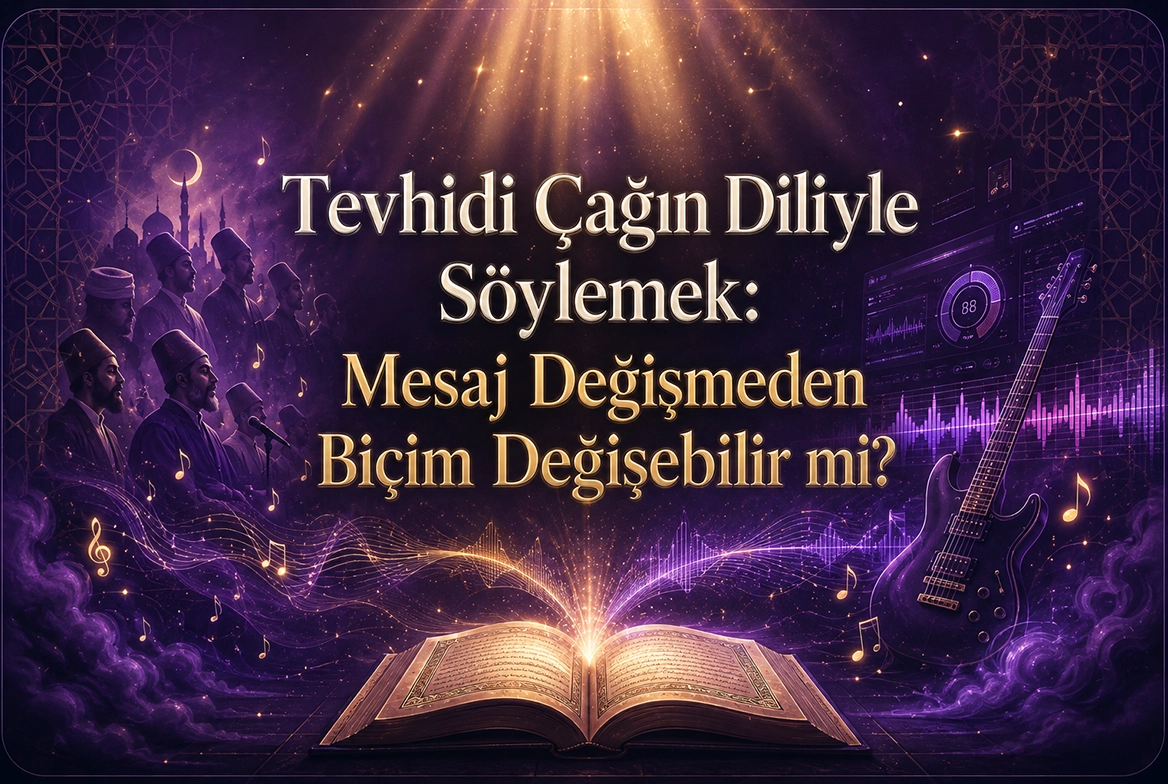
A Reflection on Verses 14:4, 30:22, and 41:44
Author: Berk KÖKSAL
Date: 08.08.2026
Location: Mersin
Verse
1:1 — In the name of GOD, Most Gracious, Most Merciful.*
Peace. Peace be upon you.
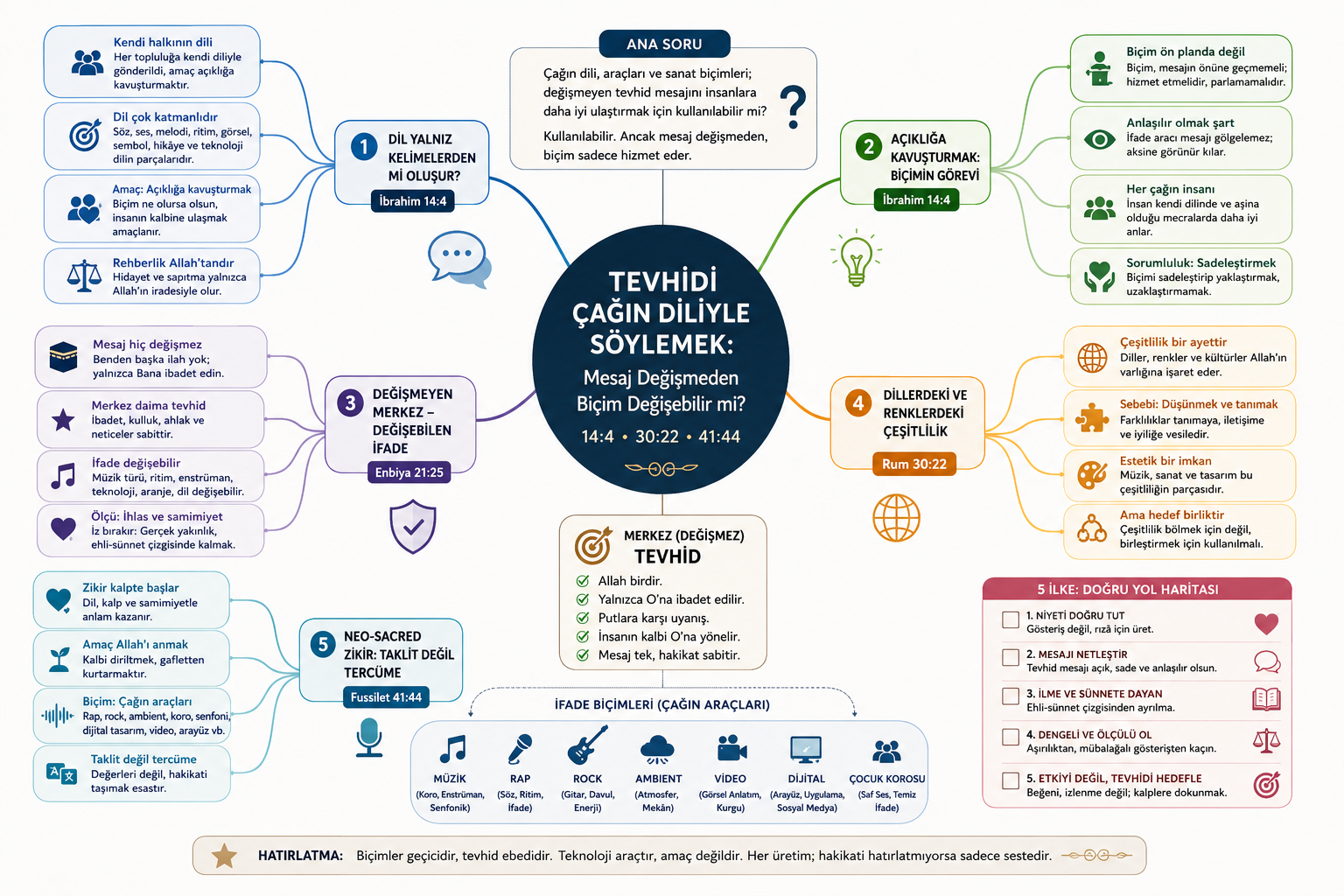
The purpose of this article is not to take Ibrahim 14:4 as grounds for declaring every new artistic form or every technological means of expression directly approved in a religious sense. Nor is it to claim that a work using modern sounds is more correct, more effective, or more meaningful simply because it is modern. The aim here is to reflect on the responsibility between the unchanging center of monotheism and changing forms of expression, and to ask whether, in trying to reach contemporary people, the message is being surrendered to the values of the age.
Introduction
The call to the oneness of GOD, to turn only to Him, to recognize only Him as absolute authority, and to question the idols human beings create does not become a different truth according to the musical genres, technologies, or cultural fashions of the time.
A message once encountered in a public square, a home, a place of worship, or on the page of a book may today be encountered through headphones, a short video, a digital music platform, a mobile application, a game world, a social-media feed, or an internet interface.
Ibrahim 14:4 states that messengers were sent in the language of their own people and that the purpose was to clarify things for them. The context of the verse is not directly modern music production, rock guitar, rap rhythm, visual design, or a software interface. For this reason, it would not be right to turn the verse into a technical ruling that says, “Every contemporary artistic form should be used for a religious message.”
In one, guitar, choir, rhythm, and technology know how to step back. In the other, all the sounds enlarge the visibility of the artist.
Summary:
1. Is Language Made Only of Words?
14:4
وَمَآ أَرْسَلْنَا مِن رَّسُولٍ إِلَّا بِلِسَانِ قَوْمِهِۦ لِيُبَيِّنَ لَهُمْ فَيُضِلُّ ٱللَّهُ مَن يَشَآءُ وَيَهْدِى مَن يَشَآءُ وَهُوَ ٱلْعَزِيزُ ٱلْحَكِيمُ
We did not send any messenger except (to preach) in the tongue of his people, in order to clarify things for them. GOD then sends astray whomever He wills, and guides whomever He wills. He is the Almighty, the Most Wise.
We did not send any messenger except to preach in the tongue of his people, in order to clarify things for them. GOD then sends astray whomever He wills and guides whomever He wills. He is the Almighty, the Most Wise.
2. Clarifying: The Task of Form
14:4 — We did not send any messenger except to preach in the tongue of his people, in order to clarify things for them. GOD then sends astray whomever He wills and guides whomever He wills. He is the Almighty, the Most Wise.
3. The Unchanging Center – The Changing Expression
21:25 — We did not send any messenger before you without inspiring him that: “There is no god except Me; you shall worship Me alone.”
4. Diversity in Languages and Colors
30:22 — Among His proofs are the creation of the heavens and the earth, and the variations in your languages and your colors. In these, there are signs for the knowledgeable.
5. Neo-Sacred Zikr: Translation, Not Imitation
44:58 — We have thus clarified it in your tongue, that they may take heed.
6. Rap, Rock, Ambient, and Choir: Are Genres Moral Authorities?
39:18 — They are the ones who examine all words, then follow the best. These are the ones whom GOD has guided; these are the ones who possess intelligence.
7. Speaking the Language of the Age Is Not Surrendering to the Values of the Age
13:37 — We revealed these laws in Arabic, and if you ever acquiesce to their wishes after this knowledge has come to you, you will have neither an ally nor a protector against GOD.
8. The Difference Between Being Modern and Being Fashionable
14:3 — They are the ones who give priority to this life over the Hereafter, repel from the path of GOD, and seek to make it crooked; they have gone far astray.
9. As If Being Called From Far Away
41:44 — If we made it a non-Arabic Quran, they would have said, “Why did it come down in that language?” Whether it is Arabic or non-Arabic, say, “For those who believe, it is a guide and a healing. As for those who disbelieve, they will be deaf and blind to it, as if they are being called from far away.”
10. Guidance and Healing: Is Aesthetic Impact Enough?
41:44 — Whether it is Arabic or non-Arabic, say, “For those who believe, it is a guide and a healing.”
11. English and Multilingual Production
30:22 — Among His proofs are the creation of the heavens and the earth, and the variations in your languages and your colors. In these, there are signs for the knowledgeable.
12. Children's Choir: The Feeling of Purity and the Responsibility of Trust
17:36 — Do not accept any information unless you verify it for yourself. I have given you hearing, eyesight, and the brain, and you are responsible for using them.
13. Visual Design, Video, and Software Interfaces Are Also a Language
16:125 — Invite to the path of your Lord with wisdom and good enlightenment, and debate with them in the best possible manner. Your Lord is fully aware of those who stray from His path, and He is fully aware of those who are guided.
14. Simplifying Versus Cheapening in the Age of Algorithms
2:42 — Do not mix truth with falsehood, nor conceal the truth knowingly.
15. A Manifesto of Expression for Neo-Sacred Zikr
5:99 — The sole duty of the messenger is to deliver the message, and GOD knows everything you declare and everything you conceal.
16. On the Arabic Roots of the Words
14:4 — We did not send any messenger except to preach in the tongue of his people, in order to clarify things for them.
Other Claims
17:36 — Do not accept any information unless you verify it for yourself. I have given you hearing, eyesight, and the brain, and you are responsible for using them.
Conclusion
14:4 — We did not send any messenger except to preach in the tongue of his people, in order to clarify things for them.
1. Is Language Made Only of Words?
Verse
14:4
وَمَآ أَرْسَلْنَا مِن رَّسُولٍ إِلَّا بِلِسَانِ قَوْمِهِۦ لِيُبَيِّنَ لَهُمْ فَيُضِلُّ ٱللَّهُ مَن يَشَآءُ وَيَهْدِى مَن يَشَآءُ وَهُوَ ٱلْعَزِيزُ ٱلْحَكِيمُ
We did not send any messenger except (to preach) in the tongue of his people, in order to clarify things for them. GOD then sends astray whomever He wills, and guides whomever He wills. He is the Almighty, the Most Wise.
We did not send any messenger except to preach in the tongue of his people, in order to clarify things for them. GOD then sends astray whomever He wills and guides whomever He wills. He is the Almighty, the Most Wise.
Source: kuranteyit.com
Reflection on the Verse
If I think of the phrase “the tongue of his people” in 14:4 only in terms of grammar and vocabulary, I may narrow the communicative dimension of the verse. Language is, of course, first and foremost spoken language. Expression built from words people do not understand weakens the purpose of clarification.
A major or minor harmony, the intensity of rhythm, the intimacy of the vocal, the sense of space being used, and the dynamic structure build a second layer of meaning around the words. This layer does not replace the verse. But it affects how the listener encounters the verse.
The phrase “One God” sung by a children’s choir and the same phrase delivered by a harsh metal vocal may be identical in dictionary meaning. Yet the emotional doors they open in the listener are different.
2. Clarifying: The Task of Form
Verse
14:4 — We did not send any messenger except to preach in the tongue of his people, in order to clarify things for them. GOD then sends astray whomever He wills and guides whomever He wills. He is the Almighty, the Most Wise.
Reflection on the Verse
One of the most important words in the verse from the standpoint of communication is “to clarify.” Language is not an end in itself. The task of language is to make things clear.
Using a modern musical genre has not fulfilled its task if it merely captures the listener’s attention but does not clarify the message. Visual design may be impressive, but if it pushes the verse into the background, it serves spectacle rather than clarity. A video may be watched millions of times, but if only the imagery remains in a person’s mind, form may have moved ahead of the center.
The task of form is not to prove itself, but to make the message visible and audible.
3. The Unchanging Center – The Changing Expression
Verse
21:25 — We did not send any messenger before you without inspiring him that: “There is no god except Me; you shall worship Me alone.”
Reflection on the Verse
While 14:4 invites reflection on the relationship between form and the language of the audience, 21:25 reminds us of the continuity of the center: “There is no god except Me; you shall worship Me alone.”
A piece of music may be acoustic, electronic, symphonic, or built around heavy guitars.
A form of expression may be poetry, rap, prose, a short video, or an application screen.
4. Diversity in Languages and Colors
Verse
30:22
وَمِنْ ءَايَٰتِهِۦ خَلْقُ ٱلسَّمَٰوَٰتِ وَٱلْأَرْضِ وَٱخْتِلَٰفُ أَلْسِنَتِكُمْ وَأَلْوَٰنِكُمْ ۚ إِنَّ فِى ذَٰلِكَ لَءَايَٰتٍۢ لِّلْعَٰلِمِينَ
Among His proofs are the creation of the heavens and the earth, and the variations in your languages and your colors. In these, there are signs for the knowledgeable.
Among His proofs are the creation of the heavens and the earth, and the variations in your languages and your colors. In these, there are signs for the knowledgeable.
Source: kuranteyit.com
Reflection on the Verse
30:22 speaks of diversity not merely as a problem that must be tolerated, but as one of GOD’s proofs. Differences in languages and colors are among the signs in creation.
This verse is not a ruling that directly grants religious approval to every musical genre. One cannot conclude, “Languages differ, therefore every aesthetic tool has the same moral value.” But it does make me question the tendency to see diversity itself as corruption.
Different instruments in an orchestra can belong to the same work. The sound of a violin is not the sound of a guitar, but both can serve the same tonal center. The presence of a children’s choir and heavy guitar within the same album world may initially seem contradictory. Yet if the center is monotheism, different colors can create a multidimensional field of remembrance rather than uniformity.
5. Neo-Sacred Zikr: Translation, Not Imitation
Verse
44:58 — We have thus clarified it in your tongue, that they may take heed.
Reflection on the Verse
When I use the concept of Neo-Sacred Zikr, my aim is not to copy a historical form of sacred music exactly as it was. Nor is it to assemble sounds perceived as “sacred” and automatically manufacture a spiritual atmosphere.
Imitation can place the sound of the past in a museum. Translation tries to carry the central call of the past to the person of today.
Neo-Sacred Zikr should walk between these two extremes:
Neither the form of the past nor the taste of the present should be turned into an idol. The center can remain the same while expression stays alive and understandable.
6. Rap, Rock, Ambient, and Choir: Are Genres Moral Authorities?
Verse
39:18 — They are the ones who examine all words, then follow the best. These are the ones whom GOD has guided; these are the ones who possess intelligence.
Reflection on the Verse
Musical genres are not prophets in themselves. The fact that a genre has historically been associated with rebellion, worship, entertainment, or protest does not give every work produced in that genre the same moral value.
Rock can open a powerful space for confrontation. Dense guitars, dynamic structures, and performances that push the limits of the human voice can make inner conflict audible. Yet if the sense of power does not step back before monotheism, it can magnify the artist’s ego.
A choir can create a sense of unity beyond the individual voice. But a collective voice can also amplify a sense of authority. A sentence does not become true because one hundred people say it.
7. Speaking the Language of the Age Is Not Surrendering to the Values of the Age
Verse
13:37 — We revealed these laws in Arabic, and if you ever acquiesce to their wishes after this knowledge has come to you, you will have neither an ally nor a protector against GOD.
Reflection on the Verse
Using forms that a society can understand is one thing; surrendering to that society’s systems of taste, consumption, and power is another.
But when one surrenders to the desires of the age, the message begins to change.
I can say, “I am speaking the language of the age,” while yielding to every expectation of the algorithm. Then I am no longer using the language of the age; the values of the age are using me.
8. The Difference Between Being Modern and Being Fashionable
Verse
14:3 — They are the ones who give priority to this life over the Hereafter, repel from the path of GOD, and seek to make it crooked; they have gone far astray.
Reflection on the Verse
Being modern can mean understanding the tools of the age in which I live and using them responsibly.
Being fashionable, by contrast, means chasing taste that is constantly changing.
A sound that is popular today may feel dated tomorrow. A production technique, vocal effect, or video format can quickly be used by everyone. If the meaning of my work rests only on the feeling of novelty, then when the form becomes old, the message may appear old as well.
9. As If Being Called From Far Away
Verse
41:44 — If we made it a non-Arabic Quran, they would have said, “Why did it come down in that language?” Whether it is Arabic or non-Arabic, say, “For those who believe, it is a guide and a healing. As for those who disbelieve, they will be deaf and blind to it, as if they are being called from far away.”
Reflection on the Verse
The phrase “as if they are being called from far away” opens a powerful field of reflection on communication.
A verse can be right in front of me on a phone screen. Yet if the words are not explained, the context is not shown, and the translation cannot be questioned, the distance remains.
Sometimes a simple sentence, a quiet recording, or a clear translation feels much closer.
10. Guidance and Healing: Is Aesthetic Impact Enough?
Verse
41:44 — … Whether it is Arabic or non-Arabic, say, “For those who believe, it is a guide and a healing.”
Reflection on the Verse
41:44 describes the Quran as guidance and healing for believers. These expressions confront me with an important test when producing spiritual music.
A production may be presented with claims such as “healing frequency,” “sacred vibration,” or “sound that heals the soul.” Such claims risk creating an immeasurable and unverifiable spiritual authority. Music may have psychological and emotional effects on human beings. But I should not equate the Quran’s being a healing with the effect of a piece of sound design.
When the music stops, does the search for guidance continue?
11. English and Multilingual Production
Verse
30:22 — Among His proofs are the creation of the heavens and the earth, and the variations in your languages and your colors. In these, there are signs for the knowledgeable.
Reflection on the Verse
For me, producing works with English lyrics is not merely a choice to reach a wider market. It is an effort to think about how the message of monotheism can be heard within different linguistic environments.
But multilingualism does not by itself create universality.
Multilingual production does not mean simplifying the message into the same slogan for everyone. It means pointing toward a shared center while respecting the richness of different languages.
12. Children’s Choir: The Feeling of Purity and the Responsibility of Trust
Verse
17:36 — Do not accept any information unless you verify it for yourself. I have given you hearing, eyesight, and the brain, and you are responsible for using them.
Reflection on the Verse
A children’s choir can awaken powerful feelings of purity, hope, and the future in a listener. The directness of a child’s voice may be perceived as cleaner than the sense of performance in an adult vocal.
For this reason, using a children’s choir is not only a musical choice; it is a responsibility of trust.
It is easy to use a children’s choir as a “pure sound.” Yet every child is a human being with a personality and rights of their own. A child is not production material.
13. Visual Design, Video, and Software Interfaces Are Also a Language
Verse
16:125 — Invite to the path of your Lord with wisdom and good enlightenment, and debate with them in the best possible manner. Your Lord is fully aware of those who stray from His path, and He is fully aware of those who are guided.
Reflection on the Verse
In an application such as Kuranteyit, the interface silently teaches the user how to behave. If I display one translation in a large and definitive way while hiding the others, the design may say, “This is the correct meaning.” If I provide a way to compare, it says, “Examine.” If I mark uncertainties, it says, “Know your limits.” If I present an AI answer as a superhuman authority, the design may encourage the user to hand over the responsibility to think.
A video can seize a person’s emotions through very rapid cuts. A cover image can use religious symbols to make a stronger claim to sacredness than the content itself. An application can steer a person’s behavior under the name of “personalization.”
For this reason, the language of the age is not only sound. Design is also a moral language.
14. Simplifying Versus Cheapening in the Age of Algorithms
Verse
2:42 — Do not mix truth with falsehood, nor conceal the truth knowingly.
Reflection on the Verse
The language of the age often requires brevity. A social-media post, a song chorus, or an application card cannot carry as much detail as a full article.
The algorithm likes definitive statements. Doubt, explanations of method, and expressions that state limits may attract less attention. The headline “This verse definitely means this” may spread faster than the sentence “As I reflect on this translation and context, I see the following possibility.”
But translating the message of monotheism into the language of the age does not mean surrendering it to the performance of certainty favored by the algorithm.
15. A Manifesto of Expression for Neo-Sacred Zikr
Verse
5:99 — The sole duty of the messenger is to deliver the message, and GOD knows everything you declare and everything you conceal.
Reflection on the Verse
The task of a messenger is not the same as the task of an artist or producer. I cannot place myself in the position of a messenger. Yet the verb “to deliver” opens a field of reflection on responsibility for anyone who carries a message.
For Neo-Sacred Zikr, I see the following principle not as a definitive religious law, but as a personal manifesto by which I will test my own production:
Does this form truly clarify monotheism, or does it merely clarify my identity as an artist?
16. On the Arabic Roots of the Words
Verse
14:4 — We did not send any messenger except to preach in the tongue of his people, in order to clarify things for them.
Reflection on the Verse
Looking at the roots of some Arabic words at the center of this article can help us see the fields of meaning opened by the verses. Yet root analysis alone does not determine the whole meaning of a verse. The form of the word in the sentence, its context, its relationship with other verses, and its use in the language must be considered together.
In 41:44, the Quran is described as guidance for believers. The artist or the music is not the owner of guidance. A work can point toward guidance, but it should not present itself as the source of guidance.
It is not right to transfer the Quran’s being a healing onto music production and say, “This frequency is healing.” The Quran described by the verse should not be confused with a sound design made by a human being.
Other Claims
Verse
17:36 — Do not accept any information unless you verify it for yourself. I have given you hearing, eyesight, and the brain, and you are responsible for using them.
Reflection on the Verse
Different objections may be raised against the approach of this article. Rather than ignoring them, they should be evaluated openly.
One may think that form is unimportant. Yet the way the same statement is presented changes how it is understood and how it affects people. If the word is not understood, if the vocal disappears under the music, or if the visual design creates a false sense of authority, form can effectively transform the message.
False information, manipulation, instrumentalizing children, hiding the use of artificial intelligence, presenting a translation as revelation, or exploiting user data can all be evaluated concretely.
Conclusion
Verse
14:4 — We did not send any messenger except to preach in the tongue of his people, in order to clarify things for them. GOD then sends astray whomever He wills and guides whomever He wills. He is the Almighty, the Most Wise.
Reflection on the Verse
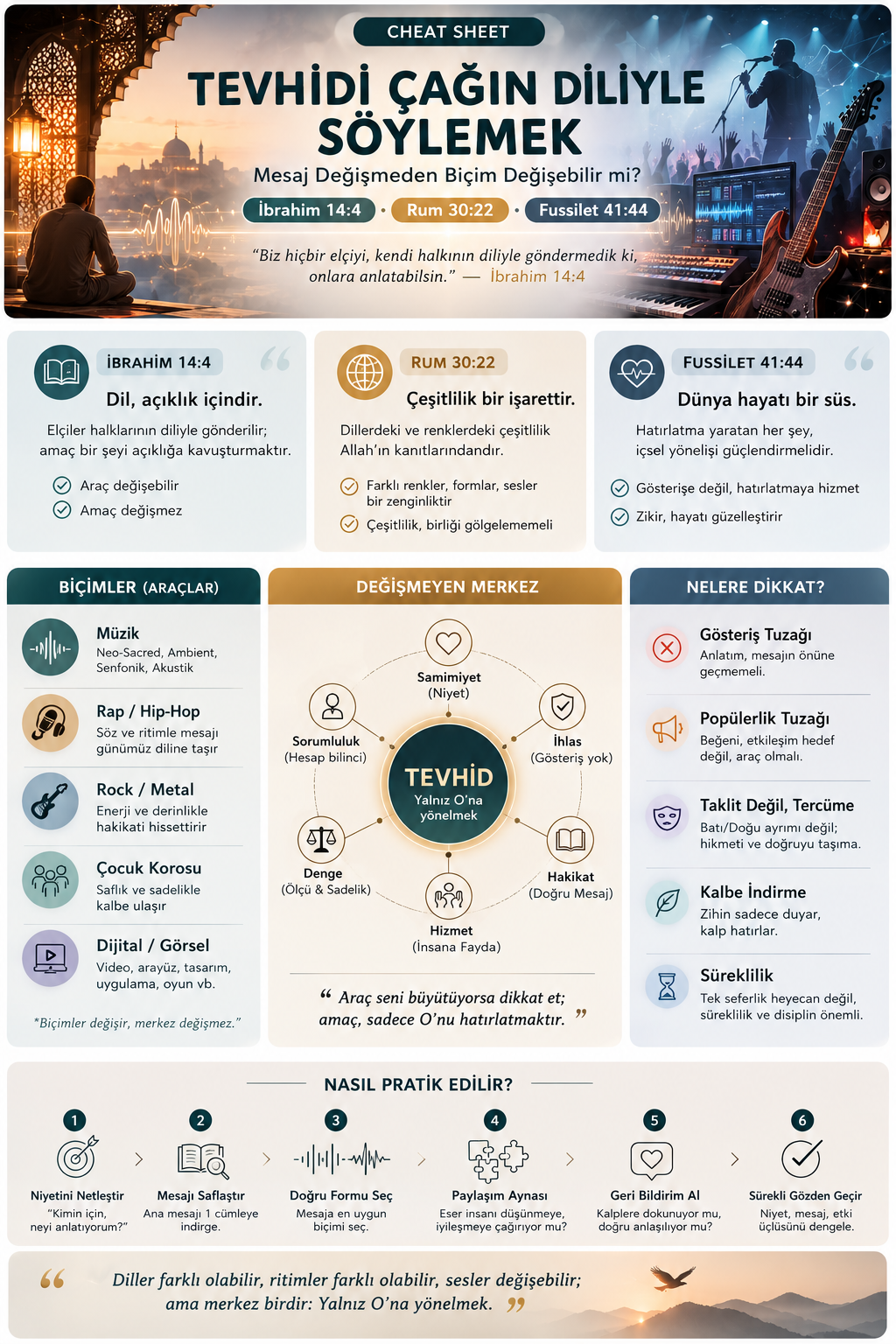
A children’s choir, sacred choir, symphonic orchestration, electronic sound design, English lyrics, video, visual design, and a software interface can all be used.
The purpose of using the language of the age is to leave a person freer and more responsible before the message. It is not to overpower them through sound, imagery, or the charisma of the artist.
None of these are evil in themselves. But in a production that carries the claim of “dhikr,” the real question is different:
Whom does the person remember when the sound falls silent?
The sound may belong to the age; the direction must remain toward GOD.
Note
This article does not present verses 14:4, 30:22, and 41:44 as direct technical rulings about modern musical genres, visual design, or digital technology. Starting from these verses, it develops a personal reflection on communication, intelligibility, linguistic diversity, guidance, and responsibility.
The assessments concerning Neo-Sacred Zikr, ZIKR RAP, rock, ambient, children’s choir, sacred choir, and symphonic orchestration belong within the framework of my personal production experience and search for conscientious responsibility. These statements should not be read as new religious rulings or binding rules for all artists.
The verse translations follow the forms given in the source text. The Turkish translation of 30:22 appearing in the source file was preserved there exactly; the Arabic text and English counterpart were added for completeness. Translation and revelation are not the same thing. Different translations should be compared, context should be examined, and no human interpretation should be identified with the word of GOD.
Experimental thematic connections are not definitive proofs of meaning between music and verses. Relating a verse to an art project does not make that project approved by the verse. On the contrary, the art project should be questioned in the presence of the verse.
Discover
Related Articles
Quran Reflections
What Did the Stones Do? A Reflection on Hell, the Dissolution of Mountains, the Development of the Self, and the Petrified Mind
A deep reflection centered on Al-Baqarah 2:24 about people and stones as the fuel of Hell; the crumbling of the mountain in the story of Moses, GOD's physical presence, the transformation of the earth, the development of the self, those who remain immobile, petrified minds, idols, and responsibility.
Read article
Quran Reflections
Deep Reverence for GOD: Ego, Disrespect, and the Inner Reality of Crossing the Boundary
A reflection through verses Al-Baqarah 2:40, Al-Hujurat 49:1, Sad 38:76, Al-Furqan 25:43, and An-Nazi'at 79:40-41 on deep reverence for GOD, ego, pride, transgression, truthful speech, knowledge, privacy, submission, and the limits of human authority.
Read article
Quran Reflections
Do You Really Trust GOD? The Word of Trust, the Obsession with Control, and the Hard Test of Submission
A severe and deep reflection through Al-Imran 3:122 and verses related to trusting GOD; on trust, submission, monotheism, the obsession with control, precaution, provision, steadfastness, religious authority, the danger of taking people as lords, and what it means in human life to see GOD as sufficient.
Read article