Escape from GOD: Is It Possible to Escape, Be Saved through Intercession, or Seek Help from Other Gods?
A deep Quran-centered reflection on whether it is possible to escape from GOD, whether anyone can intercede independently of GOD, whether salvation can come through other beings, and what divine authority, intercession, responsibility, and submission mean in light of the Quran.

Escape from GOD: Is It Possible to Escape, Be Saved through Intercession, or Seek Help from Other Gods?
Author: Berk KÖKSAL
Date: September 26, 2026
Place: Mersin
The main purpose of this article is to contemplate the verses together with other related verses and to reflect, sincerely and deeply, on what bearing witness to the oneness of GOD means in human life in terms of knowledge, justice, truthfulness, and submission.
Peace. Peace be upon you.
Why would a human being want to escape from GOD?
At first, the question may sound strange. For someone who believes in GOD, the idea of escaping from GOD appears contradictory. Yet the issue is not merely physical escape. Sometimes a person wants to escape GOD’s judgment. Sometimes one wants to escape the consequence of what one has done. Sometimes one hopes that placing an intermediary between oneself and GOD will lessen the weight of accountability. Sometimes one assumes that a beloved person, a messenger, an angel, a religious leader, or another sanctified being will provide rescue.
There is an even deeper possibility: without denying GOD altogether, a person may still try to escape His absolute authority.
“GOD exists, but this person will save me.”
“GOD judges, but this person can change His decision.”
“GOD knows, but perhaps there is a route of mediation that He does not know or has not taken into account.”
“There may be other powers beside GOD.”
Each of these thoughts is a different form of the same question:
Is there any realm of salvation independent of GOD?
When I stand before the verses, this is where the matter becomes weighty for me. The question is no longer merely, “Does intercession exist?”
The deeper question is:
Can there be any mechanism of salvation unknown to GOD, outside His will, or capable of overriding His judgment?
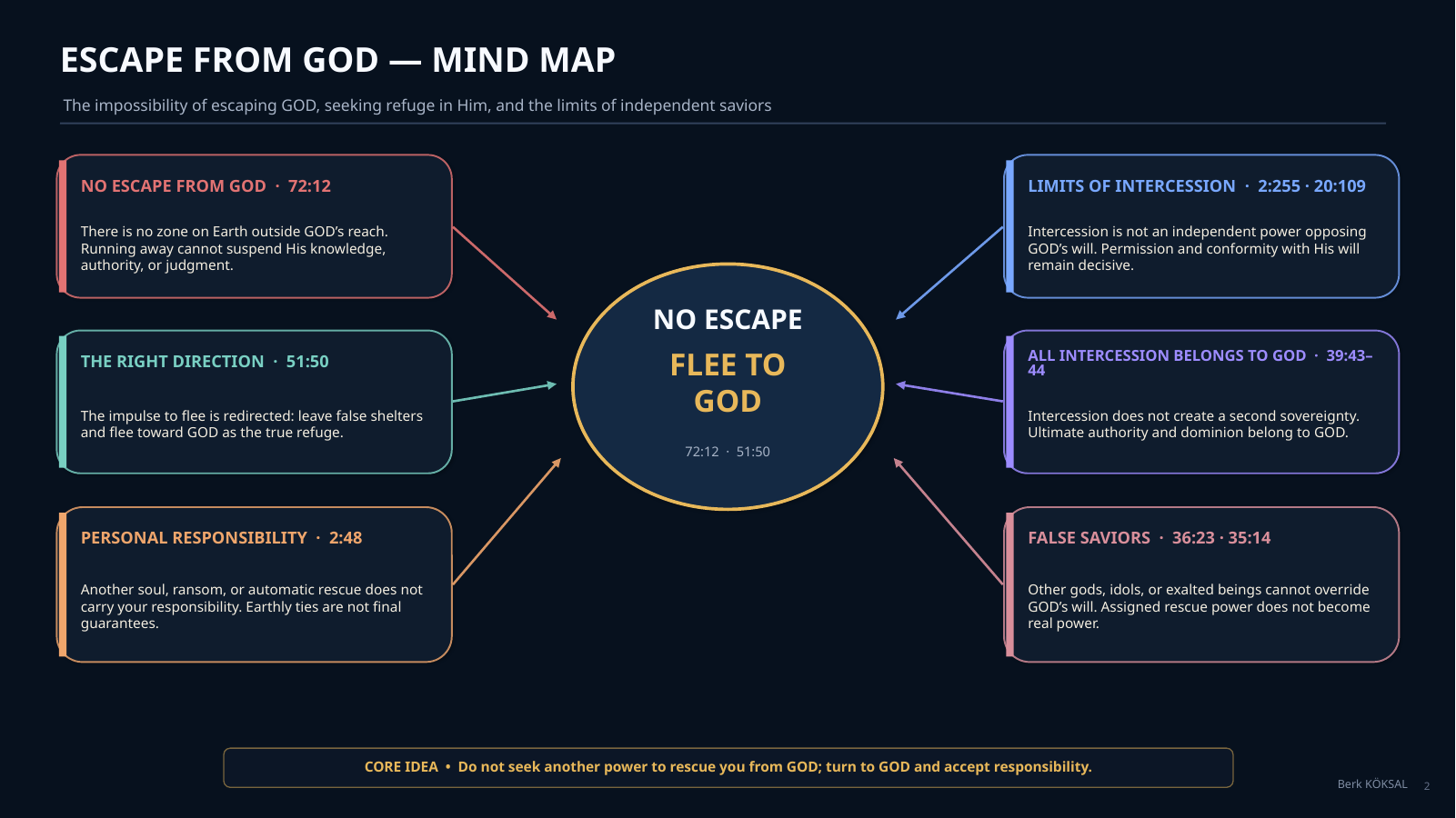
1. Is It Possible to Escape from GOD?
Verse
72:12
Arabic
وَأَنَّا ظَنَنَّآ أَن لَّن نُّعْجِزَ ٱللَّهَ فِى ٱلْأَرْضِ وَلَن نُّعْجِزَهُۥ هَرَبًا
English
“ ‘We knew full well that we can never run away from GOD on Earth; we can never run away and escape.
Türkçe
“ ‘Yeryüzünde TANRI’dan asla kaçamayacağımızı gayet iyi anladık; biz asla kaçıp kurtulamayız.
Source: kuranteyit.com
Contemplation of the Verse
What first grips me in this verse is not merely the word “run away,” but the second half of the sentence:
“we can never run away and escape.”
Running away and escaping are not the same thing.
A person can run away from another person. One can leave a city, cross the borders of a state, or seek refuge in a region beyond the reach of an authority. In the physical world, the very idea of escape assumes that there are two different domains: the place where the pursuing power has authority and another place beyond its reach.
72:12 removes that possibility when the subject is GOD.
There is no other region on Earth. There is no border at which GOD’s sovereignty ends. There is no room beyond His knowledge. There is no second universe outside His authority.
For that reason, escaping from GOD is not merely an absurd thought about running faster. When I contemplate it, I see a much wider meaning. A human being may distance oneself mentally from the truth of GOD, forget Him, ignore His judgment, or hide behind other authorities. None of these, however, amount to leaving the reality of GOD.
A person may move away from GOD within one’s own consciousness, but cannot step outside GOD’s sovereignty.
The verse’s sense of fully realizing this also matters to me. There is not only fear here; there is understanding. The impossibility of escape has been recognized.
Perhaps one of the decisive thresholds of spiritual transformation is precisely this: realizing the meaninglessness of trying to escape from GOD.
Until that is accepted, a person may continually search for other doors: other saviors, other guarantees, other intermediaries, other authorities.
But the verse closes that door at the beginning:
You cannot run away and escape.
Verse reference: 72:12
2. The Opposite Direction of Escape: Escape to GOD
Verse
51:50 — You shall escape to GOD. I am sent by Him to you as a manifest warner.
Contemplation of the Verse
While 72:12 says that we can never run away from GOD and escape, 51:50 makes a remarkable change of direction:
“You shall escape to GOD.”
On one side is the impossibility of escaping from GOD. On the other is a call to escape toward GOD.
When I place these two verses together, a powerful spiritual image emerges for me: the human impulse to flee is not simply denied; its direction is changed.
Run from falsehood. Run from wrongdoing. Run from idols. Run from false securities. Run from the shelters built by the ego. But do not run from GOD.
Run to GOD.
This keeps me from seeing submission as passive surrender alone. There is movement here. There is direction. A person moves away from something and takes refuge elsewhere.
Yet the refuge is not another created power. It is GOD Himself.
When a person recognizes wrongdoing, shame, guilt, or fear can produce a desire to withdraw from GOD. The thought may arise: “I can no longer return.”
51:50 points in the opposite direction: if you are going to flee, flee to Him.
So another thought replaces the idea of escaping from GOD:
Not salvation from GOD, but seeking salvation by taking refuge in GOD.
Verse reference: 51:50
3. Can One Soul Take the Place of Another on the Day of Judgment?
Verse
2:48 — Beware of the day when no soul can avail another soul, no intercession will be accepted, no ransom can be paid, nor can anyone be helped.
Contemplation of the Verse
This verse breaks four supports on which human beings often wish to lean: another soul, intercession, ransom, and help.
In this world, people are often protected through relationships. A connection can open a door. Money can solve a problem. A powerful person can intervene. Family, community, or status can shield someone from certain consequences.
But 2:48 tells me not to imagine the Day of Judgment according to the social order of this world.
Worldly connections do not automatically create immunity there. That brings the personal nature of responsibility into focus.
Being close to a righteous or beloved person does not automatically transfer that person’s moral worth to me. Admiring a messenger does not turn the messenger’s truthfulness into my own truthfulness. Belonging to a religious community does not merge all of its members into a single spiritual outcome.
Every person has a direction, a choice, and a responsibility.
For that reason, the thought “I have this person behind me” may become a dangerous form of assurance when projected onto the Day of Judgment.
In my earlier article “Taşların Suçu Ne? Cehennem, Dağların Çözülüşü, Nefsin Gelişimi ve Taşlaşan Zihin Üzerine Bir Tefekkür”, I reflected on Hell and responsibility from another direction. Here the question comes before the structure of Hell itself: whom does a person imagine will rescue them from the consequence?
The severity of 2:48 does not call me to despair; it calls me to responsibility. Understanding that another person cannot automatically save me is part of understanding the weight of my own choices.
Verse reference: 2:48
4. Can Intercession Override GOD’s Will?
Verse
2:255 — GOD: there is no other god besides Him, the Living, the Eternal. Never a moment of unawareness or slumber overtakes Him. To Him belongs everything in the heavens and everything on earth. Who could intercede with Him, except in accordance with His will? He knows their past, and their future. No one attains any knowledge, except as He wills. His dominion encompasses the heavens and the earth, and ruling them never burdens Him. He is the Most High, the Great.
Contemplation of the Verse
When I read the entire verse rather than isolating one sentence about intercession, the matter becomes much clearer.
The verse first tells us who GOD is. There is no other god besides Him. He is the Living, the Eternal. Everything belongs to Him. He knows the past and the future. His dominion encompasses the heavens and the earth.
Then comes the question:
“Who could intercede with Him, except in accordance with His will?”
The order matters.
Intercession is not described as a second center of power outside GOD’s sovereignty. The sentence about intercession is placed inside a declaration of absolute sovereignty.
For me, this means that if an idea of intercession breaks or overrides GOD’s will, it has already moved outside the framework described by the verse.
If a being can make GOD accept what He does not will, overturn what He has rejected, or change GOD’s decision through superior influence, we are no longer speaking merely about intercession. We have imagined an independent power beside GOD.
The verse does not support that picture.
It also places knowledge beside the issue of intercession: “He knows their past, and their future.”
That touches the central question of this article: can anything be done without GOD knowing?
Within the picture drawn by the verse, I see no room for such an idea. GOD does not sleep. No unawareness overtakes Him. The past is not unknown to Him. The future is not outside His knowledge.
Therefore, an independent “informant” who approaches GOD to tell Him a detail He missed, reveal a goodness He did not notice, or defend someone He misjudged does not fit the knowledge of GOD described by the verse.
Even if intercession is spoken of, it does not complete a deficiency in GOD’s knowledge. It does not introduce a foreign will that alters GOD’s will.
Verse reference: 2:255
5. Could There Be an Intercessor Who Knows What GOD Does Not?
Verse
10:18 — They worship beside GOD idols that possess no power to harm them or benefit them, and they say, “These are our intercessors at GOD!” Say, “Are you informing GOD of something He does not know in the heavens or the earth?” Be He glorified. He is the Most High; far above needing partners.
Contemplation of the Verse
The question in this verse is piercing:
“Are you informing GOD of something He does not know in the heavens or the earth?”
One form of the intercession problem is treated here as a problem of knowledge.
Consider human mediation. Someone who intervenes on behalf of another often tells the decision-maker something the decision-maker does not know: “You do not know his real intention.” “He also did this good deed.” “There were other circumstances behind the event.”
Such mediation can make sense between human beings because human knowledge is limited.
But when GOD is the One who judges, that model breaks down.
What could be told to GOD that He does not already know? What hidden goodness could have escaped Him? What intention could lie outside His knowledge? What detail could He have overlooked?
For that reason, 10:18 forces me to separate the concept of intercession from worldly structures of influence.
The idea of an intermediary going to GOD to provide missing information collides directly with the question posed by the verse.
Another important point is that the idols described here possess no power to harm or benefit. A human being attributes power to the being from whom rescue is expected. The verse first asks whether that power exists at all.
This becomes a basic measure of intellectual honesty in religious thought: before attributing an authority to someone, what is my basis for saying that this authority was actually granted?
People can easily turn love into authority, respect into metaphysical power, or attachment into the conclusion that a person will save them in the Hereafter.
The verse does not support that leap.
Verse reference: 10:18
6. Is Permission Enough? The Condition of Conformity with GOD’s Will
Verse
20:109 — On that day, intercession will be useless, except for those permitted by the Most Gracious, and whose utterances conform to His will.
Contemplation of the Verse
I see two restrictions in this verse. First, permission. Second, that the utterances conform to GOD’s will.
Taken together, these conditions make intercession look very different from an independent negotiation mechanism.
Receiving permission does not mean receiving unrestricted authority. The utterance must also conform to His will.
This is an important distinction.
A person may say, “If GOD permits, someone will intercede,” but then imagine that GOD gives a person an independent field of action and that this person saves whomever they wish.
Yet the verse does not speak only of permission. It also speaks of conformity to His will.
The decisive will therefore remains GOD’s will.
For me, this separates intercession completely from the idea of being “saved despite GOD.”
If intercession does not happen against GOD, it cannot be a way of escaping from GOD. If it remains within GOD’s will, it is not a door out of GOD’s sovereignty.
Rather, it demonstrates that no power moves outside His sovereignty.
Verse reference: 20:109
7. Intercession That Does Not Coincide with GOD’s Will
Verse
34:23 — Intercession with Him will be in vain, unless it coincides with His will. When their minds are finally settled down, and they ask, “What did your Lord say,” they will say, “The truth.” He is the Most High, the Most Great.
Contemplation of the Verse
The wording here speaks almost directly to the center of the debate:
“unless it coincides with His will.”
Perhaps, then, asking “Who will intercede?” is not even the first question.
The more fundamental question is:
Whose will is decisive?
The verse’s answer is GOD’s will.
For that reason, an idea of intercession imagined as lobbying against GOD’s decision does not fit the language of this verse.
If GOD wills one thing and another being can produce the opposite result through greater affection, higher status, or privileged closeness, whose will has become ultimately decisive?
That question should disturb me, because monotheism is not merely saying, “There is one Creator.” It also concerns whether I divide absolute sovereignty.
The reference to “The truth” at the end of the verse also matters.
If intercession does not change truth, if it does not turn wrong into right through a defense against truth, and if it must coincide with GOD’s will, then confidence must rest not in the personal power of the intermediary but in GOD’s judgment.
Verse reference: 34:23
8. To Whom Does All Intercession Belong?
Verse
39:43 — Have they invented intercessors to mediate between them and GOD? Say, “What if they do not possess any power, nor understanding?”
39:44 — Say, “All intercession belongs to GOD.” To Him belongs all sovereignty of the heavens and the earth, then to Him you will be returned.
Contemplation of the Verse
When I read 39:43 and 39:44 together, the most important word for me is “all.”
“All intercession belongs to GOD.”
Not part of it. Not merely its highest level. Not the final share. All intercession.
Then comes a sentence explaining why:
“To Him belongs all sovereignty of the heavens and the earth.”
Intercession and sovereignty are not separated in the verse.
This becomes a powerful measure for me. If an understanding of intercession diminishes GOD’s sovereignty, it needs to be reconsidered in light of 39:44.
If an intermediary becomes an indispensable gate between GOD and the human being, that needs reconsideration. If a person stops turning directly to GOD and anchors all hope in a created person who will rescue them, that needs reconsideration.
39:43 also asks whether people have “invented intercessors.”
That means a concept of an intercessor does not automatically become true simply because it is expressed in religious language.
Human beings can imagine an intercessor, assign authority to that figure, and then present their own construction as though GOD had granted it.
That is why truthfulness regarding religious authority is crucial.
To give a human being an authority GOD did not give may be more than an innocent extension of love. It may be saying more than the text itself says.
Verse references: 39:43-44
9. Do Even the Angels Possess Independent Authority to Intercede?
Verse
53:26 — Not even the angels in heaven possess authority to intercede. The only ones permitted by GOD are those who act in accordance with His will and His approval.
Contemplation of the Verse
What strikes me in this verse is the phrase “Not even the angels.”
Human beings may be inclined to give extraordinary rank to religious personalities on Earth. Yet the verse does not place even heavenly beings in an independent office of intercession.
The same limits appear again: GOD’s permission, GOD’s will, GOD’s approval.
The center therefore remains the same.
Even when intercession is mentioned, the intercessor is not the center. GOD is.
This makes me examine my religious attachments.
Loving a messenger is one thing. Following the truth brought by a messenger is another. Imagining that messenger as an independent savior beside GOD is something else entirely.
Believing in angels is one thing. Attributing to them an authority GOD did not grant is another.
Human beings can turn love and respect into idolization. This can be difficult to notice because we may call it “respect,” “love,” “closeness,” or “reverence.”
Changing the name, however, does not change the source of authority.
Verse reference: 53:26
10. “Nor Can They Rescue Me”
Verse
36:23 — “Shall I set up beside Him gods? If the Most Gracious willed any harm for me, their intercession cannot help me one bit, nor can they rescue me.
Contemplation of the Verse
This verse contains a sentence that almost answers the title question word for word:
“nor can they rescue me.”
Here are beings imagined as intercessors or rescuers. Yet when set against the will of GOD, their intercession cannot help.
The security architecture built by the human mind collapses at this point.
A person may turn to other gods, attribute spiritual power to them, and believe they will offer protection.
But if they have no power to act independently of GOD’s will, what is really being trusted?
Perhaps only the expectation produced by the human mind.
This leads me to an important distinction: my intense belief that something will save me does not prove that it actually possesses saving power.
The intensity of belief is not evidence of reality. Neither is the number of people who share that belief. Neither is the fact that an idea has been repeated for centuries.
Authority exists only if it truly exists.
For that reason, 36:23 is not merely a warning about idols to me. It also reflects the human mind’s ability to manufacture false security.
Verse reference: 36:23
11. Calling Is One Thing; Being Able to Respond Is Another
Verse
17:56 — Say, “Implore whatever idols you have set up beside Him.” They have no power to relieve your afflictions, nor can they prevent them.
46:5 — Who is farther astray than those who idolize beside GOD idols that can never respond to them until the Day of Resurrection, and are totally unaware of their worship?
46:6 — And when the people are summoned (on the Day of Judgment), their idols will become their enemies, and will denounce their idolatry.*
Contemplation of the Verse
The fact that a human being calls upon someone does not mean that the one being called possesses the authority to answer.
This sounds simple, yet it can easily be forgotten in religious life.
Calling does not make the other side hear. Hoping for help does not give the other side power to help. Feeling spiritually close to a sanctified person does not turn that person into a metaphysical authority who hears calls from across the universe.
46:5 goes even further: the idols are described as totally unaware of the worship directed toward them.
For me, this reverses the question, “Can anything be done without GOD knowing?”
In these verses, GOD is not the one who is unaware. The objects from whom people expect help are unaware.
That reversal is powerful.
A person may imagine GOD as distant and the intermediary as near. The verse draws another picture: GOD knows, while the beings idolized may not even be aware of the call.
46:6 then shows that the relationship does not continue as a friendship in the Hereafter.
The being thought to be a savior in this world may not affirm that claim on the Day of Judgment.
Entrusting one’s faith today to an assumption that will not defend itself tomorrow is therefore a grave risk.
Verse references: 17:56, 46:5-6
12. How Can a Created Being Become an Absolute Savior?
Verse
25:3 — Yet, they set up beside Him gods who do not create anything—they themselves are created—and who possess no power to even harm or benefit themselves, nor do they possess any power to control life, or death, or resurrection.
35:13 — He merges the night into the day, and merges the day into the night. He has committed the sun and the moon to run for a predetermined period of time. Such is GOD your Lord; to Him belongs all kingship. Any idols you set up beside Him do not possess as much as a seed’s shell.
35:14 — If you call on them, they cannot hear you. Even if they hear you, they cannot respond to you. On the Day of Resurrection, they will disown you. None can inform you like the Most Cognizant.
Contemplation of the Verse
25:3 frames the issue through createdness.
Who is the Creator? Who is created? Who controls life? Who controls death? Who controls resurrection?
Placed side by side, these questions transform the idea of “another savior” from an emotional question into an ontological one.
How can a being that is itself created possess a station of salvation independent of the Creator?
How can a being that does not possess absolute power over its own life possess absolute power over my eternal outcome?
35:13 opens the same issue through ownership:
“do not possess as much as a seed’s shell.”
A person may assign immense spiritual value to someone they love. But love does not create ownership. Respect does not create universal sovereignty. Historical importance does not create authority over the Hereafter. Millions of followers do not create independent power before GOD.
35:14 reduces romantic expectations to very simple questions:
Can they hear you? Even if they hear, can they respond? On the Day of Resurrection, will they own the relationship you imagined?
Sometimes we turn monotheism into extremely complicated debates, while the verses occasionally place the matter before us with remarkable simplicity:
They do not own. They did not create. They do not control. They cannot hear. They cannot respond.
Why, then, would I place saving power beside GOD in them?
Verse references: 25:3, 35:13-14
13. Where Are the Ties Trusted as Intercessors on the Day of Judgment?
Verse
6:94 — “You have come back to us as individuals, just as we created you the first time, and you have left behind what we provided for you. We do not see with you the intercessors that you idolized and claimed that they will help you. All ties among you have been severed; the idols you set up have abandoned you.”
Contemplation of the Verse
The word that strikes me most in this verse is “individuals.”
We enter the world as individual consciousnesses, and we return to judgment unable to hide behind our relationships.
During life, we gather identities: family, society, denomination, religious circle, teacher, leader, scholar, hero, messenger, and people we regard as saints.
Each may influence our lives. Yet 6:94 does not present any of these relationships as an automatic certificate of salvation when the human being returns.
More sharply, it says:
“All ties among you have been severed; the idols you set up have abandoned you.”
This makes me question whether idolatry should be thought of only in terms of statues.
I do not want to make the verse say what it does not say. Yet for my own life, I must ask:
To which person, institution, or identity do I assign a security beside GOD that GOD did not grant?
Whose name gives me the feeling, “I will be safe anyway”? Which affiliation prevents me from seeing my own responsibility?
If saying “I belonged to this group” does not erase individual responsibility on the Day of Judgment, then turning group identity into a guarantee of faith today may be dangerous.
Verse reference: 6:94
14. Monotheism Is Not Only Belief: Witnessing, Knowledge, and Justice
Verse
3:18 — GOD bears witness that there is no god except He, and so do the angels and those who possess knowledge. Truthfully and equitably, He is the absolute god; there is no god but He, the Almighty, Most Wise.
Contemplation of the Verse
For me, this verse takes monotheism beyond the sentence, “I believe in one GOD.”
There is witnessing. There is knowledge. There is justice. There is power. There is wisdom.
Bearing witness to the oneness of GOD also means refusing to create imaginary centers of power beside Him.
If I grant a person an authority of intercession GOD did not grant, am I bearing witness truthfully?
If I make a religious authority unquestionable, am I being just in matters of knowledge?
If I stretch the clear boundaries of a verse because I want to defend someone I love, am I being truthful?
This is where the weight of 3:18 becomes real for me.
The witnessing of those who possess knowledge is not witnessing in spite of knowledge. It is witnessing with knowledge. Justice is in the same sentence.
Therefore, the discussion of intercession does not only reveal what I think about the Hereafter. It also reveals how honest I am before truth today.
In the Berk KÖKSAL — Quran Reflections Archive, I have approached witnessing, monotheism, knowledge, and justice from other angles. Here the same witnessing faces another test:
Where do I place the person I love?
Can I love that person as a servant of GOD? Or does my love slowly turn that person into a necessary savior between GOD and me?
Sometimes monotheism is precisely the test of keeping the people we love in their proper place.
Verse reference: 3:18
15. The Danger of Taking Religious Leaders and Scholars as Lords
Verse
9:31 — They have set up their religious leaders and scholars as lords, instead of GOD. Others deified the Messiah, son of Mary. They were all commanded to worship only one god. There is no god except He. Be He glorified, high above having any partners.*
Contemplation of the Verse
The danger of taking human beings as lords enters directly into the religious sphere here.
That matters.
People are often inclined to search for idolatry in other religions, other communities, or obvious statues.
9:31 brings the danger into the field of religious leaders and scholars.
A person may teach religious knowledge, show us verses, know more than we do in a particular subject, or possess significant experience.
None of that requires placing that person where only GOD belongs.
The problem is not learning from knowledgeable people. The problem is confusing human authority with GOD’s authority.
If a leader’s word becomes dominant over a verse, I need to stop and think. If the sentence “This person said so, therefore it is true” becomes the end of investigation, I need to think. If I assign to a human being religious powers GOD did not grant merely because of history, tradition, status, or numbers, I need to think.
I also approached the limits of human authority in my earlier article “TANRI’ya Derin Saygı: Ego, Saygısızlık ve Sınırı Aşmanın İç Yüzü”.
The same boundary applies to intercession.
Loving and respecting a religious leader is one thing. Listening to that person is another. Granting that person an authority in the Hereafter capable of overriding GOD’s judgment is an entirely different claim.
Such a claim must be grounded in truth, not merely in human words.
Verse reference: 9:31
16. Is Salvation Determined by Our Wishes?
Verse
4:123 — It is not in accordance with your wishes, or the wishes of the people of the scripture: anyone who commits evil pays for it, and will have no helper or supporter against GOD.
Contemplation of the Verse
This verse touches human religious psychology very directly:
Wishes.
We all have wishes concerning salvation.
We want the people we love to be saved. We want ourselves to be forgiven. We want our community to turn out to be right. We want the people we respect to have high standing before GOD.
But desire and truth are not the same thing.
4:123 reminds me to test religious beliefs with this question:
Do I believe this because the verse says it, or because I want it to be so?
That is a difficult distinction.
A human being can begin treating what is desired as if it were evidence.
“Someone we love this much must surely save us.”
“People who belong to this community must surely be safe.”
“Those attached to this person cannot end badly.”
Such thoughts may be psychologically comforting.
But 4:123 does not make comfort the measure. It speaks of the consequence of evil and says there will be no helper or supporter against GOD.
For me, therefore, true submission does not mean submitting only to verses that please me. It also means submitting before a verse that breaks my wishes.
If a verse dismantles the security system I have built, my task is not to bend the verse to fit my system. My task is to reconsider the system.
Verse reference: 4:123
17. Arabic Word Roots: Escape, Inability, and Intercession
Verse
72:12 — “ ‘We knew full well that we can never run away from GOD on Earth; we can never run away and escape.
51:50 — You shall escape to GOD. I am sent by Him to you as a manifest warner.
39:44 — Say, “All intercession belongs to GOD.” To Him belongs all sovereignty of the heavens and the earth, then to Him you will be returned.
Contemplation of the Verse
The Arabic word structures of these verses add another layer to the subject.
In 72:12, نُعْجِزَ / نُعْجِزَهُ are connected with the root ع ج ز — ʿ-j-z. The word هَرَبًا — haraban at the end of the verse comes from ه ر ب — h-r-b.
The English rendering “run away and escape” therefore carries more than physical movement. The idea also touches the impossibility of frustrating GOD, moving beyond His reach, or rendering His authority ineffective.
For me, 72:12 therefore asks something greater than, “Can I go farther away?”
Is there any domain in which I can exceed GOD’s power?
The verse gives no such space.
In 51:50, فَفِرُّوا — fafirrū comes from the root ف ر ر — f-r-r and appears as a command. The direction is إِلَى اللَّهِ — to GOD.
This contrast is one of the strongest linguistic features of the subject:
72:12: you cannot run away from GOD and escape.
51:50: escape to GOD.
The same human movement acquires a completely different spiritual meaning when its direction changes.
In one case, the human being tries to move away from ultimate reality. In the other, the human being flees false securities and takes refuge in the Absolute.
The term intercession is associated with the root ش ف ع — sh-f-ʿ. Forms such as yashfaʿu, shafāʿat, shafīʿ, and shufaʿā belong to this same root field.
But the root itself does not establish an independent authority for an intercessor. The verses define the limits of authority.
39:44 states that limit plainly:
“All intercession belongs to GOD.”
Likewise, the witnessing in 3:18 is connected with the root ش ه د — sh-h-d.
Escape, intercession, and witnessing therefore meet at one conceptual point:
A human being cannot escape GOD’s power. A human being cannot assign saving authority to whomever one wishes. And before all of this, one remains responsible for truthful witnessing.
Verse references: 72:12, 51:50, 39:44; also 2:255, 10:18, 39:43, and 3:18
18. Other Claims
Verse
19:87 — No one will possess the power to intercede, except those who conform to the laws of the Most Gracious.
Contemplation of the Verse
The subject of intercession has been interpreted in different ways across religious traditions. These historical approaches should not replace the verses themselves, but they can help us see the range of claims that have been made.
A common classical Sunni position is that Muhammad will intercede on the Day of Judgment by GOD’s permission. Within this approach, intercession is generally not described as a power independent of GOD, but as something contingent upon GOD’s permission.
Within Shi’a traditions, there are also understandings in which prophets, imams, and servants regarded as close to GOD may intercede by GOD’s permission. Here too, independent power is commonly denied and intercession is explained as dependent upon GOD’s authorization.
By contrast, some Quran-centered approaches read verses such as 2:48, 39:44, 53:26, and 74:48 more restrictively and argue against expecting salvation in the Hereafter through prophets, angels, or sanctified persons. In this reading, verses that mention permission do not establish an independent office of intercession; they demonstrate that authority remains with GOD.
Despite their differences, these approaches can be compared at one important point: once intercession is imagined as an absolute authority independent of GOD and capable of overriding His judgment, a problem of monotheism emerges.
Historical disagreements over who may intercede and in what sense, however, should not determine the core conclusion of this reflection.
The primary measure remains the boundaries expressed by the verses:
GOD knows.
GOD judges.
GOD permits.
GOD’s will is decisive.
All intercession belongs to GOD.
Whatever the historical disagreement, the idea of an independent mechanism of salvation operating outside GOD’s knowledge finds no support in the picture drawn by these verses.
Verse reference: 19:87; also 2:48, 2:255, 20:109, 34:23, 39:44, and 53:26
19. Conclusion: Not Escaping from GOD, but Submitting to GOD
Verse
6:164 — Say, “Shall I seek other than GOD as a lord, when He is the Lord of all things? No soul benefits except from its own works, and none bears the burden of another. Ultimately, you return to your Lord, then He informs you regarding all your disputes.”
**16:51 — GOD has proclaimed: “Do not worship two gods; there is only one god. You shall reverence Me alone.” **
21:112 — Say, “My Lord, Your judgment is the absolute justice. Our Lord is the Most Gracious; only His help is sought in the face of your claims.”
Contemplation of the Verse
I return to the opening question:
Is it possible to escape from GOD?
72:12 tells me that I cannot run away and escape.
But this is not merely a frightening closure, because 51:50 immediately gives another direction:
Escape to GOD.
The question changes.
There is no escape from GOD, but there is return to GOD.
There is no hiding from GOD, but there is refuge in GOD.
There is no overriding GOD’s judgment, but there is turning toward His mercy.
Then comes the question of intercession.
Can someone rescue me without GOD knowing?
2:255 says that GOD knows the past and future and that His dominion encompasses the heavens and the earth.
10:18 questions the idea of intercessors informing GOD of something He does not know.
20:109 makes intercession subject to permission and conformity with GOD’s will.
34:23 says that intercession is in vain unless it coincides with GOD’s will.
39:44 says that all intercession belongs to GOD.
53:26 denies independent authority even to the angels.
36:23 states that other gods cannot rescue.
6:94 depicts human beings returning as individuals while the intercessors they claimed would help them are absent.
Before these verses, the picture that emerges for me is this:
There is no savior against GOD.
I do not mean by this that “GOD is not merciful.”
Quite the opposite.
The center of salvation is not another power; it is GOD.
A human being is not saved from GOD. A human being seeks salvation by turning to GOD.
That distinction matters greatly.
The question “Who will save me from GOD?” can make GOD appear as the ultimate enemy standing against the human being.
But 51:50 changes the direction:
Escape to GOD.
And 21:112 says:
“only His help is sought.”
When I think this way, monotheism becomes much deeper than saying, “GOD is one.”
Monotheism concerns whom I take refuge in when I am afraid. It concerns where I place my hope. It concerns from whom I seek forgiveness. It concerns whose knowledge I regard as absolute. It concerns whose judgment I regard as final. It concerns whose words I refuse to place above GOD’s words.
And perhaps the hardest part is keeping the people I love in their proper place.
I may love a messenger. I may be grateful to a teacher. I may learn from a scholar. I may deeply love a mother, father, friend, or spiritual guide.
But none of them is GOD.
None of them owns the sovereignty of the heavens and the earth.
None of them can make a decision of salvation for me outside GOD’s knowledge.
None of them can be placed in an independent authority over the Hereafter beyond GOD’s will without a basis in the verses.
This is where the test of not taking human beings as lords begins.
Sometimes not before a statue, but inside love. Sometimes inside religious respect. Sometimes inside the sentence, “He will save us.” Sometimes after the words, “Of course GOD exists, but…”
So I want to ask myself:
Whom am I placing beside GOD?
Whose name makes me feel safe from GOD’s judgment?
To whom am I assigning an authority the verse did not give?
Before whose words do I stop investigating?
Whose love am I turning into a guarantee over GOD’s judgment?
And in the end, 6:164 returns me to individual responsibility:
“No soul benefits except from its own works, and none bears the burden of another.”
I am responsible for my own work.
For my own witnessing. My own truthfulness. My own justice. My own submission. My own idols. My own attempts to escape.
Perhaps the real human question should not be, “How do I escape from GOD?”
Nor should it be, “Can this person save me from GOD?”
The better question is:
When I understand that there is nowhere else to escape, will I truly submit to GOD?
If there is no escape from GOD and all sovereignty belongs to Him, two directions seem to remain before the human being:
To continue trying to run away despite the fact that escape is impossible.
Or to change direction and escape to GOD.
For me, the simplest sentence left at the end of all these verses is this:
Do not run from GOD.
Run to GOD.
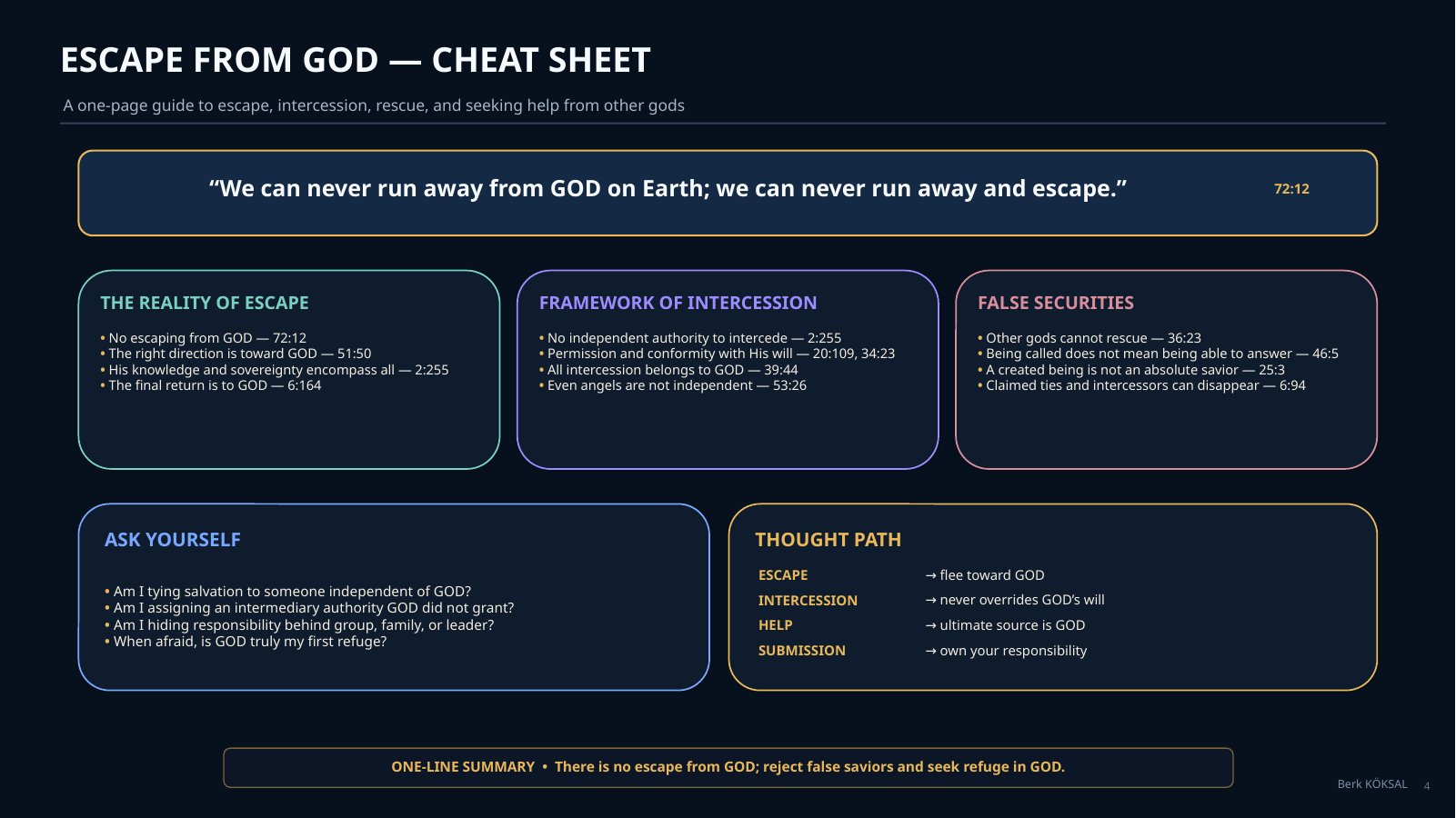
Verse references: 6:164, 16:51, 21:112; also 72:12, 51:50, 2:48, 2:255, 10:18, 20:109, 34:23, 36:23, 39:43-44, 53:26, and 6:94
Note
2:32 — They said, “Be You glorified, we have no knowledge, except that which You have taught us. You are the Omniscient, Most Wise.”
GOD knows best.
Source: kuranteyit.com
Discover
Related Articles

Quran Reflections
Loving GOD Alone: Loving Nothing but GOD, or Loving Nothing as if It Were GOD?
A deep Quran-centered reflection on what it means to love GOD the most, whether loving GOD alone means loving no created thing at all, and where love becomes rivalry, idolatry, attachment, or absolute devotion.
Read article
Quran Reflections
How Can I Follow Abraham’s Path? How Can I Find the Way Abraham Found?
A reflection on Abraham’s Quranic path through monotheism, seeking truth, guidance, submission, appreciation, rejection of idolatry, and servanthood.
Read article
Quran Reflections
Being Put to Death Every Night: Sleep, the Soul, and Morning as a Resurrection
A reflection centered on Quran 39:42 about sleep, death, the soul, morning as resurrection, the appointed term, monotheism, submission, responsibility, and contemplation.
Read article