Turning Back on Your Heels: Preserving Your Direction After Guidance
A reflection centered on Al-Baqarah 2:143 on turning back on one's heels, sliding back after guidance, leaving the faith, casting scripture behind one's back, testimony, knowledge, justice, truthfulness, submission, and the limits of religious authority.

Turning Back on Your Heels: Preserving Your Direction After Guidance
A reflection on 2:143 and verses connected with turning back
Author: Berk KÖKSAL
Date: 14.08.2026
Location: Mersin
Verse
1:1 — In the name of GOD, Most Gracious, Most Merciful.*
Peace. Peace be upon you.
The main purpose of this article is to consider the verses together with other related verses, and to express in a sincere and profound way what bearing witness to the oneness of GOD means in human life in terms of knowledge, justice, truthfulness, and submission.
Introduction
Some expressions form an image in the mind. “Turning back on one’s heels” is one of them for me. I imagine a person walking forward; the direction is clear, the step is clear. Then something happens. A command touches a habit, a test shakes the sense of security, an authority calls in another direction, or the person finds the price of a truth they know too heavy. This time the feet turn not forward, but backward.
Al-Baqarah 2:143 constructs this image through the change of the qiblah. The verse contains not only bodies changing direction, but also testimony, following the messenger, testing, and guidance. So when I read the verse, the issue ceases to be merely “which direction one turns.” A more fundamental question emerges: Why does a person turn in that direction, and whose word determines that person’s direction?
When I look elsewhere in the Quran, I see the same danger described with different words. In one place a person “turns back on their heels.” Elsewhere one “slides back.” In one place one “turns away from the faith,” elsewhere one “turns away.” Sometimes scripture is cast behind the back; sometimes, after guidance has been given, the person follows other calls. The words change, but a common spiritual movement can be sensed: after guidance comes, the direction is reversed.
This subject makes me think especially about testimony and authority. 2:143 speaks of the same community both as having a “duty of testimony among the people” and as being tested in a way that distinguishes those who readily follow the messenger from those who turn back on their heels. If testimony is only a sentence spoken by the mouth, why is this connection made? Perhaps genuine testimony becomes visible in a person’s preserving direction according to truth.
My aim here is not to easily label a person, community, or historical group as “those who turned back.” I first want to turn the verses toward myself. It is easy to look at someone else’s heels; questioning my own direction is harder. In what situation do I turn back? What do I do when human approval conflicts with GOD’s clear guidance? If a truth I know harms my interest, do I still defend it? Can I notice when a religious authority, family tradition, majority, or my own ego moves ahead of GOD’s word?
This is the central question of this article: After guidance comes, what preserves a person’s direction, what corrupts it, and in what forms can “turning back on one’s heels” be repeated in my life today?
Summary:
1. Turning Back on Your Heels: The Direction Revealed by the Qiblah
2:143
وَكَذَٰلِكَ جَعَلْنَٰكُمْ أُمَّةً وَسَطًا لِّتَكُونُوا۟ شُهَدَآءَ عَلَى ٱلنَّاسِ وَيَكُونَ ٱلرَّسُولُ عَلَيْكُمْ شَهِيدًا وَمَا جَعَلْنَا ٱلْقِبْلَةَ ٱلَّتِى كُنتَ عَلَيْهَآ إِلَّا لِنَعْلَمَ مَن يَتَّبِعُ ٱلرَّسُولَ مِمَّن يَنقَلِبُ عَلَىٰ عَقِبَيْهِ وَإِن كَانَتْ لَكَبِيرَةً إِلَّا عَلَى ٱلَّذِينَ هَدَى ٱللَّهُ وَمَا كَانَ ٱللَّهُ لِيُضِيعَ إِيمَٰنَكُمْ إِنَّ ٱللَّهَ بِٱلنَّاسِ لَرَءُوفٌ رَّحِيمٌ
We thus made you an impartial community, that you may serve as witnesses among the people, and the messenger serves as a witness among you. We changed the direction of your original Qiblah only to distinguish those among you who readily follow the messenger from those who would turn back on their heels. It was a difficult test, but not for those who are guided by GOD. GOD never puts your worship to waste. GOD is Compassionate towards the people, Most Merciful.
We thus made you an impartial community, that you may serve as witnesses among the people, and the messenger serves as a witness among you. We changed the direction of your original Qiblah only to distinguish those among you who readily follow the messenger from those who would turn back on their heels. It was a difficult test, but not for those who are guided by GOD. GOD never puts your worship to waste. GOD is Compassionate toward the people, Most Merciful.
2. If the Messenger Dies, Does the Direction Change?
3:144 — Muhammad was no more than a messenger like the messengers before him. If he dies or is killed, will you turn back on your heels? Whoever turns back on his heels cannot harm GOD in the least. GOD rewards those who are appreciative.
3. Wrong Obedience Can Turn a Person Back
3:149 — O you who believe, if you obey those who disbelieve, they will turn you back on your heels, then you will end up as losers.
3:100 — O you who believe, if you obey some of those who received the scripture, they will turn you back into disbelievers after you have believed.
2:109 — Many followers of the scripture would rather see you return to disbelief now that you have believed. This is due to jealousy on their part, after the truth became clear to them. Pardon them and leave them alone until GOD issues His judgment. GOD is Omnipotent.
4. Returning to the Old Direction After Guidance
6:71 — Say, “Shall we call beside GOD upon what possesses no power to benefit us or harm us, and turn back on our heels after GOD has guided us? We would then be like those possessed by the devils and left totally bewildered while their friends try to save them, saying, ‘Stay with us on the right path.’” Say, “GOD's guidance is the true guidance. We are commanded to submit to the Lord of the universe.”
23:66 — My proofs were presented to you, but you turned back on your heels.
5:21 — “O my people, enter the blessed land that GOD has decreed for you, and do not rebel, lest you become losers.”
8:48 — The devil had adorned their works in their eyes and said, “You cannot be defeated by any people today,” and, “I will fight beside you.” But as soon as the two armies faced one another, he turned back on his heels and fled, saying, “I disown you. I see what you do not see. I fear GOD. GOD's retribution is awesome.”
5. Sliding Back After Clear Proof
2:209 — If you slide back after the clear proofs have come to you, then know that GOD is Almighty, Most Wise.
47:25 — Surely, those who slide back after the guidance has been clearly shown to them; the devil has enticed them and distracted them.
24:47 — They say, “We believe in GOD and the messenger, and we obey,” but then some of them slide back afterward. These are not believers.
3:155 — Surely, those among you who turned back on the day the two armies clashed were deceived by the devil. This reflects some of the evil works they had committed. GOD has pardoned them. GOD is Forgiver, Clement.
6. Leaving the Faith and the Direction of the Heart
2:217 — They ask you about the Sacred Months and fighting therein. Say, “Fighting therein is sacrilege. However, repelling from the path of GOD, disbelieving in Him and in the sanctity of the Sacred Masjid, and evicting its people therefrom are greater sacrileges in the sight of GOD. Oppression is worse than murder.” They will always fight you to turn you away from your religion if they can. Those among you who turn away from their religion and die as disbelievers have nullified their works in this life and in the Hereafter. These are the dwellers of Hell; therein they abide forever.
5:54 — O you who believe, if you turn away from your religion, GOD will substitute in your place people whom He loves and who love Him. They will be humble toward the believers, stern toward the disbelievers, and will strive in the cause of GOD without fearing any blame. Such is GOD's grace; He bestows it upon whomever He wills. GOD is Bounteous, Omniscient.
16:106 — Those who disbelieve in GOD after attaining faith and become fully content with disbelief have incurred GOD's wrath. The only ones excused are those forced to profess disbelief while their hearts remain full of faith.*
63:3 — This is because they believed, then disbelieved. Consequently, their minds are blocked; they do not understand.
9:74 — They swear by GOD that they never uttered the word of disbelief, although they did utter it; they disbelieved after becoming submitters. In fact, they gave up something they never possessed. They rebelled even though GOD and His messenger showered them with His grace and provisions. If they repent, it will be better for them. But if they turn away, GOD will commit them to painful retribution in this world and in the Hereafter. They will find no lord or master on earth.
7. The Test: Where the Claim and the Real Direction Separate
22:11 — Among the people is one who worships GOD conditionally. If things go well, he is content. But if an adversity befalls him, he turns away. Thus, he loses both this life and the Hereafter. Such is the real loss.
29:2 — Do the people think that they will be left to say, “We believe,” without being put to the test?
29:3 — We tested those before them, for GOD must distinguish those who are truthful and expose the liars.
2:214 — Do you expect to enter Paradise without being tested like those before you? They were tested with hardship and adversity and were shaken, until the messenger and those who believed with him said, “Where is GOD's victory?” GOD's victory is near.
2:155 — We will surely test you with some fear, hunger, and loss of money, lives, and crops. Give good news to the steadfast.*
2:156 — When an adversity befalls them, they say, “We belong to GOD, and to Him we are returning.”
2:157 — These have deserved blessings and mercy from their Lord. These are the guided ones.
8. Casting the Scripture Behind One's Back
2:101 — Now that a messenger from GOD has come to them,* and although he proves and confirms their own scripture, some followers of the scripture—Jews, Christians, and Muslims—cast GOD's scripture behind their backs, as if they had no scripture.
3:187 — GOD made a covenant with those who received the scripture: “You shall proclaim it to the people and never conceal it.” But they cast it behind their backs, disregarded it, and sold it for a cheap price. What a miserable trade.
2:42 — Do not mix truth with falsehood, nor conceal the truth knowingly.
9. The Direction of Ancestors and the Majority Is Not the Measure of Truth
2:170 — When they are told, “Follow what GOD has revealed herein,” they say, “We follow only what we found our parents doing.” What if their parents did not understand and were not guided?
6:116 — If you obey the majority of people on earth, they will divert you from the path of GOD. They follow only conjecture; they only guess.
10. Those Who Are Followed, Those Who Follow, and the Bonds That Will Break
2:165 — Yet some people set up idols to rival GOD and love them as if they were GOD. The believers love GOD the most. If only the transgressors could see themselves when they see the retribution! They would then realize that all power belongs to GOD alone and that GOD's retribution is awesome.
2:166 — Those who were followed will disown those who followed them.* They will see the retribution, and all bonds between them will be severed.
2:167 — The followers will say, “If only we had another chance, we would disown them just as they now disown us.” GOD thus shows them that the consequences of their works are nothing but remorse; they will never exit Hell.
11. Taking Human Beings as Lords and the Limit of Religious Authority
3:64 — Say, “O followers of the scripture, let us come to a logical agreement between us and you: that we shall not worship except GOD; that we shall never set up any idols beside Him, nor set up any human beings as lords beside GOD.” If they turn away, say, “Bear witness that we are submitters.”
9:31 — They have set up their religious leaders and scholars as lords in place of GOD.* Others deified the Messiah, son of Mary. They were all commanded to worship one god. There is no god except He. Be He glorified, far above having any partners.
2:107 — Do you not realize that GOD possesses the kingship of the heavens and the earth, and that you have no Lord and Master besides GOD?
12. Testimony, Knowledge, and Justice: The Moral Ground for Not Turning Back
3:18 — GOD bears witness that there is no god except He, and so do the angels and those who possess knowledge. Truthfully and equitably, He is the absolute god; there is no god but He, the Almighty, Most Wise.
4:135 — O you who believe, be absolutely equitable when you bear witness, even if it is against yourselves, your parents, or your relatives, and observe GOD. Whether the accused is rich or poor, GOD takes care of both. Therefore, do not be biased by your personal wishes. If you deviate or disregard this command, GOD is fully Cognizant of everything you do.
5:8 — O you who believe, be totally equitable when you bear witness, and observe GOD. Do not let your conflicts with some people provoke you into committing injustice. Be totally equitable, for this is more righteous. Observe GOD. GOD is fully Cognizant of everything you do.
17:36 — Do not accept any information unless you verify it for yourself. I have given you hearing, eyesight, and the brain, and you are responsible for using them.
13. Truthfulness: Preserving Direction in Speech and in Life
33:70 — O you who believe, reverence GOD and utter only the correct word.
2:177 — Righteousness is not turning your faces toward the east or the west. The righteous are those who believe in GOD, the Last Day, the angels, the scripture, and the prophets; they give money, cheerfully, to relatives, orphans, the needy, the traveling alien, beggars, and for freeing slaves; they observe the Contact Prayers (Salat) and give the obligatory charity (Zakat); they keep their word whenever they make a promise; they steadfastly persevere in the face of persecution, hardship, and war. These are the truthful; these are the righteous.
14. Submission: Hearing, Obeying, and Not Moving Ahead
2:112 — Indeed, those who submit themselves completely to GOD alone while leading a righteous life will receive their recompense from their Lord; they have nothing to fear, nor will they grieve.*
24:51 — The only utterance of the believers, whenever invited to GOD and His messenger to judge in their affairs, is to say, “We hear and we obey.” These are the winners.
33:36 — Whenever GOD and His messenger issue any command, no believing man or believing woman has any choice regarding that command. Anyone who disobeys GOD and His messenger has gone far astray.
49:1 — O you who believe, do not place your opinion above that of GOD and His messenger. Reverence GOD. GOD is Hearer, Omniscient.
15. Making the Feet Firm
16:94 — Do not abuse the oaths among you, lest you slide back after your feet have become firm, then incur misery. Such is the consequence of repelling from the path of GOD by setting a bad example; you incur a terrible retribution.
47:7 — O you who believe, if you support GOD, He will support you and make your feet firm.
On the Arabic Roots of the Words
2:143 — We thus made you an impartial community, that you may serve as witnesses among the people, and the messenger serves as a witness among you. We changed the direction of your original Qiblah only to distinguish those among you who readily follow the messenger from those who would turn back on their heels. It was a difficult test, but not for those who are guided by GOD. GOD never puts your worship to waste. GOD is Compassionate toward the people, Most Merciful.
3:144 — Muhammad was no more than a messenger like the messengers before him. If he dies or is killed, will you turn back on your heels? Whoever turns back on his heels cannot harm GOD in the least. GOD rewards those who are appreciative.
3:149 — O you who believe, if you obey those who disbelieve, they will turn you back on your heels, then you will end up as losers.
6:71 — Say, “Shall we call beside GOD upon what possesses no power to benefit us or harm us, and turn back on our heels after GOD has guided us? We would then be like those possessed by the devils and left totally bewildered while their friends try to save them, saying, ‘Stay with us on the right path.’” Say, “GOD's guidance is the true guidance. We are commanded to submit to the Lord of the universe.”
8:48 — The devil had adorned their works in their eyes and said, “You cannot be defeated by any people today,” and, “I will fight beside you.” But as soon as the two armies faced one another, he turned back on his heels and fled, saying, “I disown you. I see what you do not see. I fear GOD. GOD's retribution is awesome.”
2:209 — If you slide back after the clear proofs have come to you, then know that GOD is Almighty, Most Wise.
3:155 — Surely, those among you who turned back on the day the two armies clashed were deceived by the devil. This reflects some of the evil works they had committed. GOD has pardoned them. GOD is Forgiver, Clement.
47:25 — Surely, those who slide back after the guidance has been clearly shown to them; the devil has enticed them and distracted them.
16:94 — Do not abuse the oaths among you, lest you slide back after your feet have become firm, then incur misery. Such is the consequence of repelling from the path of GOD by setting a bad example; you incur a terrible retribution.
47:7 — O you who believe, if you support GOD, He will support you and make your feet firm.
Other Claims
2:143 — We thus made you an impartial community, that you may serve as witnesses among the people, and the messenger serves as a witness among you. We changed the direction of your original Qiblah only to distinguish those among you who readily follow the messenger from those who would turn back on their heels. It was a difficult test, but not for those who are guided by GOD. GOD never puts your worship to waste. GOD is Compassionate toward the people, Most Merciful.
3:144 — Muhammad was no more than a messenger like the messengers before him. If he dies or is killed, will you turn back on your heels? Whoever turns back on his heels cannot harm GOD in the least. GOD rewards those who are appreciative.
3:149 — O you who believe, if you obey those who disbelieve, they will turn you back on your heels, then you will end up as losers.
6:71 — Say, “Shall we call beside GOD upon what possesses no power to benefit us or harm us, and turn back on our heels after GOD has guided us? We would then be like those possessed by the devils and left totally bewildered while their friends try to save them, saying, ‘Stay with us on the right path.’” Say, “GOD's guidance is the true guidance. We are commanded to submit to the Lord of the universe.”
22:11 — Among the people is one who worships GOD conditionally. If things go well, he is content. But if an adversity befalls him, he turns away. Thus, he loses both this life and the Hereafter. Such is the real loss.
Conclusion
2:143 — We thus made you an impartial community, that you may serve as witnesses among the people, and the messenger serves as a witness among you. We changed the direction of your original Qiblah only to distinguish those among you who readily follow the messenger from those who would turn back on their heels. It was a difficult test, but not for those who are guided by GOD. GOD never puts your worship to waste. GOD is Compassionate toward the people, Most Merciful.
3:144 — Muhammad was no more than a messenger like the messengers before him. If he dies or is killed, will you turn back on your heels? Whoever turns back on his heels cannot harm GOD in the least. GOD rewards those who are appreciative.
6:71 — Say, “Shall we call beside GOD upon what possesses no power to benefit us or harm us, and turn back on our heels after GOD has guided us? We would then be like those possessed by the devils and left totally bewildered while their friends try to save them, saying, ‘Stay with us on the right path.’” Say, “GOD's guidance is the true guidance. We are commanded to submit to the Lord of the universe.”
2:101 — Now that a messenger from GOD has come to them,* and although he proves and confirms their own scripture, some followers of the scripture—Jews, Christians, and Muslims—cast GOD's scripture behind their backs, as if they had no scripture.
3:64 — Say, “O followers of the scripture, let us come to a logical agreement between us and you: that we shall not worship except GOD; that we shall never set up any idols beside Him, nor set up any human beings as lords beside GOD.” If they turn away, say, “Bear witness that we are submitters.”
3:18 — GOD bears witness that there is no god except He, and so do the angels and those who possess knowledge. Truthfully and equitably, He is the absolute god; there is no god but He, the Almighty, Most Wise.
2:112 — Indeed, those who submit themselves completely to GOD alone while leading a righteous life will receive their recompense from their Lord; they have nothing to fear, nor will they grieve.*
16:94 — Do not abuse the oaths among you, lest you slide back after your feet have become firm, then incur misery. Such is the consequence of repelling from the path of GOD by setting a bad example; you incur a terrible retribution.
47:7 — O you who believe, if you support GOD, He will support you and make your feet firm.
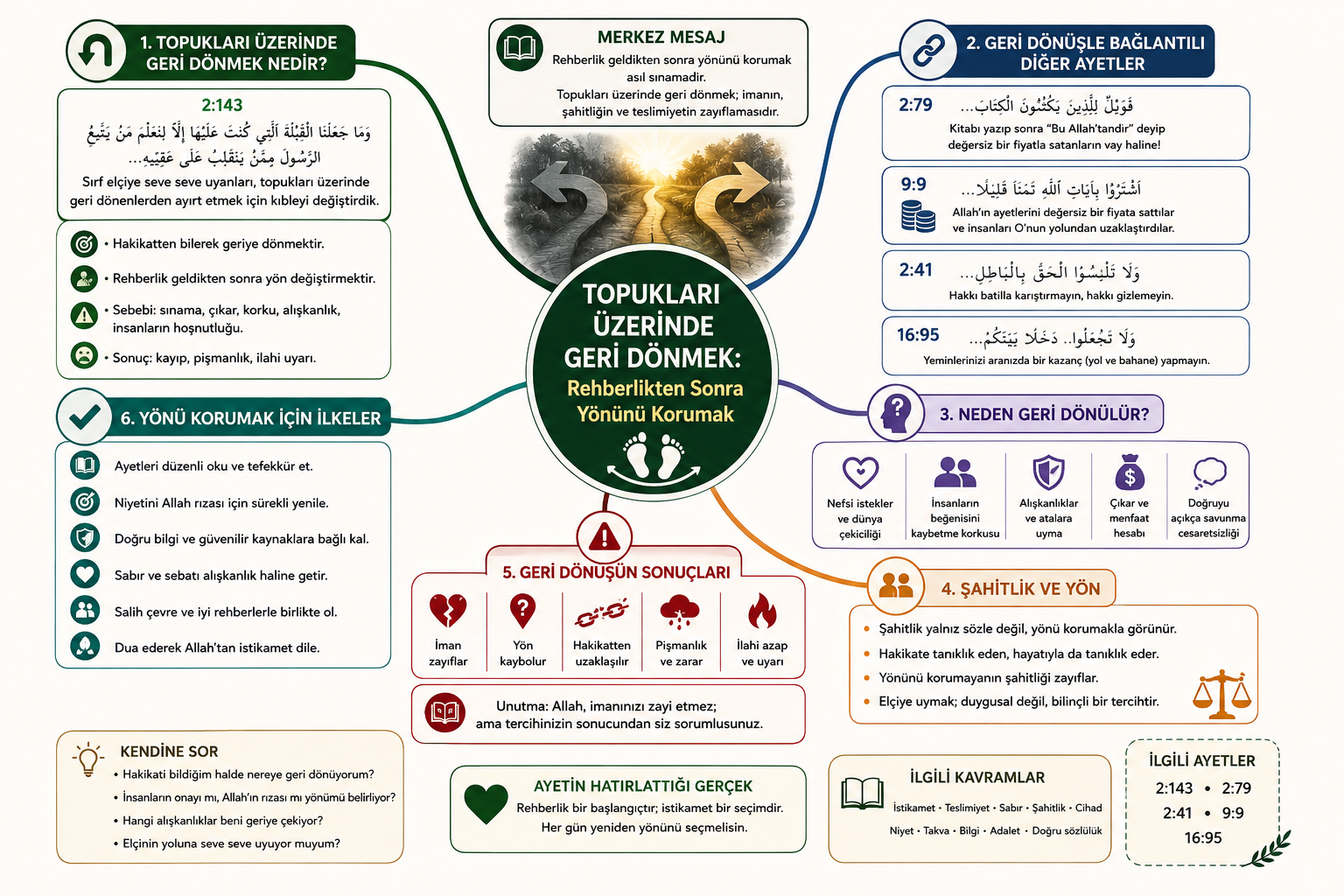
1. Turning Back on Your Heels: The Direction Revealed by the Qiblah
Verse
2:143
وَكَذَٰلِكَ جَعَلْنَٰكُمْ أُمَّةً وَسَطًا لِّتَكُونُوا۟ شُهَدَآءَ عَلَى ٱلنَّاسِ وَيَكُونَ ٱلرَّسُولُ عَلَيْكُمْ شَهِيدًا وَمَا جَعَلْنَا ٱلْقِبْلَةَ ٱلَّتِى كُنتَ عَلَيْهَآ إِلَّا لِنَعْلَمَ مَن يَتَّبِعُ ٱلرَّسُولَ مِمَّن يَنقَلِبُ عَلَىٰ عَقِبَيْهِ وَإِن كَانَتْ لَكَبِيرَةً إِلَّا عَلَى ٱلَّذِينَ هَدَى ٱللَّهُ وَمَا كَانَ ٱللَّهُ لِيُضِيعَ إِيمَٰنَكُمْ إِنَّ ٱللَّهَ بِٱلنَّاسِ لَرَءُوفٌ رَّحِيمٌ
*We thus made you an impartial community, that you may serve as witnesses among the people, and the messenger serves as a witness among you. We changed the direction of your original Qiblah only to distinguish those among you who readily follow the messenger from those who would turn back on their heels. It was a difficult test, but not for those who are guided by GOD. GOD never puts your worship to waste. GOD is Compassionate towards the people, Most Merciful. *
We thus made you an impartial community, that you may serve as witnesses among the people, and the messenger serves as a witness among you. We changed the direction of your original Qiblah only to distinguish those among you who readily follow the messenger from those who would turn back on their heels. It was a difficult test, but not for those who are guided by GOD. GOD never puts your worship to waste. GOD is Compassionate toward the people, Most Merciful.
Source: kuranteyit.com
Reflection on the Verse
The first thing that stops me in 2:143 is that the change of the qiblah is directly connected with “distinguishing.” The verse does not describe a change of direction merely as a detail of practice; that change becomes a test revealing who readily follows the messenger and who turns back on their heels.
Here the outward direction touches the inward direction. The human body can turn one way, but what truly determines the matter is the authority according to which the heart turns. If a command feels easy to me only when it agrees with my habit, is the center of my submission really GOD, or is it my own comfort? The change of the qiblah makes this question visible.
The duty of testimony at the beginning of the verse is also very important to me. For the community to serve as witnesses among the people seems like a heavier responsibility than merely repeating a statement of belief. A witness should not conceal what they have seen, distort what they know, or change direction according to personal interest. For this reason, it does not feel accidental to me that testimony and the test of turning back meet in the same verse.
At the end of the verse, the statement that GOD will never waste worship and that He is Compassionate, Most Merciful toward people prevents me from reducing the purpose of the test to a harsh language of punishment. Guidance does not come in order to lose the human being, but to reveal one’s direction and keep one on the right path. Yet the presence of guidance does not remove the responsibility to remain faithful to it.
The question I need to ask myself before this verse is simple but heavy: Am I following GOD’s guidance, or am I following it only as long as it suits me?
Verse references: 2:143.
2. If the Messenger Dies, Does the Direction Change?
Verse
3:144 — Muhammad was no more than a messenger like the messengers before him. If he dies or is killed, will you turn back on your heels? Whoever turns back on his heels cannot harm GOD in the least. GOD rewards those who are appreciative.
Reflection on the Verse
3:144 carries the phrase “turning back on your heels” into another moment of major rupture: the death or killing of the messenger. A person may have become attached to a messenger, lived in the same period, and heard his words. But above all of this, the verse asks about a more fundamental attachment.
Muhammad is stated to be no more than a messenger like the messengers before him. Then comes the unsettling question: If he dies or is killed, will you turn back on your heels? This question makes it clear that faith cannot be tied to the biological existence of a human being. The messenger departs; GOD remains. The messenger dies; the truth of the revelation does not die with him.
The sentence “Whoever turns back on his heels cannot harm GOD in the least” also breaks the ego. My faith does not add power to GOD. My return to disbelief does not subtract anything from His sovereignty. Both gain and loss belong to me.
Here I feel that the messenger should not be diminished, but that his place should be kept rightly. The messenger’s value comes not from moving ahead of GOD, but from carrying GOD’s message. If a person makes love for the messenger independent of loyalty to the messenger’s Lord, the person remains at the center and the message falls behind. 3:144 turns the direction back toward GOD at precisely this point.
This verse deepens the test in 2:143 even further: Can you preserve your direction when the qiblah changes? Can you preserve your direction when the messenger dies? It seems, then, that the value of loyalty becomes visible not when conditions remain unchanged, but when the center is shaken.
Verse references: 3:144.
3. Wrong Obedience Can Turn a Person Back
Verse
3:149 — O you who believe, if you obey those who disbelieve, they will turn you back on your heels, then you will end up as losers.
3:100 — O you who believe, if you obey some of those who received the scripture, they will turn you back into disbelievers after you have believed.
2:109 — Many followers of the scripture would rather see you return to disbelief now that you have believed. This is due to jealousy on their part, after the truth became clear to them. Pardon them and leave them alone until GOD issues His judgment. GOD is Omnipotent.
Reflection on the Verse
In 3:149, the danger of turning back is directly connected with obedience. It is said that obeying those who disbelieve can turn believers “back on their heels.” This is a very important warning for me, because a person does not always turn back alone. Sometimes a voice calls that person backward. Sometimes a community says, “You must do this.” Sometimes authority, belonging, or the desire to be accepted changes a person’s direction.
3:100 establishes the same danger in another sentence: obedience to some followers of the scripture can turn people back into disbelief after they have believed. Here the importance of the question “Who said it?” becomes visible. Not every statement made by someone who bears a religious identity, is associated with scripture, or is respected in society is automatically guidance. The verse teaches me to look at the result of the direction being given before the identity of the person giving it.
2:109 connects the desire to turn others back with jealousy. It states that even after the truth has become clear, some may still wish to turn believers back into disbelief. This shows that spiritual life is not only an inner struggle. A person must be aware of external influences.
Here the question of religious authority becomes more visible to me. A person’s being a scholar, speaking impressively, being followed by a large audience, or standing within a long tradition does not turn every word of that person into GOD’s word. Respect is one thing; submission is another. Learning is one thing; taking someone as a lord is another.
Protection from wrong obedience does not mean rejecting everyone. On the contrary, it means taking the measure back to the source. If a statement moves me away from GOD’s clear guidance, I must reconsider it no matter who said it. The warning in 3:149 looks not at people’s titles, but at the direction of obedience.
Verse references: 3:149, 3:100, 2:109.
4. Returning to the Old Direction After Guidance
Verse
6:71 — Say, “Shall we call beside GOD upon what possesses no power to benefit us or harm us, and turn back on our heels after GOD has guided us? We would then be like those possessed by the devils and left totally bewildered while their friends try to save them, saying, ‘Stay with us on the right path.’” Say, “GOD’s guidance is the true guidance. We are commanded to submit to the Lord of the universe.”
23:66 — My proofs were presented to you, but you turned back on your heels.
5:21 — “O my people, enter the blessed land that GOD has decreed for you, and do not rebel, lest you become losers.”
8:48 — The devil had adorned their works in their eyes and said, “You cannot be defeated by any people today,” and, “I will fight beside you.” But as soon as the two armies faced one another, he turned back on his heels and fled, saying, “I disown you. I see what you do not see. I fear GOD. GOD’s retribution is awesome.”
Reflection on the Verse
6:71 clearly expands the image in 2:143: turning back on one’s heels after GOD has guided. The measure is also given at the end of the verse: “GOD’s guidance is the true guidance.” For me, this sentence is one of the centers of the entire subject. The wrongness of turning back comes not merely from the fact that the movement goes backward, but from moving away from true guidance.
23:66 states that the proofs were presented, yet people turned back on their heels. This makes me think about the difference between ignorance and rejection. Sometimes a person errs because they do not know; at other times the evidence is before them and they still do not remain faithful to it. In the second case, the problem is not merely a lack of information. Will, ego, habit, or interest may enter the picture.
In 5:21, after the call to enter the promised land, there is a warning not to rebel and a reminder not to become losers. Although the Turkish translation does not use the word “heel,” it strongly meets the same semantic field of retreat. A person’s fear of taking a step they know to be right can effectively become a withdrawal.
8:48 opens a very different scene. The devil first adorns people’s works in their eyes and says that he will support them; then, at the moment of real confrontation, he turns back on his heels and says that he disowns them. The verse exposes the structure of false support. Wrong authority may first give confidence, then leave a person alone at the critical moment.
When I think about these four verses together, I see that turning back can arise from fear, wrong guidance, stubbornness despite evidence, or reliance on false security. But the common center does not change: the right direction is GOD’s guidance.
Verse references: 6:71, 23:66, 5:21, 8:48.
5. Sliding Back After Clear Proof
Verse
2:209 — If you slide back after the clear proofs have come to you, then know that GOD is Almighty, Most Wise.
47:25 — Surely, those who slide back after the guidance has been clearly shown to them; the devil has enticed them and distracted them.
24:47 — They say, “We believe in GOD and the messenger, and we obey,” but then some of them slide back afterward. These are not believers.
3:155 — Surely, those among you who turned back on the day the two armies clashed were deceived by the devil. This reflects some of the evil works they had committed. GOD has pardoned them. GOD is Forgiver, Clement.
Reflection on the Verse
2:209 and 47:25 describe sliding back specifically after clear proofs and guidance have become visible. This shakes me because we often think a spiritual problem will be solved if we simply gain more information. Yet these verses show that knowledge alone does not protect a person.
A person can read a verse, see its meaning, even explain it to another person. But when self-interest, fear, or desire enters, the person may still slide back. So knowledge and submission are not the same thing. Knowledge shows the way; walking remains the responsibility of the human being.
24:47 states that some who say, “We believe and we obey,” later slide back. Here the distance between speech and direction becomes visible. The claim of faith may be correctly formed on the tongue, but if behavior turns in another direction, speech alone is not sufficient.
3:155 introduces an important balance. Those who turned back on the day of battle are said to have been deceived by the devil, but the same verse also says that GOD pardoned them. This allows me to see mercy without minimizing the sliding back. A person’s slipping and making the slip into a permanent direction are not the same thing.
The lesson I take for myself is this: What I do when I fall is as important as not falling. Continuing to walk backward while defending the error is one thing; recognizing the mistake and returning to guidance is another. The Quran warns, but it also leaves the door of return open.
Verse references: 2:209, 47:25, 24:47, 3:155.
6. Leaving the Faith and the Direction of the Heart
Verse
2:217 — They ask you about the Sacred Months and fighting therein. Say, “Fighting therein is sacrilege. However, repelling from the path of GOD, disbelieving in Him and in the sanctity of the Sacred Masjid, and evicting its people therefrom are greater sacrileges in the sight of GOD. Oppression is worse than murder.” They will always fight you to turn you away from your religion if they can. Those among you who turn away from their religion and die as disbelievers have nullified their works in this life and in the Hereafter. These are the dwellers of Hell; therein they abide forever.
5:54 — O you who believe, if you turn away from your religion, GOD will substitute in your place people whom He loves and who love Him. They will be humble toward the believers, stern toward the disbelievers, and will strive in the cause of GOD without fearing any blame. Such is GOD’s grace; He bestows it upon whomever He wills. GOD is Bounteous, Omniscient.
16:106 — Those who disbelieve in GOD after attaining faith and become fully content with disbelief have incurred GOD’s wrath. The only ones excused are those forced to profess disbelief while their hearts remain full of faith.*
63:3 — This is because they believed, then disbelieved. Consequently, their minds are blocked; they do not understand.
9:74 — They swear by GOD that they never uttered the word of disbelief, although they did utter it; they disbelieved after becoming submitters. In fact, they gave up something they never possessed. They rebelled even though GOD and His messenger showered them with His grace and provisions. If they repent, it will be better for them. But if they turn away, GOD will commit them to painful retribution in this world and in the Hereafter. They will find no lord or master on earth.
Reflection on the Verse
2:217 describes persistent pressure intended to turn people away from their religion. The verse reminds me that faith is not lived only in a calm environment. Sometimes a person’s direction may be directly targeted; through fear, exclusion, loss of interest, or other pressures, they may be asked to return to the old direction.
5:54 sets a very powerful measure: if a community turns away from its religion, GOD can bring other people in its place. This sentence makes me think that no person or group should consider itself indispensable. GOD’s religion does not depend on our existence. Our loyalty benefits us; our turning away leads us to loss.
16:106 makes an important distinction between external pressure and the direction of the heart. A person forced to utter disbelief while the heart remains full of faith is not treated the same as a person content with disbelief. This verse shows how dangerous it is to judge another person’s heart hastily. The outward word may not always fully correspond to the inward direction.
63:3 speaks of the minds of those who believed and then disbelieved being sealed. Here, repeated changes of direction are shown to have an effect on perception. If a person continually decides against truth, eventually the wrong may affect not only the choice but also the way of seeing.
9:74, meanwhile, reminds us of the possibility of repentance. Even while speaking of grave disbelief, the verse says, “If they repent, it will be better for them,” and does not close the door. This makes me think again about the purpose of the Quran’s warning: not to drive people into despair, but to make the wrong direction visible and call them back to the right one.
Verse references: 2:217, 5:54, 16:106, 63:3, 9:74.
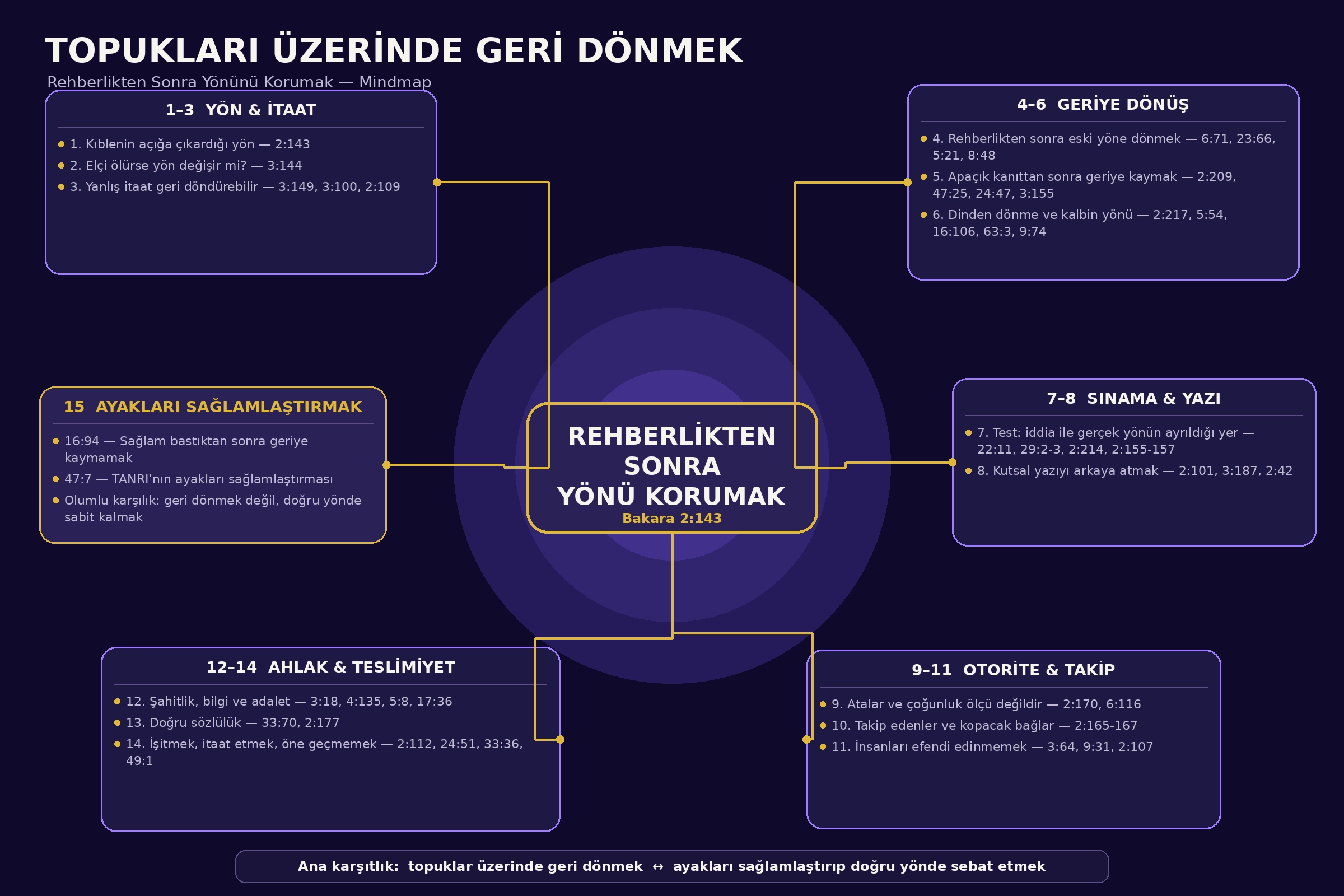
7. The Test: Where the Claim and the Real Direction Separate
Verse
22:11 — Among the people is one who worships GOD conditionally. If things go well, he is content. But if an adversity befalls him, he turns away. Thus, he loses both this life and the Hereafter. Such is the real loss.
29:2 — Do the people think that they will be left to say, “We believe,” without being put to the test?
29:3 — We tested those before them, for GOD must distinguish those who are truthful and expose the liars.
2:214 — Do you expect to enter Paradise without being tested like those before you? They were tested with hardship and adversity and were shaken, until the messenger and those who believed with him said, “Where is GOD’s victory?” GOD’s victory is near.
2:155 — We will surely test you with some fear, hunger, and loss of money, lives, and crops. Give good news to the steadfast.*
2:156 — When an adversity befalls them, they say, “We belong to GOD, and to Him we are returning.”
2:157 — These have deserved blessings and mercy from their Lord. These are the guided ones.
Reflection on the Verse
22:11 describes a person who worships GOD conditionally. When good things happen, the person is content; when adversity comes, the person turns away. This verse makes me reconsider the qiblah test in 2:143. The change of qiblah was a test; here the change in life circumstances becomes the test. Changing external conditions reveal the true center of inward attachment.
29:2-3 state that saying “We believe” is not sufficient to avoid being tested. The distance between claim and real direction becomes visible under testing. However a person defines themselves in comfort, what they hold on to when loss, fear, pressure, or loneliness comes becomes clearer.
2:214 describes earlier people being shaken by hardship and adversity until even the messenger and those who believed with him reached the point of saying, “Where is GOD’s victory?” This shows that testing is not a slight discomfort. Sometimes a person can truly be shaken. Steadfastness does not mean never struggling.
2:155-157 explicitly list fear, hunger, loss of money, lives, and crops. Then comes the statement of the steadfast: “We belong to GOD, and to Him we are returning.” Here the word “return” takes on an entirely different meaning. On one side there is turning back on one’s heels away from guidance; on the other there is returning to GOD in adversity.
This contrast is very powerful for me. A human being may always be returning somewhere: to fear, habit, the majority, the past, the ego, or to GOD. The essential matter is not the movement itself, but the direction of the return.
Verse references: 22:11, 29:2, 29:3, 2:214, 2:155, 2:156, 2:157.
8. Casting the Scripture Behind One’s Back
Verse
2:101 — Now that a messenger from GOD has come to them,* and although he proves and confirms their own scripture, some followers of the scripture—Jews, Christians, and Muslims—cast GOD’s scripture behind their backs, as if they had no scripture.
3:187 — GOD made a covenant with those who received the scripture: “You shall proclaim it to the people and never conceal it.” But they cast it behind their backs, disregarded it, and sold it for a cheap price. What a miserable trade.
2:42 — Do not mix truth with falsehood, nor conceal the truth knowingly.
Reflection on the Verse
2:101 and 3:187 use the image of “casting the scripture behind one’s back.” This expression carries a language of direction very close to the theme of turning back on one’s heels. A person can possess scripture, read it, and consider themselves part of it, yet cast it behind the back at the moment of decision.
This makes me think about the difference between religious identity and actual guidance. Keeping a book at home, belonging to a community, or being known by a certain name does not mean that scripture is in front. What matters is which one is given priority when conflict arises, when self-interest is harmed, or when habit and revelation collide.
3:187 recalls the covenant to proclaim scripture and not conceal it; then comes casting it behind the back and selling it for a cheap price. 2:42 also commands not to mix truth with falsehood and not to conceal truth knowingly. Thus the informational dimension of turning back becomes visible.
A person can sometimes move away from truth without openly denying it. One quietly pushes it into the background, does not speak about the part that disturbs, magnifies the part that fits one’s own view, and ignores the rest. The scripture physically stands in front of the person, yet mentally it has been cast behind the back.
These verses ask me this: Do I truly keep the verse in front of me, or do I push it backward where it does not suit me?
Verse references: 2:101, 3:187, 2:42.
9. The Direction of Ancestors and the Majority Is Not the Measure of Truth
Verse
2:170 — When they are told, “Follow what GOD has revealed herein,” they say, “We follow only what we found our parents doing.” What if their parents did not understand and were not guided?
6:116 — If you obey the majority of people on earth, they will divert you from the path of GOD. They follow only conjecture; they only guess.
Reflection on the Verse
2:170 reports the answer, “We follow only what we found our parents doing,” to the call to follow what GOD revealed. The question of the verse is very clear: What if their parents did not understand and were not guided?
This is not about devaluing the past. A person can learn much from family, society, and those who lived before. But learning from them and making them the final measure are not the same. The age of a tradition does not automatically make it correct; its newness does not automatically make it wrong. The measure is GOD’s guidance.
6:116 breaks the spell of numbers. It states that obeying the majority of people on earth can divert a person from the path of GOD. If the majority rests on conjecture and guesswork, it is not a guarantee of truth.
Thinking about these two verses together makes the social side of turning back more visible. A person can lose direction sometimes in the name of loyalty to the past, sometimes in order not to separate from the crowd. The sentences “Everyone does this” and “This is how we have always seen it” may comfort the mind, but by themselves they have no evidentiary value before the verses.
What is difficult for me here is not turning opposition to the majority into a new ego. Being in a minority is not automatically being right either. The matter is not to go against the crowd, but to preserve the direction of guidance regardless of what the crowd says.
Verse references: 2:170, 6:116.
10. Those Who Are Followed, Those Who Follow, and the Bonds That Will Break
Verse
2:165 — Yet some people set up idols to rival GOD and love them as if they were GOD. The believers love GOD the most. If only the transgressors could see themselves when they see the retribution! They would then realize that all power belongs to GOD alone and that GOD’s retribution is awesome.
2:166 — Those who were followed will disown those who followed them.* They will see the retribution, and all bonds between them will be severed.
2:167 — The followers will say, “If only we had another chance, we would disown them just as they now disown us.” GOD thus shows them that the consequences of their works are nothing but remorse; they will never exit Hell.
Reflection on the Verse
2:165-167 establish a very heavy picture showing the end of the weight human beings give to other beings. Some people set up idols to rival GOD and love them as they love GOD. Then we are told that the bonds between those who were followed and those who followed them will be severed, and that those who were followed will disown their followers.
When I think about these verses in terms of religious authority, I see that the real danger is not only a statue or physical idol. Magnifying a person, group, tradition, or institution until it moves ahead of GOD’s word can also shift the center of attachment.
The regret of the followers in 2:167 is striking. They say that if they had another chance, they would disown those they followed just as those people now disown them. This shows that responsibility cannot be transferred.
A person cannot escape ultimate responsibility by saying, “I only did what my teacher said,” “Society taught this,” or “Everyone accepted it.” It is possible to listen to someone else, but I cannot place that person’s choice in the place of my own testimony.
There is also a liberating side to these verses for me. If human approval is not absolute, human rejection is not absolute either. If true power belongs only to GOD, I do not have to abandon what I know to be right merely in order not to lose the approval of a group.
Verse references: 2:165, 2:166, 2:167.
11. Taking Human Beings as Lords and the Limit of Religious Authority
Verse
3:64 — Say, “O followers of the scripture, let us come to a logical agreement between us and you: that we shall not worship except GOD; that we shall never set up any idols beside Him, nor set up any human beings as lords beside GOD.” If they turn away, say, “Bear witness that we are submitters.”
9:31 — They have set up their religious leaders and scholars as lords in place of GOD.* Others deified the Messiah, son of Mary. They were all commanded to worship one god. There is no god except He. Be He glorified, far above having any partners.
2:107 — Do you not realize that GOD possesses the kingship of the heavens and the earth, and that you have no Lord and Master besides GOD?
Reflection on the Verse
3:64 does not leave the call of monotheism at “worship no one except GOD”; it places in the same sentence the prohibition against taking any human being as a lord beside GOD. For me, this is a very clear boundary concerning religious authority.
9:31 speaks of the danger of taking religious leaders and scholars as lords instead of GOD. The verse’s own wording is sufficiently weighty. I do not infer from this that all people of knowledge should be devalued. On the contrary, knowledge is valuable; but the value of the knowledgeable person does not make that person GOD.
2:107 states that the kingship of the heavens and the earth belongs to GOD and that there is no Lord and Master besides GOD. This verse determines the center of the question of authority. I can learn from people, consult the knowledge of an expert, and follow the message brought by a messenger, but ultimate ownership and sovereignty belong to GOD.
Here the phrase “turning back on one’s heels” gains a new layer of meaning. A person does not necessarily have to return to an old religion. If one moves away from GOD’s clear guidance and makes a human being the absolute measure, one’s direction may have changed as well.
Preserving this boundary is not easy, because the human being likes to lean on visible authority. Someone saying “This is the truth” reduces the burden of investigation. But 2:107 reminds me again of ultimate ownership. Human beings may possess knowledge; they do not possess lordship that can replace GOD.
Verse references: 3:64, 9:31, 2:107.
12. Testimony, Knowledge, and Justice: The Moral Ground for Not Turning Back
Verse
3:18 — GOD bears witness that there is no god except He, and so do the angels and those who possess knowledge. Truthfully and equitably, He is the absolute god; there is no god but He, the Almighty, Most Wise.
4:135 — O you who believe, be absolutely equitable when you bear witness, even if it is against yourselves, your parents, or your relatives, and observe GOD. Whether the accused is rich or poor, GOD takes care of both. Therefore, do not be biased by your personal wishes. If you deviate or disregard this command, GOD is fully Cognizant of everything you do.
5:8 — O you who believe, be totally equitable when you bear witness, and observe GOD. Do not let your conflicts with some people provoke you into committing injustice. Be totally equitable, for this is more righteous. Observe GOD. GOD is fully Cognizant of everything you do.
17:36 — Do not accept any information unless you verify it for yourself. I have given you hearing, eyesight, and the brain, and you are responsible for using them.
Reflection on the Verse
3:18 brings testimony to the oneness of GOD together with knowledge and justice in the same verse. For this reason, I do not think the duty of testimony in 2:143 is merely a declaration of identity. Testimony requires carrying what one knows truthfully and preserving justice.
4:135 carries this responsibility all the way into personal interest. A person must uphold justice even against oneself, one’s parents, or relatives. If my testimony is correct only as long as it benefits me, then I am actually attached not to truth but to my interest.
5:8 states that dislike should not corrupt justice. This is a very important boundary within the theme of turning back. A person can lose the measure either by excessively exalting someone they love or by acting unjustly toward someone they dislike. Justice should not change according to the direction of emotion.
17:36 clearly reminds us of the responsibility of knowledge: I should not accept information I have not verified; I am responsible for using hearing, sight, and the brain. This verse makes me think that the sentence “This is what I was told” is not enough in religious matters.
When I read these four verses together, I see that not turning back is not merely willpower. Verifying information, preserving justice, and not selling testimony in the face of self-interest are pieces of the moral ground that keeps direction stable.
Verse references: 3:18, 4:135, 5:8, 17:36.
13. Truthfulness: Preserving Direction in Speech and in Life
Verse
33:70 — O you who believe, reverence GOD and utter only the correct word.
2:177 — Righteousness is not turning your faces toward the east or the west. The righteous are those who believe in GOD, the Last Day, the angels, the scripture, and the prophets; they give money, cheerfully, to relatives, orphans, the needy, the traveling alien, beggars, and for freeing slaves; they observe the Contact Prayers (Salat) and give the obligatory charity (Zakat); they keep their word whenever they make a promise; they steadfastly persevere in the face of persecution, hardship, and war. These are the truthful; these are the righteous.
Reflection on the Verse
33:70 combines reverence for GOD and truthful speech in the same call. A person reveals direction not only with the feet, but also with the tongue. If I know the truth but speak differently in order to be accepted, then the turning back that began within me has been reflected in my speech.
2:177 brings a wider integrity to this subject. It states that righteousness is not merely turning the face toward the east or the west. Read together with 2:143, this is very meaningful. Physical direction is not in itself the essence of righteousness, but attachment to GOD’s command can be tested within that change of direction.
The same 2:177 defines righteousness together with faith, giving, the Contact Prayers, obligatory charity, keeping promises, and steadfastness in hardship. At the end, it says, “These are the truthful.” Truthfulness therefore becomes not only a correct sentence spoken by the mouth, but a life whose parts do not contradict one another.
This gives me a strong measure. If I say, “I submit to GOD,” do my decisions support that statement? If I say, “Truth matters,” do I protect truth when it harms me? If I say, “I worship GOD alone,” am I more afraid of losing human approval than losing GOD’s guidance?
Turning back on one’s heels does not always begin with a great declaration. First, the tongue bends a little. Then behavior follows it. For this reason, truthful speech is one of the first defenses that preserves direction.
Verse references: 33:70, 2:177.
14. Submission: Hearing, Obeying, and Not Moving Ahead
Verse
2:112 — Indeed, those who submit themselves completely to GOD alone while leading a righteous life will receive their recompense from their Lord; they have nothing to fear, nor will they grieve.*
24:51 — The only utterance of the believers, whenever invited to GOD and His messenger to judge in their affairs, is to say, “We hear and we obey.” These are the winners.
33:36 — Whenever GOD and His messenger issue any command, no believing man or believing woman has any choice regarding that command. Anyone who disobeys GOD and His messenger has gone far astray.
49:1 — O you who believe, do not place your opinion above that of GOD and His messenger. Reverence GOD. GOD is Hearer, Omniscient.
Reflection on the Verse
2:112 describes the person who submits completely to GOD alone and leads a righteous life. This verse seems like a positive definition of not turning back: the direction has become singular. Instead of being divided among different authorities, the person submits to GOD.
In 24:51, the believers’ statement is, “We hear and we obey.” This expression reminds me of the inner logic of the test in 2:143. Obedience may be easy when a command agrees with my habit. Real submission becomes visible when my own preference and the direction of revelation separate.
33:36 states that when GOD and His messenger issue a command, the believer has no other choice in that matter. 49:1 commands not to place one’s own opinion ahead of GOD and His messenger. Here the ego is tested directly.
But this obedience is not about making human beings independent lords beside GOD. 3:64 and 2:107 have already drawn that boundary. Obedience to the messenger is not establishing human sovereignty independent of GOD; it is accepting the direction of the divine message carried by the messenger.
For this reason, submission does not look like passivity to me. On the contrary, it demands continuous awareness. I need to check again and again whether I am placing my own opinion, tradition, habit, or social pressure ahead of GOD’s guidance.
The opposite of not turning back on one’s heels is not merely walking forward. It is walking in submission to the right center.
Verse references: 2:112, 24:51, 33:36, 49:1.
15. Making the Feet Firm
Verse
16:94 — Do not abuse the oaths among you, lest you slide back after your feet have become firm, then incur misery. Such is the consequence of repelling from the path of GOD by setting a bad example; you incur a terrible retribution.
47:7 — O you who believe, if you support GOD, He will support you and make your feet firm.
Reflection on the Verse
16:94 completes from the opposite direction the language of movement I have been following since the beginning of this article. In the first verse there was turning back on the heels. In other verses there was sliding back, turning away, casting scripture behind the back, and returning to the old direction after guidance. Here I see a much more concrete counterpart: not sliding back after the feet have become firm.
This expression makes me think: reaching guidance is not the end of the road. A person can see a truth, become convinced about a matter, turn away from an error, and feel that their feet are now firm. Yet 16:94 warns precisely at this point. Standing firm does not mean I can never slide again. A person can stand in a right place and still slide again by abusing a promise, covenant, or moral boundary.
For this reason, I cannot tie spiritual stability only to a right decision made in the past. Saying “I once found the truth” does not guarantee my direction today. The promise I make today, the testimony I give today, the relationship I establish today, and the conflict of interest I face today reveal again how firm my feet truly are.
The fact that 16:94 also mentions repelling from GOD’s path in the same sentence reminds me that a personal slide can affect others. A person may not only corrupt their own direction; through speech, conduct, or a bad example, one can make another person’s path more difficult. Therefore, standing firm is not only protecting myself. It also means taking into account the effect my testimony creates in others.
47:7 brings a hopeful answer to the same theme: “He will support you and make your feet firm.” Here firmness is not presented merely as the product of human will. When a person supports GOD, that person encounters GOD’s support. I do not read this as providing a support that GOD needs, but as openly taking one’s side in support of His path, His message, and righteousness. GOD needs nothing; I am the one in need.
When I place these two verses side by side, an important balance emerges. 16:94 leaves responsibility with me: Do not slide back after your feet have become firm. 47:7 does not leave trust with me alone: GOD supports and makes the feet firm. The human being is both responsible and not alone.
This section completes for me the positive counterpart of the image “turning back on one’s heels” at the beginning of the article. The issue is not merely refusing to turn backward. It is having the feet become firm in the right place. A person’s direction is understood not only by where one looks, but by where one stands and whether one can remain there even under pressure.
The question I now ask myself is no longer only, “Will I turn back?” It goes one step further:
After seeing GOD’s guidance, what kind of life am I living so that my feet become firm upon that guidance?
Verse references: 16:94, 47:7.
On the Arabic Roots of the Words
At the center of the phrase “those who turn back on their heels” in 2:143 is the verb يَنقَلِبُ (yanqalibu). This verb is related to the root ق ل ب (Qaf-Lam-Ba). The same root appears in 3:144 as ٱنقَلَبْتُمْ (inqalabtum) and يَنقَلِبْ (yanqalib), and in 3:149 as فَتَنقَلِبُوا (fatanqalibu). In these verses, this usage carries the idea of a direction or state being reversed.
In 2:143, the verb appears beside عَقِبَيْهِ (aqibayhi). In 3:144 and 3:149, its plural form أَعْقَابِكُمْ (a’qabikum) appears. The root ع ق ب (Ayn-Qaf-Ba) here has a semantic field connected with the heel and what comes after. The combination of the verb and the expression “heel” takes the turning back out of a mental abstraction and turns it into a bodily movement that appears vividly before the eye.
In 6:71, the expression نُرَدُّ عَلَىٰٓ أَعْقَابِنَا (nuraddu ala a’qabina) continues the same image of “being turned back on our heels.” Here the root ر د د (Ra-Dal-Dal) carries the idea of being turned back or sent back. Different forms of the same root family are also seen in contexts of turning away from the faith.
In 8:48 and 23:66, the forms نَكَصَ (nakasa) / نَاكِصُونَ (nakisuna) bring in the root ن ك ص (Nun-Kaf-Sad). This usage conveys the movement of retreat more directly. In 2:209, زَلَلْتُمْ (zalaltum) and in 3:155 ٱسْتَزَلَّهُمُ (istazallahumu) draw on the root ز ل ل (Za-Lam-Lam) and evoke slipping, sliding, and being made to slip. Thus the Quran describes turning back not only through a conscious verb of “turning,” but also through images of slipping and retreat.
The form ٱرْتَدُّوا (irtaddu) in 47:25 is another strong example of the theme of returning.
Together with 16:94 and 47:7, the language of movement now turns toward firmness. In 47:7, the expression meaning “He will make your feet firm” is وَيُثَبِّتْ أَقْدَامَكُمْ (wa yuthabbit aqdamakum). Here the root ث ب ت (Tha-Ba-Ta) carries the semantic field of strengthening, making firm, and keeping in place; the root ق د م (Qaf-Dal-Mim) carries the field of foot/step. In 16:94, the expression “lest you slide back after your feet have become firm” preserves the same bodily image. Thus in the movement map of the article, not only turning and slipping but also standing firm and being made firm become visible. Alongside this, the root د ب ر (Dal-Ba-Ra), expressing the “back” direction, carries in other verses the idea of turning one’s back or moving backward. The family ت و ل ي (Ta-Waw-Lam-Ya) used for “turning away” is another expression of the same spiritual loss of direction.
I do not use these roots by themselves to produce a new ruling. The clear meaning of the Turkish and English verses is already sufficient. The roots only make the following common image more visible: turning, being turned back, turning toward the heel, slipping, retreating, turning one’s back.
In the midst of all these movements, the central question does not change: After guidance comes, in which direction does the human being turn?
Verse references: 2:143, 3:144, 3:149, 6:71, 8:48, 2:209, 3:155, 47:25, 16:94, 47:7.
Other Claims
Verse
2:143 — We thus made you an impartial community, that you may serve as witnesses among the people, and the messenger serves as a witness among you. We changed the direction of your original Qiblah only to distinguish those among you who readily follow the messenger from those who would turn back on their heels. It was a difficult test, but not for those who are guided by GOD. GOD never puts your worship to waste. GOD is Compassionate toward the people, Most Merciful.
3:144 — Muhammad was no more than a messenger like the messengers before him. If he dies or is killed, will you turn back on your heels? Whoever turns back on his heels cannot harm GOD in the least. GOD rewards those who are appreciative.
3:149 — O you who believe, if you obey those who disbelieve, they will turn you back on your heels, then you will end up as losers.
6:71 — Say, “Shall we call beside GOD upon what possesses no power to benefit us or harm us, and turn back on our heels after GOD has guided us? We would then be like those possessed by the devils and left totally bewildered while their friends try to save them, saying, ‘Stay with us on the right path.’” Say, “GOD’s guidance is the true guidance. We are commanded to submit to the Lord of the universe.”
22:11 — Among the people is one who worships GOD conditionally. If things go well, he is content. But if an adversity befalls him, he turns away. Thus, he loses both this life and the Hereafter. Such is the real loss.
Reflection on the Verse
Different emphases may exist in traditional and historical interpretations of the phrase “turning back on one’s heels.” Some approaches restrict 2:143 specifically to the test of obedience that arose during the change of the qiblah. This reading rests on the direct context of the verse, and the verse itself explicitly connects the change of qiblah with a test.
Other approaches may take the repeated use of the same expression in verses such as 3:144, 3:149, and 6:71 as grounds for treating “turning back on one’s heels” as a broader image of moving away from guidance or returning to an old direction after faith. This second approach also establishes a clear connection with repetitions in the text.
I do not see these two approaches as claims that necessarily exclude one another. While 2:143 describes a specific test involving the qiblah, the use of the same image in broader situations elsewhere can widen the moral field of the phrase. Still, each verse should not be removed from its own context and reduced to the same event.
Some historical interpretations may have presented certain people or communities as permanent targets of these verses. I do not want to move toward that kind of certainty. It feels safer to reflect first on the measure the verses give for the direction of the living person. The distinction in 16:106 between the person under pressure and the person inwardly content with disbelief also requires us not to judge people’s inner worlds hastily.
Traditional approaches may also differ regarding religious authority. Some may give scholars and religious leaders broad binding authority. Yet the main thought of this article proceeds not from external interpretation but from the clear boundary in 3:64, 9:31, and 2:107: not making a human being an ultimate lord beside GOD.
The views mentioned in this section do not determine the main conclusion of the article. The main line is the explicit relationship the verses establish with one another: guidance, testing, turning back, obedience, testimony, and submission.
Verse references: 2:143, 3:144, 3:149, 6:71, 22:11.
Conclusion
When I return to Al-Baqarah 2:143, I no longer see the phrase “turning back on one’s heels” merely as a single image standing within the change of the qiblah. The verse establishes through a test the distinction between following the messenger and turning back; at the same time, it gives the community a duty of testimony. Direction, testimony, and submission meet in the same sentence.
3:144 asks this question again through the death of the messenger. 6:71 shows turning back after guidance, 3:149 shows that attachment to wrong obedience can turn a person back, and 2:209 shows the possibility of sliding back after clear proofs. In this way, turning back becomes a spiritual warning broader than a single historical event.
For me, the most difficult part of this warning is that turning back does not always take place as a large and dramatic rupture. Sometimes it begins by casting scripture behind the back without openly rejecting it. Sometimes it proceeds by saying, “Our ancestors did this,” by making the voice of the majority the measure of truth, or by placing the word of a religious authority ahead of GOD’s word. Sometimes it happens by quietly pushing a truth one knows into the background because it does not serve one’s interest.
For this reason, saying “I have not left the religion” should not by itself put me at ease. I need to ask subtler questions: Is my direction the same before guidance? Am I placing my own opinion ahead of GOD? Does the fear of losing human approval keep me from speaking the truth? Do I accept information I have not verified merely because someone I trust said it? Can I remain just even when my testimony is against me?
The opposite direction shown by the verses is also clear: submitting to GOD alone, speaking the truth, verifying information, preserving justice, and not taking human beings as lords. 3:18 connects monotheism with knowledge and justice, 2:112 connects submission with righteous living, and 17:36 connects knowledge with personal responsibility. These show me that not turning back is not merely emotional determination, but an ethical ordering of life.
Section 15 takes this thought one step further. 16:94 does not merely say “do not slide back”; it says so with the phrase “after your feet have become firm.” So the fact that a person once stood in the right place does not guarantee every future choice. Firmness is a state that must be preserved. 47:7 gives the positive counterpart: GOD’s support and the making firm of the feet.
Thus a very clear contrast forms for me between the movement at the beginning of the article and the movement at the end. On one side there is turning back on the heels; on the other there is the making firm of the feet. On one side there is sliding back after guidance; on the other there is remaining steadfast in the right place.
Perhaps the strongest image this article leaves with me now consists of three different states of “return and standing.” The first is turning back on one’s heels away from guidance. The second is returning to GOD with the statement in 2:156: “We belong to GOD, and to Him we are returning.” The third is having the feet made firm in the right place, as in 47:7.
Throughout life, a human being can make mistakes, slip, fear, and be deceived. 3:155 reminds us of forgiveness, and 9:74 of repentance. Therefore, the matter is not walking a flawless line without ever slipping. The matter is knowing in which direction to turn when one slips, and becoming firm again in the right place.
The question I want to leave for myself now has two parts:
When a test comes, where do my heels take me?
And when I see the right direction:
Do my feet truly become firm there?
Do I turn to my habit, my fear, the majority, a human being, or my own ego?
Or do I return to GOD’s guidance and learn to remain steadfast there?
Verse references: 2:143, 3:144, 6:71, 2:101, 3:64, 3:18, 2:112, 16:94, 47:7.
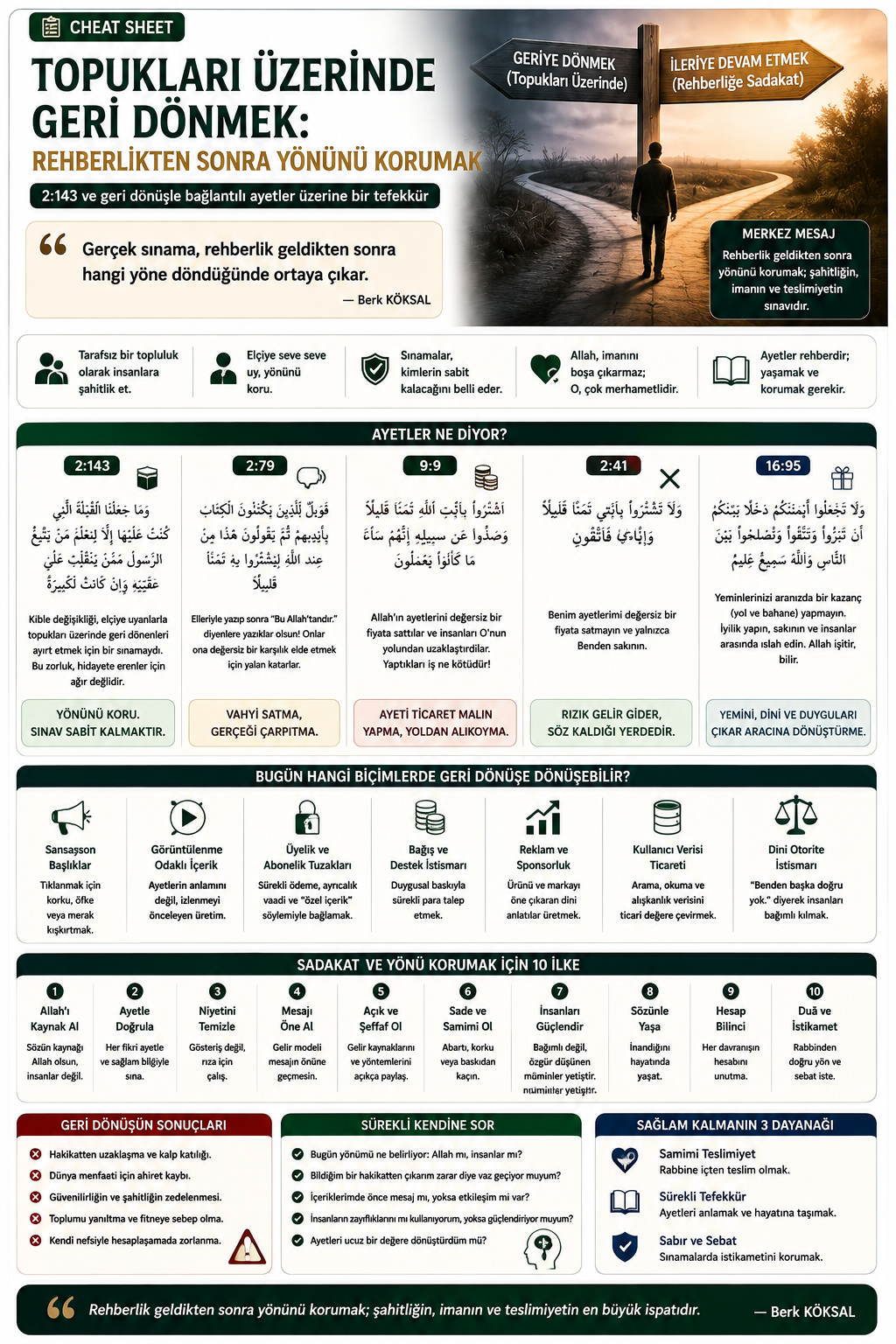
Note
2:32 — They said, “Be You glorified. We have no knowledge except what You have taught us. You are the Omniscient, Most Wise.”
39:18 — They are the ones who examine all words, then follow the best. These are the ones whom GOD has guided; these are the ones who possess intelligence.
16:94 — Do not abuse the oaths among you, lest you slide back after your feet have become firm, then incur misery. Such is the consequence of repelling from the path of GOD by setting a bad example; you incur a terrible retribution.
47:7 — O you who believe, if you support GOD, He will support you and make your feet firm.
GOD knows best.
Source: kuranteyit.com
Discover
Related Articles

Quran Reflections
Do You Really Trust GOD? The Word of Trust, the Obsession with Control, and the Hard Test of Submission
A severe and deep reflection through Al-Imran 3:122 and verses related to trusting GOD; on trust, submission, monotheism, the obsession with control, precaution, provision, steadfastness, religious authority, the danger of taking people as lords, and what it means in human life to see GOD as sufficient.
Read article
Quran Reflections
Deep Reverence: Remembering, Faithfulness to the Covenant, and Turning to GOD Alone
A comprehensive reflection centered on Al-Baqarah 2:40 on deep reverence, remembering blessings, faithfulness to the covenant, monotheism, testimony, knowledge, justice, truthful speech, submission, the limits of religious authority, inward orientation in privacy, awareness of accountability, and devotion to GOD alone.
Read article
Quran Reflections
Proclaim: Do Not Conceal the Truth, Tie the Word to GOD
A personal and concise reflection on not concealing the truth, truthful speech, testimony, tawhid, justice, submission, and the limits of religious authority through Al-Baqarah 2:159-160 and the verses gathered under the theme “Proclaim.”
Read article