Had the Retribution Come Immediately: GOD's Mercy and the Time Granted to Us
A reflection centered on Al-Ankabut 29:53, considering GOD's mercy and grace, the respite granted to us, repentance, justice, truthfulness, tawhid, and submission alongside 18:58, 35:45, 39:53-55, and other related verses.
Had the Retribution Come Immediately: GOD’s Mercy and the Time Granted to Us
Author: Berk KÖKSAL
Date: 23 September 2026
Location: Mersin
Greetings of peace. Peace be upon you.
The central purpose of this article is to reflect on the verses alongside other related verses, and to explore, with sincerity and depth, what bearing witness to GOD’s oneness means in human life in terms of knowledge, justice, truthfulness, and submission.
Summary
This reflection on 29:53 approaches retribution that does not arrive immediately as an occasion to face my own responsibility before waiting for others to be called to account. Considering the value of respite in light of 18:58 and 35:45 brings forward the need not to treat the continuation of life as a certificate of innocence or immunity. Holding on to hope in mercy, not postponing repentance, correcting wrongdoing, and respecting the rights of those who have been wronged belong within the same moral responsibility. Knowledge, testimony, and religious authority are considered within this framework too: bearing witness to the oneness of GOD without making my own judgment absolute. At the center of the article is a personal question: Am I living the time I have been given as a guarantee that I need not change, or with an awareness of the value of turning toward what is right?
Introduction
When I see someone else’s injustice, I may want the consequences to appear immediately. When I confront a wrong of my own, however, I look for time to think, feel remorse, and reform. As I reflect on 29:53, I stand between these two attitudes: while questioning the time granted to someone else, how aware am I of the understanding I expect for myself?
Retribution, mercy, and grace are not abstract subjects outside everyday life for me here. I encounter them in verifying a statement, admitting a mistake, respecting a right, and recognizing the limits of my own judgment. The fact that I have not seen an immediate consequence does not remove my responsibility to reconsider my own behavior. That is why I want to stand before 29:53 not only with the question of when, but also with the question of what I am doing now.
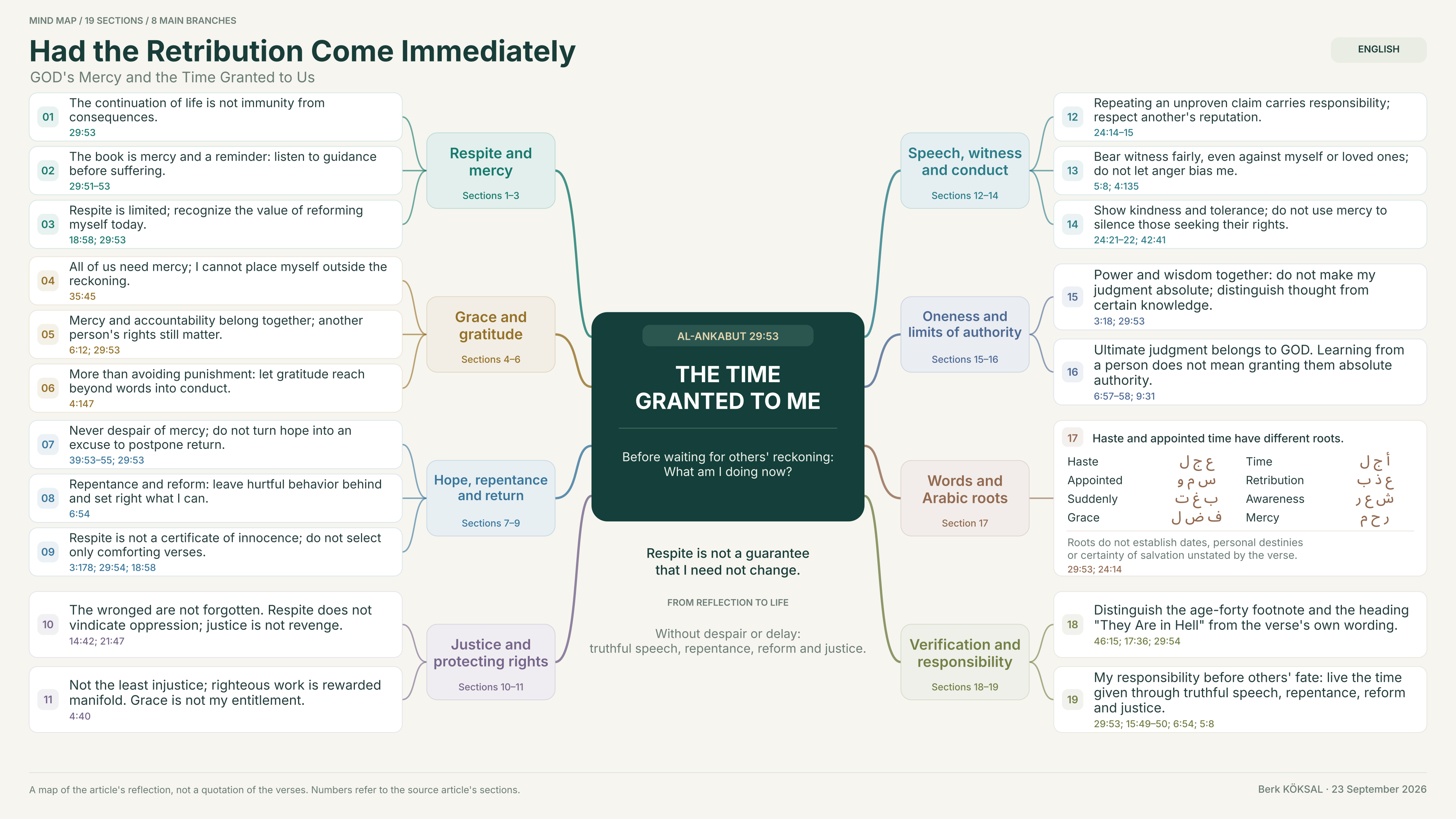
1. When Retribution Does Not Come Immediately
Verse
Arabic — 29:53
وَيَسْتَعْجِلُونَكَ بِٱلْعَذَابِ وَلَوْلَآ أَجَلٌ مُّسَمًّى لَّجَآءَهُمُ ٱلْعَذَابُ وَلَيَأْتِيَنَّهُم بَغْتَةً وَهُمْ لَا يَشْعُرُونَ
English — 29:53
They challenge you to bring the retribution! If it were not for a predetermined appointment, the retribution would have come to them immediately.* Certainly, it will come to them suddenly, when they least expect it.
Turkish — 29:53
29:53 — Sana azabı getirmen için meydan okuyorlar! Eğer önceden belirlenmiş bir atama olmasaydı, azap onlara hemen gelmiş olurdu.* Kesinlikle o, onlara hiç beklemedikleri bir anda, aniden gelecektir.
Source: kuranteyit.com
Reflection on the Verse
As I read 29:53, my mind pauses at something a person could easily pass over: the consequences of what has been done do not arrive immediately. The day continues. People speak, think, and make decisions. Yet this continuation does not, in itself, prove that what they have done is right.
Standing before the verse, I may think of others first. Those who oppress, those who lie, those who violate other people’s rights… Then I need to turn my gaze toward myself. If the consequences of my own wrongs were placed before me without a moment’s delay, how much of the sense of security I rest on today would remain?
What shakes me here is not only the possibility of retribution, but the possibility that a person might mistake the time granted to them for immunity. When I am comfortable, could I forget the difference between not yet having faced the consequences and having escaped them?
While 29:53 calls this ease into question, it also refuses to make the timing of the event subject to human defiance. My impatience, anger, or denial is not the determining measure. So my first need before this verse is not to calculate when others will be punished, but to reflect honestly on how I receive the continuation of my own life.
Section Summary
I do not want to confuse the continuation of my life with immunity. Before asking when someone else will be punished, I need to consider how I receive the time granted to me. (29:53)
2. Mercy Offered While Retribution Is Demanded
Verse
29:51 — Is it not enough of a miracle* that we sent down to you this book, being recited to them? This is indeed a mercy and a reminder for people who believe.
29:52 — Say, “GOD suffices as a witness between me and you. He knows everything in the heavens and the earth. Surely, those who believe in falsehood and disbelieve in GOD are the real losers.”
Reflection on the Verse
Reading 29:51-53 together changes the place from which I consider retribution. There is more here than a threat: there is also a book being recited, a reminder, and a witness. While insisting on seeing retribution, a person may overlook the value of the guidance that has already reached them.
Sometimes we are ready to recognize the value of a warning only after we have been hurt. Yet being able to stop before harm occurs, recognize our mistake, and change direction is valuable in itself. The way 29:51 brings mercy and remembrance together makes me reflect on precisely this possibility.
The witness in 29:52, meanwhile, places truth beyond my expectation of a spectacle. GOD’s knowledge does not depend on my witnessing some convincing scene. I cannot assume that nothing is known simply because I have not seen it.
Before these verses, I want to ask myself: Do I receive the word that has reached me as a mercy that could change me, or do I keep waiting for something else to happen so that I need not change? If I accept the value of guidance only when disaster confirms it, am I not asking to experience first the pain that the warning might have prevented?
Section Summary
I do not have to wait until I suffer before listening to a warning that could change me. Receiving guidance as mercy calls me to examine my attitude toward truth rather than my expectation of a spectacle. (29:51-53)
3. The Mercy Within a Respite
Verse
18:58 — Yet, your Lord is the Forgiver, full of mercy. If He called them to account for their deeds, He would annihilate them right there and then. Instead, He gives them a respite until a specific, predetermined time; then they can never escape.
Reflection on the Verse
18:58 gives explicit support to the connection with mercy that I make while reflecting on 29:53. Forgiveness, mercy, being called to account for one’s deeds, and respite meet in the same verse. I therefore cannot be content to see the granting of time as nothing more than an empty interval.
If all the possibilities in my life have not closed immediately after a wrong I have done, what I do during that interval matters. I can suppress remorse, try to justify myself, or begin to see my mistake for what it is. The existence of a respite does not, by itself, tell me which path I will choose. Yet before the verse, it seems equally impossible to regard this time as worthless.
I may have become accustomed to thinking of mercy only as being forgiven afterward. Here, however, I am called to pause and reflect within life before I face the reckoning. There is a process that has not been brought to an immediate end, and I am not its owner.
Still, I cannot forget the ending of 18:58. The fact that a respite has a limit does not diminish its value; it gives it greater weight. I do not need to know the date of the final moment to take the time I have seriously. Why should I have to wait until the moment from which I can no longer escape before seeking to reform myself?
Section Summary
Instead of seeing a respite as an empty interval, I consider how I respond to my wrongdoing during that time. The limits of time give greater weight to my desire to reform myself today. (18:58; 29:53)
4. Grace That All of Us Need, Not Just Others
Verse
35:45 — If GOD punished the people for their sins, He would not leave a single creature on earth. But He respites them for a predetermined interim. Once their interim is fulfilled, then GOD is Seer of His servants.
Reflection on the Verse
It is easy to speak with certainty about other people’s faults. Beside my own faults, however, explanations immediately appear: my intentions, my circumstances, being misunderstood, my weakness… 35:45 unsettles this selective outlook that demands a reckoning only for others.
As the verse considers people in relation to their sins, it does not leave me in the position of a spectator. I, too, am human. The continuation of my life is not a certificate of my own purity. When I consider the time granted to someone else excessive, I need to notice how much understanding I expect for myself.
This does not mean that all offenses are equal or that everyone will be held accountable to the same degree. I am not drawing that kind of equivalence from 35:45. What concerns me is something else: being unable to regard my own existence as an entitlement independent of the respite GOD grants.
This awareness can lessen arrogance without diminishing the seriousness of wrongdoing. I can continue to call a wrong a wrong, but I cannot do so while placing myself beyond all questioning. Knowing that I need mercy does not mean failing to see the mistakes of others. It means not forgetting myself while seeing them.
Section Summary
I cannot place myself outside the reckoning while noticing the faults of others. Remembering my own need for mercy helps me question my arrogance without diminishing the seriousness of wrongdoing. (35:45)
5. The One Who Grants Mercy Is the One Who Calls Us to Account
Verse
6:12 — Say, “To whom belongs everything in the heavens and the earth?” Say, “To GOD.” He has decreed that mercy is His attribute. He will surely summon you all on the Day of Resurrection, which is inevitable. The ones who lose their souls are those who disbelieve.
Reflection on the Verse
In 6:12, mercy and the Day of Resurrection are not separated. Ownership of everything in the heavens and the earth belongs within this same whole. Their presence together challenges an opposition I can so easily create in my mind: as though mercy should mean there is no reckoning, or a reckoning should mean that mercy cannot be spoken of.
Yet disregarding the rights of someone who has been wronged is not something that can simply be defended in the name of mercy. My wish to be forgiven can turn into a wish that what I have done to another person be treated as insignificant. This is where my search for mercy becomes entangled with my desire to favor myself.
Before this verse, I feel that I cannot define GOD’s mercy according to my own comfort. It is not for me to decide when mercy may be said to exist or at what point a reckoning becomes unnecessary. With my limited view, I cannot claim to encompass every right, every intention, and every consequence.
I want to consider the waiting in 29:53 within this whole as well. The fact that the reckoning does not take place immediately leaves room to reflect on mercy; the fact that it is announced prevents me from turning that mercy into a justification for irresponsibility. I can turn to GOD without setting the two against each other.
Section Summary
My wish to be forgiven should not become a wish that what I have done to someone else be treated as insignificant. I want to turn to GOD without setting mercy and accountability against each other for my own comfort. (6:12; 29:53)
6. Beginning with Gratitude, Not Punishment
Verse
4:147 — What will GOD gain from punishing you, if you became appreciative and believed? GOD is Appreciative, Omniscient.
Reflection on the Verse
The question in 4:147 asks me to reconsider the ideas I carry about GOD. Do I imagine Him as a being who gains something from human punishment? Am I unknowingly projecting onto Him my own resentments and my anger toward the people I want to see punished?
The verse directs me toward gratitude and belief. For this reason, I do not want to reduce my life to calculations about the punishments that might befall me. I need to dwell on recognizing what I have been given, responding honestly to that recognition, and living in accordance with the truth I say I believe.
Gratitude here makes me think of more than words. Spending the time granted to me continually complaining, defending myself, and repeating the same wrong is not the same response as wanting to turn toward what is right within that time. I cannot measure which of these I am approaching only by the expressions of thanks that leave my lips.
Keeping 4:147 beside me while considering the retribution in 29:53 does not erase fear altogether. But it does not allow fear to occupy the entire relationship either. In my turning to GOD, there is not only an end I wish to avoid; there is also a goodness I can receive with gratitude.
Section Summary
I should not reduce my turning to GOD to a calculation about avoiding punishment. Recognizing what I have been given and responding through my life makes me consider how gratitude reaches beyond words into conduct. (4:147)
7. Hope Is Not an Excuse to Delay
Verse
39:53 — Proclaim: “O My servants who exceeded the limits, never despair of GOD’s mercy. For GOD forgives all sins. He is the Forgiver, Most Merciful.”
39:54 — You shall obey your Lord, and submit to Him totally, before the retribution overtakes you, then you cannot be helped.
39:55 — And follow the best path that is pointed out for you by your Lord, before the retribution overtakes you suddenly when you least expect it.
Reflection on the Verse
Before 39:53, I think about how I should not forbid myself a return because of what I have done in the past. Yet when I read the two verses immediately after it, I cannot turn this hope into permission to postpone that return into the future.
Sometimes we remain in the same place for two different reasons. In one case, we believe we have become too bad ever to reform. In the other, we tell ourselves that we will be forgiven anyway and find reform unnecessary. One attitude appears hopeless and the other at ease, yet both can serve to distance me from my responsibility today.
When I consider 39:53-55 together, the direction of hope becomes clearer to me: not to remain motionless beneath the weight of the past, but not to treat the future as my personal guarantee either. Submission should not remain a comforting possibility I carry within me while I have yet to change anything.
The shared emphasis in 29:53 and 39:55 on a sudden arrival also matters. I cannot use uncertainty about the final moment as an excuse to remain undecided about my choices today. I may not know when I will face the consequences, but if I recognize the injustice, lie, or stubbornness I am continuing now, I do not need every tomorrow to be explained before considering a change of direction.
Section Summary
I want neither to remain motionless under the weight of my past nor to use the hope of forgiveness as a reason not to change. May hope accompany my turning toward what is right rather than my retreat from responsibility today. (39:53-55; 29:53)
8. Genuine Repentance Touches Our Lives
Verse
6:54 — When those who believe in our revelations come to you, you shall say, “Salãmun ‘Alaykum (Peace be upon you). Your Lord has decreed that mercy is His attribute. Thus, anyone among you who commits a transgression out of ignorance, and repents thereafter and reforms, then He is Forgiving, Most Merciful.”
Reflection on the Verse
What makes me pause in 6:54 is the presence of repentance and reform together. Feeling remorse within myself is valuable, but I must also face what the feeling I claim to have amounts to in my life.
When I hurt someone, I may be content merely to feel bad. The step that truly challenges me is to stop the hurtful behavior, refuse to continue the wrong, and turn toward setting right what I can. In saying this, I am not deriving a single formula to apply to every situation. I am hearing the question the verse brings into my own life: Is it only my inner discomfort that I want to change, or my behavior as well?
The mention of ignorance should not become a refuge in which I clear myself of blame. If I remain closed to learning once I recognize what I do not know, I turn that original ignorance into a permanent excuse. While repenting, am I also open to reforming myself?
When I consider the respite in 29:53 through this question, the value of time becomes tangible. I can pause before I speak again. I can stop spreading false information. I can reconsider an unjust attitude I have adopted toward someone. Reflecting on mercy then becomes not a departure from everyday life, but an effort to see more carefully what needs to change within it.
Section Summary
I do not want to measure remorse only by my inner discomfort. Taking repentance seriously means asking whether I am also open to leaving hurtful behavior behind and setting right what I can. (6:54)
9. A Respite Is Not a Certificate of Innocence
Verse
3:178 — Let not the disbelievers think that we lead them on for their own good. We only lead them on to confirm their sinfulness. They have incurred a humiliating retribution.
29:54 — They challenge you to bring retribution! Hell already surrounds the disbelievers.
Reflection on the Verse
Here I cannot settle for easy optimism. 3:178 does not allow me to regard the extension of time as automatically good for everyone. And 29:54 makes the gravity of the situation of those demanding retribution even more pronounced.
So I cannot read every delay as saying, “Then everything must be fine.” The same stretch of time may be a period in which one person faces their wrongdoing, while another embraces theirs more deeply. The continuation of a respite and a person’s turning toward what is right are not the same thing.
At this point I must also set limits to my own reflection. Recognizing the respite mentioned alongside mercy in 18:58 does not give me the right to erase the warning in 3:178. I do not want to select only the verses that comfort me and build myself a reassuring story.
Nor, before 29:54, can I claim to know the final fate of particular people. I should not make the verse’s grave warning the language of my personal hostilities. Before announcing with certainty who is in what condition, I need to ask where my own insistence is taking me. If the absence of immediate consequences emboldens me in my wrongdoing, that very sense of ease is something I need to examine.
Section Summary
Not having faced the consequences immediately is not enough to tell myself that everything is fine. While reflecting on respite, I guard against choosing only comforting expressions and avoiding scrutiny of my own insistence. (3:178; 29:54; 18:58)
10. The Rights of the Wronged Have Not Been Forgotten
Verse
14:42 — Do not ever think that GOD is unaware of what the transgressors are doing. He only respites them until a day where the eyes stare in horror.
21:47 — We will establish the scales of justice on the Day of Resurrection. No soul will suffer the least injustice. Even the equivalent of a mustard seed will be accounted for. We are the most efficient reckoners.
Reflection on the Verse
While reflecting on mercy, I cannot leave the person who suffers outside the sentence. Speaking of the time granted to the wrongdoer must not become a way of diminishing what the person who has been wronged has endured.
The assurance in 14:42 that wrongdoing is known and not overlooked stands alongside the complete reckoning in 21:47. Before these verses, I cannot make the value of justice depend solely on how quickly I can see it take place. For the same reason, however, I do not want to offer easy consolation to someone bearing the burden of delay. Believing that suffering will be accounted for does not mean that the suffering is light today.
When I put myself in the place of the victim, I want my rights not to be forgotten. When I put myself in the place of the wrongdoer, I want to be granted the possibility of return. To hold these two desires honestly within the same conscience is harder than setting mercy and justice against each other.
This is the balance I want to preserve as I reflect on 29:53: not to turn GOD’s respite into a vindication of the oppressor, and not to equate GOD’s justice with my own desire for revenge. The measure in 21:47 is not the intensity of my anger. It is that not even the smallest right should be lost.
Section Summary
I cannot leave the person who suffers behind while thinking about mercy. The balance I need to preserve is neither turning respite into a vindication of the oppressor nor turning justice into my own desire for revenge. (14:42; 21:47)
11. The Measure of Justice and the Abundance of Grace
Verse
4:40 — GOD does not inflict an atom’s weight of injustice. On the contrary, He multiplies the reward manifold for the righteous work, and grants from Him a great recompense.
Reflection on the Verse
Two aspects of 4:40 draw my attention together: not even the smallest injustice is permitted, and the reward for righteous work is multiplied. Before this verse, I cannot confine grace to a dry calculation of debts and credits.
I often want everything that is due to me to be given in full. I may notice immediately if even a little of what is mine is missing. Yet when a goodness greater than what I deserve comes my way, I can quickly begin to take it for granted. After a while, I start treating grace, too, as something owed to me.
The verse therefore awakens both trust and humility in me. Trust that no righteous work will be unjustly diminished. Humility before my habit of explaining all the goodness I receive through my own supposed superiority.
If I remain preoccupied only with the retribution that has not come in 29:53, I will always be building my relationship with GOD on the threshold of punishment. 4:40 also calls me to consider the value of righteous work. The issue is not only escaping a wrong, but turning toward goodness and knowing that I am not in a position to determine its reward myself. Gratitude here becomes recognizing the greatness of what is given without magnifying myself.
Section Summary
While wanting nothing to be taken from what is due to me, I notice how easily I take the goodness I receive for granted. Reflecting on grace calls me to gratitude without explaining the greatness of what I receive through my own supposed superiority. (4:40)
12. Answering for My Words While Speaking of Mercy
Verse
24:14 — If it were not for GOD’s grace towards you, and His mercy in this world and in the Hereafter, you would have suffered a great retribution because of this incident.
24:15 — You fabricated it with your own tongues, and the rest of you repeated it with your mouths without proof. You thought it was simple, when it was, according to GOD, gross.
Reflection on the Verse
When retribution is mentioned, my mind may immediately move toward great, distant, extraordinary events. 24:14-15 brings me instead into my own conversations. Beside a statement I repeat, a claim I pass on, a story I believe without investigating whether it is true.
The fact that many people have said something does not free me of responsibility for it. Even if I did not start it, I may be helping it circulate. And I may do this without thinking I am committing any serious wrong, treating it as an ordinary part of everyday conversation.
The difference in 24:15 between what a person considers trivial and its weight before GOD unsettles me. My failure to take a behavior seriously does not remove its significance. For this reason, the grace and mercy in 24:14 do not become cheap consolation either: not having immediately faced the consequences does not cleanse the words.
The reflection in 29:53 is now very close to me. While my life continues without interruption, I need to look at the words I keep repeating. If the care that leads me to write about mercy disappears in a sentence concerning someone else’s reputation, perhaps my reflection has not yet touched my life deeply enough.
Section Summary
My reflection on mercy is also tested by the care I take when passing on words about someone else’s reputation. Treating a claim I help circulate as trivial does not remove my responsibility. (24:14-15)
13. Refusing to Favor Even Myself When Bearing Witness
Verse
5:8 — O you who believe, you shall be absolutely equitable, and observe GOD, when you serve as witnesses. Do not be provoked by your conflicts with some people into committing injustice. You shall be absolutely equitable, for it is more righteous. You shall observe GOD. GOD is fully Cognizant of everything you do.
4:135 — O you who believe, you shall be absolutely equitable, and observe GOD, when you serve as witnesses, even against yourselves, or your parents, or your relatives. Whether the accused is rich or poor, GOD takes care of both. Therefore, do not be biased by your personal wishes. If you deviate or disregard (this commandment), then GOD is fully Cognizant of everything you do.
Reflection on the Verse
When I place 5:8 beside 4:135, two separate places of refuge become narrower: my anger toward someone I dislike, and my desire to protect someone I love. Justice is tested by my hostility in one case and by my closeness in the other.
Speaking openly about what goes against me can be harder than exposing another person’s wrongdoing. Especially if I have become accustomed to appearing right, admitting the truth may feel like a loss of standing. But preserving my testimony and preserving appearances are not the same thing.
This matters especially when I reflect on mercy. Can I expect understanding for myself while making unsupported, categorical claims about others? While asking to be given time, can I try to fit another person’s entire past and future into a single judgment?
I do not conclude from these verses that I should conceal wrongdoing or treat an offense lightly. On the contrary, I see that truthfulness binds me too. Instead of using 29:53 to support my anger, I need to examine both my anger and my loyalties before 5:8 and 4:135. The weight of my testimony concerns, first and foremost, how faithfully I remain with the truth, rather than the harm my words cause someone else.
Section Summary
Truthfulness binds me, not only others. To preserve my testimony, I need to examine both my anger toward those I dislike and my desire to favor those close to me, including myself. (5:8; 4:135)
14. How Do I Treat Others While Seeking Forgiveness?
Verse
24:21 — O you who believe, do not follow the steps of Satan. Anyone who follows the steps of Satan, should know that he advocates evil and vice. If it were not for GOD’s grace towards you, and His mercy, none of you would have been purified. But GOD purifies whomever He wills. GOD is Hearer, Knower.
24:22 — Those among you who are blessed with resources and wealth shall be charitable towards their relatives, the poor, and those who have immigrated for the sake of GOD. They shall treat them with kindness and tolerance; do you not love to attain GOD’s forgiveness? GOD is Forgiver, Most Merciful.
42:41 — Certainly, those who stand up for their rights, when injustice befalls them, are not committing any error.
Reflection on the Verse
24:21 makes it difficult for me to claim my purification as my own achievement alone. 24:22 places my desire for forgiveness beside my treatment of others. Mercy thus ceases to be something I request only for myself.
When I have the means to help someone, can I put the hurt between us ahead of all their needs? Is there no difference between remembering someone’s mistake and imposing the same punishment again in every interaction with them? These questions become especially weighty when I keep wanting a new beginning for myself.
At the same time, I cannot close off the right that 42:41 leaves open. It would not be right to use the desire for forgiveness to impose silence on a person who has been wronged. Seeking justice is not the same as being merciless. Advocating mercy does not have to mean removing boundaries or consenting to the continuation of harm.
For me, the reflection here turns toward myself before measuring how much someone else must forgive: Why do I welcome the kindness that comes my way, yet immediately begin keeping accounts when I am called to a similar kindness? While hoping for a share in mercy, am I avoiding goodness where it lies within my power?
Section Summary
While hoping for forgiveness for myself, I consider whether I avoid kindness where it lies within my power. At the same time, I must not use mercy to silence the wronged or make them accept continuing harm. (24:21-22; 42:41)
15. Power and Wisdom in Bearing Witness to the One GOD
Verse
3:18 — GOD bears witness that there is no god except He, and so do the angels and those who possess knowledge. Truthfully and equitably, He is the absolute god; there is no god but He, the Almighty, Most Wise.
Reflection on the Verse
In 3:18, witness, knowledge, justice, power, and wisdom are not considered in isolation from each other. When I return to 29:53 with this verse, I recognize my tendency to measure GOD’s power only by whether He intervenes immediately.
Being able to do something and doing it at the moment I want are not the same. My haste gives me no authority to judge His wisdom. The difficulty I experience while waiting for the outcome may be real, but that difficulty does not mean that I see the whole picture.
Here, the oneness of GOD makes me consider a responsibility that extends beyond not worshiping another power: not making my own judgment absolute either. While bearing witness to GOD’s oneness, I must not quietly reserve a share in ultimate judgment for myself.
Nor, in 3:18, is possessing knowledge a superiority that exempts a person from bearing witness. As my knowledge grows, the care I take with my words matters more. There is a great distance between knowing a verse and knowing every human intention.
Submission therefore presents itself to me not as ceasing to think, but as preserving the boundary between what I think and what I know with certainty. Believing in GOD’s power without trying to confine His wisdom to my own timetable may be one of the hardest tests of that boundary.
Section Summary
While bearing witness to the oneness of GOD, I do not want to make my own judgment absolute. Preserving the boundary between what I think and what I know with certainty is part of how submission concerns my thought and my speech. (3:18; 29:53)
16. Not Placing People Before Mercy and Judgment
Verse
6:57 — Say, “I have solid proof from my Lord, and you have rejected it. I do not control the retribution you challenge me to bring. Judgment belongs with GOD alone. He narrates the truth, and He is the best judge.”
6:58 — Say, “If I controlled the retribution you challenge me to bring, the whole matter would have been terminated long ago. GOD knows best who the wicked are.”
9:31 — They have set up their religious leaders and scholars as lords,* instead of GOD. Others deified the Messiah, son of Mary. They were all commanded to worship only one god. There is no god except He. Be He glorified, high above having any partners.
Reflection on the Verse
6:57-58 establishes a limit directly connected with the challenge in 29:53. Control over retribution does not belong to the person being challenged. When I dwell sufficiently on this limit, the tone of my own religious speech must change as well.
A person’s words can be influential. Their knowledge may be consulted and their efforts may benefit others. Yet none of this gives them the authority to administer the final reckoning of other people. Before 9:31, the question is not only whom I admire, but at what point I put a human judgment in the place of GOD’s judgment.
This is the distinction I want to preserve when considering religious leaders and scholars. Learning is one thing; granting absolute allegiance to a person is another. And this limit does not apply only to others. A reflection I write should not create such authority in my name either.
While speaking to people about GOD’s mercy, I cannot put myself in the place of its dispenser. I cannot announce, on the strength of my personal opinion, who has certainly been forgiven or who has no possibility of return. Before 6:58, I must guard against mistaking the limits of my own patience for the measure of ultimate justice. I do not know the whole meaning of a respite that I struggle to accept.
Section Summary
I distinguish learning from someone from granting them absolute authority. The same limit applies to my own writings: speaking of mercy does not authorize me to act as though mercy or the final reckoning belonged to me. (6:57-58; 9:31)
17. Arabic Word Roots: Haste, Time, Retribution, and Mercy
Verse
29:53 — They challenge you to bring the retribution! If it were not for a predetermined appointment, the retribution would have come to them immediately.* Certainly, it will come to them suddenly, when they least expect it.
24:14 — If it were not for GOD’s grace towards you, and His mercy in this world and in the Hereafter, you would have suffered a great retribution because of this incident.
Reflection on the Verse
The form يَسْتَعْجِلُونَكَ in 29:53 comes from the root ع ج ل; it carries the sense of seeking to hasten something, wanting it to come quickly. أَجَلٌ, on the other hand, comes from the root أ ج ل and concerns a period of time. The Turkish words acele and ecel may sound similar, but their Arabic roots are not the same. On one side is the human desire to hasten; on the other is a period that the person does not determine. Root: 29:53:1 — ع ج ل Root: 29:53:4 — أ ج ل
مُّسَمًّى is a form associated with the root س م و, expressing here something named or appointed. Reflecting on أَجَلٌ مُّسَمًّى together, I think it is necessary to distinguish between a time unknown to a person and a time that has not been determined. The fact that it is not marked on my calendar does not remove the determination expressed in the verse. Root: 29:53:5 — س م و
The Arabic word for retribution, عَذَاب, comes from the root ع ذ ب. It is striking that in 29:53 the same word is used both for the consequence being demanded and for the one whose coming is announced. What the challenger treats lightly does not become harmless because of the lightness of their speech. My reflection here is not to soften the meaning of retribution, but to recognize the difference between boldness in speech and the ability to bear the outcome. Root: 29:53:2 — ع ذ ب
بَغْتَةً comes from the root ب غ ت and concerns suddenness. يَشْعُرُونَ is associated with the root ش ع ر; it carries the sense of awareness or perception and appears in the verse with a preceding negation. These two expressions make me reflect on the distinction between an event’s occurrence and a person’s expectation of it. My lack of preparation does not invalidate what I will encounter. Root: 29:53:9 — ب غ ت Root: 29:53:12 — ش ع ر
In 24:14, فَضْلُ, rendered as grace, comes from the root ف ض ل, while وَرَحْمَتُهُۥ, conveying mercy, comes from the root ر ح م. Their presence alongside retribution in the same verse returns the reflection to the whole. I should not reduce mercy to a feeling that pleases me, or grace to another name for my own success. Root: 24:14:2 — ف ض ل Root: 24:14:5 — ر ح م
None of these words, on its own, gives the final fate of a particular person, an exact date, or a ruling that ties salvation to an age. We should not hurry before words either: we need to see the meaning indicated by the root without inserting into it a certainty that the verse does not express.
Section Summary
Knowledge of roots is valuable insofar as it helps me read words more carefully. I do not want to derive from their range of meaning a certainty about dates, individual destinies, or salvation that the verse itself does not express. (29:53; 24:14)
18. Other Claims
Verse
46:15 — We enjoined the human being to honor his parents. His mother bore him arduously, gave birth to him arduously, and took intimate care of him for thirty months. When he reaches maturity, and reaches the age of forty,* he should say, “My Lord, direct me to appreciate the blessings You have bestowed upon me and upon my parents, and to do the righteous works that please You. Let my children be righteous as well. I have repented to You; I am a submitter.”
17:36 — You shall not accept any information, unless you verify it for yourself. I have given you the hearing, the eyesight, and the brain, and you are responsible for using them.
Reflection on the Verse
The footnote to 29:53 in Rashad Khalifa’s translation connects the view that everyone who dies before the age of forty goes to Heaven with 46:15 and Appendix 32. This explanation needs to be distinguished from the verse’s own sentences. In 46:15, the age of forty, gratitude, righteous works, repentance, and submission appear together; but the verse contains no explicit sentence stating this general ruling about everyone who dies before forty. The approach in the footnote should not be placed on the same footing as the exact wording of the verse.
Similarly, “They Are in Hell” is a section heading in the translation. The statement in 29:54 about Hell surrounding the disbelievers is, of course, part of the verse itself. Yet constructing a detailed system from this heading that explains the entire timing and operation of retribution, or the condition of particular people, requires further interpretation. I want to preserve the limits of interpretation without confusing the heading with the verse.
Previously, in The Weight of Bearing Witness, I reflected on the relationship between knowledge, justice, and bearing witness to oneness. In The Fine Line Between Proclaiming and Proclaiming Oneself, I also questioned the danger of the person carrying the message placing themselves at the center. These are earlier personal reflections around the same questions, not judgments that take the place of the verses.
Before 17:36, I must apply this distinction to myself as well. Having written an idea before does not mean that I have verified every detail of it. Nor does feeling drawn to an interpretation turn all its conclusions into certain knowledge.
Section Summary
I take care not to place the verse’s sentences, explanatory footnotes, headings, and personal interpretations on the same footing. My earlier writings are not exempt from this distinction; feeling drawn to an idea does not make it certain knowledge. (46:15; 17:36)
19. Conclusion: What Are We Doing with the Time We Have Been Given?
Verse
15:49 — Inform My servants that I am the Forgiver, Most Merciful.
15:50 — And that My retribution is the most painful retribution.
Reflection on the Verse
This reflection, which began with 29:53, brings me from waiting for the retribution of others to considering my own responsibility. The presence of 15:49-50 together does not allow me to surrender the final word to fear alone or to comfort alone.
I do not want to despair of GOD’s mercy. But neither do I want to turn mercy into a guarantee I use to avoid changing. Without treating the time granted to me as proof of my innocence, I want to take it seriously in terms of truthful speech, repentance, reform, and justice.
The respite in 18:58, gratitude and belief in 4:147, and repentance and reform in 6:54 invite reflection on one another. 5:8 and 4:135 prevent that reflection from turning into injustice toward someone else. And 6:57-58 reminds me again not to speak of all these things as though ultimate judgment belonged to me.
Perhaps the hardest admission is this: while asking for time for myself, I question the time given to others. While wanting my own remorse to be recognized, I can reduce someone else to the wrong I have seen. Recognizing this contradiction is not the same as forgiving wrongdoing; it is giving up the attempt to place myself outside justice.
If there is still a statement I can correct, an injustice I can abandon, or a truth I can learn, I do not want to wait for retribution to arrive before attending to these things. May recognizing mercy become, for me, a responsibility that begins today.
Section Summary
Without using hope in mercy as a reason not to change, I want to take the time granted to me seriously through truthful speech, repentance, reform, and justice. This reflection leads me to accept my own responsibility before calculating the fate of others. (29:53; 15:49-50; 6:54; 5:8)
I want to live the time I have been given not as evidence that I need not change, but without forgetting the value of turning toward what is right.

Note
2:32 — They said, “Be You glorified, we have no knowledge, except that which You have taught us. You are the Omniscient, Most Wise.”
GOD knows best.
Source: kuranteyit.com
Discover
Related Articles

Quran Reflections
Deep Reverence: Remembering, Faithfulness to the Covenant, and Turning to GOD Alone
A comprehensive reflection centered on Al-Baqarah 2:40 on deep reverence, remembering blessings, faithfulness to the covenant, monotheism, testimony, knowledge, justice, truthful speech, submission, the limits of religious authority, inward orientation in privacy, awareness of accountability, and devotion to GOD alone.
Read article
Quran Reflections
What Is the Covenant Made with GOD? What Was the Covenant, and When Was It Made?
A deep Quran reflection on the covenant made with GOD, the testimony of the Children of Adam, worshiping GOD alone, rejecting servitude to the devil, when the covenant was made, and the distinct covenants involving the Children of Israel and the prophets.
Read article
Quran Reflections
[2:166] Leaders and Followers: Whom Are the Leaders Following?
A 19-section Quran reflection centered on 2:166, Satan's deceptive leadership, leaders who are themselves followers, the limits of Satan's influence, religious authority, testimony, justice, monotheism, and human responsibility.
Read article