Do You Really Trust GOD? The Word of Trust, the Obsession with Control, and the Hard Test of Submission
A severe and deep reflection through Al-Imran 3:122 and verses related to trusting GOD; on trust, submission, monotheism, the obsession with control, precaution, provision, steadfastness, religious authority, the danger of taking people as lords, and what it means in human life to see GOD as sufficient.
Do You Really Trust GOD?
The Word of Trust, the Obsession with Control, and the Hard Test of Submission
A hard reflection on 3:122 and verses related to trusting GOD
Author: Berk KÖKSAL
Date: 27.08.2026
Location: Mersin
Verse
1:1 — In the name of GOD, Most Gracious, Most Merciful.*
Introduction
Peace. Peace be upon you.
Do I really trust GOD?
This question should not be answered easily. Because saying “I trust GOD” and actually trusting GOD may not be the same thing. While the tongue speaks as though it has submitted, the mind may constantly chase control. While the mouth says “GOD is sufficient,” the heart may try to manufacture a final guarantee out of people, money, connections, plans, status, a religious authority, or its own intelligence.
Let us ask more harshly: Do I trust GOD, or do I say this because thinking that I trust GOD makes me feel good?
It is easy to trust when everything is going as I want. When there is money, health is good, people are beside me, the plan is working, reputation is intact, and tomorrow is more or less predictable, saying “I trust GOD” may not cost much. But what happens when the ground shakes? When the numbers do not add up? When people turn their backs? When the plan fails? When I cannot see the future? When something I cannot control appears before me?
That is when the inside of the statement opens up.
Previously, in Deep Reverence: Remembering, Faithfulness to the Covenant, and Turning to GOD Alone, The Weight of Witnessing, Do Not Accept Without Verifying, and How Can Monotheism Be Broken by a Single Word?, I reflected on why direction must be turned toward GOD alone, how knowledge places responsibility upon a person, and how human speech is tested. All my previous writings can be found here.
This time the question is more disturbing.
If I say that GOD controls all affairs, why do I still fall apart whenever I cannot control every detail of my life? If I say that GOD is sufficient for me, why do I feel as though every door has closed when a person rejects me? If I say that GOD provides, why does the language of my faith change when the financial calculations change? If I say that I have submitted to GOD, why does objection rise within me when His will does not match the outcome I want?
The purpose of these questions is not to drive a person into despair. On the contrary, it is to keep the word trust from being emptied of meaning.
Because trusting GOD is not a slogan.
Submission is not an identity label.
And saying “I left everything to GOD” does not mean that I actually have.
The central purpose of this article is to think about the verses together with other related verses, and to express sincerely and deeply what bearing witness to the oneness of GOD means in human life in terms of knowledge, justice, truthfulness, and submission.
The central question of this article is this: Do I really trust GOD, or do I merely feel as though I trust as long as control remains in my hands?
Summary:
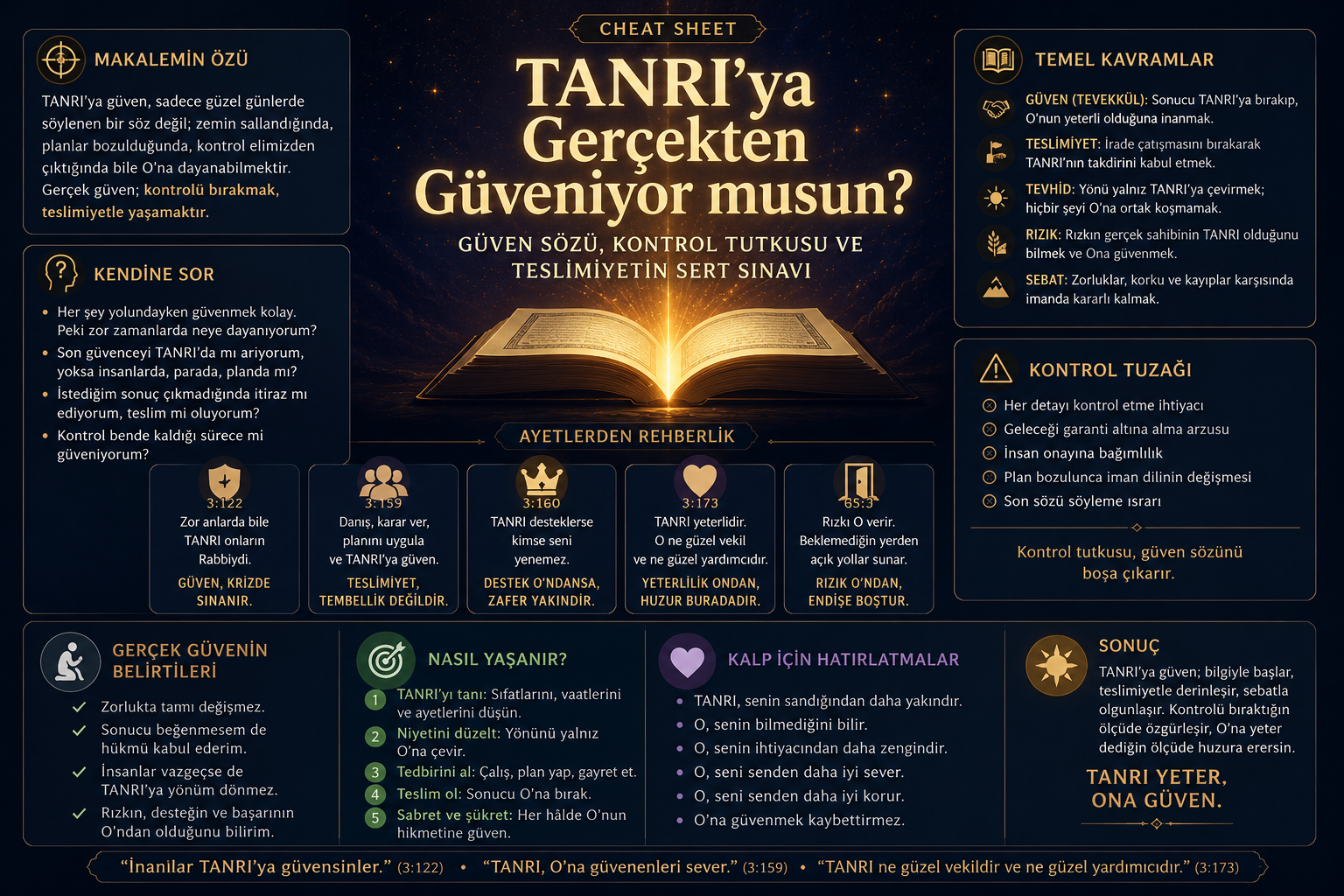
1. The First Test of Trust: Whom Do You Lean On Just as You Are About to Fall?
3:122
إِذْ هَمَّت طَّآئِفَتَانِ مِنكُمْ أَن تَفْشَلَا وَٱللَّهُ وَلِيُّهُمَا وَعَلَى ٱللَّهِ فَلْيَتَوَكَّلِ ٱلْمُؤْمِنُونَ
Two groups among you almost failed, but GOD was their Lord. In GOD the believers shall trust.
Two groups among you almost failed, but GOD was their Lord. In GOD the believers shall trust.
2. Submission Is Not Laziness: Consult, Decide, Act, and Leave the Outcome to GOD
3:159 — It was mercy from GOD that you became compassionate towards them. Had you been harsh and mean-hearted, they would have abandoned you. Therefore, you shall pardon them, ask forgiveness for them, and consult them. Once you make a decision, carry out your plan and trust in GOD. GOD loves those who trust in Him.*
3:160 — If GOD supports you, no one can defeat you. And if He abandons you, who else can support you? In GOD the believers shall trust.
3. Your Tongue Says “Obedience,” but Is the Calculation Inside You Saying Something Else?
4:81 — They pledge obedience, but as soon as they leave you, some of them harbor intentions contrary to what they said. GOD records their innermost intentions. Ignore them, and trust in GOD. GOD suffices as an advocate.
33:3 — And trust in GOD. GOD suffices as an advocate.
33:48 — Do not obey the disbelievers and the hypocrites, disregard their insults, and trust in GOD; GOD suffices as an advocate.
4. Trust Shows at the Door: Not Waiting Forever, but Entering When Necessary
5:11 — O you who believe, remember GOD's blessings upon you; when some people extended their hands to attack you, He protected you and withheld their hands. Observe GOD; in GOD the believers shall trust.
5:23 — Two men who were reverent and whom GOD had blessed said, “Just enter through the gate. If you just enter through the gate, you will surely prevail. You must trust in GOD if you are believers.”
5. If You Say “I Have Submitted,” Where Is the Trust? If You Trust, Where Is the Submission?
7:89 — “We would be blaspheming against GOD if we returned to your religion after GOD has saved us from it. How could we return to it against the will of GOD our Lord? Our Lord's knowledge encompasses all things. We have put our trust in GOD. Our Lord, grant us a decisive victory over our people. You are the best supporter.”
10:84 — Moses said, “O my people, if you have really believed in GOD, then trust in Him, if you are really submitters.”
10:85 — They said, “We trust in GOD. Our Lord, save us from the persecution of these oppressive people.
6. The Heart's Real Measure: Does Your Trust Increase as You Read the Verses?
8:2 — The true believers are those whose hearts tremble when GOD is mentioned, and when His revelations are recited to them, their faith is strengthened, and they trust in their Lord.
8:49 — The hypocrites and those harboring doubt in their hearts said, “These people are deceived by their religion.” However, if one trusts in GOD, then GOD is Almighty, Most Wise.
7. A Person Who Trusts GOD Should Not Mistake Paranoia for Faith
8:61 — If they resort to peace, so shall you, and trust in GOD. He is Hearer, Omniscient.
58:10 — Secret conspiracy is the devil's idea; through it he seeks to hurt those who have believed. Yet he cannot hurt them against GOD's will. In GOD the believers shall trust.
8. Taking Precautions Is Not Distrust; Raising Precautions Above GOD Is the Problem
9:51 — Say, “Nothing happens to us except what GOD has decreed for us. He is our Lord and Master. In GOD the believers shall trust.”
12:67 — And he said, “O my sons, do not enter through one gate; enter through separate gates. However, I cannot save you from anything predetermined by GOD. All decisions belong to GOD. I trust in Him, and all those who trust shall trust in Him.”
9. Putting Religious Authority in GOD's Place: Even Messengers Do Not Present Themselves as Independent Powers
10:71 — Recite for them the history of Noah. He said to his people, “O my people, if my position and my reminding you of GOD's revelations are too much for you, then I have trusted in GOD. Gather with your leaders, agree among yourselves on a final decision, then let me know it without delay.
14:11 — Their messengers said to them, “We are no more than human beings like you, but GOD blesses whomever He chooses from among His servants. We could not possibly show you any kind of authorization except in accordance with GOD's will. In GOD the believers shall trust.
14:12 — “Why should we not trust in GOD when He has guided us in our paths? We will steadfastly persevere in the face of your persecution. In GOD all those who trust shall trust.”
10. “Does GOD Run Everything?” Do Not Evade the Answer the Verses Give
11:56 — “I have trusted in GOD, my Lord and your Lord. There is not one creature He does not control. My Lord is on the right path.
11:123 — To GOD belongs the future of the heavens and the earth, and all affairs are controlled by Him. You shall worship Him and trust in Him. Your Lord is never unaware of anything you do.
11. You Are Not Saving the World: Do What You Can, Do Not Claim Guidance or the Outcome as Your Own
11:88 — He said, “O my people, what if I have solid proof from my Lord; what if He has provided me with a great blessing? I do not wish to do what I prohibit you from doing. I only wish to correct the wrongs as much as I can. My guidance depends totally on GOD; I have trusted in Him. I have totally submitted to Him.
42:10 — If you dispute any part of this message, the judgment for it belongs to GOD. Such is GOD my Lord. I trust in Him, and I submit to Him.
60:4 — A good example has been set for you by Abraham and those with him. They said to their people, “We disown you and the idols you worship besides GOD. We condemn you, and you will see nothing from us except enmity and hatred until you believe in GOD ALONE.”* However, Abraham committed a mistake when he said to his father, “I will pray for your forgiveness,** but I possess no power to protect you from GOD.” “Our Lord, we trust in You and submit to You; to You is the final destiny.
12. Monotheism Does Not Only Mean “One GOD”: Trust Must Also Have One Center
13:30 — We have sent you (O Rashad)* to this community, just as We did for other communities in the past. Recite to them what We revealed to you, for they have disbelieved in the Most Gracious. Say, “He is my Lord. There is no god except He. I trust in Him alone; my ultimate destiny is to Him.”
64:13 — GOD: there is no god except He. In GOD the believers shall trust.
13. Trusting for a Few Days and Expecting a Result Is Not Submission: Trust Comes with Steadfastness
16:42 — This is because they steadfastly persevere and trust in their Lord.
29:59 — They are the ones who steadfastly persevere and trust in their Lord.
14. The Names of Idols Can Change: Seeking Ultimate Security in What Is Created
16:99 — He has no power over those who believe and trust in their Lord.
39:38 — If you ask them, “Who created the heavens and the earth?” they will say, “GOD.” Say, “Why then do you set up idols beside GOD? If GOD willed an adversity for me, could they relieve such adversity? And if He willed a blessing for me, could they prevent such a blessing?” Say, “GOD is sufficient for me.” In Him the trusting shall trust.
42:36 — Whatever you are given is no more than the temporary material of this life. What GOD possesses is far better and everlasting for those who believe and trust in their Lord.
15. Remember Whom You Trust: The Living One, the Almighty, the Most Merciful
25:58 — You shall trust in the Living One—the One who never dies—and praise Him and glorify Him. He is fully Cognizant of His creatures' sins.
26:217 — And trust in the Almighty, Most Merciful.
27:79 — Therefore, trust in GOD; you are following the manifest truth.
67:29 — Say, “He is the Most Gracious; we believe in Him and trust in Him. You will surely find out who is really far astray.”
16. If You Say “GOD Is Sufficient,” Why Do You Keep Looking for Another Final Guarantee?
65:3 — And He will provide for him from where he never expected. GOD is sufficient for anyone who trusts in Him. GOD's commands are carried out. GOD has decreed the destiny of all things.
73:9 — Lord of the east and the west; there is no god except He. You shall choose Him as your advocate.
17. On the Arabic Roots of the Words: Trust, Submission, Sufficiency, and Return
3:122 — Two groups among you almost failed, but GOD was their Lord. In GOD the believers shall trust.
10:84 — Moses said, “O my people, if you have really believed in GOD, then trust in Him, if you are really submitters.”
65:3 — And He will provide for him from where he never expected. GOD is sufficient for anyone who trusts in Him. GOD's commands are carried out. GOD has decreed the destiny of all things.
73:9 — Lord of the east and the west; there is no god except He. You shall choose Him as your advocate.
18. Other Claims
3:159 — It was mercy from GOD that you became compassionate towards them. Had you been harsh and mean-hearted, they would have abandoned you. Therefore, you shall pardon them, ask forgiveness for them, and consult them. Once you make a decision, carry out your plan and trust in GOD. GOD loves those who trust in Him.*
12:67 — And he said, “O my sons, do not enter through one gate; enter through separate gates. However, I cannot save you from anything predetermined by GOD. All decisions belong to GOD. I trust in Him, and all those who trust shall trust in Him.”
65:3 — And He will provide for him from where he never expected. GOD is sufficient for anyone who trusts in Him. GOD's commands are carried out. GOD has decreed the destiny of all things.
19. Conclusion: Do You Really Trust GOD?
11:123 — To GOD belongs the future of the heavens and the earth, and all affairs are controlled by Him. You shall worship Him and trust in Him. Your Lord is never unaware of anything you do.
64:13 — GOD: there is no god except He. In GOD the believers shall trust.
65:3 — And He will provide for him from where he never expected. GOD is sufficient for anyone who trusts in Him. GOD's commands are carried out. GOD has decreed the destiny of all things.
73:9 — Lord of the east and the west; there is no god except He. You shall choose Him as your advocate.
1. The First Test of Trust: Whom Do You Lean On Just as You Are About to Fall?
Verse
3:122
إِذْ هَمَّت طَّآئِفَتَانِ مِنكُمْ أَن تَفْشَلَا وَٱللَّهُ وَلِيُّهُمَا وَعَلَى ٱللَّهِ فَلْيَتَوَكَّلِ ٱلْمُؤْمِنُونَ
Two groups among you almost failed, but GOD was their Lord. In GOD the believers shall trust.
Two groups among you almost failed, but GOD was their Lord. In GOD the believers shall trust.
Source: kuranteyit.com
Reflection on the Verse
What first strikes me in the verse is that it does not speak of trust to people who have never experienced weakness. Two groups “almost failed.” So the approach of fear, the diminishing of strength, or a person being shaken is not in itself presented as an absence of trust. But precisely at that breaking point, the verse changes direction: “but GOD was their Lord.”
Then comes the measure: “In GOD the believers shall trust.”
Here I do not want to be lenient with myself. If I turn trust in GOD into a pleasant feeling for peaceful times, I escape the test of the verse. Trust takes on meaning precisely where the possibility of failure approaches.
The strength of my plan is not trust. People standing beside me are not trust. The number in the bank is not trust. The strength of my body is not trust. All of these may be blessings, means, or tools. But none of them is the support at the center of the verse: GOD is.
For this reason, if I say “I trust GOD” while tying my entire psychological balance to conditions I can control, I need to question my own statement again.
Perhaps I do not trust GOD, but rather trust that GOD will continue to provide the conditions I want.
These are not the same thing.
Real trust cannot be merely trust in the continuation of blessings. The verse’s call to trust already comes at the edge of failure.
The question I need to ask myself is this: When my supports are shaken, does my Lord also become smaller in my eyes?
If the answer is yes, my statement of trust needs to go deeper.
Verse reference: 3:122.
2. Submission Is Not Laziness: Consult, Decide, Act, and Leave the Outcome to GOD
Verse
3:159 — It was mercy from GOD that you became compassionate towards them. Had you been harsh and mean-hearted, they would have abandoned you. Therefore, you shall pardon them, ask forgiveness for them, and consult them. Once you make a decision, carry out your plan and trust in GOD. GOD loves those who trust in Him.*
3:160 — If GOD supports you, no one can defeat you. And if He abandons you, who else can support you? In GOD the believers shall trust.
Reflection on the Verse
One of the easiest escapes in the subject of trusting GOD is to abandon responsibility while calling it submission.
3:159 does not allow this.
There is forgiveness. There is asking forgiveness for them. There is consultation. There is deciding. There is carrying out the plan. Then there is trusting in GOD.
The order is very important.
Saying “I left it to GOD” while avoiding a decision is not the trust described in this verse. Waiting without researching, consulting, or doing what falls to me can also be another comfort hidden under the name of trust.
But there is also the opposite.
I consulted. I planned. I calculated. I did what I could. If, despite all this, I am still trying to forcefully control the outcome, then I am turning my means into a lord.
The verse places two extremes before me at the same time: irresponsible passivity and the obsession with control.
Submission is neither.
Doing what falls to me belongs to me. Determining the outcome absolutely does not belong to me.
3:160 speaks even more sharply: If GOD supports you, who can defeat you? If He does not support you, who else can support you?
This does not mean that human support should be belittled; 3:159 already commands consultation. But I cannot put the person I consult in GOD’s place. I cannot put my plan in GOD’s place. I cannot put my intelligence in GOD’s place.
Consulting is one thing; making something the final authority to lean upon is another.
Leaving everything to GOD does not mean leaving my own duty to GOD. It means doing my duty and leaving the ultimate outcome to GOD’s judgment.
Perhaps my greatest deception also appears here: under the excuse “I am doing what I can,” I may actually be trying to control what is beyond my power too.
Verse references: 3:159, 3:160.
3. Your Tongue Says “Obedience,” but Is the Calculation Inside You Saying Something Else?
Verse
4:81 — They pledge obedience, but as soon as they leave you, some of them harbor intentions contrary to what they said. GOD records their innermost intentions. Ignore them, and trust in GOD. GOD suffices as an advocate.
33:3 — And trust in GOD. GOD suffices as an advocate.
33:48 — Do not obey the disbelievers and the hypocrites, disregard their insults, and trust in GOD; GOD suffices as an advocate.
Reflection on the Verse
4:81 brings the subject of trust directly toward the possibility of hypocrisy within a person. A statement is made, but there are other calculations inside.
This is a very disturbing mirror.
“I have submitted.”
“I trust.”
“GOD is sufficient.”
These are easy to say.
But what calculation am I making when no one is watching?
Do I change what I know to be true in order to gain someone’s approval? Do I soften the truth so I do not lose my reputation? Do I spend nights thinking about what people say about me while forgetting that GOD knows me? Do I live as though I must constantly explain, defend, and prove myself right?
A strong expression repeats in all three verses: “GOD suffices as an advocate.”
Then why do I spend my life constantly producing other advocates?
This does not mean I must reject people’s help. But human support and ultimate reliance are not the same thing.
A person can defend me, but cannot protect me from GOD.
A community can give me reputation, but cannot change the truth.
A religious authority can approve of me, but cannot change GOD’s judgment with its approval.
A crowd can applaud me, but cannot erase the intention GOD knows within me.
The hard truth is this: If the effort I make to correct my file in people’s eyes is greater than the effort I make to correct my condition before GOD, I need to reconsider the center of my trust.
Saying GOD is sufficient is one thing; truly seeing Him as sufficient is another.
Verse references: 4:81, 33:3, 33:48.
4. Trust Shows at the Door: Not Waiting Forever, but Entering When Necessary
Verse
5:11 — O you who believe, remember GOD’s blessings upon you; when some people extended their hands to attack you, He protected you and withheld their hands. Observe GOD; in GOD the believers shall trust.
5:23 — Two men who were reverent and whom GOD had blessed said, “Just enter through the gate. If you just enter through the gate, you will surely prevail. You must trust in GOD if you are believers.”
Reflection on the Verse
Trust is not only about a rescue that happened in the past. 5:11 reminds us of a past blessing; 5:23 calls us to enter through the gate.
Remembering and acting.
When I separate these two, trust can easily turn into a romantic memory.
I tell how GOD protected me before, but when a new test comes, I panic as though nothing like this has ever happened in my life. I carry the past blessing as a beautiful story, but not as evidence against today’s fear.
Then what benefit has remembrance brought me?
5:23 is especially severe: “You must trust in GOD if you are believers.”
This trust is not waiting forever outside the gate.
There is entering through the gate.
Sometimes a person says “I trust GOD” while actually obeying fear. They do not decide. They do not take a step. They wait at the door of what they see to be right. Then they call this waiting “patience” or “submission.”
Not every waiting is patience.
Some waiting may be fear hidden under a more acceptable name.
The verse shows me that trust is lived together with taking a step when necessary. Remembering past protection is not a guarantee that there will be no difficulty in the future; but it reminds me that GOD is not a Lord to be forgotten.
Verse references: 5:11, 5:23.
5. If You Say “I Have Submitted,” Where Is the Trust? If You Trust, Where Is the Submission?
Verse
7:89 — “We would be blaspheming against GOD if we returned to your religion after GOD has saved us from it. How could we return to it against the will of GOD our Lord? Our Lord’s knowledge encompasses all things. We have put our trust in GOD. Our Lord, grant us a decisive victory over our people. You are the best supporter.”
10:84 — Moses said, “O my people, if you have really believed in GOD, then trust in Him, if you are really submitters.”
10:85 — They said, “We trust in GOD. Our Lord, save us from the persecution of these oppressive people.
Reflection on the Verse
10:84 makes it difficult to separate trust from submission.
“If you have really believed in GOD…”
“If you are really submitters…”
The call between them is: trust in Him.
In that case, submission is not merely saying “I am a submitter.” Submission has a side that is tested through trust.
Here I need to ask myself a very direct question: If I say I have submitted to GOD, why do I constantly try to make GOD accept my conditions?
“I will trust if this happens.”
“I will trust if this person stays in my life.”
“I will trust if this work improves.”
“I will relax if I have this much money.”
“If this outcome happens, I will know GOD is with me.”
How is this submission?
Could this be less like submission and more like drafting terms and conditions?
In 7:89, trust comes together with acknowledging that GOD’s knowledge encompasses all things. I do not know all possibilities. GOD knows. Yet if I still insist that only the result I can see is right, then the phrase “GOD knows better” remains only on my tongue.
10:85 shows another balance too. People who trust GOD ask for help. So trust is not denying pain. Wanting to be saved from oppression is not distrust. Praying is not distrust.
Submission is not wanting nothing; it is not placing what I want above GOD.
Verse references: 7:89, 10:84, 10:85.
6. The Heart’s Real Measure: Does Your Trust Increase as You Read the Verses?
Verse
8:2 — The true believers are those whose hearts tremble when GOD is mentioned, and when His revelations are recited to them, their faith is strengthened, and they trust in their Lord.
8:49 — The hypocrites and those harboring doubt in their hearts said, “These people are deceived by their religion.” However, if one trusts in GOD, then GOD is Almighty, Most Wise.
Reflection on the Verse
There is a chain in 8:2: GOD is mentioned, the heart is affected, the revelations are recited, faith is strengthened, and trust in the Lord appears.
I do not want to reduce this merely to emotional trembling.
My heart may tremble. My eyes may fill at a verse. I may listen to a remembrance and be deeply moved. But if my trust in GOD is not increasing as the effect of the verses in my life grows, I need to ask where these emotions are settling.
My knowledge of revelation grows, but are people still the masters of my anxieties?
My memorization of verses grows, but does my obsession with controlling the future remain unchanged?
Do I know more names of GOD, yet a person’s words can still destroy my entire inner balance?
These are not easy questions.
8:49 shows an environment in which outsiders say, “These people are deceived by their religion.” Then trust is connected to GOD’s power and wisdom.
Here trust is not presented as a psychological story a person tells themselves to feel convinced. The GOD in whom trust is placed is Almighty, Most Wise.
Then the basis of my trust cannot be “I feel strong.”
I may feel weak.
I may not know the future.
I may not see a way out.
Trust comes not from my understanding everything, but from GOD being Almighty and Most Wise.
Verse references: 8:2, 8:49.
7. A Person Who Trusts GOD Should Not Mistake Paranoia for Faith
Verse
8:61 — If they resort to peace, so shall you, and trust in GOD. He is Hearer, Omniscient.
58:10 — Secret conspiracy is the devil’s idea; through it he seeks to hurt those who have believed. Yet he cannot hurt them against GOD’s will. In GOD the believers shall trust.
Reflection on the Verse
Distrust can sometimes present itself as “precaution.”
Suspecting everything, trying to solve everyone’s hidden agenda, constantly expecting attack, mentally constructing other people’s intentions hundreds of times… A person may think they are vigilant because they do these things.
But 8:61 says that when they resort to peace, you should also resort to peace and trust in GOD.
58:10 does not minimize the harmful intent of conspiracy, but it sets the boundary: it cannot harm them unless GOD wills.
These verses make me think this: Seeing danger and seeing danger as greater than GOD are not the same thing.
A person can be cautious. But they should not sanctify their fear.
The existence of an enemy does not mean the absence of GOD.
The forming of a conspiracy does not mean GOD has lost control.
Someone speaking against me does not mean my destiny has been handed over to their mouth.
If I magnify every ill-intentioned person in my mind as though they were a power capable of surpassing GOD’s judgment, I am giving that person too much space.
Trust teaches me a mental boundary here: See the threat, but do not make it your Lord.
Verse references: 8:61, 58:10.
8. Taking Precautions Is Not Distrust; Raising Precautions Above GOD Is the Problem
Verse
9:51 — Say, “Nothing happens to us except what GOD has decreed for us. He is our Lord and Master. In GOD the believers shall trust.”
12:67 — And he said, “O my sons, do not enter through one gate; enter through separate gates. However, I cannot save you from anything predetermined by GOD. All decisions belong to GOD. I trust in Him, and all those who trust shall trust in Him.”
Reflection on the Verse
12:67 dissolves the false dilemma surrounding trust.
On one side there is precaution: “do not enter through one gate; enter through separate gates.”
On the other side there is a very clear admission: “I cannot save you from anything predetermined by GOD.”
So taking precautions and trusting GOD are not enemies.
The problem is not precaution.
The problem is absolutizing precaution.
I can make plans. But my plan cannot invalidate GOD’s judgment. I can reduce risk. But I cannot become the owner of all decisions. I can take measures to protect my children, loved ones, or myself. But I cannot say, “I took precautions, now nothing can happen.”
9:51 goes even deeper: it says that nothing can happen to us except what GOD has decreed and that He is our Lord and Master.
If I truly accept this verse, some of the greatest burdens in my life should lose their meaning: the effort to control things that have not happened an infinite number of times in my mind.
I take my precaution.
Then I let go.
Because I am not the Lord and Master.
This is another place where a person deceives themselves: while saying “I am responsible,” they may actually live as though “I must control every outcome.”
The verses separate the two.
Verse references: 9:51, 12:67.
9. Putting Religious Authority in GOD’s Place: Even Messengers Do Not Present Themselves as Independent Powers
Verse
10:71 — Recite for them the history of Noah. He said to his people, “O my people, if my position and my reminding you of GOD’s revelations are too much for you, then I have trusted in GOD. Gather with your leaders, agree among yourselves on a final decision, then let me know it without delay.
14:11 — Their messengers said to them, “We are no more than human beings like you, but GOD blesses whomever He chooses from among His servants. We could not possibly show you any kind of authorization except in accordance with GOD’s will. In GOD the believers shall trust.
14:12 — “Why should we not trust in GOD when He has guided us in our paths? We will steadfastly persevere in the face of your persecution. In GOD all those who trust shall trust.”
Reflection on the Verse
14:11 makes me think especially about religious authority: The messengers explicitly say “We are no more than human beings like you.”
The blessing is from GOD.
The choosing is from GOD.
Authorization depends on GOD’s will.
Trust is again in GOD.
Then turning a religious person, no matter how knowledgeable or impressive, into an independent center of trust beside GOD raises a serious question of monotheism.
I can learn from a teacher.
I can benefit from a researcher’s work.
I can listen to a person’s truthful words.
I can consult.
But I find it difficult to reconcile with the verses on trust any elevation of a human being to a place that says, “Without me you cannot reach GOD,” “Without my approval you cannot be on the right path,” or “I am your ultimate spiritual security.”
Because even the language of the messengers calls the human being not to themselves but to trust in GOD.
In 10:71 Noah binds his trust to GOD in the face of open threat. In 14:12 steadfast perseverance in the face of persecution is again placed beside trust.
Here the healthy limit of religious authority becomes clear to me: A person can point to the truth; they cannot own the truth. A person can help; they cannot replace GOD. A person can teach; they cannot be the ultimate support of the heart.
Listening to a person is one thing; submitting to them is another.
The center of submission must be one.
Verse references: 10:71, 14:11, 14:12.
10. “Does GOD Run Everything?” Do Not Evade the Answer the Verses Give
Verse
11:56 — “I have trusted in GOD, my Lord and your Lord. There is not one creature He does not control. My Lord is on the right path.
11:123 — To GOD belongs the future of the heavens and the earth, and all affairs are controlled by Him. You shall worship Him and trust in Him. Your Lord is never unaware of anything you do.
Reflection on the Verse
This is one of the hardest places in the article.
Because the question is no longer indirect.
Do I really believe that GOD runs everything?
11:56 says that there is not a single creature He does not control.
11:123 says, “all affairs are controlled by Him.”
Can I read this sentence and then live as though GOD has lost control of life?
If I think a person can independently ruin my future apart from GOD, what do I believe?
If I see an economic development as greater than GOD, what do I believe?
If a disease, a job, a position, an enemy, a boss, an audience, a religious leader, or any other created power reaches the point in my mind where “nothing can be done anymore,” have I really taken 11:56 into myself?
These verses do not erase human responsibility. At the end of 11:123, it is specifically remembered that GOD is not unaware of what we do. So it is also impossible to say “Everything is under His control” and then use it to excuse my own evil, negligence, or wrong choice.
Control is His.
Responsibility is mine.
I must not confuse the two.
GOD’s control prevents me from idolizing my will. My responsibility prevents me from making GOD’s control an excuse for my laziness.
Here the balance of submission becomes very sharp.
Verse references: 11:56, 11:123.
11. You Are Not Saving the World: Do What You Can, Do Not Claim Guidance or the Outcome as Your Own
Verse
11:88 — He said, “O my people, what if I have solid proof from my Lord; what if He has provided me with a great blessing? I do not wish to do what I prohibit you from doing. I only wish to correct the wrongs as much as I can. My guidance depends totally on GOD; I have trusted in Him. I have totally submitted to Him.
42:10 — If you dispute any part of this message, the judgment for it belongs to GOD. Such is GOD my Lord. I trust in Him, and I submit to Him.
60:4 — A good example has been set for you by Abraham and those with him. They said to their people, “We disown you and the idols you worship besides GOD. We condemn you, and you will see nothing from us except enmity and hatred until you believe in GOD ALONE.”* However, Abraham committed a mistake when he said to his father, “I will pray for your forgiveness,** but I possess no power to protect you from GOD.” “Our Lord, we trust in You and submit to You; to You is the final destiny.
Reflection on the Verse
11:88 draws a very serious boundary for my ego: “I only wish to correct the wrongs as much as I can.”
As much as I can.
These two words prevent a person from putting themselves in GOD’s place.
I can try to correct. I can write. I can warn. I can research. I can produce. I can speak when I see a wrong. But I do not change people’s hearts. I do not produce guidance. I do not manage the outcome.
The thought “Everything will collapse without me” can look like responsibility, but it can carry a great claim of selfhood within it.
11:88 cuts this off: “My guidance depends totally on GOD.”
Then come trust and submission.
42:10 repeats the same bond: judgment belongs to GOD, trust is in GOD, submission is to GOD.
60:4 explicitly says that a human being has no power to protect another human being from GOD.
Then no religious figure, elder, administrator, scholar, artist, writer, or community can be my shield of security against GOD.
Losing people’s love can hurt.
Losing human support can be difficult.
But no human being can protect me against GOD.
When I truly accept this, the limit of religious authority also becomes clear: No human spiritual rank can fill GOD’s place.
Verse references: 11:88, 42:10, 60:4.
12. Monotheism Does Not Only Mean “One GOD”: Trust Must Also Have One Center
Verse
13:30 — We have sent you (O Rashad)* to this community, just as We did for other communities in the past. Recite to them what We revealed to you, for they have disbelieved in the Most Gracious. Say, “He is my Lord. There is no god except He. I trust in Him alone; my ultimate destiny is to Him.”
64:13 — GOD: there is no god except He. In GOD the believers shall trust.
Reflection on the Verse
64:13 establishes an extremely short but shaking connection.
First monotheism:
“There is no god except He.”
Then trust:
“In GOD the believers shall trust.”
This order makes me think that trust is not a small spiritual technique outside monotheism. To whom I give ultimate trust, to whom I attribute ultimate power, and before whom I inwardly submit are the lived appearance of my monotheism.
13:30 says it more personally: He is my Lord. There is no god except He. I trust in Him alone. My ultimate destiny is to Him.
I can say “one GOD” with my tongue while producing countless small absolutes in my heart.
People’s opinions.
Money.
Status.
Fear of the future.
A leader.
An institution.
My own mind.
I do not have to stop using or caring about any of these. But I cannot give them the ultimate position that belongs to GOD.
The witness of monotheism must not remain merely a sentence.
My witnessing must be confirmed by my life.
If I say “There is no god except GOD,” how much does the distribution of my fears, hopes, and trust support that statement?
This question is severe because the answer is not in the mouth but in life.
Verse references: 13:30, 64:13.
13. Trusting for a Few Days and Expecting a Result Is Not Submission: Trust Comes with Steadfastness
Verse
16:42 — This is because they steadfastly persevere and trust in their Lord.
29:59 — They are the ones who steadfastly persevere and trust in their Lord.
Reflection on the Verse
The same pairing stands out in both verses: steadfastness and trust.
This takes trust out of the realm of a momentary spiritual rise.
I may feel very strong one night. After a prayer, I may be filled with peace. I may say, “Now I have completely left it to GOD.”
What about three days later?
Three weeks later?
When the outcome I expected does not come?
When people’s behavior does not change?
When the problem continues?
It is very easy to turn trust in GOD into a transaction: “I trusted, so now what I want must happen.”
The verses give no such formula.
They persevere and trust.
So there is time within trust.
There is waiting.
There is continuing.
There is preserving direction without immediately seeing a result.
Here I see an important measure for understanding whether I am deceiving myself: Is my trust merely a method I use to obtain the result I want?
If my attitude toward GOD changes when the result is delayed, perhaps I was attached not to GOD but to the outcome I expected.
Real submission does not turn GOD into a tool I use to fulfill my desires.
GOD is not a tool.
He is the center.
Verse references: 16:42, 29:59.
14. The Names of Idols Can Change: Seeking Ultimate Security in What Is Created
Verse
16:99 — He has no power over those who believe and trust in their Lord.
39:38 — If you ask them, “Who created the heavens and the earth?” they will say, “GOD.” Say, “Why then do you set up idols beside GOD? If GOD willed an adversity for me, could they relieve such adversity? And if He willed a blessing for me, could they prevent such a blessing?” Say, “GOD is sufficient for me.” In Him the trusting shall trust.
42:36 — Whatever you are given is no more than the temporary material of this life. What GOD possesses is far better and everlasting for those who believe and trust in their Lord.
Reflection on the Verse
39:38 exposes the contradiction between a person’s verbal monotheism and practical dependence.
“Who created the heavens and the earth?”
“GOD.”
Then why are other things given the power to change GOD’s judgment?
This question can enter a person’s inner life today as well.
I may not call something an “idol.” But I have to question the role I give it.
“If this person is not here, I am finished.”
“If this money is not here, there is no way out.”
“If I lose this position, my life has no value.”
“If this person does not approve me, I cannot be right.”
“If this system does not protect me, GOD cannot protect me either.”
The verse does not state these modern sentences; these are questions I direct at my own life. But the measure of 39:38 is clear: If GOD wills adversity, can others independently remove it? If GOD wills a blessing, can they independently prevent it?
The sentence that follows the answer is very severe:
“GOD is sufficient for me.”
42:36 also teaches not to put the temporary in the place of the permanent. What we are given is the temporary material of this life. What GOD possesses is better and everlasting.
For this reason, trust has economic, social, and psychological dimensions. I use what I possess, but I try not to become its slave.
Because the moment I make what is temporary into absolute security, fear of losing it begins to govern me.
Verse references: 16:99, 39:38, 42:36.
15. Remember Whom You Trust: The Living One, the Almighty, the Most Merciful
Verse
25:58 — You shall trust in the Living One—the One who never dies—and praise Him and glorify Him. He is fully Cognizant of His creatures’ sins.
26:217 — And trust in the Almighty, Most Merciful.
27:79 — Therefore, trust in GOD; you are following the manifest truth.
67:29 — Say, “He is the Most Gracious; we believe in Him and trust in Him. You will surely find out who is really far astray.”
Reflection on the Verse
Trust is not a leap into emptiness.
These verses remind us of the GOD toward whom trust is directed together with His attributes.
The Living One.
The One who never dies.
The Almighty.
The Most Merciful.
The Most Gracious.
The difference set before me by 25:58 is enormous: People die. Systems collapse. Those who appear powerful lose their power. Institutions change. Friendships can end. The body weakens. Wealth can change hands.
Yet the verse directs trust toward the One who never dies.
If I nevertheless tie all my trust to what is mortal, I should ask why I am then broken when it fails me.
26:217 speaks of trust together with power and mercy. There is not only power; there is mercy too. 27:79 carries trust together with following manifest truth. So trust is not another name for ignorance.
This matters to me.
Trusting GOD is not ceasing to think.
It is not ceasing to investigate the truth.
On the contrary, trust is knowing who the final support is while following the truth.
In 67:29 faith and trust meet in the same sentence: “we believe in Him and trust in Him.”
If faith is the sentence on my tongue, trust may reveal its weight in my life.
Verse references: 25:58, 26:217, 27:79, 67:29.
16. If You Say “GOD Is Sufficient,” Why Do You Keep Looking for Another Final Guarantee?
Verse
65:3 — And He will provide for him from where he never expected. GOD is sufficient for anyone who trusts in Him. GOD’s commands are carried out. GOD has decreed the destiny of all things.
73:9 — Lord of the east and the west; there is no god except He. You shall choose Him as your advocate.
Reflection on the Verse
These two verses leave very little room for excuses regarding trust.
“GOD is sufficient for anyone who trusts in Him.”
And:
“You shall choose Him as your advocate.”
I do not want to immediately manufacture a material guarantee formula from this. Narrowing 65:3 into “If I trust, the amount of money I want will definitely come” would be saying something the verse does not say.
The verse speaks of a much greater sufficiency.
He is the One who provides.
His commands are carried out.
He decrees the destiny of all things.
He is Lord of the east and the west.
There is no god except He.
Then my question is this: If He is sufficient, why do I constantly produce a new “what if He is not enough” scenario for myself?
If GOD is not enough, is money enough?
If GOD is not enough, is a human being enough?
If GOD is not enough, is an institution enough?
If GOD is not enough, is my intelligence enough?
If GOD is not enough, what created power can truly be enough for me?
The question already exposes its own contradiction.
Perhaps I have been saying “GOD is sufficient” for a long time while building my actual life on the idea, “Just in case, I need to find another lord too.”
This is where the hard confrontation lies.
Submission is not saying that GOD is sufficient; it is truly moving the center of my search for sufficiency to Him.
Verse references: 65:3, 73:9.
17. On the Arabic Roots of the Words: Trust, Submission, Sufficiency, and Return
Verse
3:122 — Two groups among you almost failed, but GOD was their Lord. In GOD the believers shall trust.
10:84 — Moses said, “O my people, if you have really believed in GOD, then trust in Him, if you are really submitters.”
65:3 — And He will provide for him from where he never expected. GOD is sufficient for anyone who trusts in Him. GOD’s commands are carried out. GOD has decreed the destiny of all things.
73:9 — Lord of the east and the west; there is no god except He. You shall choose Him as your advocate.
Reflection on the Verse
When looking at Arabic word roots, I find it right to use them not to build new judgments over the verses, but to see the linguistic connections between the verses more carefully. The Turkish pronunciations below are approximate representations of the Arabic words using Turkish sounds; they do not replace the verse translation.
| Arabic | Turkish pronunciation | Root | Connection in this article |
|---|---|---|---|
| وَكَلَ | vekele | و-ك-ل (V-K-L / W-K-L) | The core root of the word family relating to trusting, relying, and entrusting an affair. |
| تَوَكُّل | tevekkül | و-ك-ل | The noun form carrying the semantic field of trusting and relying on GOD. |
| فَلْيَتَوَكَّلِ | felyetevekkel | و-ك-ل | The verb form seen in the call “shall trust” in 3:122. |
| وَكِيلًا | vekilen | و-ك-ل | The word family in the expression “You shall choose Him as your advocate” in 73:9. |
| مُسْلِمِينَ | müslimin | س-ل-م (S-L-M) | The placing of “submitters” beside the call to trust in 10:84. |
| حَسْبُهُ | hasbuhu | ح-س-ب (H-S-B) | The emphasis on sufficiency in the expression “He is sufficient” in 65:3. |
| أُنِيبُ | unibu | ن-و-ب (N-W-B) | A form used in the semantic field of returning and turning toward GOD. |
| وَلِيُّهُمَا | veliyyuhuma | و-ل-ي (W-L-Y) | The expression describing the two groups’ relationship with GOD in 3:122. |
One of the clearest roots in the verses on trust is و-ك-ل (W-K-L). The Turkish word tevekkül also belongs to this word family. The form فَلْيَتَوَكَّلِ — felyetevekkel in 3:122 appears in the Authorized Turkish Translation with the meaning “In GOD the believers shall trust.” The form وَكِيلًا — vekilen in 73:9 appears in the translation as “You shall choose Him as your advocate.”
This connection matters to me: Trust is not merely a feeling I generate inside myself; it is also related to whom I choose as my support and advocate.
In 10:84, the expression مُسْلِمِينَ — müslimin appears immediately beside the call to trust. This word belongs to the root family س-ل-م (S-L-M) and appears as “submitters” in the Authorized Turkish text. In the verse’s own sentence structure, faith, trust, and submission stand side by side. For this reason, it becomes difficult to detach trust completely from submission.
In 65:3, the expression حَسْبُهُ — hasbuhu belongs to the root family ح-س-ب (H-S-B). The Authorized Turkish text gives the center of the thought clearly: “GOD is sufficient for anyone who trusts in Him.” Trust sets a boundary on the need to search endlessly for sufficiency elsewhere.
When thinking about the line of turning toward GOD in 11:88 and 42:10, the form أُنِيبُ — unibu also stands out. This word belongs to the root family ن-و-ب (N-W-B). This linguistic connection shows me that trust may be understood not as a motionless posture, but together with turning one’s direction back toward GOD.
The form وَلِيُّهُمَا — veliyyuhuma used in relation to GOD in 3:122 belongs to the root family و-ل-ي (W-L-Y). The Authorized Turkish text renders it as “GOD was their Lord.” It is noteworthy that this relationship is mentioned immediately before the command to trust.
By placing all these roots side by side, I do not want to produce a new definition of faith. But within the language of the verses I see a strong coherence: trusting, submitting, turning, seeing GOD as sufficient, and taking Him as advocate do not appear as disconnected subjects.
Trust is not merely the thought “good things will happen.”
It is the question of into whose hands I entrust myself.
Verse references: 3:122, 10:84, 11:88, 42:10, 65:3, 73:9.
18. Other Claims
Verse
3:159 — It was mercy from GOD that you became compassionate towards them. Had you been harsh and mean-hearted, they would have abandoned you. Therefore, you shall pardon them, ask forgiveness for them, and consult them. Once you make a decision, carry out your plan and trust in GOD. GOD loves those who trust in Him.*
12:67 — And he said, “O my sons, do not enter through one gate; enter through separate gates. However, I cannot save you from anything predetermined by GOD. All decisions belong to GOD. I trust in Him, and all those who trust shall trust in Him.”
65:3 — And He will provide for him from where he never expected. GOD is sufficient for anyone who trusts in Him. GOD’s commands are carried out. GOD has decreed the destiny of all things.
Reflection on the Verse
There may be different religious, traditional, and historical approaches to trusting GOD. Rather than making these approaches the measure of the article’s main thought, I find it more appropriate to keep them separate here.
Some approaches may explain trust in a way close to abandoning means altogether. Yet in 3:159, consultation, decision, and carrying out the plan are explicitly present before the call to trust. In 12:67, a concrete precaution is taken while it is also stated that all decisions belong to GOD. Therefore, I cannot conclusively derive from the verses that real trust necessarily means abandoning every kind of precaution.
Conversely, another approach may reduce trust almost entirely to human effort and carry it to the point of saying, “Do what you can, and the rest will happen mechanically anyway.” This too can weaken the central role the verses give to GOD. 65:3 speaks not only of human planning, but of GOD’s sufficiency, provision, command, and decree over the outcome.
Another claim may be constructed in the form that a person who trusts GOD will necessarily obtain the worldly result they want. But one must be cautious about turning the verses into such an unlimited guarantee of outcomes. Some verses on trust also contain oppression, threat, uncertainty, steadfastness, and the temporary life of this world. Therefore, turning trust into a contract of the form “If I trust, GOD is obliged to do what I want” can create tension with the concept of submission.
Some religious structures may give scholars, teachers, or leaders very powerful spiritual roles. Receiving knowledge from people, consulting them, or listening to their truthful words is not the same as making them the ultimate source of trust in GOD’s place. 3:159 does not exclude consultation. But the repeated presentation of GOD as the sufficient advocate and ultimate support in the verses on trust creates a serious boundary against absolutizing human authority.
Finally, reading trust only as “inner peace” also seems incomplete to me. 8:2 speaks of the heart’s response, but the whole of the verses on trust also includes deciding, entering through the gate, persevering, turning toward peace, submitting, trying to correct wrongs, and choosing GOD as the ultimate advocate.
The details of these different approaches can be discussed separately. But the main measure of this article does not change: not producing a more definite judgment than what the verses explicitly say.
Verse references: 3:159, 8:2, 12:67, 65:3.
19. Conclusion: Do You Really Trust GOD?
Verse
11:123 — To GOD belongs the future of the heavens and the earth, and all affairs are controlled by Him. You shall worship Him and trust in Him. Your Lord is never unaware of anything you do.
64:13 — GOD: there is no god except He. In GOD the believers shall trust.
65:3 — And He will provide for him from where he never expected. GOD is sufficient for anyone who trusts in Him. GOD’s commands are carried out. GOD has decreed the destiny of all things.
73:9 — Lord of the east and the west; there is no god except He. You shall choose Him as your advocate.
Reflection on the Verse
Now I need to return to the opening question without evasion.
Do you really trust GOD?
Think for a moment before saying “yes.”
Do you trust when everything is going well?
Or when your plan falls apart too?
Do you trust while people support you?
Or when you are alone too?
When there is money?
Or when resources diminish too?
When the answer you want comes?
Or when the answer does not come in the form you wanted too?
You say you have submitted to GOD. But are you still trying to write the outcome of your life yourself?
You say you trust GOD. Then why does everything you cannot control tear you apart from within?
You say “GOD is sufficient.” Then why, when a person leaves you, do you act as though GOD has left you too?
You say “Everything is under GOD’s control.” Then why do you magnify an enemy, an economic problem, an institution, or another created power as though it could surpass GOD’s judgment?
Perhaps the problem of trust is not that we do not speak enough about GOD.
Perhaps the real problem is that we speak a lot and submit very little.
4:81 describes people who promise obedience while carrying different intentions inside. This verse teaches me to question my own language. Is what I say confirmed by my life?
3:159 does not remove my responsibility: consult, decide, carry out your plan, then trust.
12:67 does not forbid precaution: enter through separate gates; but know that this cannot save you from GOD’s decision.
11:88 teaches me my limit: try to correct as much as you can; do not claim guidance as your own.
10:84 does not separate trust from submission.
64:13 places monotheism beside trust.
65:3 explains the center of sufficiency.
73:9 says who the advocate should be.
11:123 is clear enough to close the center of the debate: “all affairs are controlled by Him. You shall worship Him and trust in Him.”
For me, then, the expression “leaving everything to GOD” no longer means abandoning responsibility.
Leaving the ultimate judgment to GOD.
Leaving the outcome to GOD.
Leaving people’s hearts to GOD.
Leaving the final account of provision to GOD.
Leaving protection to GOD.
Leaving the part of the future I do not know to GOD.
Remembering GOD rather than panic where my power ends.
But at the same time carrying the responsibility given to me.
Speaking the truth.
Trying to be just.
Consulting.
Deciding.
Working.
Taking precautions.
Correcting my mistakes.
Entering through the gate.
Persevering.
Then removing my hands from the outcome.
Because the outcome is not my godhood.
I am not an absolute power created to control the result.
I do not know everything.
I cannot control everyone’s heart.
I cannot see tomorrow.
I cannot prevent everything that may happen to me.
I cannot protect myself from GOD.
And no one else can protect me from GOD either.
This acceptance is necessary not to diminish a person, but to put them in their proper place.
Perhaps true peace is not becoming powerful enough to control everything.
Perhaps peace is born at the point where I accept that I will never be able to control everything and begin to truly understand that everything is under GOD’s control.
And here is the final question:
Do you trust GOD?
Or do you trust GOD to give you the life you want?
Have you submitted to GOD?
Or are you still reserving for yourself the right to control the outcome?
There is no need to show the answer to these two questions to anyone else.
GOD already knows.
What I need to do is place my own statement against my own life.
And if I see a gap between them, instead of trying to cover that gap with beautiful sentences, turn to GOD.
Because the final word of trust is not my strength.
GOD is sufficient.
Verse references: 3:159, 4:81, 10:84, 11:88, 11:123, 12:67, 64:13, 65:3, 73:9.
Note
2:32 — They said, “Be You glorified. We have no knowledge except that which You have taught us. You are the Omniscient, Most Wise.”
GOD knows best.
Source: kuranteyit.com
Discover
Related Articles

Quran Reflections
Turning Back on Your Heels: Preserving Your Direction After Guidance
A reflection centered on Al-Baqarah 2:143 on turning back on one's heels, sliding back after guidance, leaving the faith, casting scripture behind one's back, testimony, knowledge, justice, truthfulness, submission, and the limits of religious authority.
Read article
Quran Reflections
Deep Reverence: Remembering, Faithfulness to the Covenant, and Turning to GOD Alone
A comprehensive reflection centered on Al-Baqarah 2:40 on deep reverence, remembering blessings, faithfulness to the covenant, monotheism, testimony, knowledge, justice, truthful speech, submission, the limits of religious authority, inward orientation in privacy, awareness of accountability, and devotion to GOD alone.
Read article
Quran Reflections
What Did the Stones Do? A Reflection on Hell, the Dissolution of Mountains, the Development of the Self, and the Petrified Mind
A deep reflection centered on Al-Baqarah 2:24 about people and stones as the fuel of Hell; the crumbling of the mountain in the story of Moses, GOD's physical presence, the transformation of the earth, the development of the self, those who remain immobile, petrified minds, idols, and responsibility.
Read article