Music and Remembrance
A reflection on glorifying the name of the Lord, remembrance, sound, art, tawhid, truthful speech, justice, and submission through Al-A'la 87:1.

A Reflection on Glorifying the Name of Your Lord, the Most High
Author: Berk KÖKSAL
Date: 29.07.2026
Location: Mersin
Verse
1:1 — In the name of GOD, Most Gracious, Most Merciful.*
Introduction
Greetings. Peace be upon you.
Music reaches deeply into a person very quickly. Sometimes a single sound can do what a long speech cannot: awaken a forgotten feeling, silence a crowd all at once, or gather people around the same words. Remembrance, meanwhile, is turning one’s direction toward GOD, remembering Him, and glorifying the name of one’s Lord. When these two areas come together, they create both a powerful possibility and a serious responsibility.
It is easy to pass a quick judgment on this subject. One side may exclude music altogether simply because it is called music; another may regard every sound that feels beautiful as spiritual. Yet when I stand before the verses, a more careful path opens. The verses do not issue a direct general ruling under the broad heading of music; but they clearly tell us toward whom glorification should be directed, what purpose remembrance should serve, what moral character speech should have, and that a person must not say about GOD what he does not know.
In this article I do not want to frame the question merely as “Is there music, or is there not?” The real issue is deeper: Whom does sound magnify? Does the word carry truth, or does it use the appearance of truth to bind a person to another center? After the excitement passes, is what remains a person who is more just, more truthful, and more devoted to GOD?
The first verse places a simple and striking measure before all these questions: “Glorify the name of your Lord, the Most High.”
Summary:
1. Glorifying the Name of Your Lord, the Most High: The Threshold of Reflection
87:1
سَبِّحِ ٱسْمَ رَبِّكَ ٱلْأَعْلَى
Glorify the name of your Lord, the Most High.
Glorify the name of your Lord, the Most High.
2. Remembrance: From Mentioning the Name to Drawing Near
73:8 — You shall commemorate the name of your Lord, to come ever closer and closer to Him.
76:25 — And commemorate the name of your Lord day and night.
76:26 — During the night, fall prostrate before Him, and glorify Him through many a long night.
87:15 — By remembering the name of his Lord and observing the Contact Prayers (Salat).
13:28 — They are the ones whose hearts rejoice in remembering GOD. Absolutely, by remembering GOD, the hearts rejoice.
3. The Ethics of Sound: Praise, Calling, and Measure
2:30 — Recall that your Lord said to the angels, “I am placing a representative (a temporary god) on Earth.” They said, “Will You place therein one who will spread evil therein and shed blood, while we sing Your praises, glorify You, and uphold Your absolute authority?” He said, “I know what you do not know.”
7:180 — To GOD belongs the most beautiful names; call upon Him therewith, and disregard those who distort His names. They will be requited for their sins.
17:110 — Say, “Call Him GOD, or call Him the Most Gracious; whichever name you use, to Him belongs the most beautiful names.” Do not utter your Contact Prayers (Salat) too loudly, nor secretly; use a moderate tone.
20:130 — Therefore, be patient in the face of their utterances, and praise and glorify your Lord before sunrise and before sunset. And during the night glorify Him, as well as at both ends of the day, that you may be happy.
4. The Glorification of Creation and the Limits of Human Hearing
24:41 — Do you not realize that everyone in the heavens and the earth glorifies GOD, even the birds as they fly in a column? Each knows its own prayer and glorification. GOD is fully aware of everything they do.
17:44 — The seven universes, the earth, and everyone in them glorify Him. There is nothing that does not glorify Him, but you do not understand their glorification. He is Clement, Forgiving.
59:24 — He is the one GOD; the Creator, the Initiator, the Designer. To Him belongs the most beautiful names. Everything in the heavens and the earth glorifies Him. He is the Almighty, Most Wise.
5. The Mountains and Birds Glorifying with David
21:79 — We granted Solomon the correct understanding, though we endowed both of them with wisdom and knowledge. We committed the mountains, as well as the birds, to serve David in glorifying (GOD). This is what we did.
38:18 — We committed the mountains to serve him, glorifying with him night and day.
34:10 — We endowed David with blessings from us: “O mountains, submit with him, and you too, O birds.” We softened the iron for him.
6. The Test of Artistic Speech: Poetry, Truthfulness, and Remembrance
26:224 — As for the poets, they are followed only by the strayers.
26:225 — Do you not see that their loyalty shifts according to the situation?
26:226 — And that they say what they do not do?
26:227 — Exempted are those who believe and lead a righteous life, remember GOD frequently, and defend their rights. Surely, the transgressors will find out what their ultimate destiny is.
33:70 — O you who believe, reverence GOD and utter only the correct utterances.
2:42 — Do not confound the truth with falsehood, nor shall you conceal the truth knowingly.
7. Entertainment, Vain Talk, and the Scattering of Attention
62:11 — When some of them come across a business deal or some entertainment, they rush to it and leave you standing! Say, “What GOD possesses is far better than entertainment or business. GOD is the best Provider.”
23:3 — And they avoid vain talk.
25:72 — They do not bear false witness. When they encounter vain talk, they disregard it.
31:6 — Among the people there are those who uphold baseless Hadith, and thus divert others from the path of GOD without knowledge, and take it in vain. These have incurred a shameful retribution.
17:64 — “You may entice them with your voice, and mobilize all your forces and all your men against them, and share in their money and children, and promise them. Anything the devil promises is no more than an illusion.”
8. The Limit of Issuing a Ruling About Music
16:116 — Do not utter lies with your own tongues, “This is lawful, and this is unlawful,” to fabricate lies and attribute them to GOD. Surely, those who fabricate lies and attribute them to GOD will never succeed.
5:87 — O you who believe, do not prohibit the good things made lawful by GOD, and do not aggress; GOD does not love the aggressors.
7:32 — Say, “Who prohibited the nice things GOD has created for His creatures, and the good provisions?” Say, “Such provisions are to be enjoyed in this life by those who believe. Moreover, the good provisions will be exclusively theirs on the Day of Resurrection.” We thus explain the revelations for people who know.
9. Not Turning What GOD Deliberately Left Unspecified into a Religious Burden
5:101 — O you who believe, do not ask about matters which, if revealed to you prematurely, would hurt you. If you ask about them in light of the Quran, they will become obvious to you. GOD has deliberately overlooked them. GOD is Forgiver, Clement.
10. The Measure That Testimony, Tawhid, and Justice Place on Music
3:18 — GOD bears witness that there is no god except He, and so do the angels and those who possess knowledge. Truthfully and equitably, He is the absolute god; there is no god except He, the Almighty, Most Wise.
72:18 — The places of worship belong to GOD; do not call on anyone else beside GOD.
22:62 — It is a fact that GOD is the Truth, while setting up any idols beside Him constitutes falsehood, and GOD is the Most High, the Supreme.
39:3 — Absolutely, the religion shall be devoted to GOD alone. Those who set up idols beside Him say, “We idolize them only to bring us closer to GOD; they are in a better position!” GOD will judge them regarding their disputes. GOD does not guide such liars, disbelievers.
11. The Limit of Knowledge: Not Making GOD Say What You Do Not Know
2:32 — They said, “Be You glorified. We have no knowledge, except that which You have taught us. You are the Omniscient, Most Wise.”
49:6 — O you who believe, if a wicked person brings you any news, you shall first investigate, lest you commit injustice toward some people out of ignorance, then become sorry and remorseful for what you have done.
10:68 — They said, “GOD has begotten a son!” Be He glorified. He is the Richest. Everything in the heavens and everything on earth belongs to Him. You have no proof to support such a blasphemy. Are you saying about GOD what you do not know?
12. Submission and the Danger of Taking Humans as Lords
2:285 — The messenger has believed in what was sent down to him from his Lord, and so did the believers. They believe in GOD, His angels, His scripture, and His messengers: “We make no distinction among any of His messengers.” They say, “We hear, and we obey.* Forgive us, our Lord. To You is the ultimate destiny.”
9:31 — They have set up their religious leaders and scholars as lords* instead of GOD. Others deified the Messiah, son of Mary. They were all commanded to worship only one god. There is no god except He. Be He glorified, far above having any partners.
3:79 — Never would a human being whom GOD blessed with the scripture and prophethood say to the people, “Idolize me beside GOD.” Instead, according to the scripture you preach and the teachings you learn, “Devote yourselves absolutely to your Lord alone.”
3:80 — Nor would he command you to idolize the angels and the prophets as lords. Would he encourage you to disbelieve after becoming submitters?
13. The Moral Fruit of Remembrance: Justice, Truthful Speech, and Responsibility
4:135 — O you who believe, you shall be absolutely equitable when you bear witness, even if it is against yourselves, your parents, or your relatives, and you shall observe GOD. Whether the accused is rich or poor, GOD takes care of both. Therefore, do not be biased by your personal wishes. If you deviate or disregard this commandment, GOD is fully Cognizant of everything you do.
5:8 — O you who believe, you shall be absolutely equitable when you bear witness, and you shall observe GOD. Do not be provoked by your conflicts with some people into committing injustice. You shall be absolutely equitable, for it is more righteous. You shall observe GOD. GOD is fully Cognizant of everything you do.
16:90 — GOD advocates justice, charity, and regarding the rights of relatives. And He forbids evil, vice, and transgression. He enlightens you, that you may take heed.
14. On the Arabic Roots of the Words
87:1 — Glorify the name of your Lord, the Most High.
Other Claims
16:116 — Do not utter lies with your own tongues, “This is lawful, and this is unlawful,” to fabricate lies and attribute them to GOD. Surely, those who fabricate lies and attribute them to GOD will never succeed.
5:87 — O you who believe, do not prohibit the good things made lawful by GOD, and do not aggress; GOD does not love the aggressors.
Conclusion
87:1 — Glorify the name of your Lord, the Most High.
73:8 — You shall commemorate the name of your Lord, to come ever closer and closer to Him.
13:28 — They are the ones whose hearts rejoice in remembering GOD. Absolutely, by remembering GOD, the hearts rejoice.
3:18 — GOD bears witness that there is no god except He, and so do the angels and those who possess knowledge. Truthfully and equitably, He is the absolute god; there is no god except He, the Almighty, Most Wise.
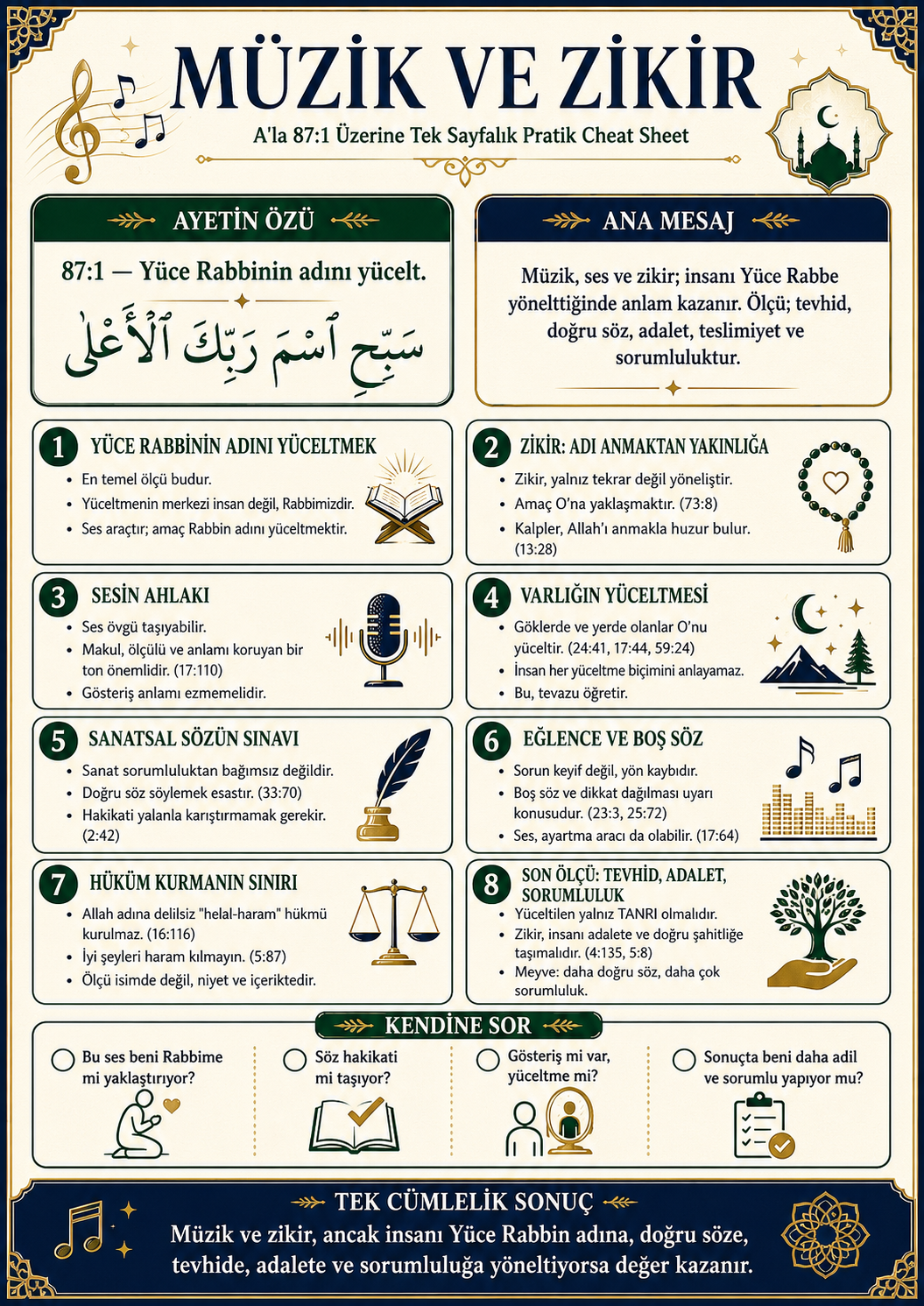
1. Glorifying the Name of Your Lord, the Most High: The Threshold of Reflection
Verse
87:1
سَبِّحِ ٱسْمَ رَبِّكَ ٱلْأَعْلَى
Glorify the name of your Lord, the Most High.
Glorify the name of your Lord, the Most High.
Source: kuranteyit.com
Reflection on the Verse
The brevity of this verse should not mislead us. In just a few words it contains both direction and boundary. The verse turns a person’s attention not to the beauty of the sound, the talent of the performer, or the intensity experienced by the listener, but to the name of the Lord, the Most High. The center of glorification is not the human being. The human voice can become a meaningful tool only when it is directed toward this center.
When music is involved, the tool can easily become the goal. A beautiful mode, a powerful rhythm, or the shared excitement of a crowd can make a person feel a great deal. But feeling a great deal is not, by itself, glorifying the name of the Lord. The question I need to ask myself is this: Does this effect turn me toward GOD, or bind me to the owner of the voice, to my own emotion, and to the spiritual image of that moment?
87:1 places a boundary stone at the beginning of the discussion: Sound may change, form may change, culture and taste may change; but exaltedness belongs to the Lord. The human task is not to transfer that exaltedness to oneself, to the artist, or to the community, but to glorify the name of the Lord.
2. Remembrance: From Mentioning the Name to Drawing Near
Verse
73:8 — You shall commemorate the name of your Lord, to come ever closer and closer to Him.
76:25 — And commemorate the name of your Lord day and night.
76:26 — During the night, fall prostrate before Him, and glorify Him through many a long night.
87:15 — By remembering the name of his Lord and observing the Contact Prayers (Salat).
13:28 — They are the ones whose hearts rejoice in remembering GOD. Absolutely, by remembering GOD, the hearts rejoice.
Reflection on the Verse
In these verses remembrance is not confined to a certain hour or to a single form of expression. Night and day, prostration and the Contact Prayers, remembering and drawing near all appear before us as parts of the same orientation. Verse 73:8 in particular states the purpose of remembering the name of the Lord clearly: to come ever closer and closer to Him.
Any relationship formed through music is also subject to this measure. A melody may carry the name of the Lord, but the real test is where it carries the listener’s heart. When art ceases to be a means that helps one remember GOD and becomes a spiritual goal in itself, attention can easily shift toward performance, the artist, or the search for emotion. A person may think he is remembering GOD while in reality he is seeking his own excitement.
13:28 says that hearts rejoice in remembering GOD. It feels incomplete to me to read this joy as merely a cheerful emotion. The joy of the heart is finding its center. A person fragmented by fears, expectations, and the approval of others turns again toward a single direction within remembrance. Music may deepen this remembering, but if it turns into an intoxication that causes responsibility to be forgotten, it can move away from the wakeful joy of remembrance.
3. The Ethics of Sound: Praise, Calling, and Measure
Verse
2:30 — Recall that your Lord said to the angels, “I am placing a representative (a temporary god) on Earth.” They said, “Will You place therein one who will spread evil therein and shed blood, while we sing Your praises, glorify You, and uphold Your absolute authority?” He said, “I know what you do not know.”
7:180 — To GOD belongs the most beautiful names; call upon Him therewith, and disregard those who distort His names. They will be requited for their sins.
17:110 — Say, “Call Him GOD, or call Him the Most Gracious; whichever name you use, to Him belongs the most beautiful names.” Do not utter your Contact Prayers (Salat) too loudly, nor secretly; use a moderate tone.
20:130 — Therefore, be patient in the face of their utterances, and praise and glorify your Lord before sunrise and before sunset. And during the night glorify Him, as well as at both ends of the day, that you may be happy.
Reflection on the Verse
In 2:30 the angels say that they sing GOD’s praises and glorify Him. 7:180 teaches us to call upon GOD by the most beautiful names. Sound does not appear here as something inherently suspect. Sound can carry praise, make a call audible, and bring an inner devotion outward.
But 17:110 places measure beside sound. The Contact Prayers are to be uttered neither excessively loudly nor secretly; a moderate tone is prescribed. It would not be right to derive from this verse a technical sound level for every kind of music. Even so, the moral principle taught by the verse is clear: Sound directed toward GOD should not crush meaning through a desire for display, nor should it disappear altogether.
The strength of sound should lie not in overpowering ears, but in carrying the right meaning. Sometimes a sound that is too loud makes the words inaudible. At other times, a person may completely bury the truth he believes under the pretext of not attracting attention. The call for a moderate tone in the verse makes me think not merely of decibels, but of a measured stance.
4. The Glorification of Creation and the Limits of Human Hearing
Verse
24:41 — Do you not realize that everyone in the heavens and the earth glorifies GOD, even the birds as they fly in a column? Each knows its own prayer and glorification. GOD is fully aware of everything they do.
17:44 — The seven universes, the earth, and everyone in them glorify Him. There is nothing that does not glorify Him, but you do not understand their glorification. He is Clement, Forgiving.
59:24 — He is the one GOD; the Creator, the Initiator, the Designer. To Him belongs the most beautiful names. Everything in the heavens and the earth glorifies Him. He is the Almighty, Most Wise.
Reflection on the Verse
24:41 says that every being knows its own prayer and form of glorification. 17:44 says that we do not understand these glorifications. When I consider these two verses together, I feel that glorification cannot be reduced to a single form known to human beings. The flight of birds, the order of the heavens, and life on earth do not need to be a song decipherable by the human ear; yet they still glorify GOD.
This teaches humility. To regard only the form of sound to which we are accustomed as a religious expression may mean passing a quick judgment about forms of glorification we do not know. This does not mean that every genre of music is automatically glorification. The verses do not make such a generalization. But neither does there seem to be solid ground for imprisoning glorification within a single culture, a single melody, or a single manner of expression.
The limits of human hearing also carry an important moral consequence. A melody unfamiliar to me is not wrong merely because it is unfamiliar. A work that deeply moves me is not right merely because it moves me. Personal taste cannot be the measure of truth. GOD knows the prayer and glorification of every being; the human being must admit that there is a vast field beyond what he himself can hear.
5. The Mountains and Birds Glorifying with David
Verse
21:79 — We granted Solomon the correct understanding, though we endowed both of them with wisdom and knowledge. We committed the mountains, as well as the birds, to serve David in glorifying (GOD). This is what we did.
38:18 — We committed the mountains to serve him, glorifying with him night and day.
34:10 — We endowed David with blessings from us: “O mountains, submit with him, and you too, O birds.” We softened the iron for him.
Reflection on the Verse
The mountains and birds glorifying together with David opens a powerful scene when reflecting on remembrance. A person’s orientation is mentioned together with the beings around him. Glorification is not merely an inward, closed-off experience; it appears within a broad togetherness that includes the mountains and the birds.
The call to submission in 34:10 is especially striking. Glorification is not simply making sound; it gains meaning through submission. The mountains and birds are not mentioned in order to idolize David, but to join a glorification directed toward GOD. This distinction is important when thinking about the place of the artist in religious music. The artist can point toward the direction; he cannot become the direction itself.
These verses make me think that glorification can bring creation together, but this unity is formed not around a human being, but under GOD’s authority. Music may serve such a unity, yet the verses do not impose a necessity they never stated. From this, one cannot conclude that music is commanded as a special form of worship.
6. The Test of Artistic Speech: Poetry, Truthfulness, and Remembrance
Verse
26:224 — As for the poets, they are followed only by the strayers.
26:225 — Do you not see that their loyalty shifts according to the situation?
26:226 — And that they say what they do not do?
26:227 — Exempted are those who believe and lead a righteous life, remember GOD frequently, and defend their rights. Surely, the transgressors will find out what their ultimate destiny is.
33:70 — O you who believe, reverence GOD and utter only the correct utterances.
2:42 — Do not confound the truth with falsehood, nor shall you conceal the truth knowingly.
Reflection on the Verse
The verses about poets clearly set out the moral test of artistic speech. The criticism is directed not at the existence of art itself, but at loyalty that shifts according to circumstances, saying what one does not do, and establishing a misguided relationship of following. Then those who believe, lead a righteous life, remember GOD frequently, and defend their rights are set apart.
This distinction matters. Artistic speech is not freed from responsibility because it is effective; on the contrary, as its influence grows, so does its responsibility. Music places words into memory through rhythm and melody. A truthful word can reach the heart more deeply; but a lie can also become more attractive and lasting.
The command in 33:70 to utter only correct words is a serious measure for words sung in music as well. A person can describe on stage a submission he does not live. The listener may also prefer not to see the gap between the beauty of the words and the life behind them. Yet artistic form does not straighten what is crooked in the content.
7. Entertainment, Vain Talk, and the Scattering of Attention
Verse
62:11 — When some of them come across a business deal or some entertainment, they rush to it and leave you standing! Say, “What GOD possesses is far better than entertainment or business. GOD is the best Provider.”
23:3 — And they avoid vain talk.
25:72 — They do not bear false witness. When they encounter vain talk, they disregard it.
31:6 — Among the people there are those who uphold baseless Hadith, and thus divert others from the path of GOD without knowledge, and take it in vain. These have incurred a shameful retribution.
17:64 — “You may entice them with your voice, and mobilize all your forces and all your men against them, and share in their money and children, and promise them. Anything the devil promises is no more than an illusion.”
Reflection on the Verse
Entertainment is named in 62:11, but what is criticized is not the mere existence of entertainment; it is people abandoning the divine call and rushing toward it. When this distinction is missed, it becomes easy to manufacture a prohibition the verse itself did not state. Something giving a person pleasure does not automatically make it wrong. The problem is when pleasure displaces priorities and is regarded as more valuable than what GOD possesses.
23:3 and 25:72 teach distance from vain talk. As the words of music are repeated, they can settle into a person’s memory, language, and character. Emptiness is not merely meaningless words; content that consumes attention, weakens the sense of responsibility, or normalizes falsehood can also empty a person. On the other hand, an instrumental melody cannot automatically be called vain merely because it contains no words. The verses speak about vain talk and false testimony, not about music as such.
What kind of person is what I listen to making me? Does it cause me to neglect the Contact Prayers and my responsibilities? Does it direct my heart toward remembering GOD, or toward constantly seeking a new pleasure? Attention is a great capital that governs human life. Remembrance gathers that attention again toward GOD.
8. The Limit of Issuing a Ruling About Music
Verse
16:116 — Do not utter lies with your own tongues, “This is lawful, and this is unlawful,” to fabricate lies and attribute them to GOD. Surely, those who fabricate lies and attribute them to GOD will never succeed.
5:87 — O you who believe, do not prohibit the good things made lawful by GOD, and do not aggress; GOD does not love the aggressors.
7:32 — Say, “Who prohibited the nice things GOD has created for His creatures, and the good provisions?” Say, “Such provisions are to be enjoyed in this life by those who believe. Moreover, the good provisions will be exclusively theirs on the Day of Resurrection.” We thus explain the revelations for people who know.
Reflection on the Verse
When speaking about music, the heaviest responsibility is not to attribute to GOD a ruling He did not state. In the verses discussed in this article, there is no general prohibition issued by name against music, melody, rhythm, or instruments. This observation does not mean that all music is right. It only shows that saying “GOD prohibited every kind of music” without an explicit ruling may go beyond the limits of knowledge.
16:116 limits the human tongue from manufacturing what is lawful and unlawful. A sense of religious authority can easily give a person the courage to speak on GOD’s behalf. But personal preference and divine ruling are not the same thing. A person may avoid certain forms of music and choose a narrower path in order to protect his own heart. Presenting that preference as GOD’s definitive ruling for everyone is a separate claim and requires evidence.
The cautious point I reach is this: Music is not commanded in the verses as a special form of worship; yet the possibility that it can serve as a tool for remembering the name of the Lord is not closed either. Its value is understood not from its name, but from its direction and moral fruit.
9. Not Turning What GOD Deliberately Left Unspecified into a Religious Burden
Verse
5:101 — O you who believe, do not ask about matters which, if revealed to you prematurely, would hurt you. If you ask about them in light of the Quran, they will become obvious to you. GOD has deliberately overlooked them. GOD is Forgiver, Clement.
Reflection on the Verse
When reflecting on 5:101, an important distinction must first be preserved. The verse does not completely forbid a person from sincerely searching for truth or putting questions to the Quran. On the contrary, it states that matters will become clear when asked in the light of the Quran. The boundary concerns the tendency to force details that GOD has not explained and produce new burdens and rulings from them.
The music debate should be reconsidered from this perspective. The Quran contains measures showing that sound can be used for right or wrong purposes; vain talk, enticement, idolization, being drawn away from responsibilities, and falsehood are certainly criticized. But these verses contain no general ruling of prohibition that encompasses music, melody, rhythm, or instruments by name. Definitively attributing such a ruling to GOD would not merely be offering a personal interpretation; it could mean placing a prohibition in GOD’s name within an area He left open.
This verse asks me: Am I submitting to the measures GOD clearly stated in the Quran, or am I filling the areas He deliberately left unexplained with my own rulings? Honest reflection on music requires not only saying what GOD said, but also refusing to make Him say what He did not say.
10. The Measure That Testimony, Tawhid, and Justice Place on Music
Verse
3:18 — GOD bears witness that there is no god except He, and so do the angels and those who possess knowledge. Truthfully and equitably, He is the absolute god; there is no god except He, the Almighty, Most Wise.
72:18 — The places of worship belong to GOD; do not call on anyone else beside GOD.
22:62 — It is a fact that GOD is the Truth, while setting up any idols beside Him constitutes falsehood, and GOD is the Most High, the Supreme.
39:3 — Absolutely, the religion shall be devoted to GOD alone. Those who set up idols beside Him say, “We idolize them only to bring us closer to GOD; they are in a better position!” GOD will judge them regarding their disputes. GOD does not guide such liars, disbelievers.
Reflection on the Verse
3:18 presents the testimony of tawhid together with knowledge and justice. Bearing witness to the oneness of GOD is not merely uttering a correct sentence. It means recognizing that absolute authority belongs to Him alone and living that recognition in justice. The mention of power and wisdom at the end of the verse takes testimony beyond a passing emotion and turns it into a measure spread across the whole of life.
When music is used for remembrance, it must serve this testimony. While GOD’s name is being spoken, no other being or human should become the true center of the call. 72:18 clearly commands that no one besides GOD be called upon. This measure requires careful listening to whom the words in a religious song or collective remembrance are actually directed.
Tawhid is not a fear constructed against music; it is a liberating measure that determines music’s direction.
11. The Limit of Knowledge: Not Making GOD Say What You Do Not Know
Verse
2:32 — They said, “Be You glorified. We have no knowledge, except that which You have taught us. You are the Omniscient, Most Wise.”
49:6 — O you who believe, if a wicked person brings you any news, you shall first investigate, lest you commit injustice toward some people out of ignorance, then become sorry and remorseful for what you have done.
10:68 — They said, “GOD has begotten a son!” Be He glorified. He is the Richest. Everything in the heavens and everything on earth belongs to Him. You have no proof to support such a blasphemy. Are you saying about GOD what you do not know?
Reflection on the Verse
The words of the angels in 2:32 show true humility before knowledge: What they know is limited to what they have been taught. In a subject such as music and remembrance, around which different claims have circulated for centuries, this attitude is extremely valuable. When a person constructs a definitive divine ruling without a clear verse, he risks putting his own knowledge in the place of GOD’s knowledge.
49:6 requires incoming information to be investigated; otherwise, it warns, people may be treated unjustly out of ignorance. Not every statement frequently repeated in religious circles is true merely because it is widespread. When a sermon, book, video, or musical work says “GOD prohibited this” or “GOD commanded this,” a person should first investigate whether that claim is actually found in the verse. Research is not only an intellectual exercise, but a moral duty that prevents injustice.
Accepting the limits of knowledge does not weaken thought; it makes thought honest. Being able to say “I do not know” or “The verse does not say this explicitly” is one way of glorifying GOD’s knowledge. This humility can take the music debate out of a harsh identity struggle in which people judge one another and turn it into a calm investigation around the clear measures of the verses.
12. Submission and the Danger of Taking Humans as Lords
Verse
2:285 — The messenger has believed in what was sent down to him from his Lord, and so did the believers. They believe in GOD, His angels, His scripture, and His messengers: “We make no distinction among any of His messengers.” They say, “We hear, and we obey.* Forgive us, our Lord. To You is the ultimate destiny.”
9:31 — They have set up their religious leaders and scholars as lords* instead of GOD. Others deified the Messiah, son of Mary. They were all commanded to worship only one god. There is no god except He. Be He glorified, far above having any partners.
3:79 — Never would a human being whom GOD blessed with the scripture and prophethood say to the people, “Idolize me beside GOD.” Instead, according to the scripture you preach and the teachings you learn, “Devote yourselves absolutely to your Lord alone.”
3:80 — Nor would he command you to idolize the angels and the prophets as lords. Would he encourage you to disbelieve after becoming submitters?
Reflection on the Verse
In 2:285 the believers’ response is “We hear, and we obey.” Submission means not placing one’s own desire or inherited tradition ahead of GOD’s revelation. But when the direction of obedience becomes confused, the religious sphere can become a structure in which human authorities hold absolute power over speech.
Because music magnifies emotion, it can also magnify the danger of glorifying a person. Repeated names, excessive praise, and collective excitement can load a person with qualities the verses never gave him. Tawhid is not preserved merely by saying GOD’s name at the beginning of a work; the whole call of the work must preserve that He alone is Lord and Master.
Submission is not a system that enslaves people to other people. On the contrary, it is a consciousness that limits every human authority beneath GOD. If remembrance music strengthens this consciousness, directs the listener to GOD rather than the artist, and keeps obedience alive toward revelation, it can render meaningful service. But if it drives a person toward unquestioning devotion around a religious personality, it can damage the direction of tawhid through the very language of remembrance.
13. The Moral Fruit of Remembrance: Justice, Truthful Speech, and Responsibility
Verse
4:135 — O you who believe, you shall be absolutely equitable when you bear witness, even if it is against yourselves, your parents, or your relatives, and you shall observe GOD. Whether the accused is rich or poor, GOD takes care of both. Therefore, do not be biased by your personal wishes. If you deviate or disregard this commandment, GOD is fully Cognizant of everything you do.
5:8 — O you who believe, you shall be absolutely equitable when you bear witness, and you shall observe GOD. Do not be provoked by your conflicts with some people into committing injustice. You shall be absolutely equitable, for it is more righteous. You shall observe GOD. GOD is fully Cognizant of everything you do.
16:90 — GOD advocates justice, charity, and regarding the rights of relatives. And He forbids evil, vice, and transgression. He enlightens you, that you may take heed.
Reflection on the Verse
If remembrance is seen merely as a practice that provides inner peace, the moral field opened by the verses becomes narrow. 4:135 requires a person to bear equitable witness even against himself, his parents, or his relatives. 5:8 says that conflict must not drive a person into injustice. 16:90 advocates justice, charity, and respect for the rights of relatives.
Remembering GOD does not create a spiritual realm separate from these commandments. On the contrary, remembrance should send a person back into life in a more responsible way. The fruit of music that glorifies GOD’s name should not be only tears or excitement. After that work, does a person bear witness more truthfully? Does he avoid being unjust toward someone he dislikes? Can he see the wrong of his own community? Does he pay greater attention to the rights of relatives, the poor, and the wronged?
For me, one of the most serious measures is this: Does a sound that remembers GOD make a person more just and more truthful? The verses do not determine the musical form, but they do clearly determine the moral direction of remembrance.
14. On the Arabic Roots of the Words
Verse
87:1 — Glorify the name of your Lord, the Most High.
Reflection on the Verse
Looking closely at the Arabic words of the central verse allows the intensity of the command to be felt more clearly. Here root information does not replace the verse; it only helps us carefully consider the field of meaning opened by the words.
ٱلْأَعْلَى (al-A’la) is related to the root ع-ل-و (Ayn-Lam-Waw) and carries the meaning of the highest, the most exalted. The human voice rises and fades; the artist’s fame is born and disappears; the tastes of communities change. The Most High is dependent on none of these. Music does not make GOD more exalted. Through music, a person may turn his own awareness toward His exaltedness.
When the words are considered together, the verse gains a meaning much deeper than merely a call to raise one’s voice: Keep the name of your Lord free from deficient conceptions, remember His Lordship that watches over you, and recognize that He alone is the Most High above every human greatness. Music may carry this consciousness; but when it loses its direction, no matter how impressive the sound may be, it moves away from the center of the verse.
Other Claims
Verse
16:116 — Do not utter lies with your own tongues, “This is lawful, and this is unlawful,” to fabricate lies and attribute them to GOD. Surely, those who fabricate lies and attribute them to GOD will never succeed.
5:87 — O you who believe, do not prohibit the good things made lawful by GOD, and do not aggress; GOD does not love the aggressors.
Reflection on the Verse
Different religious approaches to music have been put forward in different periods. Some approaches regard a broad range of instruments and music as objectionable or prohibited. Some evaluate lyrics, setting, purpose, and effect on the person separately. Other approaches argue that melodies which remember GOD, carry truthful words, and do not distract from responsibilities can be used.
These views have been debated within their own historical and traditional foundations. Yet the fact that a view is old, widespread, or defended by people with authority does not automatically make it GOD’s explicit ruling. Likewise, appearing new or liberal does not guarantee that it is correct. 16:116 and 5:87 require caution both against manufacturing new prohibitions in GOD’s name and against carelessly transgressing divine limits.
A person may choose a narrower path as a matter of conscience. But when turning that preference into a binding ruling for everyone in GOD’s name, he must not forget the responsibility of evidence. A person who loves music should likewise not automatically count everything he loves as remembrance and glorification. Both approaches must stand before the verses with knowledge, justice, and humility.
Conclusion
Verse
87:1 — Glorify the name of your Lord, the Most High.
73:8 — You shall commemorate the name of your Lord, to come ever closer and closer to Him.
13:28 — They are the ones whose hearts rejoice in remembering GOD. Absolutely, by remembering GOD, the hearts rejoice.
3:18 — GOD bears witness that there is no god except He, and so do the angels and those who possess knowledge. Truthfully and equitably, He is the absolute god; there is no god except He, the Almighty, Most Wise.
Reflection on the Verse
At the center of this reflection on music and remembrance, one command remains: Glorify the name of your Lord, the Most High. This command does not turn music into a sacred obligation, nor does it prohibit it by name. But it gives a firm direction by which every form of sound and art, including music, can be evaluated. Only GOD should be glorified. The call should be directed only to Him. Speech should not mix truth with falsehood. Art should not detach a person from the Contact Prayers, justice, and responsibility.
73:8 connects remembering the name of the Lord with drawing ever closer and closer to Him. Therefore, whether music serves remembrance cannot be understood merely from the presence of GOD’s name in its lyrics. To whom is the person actually drawing near? A work that creates dependence on the artist, the community, and spiritual pleasure may lose its direction even if it uses GOD’s name. A work that is truthful, measured, devoted to tawhid, and calls a person toward responsibility may help remembrance.
The verse places this question before every sound, every silence, and every action. The human voice may be beautiful; but only the Lord is the Most High.
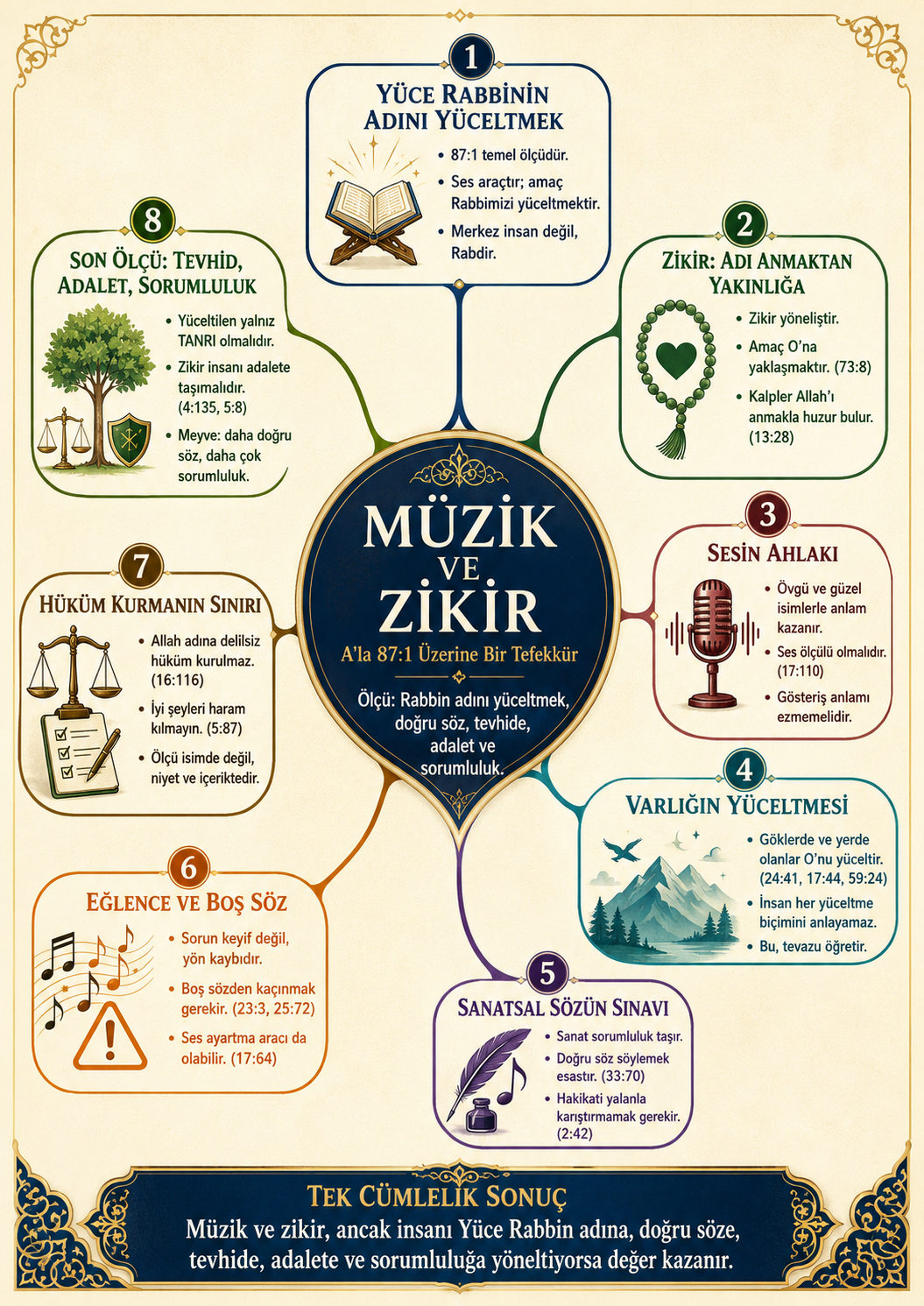
Note
2:32 — They said, “Be You glorified. We have no knowledge, except that which You have taught us. You are the Omniscient, Most Wise.”
GOD knows best.
Source: kuranteyit.com
Discover
Related Articles

Quran Reflections
True Wealth According to the Quran: Material Wealth or Not Being Rich?
A 19-part reflection centered on Al-Baqarah 2:247, exploring wealth, material possessions, poverty, provision, justice, charity, Qarun, trade, temporary worldly blessings, closeness to GOD, and true gain.
Read article
Quran Reflections
Mizan: Mixing, Mastering, and Measure in the Quran
A reflection on mizan, measure, justice, not transgressing limits, the order in creation, looking again and again, and how the experience of balance in music production mirrors human life through Ar-Rahman 55:7-9, Al-Qamar 54:49, and Al-Mulk 67:3-4.
Read article
Quran Reflections
What Is the Heavenly Society? What Is the Dispute in the High Society?
A comprehensive reflection centered on As-Saffat 37:8 and Sad 38:69 about the High Society, the dispute in the heavenly society, the creation of the human being, Satan's pride and rebellion, tawhid, testimony, knowledge, justice, submission, verification, and the limits of religious authority.
Read article