Deep Reverence: Remembering, Faithfulness to the Covenant, and Turning to GOD Alone
A comprehensive reflection centered on Al-Baqarah 2:40 on deep reverence, remembering blessings, faithfulness to the covenant, monotheism, testimony, knowledge, justice, truthful speech, submission, the limits of religious authority, inward orientation in privacy, awareness of accountability, and devotion to GOD alone.
Deep Reverence: Remembering, Faithfulness to the Covenant, and Turning to GOD Alone
A reflection on 2:40 and verses connected with deep reverence
Author: Berk KÖKSAL
Date: 12.08.2026
Location: Mersin
Verse
1:1 — In the name of GOD, Most Gracious, Most Merciful.*
Greetings. Peace be upon you.
The primary aim of this article is to consider the verses together with other related verses and to express, in a sincere and profound way, what bearing witness to the oneness of GOD means in human life in terms of knowledge, justice, truthfulness, and submission.
Introduction
At first glance, the expression “deep reverence” can be read as an emotion. A person may tremble before greatness, feel apprehensive, fall silent, or become aware of their own smallness. But when I enter into Al-Baqarah 2:40, the phrase does not stand alone. Before it comes a blessing; then comes the call to fulfill the human side of the covenant. At the end comes a direct instruction: “Reverence Me.”
For this reason, I do not want to explain deep reverence in this article only through fear, only through humility, or only through emotional intensity. When the verses in the document are placed side by side, a broader map emerges: deep reverence becomes visible sometimes as faithfulness to the covenant, sometimes as truthful speech, sometimes as fearing GOD rather than people, sometimes as preserving one’s orientation in privacy, sometimes as justice, sometimes as worship, and sometimes as restraining the self from sinful desires.
Previously, in The Weight of Testimony, I reflected on the relationship between monotheism, knowledge, and justice; in Not Accepting Without Verification, on the responsibility of knowledge; and in How Can Tawhid Be Distorted by a Single Word?, on how carefully language must be used when speaking about GOD. “Deep reverence” seems like a quieter current running beneath all these themes. Because whoever a person truly exalts is also where they anchor their deepest fear, hope, obedience, and accountability.
At the center of this reflection is one question: What does deep reverence for GOD concretely change in my life?
Summary:
1. Remembering, Blessing, and Covenant: The First Threshold of Deep Reverence
2:40
يَٰبَنِىٓ إِسْرَٰٓءِيلَ ٱذْكُرُوا۟ نِعْمَتِىَ ٱلَّتِىٓ أَنْعَمْتُ عَلَيْكُمْ وَأَوْفُوا۟ بِعَهْدِىٓ أُوفِ بِعَهْدِكُمْ وَإِيَّٰىَ فَٱرْهَبُونِ
O Children of Israel, remember My favor, which I bestowed upon you, and fulfill your part of the covenant, that I fulfill My part of the covenant, and reverence Me.
O Children of Israel, remember My favor, which I bestowed upon you. Fulfill your part of the covenant, that I may fulfill My part of the covenant. Reverence Me.
2:63 — We made a covenant with you, as we raised Mount Sinai above you: “You shall uphold what we have given you strongly, and remember its contents, that you may be saved.”
2:83 — We made a covenant with the Children of Israel: “You shall not worship except GOD. You shall honor your parents, and regard the relatives, the orphans, and the poor. You shall treat the people amicably. You shall observe the Contact Prayers (Salat) and give the obligatory charity (Zakat).” But you turned away, except a few of you, and you became averse.
2:84 — We made a covenant with you that you shall not shed your blood, nor evict one another from your homes. You agreed and bore witness.
5:7 — Remember GOD's blessings upon you, and His covenant that He covenanted with you: you said, “We hear and we obey.” You shall observe GOD; GOD is fully aware of the innermost thoughts.
2:41 — You shall believe in what I have revealed herein, confirming what you have; do not be the first to reject it. Do not trade away My revelations for a cheap price, and observe Me.
2:42 — Do not confound the truth with falsehood, nor shall you conceal the truth knowingly.
4:131 — To GOD belongs everything in the heavens and the earth, and we have enjoined upon those who received the scripture before you, as well as you, to reverence GOD. If you disbelieve, everything in the heavens and the earth belongs to GOD. GOD is in no need of anything, the Most Praiseworthy.
76:7 — They fulfill their pledges and reverence a day that is extremely difficult.
2. The Softening of the Heart: What Does Deep Reverence Do Within?
2:45 — You shall seek help through steadfastness and the Contact Prayers (Salat). This is difficult indeed, but not so for those who are reverent,
2:74 — Yet your hearts became hardened like rocks, or even harder. For there are rocks from which rivers gush out. Some crack open and gentle streams flow from them, and other rocks shrink out of reverence for GOD. GOD is never unaware of anything you do.
7:154 — When Moses' anger subsided, he picked up the tablets, which contained guidance and mercy for those who reverence their Lord.
13:13 — The thunder praises His glory, and so do the angels out of reverence for Him. He sends the lightning bolts, striking according to His will. Yet they argue about GOD, while His power is awesome.
17:109 — They fall on their chins, prostrating and weeping. For it increases their reverence.
3. Fearing GOD, Not People
3:28 — The believers shall never ally themselves with disbelievers in place of believers. Whoever does this is exiled from GOD, except those who are forced to do so to avoid persecution. GOD warns you to reverence Him alone. The ultimate destiny is to GOD.
3:30 — The day will come when every soul will find all the good it has done brought before it. As for its evil works, it will wish that they were far, far away. GOD warns you to reverence Him alone. GOD is Compassionate toward the people.
5:44 — We sent down the Torah,* containing guidance and light. The Jewish prophets, as well as the rabbis and priests, ruled by it as commanded in GOD's scripture and as they themselves witnessed. Therefore, do not reverence the people; instead, reverence Me. And do not trade away My revelations for a cheap price. Those who do not rule in accordance with GOD's revelations are disbelievers.
33:37 — Recall that you said to the one who was blessed by GOD and blessed by you, “Keep your wife and reverence GOD,” while you concealed within yourself what GOD wished to proclaim. Thus, you feared the people when you should have feared GOD alone. When Zaid was completely through with his wife, we had you marry her, in order to establish the precedent that a man may marry the divorced wife of his adopted son. GOD's commands shall be carried out.
33:39 — Those who deliver GOD's messages and reverence Him alone should never fear anyone but GOD. GOD is the most efficient reckoner.
4. Revelation, Message, and the Authority of Deep Reverence
3:199 — Surely, some followers of the previous scripture do believe in GOD, and in what was revealed to you, and in what was revealed to them. They reverence GOD and never trade away GOD's revelations for a cheap price. These will receive their recompense from their Lord. GOD is most efficient in reckoning.
16:2 — He sends down the angels with revelations bearing His commands to whomever He chooses from among His servants: “Proclaim that there is no other god beside Me; reverence Me.”
20:3 — Only to remind those who are reverent.
50:45 — We are fully aware of everything they utter, while you have no power over them. Therefore, remind with this Quran those who reverence My warnings.
65:10 — GOD has prepared for them a severe retribution. Therefore, reverence GOD, O you who possess intelligence and have believed. GOD has sent down to you a message −*
5. Monotheism: The Single Center of Deep Reverence
6:51 — And preach with this (Quran) to those who reverence being summoned before their Lord, that they may attain salvation—they have no Lord and Master beside Him, nor an intercessor.
16:51 — GOD has proclaimed: “Do not worship two gods; there is only one god. Reverence Me alone.”
23:52 — Such is your congregation—one congregation—and I am your Lord; reverence Me.
29:16 — Abraham said to his people, “Worship GOD and reverence Him. This is better for you, if you only knew.
30:31 — You shall submit to Him, reverence Him, observe the Contact Prayers (Salat), and—whatever you do—never ever fall into idol worship.
48:9 — That you people may believe in GOD and His messenger, reverence Him, observe Him, and glorify Him day and night.
3:18 — GOD bears witness that there is no god except Him, and so do the angels and those who possess knowledge. Truthfully and justly, He is the absolute god; there is no god except Him, the Almighty, Most Wise.
6:19 — Say, “Whose testimony is the greatest?” Say, “GOD's. He witnesses between me and you that this Quran* has been inspired to me, to preach it to you and whomever it reaches. Indeed, you bear witness that there are other gods* beside GOD.” Say, “I do not testify as you do; there is only one god, and I disown your idol worship.”
6. Obedience: The Boundary Between Following the Messenger and Taking a Human as Lord
16:50 — They reverence their Lord, high above them, and do what they are commanded to do.
20:44 — “Speak to him nicely; he may take heed or become reverent.”
24:52 — Those who obey GOD and His messenger, reverence GOD, and observe Him; these are the winners.
26:108 — “Reverence GOD and obey me.
26:110 — “Reverence GOD and obey me.”
26:179 — “Reverence GOD and obey me.
43:63 — When Jesus went with the proofs, he said, “I bring you wisdom, and I clarify some of the matters in which you dispute. Reverence GOD and obey me.
71:3 — “To warn you to worship GOD, reverence Him, and obey me.
9:31 — They have taken their religious leaders and scholars as lords* instead of GOD. Others deified the Messiah, son of Mary. All of them were commanded to worship only one god. There is no god except Him. Be He glorified, far above having any partners.
7. Truthful Speech, Testimony, and Justice
9:119 — O you who believe, reverence GOD and be among the truthful.
22:30 — Those who reverence the rites decreed by GOD have deserved a good reward at their Lord. All livestock are made lawful for you to eat, except those specifically prohibited for you. Avoid the abomination of idol worship and avoid bearing false witness.
33:70 — O you who believe, reverence GOD and utter only the correct words.
58:9 — O you who believe, if you must confer secretly, do not confer to commit sin, transgression, and disobedience of the messenger. Confer in order to work righteousness and reverence. Reverence GOD, before whom you will be summoned.
59:7 — Whatever GOD restored to His messenger from the defeated communities shall be given, as a form of charity, to GOD and His messenger. Give it to the relatives, the orphans, the poor, and the traveling alien. Thus, it will not remain monopolized by the powerful among you. You may keep the spoils the messenger gives you, but do not take what he forbids you from taking. Reverence GOD. GOD is severe in enforcing retribution.
8. Knowledge: Deep Reverence as Awareness, Not Blindness
5:100 — Proclaim: “The bad and the good are not the same, even if the abundance of the bad may impress you. Reverence GOD, O you who possess intelligence, that you may succeed.”
35:28 — Also, people, animals, and livestock come in various colors. Thus, the people who truly reverence GOD are those who possess knowledge. GOD is Almighty, Forgiving.
79:26 — This is a lesson for those who are reverent.
87:10 — The reverent will take heed.
71:13 — Why do you not strive to reverence GOD?
39:18 — They are the ones who examine all words, then follow the best. These are the ones whom GOD has guided; these are the ones who possess intelligence.
9. Deep Reverence in Privacy
21:49 — They reverence their Lord even when alone in their privacy, and they are apprehensive about the Hour.
35:18 — No soul can bear the sins of another soul. If a soul burdened with sins implores another to carry part of its load, no other soul can carry any part of it, even if they are related. The only people who heed your warnings are those who reverence their Lord even when alone in their privacy and observe the Contact Prayers (Salat). Whoever purifies the self does so for their own good. The final destiny is to GOD.
36:11 — You will be heeded only by those who follow this message and reverence the Most Gracious—even when alone in their privacy. Give them good news of forgiveness and a generous recompense.
50:33 — They reverenced the Most Gracious in their privacy and came wholeheartedly.
67:12 — As for those who reverence their Lord when alone in their privacy, they have deserved forgiveness and a great recompense.
10. Contact Prayers, Prayer, Hope, and Inner Orientation
6:72 — “And to observe the Contact Prayers (Salat) and reverence Him—He is the One before whom you will be summoned (for the reckoning).”
7:56 — Do not corrupt the earth after it has been set straight, and worship Him with reverence and hope. Surely, GOD's mercy is attainable by the righteous.
21:90 — We* responded to him and granted him John; we corrected his wife for him. This is because they used to hasten to work righteousness, and they implored us in times of joy as well as in times of fear. To us, they were reverent.
23:2 — who are reverent during their Contact Prayers (Salat).
23:57 — Surely, those who are conscious of their Lord with reverence,
23:60 — Their hearts are filled with reverence as they give their charities, for they realize that they will be summoned before their Lord.
32:16 — Their sides readily forsake their beds in order to worship their Lord with reverence and hope, and from our provisions to them they give.
11. Trust, Striving, and Enlightenment
5:23 — Two men who were reverent and blessed by GOD said, “Just enter through the gate. If you only enter through it, you will surely prevail. You must trust in GOD, if you are believers.”
5:35 — O you who believe, reverence GOD, seek the ways and means to Him, and strive in His cause, that you may succeed.
8:29 — O you who believe, if you reverence GOD, He will enlighten you, remit your sins, and forgive you. GOD possesses infinite grace.
9:109 — Is one who establishes his building on the foundation of reverencing GOD and seeking His approval better, or one who establishes his building on the edge of a crumbling cliff, then falls with it into the fire of Hell? GOD does not guide the transgressing people.
57:28 — O you who believe, reverence GOD and believe in His messenger. He will then grant you a double reward from His mercy, provide you with light to guide you, and forgive you. GOD is Forgiving, Most Merciful.
12. Moral Boundaries: Anger, Provision, Chastity, and the Self
5:28 — “Even if you extend your hand to kill me, I will not extend my hand to kill you. For I reverence GOD, Lord of the universe.
5:88 — And eat from the good and lawful things that GOD has provided for you. Reverence GOD, in whom you are believers.
5:96 — All fish of the sea are made lawful for you to eat. During the sacred journey, this may provide for your needs throughout your journey. Do not hunt during the sacred journey. Reverence GOD, before whom you will be summoned.
11:78 — His people came rushing to him; they had become accustomed to sinful behavior. He said, “O my people, it would be purer for you if you take my daughters instead. Reverence GOD; do not shame me with my guests. Is there not one reasonable man among you?”
33:55 — The women may relax their dress code around their fathers, their sons, their brothers, the sons of their brothers, the sons of their sisters, other women, and their female servants. They shall reverence GOD. GOD witnesses all things.
64:16 — Therefore, reverence GOD as much as you can, listen, obey, and give for your own good. Those who are protected from their own stinginess are the successful ones.
79:40 — As for the one who reverences the majesty of their Lord and restrains the self from sinful desires.
13. Crowds, Pressure, and Worldly Delusion
5:57 — O you who believe, do not befriend those among the previous scripture recipients who mock and ridicule your religion, nor shall you befriend the disbelievers. Reverence GOD, if you are truly believers.
31:33 — O people, reverence your Lord, and fear a day when a father cannot help his own child, nor can a child help the father. Surely, GOD's promise is truth. Therefore, do not let this life distract you; do not let insignificant illusions divert you from GOD.
33:1 — O prophet, reverence GOD and do not obey the disbelievers and the hypocrites. GOD is Omniscient, Most Wise.
49:1 — O you who believe, do not place your opinion above that of GOD and His messenger. Reverence GOD. GOD is Hearer, Omniscient.
60:11 — If any of your wives joins the enemy and you are forced to fight, then make the enemy compensate the men who lost their wives by reimbursing what they had spent on them. Reverence GOD, in whom you believe.
14. Awareness of Accountability: What Have I Sent Ahead for Tomorrow?
13:21 — They join what GOD has commanded to be joined, reverence their Lord, and fear the dreadful reckoning.
22:1 — O people, reverence your Lord, for the quaking of the Hour is a terrible thing.
39:16 — They will have masses of fire above them and beneath them. GOD thus warns His servants: “O My servants, reverence Me.”
59:18 — O you who believe, reverence GOD, and let every soul examine what it has sent ahead for tomorrow. Reverence GOD; GOD is fully Cognizant of everything you do.
70:27 — They reverence the retribution of their Lord.
15. Justice, Peace, and Deep Reverence in Relationships
49:10 — The believers are members of one family; maintain peace within your family and reverence GOD, that you may attain mercy.
65:1 — O prophet, when you people divorce women, make sure that the divorce waiting period is fulfilled. Calculate this waiting period accurately.* Reverence GOD your Lord. Do not evict them from their homes, nor make life miserable for them to force them to leave on their own, unless they commit a proven adultery. These are GOD's laws. Anyone who transgresses GOD's laws commits an injustice against himself. You never know; perhaps GOD wills something good to come out of this.
65:2 — Once the waiting period is fulfilled, you may reconcile with them equitably, or complete the separation equitably. Have two equitable witnesses witness the divorce before GOD. This is to enlighten those who believe in GOD and the Last Day. Whoever reverences GOD, He will create a way out for him.
65:4 — As for women who have reached menopause, if you have any doubts, their waiting period shall be three months. As for those who do not menstruate, if they discover that they are pregnant, their waiting period ends upon giving birth. Whoever reverences GOD, He makes everything easy for him.
65:5 — This is GOD's command that He has sent down to you. Whoever reverences GOD, He remits his sins and rewards him generously.
16. Blessing, Grace, Righteousness, and the Character of the Believer
5:112 — Recall that the disciples said, “O Jesus, son of Mary, can your Lord send down to us a feast from the sky?” He said, “You should reverence GOD, if you are believers.”
26:132 — “Reverence the One who has provided you with everything you know.
33:35 — The submitting men, the submitting women, the believing men, the believing women, the obedient men, the obedient women, the truthful men, the truthful women, the steadfast men, the steadfast women, the reverent men, the reverent women, the charitable men, the charitable women, the fasting men, the fasting women, the chaste men, the chaste women, and the men who commemorate GOD frequently and the women who commemorate GOD frequently; GOD has prepared for them forgiveness and a great recompense.
39:10 — Say, “O My servants who have believed, reverence your Lord.” Those who work righteousness in this world have deserved a good reward. GOD's earth is spacious, and those who steadfastly persevere will receive their recompense generously, without limit.
39:20 — As for those who reverence their Lord, they will have mansions upon mansions built for them, with flowing streams. This is GOD's promise, and GOD never breaks His promise.
17. The Tremor Awakened by the Verses
17:59 — What prevented us from sending miracles was that previous generations rejected them. For example, we showed Thamoud the camel, a profound miracle, but they transgressed against it. We sent the miracles only to instill reverence.
17:60 — We informed you that your Lord fully controls the people, and we made the vision we showed you, as well as the tree cursed in the Quran, a test for the people.* We showed them solid proofs to instill reverence in them, but this only increased their rebellion.
39:23 — GOD has revealed herein the best Hadith; a book that is consistent and points out both ways (Heaven and Hell). The skins of those who reverence their Lord cringe therefrom, then their skins and hearts soften up for GOD's message. Such is GOD's guidance; He bestows it upon whomever He wills. As for those sent astray by GOD, nothing can guide them.
42:5 — The heavens above them almost shatter out of reverence for Him; the angels praise and glorify their Lord and ask forgiveness for those on earth. Surely, GOD is Forgiving, Most Merciful.
55:45 — Which of your Lord's marvels can you deny?
55:46 — Two gardens (one for the jinn and one for the humans) are reserved for those who reverence the majesty of their Lord.
18. Taking Heed, Turning, and Restraining the Self
22:32 — Indeed, those who reverence the rites decreed by GOD demonstrate the righteousness in their hearts.
26:184 — “Reverence the One who created you and the previous generations.”
79:19 — “Let me guide you to your Lord, that you may become reverent.”
80:9 — And is truly reverent.
19. The End of the Promise: The Fruit of Deep Reverence
14:14 — “And after them, we will let you settle in their land. This is the reward for those who reverence My majesty and reverence My promise.”
39:73 — Those who reverenced their Lord will be ushered in throngs into Paradise. When they reach it and its gates are opened, its guards will say, “Peace be upon you; you have won. Therefore, you abide here forever.”
98:8 — Their reward at their Lord is the gardens of Eden, with flowing streams; they abide therein forever. GOD is pleased with them and they are pleased with Him. Such is the reward for those who reverence their Lord.

1. Remembering, Blessing, and Covenant: The First Threshold of Deep Reverence
Verse
2:40
يَٰبَنِىٓ إِسْرَٰٓءِيلَ ٱذْكُرُوا۟ نِعْمَتِىَ ٱلَّتِىٓ أَنْعَمْتُ عَلَيْكُمْ وَأَوْفُوا۟ بِعَهْدِىٓ أُوفِ بِعَهْدِكُمْ وَإِيَّٰىَ فَٱرْهَبُونِ
O Children of Israel, remember My favor, which I bestowed upon you, and fulfill your part of the covenant, that I fulfill My part of the covenant, and reverence Me.
O Children of Israel, remember My favor, which I bestowed upon you. Fulfill your part of the covenant, that I may fulfill My part of the covenant. Reverence Me.Source: kuranteyit.com
2:63 — We made a covenant with you, as we raised Mount Sinai above you: “You shall uphold what we have given you strongly, and remember its contents, that you may be saved.”
2:83 — We made a covenant with the Children of Israel: “You shall not worship except GOD. You shall honor your parents, and regard the relatives, the orphans, and the poor. You shall treat the people amicably. You shall observe the Contact Prayers (Salat) and give the obligatory charity (Zakat).” But you turned away, except a few of you, and you became averse.
2:84 — We made a covenant with you that you shall not shed your blood, nor evict one another from your homes. You agreed and bore witness.
5:7 — Remember GOD’s blessings upon you, and His covenant that He covenanted with you: you said, “We hear and we obey.” You shall observe GOD; GOD is fully aware of the innermost thoughts.
2:41 — You shall believe in what I have revealed herein, confirming what you have; do not be the first to reject it. Do not trade away My revelations for a cheap price, and observe Me.
2:42 — Do not confound the truth with falsehood, nor shall you conceal the truth knowingly.
4:131 — To GOD belongs everything in the heavens and the earth, and we have enjoined upon those who received the scripture before you, as well as you, to reverence GOD. If you disbelieve, everything in the heavens and the earth belongs to GOD. GOD is in no need of anything, the Most Praiseworthy.
76:7 — They fulfill their pledges and reverence a day that is extremely difficult.
Reflection on the Verse
2:40 takes me first not to an emotion, but to a relationship. The flow of the verse is very clear: the blessing is remembered, the human side of the covenant is fulfilled, and then comes the command, “Reverence Me.” This sequence makes me think that deep reverence is not merely an inward shiver. It is an orientation nourished by remembrance, tested by faithfulness, and answered in conduct.
2:63 does not leave the covenant as a merely verbal acceptance; it emphasizes holding strongly to what was given and remembering what it contains. 2:83 and 2:84 show how the covenant spreads into life: worshiping GOD alone, observing the rights of relatives and the vulnerable, treating people amicably, observing the Contact Prayers, giving the obligatory charity, not taking life, and remaining faithful to one’s testimony. For this reason, the covenant is not an abstract belonging in my eyes; it becomes a pledge that measures a person’s worship, morality, and relationships with others at the same time.
In 5:7, the words “We hear and we obey” sound like the inner voice of the covenant. The value of a promise becomes clear not at the moment it is spoken, but in what it becomes afterward. The mention in 76:7 of those who fulfill their pledges strengthens the same line. It is easy for me to say that I have deep reverence; but those words gain weight when I keep my promise, do not forget the blessing, and carry my responsibility before GOD.
One of the most striking aspects of 2:40 for me is this: the verse does not stop at saying “Mention Me.” Remember, fulfill, and reverence. Memory, faithfulness, and orientation are not separated from one another. Deep reverence is the opposite of forgetfulness; it is not an excuse for unfaithfulness to the covenant.
Verse references: 2:40, 2:41, 2:42, 2:63, 2:83, 2:84, 4:131, 5:7, 76:7.
2. The Softening of the Heart: What Does Deep Reverence Do Within?
Verse
2:45 — You shall seek help through steadfastness and the Contact Prayers (Salat). This is difficult indeed, but not so for those who are reverent,
2:74 — Yet your hearts became hardened like rocks, or even harder. For there are rocks from which rivers gush out. Some crack open and gentle streams flow from them, and other rocks shrink out of reverence for GOD. GOD is never unaware of anything you do.
7:154 — When Moses’ anger subsided, he picked up the tablets, which contained guidance and mercy for those who reverence their Lord.
13:13 — The thunder praises His glory, and so do the angels out of reverence for Him. He sends the lightning bolts, striking according to His will. Yet they argue about GOD, while His power is awesome.
17:109 — They fall on their chins, prostrating and weeping. For it increases their reverence.
Reflection on the Verse
If deep reverence were only an outwardly visible behavior, the comparison in 2:74 between hearts and even rocks that shrink out of reverence for GOD would not be so striking. The verse says that the heart can harden; it even presents the possibility that a human heart may fall behind stone itself. This calls me to look for deep reverence first not in the appearance of others, but in my own inner hardness.
In 2:45, seeking help through steadfastness and the Contact Prayers takes on a different meaning for those who are reverent, making me think about the relationship between inward orientation and the capacity to bear burdens. In 7:154, the tablets contain guidance and mercy for those who reverence their Lord; in 17:109, the verses increase reverence. These illuminate the same point from different directions: before revelation, the heart either softens or hardens in order to protect itself.
In 13:13, the thunder praising His glory and the angels being mentioned with reverence break the human measure that places the self at the center. My emotion, my fear, or my enthusiasm is not the measure of deep reverence. When I remember the place of all creation before GOD, I begin to see my own place more accurately as well.
The trace of deep reverence in the heart may not be constant tension, but rather not becoming hardened before truth. Can a person turn back when they see that they were mistaken? Can they listen to a verse without bending it when it touches their interests? This is where the heart reveals itself.
Verse references: 2:45, 2:74, 7:154, 13:13, 17:109.
3. Fearing GOD, Not People
Verse
3:28 — The believers shall never ally themselves with disbelievers in place of believers. Whoever does this is exiled from GOD, except those who are forced to do so to avoid persecution. GOD warns you to reverence Him alone. The ultimate destiny is to GOD.
3:30 — The day will come when every soul will find all the good it has done brought before it. As for its evil works, it will wish that they were far, far away. GOD warns you to reverence Him alone. GOD is Compassionate toward the people.
5:44 — We sent down the Torah,* containing guidance and light. The Jewish prophets, as well as the rabbis and priests, ruled by it as commanded in GOD’s scripture and as they themselves witnessed. Therefore, do not reverence the people; instead, reverence Me. And do not trade away My revelations for a cheap price. Those who do not rule in accordance with GOD’s revelations are disbelievers.
33:37 — Recall that you said to the one who was blessed by GOD and blessed by you, “Keep your wife and reverence GOD,” while you concealed within yourself what GOD wished to proclaim. Thus, you feared the people when you should have feared GOD alone. When Zaid was completely through with his wife, we had you marry her, in order to establish the precedent that a man may marry the divorced wife of his adopted son. GOD’s commands shall be carried out.
33:39 — Those who deliver GOD’s messages and reverence Him alone should never fear anyone but GOD. GOD is the most efficient reckoner.
Reflection on the Verse
5:44 draws one of the distinctions at the center of this article very clearly: “do not reverence the people; instead, reverence Me.” When I read this sentence, I do not think only of explicit pressures. The desire to be liked, fear of exclusion, anxiety about losing the approval of a community, apprehension about the reaction of a religious authority, or silencing one’s conscience under the shadow of a powerful person all bring the same question before me: Whom am I truly magnifying?
33:37 directly makes visible the tension between fearing people and fearing GOD. 33:39 states that those who deliver the messages reverence Him alone and should fear no one but GOD. Here, the source of courage is not a person’s self-confidence; it is knowing who carries out the reckoning.
3:28 and 3:30 connect this orientation with the final return and awareness of accountability. There may be caution, coercion, and real dangers in human relationships; the verse itself treats coercion separately. But surrendering the heart’s ultimate center of fear and allegiance to another power is something else. Deep reverence should not turn into a coarse fearlessness toward every person; it should clarify to whom I give ultimate weight.
This distinction is also decisive for me regarding religious authority. A person may be knowledgeable, experienced, and may say something true. But no human being can take GOD’s place. Deep reverence does not teach contempt for people; it teaches not placing a human being in GOD’s place.
Verse references: 3:28, 3:30, 5:44, 33:37, 33:39.
4. Revelation, Message, and the Authority of Deep Reverence
Verse
3:199 — Surely, some followers of the previous scripture do believe in GOD, and in what was revealed to you, and in what was revealed to them. They reverence GOD and never trade away GOD’s revelations for a cheap price. These will receive their recompense from their Lord. GOD is most efficient in reckoning.
16:2 — He sends down the angels with revelations bearing His commands to whomever He chooses from among His servants: “Proclaim that there is no other god beside Me; reverence Me.”
20:3 — Only to remind those who are reverent.
50:45 — We are fully aware of everything they utter, while you have no power over them. Therefore, remind with this Quran those who reverence My warnings.
65:10 — GOD has prepared for them a severe retribution. Therefore, reverence GOD, O you who possess intelligence and have believed. GOD has sent down to you a message −*
Reflection on the Verse
In 3:199, deep reverence and not trading away GOD’s revelations for a cheap price meet in the same sentence. This shows that one’s approach to revelation is not merely an intellectual matter, but a moral one. A person can read, transmit, and teach a text; but when their relationship with it begins to be shaped by interest, prestige, or the demands of the crowd, deep reverence is tested.
The message of 16:2 places monotheism and deep reverence side by side: proclaiming that there is no other god beside GOD is given together with deep reverence directed to Him alone. 50:45 explicitly identifies the Quran as the means of reminding and says that the person delivering the message has no power over people. Together, these establish a very important boundary for me: the message is powerful; the task of the person who conveys it is not to bind people to their own authority.
While 20:3 says that the reminder finds a response in the reverent person, 65:10 says, after calling believers and those who possess intelligence to reverence, that GOD has sent down a message. For this reason, encountering the Quran is not merely acquiring information. The message establishes a measure before a person and leads to a question heavier than “Do you know this?”: “What do you do in response to it?”
Earlier, in Not Accepting Without Verification and Finding Is One Thing, Understanding Is Another, I reflected on how knowledge does not remove human responsibility. Here the same line appears before me through another expression: deep reverence. Not placing knowledge above revelation, not placing the tool in the place of the source, and not imprisoning what I read outside my life.
Verse references: 3:199, 16:2, 20:3, 50:45, 65:10.
5. Monotheism: The Single Center of Deep Reverence
Verse
6:51 — And preach with this (Quran) to those who reverence being summoned before their Lord, that they may attain salvation—they have no Lord and Master beside Him, nor an intercessor.
16:51 — GOD has proclaimed: “Do not worship two gods; there is only one god. Reverence Me alone.”
23:52 — Such is your congregation—one congregation—and I am your Lord; reverence Me.
29:16 — Abraham said to his people, “Worship GOD and reverence Him. This is better for you, if you only knew.
30:31 — You shall submit to Him, reverence Him, observe the Contact Prayers (Salat), and—whatever you do—never ever fall into idol worship.
48:9 — That you people may believe in GOD and His messenger, reverence Him, observe Him, and glorify Him day and night.
3:18 — GOD bears witness that there is no god except Him, and so do the angels and those who possess knowledge. Truthfully and justly, He is the absolute god; there is no god except Him, the Almighty, Most Wise.
6:19 — Say, “Whose testimony is the greatest?” Say, “GOD’s. He witnesses between me and you that this Quran* has been inspired to me, to preach it to you and whomever it reaches. Indeed, you bear witness that there are other gods* beside GOD.” Say, “I do not testify as you do; there is only one god, and I disown your idol worship.”
Reflection on the Verse
The simplicity of 16:51 is strong enough to carry the entire section: the call not to worship two gods, to turn to only one god, and to reverence GOD alone all meet in the same sentence. Here monotheism stops being a theoretical proposition about number. Who is worshiped and who is deeply revered are bound to the same center.
6:51 states that beside GOD there is no Lord and Master and no intercessor. 23:52 says, “I am your Lord; reverence Me,” while 29:16 directly places worshiping GOD and reverencing Him side by side. 30:31 makes submission, deep reverence, the Contact Prayers, and staying away from idol worship parts of the same orientation.
Alongside these verses, I cannot pass over 3:18 without reflection: bearing witness to the oneness of GOD is mentioned together with knowledge and justice. In 6:19, while GOD’s testimony is declared the greatest, the human being is told not to bear witness that there are other gods. Testimony is not merely saying “one” with the tongue; it reveals which being life grants absolute authority to.
In 48:9, belief, reverence, observance, and glorification appear together. For me, the daily test of monotheism begins here: Am I moving a person, institution, tradition, system, my own self, or my fear into a place that belongs to GOD? Deep reverence is not monotheism’s emotional shadow; it is monotheism’s direction in life.
Verse references: 6:51, 16:51, 23:52, 29:16, 30:31, 48:9, 3:18, 6:19.
6. Obedience: The Boundary Between Following the Messenger and Taking a Human as Lord
Verse
16:50 — They reverence their Lord, high above them, and do what they are commanded to do.
20:44 — “Speak to him nicely; he may take heed or become reverent.”
24:52 — Those who obey GOD and His messenger, reverence GOD, and observe Him; these are the winners.
26:108 — “Reverence GOD and obey me.
26:110 — “Reverence GOD and obey me.”
26:179 — “Reverence GOD and obey me.
43:63 — When Jesus went with the proofs, he said, “I bring you wisdom, and I clarify some of the matters in which you dispute. Reverence GOD and obey me.
71:3 — “To warn you to worship GOD, reverence Him, and obey me.
9:31 — They have taken their religious leaders and scholars as lords* instead of GOD. Others deified the Messiah, son of Mary. All of them were commanded to worship only one god. There is no god except Him. Be He glorified, far above having any partners.
Reflection on the Verse
16:50 says that the angels reverence their Lord and do what they are commanded. This is one of the clearest examples of the relationship between deep reverence and obedience. Yet because the word obedience can so easily be abused in the human world, it is necessary to distinguish whom the verses call people to obey and in what context.
In 26:108, 26:110, and 26:179, the messengers repeatedly call, “Reverence GOD and obey me.” In 43:63, Jesus brings wisdom and clarification, then points in the same direction. In 71:3, worshiping GOD, reverencing Him, and obeying the messenger are mentioned together. Obedience to the messenger gains meaning not because the messenger establishes an independent sovereignty of his own, but because he carries GOD’s message.
Here 9:31 is a protective boundary for me: people are criticized for taking their religious leaders and scholars as lords instead of GOD. This verse does not forbid listening to a knowledgeable person; rather, it exposes the danger of giving a knowledgeable person the place that belongs to GOD. In 24:52, obedience to GOD and His messenger meets deep reverence for GOD on the same line of success.
20:44 also makes me think that obedience and preaching should not turn into a coarse display of superiority. Moses and Aaron are told to speak gently even to Pharaoh. The truth of the message does not give a person the right to be harsh. If, while claiming deep reverence, I crush other people, I may turn my own ego into the center of the message.
Verse references: 16:50, 20:44, 24:52, 26:108, 26:110, 26:179, 43:63, 71:3, 9:31.
7. Truthful Speech, Testimony, and Justice
Verse
9:119 — O you who believe, reverence GOD and be among the truthful.
22:30 — Those who reverence the rites decreed by GOD have deserved a good reward at their Lord. All livestock are made lawful for you to eat, except those specifically prohibited for you. Avoid the abomination of idol worship and avoid bearing false witness.
33:70 — O you who believe, reverence GOD and utter only the correct words.
58:9 — O you who believe, if you must confer secretly, do not confer to commit sin, transgression, and disobedience of the messenger. Confer in order to work righteousness and reverence. Reverence GOD, before whom you will be summoned.
59:7 — Whatever GOD restored to His messenger from the defeated communities shall be given, as a form of charity, to GOD and His messenger. Give it to the relatives, the orphans, the poor, and the traveling alien. Thus, it will not remain monopolized by the powerful among you. You may keep the spoils the messenger gives you, but do not take what he forbids you from taking. Reverence GOD. GOD is severe in enforcing retribution.
Reflection on the Verse
The call of 9:119 is very simple: reverence GOD and be among the truthful. 33:70 establishes the same connection even more directly: deep reverence and speaking only the correct words. These two verses make the effect of deep reverence on language visible. If I say that I turn toward GOD while bending words for my own interests, I undermine my own claim from within.
In 22:30, after reverence for the rites comes the command to avoid the abomination of idol worship and false testimony. 58:9 calls for secret meetings, if they must occur, to be for righteousness and reverence rather than sin, transgression, and disobedience. 59:7 reminds us that economic distribution should not become a monopoly of the powerful, and again calls for reverence of GOD. In this way, truthful speech, testimony, and justice are not separated from one another.
In 3:18, testimony to the oneness of GOD is mentioned together with the words “truthfully and justly.” The inclusion of those who possess knowledge in this testimony makes me think of this as well: knowledge makes testimony heavier. If I know and still conceal the truth, I have not merely transmitted a piece of information incompletely; I have also damaged the credibility of my testimony.
The issue I reflected on in The Weight of Testimony joins deep reverence here. Just as whom I exalt, before whom I bow, and whose word I grant absoluteness are part of my monotheism, so is the truthfulness of my own speech. Deep reverence for GOD turns the ethics of language into a daily act of worship.
Verse references: 9:119, 22:30, 33:70, 58:9, 59:7.
8. Knowledge: Deep Reverence as Awareness, Not Blindness
Verse
5:100 — Proclaim: “The bad and the good are not the same, even if the abundance of the bad may impress you. Reverence GOD, O you who possess intelligence, that you may succeed.”
35:28 — Also, people, animals, and livestock come in various colors. Thus, the people who truly reverence GOD are those who possess knowledge. GOD is Almighty, Forgiving.
79:26 — This is a lesson for those who are reverent.
87:10 — The reverent will take heed.
71:13 — Why do you not strive to reverence GOD?
39:18 — They are the ones who examine all words, then follow the best. These are the ones whom GOD has guided; these are the ones who possess intelligence.
Reflection on the Verse
35:28 says that “the people who truly reverence GOD are those who possess knowledge.” This makes it difficult to view deep reverence as an ignorant trembling. Real knowledge gains meaning if it leads a person not toward a sense of their own greatness, but toward seeing GOD’s greatness and their own limits.
5:100 tells those who possess intelligence not to be impressed by the abundance of what is bad. The way 39:18 connects examining all words and then following the best with those who possess intelligence completes the same line. Deep reverence is not the enemy of inquiry; it may be a measure that prevents the self, while researching, from easily surrendering to the majority, to authority, or to the conclusion it prefers.
79:26 and 87:10 say that the lesson and the reminder will be heeded by the reverent person. 71:13 asks, “Why do you not strive to reverence GOD?” This question makes me think that deep reverence is not merely an inborn feeling. A person may have to train their attention, knowledge, memory, and conduct in this direction.
If knowledge makes me harder, more arrogant, and quicker to pass judgment, I need to ask again where my knowledge is leading me. The connection between knowledge and deep reverence in 35:28 shows the fruit of knowledge: not self-importance, but knowing one’s place.
Verse references: 5:100, 35:28, 79:26, 87:10, 71:13, 39:18.
9. Deep Reverence in Privacy
Verse
21:49 — They reverence their Lord even when alone in their privacy, and they are apprehensive about the Hour.
35:18 — No soul can bear the sins of another soul. If a soul burdened with sins implores another to carry part of its load, no other soul can carry any part of it, even if they are related. The only people who heed your warnings are those who reverence their Lord even when alone in their privacy and observe the Contact Prayers (Salat). Whoever purifies the self does so for their own good. The final destiny is to GOD.
36:11 — You will be heeded only by those who follow this message and reverence the Most Gracious—even when alone in their privacy. Give them good news of forgiveness and a generous recompense.
50:33 — They reverenced the Most Gracious in their privacy and came wholeheartedly.
67:12 — As for those who reverence their Lord when alone in their privacy, they have deserved forgiveness and a great recompense.
Reflection on the Verse
A person can learn to look good in a crowd. The real orientation emerges when no one is watching. 21:49 describes those who reverence their Lord even when alone in their privacy. 35:18 defines those who heed the warning by the same measure of privacy. 36:11 and 67:12 connect the same line with forgiveness and recompense.
In 50:33, those who reverenced the Most Gracious in their privacy are said to have come “wholeheartedly.” This expression is important to me: deep reverence is not merely a behavior imposed from outside; it is the willing return of the heart. If a person preserves the same orientation when alone, the foundation of display becomes weaker.
Previously, when writing about privacy in religious applications, I reflected on the moral weight of not entering another person’s private space without permission. Here privacy opens from another direction: my relationship with GOD where no one else can see it. When the phone is off, the stage is over, no one applauds, and no one monitors me, what do I choose?
The quietest test of deep reverence may be here. A person can appear serious in public yet apply a completely different measure to themselves when alone. The verses present solitude not as a place where responsibility disappears, but as a place where orientation becomes clearer.
Verse references: 21:49, 35:18, 36:11, 50:33, 67:12.
10. Contact Prayers, Prayer, Hope, and Inner Orientation
Verse
6:72 — “And to observe the Contact Prayers (Salat) and reverence Him—He is the One before whom you will be summoned (for the reckoning).”
7:56 — Do not corrupt the earth after it has been set straight, and worship Him with reverence and hope. Surely, GOD’s mercy is attainable by the righteous.
21:90 — We* responded to him and granted him John; we corrected his wife for him. This is because they used to hasten to work righteousness, and they implored us in times of joy as well as in times of fear. To us, they were reverent.
23:2 — who are reverent during their Contact Prayers (Salat).
23:57 — Surely, those who are conscious of their Lord with reverence,
23:60 — Their hearts are filled with reverence as they give their charities, for they realize that they will be summoned before their Lord.
32:16 — Their sides readily forsake their beds in order to worship their Lord with reverence and hope, and from our provisions to them they give.
Reflection on the Verse
6:72 combines observing the Contact Prayers, deep reverence for GOD, and being summoned before Him in the same sentence. 23:2 says that the successful believers are reverent during the Contact Prayers. These verses remind me that form and inward orientation should not be separated from one another.
In 7:56, worshiping GOD “with reverence and hope” is mentioned together. This balance is very important. Deep reverence is not a dark fear that destroys hope, nor is hope a comfort that forgets accountability. 21:90 describes those who hastened to work righteousness as imploring GOD both in joy and in fear, and as being reverent.
23:57 and 23:60 show the heart living with an awareness of deep reverence and not losing its sense of accountability even while giving charity. In 32:16, people rise from their beds, worship their Lord with reverence and hope, and give from their provisions. Thus inward orientation becomes a movement that includes both the body and material possessions.
For me, the most serious question about worship begins after the question “Did I do it?”: What kind of person did what I did make me? If the Contact Prayers do not make me more truthful, more just, more generous, and more awake, I need to reconsider the orientation within the form.
Verse references: 6:72, 7:56, 21:90, 23:2, 23:57, 23:60, 32:16.
11. Trust, Striving, and Enlightenment
Verse
5:23 — Two men who were reverent and blessed by GOD said, “Just enter through the gate. If you only enter through it, you will surely prevail. You must trust in GOD, if you are believers.”
5:35 — O you who believe, reverence GOD, seek the ways and means to Him, and strive in His cause, that you may succeed.
8:29 — O you who believe, if you reverence GOD, He will enlighten you, remit your sins, and forgive you. GOD possesses infinite grace.
9:109 — Is one who establishes his building on the foundation of reverencing GOD and seeking His approval better, or one who establishes his building on the edge of a crumbling cliff, then falls with it into the fire of Hell? GOD does not guide the transgressing people.
57:28 — O you who believe, reverence GOD and believe in His messenger. He will then grant you a double reward from His mercy, provide you with light to guide you, and forgive you. GOD is Forgiving, Most Merciful.
Reflection on the Verse
In 5:23, two reverent men remind others of trust in the midst of fear: “You must trust in GOD, if you are believers.” Here deep reverence does not paralyze a person; it calls them to pass through the gate they believe to be right. 5:35 expands the same movement: reverence GOD, seek the ways and means to Him, and strive in His cause.
In 8:29, the connection of deep reverence with enlightenment, the remission of sins, and forgiveness makes me think that orientation is also related to mental clarity. A person may see better not because they know everything, but because they do not imagine themselves to possess absolute knowledge.
9:109 asks about the foundation of a structure: reverence for GOD and seeking His approval, or the edge of a crumbling cliff? For me, this metaphor is a mirror that can be applied not only to large religious projects but to daily decisions as well. On what foundation am I building something? Visible success, approval, money, status, or a sound ground that GOD would approve?
57:28 mentions the promise of light and forgiveness together with deep reverence and belief. I should not view that light as my own achievement. The effort is mine to make; guidance and grace come from GOD. Deep reverence establishes a balance that enlarges human effort while preventing a person from deifying themselves.
Verse references: 5:23, 5:35, 8:29, 9:109, 57:28.
12. Moral Boundaries: Anger, Provision, Chastity, and the Self
Verse
5:28 — “Even if you extend your hand to kill me, I will not extend my hand to kill you. For I reverence GOD, Lord of the universe.
5:88 — And eat from the good and lawful things that GOD has provided for you. Reverence GOD, in whom you are believers.
5:96 — All fish of the sea are made lawful for you to eat. During the sacred journey, this may provide for your needs throughout your journey. Do not hunt during the sacred journey. Reverence GOD, before whom you will be summoned.
11:78 — His people came rushing to him; they had become accustomed to sinful behavior. He said, “O my people, it would be purer for you if you take my daughters instead. Reverence GOD; do not shame me with my guests. Is there not one reasonable man among you?”
33:55 — The women may relax their dress code around their fathers, their sons, their brothers, the sons of their brothers, the sons of their sisters, other women, and their female servants. They shall reverence GOD. GOD witnesses all things.
64:16 — Therefore, reverence GOD as much as you can, listen, obey, and give for your own good. Those who are protected from their own stinginess are the successful ones.
79:40 — As for the one who reverences the majesty of their Lord and restrains the self from sinful desires.
Reflection on the Verse
In 5:28, a person explains to the brother who wants to kill him that he will not extend his hand to kill, and gives as the reason his deep reverence for GOD, Lord of the universe. This shows the boundary that deep reverence places in a moment of anger. Even when a person thinks they are right, they are not authorized to do anything whatsoever.
5:88 and 5:96 remind us of deep reverence in the context of lawful provision and established limits. In 11:78, the protection of guests and a moral boundary, and in 33:55, the ordering of private life, again close with a call to reverence GOD. The fields of these verses differ, but their common direction is the same: deep reverence becomes visible not only during worship, but in the boundaries of body, provision, anger, and relationships.
64:16, with the expression “as much as you can,” reminds me both of responsibility and of human capacity; then come listening, obedience, and giving. 79:40 joins deep reverence with restraining the self from sinful desires. This may be the summary of the whole section: deep reverence means not accepting every desire of the self as a right.
The self can produce very powerful reasons to legitimize whatever it wants. Deep reverence does not erase the voice of the self; it puts a boundary around it. Preserving the difference between “I want it” and “it is right” is the foundation of inner discipline.
Verse references: 5:28, 5:88, 5:96, 11:78, 33:55, 64:16, 79:40.
13. Crowds, Pressure, and Worldly Delusion
Verse
5:57 — O you who believe, do not befriend those among the previous scripture recipients who mock and ridicule your religion, nor shall you befriend the disbelievers. Reverence GOD, if you are truly believers.
31:33 — O people, reverence your Lord, and fear a day when a father cannot help his own child, nor can a child help the father. Surely, GOD’s promise is truth. Therefore, do not let this life distract you; do not let insignificant illusions divert you from GOD.
33:1 — O prophet, reverence GOD and do not obey the disbelievers and the hypocrites. GOD is Omniscient, Most Wise.
49:1 — O you who believe, do not place your opinion above that of GOD and His messenger. Reverence GOD. GOD is Hearer, Omniscient.
60:11 — If any of your wives joins the enemy and you are forced to fight, then make the enemy compensate the men who lost their wives by reimbursing what they had spent on them. Reverence GOD, in whom you believe.
Reflection on the Verse
5:57 reminds us to reverence GOD while addressing the pressure of those who mock belief and the boundaries of friendship. 31:33 says that this life and insignificant illusions must not divert a person from GOD. One points to social pressure, the other to the deceptive attraction of the world.
In 33:1, even the prophet is commanded to reverence GOD and not obey the disbelievers and hypocrites. 49:1 tells the believers not to place their own opinions above GOD and His messenger. These verses make me think that a person can turn even their own conviction into an idol of authority. Sometimes the person I fear most is not someone else, but the shaking of my own opinion.
60:11 places equitable compensation and the call to reverence GOD side by side even in an extremely concrete and difficult social situation. Deep reverence does not flee from the complex areas of real life; on the contrary, it demands a measure there.
The applause of the crowd, the anger of a group, or excessive confidence in my own rightness can easily move me away from the center. Deep reverence keeps alive the question “Is this right before GOD?” before the question “How many people are with me?”
Verse references: 5:57, 31:33, 33:1, 49:1, 60:11.
14. Awareness of Accountability: What Have I Sent Ahead for Tomorrow?
Verse
13:21 — They join what GOD has commanded to be joined, reverence their Lord, and fear the dreadful reckoning.
22:1 — O people, reverence your Lord, for the quaking of the Hour is a terrible thing.
39:16 — They will have masses of fire above them and beneath them. GOD thus warns His servants: “O My servants, reverence Me.”
59:18 — O you who believe, reverence GOD, and let every soul examine what it has sent ahead for tomorrow. Reverence GOD; GOD is fully Cognizant of everything you do.
70:27 — They reverence the retribution of their Lord.
Reflection on the Verse
59:18 is one of the most personal verses in this article for me: every soul is asked to look at what it has sent ahead “for tomorrow.” Deep reverence is repeated twice, and GOD is declared fully aware of everything that is done. This shows how narrow it is to measure life only by the reaction received today.
In 13:21, deep reverence and fear of the dreadful reckoning stand side by side. 22:1 reminds us of the quaking of the Hour. 70:27 describes those who carry the seriousness of their Lord’s retribution. 39:16 makes the warning personal with the words, “O My servants, reverence Me.”
Awareness of accountability does not have to produce despair. On the contrary, it makes the possibility of changing today serious. If I can examine today what I am sending ahead for tomorrow, I still have the possibility of correcting my direction. Deep reverence brings the future reckoning into today’s conduct.
My question to myself is simple but difficult to escape: Which thing I do today would I want to see when it is placed before me tomorrow? Which word, earning, silence, or anger of mine would I wish to be very far away? The scene drawn by 3:30 does not leave this question abstract.
Verse references: 13:21, 22:1, 39:16, 59:18, 70:27.
15. Justice, Peace, and Deep Reverence in Relationships
Verse
49:10 — The believers are members of one family; maintain peace within your family and reverence GOD, that you may attain mercy.
65:1 — O prophet, when you people divorce women, make sure that the divorce waiting period is fulfilled. Calculate this waiting period accurately.* Reverence GOD your Lord. Do not evict them from their homes, nor make life miserable for them to force them to leave on their own, unless they commit a proven adultery. These are GOD’s laws. Anyone who transgresses GOD’s laws commits an injustice against himself. You never know; perhaps GOD wills something good to come out of this.
65:2 — Once the waiting period is fulfilled, you may reconcile with them equitably, or complete the separation equitably. Have two equitable witnesses witness the divorce before GOD. This is to enlighten those who believe in GOD and the Last Day. Whoever reverences GOD, He will create a way out for him.
65:4 — As for women who have reached menopause, if you have any doubts, their waiting period shall be three months. As for those who do not menstruate, if they discover that they are pregnant, their waiting period ends upon giving birth. Whoever reverences GOD, He makes everything easy for him.
65:5 — This is GOD’s command that He has sent down to you. Whoever reverences GOD, He remits his sins and rewards him generously.
Reflection on the Verse
49:10 defines the believers as members of one family and connects maintaining peace with the call to reverence GOD. This shows that deep reverence cannot abandon human relationships and live only in the inner world. Preserving peace also carries the ethics of worship.
Verses 65:1-5 connect details such as measure, time, not expelling someone from the home, equitable reconciliation or equitable separation, testimony, and facilitation with deep reverence in a field such as divorce, where emotions may be heavy. Especially in 65:2, the requirement of two equitable witnesses shows deep reverence and justice meeting on the same ground.
65:4 and 65:5 state that deep reverence is associated with facilitation, the remission of sins, and reward. This promise should not be read as a formula that guarantees the result a person wants. In the context of the verses, boundaries and justice come first; the promise follows them.
The difficult part of justice is remaining just when I do not like the person before me. Deep reverence establishes a measure here that stands above personal feeling. If I say I turn toward GOD, then I also need to question the short-term comfort that injustice may provide me in my relationships.
Verse references: 49:10, 65:1, 65:2, 65:4, 65:5.
16. Blessing, Grace, Righteousness, and the Character of the Believer
Verse
5:112 — Recall that the disciples said, “O Jesus, son of Mary, can your Lord send down to us a feast from the sky?” He said, “You should reverence GOD, if you are believers.”
26:132 — “Reverence the One who has provided you with everything you know.
33:35 — The submitting men, the submitting women, the believing men, the believing women, the obedient men, the obedient women, the truthful men, the truthful women, the steadfast men, the steadfast women, the reverent men, the reverent women, the charitable men, the charitable women, the fasting men, the fasting women, the chaste men, the chaste women, and the men who commemorate GOD frequently and the women who commemorate GOD frequently; GOD has prepared for them forgiveness and a great recompense.
39:10 — Say, “O My servants who have believed, reverence your Lord.” Those who work righteousness in this world have deserved a good reward. GOD’s earth is spacious, and those who steadfastly persevere will receive their recompense generously, without limit.
39:20 — As for those who reverence their Lord, they will have mansions upon mansions built for them, with flowing streams. This is GOD’s promise, and GOD never breaks His promise.
Reflection on the Verse
In 5:112, Jesus’ answer to the disciples tests the claim of belief through deep reverence. 26:132 says to reverence the One who provided people with everything they know. Here blessing becomes not only a gift for which to be thankful, but also a responsibility that reminds one of one’s orientation.
33:35 lists submission, belief, obedience, truthfulness, steadfastness, deep reverence, charity, fasting, chastity, and frequent commemoration of GOD for men and women within the same broad moral framework. This verse does not make deep reverence a title standing alone; it shows it together with other qualities of character.
39:10 states that deep reverence for the Lord opens, together with working righteousness and steadfast perseverance, onto the hope of unlimited recompense. 39:20 reminds us of the promise given to those who reverence their Lord. If a person measures blessing only by comfort in this world, they may narrow the long horizon of deep reverence.
For me, blessing is not the abundance of what I possess; it is my ability to use what I have correctly without forgetting who gave it. Deep reverence does not turn blessing into an idol. The blessing may disappear; the place of the Giver does not change.
Verse references: 5:112, 26:132, 33:35, 39:10, 39:20.
17. The Tremor Awakened by the Verses
Verse
17:59 — What prevented us from sending miracles was that previous generations rejected them. For example, we showed Thamoud the camel, a profound miracle, but they transgressed against it. We sent the miracles only to instill reverence.
17:60 — We informed you that your Lord fully controls the people, and we made the vision we showed you, as well as the tree cursed in the Quran, a test for the people.* We showed them solid proofs to instill reverence in them, but this only increased their rebellion.
39:23 — GOD has revealed herein the best Hadith; a book that is consistent and points out both ways (Heaven and Hell). The skins of those who reverence their Lord cringe therefrom, then their skins and hearts soften up for GOD’s message. Such is GOD’s guidance; He bestows it upon whomever He wills. As for those sent astray by GOD, nothing can guide them.
42:5 — The heavens above them almost shatter out of reverence for Him; the angels praise and glorify their Lord and ask forgiveness for those on earth. Surely, GOD is Forgiving, Most Merciful.
55:45 — Which of your Lord’s marvels can you deny?
55:46 — Two gardens (one for the jinn and one for the humans) are reserved for those who reverence the majesty of their Lord.
Reflection on the Verse
17:59 and 17:60 state that miracles and solid proofs were shown to instill deep reverence in people, yet those same proofs could increase rebellion in some. This means the greatness of the sign alone does not determine the result. Before the same truth, one person may soften while another may resist even more.
39:23 describes this inner distinction in very vivid language: the skins of those who reverence their Lord cringe, then their skins and hearts soften toward GOD’s message. Here the trembling is not the final stop; there is a softening. Deep reverence opens not to frozen fear, but to guidance.
In 42:5, the heavens almost shatter out of reverence for Him and the angels glorify Him. When this is considered together with the marvels of the Lord in 55:45-46 and the gardens promised to those who reverence His majesty, it gives rise to a sense of greatness that exceeds ordinary human measure.
I do not want to measure the tremor before a verse only by tears or a bodily reaction. The real question is what happens after the tremor. Does the heart soften? Does the person become more truthful? Do they act more justly? Can they see their own idols more clearly? If the effect does not pass into conduct, the magnitude of the emotion alone is not a reliable measure.
Verse references: 17:59, 17:60, 39:23, 42:5, 55:45, 55:46.
18. Taking Heed, Turning, and Restraining the Self
Verse
22:32 — Indeed, those who reverence the rites decreed by GOD demonstrate the righteousness in their hearts.
26:184 — “Reverence the One who created you and the previous generations.”
79:19 — “Let me guide you to your Lord, that you may become reverent.”
80:9 — And is truly reverent.
Reflection on the Verse
22:32 says that reverence for the rites decreed by GOD demonstrates the righteousness in the hearts. The value of outward conduct is connected here to inward righteousness. The rite has meaning not to magnify the human being, but to make the direction of the heart visible.
26:184 says, “Reverence the One who created you and the previous generations,” calling the human being to a reality of creation above their own age, culture, and surroundings. In 79:19, Moses says to Pharaoh, “Let me guide you to your Lord, that you may become reverent.” Deep reverence appears here as the result of turning toward the Lord.
80:9 is brief but powerful: “And is truly reverent.” The attention shown to the person in the context of the verse makes me think about how misleading it can be to choose between people according to appearance and social weight. The person who carries deep reverence may look unimportant from the outside; but status is not the measure.
I remember 79:40 again as the inner voice of this section: reverence for the majesty of the Lord and restraining the self from sinful desires. Taking heed, turning, and restraining the self are parts of the same life. When a person begins to apply every warning only to others, their own self becomes invisible.
Verse references: 22:32, 26:184, 79:19, 80:9.
19. The End of the Promise: The Fruit of Deep Reverence
Verse
14:14 — “And after them, we will let you settle in their land. This is the reward for those who reverence My majesty and reverence My promise.”
39:73 — Those who reverenced their Lord will be ushered in throngs into Paradise. When they reach it and its gates are opened, its guards will say, “Peace be upon you; you have won. Therefore, you abide here forever.”
98:8 — Their reward at their Lord is the gardens of Eden, with flowing streams; they abide therein forever. GOD is pleased with them and they are pleased with Him. Such is the reward for those who reverence their Lord.
Reflection on the Verse
14:14 announces an outcome for those who reverence GOD’s majesty and His promise. In 39:73, those who reverence their Lord are ushered into Paradise and hear, “Peace be upon you; you have won.” This prevents me from reading the end of deep reverence only through the language of fear. At the end of the path there is peace.
98:8 describes a reciprocity in which GOD is pleased with them and they are pleased with Him. This verse takes me back to 2:40. The article began with a sentence about covenant; at the end there is approval and recompense. The human being is not bargaining with GOD, but fulfills their responsibility by trusting His promise.
For this reason, reducing deep reverence only to fear of punishment would be incomplete. The verses in the document show deep reverence together with covenant, monotheism, obedience, truthful speech, justice, privacy, knowledge, worship, striving, restraint of the self, accountability, and hope. This breadth teaches me not to confine the expression to a single emotion.
Where I arrive is this: deep reverence is recognizing GOD’s true weight in the heart and in life. It diminishes the pressure of people, limits the claims of the self, calls speech toward truthfulness, and carries the future reckoning into today’s decision. Most importantly, it makes the direction one: GOD alone.
Verse references: 14:14, 39:73, 98:8.
On the Arabic Roots of the Words
When I look at the Arabic sentence of 2:40 in terms of roots, I see that the flow of meaning in the verse is also connected within the words themselves. Rather than making roots an independent source of judgment, it seems safer to consider them together with the verse’s own Turkish and English renderings.
The root ذ ك ر (Dhal-Kaf-Ra) appears in the verse in the expression ٱذْكُرُوا۟ (udhkurū). The Authorized English Text says “remember,” and the Turkish text says “hatırlayın.” The first movement of deep reverence begins by breaking forgetfulness. When the blessing is forgotten, the covenant can easily look like a burden; when it is remembered, responsibility becomes a response to goodness received.
The root ن ع م (Nun-Ayn-Mim) is connected with نِعْمَتِىَ (ni’matī) and the idea of favor in the verse. The Turkish translation says, “Remember My favor, which I bestowed upon you.” Thus deep reverence is nourished not only by the possibility of punishment, but also by the remembrance of goodness and grace.
The root ع ه د (Ayn-Ha-Dal) carries the covenant in the expressions بِعَهْدِىٓ (bi-ahdī) / بِعَهْدِكُمْ (bi-ahdikum). The central structure of the verse establishes a language of reciprocity: “Fulfill your part of the covenant, that I may fulfill My part of the covenant.” This reciprocity does not make GOD and the human being equal; it makes human responsibility and the reliability of GOD’s promise visible in the same sentence.
The root و ف ي (Waw-Fa-Ya) carries the idea of fulfillment through the forms أَوْفُوا۟ (awfū) / أُوفِ (ūfi). Remembering is not left here as a passive mental activity; it becomes faithfulness. The doorway through which deep reverence opens into conduct is very clear in these verbs.
The root ر ه ب (Ra-Ha-Ba) appears at the end of the verse in the form فَٱرْهَبُونِ (farhabūnī). The Authorized English Text renders it as “reverence Me,” while the Turkish text renders it as “Bana derin saygı duyun.” Reading this choice together with the other verses in the article makes me think that I should not understand the word merely as panic or paralyzing fear. The same deep reverence is mentioned together with truthful speech, obedience, hope, inward orientation in privacy, justice, knowledge, and restraining the self.
The roots do not establish a new religion for me; they help me notice more carefully the connection already visible in the verse: remember → recognize the blessing → remain faithful to the covenant → reverence GOD alone.
Other Claims
Verse
2:40 — O Children of Israel, remember My favor, which I bestowed upon you. Fulfill your part of the covenant, that I may fulfill My part of the covenant. Reverence Me.
5:44 — We sent down the Torah,* containing guidance and light. The Jewish prophets, as well as the rabbis and priests, ruled by it as commanded in GOD’s scripture and as they themselves witnessed. Therefore, do not reverence the people; instead, reverence Me. And do not trade away My revelations for a cheap price. Those who do not rule in accordance with GOD’s revelations are disbelievers.
16:51 — GOD has proclaimed: “Do not worship two gods; there is only one god. Reverence Me alone.”
35:28 — Also, people, animals, and livestock come in various colors. Thus, the people who truly reverence GOD are those who possess knowledge. GOD is Almighty, Forgiving.
3:18 — GOD bears witness that there is no god except Him, and so do the angels and those who possess knowledge. Truthfully and justly, He is the absolute god; there is no god except Him, the Almighty, Most Wise.
Reflection on the Verse
Different words may be preferred for the expression “deep reverence” in different translation and interpretive traditions. Some approaches may explain the expression at the end of the verse with an emphasis on fear, some through the language of caution or awe, and others through a semantic field that carries reverence and trembling together. The existence of these differences is not, by itself, sufficient to pass judgment on a person’s intention or faith.
The main line of this article does not rest on those external interpretations. The text I rely on here is the Authorized English Translation together with the Turkish rendering given in the document: “reverence Me / Bana derin saygı duyun.” I have tried to consider this rendering together with the other verses in the same document where the expression “deep reverence” appears.
Another claim may be that deep reverence is only fear and should not be connected with love, hope, or awareness. Yet the verses used in this article show deep reverence together with hope in 7:56, knowledge in 35:28, truthful speech in 9:119 and 33:70, self-examination in 59:18, and justice in 65:2. For this reason, a single emotional definition may narrow the broad relationship established by the verses.
There are also different approaches regarding religious authority. While some traditions grant religious leaders and scholars broad interpretive authority, the warning in 9:31 against taking religious leaders and scholars as lords instead of GOD remains a boundary for me. I read this verse not as a reason to reject every knowledgeable person, but as a reason not to absolutize any human being in GOD’s place. The statement in 5:44, “do not reverence the people; instead, reverence Me,” strengthens this boundary as well.
The mention of those who possess knowledge within the testimony of 3:18 also prevents devaluing the knowledgeable person. Value and absolute authority are not the same thing. A knowledgeable person may bear true testimony, but does not become GOD. The messenger delivers the message, but the owner of the message is GOD. A person may listen to an intermediary, but cannot change the center of worship and ultimate deep reverence.
Mentioning these different claims does not change the main conclusion of the article. For me, the shared direction of the verses is simpler: the ultimate address of deep reverence is GOD, and this orientation is tested by truthfulness, justice, knowledge, submission, and responsibility.
Conclusion
When I return to Al-Baqarah 2:40, I no longer hear the final sentence of the verse on its own. The words “Reverence Me” echo together with the two movements that precede them: remember the blessing and fulfill your part of the covenant.
When I consider together all 99 verses listed under “Verse Analysis” on www.kuranteyit.com in this article, under 19 headings, I see that deep reverence is a measure of life too broad to be reduced to a single emotion. The verses connect it with monotheism, truthful speech, knowledge, justice, worship, privacy, trust, striving, accountability, hope, and restraining the self.
The clearest line is the matter of direction. 5:44 says to reverence GOD, not people. 16:51 says, “Reverence Me alone.” 33:39 states that those who deliver the messages reverence Him alone. For me, these three emphases make clear the emotional and moral center of monotheism: a person can respect many people, learn from many people, and love many people; but they cannot give another being the ultimate weight that belongs to GOD.
Deep reverence also does not appear to be a language constructed to diminish the human being. 8:29 speaks of enlightenment and forgiveness, 57:28 of light and mercy, 39:20 and 39:73 of reward and peace, and 98:8 of servants with whom GOD is pleased. The seriousness of accountability and the openness of hope stand on the same map.
For this reason, I want to test deep reverence in my own life with these questions: Do I remember the blessings? Do I keep my promises? Do I place people’s approval before GOD? Am I truthful? Do I preserve the same measure when I am alone? Does my knowledge make me more humble and more responsible? Do I know a boundary in my anger? Do I look today at what I am sending ahead for tomorrow?
2:40 does more than command an emotion. It reminds me of my direction.
Remember the blessing. Remain faithful to the covenant. Reverence GOD alone.
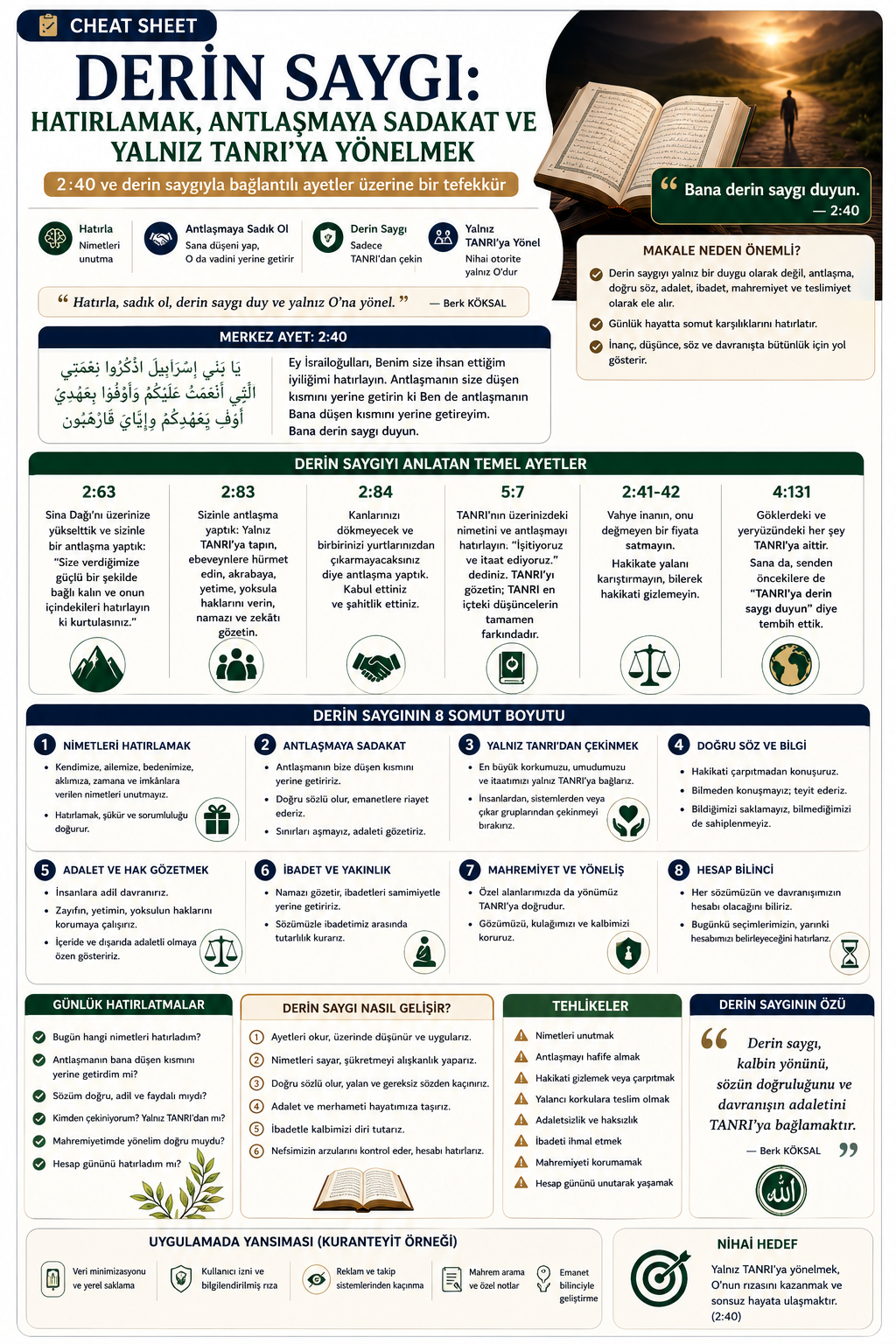
Note
2:32 — They said, “Be You glorified. We have no knowledge except that which You have taught us. You are the Omniscient, Most Wise.”
18:109 — Say, “If the ocean were ink for the words of my Lord, the ocean would run out before the words of my Lord run out, even if we doubled the ink supply.”
GOD knows best.
Source: kuranteyit.com
Deep Reverence Manifesto: 19 Steps After the Verses
- 2:40 — Remember the blessing; fulfill your part of the covenant and place the call “Reverence Me” at the center of your life.
- 5:44 — Preserve the boundary: “do not reverence the people; instead, reverence Me.”
- 9:119 — “be among the truthful.”
- 16:51 — “Reverence Me alone.”
- 23:2 — During the Contact Prayers, carry deep reverence not only in form but in the heart.
- 35:18 — Reverence your Lord even when alone in your privacy.
- 35:28 — As your knowledge increases, question whether your deep reverence increases as well.
- 39:23 — Do not harden before GOD’s message; allow your heart to soften.
- 49:10 — Maintain peace in your family and among the believers.
- 59:18 — “let every soul examine what it has sent ahead for tomorrow.”
- 64:16 — Reverence as much as you can; listen, obey, and give.
- 65:2 — Preserve justice and testimony even in separation.
- 67:12 — Continue in the same direction even when no one sees you.
- 71:13 — “strive to reverence GOD.”
- 76:7 — Fulfill your pledge.
- 79:40 — Restrain the self from sinful desires.
- 87:10 — Allow deep reverence to make you someone who takes heed and receives the reminder.
- 6:51 — Do not set up beside GOD another Lord and Master or an independent intercessor.
- 98:8 — At the end of the path, remember not only fear, but also GOD’s approval and the promise of peace.
Discover
Related Articles

Quran Reflections
Deep Reverence for GOD: Ego, Disrespect, and the Inner Reality of Crossing the Boundary
A reflection through verses Al-Baqarah 2:40, Al-Hujurat 49:1, Sad 38:76, Al-Furqan 25:43, and An-Nazi'at 79:40-41 on deep reverence for GOD, ego, pride, transgression, truthful speech, knowledge, privacy, submission, and the limits of human authority.
Read article
Quran Reflections
Gratitude: Are We Truly Grateful, or Are We Deceiving Ourselves?
A deep reflection centered on Al-Baqarah 2:152, on remembering, gratitude, ingratitude, accountability for blessings, righteousness, monotheism, knowledge, justice, submission, and testing one's own claim of gratitude before the verses.
Read article
Quran Reflections
Turning Back on Your Heels: Preserving Your Direction After Guidance
A reflection centered on Al-Baqarah 2:143 on turning back on one's heels, sliding back after guidance, leaving the faith, casting scripture behind one's back, testimony, knowledge, justice, truthfulness, submission, and the limits of religious authority.
Read article