[55:46, 56:11] Entering Paradise or Reaching the High Heaven? The Cost of Nearness
A 19-section reflection on Quran 55:46 and 56:11, exploring High Heaven, Lower Heaven, nearness to GOD, the heavenly society, animals, ego, and submission, with a separate study of Rashad Khalifa’s explanations.
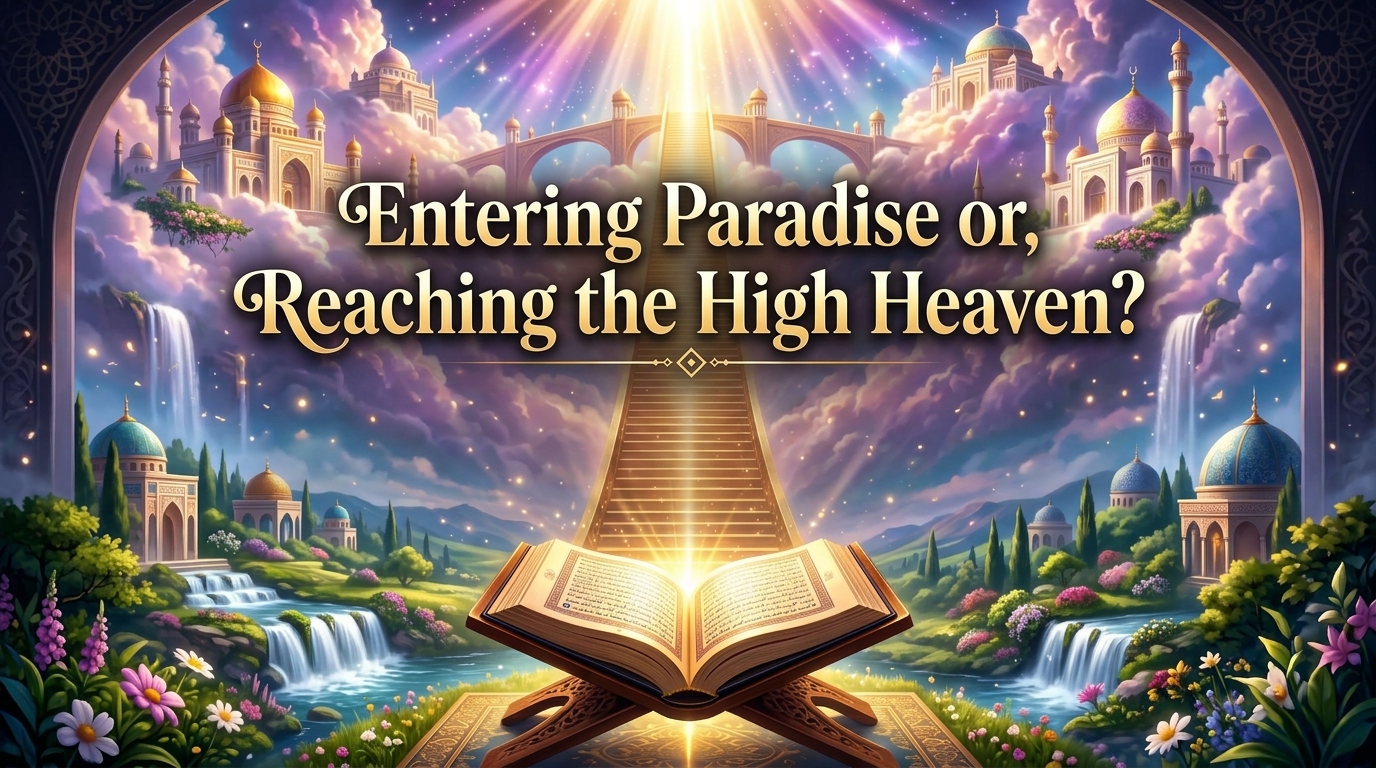
[55:46, 56:11] Entering Paradise or Reaching the High Heaven? The Cost of Nearness
A Nineteen-Part Reflection on Quran 55:46 and 56:11
Author: Berk KÖKSAL
Date: October 10, 2026
Location: Mersin
Verse
55:46
وَلِمَنْ خَافَ مَقَامَ رَبِّهِۦ جَنَّتَانِ
For those who reverence the majesty of their Lord, two gardens (one for the jinns and one for the humans).
İki bahçe (biri cinlere, biri de insanlara), Rablerinin haşmetine derin saygı duyanlar için.
Source: kuranteyit.com
Introduction
Greetings. Peace be upon you.
Before writing this article, I asked myself a question that is not entirely comfortable: if GOD promises Paradise, why think specifically about the High Heaven? Can a person become ungrateful by wishing for a higher reward? Or might a person diminish the responsibility of earthly life by refusing even to consider the possibility of greater nearness?
One reason this question has stayed with me is Rashad Khalifa’s account of the heavenly society. In his explanations, animals return to the Lower Heaven, while humans refuse a more straightforward opportunity for submission and undertake the earthly test. He also connects the High Heaven with greater nearness to GOD. Listening to him, I found myself asking: if we may have turned away from a safer path, should we now live by telling ourselves that any degree of Paradise will somehow be enough?
Yet I cannot turn that question into words the Quran has not spoken. In my earlier reflection on the High Society, I explored the boundary between what is disclosed and what I merely imagine. I want the same discipline here. I will first consider the gardens of 55:46 and 55:62 and the language of nearness in 56:11. Then I will consider animals, choice, ego, and why life on earth matters. Khalifa’s own explanations appear separately, under his name.
What this inquiry awakens in me is not a frantic competition but a sense of responsibility: never disparage Paradise, and still sincerely desire to draw nearer. I want that longing to change my speech, my work, my testimony, and my submission to GOD.
Summary:
1. The First Question: Entering Paradise or Being Brought Nearer?
55:46 — For those who reverence the majesty of their Lord, two gardens (one for the jinns and one for the humans).
56:11 — They are those who will be closest (to God).
2. Two Gardens, and Two More Below Them
55:46 — For those who reverence the majesty of their Lord, two gardens (one for the jinns and one for the humans).
55:62 — Below them are two gardens (one for the jinns and one for the humans).
3. Flowing Springs and Wells That Must Be Pumped
55:50 — Two springs are in them, flowing.
55:66 — In them, wells to be pumped.
4. The Variety of Fruit: A Reward Greater Than Its Inventory
55:52 — Of every fruit in them, two kinds.
55:68 — In them are fruits, date palms, and pomegranate.
32:17 — You have no idea how much joy and happiness are waiting for you as a reward for your (righteous) works.
5. Companionship, Nearness, and a Life We Have Not Seen
55:56 — Their beautiful mates were never touched by any human or jinn.
55:72 — Confined in the tents.
18:108 — Forever they abide therein; they will never want any other substitute.
6. Three Groups, and Those Brought Closest
56:7 — You will be stratified into three kinds.
56:10 — Then there is the elite of the elite.
56:11 — They are those who will be closest (to God).
56:12 — In the gardens of bliss.
7. The Right Side Is Not a Category to Despise
56:27 — Those of the right side, will be on the right side.
56:31 — Abundant water.
56:39 — Many from the early generations.
56:40 — Many from the later generations.*
8. Even Escaping Hell Is a Great Triumph
3:185 — Every person tastes death, then you receive your recompense on the Day of Resurrection. Whoever misses Hell, barely, and makes it to Paradise, has attained a great triumph. The life of this world is no more than an illusion.
32:17 — You have no idea how much joy and happiness are waiting for you as a reward for your (righteous) works.
9. Why Are the Differences in the Hereafter More Important?
17:21 — Note how we preferred some people above others (in this life). The differences in the Hereafter are far greater and far more significant.
4:95 — Not equal are the sedentary among the believers who are not handicapped, and those who strive in the cause of GOD with their money and their lives. GOD exalts the strivers with their money and their lives above the sedentary. For both, GOD promises salvation, but GOD exalts the strivers over the sedentary with a great recompense.
4:96 — The higher ranks come from Him, as well as forgiveness and mercy. GOD is Forgiver, Most Merciful.
10. The High Society: What Do I Know About a Beginning I Cannot Remember?
38:69 — “I had no knowledge previously, about the feud in the High Society.*
33:72 — We have offered the responsibility (freedom of choice) to the heavens and the earth, and the mountains, but they refused to bear it, and were afraid of it. But the human being accepted it; he was transgressing, ignorant.*
7:172 — Recall that your Lord summoned all the descendants of Adam, and had them bear witness for themselves: “Am I not your Lord?” They all said, “Yes. We bear witness.” Thus, you cannot say on the Day of Resurrection, “We were not aware of this.”
11. Animals Are Communities: What Does the Quran Say of Their Destiny?
6:38 — All the creatures on earth, and all the birds that fly with wings, are communities like you. We did not leave anything out of this book.** To their Lord, all these creatures will be summoned.
22:18 — Do you not realize that to GOD prostrates everyone in the heavens and the earth, and the sun, and the moon, and the stars, and the mountains, and the trees, and the animals, and many people? Many others among the people are committed to doom. Whomever GOD shames, none will honor him. Everything is in accordance with GOD’s will.
12. A Creation That Prostrates, and a Human Being Under Test
55:6 — The stars and the trees prostrate.
67:2 — The One who created death and life for the purpose of distinguishing those among you who would do better.* He is the Almighty, the Forgiving.
76:3 — We showed him the two paths, then, he is either appreciative, or unappreciative.
13. The First Obstacle: What Will an Aspirant Do with the Ego?
2:54 — Recall that Moses said to his people, “O my people, you have wronged your souls by worshiping the calf. You must repent to your Creator. You shall kill your egos. This is better for you in the sight of your Creator.” He did redeem you. He is the Redeemer, Most Merciful.
25:43 — Have you seen the one whose god is his own ego? Will you be his advocate?
14. Testimony and Oneness: The Direction of the Aspiration
36:60 — Did I not covenant with you, O Children of Adam, that you shall not worship the devil? That he is your most ardent enemy?
36:61 — And that you shall worship Me alone? This is the right path.
3:18 — GOD bears witness that there is no god except He, and so do the angels and those who possess knowledge. Truthfully and equitably, He is the absolute god; there is no god but He, the Almighty, Most Wise.
15. Reverence: Nearness Is Not a Performance
79:40 — As for the one who reverenced the majesty of his Lord, and enjoined the self from sinful lusts.
79:41 — Paradise will be the abode.
98:8 — Their reward at their Lord is the gardens of Eden with flowing streams, wherein they abide forever. GOD is pleased with them, and they are pleased with Him. Such is the reward for those who reverence their Lord.
16. Racing: Not Defeating Others, but Moving Toward the Right End
3:133 — You should eagerly race towards forgiveness from your Lord and a Paradise whose width encompasses the heavens and the earth; it awaits the righteous,
57:21 — Therefore, you shall race towards forgiveness from your Lord, and a Paradise whose width encompasses the heaven and the earth. It awaits those who believed in GOD and His messengers. Such is GOD’s grace that He bestows upon whomever He wills. GOD is Possessor of Infinite Grace.
83:26 — Its spice is like musk. This is what the competitors should compete for.
17. Faith, Effort, and the Refusal to Postpone Good
4:95 — Not equal are the sedentary among the believers who are not handicapped, and those who strive in the cause of GOD with their money and their lives. GOD exalts the strivers with their money and their lives above the sedentary. For both, GOD promises salvation, but GOD exalts the strivers over the sedentary with a great recompense.
4:96 — The higher ranks come from Him, as well as forgiveness and mercy. GOD is Forgiver, Most Merciful.
23:60 — As they give their charities, their hearts are fully reverent. For they recognize that they will be summoned before their Lord,
23:61 — They are eager to do righteous works; they compete in doing them.
18. Has the Road Closed for Someone Who Has Fallen?
3:135 — If they fall in sin or wrong their souls, they remember GOD and ask forgiveness for their sins—and who forgives the sins except GOD—and they do not persist in sins, knowingly.
39:53 — Proclaim: “O My servants who exceeded the limits, never despair of GOD’s mercy. For GOD forgives all sins. He is the Forgiver, Most Merciful.”
19. Which Paradise Am I Living Toward Today?
6:162 — Say, “My Contact Prayers (Salat), my worship practices, my life and my death, are all devoted absolutely to GOD alone, the Lord of the universe.
17:36 — You shall not accept any information, unless you verify it for yourself. I have given you the hearing, the eyesight, and the brain, and you are responsible for using them.
2:32 — They said, “Be You glorified, we have no knowledge, except that which You have taught us. You are the Omniscient, Most Wise.”
1. The First Question: Entering Paradise or Being Brought Nearer?
Verse
55:46 — For those who reverence the majesty of their Lord, two gardens (one for the jinns and one for the humans).
56:11 — They are those who will be closest (to God).
Reflection on the Verse
When I think of Paradise, I first think of rescue, peace, and the end of fear. Yet 55:46 opens another window. Before describing the gardens, it speaks about reverencing the majesty of one’s Lord. The promise begins with a human posture toward GOD.
Then 56:11 gives me the word that changes the question: nearness. Am I longing for Paradise merely because of what it contains, or do I long for closeness to the One who gives it? These desires need not be enemies. Still, I need to ask which one occupies the center of my heart.
Reflecting on the High Heaven is not a declaration that I deserve the highest reward. It is a question about how I live now. Do I genuinely value nearness to GOD, or have I reduced Paradise to the name of a place where my troubles will end?
Verse connections: 55:46, 56:11.
2. Two Gardens, and Two More Below Them
Verse
55:46 — For those who reverence the majesty of their Lord, two gardens (one for the jinns and one for the humans).
55:62 — Below them are two gardens (one for the jinns and one for the humans).
Reflection on the Verse
The phrase “Below them” in 55:62 makes me stop. The same sura first describes two gardens and then two more below them. I can at least say that the text itself presents a distinction; I have not invented it.
But those words alone do not give me a complete architectural plan of Paradise, a definitive list of its inhabitants, or a method of assigning particular people to particular gardens. The ease with which a picture forms in my imagination does not make that picture revelation.
Nor do I want “lower” to become an insult. Being in a lower garden is not the same as being disgraced. The verse still speaks of gardens. My question is not how to diminish someone else’s reward, but how not to be indifferent to the responsibility of seeking a greater good.
Verse connections: 55:46, 55:62.
3. Flowing Springs and Wells That Must Be Pumped
Verse
55:50 — Two springs are in them, flowing.
55:66 — In them, wells to be pumped.
Reflection on the Verse
The first gardens are described with flowing springs. The others are described with wells that must be pumped. The contrast is hard to miss, yet I cannot claim that I have been given an engineering diagram of the world to come.
For me, the significance is not the mechanics of heavenly plumbing. It is that the descriptions invite us to notice a difference in degree and abundance. The language suggests a contrast between freely flowing provision and provision requiring an action. Turning that suggestion into a fully literal mechanism would go further than I know.
I spend considerable energy trying to make temporary life more convenient. At the same time, I can postpone the effort of living closer to GOD. The image of the springs returns a difficult question to me: why do I work so hard for passing comforts and so little, at times, for lasting nearness?
Verse connections: 55:50, 55:66.
4. The Variety of Fruit: A Reward Greater Than Its Inventory
Verse
55:52 — Of every fruit in them, two kinds.
55:68 — In them are fruits, date palms, and pomegranate.
32:17 — You have no idea how much joy and happiness are waiting for you as a reward for your (righteous) works.
Reflection on the Verse
One description speaks of two kinds of every fruit; the other names particular fruits. I read those words, but I resist turning the promise into a shopping list. Verse 32:17 reminds me that I do not know the full extent of the happiness being prepared.
So the difference between the gardens cannot be exhausted by counting their provisions. The deeper question concerns the nearness, peace, and generosity contained in the promise. The verses describe real distinctions without claiming to exhaust the experience of the Hereafter.
I know from music that listing the instruments in a composition cannot convey the whole effect of hearing it. The fruits of Paradise should not be reduced to an inventory either. I can receive the language of the promise without pretending to know everything its fulfillment will feel like.
Verse connections: 55:52, 55:68, 32:17.
5. Companionship, Nearness, and a Life We Have Not Seen
Verse
55:56 — Their beautiful mates were never touched by any human or jinn.
55:72 — Confined in the tents.
18:108 — Forever they abide therein; they will never want any other substitute.
Reflection on the Verse
The descriptions of companionship also differ. But those differences do not authorize me to reconstruct the entire social life of Paradise. I cannot simply project the habits of this world into eternity and call the result knowledge.
Verse 18:108 says that the inhabitants of Paradise will never desire an alternative place. That matters here. A discussion of higher and lower gardens can quietly import the restless competition of earthly life into a promise that speaks of contentment. I have no right to define their peace through my own dissatisfaction.
Aspiring to the High Heaven makes sense not as rivalry with other people, but as a serious response to the possibility of growing nearer to GOD while I still have a life in which to choose and act.
Verse connections: 55:56, 55:72, 18:108.
6. Three Groups, and Those Brought Closest
Verse
56:7 — You will be stratified into three kinds.
56:10 — Then there is the elite of the elite.
56:11 — They are those who will be closest (to God).
56:12 — In the gardens of bliss.
Reflection on the Verse
Verse 56:7 speaks of three groupings. Then 56:10-12 gives special attention to the elite of the elite, those brought closest, in gardens of bliss. I read this sequence not merely as a ranking of rewards but as a warning about what I place at the center of life.
What arrests me is the emphasis on nearness in 56:11. The language turns from categories toward relationship with GOD. If I seek to be near Him, I cannot imagine Paradise as a possession detached from its Giver.
I do not read these verses as a certificate of rank issued in my name. The word “elite” would be misused if I turned it into permission to look down on others. Claiming to seek nearness is easy. Living with the humility that such a claim demands is the daily test.
Verse connections: 56:7, 56:10, 56:11, 56:12.
7. The Right Side Is Not a Category to Despise
Verse
56:27 — Those of the right side, will be on the right side.
56:31 — Abundant water.
56:39 — Many from the early generations.
56:40 — Many from the later generations.*
Reflection on the Verse
The description of those on the right includes water, shade, and abundance. It does not present their share as humiliation or deprivation. I want to keep that clear. If I belittle the Lower Heaven while aspiring to the High Heaven, I may forget gratitude for GOD’s mercy.
“There is no need for me to strive, so long as I enter Paradise somehow” is not the same statement as “The Lower Heaven has no value.” The first can be a necessary challenge to my complacency. The second can become an unwarranted judgment upon a gift from GOD.
I therefore want two attitudes to remain together. I will not diminish anyone else’s promised joy. I will also refuse to use the possibility of a lesser reward as an excuse for doing less than I can with the life entrusted to me.
Verse connections: 56:27, 56:31, 56:39, 56:40.
8. Even Escaping Hell Is a Great Triumph
Verse
3:185 — Every person tastes death, then you receive your recompense on the Day of Resurrection. Whoever misses Hell, barely, and makes it to Paradise, has attained a great triumph. The life of this world is no more than an illusion.
32:17 — You have no idea how much joy and happiness are waiting for you as a reward for your (righteous) works.
Reflection on the Verse
Verse 3:185 protects me from an important mistake: escaping Hell and reaching Paradise is called a great triumph. I cannot let a discussion of the High Heaven diminish that truth. I possess no earthly scale capable of measuring the greatness of such salvation.
So I need to correct one tempting formulation. Going to the Lower Heaven is not the risk; treating our earthly test carelessly is the risk. The danger does not arise from the existence of a lower garden. It can arise when I waste the time and responsibility I have been given. I do not know the rank that will be granted to me.
Verse 32:17 opens a vast unknown beyond my calculations. In its light, it would be wrong either to diminish Paradise or to distribute guarantees about the Hereafter. My part is to take the call seriously.
Verse connections: 3:185, 32:17.
9. Why Are the Differences in the Hereafter More Important?
Verse
17:21 — Note how we preferred some people above others (in this life). The differences in the Hereafter are far greater and far more significant.
4:95 — Not equal are the sedentary among the believers who are not handicapped, and those who strive in the cause of GOD with their money and their lives. GOD exalts the strivers with their money and their lives above the sedentary. For both, GOD promises salvation, but GOD exalts the strivers over the sedentary with a great recompense.
4:96 — The higher ranks come from Him, as well as forgiveness and mercy. GOD is Forgiver, Most Merciful.
Reflection on the Verse
Verse 17:21 asks me to notice that differences in the Hereafter are greater and more important than differences here. In this world I am quick to see who is better known, wealthier, or more powerful. Yet the verse does not tell me that such measures determine our eternal place.
Verses 4:95-96 distinguish those who strive from those who remain inactive and speak about higher ranks. I do not turn them into a demand for self-destruction through endless activity. I read them as a reminder that striving in GOD’s cause is not a trivial matter.
When I make music, merely completing a piece is not the same as giving it my genuine attention. With the Hereafter, the question is far more serious: am I living for recognition or for GOD? My effort matters, but I cannot appoint myself the judge of the rank another soul deserves.
Verse connections: 17:21, 4:95, 4:96.
10. The High Society: What Do I Know About a Beginning I Cannot Remember?
Verse
38:69 — “I had no knowledge previously, about the feud in the High Society.*
33:72 — We have offered the responsibility (freedom of choice) to the heavens and the earth, and the mountains, but they refused to bear it, and were afraid of it. But the human being accepted it; he was transgressing, ignorant.*
7:172 — Recall that your Lord summoned all the descendants of Adam, and had them bear witness for themselves: “Am I not your Lord?” They all said, “Yes. We bear witness.” Thus, you cannot say on the Day of Resurrection, “We were not aware of this.”
Reflection on the Verse
Verse 38:69 speaks of a feud in the High Society. Verse 33:72 speaks of a responsibility accepted by the human being. Verse 7:172 recalls testimony borne before our Lord. Together they make me consider whether my existence can be understood solely in terms of my date of birth.
But I must set a boundary. These verses do not themselves contain the sentence, “Humans refused the Lower Heaven and gambled on the High Heaven.” That is a developed part of Rashad Khalifa’s account of the heavenly society, which deserves its own clearly identified section below.
What I can say directly from the verses is more modest: there is an ancient dispute about which I have limited information, a weighty responsibility, and testimony already given. Perhaps my task is not to reconstruct every unseen scene, but to examine what I do with that testimony today.
Verse connections: 38:69, 33:72, 7:172.
11. Animals Are Communities: What Does the Quran Say of Their Destiny?
Verse
6:38 — All the creatures on earth, and all the birds that fly with wings, are communities like you. We did not leave anything out of this book.** To their Lord, all these creatures will be summoned.
22:18 — Do you not realize that to GOD prostrates everyone in the heavens and the earth, and the sun, and the moon, and the stars, and the mountains, and the trees, and the animals, and many people? Many others among the people are committed to doom. Whomever GOD shames, none will honor him. Everything is in accordance with GOD’s will.
Reflection on the Verse
Verse 6:38 says that land creatures and birds are communities like us and will be summoned to their Lord. That already prevents me from treating them as mere objects placed around me. Verse 22:18 also places animals, trees, mountains, stars, the sun, and the moon among those that prostrate.
But does the verse itself say that every animal will enter the Lower Heaven after death? Reading it on its own, I cannot derive a precise heavenly destination from the statement that they will be summoned. I located Rashad Khalifa saying explicitly that animals go to the Lower Heaven in a recorded lecture. That remains his explanation; it should not be inserted into the verse as though the verse itself had named their destination.
There is also an ethical consequence. I have no reason to look at an animal as worthless. Its relationship to GOD may extend beyond its usefulness to me. Would mercy toward created beings not be a more fitting response than boasting of my supposed superiority?
Verse connections: 6:38, 22:18.
12. A Creation That Prostrates, and a Human Being Under Test
Verse
55:6 — The stars and the trees prostrate.
67:2 — The One who created death and life for the purpose of distinguishing those among you who would do better.* He is the Almighty, the Forgiving.
76:3 — We showed him the two paths, then, he is either appreciative, or unappreciative.
Reflection on the Verse
The prostration of stars and trees need not resemble my own. Nevertheless, 55:6 speaks of their submission. Verse 67:2 places death and life in the context of a test, and 76:3 speaks of the human response to guidance: appreciation or ingratitude.
Together these verses make me feel the weight of human choice within a much larger creation. They do not, however, disclose every detail of the past lives of angels, animals, humans, and jinns.
The ability to choose is too easily turned into a reason for pride. The real question is not, “If I have freedom, am I superior?” It is, “If I can choose, how am I accountable for what I choose?” The aspiration to the High Heaven must never become a comforting story about my privileged status.
Verse connections: 55:6, 67:2, 76:3.
13. The First Obstacle: What Will an Aspirant Do with the Ego?
Verse
2:54 — Recall that Moses said to his people, “O my people, you have wronged your souls by worshiping the calf. You must repent to your Creator. You shall kill your egos. This is better for you in the sight of your Creator.” He did redeem you. He is the Redeemer, Most Merciful.
25:43 — Have you seen the one whose god is his own ego? Will you be his advocate?
Reflection on the Verse
The command to “Kill your ego” in 2:54 is easy to repeat and difficult to live. Verse 25:43 warns that a person can turn the ego itself into a god. Even my desire for the greatest reward could become another project of self-exaltation if I am not careful.
There is a world of difference between “I deserve the High Heaven” and “I want to draw nearer to GOD, so I need to change.” The first pronounces judgment over myself. The second recognizes error, deficiency, and unfinished learning.
If earthly life is understood as another chance, this is where the thought becomes uncomfortable. A second chance cannot be used merely to calculate a superior prize. I must confront what is hardest to admit about myself, turn away from wrong, and learn to live without crushing others. The High Heaven cannot become a new crown for my ego.
Verse connections: 2:54, 25:43.
14. Testimony and Oneness: The Direction of the Aspiration
Verse
36:60 — Did I not covenant with you, O Children of Adam, that you shall not worship the devil? That he is your most ardent enemy?
36:61 — And that you shall worship Me alone? This is the right path.
3:18 — GOD bears witness that there is no god except He, and so do the angels and those who possess knowledge. Truthfully and equitably, He is the absolute god; there is no god but He, the Almighty, Most Wise.
Reflection on the Verse
Verses 36:60-61 recall a clear covenant: do not worship the devil; worship GOD alone. Verse 3:18 places testimony to GOD’s oneness alongside knowledge and justice. I find no secret shortcut to Paradise in these verses. I find a plain demand for loyalty.
If I let a human being become the final source of religious authority, sanctify the demands of my ego, or conceal a truth for personal gain, perhaps monotheism has remained on my tongue while leaving my choices untouched. This is how I want to test my aspiration: who truly occupies the center of my life?
It would be contradictory to seek nearness to GOD while establishing rivals beside Him. I can respect people, read researchers, and learn from Rashad Khalifa’s reflections without handing any of them the authority that belongs to GOD alone.
Verse connections: 36:60, 36:61, 3:18.
15. Reverence: Nearness Is Not a Performance
Verse
79:40 — As for the one who reverenced the majesty of his Lord, and enjoined the self from sinful lusts.
79:41 — Paradise will be the abode.
98:8 — Their reward at their Lord is the gardens of Eden with flowing streams, wherein they abide forever. GOD is pleased with them, and they are pleased with Him. Such is the reward for those who reverence their Lord.
Reflection on the Verse
Verses 79:40-41 connect reverence for the Lord’s majesty and restraint of sinful desire with Paradise. The ending of 98:8 affects me even more: GOD is pleased with them, and they are pleased with Him.
Here nearness means something deeper to me than owning a greater amount of provision. It suggests the direction of a servant who wants to glorify GOD rather than glorify the self. Motives can become distorted even while someone appears devout. I cannot see the contents of another person’s striving, and I must continue examining my own.
In my earlier reflection on Deep Reverence for GOD, I considered reverence as more than a feeling: it is also knowing a boundary. If my longing for the High Heaven is real, it ought to affect how I respect those boundaries now.
Verse connections: 79:40, 79:41, 98:8.
16. Racing: Not Defeating Others, but Moving Toward the Right End
Verse
3:133 — You should eagerly race towards forgiveness from your Lord and a Paradise whose width encompasses the heavens and the earth; it awaits the righteous,
57:21 — Therefore, you shall race towards forgiveness from your Lord, and a Paradise whose width encompasses the heaven and the earth. It awaits those who believed in GOD and His messengers. Such is GOD’s grace that He bestows upon whomever He wills. GOD is Possessor of Infinite Grace.
83:26 — Its spice is like musk. This is what the competitors should compete for.
Reflection on the Verse
Verses 3:133 and 57:21 urge a race toward forgiveness and Paradise; 83:26 also gives direction to the act of competing. My ordinary reflex is to think about speed, achievement, and being seen ahead of others. But the finish line here is not public applause.
For me this race means refusing to postpone a truth I already understand, admitting a mistake instead of defending it, helping when I can, and remembering GOD beyond moments of convenience. Someone else’s failure does not count as my progress. Someone else’s fall does not bring me nearer to GOD.
The most substantial road I can describe toward the High Heaven is not a magical technique. It is faithfulness to the opportunities of a life that will not last forever. I do not determine the result, but neither should I continually postpone the effort that is mine to make.
Verse connections: 3:133, 57:21, 83:26.
17. Faith, Effort, and the Refusal to Postpone Good
Verse
4:95 — Not equal are the sedentary among the believers who are not handicapped, and those who strive in the cause of GOD with their money and their lives. GOD exalts the strivers with their money and their lives above the sedentary. For both, GOD promises salvation, but GOD exalts the strivers over the sedentary with a great recompense.
4:96 — The higher ranks come from Him, as well as forgiveness and mercy. GOD is Forgiver, Most Merciful.
23:60 — As they give their charities, their hearts are fully reverent. For they recognize that they will be summoned before their Lord,
23:61 — They are eager to do righteous works; they compete in doing them.
Reflection on the Verse
Verses 4:95-96 distinguish degrees of striving among believers, while 23:60-61 describes people eager to do righteous works and quick to pursue them. This energy is not empty ambition. It belongs to people aware that they will be gathered before their Lord.
Aspiring to the High Heaven cannot, in my view, mean collecting more religious information while leaving my conduct unchanged. Knowledge stored but not lived becomes another possession. Truthful speech, fairness, trustworthiness, generosity, appreciation, and submission are where knowledge begins to change a life.
I can miss a small opportunity for goodness while searching for a spectacular one. Yet respecting a person’s rights, finishing honest work, and refusing unjust gain all concern my direction. I do not treat these as guaranteed tickets to the highest rank. They are part of the responsibility of trying to live more faithfully before GOD.
Verse connections: 4:95, 4:96, 23:60, 23:61.
18. Has the Road Closed for Someone Who Has Fallen?
Verse
3:135 — If they fall in sin or wrong their souls, they remember GOD and ask forgiveness for their sins—and who forgives the sins except GOD—and they do not persist in sins, knowingly.
39:53 — Proclaim: “O My servants who exceeded the limits, never despair of GOD’s mercy. For GOD forgives all sins. He is the Forgiver, Most Merciful.”
Reflection on the Verse
I do not want a discussion of the High Heaven to become an accumulation of fear. Verse 3:135 speaks of people who do wrong, remember GOD, seek forgiveness, and refuse to persist knowingly in sin. Verse 39:53 refuses despair.
I therefore cannot conclude, “I have made mistakes, so I can no longer seek a greater closeness.” Wrongdoing should not be trivialized; where I have caused harm, I have responsibilities, and change can be difficult. But it is not for me to cancel the possibility of returning.
The search for higher nearness does not begin by denying my past. It begins by facing it truthfully and living differently now. This is the hopeful side of my question: while I am still alive, can I still turn toward what is right? The verses invite me not to despair, but to remember and to return.
Verse connections: 3:135, 39:53.
19. Which Paradise Am I Living Toward Today?
Verse
6:162 — Say, “My Contact Prayers (Salat), my worship practices, my life and my death, are all devoted absolutely to GOD alone, the Lord of the universe.
17:36 — You shall not accept any information, unless you verify it for yourself. I have given you the hearing, the eyesight, and the brain, and you are responsible for using them.
2:32 — They said, “Be You glorified, we have no knowledge, except that which You have taught us. You are the Omniscient, Most Wise.”
Reflection on the Verse
Verse 6:162 directs life and death to GOD alone. Verse 17:36 recalls the obligation to verify what I claim to know. Verse 2:32 shows the angels acknowledging that they know only what they have been taught. Together these verses give this reflection both a direction and a limit.
I want to seek the High Heaven. I will not hide that longing. But I cannot allow it to turn me into someone who makes hasty pronouncements, guarantees rewards, or measures the destiny of others. Trying today to become more sincere, fair, truthful, attentive, and submitted is at least a responsibility I can recognize.
I ask myself again: how much do I know about life after death? Very little. What can I do about the One to whom I dedicate my present life? Much, today. So this inquiry ceases to be a calculation of heavenly addresses. I want to belong to GOD, and I hope for greater nearness through His grace.
Verse connections: 6:162, 17:36, 2:32.
Rashad Khalifa’s Reflections on High Heaven, Lower Heaven, and Animals
Verse
38:69 — “I had no knowledge previously, about the feud in the High Society.*
33:72 — We have offered the responsibility (freedom of choice) to the heavens and the earth, and the mountains, but they refused to bear it, and were afraid of it. But the human being accepted it; he was transgressing, ignorant.*
6:38 — All the creatures on earth, and all the birds that fly with wings, are communities like you. We did not leave anything out of this book.** To their Lord, all these creatures will be summoned.
55:46 — For those who reverence the majesty of their Lord, two gardens (one for the jinns and one for the humans).
55:62 — Below them are two gardens (one for the jinns and one for the humans).
56:11 — They are those who will be closest (to God).
3:185 — Every person tastes death, then you receive your recompense on the Day of Resurrection. Whoever misses Hell, barely, and makes it to Paradise, has attained a great triumph. The life of this world is no more than an illusion.
46:15 — We enjoined the human being to honor his parents. His mother bore him arduously, gave birth to him arduously, and took intimate care of him for thirty months. When he reaches maturity, and reaches the age of forty,* he should say, “My Lord, direct me to appreciate the blessings You have bestowed upon me and upon my parents, and to do the righteous works that please You. Let my children be righteous as well. I have repented to You; I am a submitter.”
17:36 — You shall not accept any information, unless you verify it for yourself. I have given you the hearing, the eyesight, and the brain, and you are responsible for using them.
Reflection on the Verse
Among the most substantial accounts behind this question are the reflections of Rashad Khalifa. I want to give them a separate place here, not simply to borrow an interpretation, but because they connect three questions that I cannot easily separate: Why are humans on earth? What becomes of animals? And what distinguishes the High Heaven from the Lower Heaven? His account forms a framework against which I can examine my own assumptions. At every point, though, the text of a Quran verse, a footnote, an appendix, and a recorded lecture must remain distinguishable kinds of evidence.
The heavenly dispute: Appendix 7 and the Introduction
In Appendix 7, Why Were We Created?, Khalifa interprets the feud mentioned in 38:69 as a rebellion against GOD’s absolute authority, centered on Satan’s claim. He describes different responses among the heavenly creatures: angels who upheld that authority; creatures represented by animals who regretted rebellion and accepted submission; and humans and jinns who remained implicated in the dispute. A fuller account of these classifications appears in the Introduction to his translation.
I need to preserve a distinction here. Verse 38:69 reports a dispute; it does not enumerate every prior decision of four categories of beings. Verse 33:72 speaks of responsibility, but it does not reproduce a full conversation in which humans are explicitly offered a particular rank of Paradise and reject it. Khalifa’s historical reconstruction comes from reading passages together. I may find the reconstruction compelling without turning it into the literal wording of revelation.
The May 11, 1989 lecture: Animals and the Lower Heaven
The clearest direct statement I found appears in Khalifa’s recorded Quran Study 49 talk, dated May 11, 1989. Around 23:13-24:17, he describes the vast majority of rebellious beings as having repented and submitted to GOD, associating this choice with animals, trees, mountains, and stars. He also invokes 55:6.
Around 27:34-28:14, he says that humans rejected the option of coming to earth as animals living in submission. He mentions dogs, horses, cats, and mice, and connects the refusal to human ego and excessive confidence in one’s own ability to choose correctly. At roughly 28:26, he states plainly that these creatures go to the Lower Heaven. At roughly 28:51, he speaks of the human who upholds GOD’s absolute authority reaching the High Heaven. He stresses the difference between the two.
I attribute those statements to him rather than inserting them into 6:38. The verse says that creatures and birds are communities like us and will be summoned to their Lord; it does not explicitly name the level of Paradise where every animal will reside. Khalifa’s lecture supplies his answer to that question, not an additional sentence in the Quran. Nor is the desire for a higher Heaven presented as the only explanation for humanity’s refusal in his account: ego and confidence in the self play significant roles.
Appendix 5: The difference is more than a change of name
In Appendix 5, Heaven and Hell, Khalifa reads Sura 55 as describing two High Heavens and two Lower Heavens, connected respectively with humans and jinns. He compares the freely flowing springs with the wells that must be pumped (55:50; 55:66), the fruit descriptions (55:52; 55:68), and the descriptions of companionship (55:56; 55:72). He treats such depictions as allegorical language pointing toward a reality we cannot adequately imagine from earthly experience.
Importantly, the same appendix describes reaching even the Lower Heaven as a great triumph for someone spared Hell, connecting this to 3:185. This correction matters deeply to my argument. Seeking the High Heaven cannot require scorning the Lower Heaven as worthless. Khalifa’s own written account does not require such contempt.
Appendix 11: Nearness is the central distinction
Appendix 11, The Day of Resurrection, explains the ranks of humans and jinns in terms of the development of the soul. In this account, those who nourish their souls through worshiping GOD alone, believing in the Hereafter, and righteous living can endure greater closeness to GOD. Those who have developed less belong to a lower level. The High Heaven is therefore not simply the neighborhood with the most possessions. The heart of the contrast is nearness.
When I read that alongside 56:11, the question becomes more personal. What I desire is not merely a larger garden; I want to become a servant able to draw nearer to GOD. I do not know the full measure by which such nearness will be determined. Nor can I read a person’s spiritual degree from appearance. Khalifa’s explanation is most useful to me as a challenge to my own direction, not as a license to rank other people.
Appendix 32: The age of forty as a specific interpretation
In Appendix 32, The Crucial Age of 40, Khalifa treats forty as a special threshold of accountability. He gives an explanation of salvation for people who die before that age and distinguishes between those who, in his view, developed their souls enough for the High Heaven and others destined for the Lower Heaven. He draws this understanding in part from 46:15. But the explicit mention of forty in 46:15 is not identical with every conclusion he draws about a person’s eternal destination.
That distinction matters. Reflecting on divine mercy and hope is one thing; keeping a definitive register of the final destiny of individual people is another. I can report his interpretation faithfully without presenting it as a judgment that I myself have been empowered to issue on GOD’s behalf.
Where, then, is the risk?
The part of this account that most unsettles me is the possibility that, if a straightforward form of submission was refused in the heavenly society, the human test became both an extraordinary opportunity and a grave risk. If a desire for higher nearness helped motivate that choice, what happens when the very ego that obstructed the simpler path continues ruling our lives on earth?
But I cannot say, “Going to the Lower Heaven is an unnecessary risk.” The Lower Heaven is not the risk. The risk is what we do with the freedom and responsibility of this life. Verse 3:185 calls reaching Paradise a great triumph; verse 56:11 invites reflection on exceptional nearness. Both can remain true in my mind: never despise salvation, and never use the possibility of salvation as an excuse for indifference.
Listening to Khalifa’s talk, I ask myself one final question. If I fear that I once let an opportunity slip away, why would I turn this one into another performance by my ego? Why should longing for the High Heaven make me think I am already superior? What seems more fitting is to long for nearness and to let that longing change how I love, speak truthfully, act fairly, and submit.
Verse connections: 38:69, 33:72, 6:38, 55:46, 55:62, 56:11, 3:185, 46:15, 17:36. The accounts attributed to Rashad Khalifa are interpretations found in the linked written explanations and recorded lecture, not the wording of Quran verses.
The Arabic Roots of Key Words
Verse
55:46 — For those who reverence the majesty of their Lord, two gardens (one for the jinns and one for the humans).
55:62 — Below them are two gardens (one for the jinns and one for the humans).
56:10 — Then there is the elite of the elite.
56:11 — They are those who will be closest (to God).
17:21 — Note how we preferred some people above others (in this life). The differences in the Hereafter are far greater and far more significant.
Reflection on the Verse
Roots should not become a hunt for hidden knowledge detached from the verses. Used carefully, however, they can make the direction of a passage clearer. In 55:46, خَافَ (khāfa) belongs to the root خ و ف, associated with fear and reverence. مَقَامَ (maqām) is related to ق و م, with meanings involving standing, station, and place. Reverence in this verse concerns how one stands before the majesty of one’s Lord.
جَنَّتَانِ (jannatān) means two gardens and belongs to the semantic field of the root ج ن ن, associated with covering and enclosed gardens. The expression دُونِهِمَا (dūnihimā) in 55:62 can point to a relation of being below, apart from, or at a lesser position. Rashad Khalifa’s Authorized English Translation renders the relevant expression “Below them”; its Turkish translation uses “Onların altında.” That is where the language of relative position enters the argument.
In 56:10, السَّابِقُونَ (as-sābiqūn) comes from س ب ق, an area of meaning that includes going ahead and preceding. In 56:11, الْمُقَرَّبُونَ (al-muqarrabūn) is connected with ق ر ب, nearness. The language of degrees in 17:21 is related to د ر ج. These are rich semantic fields; they do not function as secret keys from which to manufacture a new map of the Hereafter. They do help me see why racing, degrees, reverence, and nearness can belong to one coherent reflection.
Verse connections: 55:46, 55:62, 56:10, 56:11, 17:21.
Other Claims
Verse
55:46 — For those who reverence the majesty of their Lord, two gardens (one for the jinns and one for the humans).
55:62 — Below them are two gardens (one for the jinns and one for the humans).
32:17 — You have no idea how much joy and happiness are waiting for you as a reward for your (righteous) works.
3:185 — Every person tastes death, then you receive your recompense on the Day of Resurrection. Whoever misses Hell, barely, and makes it to Paradise, has attained a great triumph. The life of this world is no more than an illusion.
Reflection on the Verse
Some traditional readings understand the differences in Paradise primarily as degrees or spiritual stations rather than wholly separate territories. Others emphasize how the gardens in 55:46 and 55:62 complement one another. Some commentators seek more concrete meanings for the springs, fruit, and companionship. These approaches belong to the history of interpretation; I do not wish to make an inherited map of Paradise the foundation of this reflection.
Another disagreement concerns the destiny of animals. Some approaches understand their gathering as part of divine judgment without committing to an eternal heavenly rank. Rashad Khalifa, as discussed separately, understands them as examples of submission destined for the Lower Heaven. Neither view may alter the actual statement of 6:38: the creatures will be summoned. Claims about precise locations belong to interpretation unless explicitly supplied by the verse.
I hold these positions cautiously beside three anchors: 55:46 and 55:62 provide distinct garden descriptions; 32:17 reminds me how much of the reward remains beyond my knowledge; and 3:185 calls reaching Paradise a great triumph. Issuing final verdicts about the destinations of other souls would claim an authority this reflection has not been given.
Verse connections: 55:46, 55:62, 32:17, 3:185.
Conclusion
Verse
56:11 — They are those who will be closest (to God).
55:46 — For those who reverence the majesty of their Lord, two gardens (one for the jinns and one for the humans).
55:62 — Below them are two gardens (one for the jinns and one for the humans).
3:185 — Every person tastes death, then you receive your recompense on the Day of Resurrection. Whoever misses Hell, barely, and makes it to Paradise, has attained a great triumph. The life of this world is no more than an illusion.
3:133 — You should eagerly race towards forgiveness from your Lord and a Paradise whose width encompasses the heavens and the earth; it awaits the righteous,
36:61 — And that you shall worship Me alone? This is the right path.
98:8 — Their reward at their Lord is the gardens of Eden with flowing streams, wherein they abide forever. GOD is pleased with them, and they are pleased with Him. Such is the reward for those who reverence their Lord.
Reflection on the Verse
I can now answer my opening question more carefully. Entering Paradise or reaching the High Heaven? I do not want to set one against the other. Verse 3:185 calls entering Paradise a great triumph. Yet the distinct gardens of 55:46 and 55:62, and the people brought nearest in 56:11, open a deeper horizon for how I live.
In Rashad Khalifa’s account of the heavenly society, humanity turns away from a more straightforward form of submission and enters a demanding earthly test. I cannot attribute every detail of that narrative directly to a verse. Nevertheless, it confronts me with a powerful personal question: if ego caused an easier opportunity to be refused, will I now surrender this opportunity to the same ego? Do I want the High Heaven because I long to be near GOD, or because I still long to think myself superior?
I want to aspire to the High Heaven today. I say this as an intention about my direction, not as a claim of rank. More truthfulness, more justice, more appreciation, deeper submission: these are not items on a bargaining list. They are ways in which a servant who belongs to GOD tries to keep life and speech together.
I will not belittle GOD’s mercy. I will not scorn the Lower Heaven. But neither do I want to waste the days entrusted to me by telling myself that I will somehow be saved anyway. I want to hear the call to race in 3:133 as a reason not to delay what is good, not as permission to defeat or disparage other people.
At the beginning I was looking for a place. Now I am looking for a direction. I do not know what degree will be given to me, nor can I appoint myself the judge of GOD’s final decision. I can, however, let the longing for nearness change the person I try to be today. My deepest hope is not merely to occupy a higher location, but to be among the servants with whom GOD is pleased.
Verse connections: 56:11, 55:46, 55:62, 3:185, 3:133, 36:61, 98:8.
Note
2:32 — They said, “Be You glorified, we have no knowledge, except that which You have taught us. You are the Omniscient, Most Wise.”
GOD knows best.
Source: kuranteyit.com
Discover
Related Articles

Quran Reflections
[1:1] Overcoming Negative Thoughts: Seeking Refuge in GOD and Trusting Him
A 19-section Quran reflection centered on 1:1, exploring negative thoughts, whispering, seeking refuge in GOD, trust, mercy, steadfastness, knowledge, testimony, and submission.
Read article
Quran Reflections
[44:10–16] The Smoke Retribution: A Warning from the Sky, a Return to Old Ways
A 19-section reflection on Quran 44:10–16, exploring smoke retribution, divine warnings, repentance, returning to old ways, the messenger, mercy, justice, and submission, including a separate examination of Rashad Khalifa’s 1986 and 1990 interpretations.
Read article
Quran Reflections
[43:36] Who Is the Jinn Companion? Its Role, Repentance, Paradise, and Final Accountability
A deep 19-part reflection on the jinn companion, its misleading influence, moral agency, repentance, possible redemption, relations with other jinn, just recompense, and Rashad Khalifa’s personal views.
Read article