How Can Tawhid Be Distorted by a Single Word? One GOD or 'Highest of the High'?
A deep reflection through Al-Baqarah 2:255 and 15 verses in which the same translation pattern recurs, examining the difference between "Most High" and "Highest of the High"; tawhid, translation fidelity, verification, testimony, speaking about GOD without knowledge, grammar, intercession, sovereignty, and religious authority.

How Can Tawhid Be Distorted by a Single Word?
One GOD or “Highest of the High”?
A Reflection on the Phrase “He Is the Most High, the Great” in 2:255, Tawhid, and the Responsibility of Translation
Author: Berk KÖKSAL
Date: 10.08.2026
Location: Mersin
Verse
1:1 — In the name of GOD, Most Gracious, Most Merciful.*
Introduction
Peace. Peace be upon you.
Sometimes a single word in a translation is not merely a word. It can change the direction of a sentence, create a new category in the reader’s mind, and suggest a relationship that does not exist in the source text. When the subject is how GOD is described, the translator’s responsibility becomes even heavier. The issue here is not producing elegant Turkish; it is carrying what the revelation says as faithfully as possible.
As a mix and mastering engineer, I have heard many times how a small intervention can change the whole. Raising a vocal by only a few decibels can push other layers backward; overworking one frequency can shift the center of a track without the listener immediately noticing. A word can work the same way in translation. It may look small on its own, but if it changes the relationship map of the sentence, it is no longer merely one word.
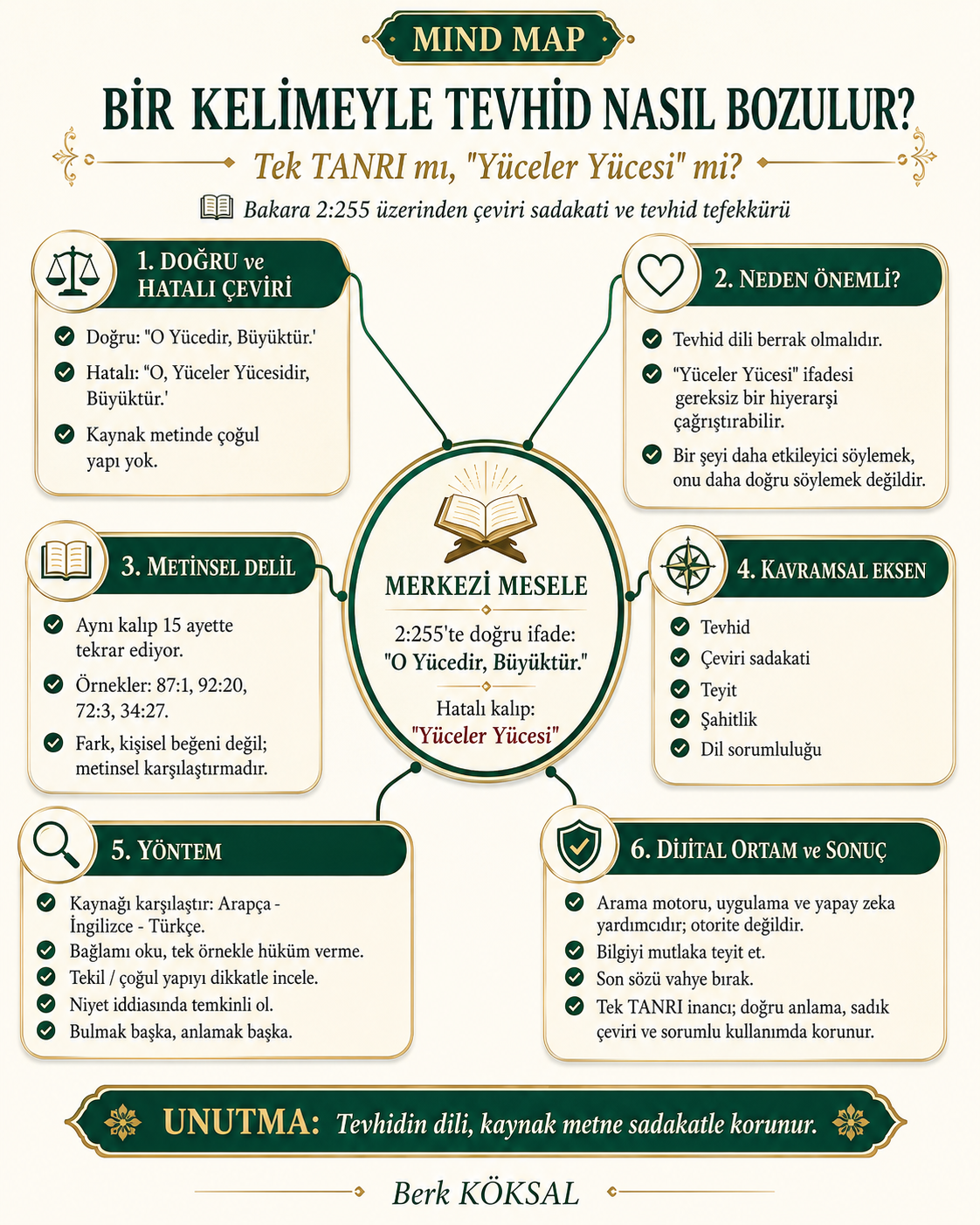
The starting point of this article is the end of Al-Baqarah 2:255. The CORRECT Turkish translation of the Authorized English Text ends with “O Yücedir, Büyüktür.” The English text carries the same structure with two singular descriptions: “He is the Most High, the Great.” By contrast, the incorrect Turkish text uses “O, Yüceler Yücesidir, Büyüktür.” At first glance, this may appear to be merely a more ornate Turkish expression. Yet in a text centered on tawhid, turning the singular quality “Yüce” into the phrase “Yüceler Yücesi” introduces a plural class of “yüceler” into the Turkish sentence—a class that is not present in the source text.
At this point a simple but weighty question arises in my mind: If GOD is the “Yücesi” in the phrase, then who are the “yüceler”? Is such a plural group present in the source verse? Is it present in the English rendering? Is it present in the Arabic structure? These questions move beyond a dispute about one word and become a matter of testimony, because when we speak about GOD, what we say must truly rest on what He has declared.
The central purpose of this article is to think about these verses together with other related verses and to express, sincerely and deeply, what bearing witness to the oneness of GOD means in human life in terms of knowledge, justice, truthfulness, and submission. Before reading intention into a translation error, I will look at what the resulting text actually says. Passing a definite judgment about a person’s inner state is one thing; showing that a layer of meaning not found in the source has entered a translation is another. The firm measure given by the verses is enough for us to be careful and clear about the latter.
For that reason, this issue should be guided not by anger but by awareness of accountability before the verse. Losing justice even while defending the name of GOD, or making GOD say what we do not know while speaking in the name of tawhid, would reproduce the very kind of error we are trying to correct. The central question in this article is therefore: What does the verse say, what does the translation say, and how does the difference affect the consciousness of tawhid?
I also do not want to leave my own position of belief unclear. I accept the English text presented by Rashad Khalifa as the Authorized Translation that came through GOD’s Messenger of the Covenant, and I am confident in its correctness. This article does not reopen the Authorized English Text for judgment; it examines a specific difference that arose in its Turkish rendering. Nor do I use Kuranteyit to set up a new religious authority against that text, but to understand the text I accept more carefully, to see Turkish renderings side by side, and to carry my own responsibility of understanding with greater discipline.
When I use the expression “incorrect text” in this article, I am also stating my criterion clearly: a faithful Turkish rendering of the Authorized English Text. I am not debating how powerful a free literary adaptation may sound. I am asking why, when the source contains a singular description, it was turned into a plural construction in Turkish; what that change adds; and what it may evoke.
The severity of the title should also be read within this boundary. When I ask, “How can tawhid be distorted by a single word?” I am not claiming that everyone who uses this expression loses faith because of one word. My question is more measurable: In a text where tawhid is established with exceptional clarity, can the language of tawhid become blurred when a plural structure absent from the source enters the translation? Judging a person’s intention and ultimate state of belief is one thing; showing a shift of meaning in translation is another.
This issue brings together four lines I previously explored in Is Comparing Quran Translations Doubt or Responsibility?, The Weight of Testimony, Expressing Tawhid in the Language of the Age, and Mizan: verification, testimony, the boundary between form and message, and measure. I return here to the same principle: Saying something more impressively does not mean saying it more accurately.
Summary:
1. 2:255: The Unity Tawhid Establishes from the Beginning to the End of the Sentence
2:255
ٱللَّهُ لَآ إِلَٰهَ إِلَّا هُوَ ٱلْحَىُّ ٱلْقَيُّومُ لَا تَأْخُذُهُۥ سِنَةٌ وَلَا نَوْمٌ لَّهُۥ مَا فِى ٱلسَّمَٰوَٰتِ وَمَا فِى ٱلْأَرْضِ مَن ذَا ٱلَّذِى يَشْفَعُ عِندَهُۥٓ إِلَّا بِإِذْنِهِۦ يَعْلَمُ مَا بَيْنَ أَيْدِيهِمْ وَمَا خَلْفَهُمْ وَلَا يُحِيطُونَ بِشَىْءٍ مِّنْ عِلْمِهِۦٓ إِلَّا بِمَا شَآءَ وَسِعَ كُرْسِيُّهُ ٱلسَّمَٰوَٰتِ وَٱلْأَرْضَ وَلَا يَـُٔودُهُۥ حِفْظُهُمَا وَهُوَ ٱلْعَلِىُّ ٱلْعَظِيمُ
GOD: there is no other god besides Him, the Living, the Eternal. Never a moment of unawareness or slumber overtakes Him. To Him belongs everything in the heavens and everything on earth. Who could intercede with Him, except in accordance with His will? He knows their past, and their future. No one attains any knowledge, except as He wills. His dominion encompasses the heavens and the earth, and ruling them never burdens Him. He is the Most High, the Great.
GOD: there is no other god besides Him, the Living, the Eternal. Never a moment of unawareness or slumber overtakes Him. To Him belongs everything in the heavens and everything on earth. Who could intercede with Him, except in accordance with His will? He knows their past and their future. No one attains any knowledge except as He wills. His dominion encompasses the heavens and the earth, and ruling them never burdens Him. He is the Most High, the Great.
2. The Spread of the Same Pattern: From a Single Choice to a Systematic Shift in Meaning
4:34 — Men are made responsible for women,** and GOD has endowed them with certain qualities and made them providers. The righteous women will willingly accept this arrangement as GOD's command and honor their husbands during their absence. If you experience rebellion from the women, first talk to them, then you may resort to negative incentives such as abandoning them in bed, then—as a last alternative—you may beat them. If they obey you, you are not permitted to transgress against them. GOD is Most High, Supreme.
6:100 — Yet they set up idols from among the jinn beside GOD, though He is the One who created them. They even attribute sons and daughters to Him without any knowledge. Be He glorified. He is far above their claims, Most High.
10:18 — They worship beside GOD idols that possess no power to harm or benefit them, and they say, “These are our intercessors at GOD!” Say, “Are you informing GOD of something He does not know in the heavens or on earth?” Be He glorified. He is far above needing partners, Most High.
13:9 — Knower of all secrets and declarations; the Supreme, the Most High.
16:1 — GOD's command has already been issued (and everything has already been written), so do not rush it.* Be He glorified; Most High above any idol they set up.
22:62 — This establishes the fact that GOD is the Truth, while setting up any idol beside Him constitutes falsehood, and GOD is Most High, Supreme.
31:30 — This proves that GOD is the Truth, that any idol they set up beside Him is falsehood, and that GOD is Most High, the Most Great.
34:23 — Intercession with Him will be futile unless it accords with His will. When their minds finally settle and they ask, “What did your Lord say?” they will say, “The truth.” He is Most High, the Most Great.
40:12 — This is because when GOD ALONE was advocated, you disbelieved, but when others were mentioned beside Him, you believed. Therefore GOD's judgment has been issued; He is Most High, Great.
42:4 — To Him belongs everything in the heavens and everything on earth; He is Most High, Great.
42:51 — No human being can communicate with GOD except through inspiration, or from behind a barrier, or by sending a messenger through whom He reveals whatever He wills. He is Most High, Most Wise.
72:3 — “Our one Lord is the Most High. He has never had a wife, nor a son.
87:1 — Glorify the name of your Most High Lord.
92:20 — Seeking only his Most High Lord.
3. One GOD: The Clear and Repeated Language of Oneness
2:163 — Your god is one god; there is no god except Him, Most Gracious, Most Merciful.
3:2 — GOD: there is no god except Him; the Living, the Eternal.
4:87 — GOD: there is no god except Him. He will surely summon you on the inevitable Day of Resurrection. Whose narration is more truthful than GOD's?
5:73 — Pagans indeed are those who say that GOD is a third of a trinity. There is no god except the one god. Unless they refrain from saying this, the disbelievers among them will incur a painful retribution.
6:3 — He is the one GOD in the heavens and on earth. He knows your secrets and your declarations, and He knows everything you earn.
28:70 — He is the one GOD; there is no other god beside Him. To Him belongs all praise in this first life and in the Hereafter. All judgment belongs to Him, and to Him you will be returned.
34:27 — Say, “Show me those idols you have set up as partners with Him!” Say, “No; He is the one GOD, the Almighty, Most Wise.”
4. GOD ALONE: A Measure for the Tendency to Place Other Names Beside Him
39:45 — When GOD ALONE is mentioned, the hearts of those who do not believe in the Hereafter shrink with aversion. But when others are mentioned beside Him, they become satisfied.*
40:12 — This is because when GOD ALONE was advocated, you disbelieved, but when others were mentioned beside Him, you believed. Therefore GOD's judgment has been issued; He is Most High, Great.
6:19 — Say, “Whose testimony is the greatest?” Say, “GOD's. He is a witness between me and you that this Quran* has been inspired to me, to preach it to you and to whomever it reaches. Indeed, you bear witness that there are other gods* beside GOD.” Say, “I do not bear the kind of witness you bear; there is only one god, and I disown your idolatry.”
10:66 — Absolutely, everyone in the heavens and everyone on earth belongs to GOD. Those who set up idols beside GOD are really following nothing. They only think they are following something. They only guess.
5. The Weight of Testimony: Every Word We Say About GOD Is a Testimony
3:18 — GOD bears witness that there is no god except Him, and so do the angels and those who possess knowledge. Truthfully and equitably, He is the absolute god; there is no god except Him, the Almighty, Most Wise.
6:19 — Say, “Whose testimony is the greatest?” Say, “GOD's. He is a witness between me and you that this Quran* has been inspired to me, to preach it to you and to whomever it reaches. Indeed, you bear witness that there are other gods* beside GOD.” Say, “I do not bear the kind of witness you bear; there is only one god, and I disown your idolatry.”
2:140 — Do you say that Abraham, Ismail, Isaac, Jacob, and the Patriarchs were Jewish or Christian? Say, “Do you know better than GOD? Who is more evil than one who conceals a testimony learned from GOD? GOD is never unaware of anything you do.”
6. Saying About GOD What You Do Not Know: The Grave Boundary Set by 2:169
2:169 — He only commands you to commit evil and vice, and to say about GOD what you do not know.
6:100 — Yet they set up idols from among the jinn beside GOD, though He created them. They even attribute sons and daughters to Him without any knowledge. Be He glorified. He is far above their claims, Most High.
7:28 — They commit a gross sin, then say, “We found our parents doing this, and GOD has commanded us to do it.” Say, “GOD never advocates sin. Are you saying about GOD what you do not know?”
7:33 — Say, “My Lord prohibits only evil deeds, whether obvious or hidden, sins, unjust aggression, setting up powerless idols beside GOD, and saying about GOD what you do not know.”
10:68 — They said, “GOD has begotten a son!” Be He glorified. He is the Richest. To Him belongs everything in the heavens and everything on earth. You have no proof to support such blasphemy. Are you saying about GOD what you do not know?
10:18 — They worship beside GOD idols that possess no power to harm or benefit them, and they say, “These are our intercessors at GOD!” Say, “Are you informing GOD of something He does not know in the heavens or on earth?” Be He glorified. He is far above needing partners, Most High.
13:33 — Is there anyone equal to the One who controls every soul? Yet they set up rival idols beside GOD. Say, “Name them. Are you informing Him of something on earth that He does not know? Or are you fabricating empty words?” Indeed, the schemes of the disbelievers have been adorned in their eyes. Thus they are diverted from the right path. Whoever GOD sends astray can never find a guiding teacher.
7. GOD's Names and Attributes: Glorification Does Not Grant Permission to Change the Word
7:180 — To GOD belong the most beautiful names; call upon Him by them, and disregard those who distort His names. They will be requited for their sins.
3:99 — Say, “O followers of the scripture, why do you repel those who wish to believe from the path of GOD and try to distort it, even though you are witnesses?” GOD is never unaware of anything you do.
87:1 — Glorify the name of your Most High Lord.
8. The Powerlessness of Idols and the Error of Creating Rivals to GOD
5:76 — Say, “Would you worship beside GOD powerless idols that can neither harm you nor benefit you? GOD is Hearer, Omniscient.”
7:33 — Say, “My Lord prohibits only evil deeds, whether obvious or hidden, sins, unjust aggression, setting up powerless idols beside GOD, and saying about GOD what you do not know.”
7:190 — But when He gives them a good baby, they turn His gift into an idol rivaling Him. GOD be glorified; He is far above any partnership.
10:18 — They worship beside GOD idols that possess no power to harm or benefit them, and they say, “These are our intercessors at GOD!” Say, “Are you informing GOD of something He does not know in the heavens or on earth?” Be He glorified. He is far above needing partners, Most High.
28:68 — Your Lord is the One who creates whatever He wills and chooses; no one else makes any choice. Glory be to GOD, the Most High. He is far above needing partners.
34:27 — Say, “Show me those idols you have set up as partners with Him!” Say, “No; He is the one GOD, the Almighty, Most Wise.”
9. Sovereignty, Ownership, and Control: What Being “Most High” Means in the Verses
2:107 — Do you not realize that GOD possesses the kingship of the heavens and the earth, and that you have none besides GOD as your Lord and Master?
2:284 — To GOD belongs everything in the heavens and everything on earth. Whether you declare your innermost thoughts or conceal them, GOD holds you accountable for them. He forgives whomever He wills and punishes whomever He wills. GOD is Omnipotent.
3:189 — To GOD belongs the sovereignty of the heavens and the earth. GOD is Omnipotent.
5:120 — To GOD belongs the sovereignty of the heavens and the earth and everything in them, and He is Omnipotent.
42:4 — To Him belongs everything in the heavens and everything on earth; He is Most High, Great.
57:2 — To Him belongs the kingship of the heavens and the earth. He controls life and death. He is Omnipotent.
10. The Limit of Knowledge: Exaltation and Knowledge Meet in the Same Verse, 2:255
2:32 — They said, “Be You glorified. We have no knowledge except what You have taught us. You are the Omniscient, Most Wise.”
13:9 — Knower of all secrets and declarations; the Supreme, the Most High.
16:70 — GOD created you, then He terminates your lives. He lets some of you live to the most advanced age, only to learn that there is a limit to the knowledge they can acquire. GOD is Omniscient, Omnipotent.
43:85 — Most High is the One who possesses the sovereignty of the heavens and the earth and everything between them. Knowledge of the Hour is with Him, and to Him you will be returned.
11. The Limit of Intercession: Power Is Not Distributed Independently of GOD
2:254 — O you who believe, give from the provisions we have given you before a day comes when there will be no trade, no favoritism, and no intercession. The disbelievers are the unjust.
6:51 — Preach with this Quran to those who reverence being summoned before their Lord, that they may attain salvation—they have no Lord and Master beside Him, nor an intercessor.
10:3 — Your one Lord is GOD; He created the heavens and the earth in six days, then assumed all authority. He controls all matters. There is no intercessor except in accordance with His will. Such is GOD your Lord. You shall worship Him. Would you not take heed?
10:18 — They worship beside GOD idols that possess no power to harm or benefit them and say, “These are our intercessors at GOD!” Say, “Are you informing GOD of something He does not know in the heavens or on earth?” Be He glorified. He is far above needing partners, Most High.
19:87 — No one will possess the power to intercede except those who conform to the laws of the Most Gracious.
20:109 — On that day intercession will be useless except for those permitted by the Most Gracious and whose words accord with His will.
34:23 — Intercession with Him will be futile unless it accords with His will. When their minds finally settle and they ask, “What did your Lord say?” they will say, “The truth.” He is Most High, the Most Great.
12. GOD's Greatness: Why Do “Most High” and “Great” Appear Side by Side?
31:30 — This proves that GOD is the Truth, that any idol they set up beside Him is falsehood, and that GOD is Most High, the Most Great.
39:67 — They can never comprehend the greatness of GOD. On the Day of Resurrection the whole earth will be in His fist. In fact, the universes will be folded within His right hand.* Be He glorified. He is far above needing any partner.
40:12 — This is because when GOD ALONE was advocated, you disbelieved, but when others were mentioned beside Him, you believed. Therefore GOD's judgment has been issued; He is Most High, Great.
42:4 — To Him belongs everything in the heavens and everything on earth; He is Most High, Great.
56:74 — Glorify the name of your Great Lord.
56:96 — Glorify the name of your Great Lord.
69:52 — Therefore, glorify the name of your Most Great Lord.
13. The Name of the Most High Lord: Name, Orientation, and Seeking Him Alone
72:3 — “Our one Lord is the Most High. He has never had a wife, nor a son.
87:1 — Glorify the name of your Most High Lord.
92:20 — Seeking only his Most High Lord.
42:51 — No human being can communicate with GOD except through inspiration, or from behind a barrier, or by sending a messenger through whom He reveals whatever He wills. He is Most High, Most Wise.
14. The Danger of Taking Humans as Lords: Translation Authority Can Also Be Questioned
9:31 — They have set up their religious leaders and scholars as lords in place of GOD.* Others deified the Messiah, son of Mary. All of them were commanded to worship only one god. There is no god except Him. Be He glorified, far above having any partner.
3:79 — Never would a human being whom GOD blessed with scripture and prophethood say to the people, “Idolize me beside GOD.” Rather, according to the scripture you preach and the teachings you learn, he would say, “Devote yourselves absolutely to your Lord alone.”
3:80 — Nor would he command you to idolize the angels and the prophets as lords. Would he exhort you to disbelieve after you became submitters?
2:107 — Do you not realize that GOD possesses the kingship of the heavens and the earth, and that you have none besides GOD as your Lord and Master?
3:150 — Your Lord and Master is GOD alone, and He is the best supporter.
4:45 — GOD knows best who your enemies are. GOD is the only Lord and Master. GOD is the only Supporter.
15. Judgment Belongs to GOD Alone: Not Producing New Authorities Through Religious Language
12:40 — “You worship beside Him nothing but innovations that you and your parents fabricated. GOD never authorized such idols. All judgment belongs to GOD, and He has commanded that you worship none except Him. This is the perfect religion, but most people do not know.
40:12 — This is because when GOD ALONE was advocated, you disbelieved, but when others were mentioned beside Him, you believed. Therefore GOD's judgment has been issued; He is Most High, Great.
2:285 — The messenger believed in what was sent down to him from his Lord, and so did the believers. They believe in GOD, His angels, His scripture, and His messengers: “We make no distinction among any of His messengers.” They say, “We hear and we obey.* Forgive us, our Lord. To You is the ultimate destination.”
16. Summary of the Translation Difference: Where Did “Yüceler” Come From?
2:255 — GOD: there is no other god besides Him, the Living, the Eternal. Never a moment of unawareness or slumber overtakes Him. To Him belongs everything in the heavens and everything on earth. Who could intercede with Him, except in accordance with His will? He knows their past and their future. No one attains any knowledge except as He wills. His dominion encompasses the heavens and the earth, and ruling them never burdens Him. He is the Most High, the Great.
40:12 — This is because when GOD ALONE was advocated, you disbelieved, but when others were mentioned beside Him, you believed. Therefore GOD's judgment has been issued; He is Most High, Great.
42:4 — To Him belongs everything in the heavens and everything on earth; He is Most High, Great.
87:1 — Glorify the name of your Most High Lord.
17. On the Arabic Roots of the Words
2:255 — GOD: there is no other god besides Him, the Living, the Eternal. Never a moment of unawareness or slumber overtakes Him. To Him belongs everything in the heavens and everything on earth. Who could intercede with Him, except in accordance with His will? He knows their past and their future. No one attains any knowledge except as He wills. His dominion encompasses the heavens and the earth, and ruling them never burdens Him. He is the Most High, the Great.
13:9 — Knower of all secrets and declarations; the Supreme, the Most High.
34:23 — Intercession with Him will be futile unless it accords with His will. When their minds finally settle and they ask, “What did your Lord say?” they will say, “The truth.” He is Most High, the Most Great.
87:1 — Glorify the name of your Most High Lord.
18. Translating into Turkish Is Not Rewriting: Form May Change, the Message Must Not
14:4 — We never sent any messenger except to preach in the language of his people, in order to clarify things for them. GOD then sends astray whomever He wills and guides whomever He wills. He is the Almighty, Most Wise.
41:44 — If we made it a non-Arabic Quran, they would have said, “Why did it come down in that language?” Whether Arabic or non-Arabic, say, “For those who believe, it is a guide and a healing. As for those who disbelieve, they will be deaf and blind to it, as if they are being called from far away.”
19. Verification and the Burden of Proof: How Should a Translation Error Be Demonstrated?
17:36 — You shall not accept any information unless you verify it for yourself. I have given you the hearing, the eyesight, and the brain, and you are responsible for using them.
39:18 — They are the ones who examine all words, then follow the best. These are the ones guided by GOD; these are the ones who possess intelligence.
47:24 — Why do they not study the Quran carefully? Do they have locks on their minds?
Other Claims
7:33 — Say, “My Lord prohibits only evil deeds, whether obvious or hidden, sins, unjust aggression, setting up powerless idols beside GOD, and saying about GOD what you do not know.”
3:18 — GOD bears witness that there is no god except Him, and so do the angels and those who possess knowledge. Truthfully and equitably, He is the absolute god; there is no god except Him, the Almighty, Most Wise.
2:32 — They said, “Be You glorified. We have no knowledge except what You have taught us. You are the Omniscient, Most Wise.”
Conclusion
2:255 — GOD: there is no other god besides Him, the Living, the Eternal. Never a moment of unawareness or slumber overtakes Him. To Him belongs everything in the heavens and everything on earth. Who could intercede with Him, except in accordance with His will? He knows their past and their future. No one attains any knowledge except as He wills. His dominion encompasses the heavens and the earth, and ruling them never burdens Him. He is the Most High, the Great.
3:18 — GOD bears witness that there is no god except Him, and so do the angels and those who possess knowledge. Truthfully and equitably, He is the absolute god; there is no god except Him, the Almighty, Most Wise.
39:45 — When GOD ALONE is mentioned, the hearts of those who do not believe in the Hereafter shrink with aversion. But when others are mentioned beside Him, they become satisfied.*
7:180 — To GOD belong the most beautiful names; call upon Him by them, and disregard those who distort His names. They will be requited for their sins.
2:32 — They said, “Be You glorified. We have no knowledge except what You have taught us. You are the Omniscient, Most Wise.”
1. 2:255: The Unity Tawhid Establishes from the Beginning to the End of the Sentence
Verse
2:255
ٱللَّهُ لَآ إِلَٰهَ إِلَّا هُوَ ٱلْحَىُّ ٱلْقَيُّومُ لَا تَأْخُذُهُۥ سِنَةٌ وَلَا نَوْمٌ لَّهُۥ مَا فِى ٱلسَّمَٰوَٰتِ وَمَا فِى ٱلْأَرْضِ مَن ذَا ٱلَّذِى يَشْفَعُ عِندَهُۥٓ إِلَّا بِإِذْنِهِۦ يَعْلَمُ مَا بَيْنَ أَيْدِيهِمْ وَمَا خَلْفَهُمْ وَلَا يُحِيطُونَ بِشَىْءٍ مِّنْ عِلْمِهِۦٓ إِلَّا بِمَا شَآءَ وَسِعَ كُرْسِيُّهُ ٱلسَّمَٰوَٰتِ وَٱلْأَرْضَ وَلَا يَـُٔودُهُۥ حِفْظُهُمَا وَهُوَ ٱلْعَلِىُّ ٱلْعَظِيمُ
GOD: there is no other god besides Him, the Living, the Eternal. Never a moment of unawareness or slumber overtakes Him. To Him belongs everything in the heavens and everything on earth. Who could intercede with Him, except in accordance with His will? He knows their past, and their future. No one attains any knowledge, except as He wills. His dominion encompasses the heavens and the earth, and ruling them never burdens Him. He is the Most High, the Great.
GOD: there is no other god besides Him, the Living, the Eternal. Never a moment of unawareness or slumber overtakes Him. To Him belongs everything in the heavens and everything on earth. Who could intercede with Him, except in accordance with His will? He knows their past and their future. No one attains any knowledge except as He wills. His dominion encompasses the heavens and the earth, and ruling them never burdens Him. He is the Most High, the Great.
Source: kuranteyit.com
Reflection on the Verse
2:255 sets the measure in its very first sentence: “GOD: there is no other god besides Him.” Every quality that follows is placed within this opening. He is the Living, He is the Eternal, He is untouched by unawareness or slumber, everything in the heavens and on earth belongs to Him, intercession depends on His will, He knows the past and the future, access to knowledge is possible by His will, and His dominion encompasses the heavens and the earth. At the end, two clear descriptions are given of the same subject: “He is the Most High, the Great.”
When I read the verse as a whole, I see that the final sentence is not an independent ornament. The words “Most High” and “Great” come after the declaration “there is no other god besides Him.” In other words, exaltedness belongs within the single-centered structure established by the verse. Declaring oneness first and then placing at the end of the sentence a plural group of “yüceler” that is not in the source raises, at the very least, a serious question of translation fidelity.
The incorrect Turkish sentence “O, Yüceler Yücesidir, Büyüktür.” can be read as if there were a plural category called “yüceler,” with GOD as the highest among them. The verse itself does not place GOD at the summit of a class. On the contrary, it cuts off that classification from the beginning: there is no other god besides Him. The issue is therefore not merely a stylistic difference between “the Most High” and “Yüceler Yücesi”; it is the transformation of a singular divine description into a plural comparative construction.
More importantly, the English text uses two singular descriptions: “the Most High, the Great.” I am not ignoring the fact that the word “Most” expresses a superlative degree; yet the English structure remains an adjectival phrase attached to a singular subject. It does not create a plural noun phrase such as “high ones / yüceler.” The final Arabic phrase is likewise “وَهُوَ ٱلْعَلِىُّ ٱلْعَظِيمُ” (wa huwa al-ʿAliyyu al-ʿAẓīm). Here “He” is singular, and the descriptions that follow refer back to that same singular subject. My criticism therefore is not the claim that “there is no degree of superiority”; it concerns the addition in Turkish of a plural noun construction that is not found in the source. The translator’s task is not to summon beings, classes, or relationships that are absent from the source sentence, but to carry the weight of the source sentence.
The first ethic I learn from 2:255 is therefore an ethic of translation: saying more in order to make GOD sound more impressive is not always speaking more truthfully. Sometimes faithfulness appears precisely in not adding an ornate expression. The power of the verse is already in its own words.
Verse reference: 2:255.
2. The Spread of the Same Pattern: From a Single Choice to a Systematic Shift in Meaning
Verse
4:34 — Men are made responsible for women,** and GOD has endowed them with certain qualities and made them providers. The righteous women will willingly accept this arrangement as GOD’s command and honor their husbands during their absence. If you experience rebellion from the women, first talk to them, then you may resort to negative incentives such as abandoning them in bed, then—as a last alternative—you may beat them. If they obey you, you are not permitted to transgress against them. GOD is Most High, Supreme.
6:100 — Yet they set up idols from among the jinn beside GOD, though He created them. They even attribute sons and daughters to Him without any knowledge. Be He glorified. He is far above their claims, Most High.
10:18 — They worship beside GOD idols that possess no power to harm or benefit them, and they say, “These are our intercessors at GOD!” Say, “Are you informing GOD of something He does not know in the heavens or on earth?” Be He glorified. He is far above needing partners, Most High.
13:9 — Knower of all secrets and declarations; the Supreme, the Most High.
16:1 — GOD’s command has already been issued (and everything has already been written), so do not rush it.* Be He glorified; Most High above any idol they set up.
22:62 — This establishes the fact that GOD is the Truth, while setting up any idol beside Him constitutes falsehood, and GOD is Most High, Supreme.
31:30 — This proves that GOD is the Truth, that any idol they set up beside Him is falsehood, and that GOD is Most High, the Most Great.
34:23 — Intercession with Him will be futile unless it accords with His will. When their minds finally settle and they ask, “What did your Lord say?” they will say, “The truth.” He is Most High, the Most Great.
40:12 — This is because when GOD ALONE was advocated, you disbelieved, but when others were mentioned beside Him, you believed. Therefore GOD’s judgment has been issued; He is Most High, Great.
42:4 — To Him belongs everything in the heavens and everything on earth; He is Most High, Great.
42:51 — No human being can communicate with GOD except through inspiration, or from behind a barrier, or by sending a messenger through whom He reveals whatever He wills. He is Most High, Most Wise.
72:3 — “Our one Lord is the Most High. He has never had a wife, nor a son.
87:1 — Glorify the name of your Most High Lord.
92:20 — Seeking only his Most High Lord.
Reflection on the Verse
The translation difference first needs to be placed side by side in its bare form. In the comparison below, the expressions on the left represent the CORRECT Turkish translation of the Authorized English Text; those on the right are taken from the incorrect Turkish text:
Visual key: the green highlight marks the “Yüce / Yücedir” forms in the correct Turkish rendering of the Authorized English Text; the yellow highlight marks the “Yüceler / Yücesi” pattern inserted into the incorrect text. The colors are my editorial markings; they are not part of the verse text.
| Verse | CORRECT Turkish Translation of the Authorized English Text | Expression in the Incorrect Text |
|---|---|---|
| 2:255 | “O Yücedir, Büyüktür.” | “O, Yüceler Yücesidir, Büyüktür.” |
| 4:34 | “TANRI Yücedir, En Üstündür.” | “TANRI Yüceler Yücesidir, En Üst Otoritedir.” |
| 6:100 | “O, onların iddialarının çok üstünde Yücedir.” | “O, Yüceler Yücesidir, onların iddialarının çok ötesindedir.” |
| 10:18 | “O, ortaklara ihtiyaç duymanın çok üstünde Yücedir.” | “O, Yüceler Yücesidir; ortaklara ihtiyaç duymanın çok üstünde.” |
| 13:9 | “En Üstün, Yüce.” | “En Üst Otorite, Yüceler Yücesi.” |
| 16:1 | “O’na yücelik olsun; onların edindikleri herhangi bir putun çok üstünde olan Yüce.” | “O’na yücelik olsun; Yüceler Yücesi, oluşturdukları herhangi bir putun çok ötesinde.” |
| 22:62 | “TANRI Yücedir, En Üstündür.” | “TANRI Yüceler Yücesidir, En Üst Otoritedir.” |
| 31:30 | “TANRI’nın Yüce, En Büyük olduğunu ispatlar.” | “TANRI’nın Yüceler Yücesi ve En Büyük olduğunu ispatlar.” |
| 34:23 | “O Yücedir, En Büyüktür.” | “O, Yüceler Yücesidir, Uludur.” |
| 40:12 | “O Yücedir, Büyüktür.” | “O Yüceler Yücesidir, Büyüktür.” |
| 42:4 | “O Yücedir, Büyüktür.” | “O, Yüceler Yücesidir, Büyüktür.” |
| 42:51 | “O Yücedir, En Bilgedir.” | “O, Yüceler Yücesidir, En Bilgedir.” |
| 72:3 | “Yüce olan bizim tek Rabbimizdir.” | “Yüceler Yücesi bizim tek Rabbimizdir.” |
| 87:1 | “Yüce Rabbinin adını yücelt.” | “Yüceler Yücesi olan Rabbinin adını yücelt.” |
| 92:20 | “Sadece Yüce Rabbini arayarak.” | “Sadece Yüceler Yücesi olan Rabbini arar.” |
There is an important methodological boundary here. In some rows, the only difference is not the “Yüceler Yücesi” phrase; choices such as “En Üstündür / En Üst Otoritedir,” “En Büyüktür / Uludur,” or other parts of the sentence also differ. This article does not attribute all of those additional differences to a single cause. In the table I am isolating only the common variable repeated across fifteen verses: the “Yüceler Yücesi” pattern. In this way, the criticism is based on the genuinely recurring pattern rather than loading every difference in the table onto one word.
If the incorrect “Yüceler Yücesi” pattern appeared only in 2:255, it would be easier to regard it as a one-off stylistic preference. But when the same pattern is repeatedly used in place of different Arabic expressions, different English renderings, and different Turkish descriptions, the issue becomes larger. Where the CORRECT Turkish rendering of the Authorized English Text says in 4:34 “TANRI Yücedir, En Üstündür,” the incorrect text says “TANRI Yüceler Yücesidir, En Üst Otoritedir.” In 6:100, where the correct text says “O, onların iddialarının çok üstünde Yücedir,” the incorrect text turns it into “O, Yüceler Yücesidir.” The same template is applied where the correct text has “En Üstün, Yüce” in 13:9, “putun çok üstünde olan Yüce” in 16:1, “Yücedir, En Üstündür” in 22:62, “Yüce, En Büyük” in 31:30, “Yücedir, En Büyüktür” in 34:23, and “Yücedir, En Bilgedir” in 42:51.
What is especially striking about this spread is that the source expressions are not all identical. In one place there is “Yüce,” elsewhere “En Üstün,” elsewhere “En Büyük,” elsewhere a description paired with “En Bilge.” The incorrect pattern flattens this diversity and repeatedly impresses the same plural construction on the reader’s mind. The translator’s preferred template thus begins to move into the foreground in place of the source text’s own verbal texture.
87:1 and 92:20 make the situation still more visible. The CORRECT Turkish translation of the Authorized English Text says “Yüce Rabbinin adını yücelt” and “Sadece Yüce Rabbini arayarak.” The incorrect text instead says “Yüceler Yücesi olan Rabbinin adını yücelt” and “Sadece Yüceler Yücesi olan Rabbini arar.” Here the plural “yüceler,” absent from the source, is placed directly inside the description of the Lord rather than merely at the end of one verse.
72:3 is even more striking in terms of tawhid: “Yüce olan bizim tek Rabbimizdir.” To place the phrase “Yüceler Yücesi” immediately beside “our one Lord” creates an unnecessary tension within the Turkish sentence itself. The verse’s primary direction is the emphasis on “our one Lord.” A translation should clarify that direction, not add a plural comparative layer absent from the source.
We have only the word differences before us, so we cannot make a definitive judgment about intention. We cannot read a person’s heart. But we can speak about the result: different singular descriptions have repeatedly been replaced by “Yüceler Yücesi.” The criticism therefore rests not on a matter of taste but on the translation’s fidelity to the source text.
Verse references: 4:34, 6:100, 10:18, 13:9, 16:1, 22:62, 31:30, 34:23, 40:12, 42:4, 42:51, 72:3, 87:1, 92:20.
3. One GOD: The Clear and Repeated Language of Oneness
Verse
2:163 — Your god is one god; there is no god except Him, Most Gracious, Most Merciful.
3:2 — GOD: there is no god except Him; the Living, the Eternal.
4:87 — GOD: there is no god except Him. He will surely summon you on the inevitable Day of Resurrection. Whose narration is more truthful than GOD’s?
5:73 — Pagans indeed are those who say that GOD is a third of a trinity. There is no god except the one god. Unless they refrain from saying this, the disbelievers among them will incur a painful retribution.
6:3 — He is the one GOD in the heavens and on earth. He knows your secrets and your declarations, and He knows everything you earn.
28:70 — He is the one GOD; there is no other god beside Him. To Him belongs all praise in this first life and in the Hereafter. All judgment belongs to Him, and to Him you will be returned.
34:27 — Say, “Show me those idols you have set up as partners with Him!” Say, “No; He is the one GOD, the Almighty, Most Wise.”
Reflection on the Verse
The language the Quran uses in these verses is remarkably clear. “One GOD,” “there is no god except Him,” and “the one GOD” are repeated in different contexts. This repetition suggests to me that tawhid is not merely an abstract philosophical idea; it is also a testimony that must be protected in language.
2:163 says, “Your god is one god.” 3:2 carries almost the same clarity as the beginning of 2:255: “GOD: there is no god except Him.” While rejecting a trinitarian structure, 5:73 closes the boundary with “there is no god except the one god.” 6:3 declares that He is the one GOD in the heavens and on earth. 28:70 again says, “He is the one GOD.” In 34:27, after the idols are called upon to be shown, the answer is given: “No; He is the one GOD.”
When I evaluate the phrase “Yüceler Yücesi” before these verses, the fundamental question for me is this: Does a translation strengthen the clarity of tawhid, or does it add a plural suggestion that the source does not establish? An idiom may be used in Turkish for praise, but intention is not the only measure in translating revelation. Fidelity to the source structure is also a measure.
Tawhid does not make GOD “the greatest among other gods.” Tawhid rejects the divinity claims of other gods at their root. The answer in 34:27—“He is the one GOD”—does exactly this. Therefore, when expressing GOD’s exaltedness, there is no need to create other actual or imagined “yüceler” in the mind. His exaltedness is not first place on a comparative podium; it is an attribute of the one divine authority proclaimed by the verses.
Verse references: 2:163, 3:2, 4:87, 5:73, 6:3, 28:70, 34:27.
4. GOD ALONE: A Measure for the Tendency to Place Other Names Beside Him
Verse
39:45 — When GOD ALONE is mentioned, the hearts of those who do not believe in the Hereafter shrink with aversion. But when others are mentioned beside Him, they become satisfied.*
40:12 — This is because when GOD ALONE was advocated, you disbelieved, but when others were mentioned beside Him, you believed. Therefore GOD’s judgment has been issued; He is Most High, Great.
6:19 — Say, “Whose testimony is the greatest?” Say, “GOD’s. He is a witness between me and you that this Quran* has been inspired to me, to preach it to you and to whomever it reaches. Indeed, you bear witness that there are other gods* beside GOD.” Say, “I do not bear the kind of witness you bear; there is only one god, and I disown your idolatry.”
10:66 — Absolutely, everyone in the heavens and everyone on earth belongs to GOD. Those who set up idols beside GOD are really following nothing. They only think they are following something. They only guess.
Reflection on the Verse
39:45 and 40:12 make the same human tendency visible in two different sentences. In 39:45, some hearts shrink “when GOD ALONE is mentioned,” yet become satisfied when others are mentioned beside Him. In 40:12, a posture is described that disbelieves “when GOD ALONE is advocated” but believes “when others are mentioned beside Him.”
I am not using these verses as if they were direct rules of Turkish grammar. 39:45 and 40:12 are not discussing the phrase “Yüceler Yücesi.” The proof of the translation error comes from comparing the source and the Turkish rendering side by side, not from this thematic similarity. These verses instead establish the context that makes us think about why that difference matters in terms of tawhid.
When I place these two verses beside the translation issue, I understand more clearly why words are not insignificant. Tawhid is not merely saying “GOD exists.” It is refusing to add other centers beside GOD that share His authority or divinity. 6:19 expresses this in the language of testimony. When people bear witness that “there are other gods beside GOD,” the answer given to the messenger is clear: “I do not bear the kind of witness you bear; there is only one god.”
10:66 shows the epistemic emptiness behind idols: “They only think they are following something. They only guess.” This verse makes me think about how easily multiplied names or presumed centers of power in matters of tawhid can become conjecture. A linguistic habit is not enough to establish another power, intermediary, or sacred class beside GOD; evidence is required.
When discussing “Yüceler Yücesi” before these verses, we do not have to treat the word “yüceler” as referring to real gods. Yet where the language of tawhid so carefully says “alone,” “only,” and “there is no other god,” we can see why adding a plural class absent from the source is unnecessary. The language of tawhid does not need an extra crowd.
Verse references: 39:45, 40:12, 6:19, 10:66.
5. The Weight of Testimony: Every Word We Say About GOD Is a Testimony
Verse
3:18 — GOD bears witness that there is no god except Him, and so do the angels and those who possess knowledge. Truthfully and equitably, He is the absolute god; there is no god except Him, the Almighty, Most Wise.
6:19 — Say, “Whose testimony is the greatest?” Say, “GOD’s. He is a witness between me and you that this Quran* has been inspired to me, to preach it to you and to whomever it reaches. Indeed, you bear witness that there are other gods* beside GOD.” Say, “I do not bear the kind of witness you bear; there is only one god, and I disown your idolatry.”
2:140 — Do you say that Abraham, Ismail, Isaac, Jacob, and the Patriarchs were Jewish or Christian? Say, “Do you know better than GOD? Who is more evil than one who conceals a testimony learned from GOD? GOD is never unaware of anything you do.”
Reflection on the Verse
3:18 does not present GOD’s oneness merely as a statement of information; it presents it as testimony. GOD bears witness, the angels bear witness, and those who possess knowledge bear witness. Moreover, this testimony stands within the phrase “truthfully and equitably.” For that reason, speaking about tawhid cannot be separated from truthfulness and justice.
In 6:19, the answer to the question “Whose testimony is the greatest?” is GOD. The majority of people, a translation tradition, an authority, or the habit of a community cannot precede GOD’s testimony. If the source text says “He is the Most High, the Great,” the translator’s task is not to make personal preference the greatest testimony.
2:140 asks an even more unsettling question: “Do you know better than GOD?” It then calls attention to the danger of concealing a testimony learned from GOD. This verse is not directly describing a specific translation error, but it establishes the moral link between knowledge and testimony very clearly. Just as we should not conceal what we know, not speaking as though we know what we do not know is part of the same honesty.
Translation itself is also a form of testimony. The moment we say, “This word means this,” we present the reader with testimony on behalf of the source text. No matter how religious that testimony may sound, it is not exempt from the test of truthfulness. Right testimony about tawhid does not enlarge GOD’s word by adding to it; it tries to carry it as clearly as possible.
Verse references: 3:18, 6:19, 2:140.
6. Saying About GOD What You Do Not Know: The Grave Boundary Set by 2:169
Verse
2:169 — He only commands you to commit evil and vice, and to say about GOD what you do not know.
6:100 — Yet they set up idols from among the jinn beside GOD, though He created them. They even attribute sons and daughters to Him without any knowledge. Be He glorified. He is far above their claims, Most High.
7:28 — They commit a gross sin, then say, “We found our parents doing this, and GOD has commanded us to do it.” Say, “GOD never advocates sin. Are you saying about GOD what you do not know?”
7:33 — Say, “My Lord prohibits only evil deeds, whether obvious or hidden, sins, unjust aggression, setting up powerless idols beside GOD, and saying about GOD what you do not know.”
10:68 — They said, “GOD has begotten a son!” Be He glorified. He is the Richest. To Him belongs everything in the heavens and everything on earth. You have no proof to support such blasphemy. Are you saying about GOD what you do not know?
10:18 — They worship beside GOD idols that possess no power to harm or benefit them, and they say, “These are our intercessors at GOD!” Say, “Are you informing GOD of something He does not know in the heavens or on earth?” Be He glorified. He is far above needing partners, Most High.
13:33 — Is there anyone equal to the One who controls every soul? Yet they set up rival idols beside GOD. Say, “Name them. Are you informing Him of something on earth that He does not know? Or are you fabricating empty words?” Indeed, the schemes of the disbelievers have been adorned in their eyes. Thus they are diverted from the right path. Whoever GOD sends astray can never find a guiding teacher.
Reflection on the Verse
The wording of 2:169 is extremely grave: one of the things the devil commands is “to say about GOD what you do not know.” 7:33 likewise explicitly places saying about GOD what we do not know among the prohibited acts. Here the ethics of knowledge is not merely an academic sensitivity; it is a spiritual boundary.
6:100 criticizes people for attributing sons and daughters to GOD “without any knowledge.” In 10:68 the same problem is framed in terms of proof: “You have no proof to support such blasphemy. Are you saying about GOD what you do not know?” In 7:28, too, people are rejected when they attribute their own practice to GOD by saying, “GOD has commanded us to do it”: “Are you saying about GOD what you do not know?”
10:18 meets the translation problem at the center of this article almost directly. The verse rejects the claim that idols with no power to harm or benefit can be intercessors at GOD, and asks: “Are you informing GOD of something He does not know in the heavens or on earth?” It then says in the correct translation, “He is far above needing partners, Most High.” It is precisely here that the incorrect Turkish text uses the pattern “O, Yüceler Yücesidir.” Placing the plural “yüceler,” absent from the source, at the end of a verse that rejects claims of partnership is therefore a particularly troubling translation choice.
13:33 asks a similar question: “Name them. Are you informing Him of something on earth that He does not know? Or are you fabricating empty words?” This reminds me that naming something is not proof. Calling something “exalted,” “intermediary,” “intercessor,” “lord,” or giving it another sacred title does not give that being a real position beside GOD.
At this point we must weigh our own claim on the same scale. If we say, “This translation was definitely made with such-and-such evil intention,” when we have no information proving that intention, then we too enter the area of what we do not know. That is exactly the kind of error the verses criticize. We can strongly demonstrate the textual difference; but leaving judgment about hearts to GOD is required by the ethics of knowledge as much as by tawhid.
Verse references: 2:169, 6:100, 7:28, 7:33, 10:68, 10:18, 13:33.
7. GOD’s Names and Attributes: Glorification Does Not Grant Permission to Change the Word
Verse
7:180 — To GOD belong the most beautiful names; call upon Him by them, and disregard those who distort His names. They will be requited for their sins.
3:99 — Say, “O followers of the scripture, why do you repel those who wish to believe from the path of GOD and try to distort it, even though you are witnesses?” GOD is never unaware of anything you do.
87:1 — Glorify the name of your Most High Lord.
Reflection on the Verse
After saying “To GOD belong the most beautiful names,” 7:180 immediately speaks of those who distort His names. This makes me think that even the desire to glorify GOD does not grant unlimited linguistic authority. The names belong to Him; the human task is to call upon Him by them, not to sanctify our own additions.
The phrases in 3:99 about “repelling from the path of GOD” and “trying to distort it” also show that distortion is not merely a technical textual problem. When the direction of a word changes, the way people understand may also change. Of course, not every mistranslation can be regarded as a deliberate distortion of equal gravity. Yet the verse keeps us alert to the possibility of playing with the truth.
To avoid exceeding the scope of the verses, I need to make another distinction here. I am not turning 7:180 into a technical ruling that “every translation error made today is directly the distortion of names condemned by this verse.” Likewise, 3:99 is not a verse about modern Turkish Quran-editing practice. I place these verses side by side as a measure for thinking about fidelity and the responsibility not to distort language used about GOD. The textual error is demonstrated concretely through comparison; the moral principle drawn from the verses determines how I should approach that error.
The grammatical distinction between “name” and “attribute” must also be preserved. In 2:255, ٱلْعَلِىُّ (al-ʿAliyy) and ٱلْعَظِيمُ (al-ʿAẓīm) are singular expressions describing GOD in the sentence. The issue in this section is therefore not merely a technical “list of proper names”; it concerns how faithfully human beings remain to the source text when naming and describing GOD.
The correct wording of 87:1 is very simple: “Glorify the name of your Most High Lord.” This command especially gives me pause. Glorifying the name of the Lord does not mean producing more ornate descriptions for Him that do not exist in the source. Glorification also means carrying the truth He has declared without diminishing or expanding it.
For this reason, the discussion of “Yüceler Yücesi” is not merely a dictionary issue. It concerns how we carry the names and attributes of GOD. If the source text uses a singular description, shifting to a plural “yüceler” construction because it sounds more magnificent risks moving away from fidelity in the name of glorification. There is no need to redesign GOD’s word in order to glorify Him.
Verse references: 7:180, 3:99, 87:1.
8. The Powerlessness of Idols and the Error of Creating Rivals to GOD
Verse
5:76 — Say, “Would you worship beside GOD powerless idols that can neither harm you nor benefit you? GOD is Hearer, Omniscient.”
7:33 — Say, “My Lord prohibits only evil deeds, whether obvious or hidden, sins, unjust aggression, setting up powerless idols beside GOD, and saying about GOD what you do not know.”
7:190 — But when He gives them a good baby, they turn His gift into an idol rivaling Him. GOD be glorified; He is far above any partnership.
10:18 — They worship beside GOD idols that possess no power to harm or benefit them, and they say, “These are our intercessors at GOD!” Say, “Are you informing GOD of something He does not know in the heavens or on earth?” Be He glorified. He is far above needing partners, Most High.
28:68 — Your Lord is the One who creates whatever He wills and chooses; no one else makes any choice. Glory be to GOD, the Most High. He is far above needing partners.
34:27 — Say, “Show me those idols you have set up as partners with Him!” Say, “No; He is the one GOD, the Almighty, Most Wise.”
Reflection on the Verse
5:76 says that those worshiped beside GOD are “powerless idols that can neither harm you nor benefit you.” 10:18 places the same powerlessness beside the claim of intercession. One of the fundamental errors of idolization, then, is assigning a spiritual or cosmic share to a being that possesses no real power.
7:190 speaks of GOD’s gift being turned into an idol rivaling Him and declares that GOD is far above any partnership. 28:68 emphasizes that creation and choice belong to the Lord with the statement that “no one else makes any choice.” In 34:27, the idols are called upon to be shown, and the conclusion returns again to the one GOD.
The troubling aspect of “Yüceler Yücesi” becomes clearer here. If “yüceler” does not remain merely a literary plural but evokes in the mind independent possessors of exaltedness and power, a picture of hierarchy can arise that the verses repeatedly reject: various yüceler and the highest among them. But that is not the structure the verses establish. Idols have no power of harm or benefit; creation and choice belong to GOD; “He is the one GOD.”
We should not place a magical guilt on the word itself. We cannot say that someone who uses “Yüceler Yücesi” necessarily believes in the existence of other gods. The stronger question at the level of translation is this: Does the source text establish this hierarchy? In the verses under consideration, the answer is no. A translation should therefore not generate an unnecessary possibility of hierarchy.
Verse references: 5:76, 7:33, 7:190, 10:18, 28:68, 34:27.
9. Sovereignty, Ownership, and Control: What Being “Most High” Means in the Verses
Verse
2:107 — Do you not realize that GOD possesses the kingship of the heavens and the earth, and that you have none besides GOD as your Lord and Master?
2:284 — To GOD belongs everything in the heavens and everything on earth. Whether you declare your innermost thoughts or conceal them, GOD holds you accountable for them. He forgives whomever He wills and punishes whomever He wills. GOD is Omnipotent.
3:189 — To GOD belongs the sovereignty of the heavens and the earth. GOD is Omnipotent.
5:120 — To GOD belongs the sovereignty of the heavens and the earth and everything in them, and He is Omnipotent.
42:4 — To Him belongs everything in the heavens and everything on earth; He is Most High, Great.
57:2 — To Him belongs the kingship of the heavens and the earth. He controls life and death. He is Omnipotent.
Reflection on the Verse
The verses do not leave GOD’s exaltedness as an empty title. Alongside His exaltedness, they repeatedly mention sovereignty, ownership, judgment, and control over life and death. 2:107 says that the kingship of the heavens and the earth belongs to GOD and that there is no Lord and Master besides Him. 3:189 assigns sovereignty to Him. 5:120 binds the sovereignty of the heavens, the earth, and everything in them to Him. 57:2 assigns to Him control over life and death.
42:4 joins this line directly to the expression under discussion: “To Him belongs everything in the heavens and everything on earth; He is Most High, Great.” The incorrect Turkish phrase “Yüceler Yücesidir” changes the source structure here as well. Yet the logic of the verse is not “the highest among many exalted ones”; it is that everything belongs to Him and that He is Most High and Great.
This difference shows me that I should learn the word “Most High” from the verses’ own context. Exaltedness is not a comparative rank gained over other “yüceler.” It is connected to the One to whom all sovereignty, ownership, judgment, life, and death belong. The verse does not give other beings smaller shares in this sovereignty and then place GOD above them.
2:284 adds accountability over our innermost thoughts to this sovereignty. This makes the issue still deeper for me: the One who owns everything also knows what is hidden within us and holds us accountable. The ending of 42:4—“He is Most High, Great”—is therefore not an accidental ordering. Exaltedness belongs to the single subject who possesses all sovereignty.
Verse references: 2:107, 2:284, 3:189, 5:120, 42:4, 57:2.
10. The Limit of Knowledge: Exaltation and Knowledge Meet in the Same Verse, 2:255
Verse
2:32 — They said, “Be You glorified. We have no knowledge except what You have taught us. You are the Omniscient, Most Wise.”
13:9 — Knower of all secrets and declarations; the Supreme, the Most High.
16:70 — GOD created you, then He terminates your lives. He lets some of you live to the most advanced age, only to learn that there is a limit to the knowledge they can acquire. GOD is Omniscient, Omnipotent.
43:85 — Most High is the One who possesses the sovereignty of the heavens and the earth and everything between them. Knowledge of the Hour is with Him, and to Him you will be returned.
Reflection on the Verse
Knowledge lies at the center of 2:255: GOD knows the past and the future; no one attains any knowledge except according to His will. The fact that the verse ends with “He is the Most High, the Great” therefore shows exaltedness and unlimited knowledge meeting in the same divine subject.
The words of the angels in 2:32 form one of the clearest sentences in the ethics of knowledge: “We have no knowledge except what You have taught us.” This contains a profound discipline especially for anyone who translates, interprets, or transmits religious judgments. Being able to stop where we do not know does not diminish the glorification of GOD; on the contrary, it acknowledges that His knowledge lies beyond our limits.
13:9 describes GOD as “Knower of all secrets and declarations; the Supreme, the Most High.” The transformation of this final part in the incorrect Turkish text into “En Üst Otorite, Yüceler Yücesi” is again notable. Knowledge and exaltedness stand directly beside one another in the correct rendering. Adding a plural structure absent from the source creates an even heavier responsibility when speaking about the One who knows all secrets and declarations.
16:70 reminds us of the limit of human knowledge through aging. 43:85 says that knowledge of the Hour is with GOD. Human beings remain limited no matter how knowledgeable they become. The translator is not outside this limit. Replacing the Authorized Translation’s “Most High” with “Yüceler Yücesi” according to our own taste is not merely a stylistic choice; it is also a decision about the limits of knowledge.
For me, the summary of this section is 2:32: “We have no knowledge except what You have taught us.” Translation fidelity is one form of that humility.
Verse references: 2:32, 13:9, 16:70, 43:85.
11. The Limit of Intercession: Power Is Not Distributed Independently of GOD
Verse
2:254 — O you who believe, give from the provisions we have given you before a day comes when there will be no trade, no favoritism, and no intercession. The disbelievers are the unjust.
6:51 — Preach with this Quran to those who reverence being summoned before their Lord, that they may attain salvation—they have no Lord and Master beside Him, nor an intercessor.
10:3 — Your one Lord is GOD; He created the heavens and the earth in six days, then assumed all authority. He controls all matters. There is no intercessor except in accordance with His will. Such is GOD your Lord. You shall worship Him. Would you not take heed?
10:18 — They worship beside GOD idols that possess no power to harm or benefit them, and they say, “These are our intercessors at GOD!” Say, “Are you informing GOD of something He does not know in the heavens or on earth?” Be He glorified. He is far above needing partners, Most High.
19:87 — No one will possess the power to intercede except those who conform to the laws of the Most Gracious.
20:109 — On that day intercession will be useless except for those permitted by the Most Gracious and whose words accord with His will.
34:23 — Intercession with Him will be futile unless it accords with His will. When their minds finally settle and they ask, “What did your Lord say?” they will say, “The truth.” He is Most High, the Most Great.
Reflection on the Verse
Intercession is one of the most visible areas in which the tendency to create independent centers of power beside GOD appears. 2:254 warns of a day when there will be no intercession. 6:51 says that a person will find no Lord, Master, or intercessor beside GOD. 10:3 states that intercession can exist only in accordance with GOD’s will. 19:87 and 20:109 likewise bind the power of intercession to permission and divine will.
In 10:18 the idols are defended with the claim “These are our intercessors at GOD”; the verse says they have no power to harm or benefit. This shows how easily religious language can produce an illusion of independent authority. Seeing a being as sacred, beloved, or respected does not grant it power of intercession independent of GOD.
The ending of 34:23 is especially meaningful in this respect: “He is Most High, the Most Great.” Translating this in the incorrect text as “O, Yüceler Yücesidir, Uludur” can produce an implication at odds with the verse’s centralizing of the authority of intercession. The verse does not distribute power; it binds intercession to GOD’s will and then describes Him in singular form as Most High and Most Great.
The verses on intercession make me think that the description “Most High” cannot be detached here from the discussion of independent divine authority. No one beside GOD is, on their own, a center of power distributing harm, benefit, judgment, or intercession. Every expression used in translation should therefore preserve this unity of authority established by the verse.
Verse references: 2:254, 6:51, 10:3, 10:18, 19:87, 20:109, 34:23.
12. GOD’s Greatness: Why Do “Most High” and “Great” Appear Side by Side?
Verse
31:30 — This proves that GOD is the Truth, that any idol they set up beside Him is falsehood, and that GOD is Most High, the Most Great.
39:67 — They can never comprehend the greatness of GOD. On the Day of Resurrection the whole earth will be in His fist. In fact, the universes will be folded within His right hand.* Be He glorified. He is far above needing any partner.
40:12 — This is because when GOD ALONE was advocated, you disbelieved, but when others were mentioned beside Him, you believed. Therefore GOD’s judgment has been issued; He is Most High, Great.
42:4 — To Him belongs everything in the heavens and everything on earth; He is Most High, Great.
56:74 — Glorify the name of your Great Lord.
56:96 — Glorify the name of your Great Lord.
69:52 — Therefore, glorify the name of your Most Great Lord.
Reflection on the Verse
After establishing the distinction between truth and the idol, 31:30 declares that GOD is Most High, the Most Great. 39:67 says that human beings can never fully comprehend GOD’s greatness and gives the image of the whole earth and the universes under His power. 56:74, 56:96, and 69:52 end with the call to glorify the name of the Great or Most Great Lord.
What these verses have in common is that they do not compare GOD’s greatness with the greatness of other gods. The comparison in 31:30 is not “Is GOD greater, or are other gods greater?” The verse says that GOD is truth and the idol is falsehood. An ontological distinction comes first: what is true and what is false. Then GOD is declared Most High and Most Great.
In 40:12, too, after the distinction between “GOD ALONE” and “others beside Him,” the statement follows: “He is Most High, Great.” This order says a great deal. Exaltedness and greatness are not simply the highest degree on a scale where others possess similar shares. The verse rejects placing others beside GOD and then declares His exaltedness and greatness.
The central problem with “Yüceler Yücesi” is therefore not that it fails to make GOD great enough; on the contrary, in the effort to magnify Him it adds a comparative form the source does not establish. The verses already teach us how to glorify GOD: “Glorify the name of your Great Lord.” There is no need to create other “great ones” or “yüceler.”
Verse references: 31:30, 39:67, 40:12, 42:4, 56:74, 56:96, 69:52.
13. The Name of the Most High Lord: Name, Orientation, and Seeking Him Alone
Verse
72:3 — “Our one Lord is the Most High. He has never had a wife, nor a son.
87:1 — Glorify the name of your Most High Lord.
92:20 — Seeking only his Most High Lord.
42:51 — No human being can communicate with GOD except through inspiration, or from behind a barrier, or by sending a messenger through whom He reveals whatever He wills. He is Most High, Most Wise.
Reflection on the Verse
72:3 directly binds exaltedness to the one Lord by saying, “Our one Lord is the Most High.” 87:1 commands, “Glorify the name of your Most High Lord.” 92:20 describes the orientation as “Seeking only his Most High Lord.” Taken together, these verses show that the language of exaltedness is not merely about an adjective; it determines the center of worship and orientation.
“Our one Lord,” “glorify the name of your Lord,” “seeking only his Most High Lord”… There is no plural divine class in these expressions. There is one Lord, and the search turns toward Him. 42:51 also describes GOD, the source of revelation, as “He is Most High, Most Wise.” Even the form of communication depends on His will.
These verses show that unnecessarily enlarging the word “Most High” in Turkish can actually diminish the simplicity of direction in the verse. 87:1 is already extraordinarily powerful: “Glorify the name of your Most High Lord.” The Lord is one, the orientation is one, the command is clear. Adding “Yüceler Yücesi” does not make the sentence more faithful; it simply creates another linguistic structure absent from the source.
The safest way to glorify Him is to carry His name in the form He has declared. No matter how ornate human speech may be, when it moves in front of the clarity of revelation, beauty can become the rival of fidelity.
Verse references: 72:3, 87:1, 92:20, 42:51.
14. The Danger of Taking Humans as Lords: Translation Authority Can Also Be Questioned
Verse
9:31 — They have set up their religious leaders and scholars as lords in place of GOD.* Others deified the Messiah, son of Mary. All of them were commanded to worship only one god. There is no god except Him. Be He glorified, far above having any partner.
3:79 — Never would a human being whom GOD blessed with scripture and prophethood say to the people, “Idolize me beside GOD.” Rather, according to the scripture you preach and the teachings you learn, he would say, “Devote yourselves absolutely to your Lord alone.”
3:80 — Nor would he command you to idolize the angels and the prophets as lords. Would he exhort you to disbelieve after you became submitters?
2:107 — Do you not realize that GOD possesses the kingship of the heavens and the earth, and that you have none besides GOD as your Lord and Master?
3:150 — Your Lord and Master is GOD alone, and He is the best supporter.
4:45 — GOD knows best who your enemies are. GOD is the only Lord and Master. GOD is the only Supporter.
Reflection on the Verse
9:31 describes the danger of taking religious leaders and scholars as lords in place of GOD. 3:79 and 3:80 state that even a person blessed with scripture and prophethood would never ask people to idolize him beside GOD or command them to take angels and prophets as lords.
These verses also offer a liberating measure in the matter of translation. But to avoid contradicting my earlier writings, I need to state the address clearly: what I am questioning is not the Authorized English Text. The text on which I base my belief is clear. What I question is the choice made in rendering that text into Turkish. The reputation, title, place within a community, or past service of the person who prepared the Turkish translation cannot make a rendering that conflicts with the source untouchable. The Turkish rendering can be tested against the Authorized English Text on which it is based.
2:107 says that there is no Lord and Master besides GOD. 3:150 and 4:45 likewise identify GOD as the one Lord, Master, and Supporter. These verses make me think that critical fidelity in religion is not hostility. Showing an error in a Turkish translation does not mean declaring the translator entirely worthless; on the contrary, it means refusing to turn human labor into an unquestionable authority above the source text.
The same measure applies to the critic. The critic cannot become a new lord either. The moment a person says, “My interpretation cannot be questioned,” the same danger approaches. The sound path is to return not to persons but to the verse. What does the source say? What does the CORRECT Turkish translation of the Authorized English Text say? What was added or removed? These questions are safer than personal loyalties.
Verse references: 9:31, 3:79, 3:80, 2:107, 3:150, 4:45.
15. Judgment Belongs to GOD Alone: Not Producing New Authorities Through Religious Language
Verse
12:40 — “You worship beside Him nothing but innovations that you and your parents fabricated. GOD never authorized such idols. All judgment belongs to GOD, and He has commanded that you worship none except Him. This is the perfect religion, but most people do not know.
40:12 — This is because when GOD ALONE was advocated, you disbelieved, but when others were mentioned beside Him, you believed. Therefore GOD’s judgment has been issued; He is Most High, Great.
2:285 — The messenger believed in what was sent down to him from his Lord, and so did the believers. They believe in GOD, His angels, His scripture, and His messengers: “We make no distinction among any of His messengers.” They say, “We hear and we obey.* Forgive us, our Lord. To You is the ultimate destination.”
Reflection on the Verse
12:40 says, “All judgment belongs to GOD,” and joins this with the command to worship none except Him. 40:12 likewise recalls that judgment belongs to GOD, especially in the context of the reaction shown when GOD ALONE is advocated. In 2:285, the response of the believers is, “We hear and we obey.”
These verses draw the boundary of religious authority. Human beings can explain, translate, teach, and debate. But in a religion where judgment belongs to GOD, human speech cannot be turned into revelation itself. What I am emphasizing here is specifically the human labor that carries the Authorized English Text into Turkish. The Turkish rendering does not replace the source text; it is made with a claim of fidelity to it and can therefore be compared with the source, examined, and corrected when necessary.
This is precisely where questioning an expression such as “Yüceler Yücesi” becomes meaningful. This is not a battle over Turkish taste. If a translation creates a layer of meaning different from the source, “the translator preferred it this way” cannot be the final word. The measure of the final word is the verse. Judgment and the religious center belong to GOD.
Submission is not blind human obedience either. The words “We hear and we obey” in 2:285 are directed toward the revelation sent down from the Lord. They are not a call to unconditional submission to a human being, institution, or translation tradition. Preserving this distinction is one of the most concrete forms of tawhid in daily life.
Verse references: 12:40, 40:12, 2:285.
16. Summary of the Translation Difference: Where Did “Yüceler” Come From?
Verse
2:255 — GOD: there is no other god besides Him, the Living, the Eternal. Never a moment of unawareness or slumber overtakes Him. To Him belongs everything in the heavens and everything on earth. Who could intercede with Him, except in accordance with His will? He knows their past and their future. No one attains any knowledge except as He wills. His dominion encompasses the heavens and the earth, and ruling them never burdens Him. He is the Most High, the Great.
40:12 — This is because when GOD ALONE was advocated, you disbelieved, but when others were mentioned beside Him, you believed. Therefore GOD’s judgment has been issued; He is Most High, Great.
42:4 — To Him belongs everything in the heavens and everything on earth; He is Most High, Great.
87:1 — Glorify the name of your Most High Lord.
Reflection on the Verse
After all the preceding sections, the issue needs to be seen again in its simplest form. The CORRECT Turkish translation of the Authorized English Text says in 2:255 “O Yücedir, Büyüktür,” in 40:12 again “O Yücedir, Büyüktür,” in 42:4 again “O Yücedir, Büyüktür,” and in 87:1 “Yüce Rabbinin adını yücelt.” The incorrect text uses the “Yüceler Yücesi” pattern in each of these places.
In Turkish, “Yüceler Yücesi” forms a noun construction. “Yüceler” is plural, followed by their “Yücesi.” The source text contains no such plural noun. In 2:255 there are two singular descriptions. In 40:12 and 42:4 there are likewise descriptions referring back to a singular subject. In 87:1, “Yüce” directly modifies “Lord.”
So I ask the question again: Where did “Yüceler” come from? In terms of translation fidelity, the answer should be demonstrable in the source verse. If it cannot be shown there, the expression at least carries an unnecessary additional meaning. We cannot say with certainty that this additional meaning will necessarily create polytheistic belief in the reader; yet it is also difficult to defend adding a plural class absent from the source to a text that establishes tawhid with extraordinary clarity.
For me, the matter becomes clear here: we do not need to say “Yüceler Yücesi” in order to preserve GOD’s exaltedness. The verse already declares that He is Most High. No human word can increase GOD’s greatness; all a human being can do is carry the word that was declared honestly.
Verse references: 2:255, 40:12, 42:4, 87:1.
17. On the Arabic Roots of the Words
Verse
2:255 — GOD: there is no other god besides Him, the Living, the Eternal. Never a moment of unawareness or slumber overtakes Him. To Him belongs everything in the heavens and everything on earth. Who could intercede with Him, except in accordance with His will? He knows their past and their future. No one attains any knowledge except as He wills. His dominion encompasses the heavens and the earth, and ruling them never burdens Him. He is the Most High, the Great.
13:9 — Knower of all secrets and declarations; the Supreme, the Most High.
34:23 — Intercession with Him will be futile unless it accords with His will. When their minds finally settle and they ask, “What did your Lord say?” they will say, “The truth.” He is Most High, the Most Great.
87:1 — Glorify the name of your Most High Lord.
Reflection on the Verse
The Arabic expression at the end of 2:255 is وَهُوَ ٱلْعَلِىُّ ٱلْعَظِيمُ (wa huwa al-ʿAliyyu al-ʿAẓīm). Here ٱلْعَلِىُّ (al-ʿAliyy) is connected to the root field ع-ل-و (Ayn-Lam-Waw) and carries the semantic field of elevation, exaltedness, and superiority. In this sentence the word refers back to the singular subject “He.” ٱلْعَظِيمُ (al-ʿAẓīm) comes from the root field ع-ظ-م (Ayn-Zı-Mim) and carries the meaning of greatness and majesty. It too describes the same singular subject. Together the two words are preserved in the rendering, “He is the Most High, the Great.”
The ٱلْأَعْلَى (al-Aʿlā) in 87:1 is likewise within the root field ع-ل-و (Ayn-Lam-Waw). In the structure رَبِّكَ ٱلْأَعْلَى (rabbika al-aʿlā) it means “your Most High Lord.” Here again there is no plural noun meaning “yüceler”; the description is directed to the Lord. Moreover, ٱلْأَعْلَى (al-Aʿlā) itself carries a superlative degree in Arabic. The issue therefore cannot be that the text fails to express GOD’s superiority strongly enough; the discussion is why this superiority needs to be reconstructed in Turkish as a plural noun phrase.
On the Turkish side, the difference can be seen even more concretely. In the construction “Yüceler Yücesi,” the first element, “Yüceler,” is the pluralized and nominalized form of the word “yüce.” The second element, “Yücesi,” is the possessive element of the construction, carrying the third-person singular possessive suffix. Grammatically, a plural first element enters the Turkish sentence that does not occur in the same way in the English and Arabic source structures.
But precisely here I must preserve the boundary of the criticism. Turkish can use constructions such as “güzeller güzeli” and “iyiler iyisi” as idiomatic superlative expressions. A person who uses such a construction is not thereby declaring faith in an independent and real ontological class of the plural beings named by the first element. Therefore, grammatical plurality and theological polytheism are not the same thing. My strong and demonstrable objection is this: a plural structure absent from the source has been added to the Turkish translation, and in the context of tawhid it opens an unnecessary field of suggestion. It does not follow directly from this that “the person who uses this phrase is an idol worshiper.”
The ٱلْمُتَعَالِ (al-Mutaʿāl) in 13:9 is also connected with the same root field of elevation and exaltedness. The CORRECT Turkish translation of the Authorized English Text renders this as “En Üstün, Yüce.” In 34:23, meanwhile, ٱلْكَبِيرُ (al-Kabīr) occurs; the root ك-ب-ر (Kaf-Ba-Ra) carries the semantic field of greatness and is rendered “En Büyüktür.”
This distinction makes another problem more visible: ٱلْعَلِىُّ (al-ʿAliyy), ٱلْأَعْلَى (al-Aʿlā), and ٱلْمُتَعَالِ (al-Mutaʿāl) are related to the same root field but are not identical forms. The Authorized English Text likewise does not mechanically repeat exactly the same pattern in every verse. Yet the incorrect Turkish text repeatedly places the “Yüceler Yücesi” template over these different structures. This is not merely one word choice; it is a problem of flattening the diversity of the source into a single Turkish formula.
What these roots share is that they describe GOD’s exaltedness and greatness, but in the final sentence of 2:255 they do not establish a plural community meaning “yüceler.” The Arabic sentence begins with “He” and continues with singular descriptions. The English likewise carries this as “He is the Most High, the Great.” The plural step added by the Turkish phrase “Yüceler Yücesi” is not visible in either structure.
Root analysis alone does not solve every translation question. Context determines how a word functions. But here the context points in the same direction: 2:255 begins with “there is no other god besides Him,” gives all ownership, knowledge, and sovereignty to Him in the middle, and ends by describing Him in singular form as Most High and Great. The grammatical structure and the context of tawhid support one another.
For this reason, it is difficult to show an exact source equivalent for “Yüceler Yücesi.” The source does not rank GOD among other “yüceler.” It declares Him Most High.
Verse references: 2:255, 13:9, 34:23, 87:1.
18. Translating into Turkish Is Not Rewriting: Form May Change, the Message Must Not
Verse
14:4 — We never sent any messenger except to preach in the language of his people, in order to clarify things for them. GOD then sends astray whomever He wills and guides whomever He wills. He is the Almighty, Most Wise.
41:44 — If we made it a non-Arabic Quran, they would have said, “Why did it come down in that language?” Whether Arabic or non-Arabic, say, “For those who believe, it is a guide and a healing. As for those who disbelieve, they will be deaf and blind to it, as if they are being called from far away.”
Reflection on the Verse
When I previously reflected on Expressing Tawhid in the Language of the Age, I wrote that form may change but the center must not. The same principle applies even more sensitively to translation. Turkish should be natural; the reader should be able to understand what the sentence says. But making something understandable and rewriting it are not the same thing.
I am not using 14:4 as a direct technical ruling on modern translation theory. The immediate context of the verse is that messengers were sent in the language of their people. Yet the aim of “clarifying” gives me an important measure: form should make the message visible, not place its own meaning in front of the message. If a translation adds a relationship absent from the source merely to sound more magnificent to the reader, form stops being only a carrier and begins to intervene in the content.
41:44 also makes me think about the distance between language and intelligibility. Sometimes making a sentence sound “more religious,” “more poetic,” or “more majestic” does not bring it closer; on the contrary, it can cover the simplicity of the source sentence. The expression in 87:1, “Glorify the name of your Most High Lord,” is already powerful. It does not need an additional “Yüceler Yücesi” layer absent from the source in order to be strengthened.
The same is true in the studio: raising everything is not power. Sometimes the way to give an element its due is to leave it where it is. In translation, too, making every word more ornate is not fidelity. Sometimes the strongest Turkish is the Turkish that knows not to add grandeur the source did not establish.
Verse references: 14:4, 41:44, 87:1.
19. Verification and the Burden of Proof: How Should a Translation Error Be Demonstrated?
Verse
17:36 — You shall not accept any information unless you verify it for yourself. I have given you the hearing, the eyesight, and the brain, and you are responsible for using them.
39:18 — They are the ones who examine all words, then follow the best. These are the ones guided by GOD; these are the ones who possess intelligence.
47:24 — Why do they not study the Quran carefully? Do they have locks on their minds?
Reflection on the Verse
Criticizing a translation is not exempt from the responsibility of verification. Saying “this word is wrong” is easy; what is harder is showing why it is wrong in a way the reader can check with their own eyes. For me, the strength of this article depends not on the volume of its anger but on how verifiable it is.
For that reason, I try to follow a four-step method here. First, I look at the expression in the Authorized English Text. Then I place the CORRECT Turkish translation and the incorrect Turkish rendering side by side. Next, especially in 2:255 and in the root section, I examine whether the Arabic structure is singular or plural and look at the root field. Finally, I check whether the same Turkish pattern recurs in other verses. When these layers point in the same direction, the criticism moves beyond personal taste and rests on a textual basis.
17:36 is directed at the critic as well. I cannot assume that I am automatically on the right side merely because I criticize the incorrect text. I too must verify my claim. A screenshot, a single example, or an upsetting word is not enough. That is why showing the repetition across fifteen verses is especially important in this article.
39:18 reminds us to examine all words, while 47:24 calls us to study carefully. Together they call me not only to “find the difference” but also to weigh what that difference means. Finding is one thing; understanding is another. Identifying the presence of a plural suffix is the first step; its function within a Turkish idiom, its resonance in the context of tawhid, and its weight in terms of translation fidelity must be evaluated separately.
For this reason, it seems more accurate to me to keep the article’s claims at three levels. Observation: the “Yüceler Yücesi” pattern recurs in fifteen verses. Linguistic inference: this pattern creates a plural first element in Turkish and adds a layer to the source structure. Claim about intention: why and with what inner purpose this choice was made. The first two can be discussed from the text; if we have no additional evidence for the third, we must remain silent.
Verse references: 17:36, 39:18, 47:24.
Other Claims
Verse
7:33 — Say, “My Lord prohibits only evil deeds, whether obvious or hidden, sins, unjust aggression, setting up powerless idols beside GOD, and saying about GOD what you do not know.”
3:18 — GOD bears witness that there is no god except Him, and so do the angels and those who possess knowledge. Truthfully and equitably, He is the absolute god; there is no god except Him, the Almighty, Most Wise.
2:32 — They said, “Be You glorified. We have no knowledge except what You have taught us. You are the Omniscient, Most Wise.”
Reflection on the Verse
Different defenses may be offered for the expression “Yüceler Yücesi.” The first is the view that in Turkish this pattern is not used to affirm multiple gods in a literal sense, but simply as an idiomatic construction of extreme praise. On this view, the “yüceler” are not understood as independent gods; the phrase is treated as a figure of speech intensifying the meaning of “the Most High.”
This possibility reminds us not to say that everyone who uses the expression necessarily intends a polytheistic meaning. Caution about intention matters here. While 7:33 prohibits saying about GOD what we do not know, 2:32 teaches us to acknowledge the limits of our knowledge. For that reason, a textual difference by itself is not enough to establish a definitive judgment about a translator’s heart or to say, “He certainly did this for this purpose.”
The strong side of this defense should not be dismissed. Turkish genuinely has idiomatic superlative constructions such as “güzeller güzeli,” and a speaker does not imagine that they are establishing a plural metaphysical class. Likewise, the English expression “Most High” also contains a degree of superiority. Therefore, the conclusion “I see a plural form, therefore the sentence is automatically polytheistic” would be linguistically too quick.
At the same time, the defense of idiomatic use does not completely resolve the problem of translation fidelity. The source expressions under examination do not contain a plural Turkish construction of the form “X of the Xs.” The English of 2:255 says “the Most High, the Great”; the Arabic contains two descriptions tied to a singular subject. So even if a reader understands “Yüceler Yücesi” as an innocent idiom, the question remains valid: “If I want to carry the Authorized English Text faithfully into Turkish, do I truly need this additional construction?”
The criterion behind the word “incorrect” also needs to be recalled. Within a free literary approach to translation, someone may defend “Yüceler Yücesi” as a powerful Turkish rendering. My criterion, however, is not free adaptation; it is to carry the CORRECT Turkish translation of the Authorized English Text with as much fidelity of meaning and structure as possible. Within this criterion, the systematically added plural construction is an unnecessary and problematic intervention.
Another claim is that this choice was made deliberately in order to distort tawhid. What can be observed in the text is that the same pattern recurs in many verses. But repetition alone does not definitively prove intention. We can say it is a systematic choice; we can show that this choice does not agree with the source; we can discuss how it can create troubling implications in terms of tawhid. But passing a definitive judgment on a person’s inner intention may exceed the boundary of knowledge given to us by the verses.
A more ordinary explanation for the same repetition is also possible: the translator may have adopted a particular Turkish stylistic template and pulled different source expressions into the same formula. This possibility does not make the choice correct; it merely shows that systematicity and bad intention are not the same thing. The strength of textual criticism is precisely that it does not need to prove intention.
Likewise, broad judgments such as “everyone who uses this expression is an idol worshiper” or “this single word alone makes a person a disbeliever” would exceed the verse-centered line of this article. The phrase “truthfully and equitably” in 3:18 demands justice in criticism as well. However serious a translation error may be considered, judging a person’s state of belief is a separate matter.
For this reason, I use the question in the title—“How can tawhid be distorted?”—not as a judgment of faith upon a person, but as a linguistic warning: the clear structure of a tawhid statement can be blurred when relationships absent from the source are added; but the final judgment about the tawhid in a person’s heart cannot be inferred from a title or a single idiom.
This caution does not weaken the criticism. On the contrary, it makes it stronger. We can state with certainty what the text supports: in many places where the CORRECT Turkish translation of the Authorized English Text has singular renderings such as “Yüce,” “En Üstün,” and “En Büyük,” the incorrect text uses the “Yüceler Yücesi” pattern. The Arabic and English source of 2:255 do not contain this plural construction. The verses of tawhid repeatedly emphasize GOD’s oneness, His being mentioned alone, and the absence of independent partners and powers beside Him. These facts are strong enough for the criticism; there is no need to read intentions.
Verse references: 7:33, 3:18, 2:32.
Conclusion
Verse
2:255 — GOD: there is no other god besides Him, the Living, the Eternal. Never a moment of unawareness or slumber overtakes Him. To Him belongs everything in the heavens and everything on earth. Who could intercede with Him, except in accordance with His will? He knows their past and their future. No one attains any knowledge except as He wills. His dominion encompasses the heavens and the earth, and ruling them never burdens Him. He is the Most High, the Great.
3:18 — GOD bears witness that there is no god except Him, and so do the angels and those who possess knowledge. Truthfully and equitably, He is the absolute god; there is no god except Him, the Almighty, Most Wise.
39:45 — When GOD ALONE is mentioned, the hearts of those who do not believe in the Hereafter shrink with aversion. But when others are mentioned beside Him, they become satisfied.*
7:180 — To GOD belong the most beautiful names; call upon Him by them, and disregard those who distort His names. They will be requited for their sins.
2:32 — They said, “Be You glorified. We have no knowledge except what You have taught us. You are the Omniscient, Most Wise.”
Reflection on the Verse
There is an uninterrupted line of tawhid between the beginning and the end of 2:255. The verse begins, “there is no other god besides Him”; it binds life, eternity, ownership, intercession, knowledge, and sovereignty to the one GOD; and it ends, “He is the Most High, the Great.” Within this whole, GOD is not described as a being standing at the highest rank among other “yüceler.” There is no divine partner besides Him.
For this reason, the strongest ground for objecting to the translation pattern “Yüceler Yücesi” is not anger but the text. The Arabic of 2:255 contains no plural community of “yüceler.” The English says, “He is the Most High, the Great.” The CORRECT Turkish translation of the Authorized English Text likewise gives “O Yücedir, Büyüktür.” The incorrect text adds a plural construction to this singular structure. Moreover, the same choice is repeated not only in 2:255 but across different verses and in place of different descriptions.
Words matter in terms of tawhid. 3:18 joins the oneness of GOD with testimony and justice. 39:45 makes the response of the heart when GOD ALONE is mentioned a measure. 7:180 warns against distorting GOD’s names. 2:169 and 7:33 turn not speaking about GOD without knowledge into a grave moral boundary. 10:18 rejects the creation of intercessors who possess no power to harm or benefit. 9:31 shows the danger of taking human beings as lords under the name of religious authority. When these verses are placed side by side, the weight of translation responsibility becomes clear.
For me, the most important conclusion is this: glorifying GOD does not mean trying to enlarge His word. Human beings cannot make GOD more Most High by adding to revelation. He is already Most High. A human being can only distort or preserve his own testimony. Right testimony tries to carry what He has declared as it is, remains silent where it does not know, and does not present what is absent from the source as divine speech.
GOD knows the intention of a person who uses the phrase “Yüceler Yücesi.” What lies before us, however, is a measurable text. In that text, the difference between the correct and incorrect renderings is clear. When criticism stops at this point, it is both strong and just. It speaks through word-by-word comparison rather than an accusation of intention. Because even while defending tawhid, we must not say about GOD what we do not know.
The weight of testimony appears here as well. When we say “there is no god except Him,” we are not merely constructing a sentence. We place language, authority, knowledge, and our loyalties beneath this statement. In translation, interpretation, and religious teaching alike, we try not to place human speech beside GOD as a shared authority.
A sentence I arrived at while reflecting on Mizan returns here: raising everything is not power. In translation too, making every expression more magnificent is not fidelity. The moment I try to add another layer to make GOD’s word look “greater,” I may begin enlarging not GOD but my own language. Sometimes the greatest respect is to leave the word where it is.
At the end of this article, the strongest conclusion I believe can be defended is this: the expression “Yüceler Yücesi” is not necessary for the CORRECT Turkish translation of the Authorized English Text in the verses examined; it adds a plural structure absent from the source and creates an unnecessary implication in the context of tawhid. We do not have evidence of the same clarity to go further and judge people’s intentions or faith.
The final sentence of 2:255 is enough: He is the Most High, the Great.
There is no need to create “yüceler” in order to glorify Him.
Verse references: 2:255, 3:18, 39:45, 7:180, 2:32.
Note
2:32 — They said, “Be You glorified. We have no knowledge except what You have taught us. You are the Omniscient, Most Wise.”
20:114 — Most Exalted is GOD, the one true King. Do not rush to utter the Quran before it is revealed to you, and say, “My Lord, increase my knowledge.”
This article does not claim to pronounce a judgment of idolatry, disbelief, or rejection upon everyone who uses the expression “Yüceler Yücesi.” The subject examined is the systematic addition, in the Turkish rendering of the Authorized English Text, of a plural structure that does not exist in the source and the risk of meaning this creates for the language of tawhid.
The Arabic root and grammar notes have not been used as dictionary rulings that determine the entire meaning by themselves. Root, sentence structure, English rendering, Turkish rendering, and verse context have been evaluated together. It has also been acknowledged that “Yüceler Yücesi” can function in Turkish as an idiomatic expression of superiority, and it has been specifically stated that grammatical plurality does not automatically mean theological polytheism.
The green and yellow markings in the article are editorial comparison tools. They are not part of the original form of the verses or source texts.
GOD knows best.
Source: kuranteyit.com
CORRECT Turkish Translation: Quran TFT
Discover
Related Articles

Quran Reflections
Is Comparing Quran Translations Doubt or Responsibility?
A personal reflection on understanding Rashad Khalifa's authorized English translation, the birth of Kuranteyit, the responsibility of verification, the limits of digital tools, and turning research into action through Az-Zumar 39:18, Al-Isra 17:36, and Muhammad 47:24.
Read article
Quran Reflections
Proclaim: Do Not Conceal the Truth, Tie the Word to GOD
A personal and concise reflection on not concealing the truth, truthful speech, testimony, tawhid, justice, submission, and the limits of religious authority through Al-Baqarah 2:159-160 and the verses gathered under the theme “Proclaim.”
Read article
Quran Reflections
Finding Is One Thing, Understanding Is Another: The Verse in the Age of Search Engines
A reflection through Muhammad 47:24, Sad 38:29, Az-Zumar 39:18, and Al-Isra 17:36 on the difference between accessing a verse and understanding it in the age of search engines; keywords, context, selective reading, approximate matching, translation differences, verification, and responsibility in action.
Read article