The Fine Line Between Proclaiming and Proclaiming Yourself
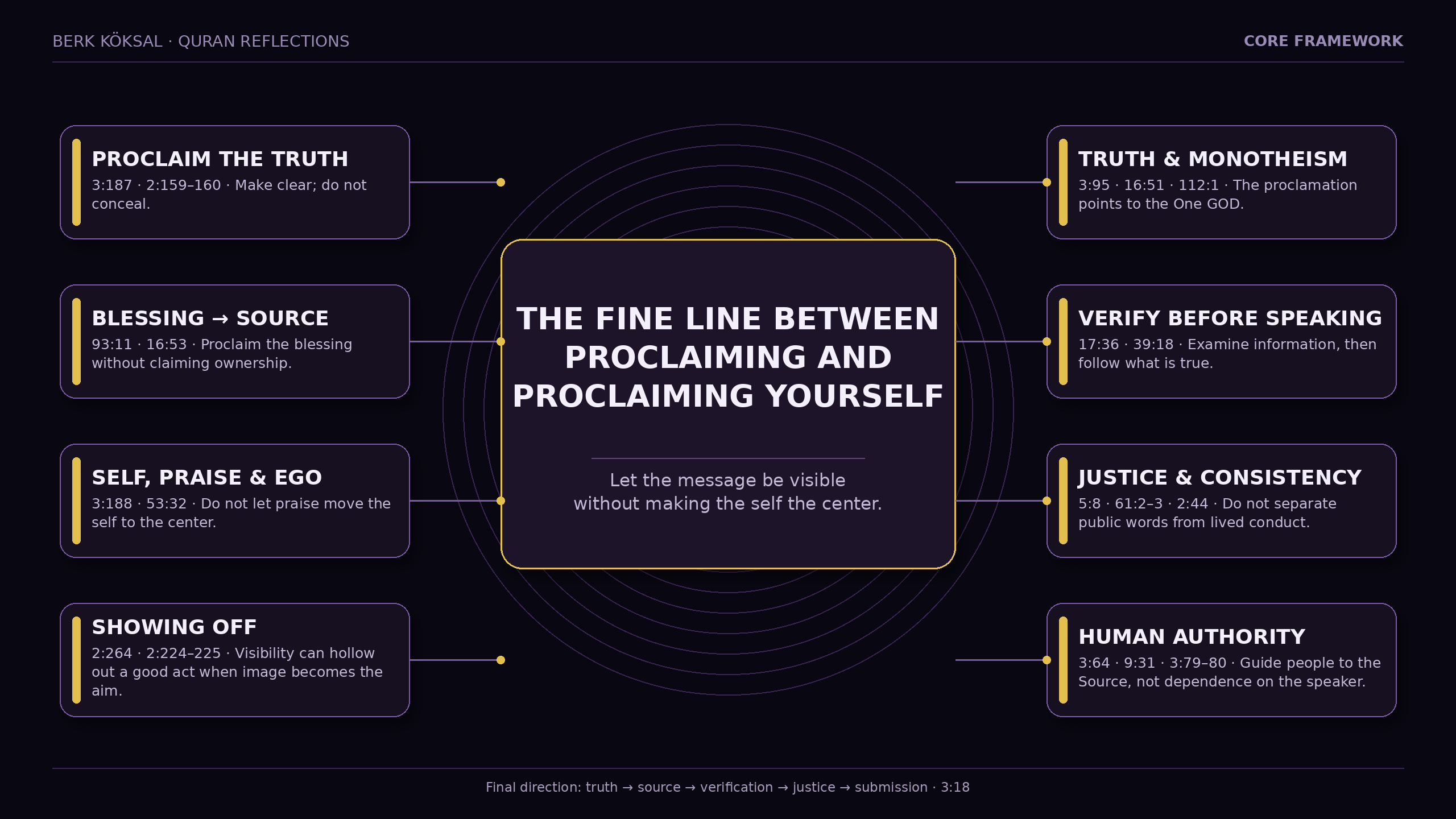
A deep reflection centered on Al-Imran 3:187, on proclaiming, announcing blessings, praise, showing off, testimony, knowledge, justice, truthfulness, monotheism, submission, and the danger of placing oneself at the center while carrying the message.

The Fine Line Between Proclaiming and Proclaiming Yourself
A reflection on 3:187 and verses related to proclamation, blessing, praise, testimony, showing off, knowledge, and submission
Author: Berk KÖKSAL
Date: 21.09.2026
Location: Mersin
Verse
1:1 — In the name of GOD, Most Gracious, Most Merciful.*
Introduction
Peace. Peace be upon you.
The central purpose of this article is to think about the verses together with other related verses, and to express sincerely and deeply what bearing witness to the oneness of GOD means in human life in terms of knowledge, justice, truthfulness, and submission.
Previously, in Proclaim: Not Concealing the Truth and Tying the Word to GOD, I reflected on not concealing revealed guidance, carrying the word truthfully, and keeping the direction of proclamation tied to GOD. In Whom Does the Microphone Glorify? ZIKR RAP, Word, and Responsibility, I questioned how a visible medium can amplify a voice without purifying the intention behind it. In The Weight of Testimony and Should a Quran App Give Rulings? The Boundary Between Tool and Authority, I returned to knowledge, testimony, and the limits of human authority. All my previous writings can be found here.
This time a more unsettling question stands before me:
While proclaiming the truth, can I begin, without noticing it, to proclaim myself?
A person can share a verse. Write a book. Make an album. Produce music that remembers GOD. Build a Quran application. Publish research. Direct people to sources. From the outside, all of these can make both the message and the person carrying the message visible at the same time.
This is where the test begins.
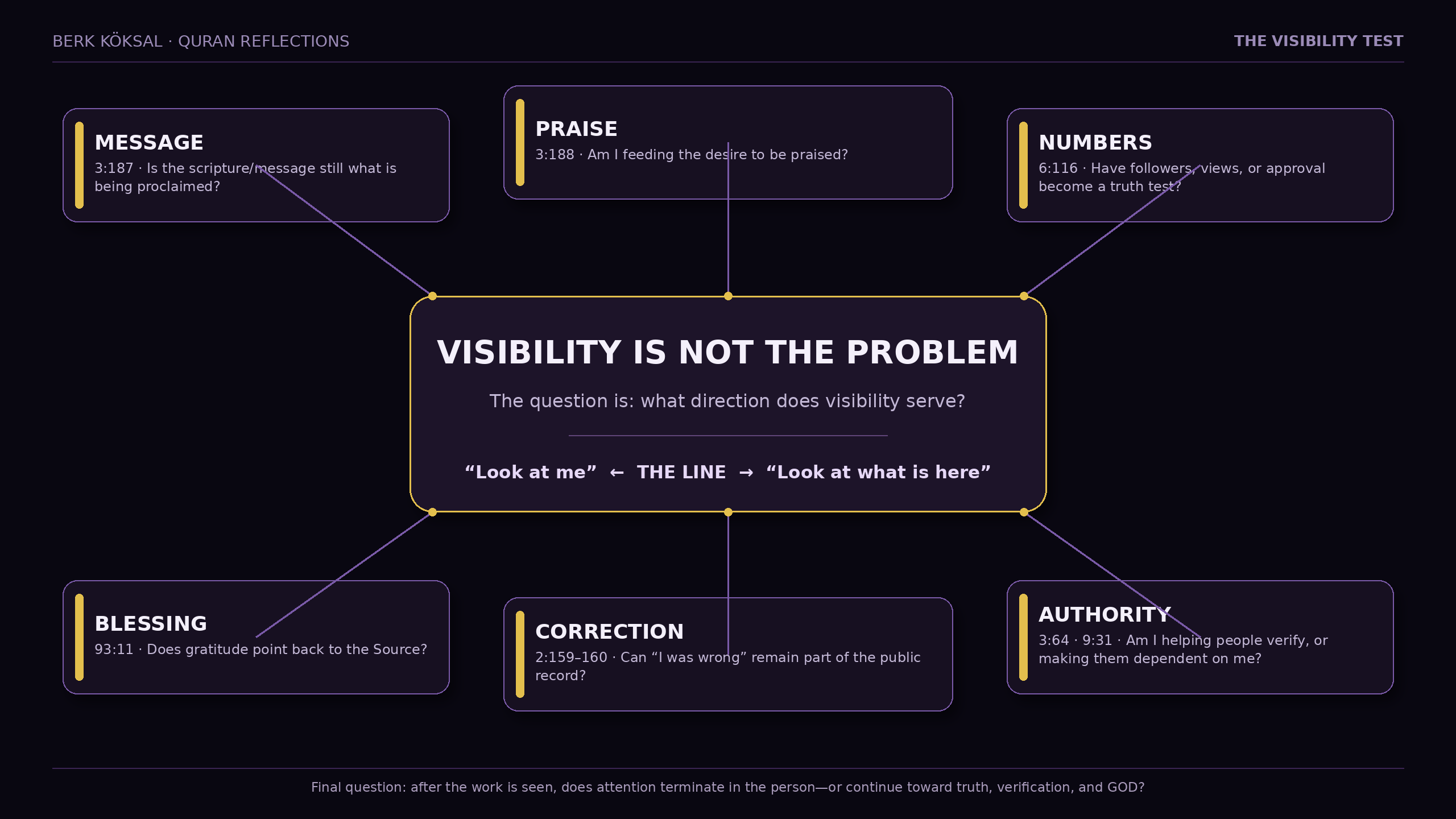
Visibility may be necessary in order not to conceal the message. Yet as visibility grows, a person’s own name, story, talent, follower count, achievements, and even religious identity can move in front of the message.
The problem is not that my name is visible. The problem begins when the message is used to enlarge my name.
From the outside, these two situations can look almost identical. Inside, they may be very different.
Summary:
1. The Object of the Proclamation: The Message or Me?
3:187
وَإِذْ أَخَذَ ٱللَّهُ مِيثَٰقَ ٱلَّذِينَ أُوتُوا۟ ٱلْكِتَٰبَ لَتُبَيِّنُنَّهُۥ لِلنَّاسِ وَلَا تَكْتُمُونَهُۥ فَنَبَذُوهُ وَرَآءَ ظُهُورِهِمْ وَٱشْتَرَوْا۟ بِهِۦ ثَمَنًا قَلِيلًا فَبِئْسَ مَا يَشْتَرُونَ
GOD took a covenant from those who received the scripture: “You shall proclaim it to the people, and never conceal it.” But they disregarded it behind their backs, and traded it away for a cheap price. What a miserable trade.
GOD took a covenant from those who received the scripture: “You shall proclaim it to the people, and never conceal it.” But they disregarded it behind their backs, and traded it away for a cheap price. What a miserable trade.
2. One Verse Later: Boasting and Wanting to Be Praised
3:188 — Those who boast about their works, and wish to be praised for something they have not really done, should not think that they can evade the retribution. They have incurred a painful retribution.
3:189 — To GOD belongs the sovereignty of the heavens and the earth. GOD is Omnipotent.
3. Proclaiming a Blessing Is Not Claiming Ownership of It
93:11 — You shall proclaim the blessing your Lord has bestowed upon you.
16:53 — Any blessing you enjoy is from GOD. Yet, whenever you incur any adversity you immediately complain to Him.
4. Returning from Concealment: Repent, Reform, and Proclaim
2:159 — Those who conceal our revelations and guidance, after proclaiming them for the people in the scripture, are condemned by GOD; they are condemned by all the condemners.
2:160 — As for those who repent, reform, and proclaim, I redeem them. I am the Redeemer, Most Merciful.
5. Selective Visibility: Showing One Part While Concealing Another
6:91 — They never valued GOD as He should be valued. Thus, they said, “GOD does not reveal anything to any human being.” Say, “Who then revealed the scripture that Moses brought, with light and guidance for the people?” You put it down on paper to proclaim it, while concealing a lot of it. You were taught what you never knew—you and your parents. Say, “GOD (is the One who revealed it)” then leave them in their heedlessness, playing.
6. The Content of the Proclamation: Truth and Monotheism
3:95 — Say, “GOD has proclaimed the truth: You shall follow Abraham’s religion—monotheism. He never was an idolater.”
16:51 — GOD has proclaimed: “Do not worship two gods; there is only one god. You shall reverence Me alone.”
112:1 — Proclaim, “He is the One and only GOD.
7. The Address of Praise
17:111 — And proclaim: “Praise be to GOD, who has never begotten a son, nor does He have a partner in His kingship, nor does He need any ally out of weakness,” and magnify Him constantly.
8. Do Not Exalt Yourself
53:32 — They avoid gross sins and transgressions, except for minor offenses. Your Lord’s forgiveness is immense. He has been fully aware of you since He initiated you from the earth, and while you were embryos in your mothers’ bellies. Therefore, do not exalt yourselves; He is fully aware of the righteous.
9. Showing Off Can Hollow Out a Good Deed
2:264 — O you who believe, do not nullify your charities by inflicting reproach and insult, like one who spends his money to show off, while disbelieving in GOD and the Last Day. His example is like a rock covered with a thin layer of soil; as soon as heavy rain falls, it washes off the soil, leaving it a useless rock. They gain nothing from their efforts. GOD does not guide disbelieving people.
10. Using GOD’s Name to Build My Own Image
2:224 — Do not subject GOD’s name to your casual swearing, that you may appear righteous, pious, or to attain credibility among the people. GOD is Hearer, Knower.
2:225 — GOD does not hold you responsible for the mere utterance of oaths; He holds you responsible for your innermost intentions. GOD is Forgiver, Clement.
11. Follower Count Is Not a Measure of Truth
6:116 — If you obey the majority of people on earth, they will divert you from the path of GOD. They follow only conjecture; they only guess.
12. Calling Others to Righteousness While Forgetting Myself
2:44 — Do you exhort the people to be righteous, while forgetting yourselves, though you read the scripture? Do you not understand?
13. The Distance Between What I Say and What I Do
61:2 — O you who believe, why do you say what you do not do?
61:3 — Most abominable in the sight of GOD is that you say what you do not do.
14. Justice in Testimony: Not Favoring Even Myself
5:8 — O you who believe, you shall be absolutely equitable, and observe GOD, when you serve as witnesses. Do not be provoked by your conflicts with some people into committing injustice. You shall be absolutely equitable, for it is more righteous. You shall observe GOD. GOD is fully Cognizant of everything you do.
15. Before Proclaiming: Know, Verify, and Follow
17:36 — You shall not accept any information, unless you verify it for yourself. I have given you the hearing, the eyesight, and the brain, and you are responsible for using them.
39:18 — They are the ones who examine all words, then follow the best. These are the ones whom GOD has guided; these are the ones who possess intelligence.
16. Not Taking People as Lords — and Not Letting Myself Be Made One
3:64 — Say, “O followers of the scripture, let us come to a logical agreement between us and you: that we shall not worship except GOD; that we never set up any idols besides Him, nor set up any human beings as lords beside GOD.” If they turn away, say, “Bear witness that we are submitters.”
9:31 — They have set up their religious leaders and scholars as lords,* instead of GOD. Others deified the Messiah, son of Mary. They were all commanded to worship only one god. There is no god except He. Be He glorified, high above having any partners.
3:79 — Never would a human being whom GOD blessed with the scripture and prophethood say to the people, “Idolize me beside GOD.” Instead, (he would say), “Devote yourselves absolutely to your Lord alone,” according to the scripture you preach and the teachings you learn.
3:80 — Nor would he command you to idolize the angels and the prophets as lords. Would he exhort you to disbelieve after becoming submitters?
17. On the Arabic Roots of the Words: Proclaiming, Concealing, and Magnifying
3:187 — GOD took a covenant from those who received the scripture: “You shall proclaim it to the people, and never conceal it.” But they disregarded it behind their backs, and traded it away for a cheap price. What a miserable trade.
93:11 — You shall proclaim the blessing your Lord has bestowed upon you.
53:32 — They avoid gross sins and transgressions, except for minor offenses. Your Lord’s forgiveness is immense. He has been fully aware of you since He initiated you from the earth, and while you were embryos in your mothers’ bellies. Therefore, do not exalt yourselves; He is fully aware of the righteous.
17:111 — And proclaim: “Praise be to GOD, who has never begotten a son, nor does He have a partner in His kingship, nor does He need any ally out of weakness,” and magnify Him constantly.
18. Other Claims
3:187 — GOD took a covenant from those who received the scripture: “You shall proclaim it to the people, and never conceal it.” But they disregarded it behind their backs, and traded it away for a cheap price. What a miserable trade.
93:11 — You shall proclaim the blessing your Lord has bestowed upon you.
2:264 — O you who believe, do not nullify your charities by inflicting reproach and insult, like one who spends his money to show off, while disbelieving in GOD and the Last Day. His example is like a rock covered with a thin layer of soil; as soon as heavy rain falls, it washes off the soil, leaving it a useless rock. They gain nothing from their efforts. GOD does not guide disbelieving people.
53:32 — They avoid gross sins and transgressions, except for minor offenses. Your Lord’s forgiveness is immense. He has been fully aware of you since He initiated you from the earth, and while you were embryos in your mothers’ bellies. Therefore, do not exalt yourselves; He is fully aware of the righteous.
19. Conclusion: Let the Message Be Visible Without Making Me the Center
3:18 — GOD bears witness that there is no god except He, and so do the angels and those who possess knowledge. Truthfully and equitably, He is the absolute god; there is no god but He, the Almighty, Most Wise.
1. The Object of the Proclamation: The Message or Me?
Verse
3:187
وَإِذْ أَخَذَ ٱللَّهُ مِيثَٰقَ ٱلَّذِينَ أُوتُوا۟ ٱلْكِتَٰبَ لَتُبَيِّنُنَّهُۥ لِلنَّاسِ وَلَا تَكْتُمُونَهُۥ فَنَبَذُوهُ وَرَآءَ ظُهُورِهِمْ وَٱشْتَرَوْا۟ بِهِۦ ثَمَنًا قَلِيلًا فَبِئْسَ مَا يَشْتَرُونَ
GOD took a covenant from those who received the scripture: “You shall proclaim it to the people, and never conceal it.” But they disregarded it behind their backs, and traded it away for a cheap price. What a miserable trade.
GOD took a covenant from those who received the scripture: “You shall proclaim it to the people, and never conceal it.” But they disregarded it behind their backs, and traded it away for a cheap price. What a miserable trade.
Source: kuranteyit.com
Reflection on the Verse
What first strikes me is the command at the center of the verse: “You shall proclaim it to the people.” The direction is clear. There is a human being who proclaims, but the thing being proclaimed is not the human being; it is the scripture.
This distinction forms the foundation of the subject for me. When I release a musical work, my name is visible. A reflection has an author’s name beneath it. An application has a developer. An album has a cover, a description, and a producer. I cannot derive from this verse a rule that all of these must disappear. But the verse makes me ask a harder question: Has my name begun to move in front of what I am carrying?
When someone reaches me, do they finally remain with me, or do they go to the Source? When I speak about a verse, do I desire that people remember me more than they remember the verse? When a work of mine receives attention, is the joy within me tied to the message of GOD reaching people, or to “me” being seen?
It is not easy for someone outside me to answer this. Sometimes it is not easy even for me to answer it about myself. The self can produce subtle justifications. Even the sentence “I am already doing this for GOD” can become armor that protects me from examining myself.
Proclaiming can be a responsibility. But the person who proclaims cannot take the place of what is proclaimed.
Verse reference: 3:187.
2. One Verse Later: Boasting and Wanting to Be Praised
Verse
3:188 — Those who boast about their works, and wish to be praised for something they have not really done, should not think that they can evade the retribution. They have incurred a painful retribution.
3:189 — To GOD belongs the sovereignty of the heavens and the earth. GOD is Omnipotent.
Reflection on the Verse
Reading 3:188 immediately after 3:187 creates a strong tension for me. One verse carries the responsibility to proclaim; the next speaks of boasting about one’s works and wanting praise for something not truly done. Then 3:189 declares that the sovereignty of the heavens and the earth belongs to GOD.
I do not want to turn the sequence of these verses into a detailed theory by itself. Yet for reflection, it leaves a very clear question before me: Whose praise am I enlarging while I proclaim?
A person may truly have done something. He may have completed an album, researched for years, developed software, or carried a difficult work to completion. The labor is real. But the reality of labor does not automatically purify the desire for praise within the heart.
The sentence “I did this” may be technically true while carrying a very different meaning within. I composed. I played guitar. I wrote code. I researched. These can describe the human side of an event. But 3:189 suddenly widens the scale: the sovereignty of the heavens and the earth belongs to GOD.
Everything I do takes place within a life, a body, a mind, time, hearing, the ability to learn, and a created universe that were given to me. My effort can be real; my claim to absolute ownership is not.
Perhaps the first sign of the line between proclaiming and proclaiming myself appears here: While carrying the message, a person can know his share without taking sovereignty upon himself.
Verse references: 3:188-189.
3. Proclaiming a Blessing Is Not Claiming Ownership of It
Verse
93:11 — You shall proclaim the blessing your Lord has bestowed upon you.
16:53 — Any blessing you enjoy is from GOD. Yet, whenever you incur any adversity you immediately complain to Him.
Reflection on the Verse
Verse 93:11 is powerful even on its own: proclaim the blessing. But 16:53 gives the direction by stating that every blessing we enjoy is from GOD.
A very subtle shift is possible here. “I am proclaiming the blessing given to me” is not the same sentence as “Look at what I have.” From the outside, the same photograph, album, announcement of success, or website may be visible. The inward direction can still be different.
When I release a work, it can be natural to say, “I made this.” But if the whole story begins to revolve continuously around my talent, intelligence, success, transformation, and special position, the Source of the blessing can slowly move into the background.
A measure I reached while reflecting on gratitude returns here: the purpose of proclamation is not to enlarge the self, but to make the Source visible. More than saying, “What do I have?” I need to be able to say, “I am not the absolute owner of what was given to me.”
The voice was given to me. The mind was given to me. The ability to learn was given to me. The people, time, and doors that appeared before me were given to me. I am responsible for what I do with them. But I am not their absolute source.
Perhaps the proclamation of gratitude begins exactly here.
Verse references: 93:11, 16:53.
4. Returning from Concealment: Repent, Reform, and Proclaim
Verse
2:159 — Those who conceal our revelations and guidance, after proclaiming them for the people in the scripture, are condemned by GOD; they are condemned by all the condemners.
2:160 — As for those who repent, reform, and proclaim, I redeem them. I am the Redeemer, Most Merciful.
Reflection on the Verse
The order in 2:160 especially affects me: repent, reform, and proclaim.
Here proclamation does not look like the display of a flawless person. On the contrary, it stands within a movement of correction after error. For me, this is both comforting and demanding.
One of the great traps for a person who becomes visible in a religious space is beginning to protect his own previous words. I published an article. I stated a view. I recorded a video. I defended a piece of research. Then I saw something new and realized that I was wrong. What will I do? Protect my reputation, or proclaim what is correct?
If my error reached a thousand people, is it enough to correct it only inside myself? The verse leads me to a personal question: If the error I proclaimed was visible, should my correction also be visible?
One of the hardest proclamations for the self may sometimes be this: “I was wrong.”
When a person begins to proclaim himself, admitting error becomes a loss of brand. When he tries to proclaim the truth, admitting error can become part of the path.
Then visibility is no longer only a display window for my successes; it becomes a field of testimony where my corrections can also be seen.
Verse references: 2:159-160.
5. Selective Visibility: Showing One Part While Concealing Another
Verse
6:91 — They never valued GOD as He should be valued. Thus, they said, “GOD does not reveal anything to any human being.” Say, “Who then revealed the scripture that Moses brought, with light and guidance for the people?” You put it down on paper to proclaim it, while concealing a lot of it. You were taught what you never knew—you and your parents. Say, “GOD (is the One who revealed it)” then leave them in their heedlessness, playing.
Reflection on the Verse
The expression in this verse is striking: something is put down on paper in order to proclaim it, while a great deal of it is concealed at the same time.
This means that publication by itself is not automatic proof that something has been conveyed with complete honesty. It leads me to an uncomfortable question about my own writing: When I research a subject, do I select only the verses that support my view? Do I reduce the visibility of verses that challenge me? Do I make the part that vindicates me the large headline while pushing the part that questions my own behavior into the background?
I could publish a great deal that way. I could even appear very religious. But the amount published and faithfulness to truth are not the same thing.
In the digital world we have to select. We cannot place the entire Quran in every article or explain every aspect of a subject in every video. Therefore selection by itself is not concealment. The real question concerns intention and truthfulness: Am I deliberately distorting? Am I making information that goes against me invisible merely to protect my image?
This distinction becomes especially important when a person begins to position himself as a religious narrator, because editorial judgment can then become a tool for protecting the self.
Verse reference: 6:91.
6. The Content of the Proclamation: Truth and Monotheism
Verse
3:95 — Say, “GOD has proclaimed the truth: You shall follow Abraham’s religion—monotheism. He never was an idolater.”
16:51 — GOD has proclaimed: “Do not worship two gods; there is only one god. You shall reverence Me alone.”
112:1 — Proclaim, “He is the One and only GOD.
Reflection on the Verse
In these three verses proclamation repeatedly returns to the same center. Truth is tied to GOD. Monotheism is proclaimed. The One and only GOD is proclaimed.
The center enlarged by the proclamation is not the human being.
This makes me think that monotheism is not merely a sentence of belief. It can also change the architecture of communication. If I do religious work, people may pass through me, but they should not end with me. I can be a door; I should not become a wall. I can explain research; I should not become the owner of truth. I can draw attention to a verse; I should not place my interpretation in the position of the verse itself.
Monotheism seems to require the self to withdraw from the center here. This does not mean erasing the human being. Berk is still Berk. A work can have a signature. There can be a biography. There can be labor. But the moment I touch what is sacred, I should not manufacture sacred immunity for myself.
The proclamation that “He is the One and only GOD” sets a measure not only for other idols, but also for my own desire to become the center.
Verse references: 3:95, 16:51, 112:1.
7. The Address of Praise
Verse
17:111 — And proclaim: “Praise be to GOD, who has never begotten a son, nor does He have a partner in His kingship, nor does He need any ally out of weakness,” and magnify Him constantly.
Reflection on the Verse
In this verse proclamation and praise are directly joined. But the address of the praise is clear: GOD.
Previously, in Whom Does the Microphone Glorify? ZIKR RAP, Word, and Responsibility, I reflected on how a microphone amplifies a voice but does not purify intention. Today I ask the same question more broadly: Whom does the website glorify? Whom does the album glorify? Whom does the cover glorify? Whom does the reflection glorify? Whom does the social-media post glorify?
As an artist, I do not have to hide my name. But if a work I say I made to praise GOD leaves behind, above all else, an impression of my own greatness, I need to think again.
And this test is not limited to praise coming from outside. A person can begin to admire himself inwardly. He completes a work, looks at it again and again, and moves himself to the center. Rejoicing in the work is not the same as turning the work into a certificate of one’s own greatness.
Verse 17:111 points the direction again: praise and magnification turn toward GOD.
Verse reference: 17:111.
8. Do Not Exalt Yourself
Verse
53:32 — They avoid gross sins and transgressions, except for minor offenses. Your Lord’s forgiveness is immense. He has been fully aware of you since He initiated you from the earth, and while you were embryos in your mothers’ bellies. Therefore, do not exalt yourselves; He is fully aware of the righteous.
Reflection on the Verse
“Do not exalt yourselves.” Before this sentence, it almost feels as though there is little more to say.
A person’s religious identity can become a very subtle tool for elevating himself. “I am a submitter.” “I found the truth.” “I am different from others.” “I know the correct source.” “I researched this for years.” Some of these sentences may describe a fact. Yet the distance between truthfulness and a feeling of superiority can be very short.
The measure at the end of the verse relieves me: GOD is fully aware of the righteous. I do not have to certify myself. This does not prevent me from explaining the work I have done. But I may not need to market my own righteousness.
I can explain what I did. I can explain why I did it. I can show my source. But I should not give a judgment about myself that GOD has not given. Sentences such as “I am righteous,” “I am superior,” or “My intention is certainly pure” may be too large even for a person to say about his own inner world.
I can try to guard my intention. It feels safer to leave the final judgment of my heart to GOD.
Verse reference: 53:32.
9. Showing Off Can Hollow Out a Good Deed
Verse
2:264 — O you who believe, do not nullify your charities by inflicting reproach and insult, like one who spends his money to show off, while disbelieving in GOD and the Last Day. His example is like a rock covered with a thin layer of soil; as soon as heavy rain falls, it washes off the soil, leaving it a useless rock. They gain nothing from their efforts. GOD does not guide disbelieving people.
Reflection on the Verse
This verse speaks specifically about charity. For that reason, I do not want to expand it as though it were giving exactly the same ruling about every visible religious activity.
But I can reflect on the moral danger it shows: Showing off can enter an action that appears good. A person may truly give money. The action is real. Yet the desire to be seen can create another center inside the action.
From there I return to my own work. A reflection may truly have been written. An album may truly remember GOD. A project may truly benefit people. The existence of these things does not automatically make my intention flawless.
More than one impulse can exist in the same work. I may want to remember GOD. I may want to help people. At the same time, I may also want to be liked. It is important not to deceive myself here.
Perhaps the aim is not to make a superhuman claim such as, “I will never have any desire to be praised.” A more truthful question may be: When I notice that desire, do I feed it, or do I correct my direction again?
Verse reference: 2:264.
10. Using GOD’s Name to Build My Own Image
Verse
2:224 — Do not subject GOD’s name to your casual swearing, that you may appear righteous, pious, or to attain credibility among the people. GOD is Hearer, Knower.
2:225 — GOD does not hold you responsible for the mere utterance of oaths; He holds you responsible for your innermost intentions. GOD is Forgiver, Clement.
Reflection on the Verse
These two verses question me sharply in today’s world of visibility. Verse 2:224 speaks about appearing righteous and pious and attaining credibility among people, and warns against subjecting GOD’s name to that purpose.
Speaking about GOD in religious content is natural. Turning GOD’s name into a seal of trust for my personal brand is something else.
I do not want to depend on an impression such as, “This person speaks about GOD a lot, so he must be right.” The more dangerous version within myself may be: “I work for GOD, therefore what I do is right.” No. What I do still has to be examined.
Verse 2:225 goes further inward and ties responsibility to innermost intentions. There is a field deeper than how sincere I appear to people. Why am I doing this? Why am I sharing it? Why am I writing this sentence?
A visible profile cannot give the final answer to those questions.
Verse references: 2:224-225.
11. Follower Count Is Not a Measure of Truth
Verse
6:116 — If you obey the majority of people on earth, they will divert you from the path of GOD. They follow only conjecture; they only guess.
Reflection on the Verse
In today’s world, numbers can look very convincing: followers, streams, views, likes, shares, chart positions, and search results.
When a piece of content reaches a million people, the mind can begin to assume that it is more important. Verse 6:116 reminds me that numbers and truth must be kept separate. The approval of the majority is not a certificate of being right.
But the opposite can also produce a new ego: “I am in the minority, therefore I am right.” The verse does not say that either. A number is only a number. A million people listening to me does not make me more correct before GOD. Ten people listening does not automatically make me more sincere.
This matters especially in religious production. If I begin to read follower count as GOD’s approval, the algorithm becomes a spiritual measure. Then I may begin shaping the message for performance rather than for truthfulness.
Which title will get more clicks? Which controversy will generate more anger? Which sentence will be shared more? These can be understandable publishing questions. But if they take control of the entire measure, the message slowly begins to serve the medium.
Verse reference: 6:116.
12. Calling Others to Righteousness While Forgetting Myself
Verse
2:44 — Do you exhort the people to be righteous, while forgetting yourselves, though you read the scripture? Do you not understand?
Reflection on the Verse
This is not an easy verse for someone who writes reflections. By the nature of writing, I am constantly saying something: Pay attention to this. Think about this. There is a danger here. There is a measure here.
But the verse turns toward me and asks: Where are you?
If reflection becomes a spotlight I point only at others, I can remain in darkness. Perhaps the first rule of writing about a verse should be this: The verse must read me first.
If I speak about the arrogance of others while failing to see my own, the beauty of the article does not save me. If I criticize the problem of religious authority while people are turning me into a new authority and I enjoy it, I need to think again.
If I tell others “do not proclaim yourself” while using this very article to enlarge my own name, the whole article catches me with its own title.
For that reason, I do not see this article as an accusation directed at others, but as an open question directed at myself: While I proclaim, am I forgetting myself, or am I forgetting the message and remembering myself?
Verse reference: 2:44.
13. The Distance Between What I Say and What I Do
Verse
61:2 — O you who believe, why do you say what you do not do?
61:3 — Most abominable in the sight of GOD is that you say what you do not do.
Reflection on the Verse
The more a public religious identity grows, the heavier these verses seem to become. Public speech creates an image of a person. People know me through my writings, music, and posts. From the sum of these pieces, a Berk forms in their minds.
That Berk may appear very truthful, calm, submitted, or knowledgeable. But the real human being is always more complicated. He has shortcomings. Anger. Fear. Places where he is wrong.
This is why I am wary of turning a digital religious identity into a costume. The height of the words I speak does not automatically raise the level of the life I live.
If I produce a hundred songs that remember GOD but treat the person near me unjustly, what am I missing? If I write about justice and abandon justice in a conflict, what am I proclaiming? If I speak about humility but cannot tolerate criticism, who is carrying the word?
A polished biography cannot answer these questions. Life does.
Verse references: 61:2-3.
14. Justice in Testimony: Not Favoring Even Myself
Verse
5:8 — O you who believe, you shall be absolutely equitable, and observe GOD, when you serve as witnesses. Do not be provoked by your conflicts with some people into committing injustice. You shall be absolutely equitable, for it is more righteous. You shall observe GOD. GOD is fully Cognizant of everything you do.
Reflection on the Verse
Testimony is not only about other people. A person also bears a kind of testimony when telling his own life: while writing a biography, listing achievements, describing his role in a conflict, or interpreting his past.
The problem is this: impartiality becomes difficult when a person is both the main character and the editor of his own story. I remember my successes. I place my errors in context. The injustices done to me are clear; the things I did are complicated. The self is a very good lawyer for itself.
Verse 5:8 commands justice in relation to others. From it I also draw a reflection about my own story: When I tell my story, do I favor myself?
If I enlarge every fault of someone I criticize and erase every good thing in them, justice disappears. In the same way, if I enlarge all my own good and make my faults invisible, truth becomes incomplete.
This does not mean that everyone must publish every private mistake on the internet. Privacy is one thing. Manufactured flawlessness is another.
When a person begins to proclaim himself, it can become very easy to slide toward the second.
Verse reference: 5:8.
15. Before Proclaiming: Know, Verify, and Follow
Verse
17:36 — You shall not accept any information, unless you verify it for yourself. I have given you the hearing, the eyesight, and the brain, and you are responsible for using them.
39:18 — They are the ones who examine all words, then follow the best. These are the ones whom GOD has guided; these are the ones who possess intelligence.
Reflection on the Verse
The excitement of proclaiming should not move ahead of verification. Something may be very striking. It may fit my beliefs perfectly. It may vindicate me. It may fit the story of a project beautifully. But if it is not true, it should not be proclaimed.
Verse 17:36 brings me back to that responsibility. Verse 39:18 speaks not only of examining words, but then following the best. The difference between these two stages matters: gathering information is one thing; submitting to the truth I recognize is another.
A person can even turn research into part of his image. “I research a lot.” “I examine everything.” “I am a questioning person.” These too can become a new personal brand.
The real test begins when the better word conflicts with my previous view. Will I follow it? Or will I protect my old statement?
Verification is easy when it serves the ego. The real cost appears when verification exposes my own error. Therefore, for me, the ethics of proclamation is not merely finding correct information. It is being able to follow the correct information I find.
Verse references: 17:36, 39:18.
16. Not Taking People as Lords — and Not Letting Myself Be Made One
Verse
3:64 — Say, “O followers of the scripture, let us come to a logical agreement between us and you: that we shall not worship except GOD; that we never set up any idols besides Him, nor set up any human beings as lords beside GOD.” If they turn away, say, “Bear witness that we are submitters.”
9:31 — They have set up their religious leaders and scholars as lords,* instead of GOD. Others deified the Messiah, son of Mary. They were all commanded to worship only one god. There is no god except He. Be He glorified, high above having any partners.
3:79 — Never would a human being whom GOD blessed with the scripture and prophethood say to the people, “Idolize me beside GOD.” Instead, (he would say), “Devote yourselves absolutely to your Lord alone,” according to the scripture you preach and the teachings you learn.
3:80 — Nor would he command you to idolize the angels and the prophets as lords. Would he exhort you to disbelieve after becoming submitters?
Reflection on the Verse
When a person begins to proclaim himself, it is not only his own self that grows. The relationship his listeners form with him can also change.
People can learn from a writer. They can trust the work of a researcher. They can love a teacher. They can be moved by an artist’s work. I do not conclude from any of these things alone that idolatry has occurred. But the verses keep the boundary clear: human beings are not to be set up as lords beside GOD.
Verse 9:31 gives a severe example through religious leaders and scholars. Verse 3:79 sets an even more striking boundary: even a human being blessed with scripture and prophethood does not tell people to idolize him beside GOD.
This places responsibility not only on the follower, but also on the speaker. Am I encouraging someone to exalt me beyond my place? “Do not check my words.” “I cannot be wrong.” “There is no right path outside my interpretation.” I need to guard myself from moving toward such a position.
Previously, in Should a Quran App Give Rulings? The Boundary Between Tool and Authority, I tried to separate the tool from the Source. The same boundary applies to a human being. A person can help; he cannot take the place of the Source.
Perhaps one important responsibility of someone who truly wants to direct people toward GOD is this: Do not make people dependent on yourself.
Instead of “Believe me”: Look. Read. Verify. Turn to GOD.
Verse references: 3:64, 9:31, 3:79-80.
17. On the Arabic Roots of the Words: Proclaiming, Concealing, and Magnifying
Verse
3:187 — GOD took a covenant from those who received the scripture: “You shall proclaim it to the people, and never conceal it.” But they disregarded it behind their backs, and traded it away for a cheap price. What a miserable trade.
93:11 — You shall proclaim the blessing your Lord has bestowed upon you.
53:32 — They avoid gross sins and transgressions, except for minor offenses. Your Lord’s forgiveness is immense. He has been fully aware of you since He initiated you from the earth, and while you were embryos in your mothers’ bellies. Therefore, do not exalt yourselves; He is fully aware of the righteous.
17:111 — And proclaim: “Praise be to GOD, who has never begotten a son, nor does He have a partner in His kingship, nor does He need any ally out of weakness,” and magnify Him constantly.
Reflection on the Verse
When I look at the word “proclaim” in the title of this article through the Arabic expressions, the subject becomes somewhat clearer.
In 3:187, لَتُبَيِّنُنَّهُ — latubayyinunnahu, rendered in the Authorized English Translation as ‘You shall proclaim it’ is connected with the root ب ي ن — b-y-n. Its field of meaning includes clarity, distinction, and making something manifest. In the same verse, تَكْتُمُونَهُ — taktumūnahu stands on the opposite side and is connected with ك ت م — k-t-m, the field of concealing and hiding.
In 93:11, فَحَدِّثْ — faḥaddith is connected with ح د ث — ḥ-d-th. The Authorized English Translation renders the command as ‘proclaim.’ The object of the sentence is not the person’s own greatness, but the blessing his Lord has bestowed upon him.
In 53:32, فَلَا تُزَكُّوا أَنفُسَكُمْ — falā tuzakkū anfusakum appears where the warning against exalting the self is given. The authorized English translation renders it: “do not exalt yourselves.”
In 17:111, وَكَبِّرْهُ تَكْبِيرًا — wa kabbirhu takbīrā, through the root ك ب ر — k-b-r, directs greatness and magnification toward GOD.
I do not use roots by themselves as dictionary rulings that determine the entire meaning of a verse. The sentence, context, and the Authorized English Translation should be considered together. Yet when these expressions stand beside one another, they create a powerful direction for me:
Make the truth clear. Do not conceal. Proclaim the blessing. Do not exalt yourself. Magnify GOD.
I am not claiming that these are one sentence from a single verse. But read together, they leave a clear measure before my own self.
Verse references: 3:187, 93:11, 53:32, 17:111.
18. Other Claims
Verse
3:187 — GOD took a covenant from those who received the scripture: “You shall proclaim it to the people, and never conceal it.” But they disregarded it behind their backs, and traded it away for a cheap price. What a miserable trade.
93:11 — You shall proclaim the blessing your Lord has bestowed upon you.
2:264 — O you who believe, do not nullify your charities by inflicting reproach and insult, like one who spends his money to show off, while disbelieving in GOD and the Last Day. His example is like a rock covered with a thin layer of soil; as soon as heavy rain falls, it washes off the soil, leaving it a useless rock. They gain nothing from their efforts. GOD does not guide disbelieving people.
53:32 — They avoid gross sins and transgressions, except for minor offenses. Your Lord’s forgiveness is immense. He has been fully aware of you since He initiated you from the earth, and while you were embryos in your mothers’ bellies. Therefore, do not exalt yourselves; He is fully aware of the righteous.
Reflection on the Verse
Different readings can be offered regarding the scope of these verses.
It can be argued that 3:187 primarily describes a covenant directed to particular communities that received scripture, and therefore does not directly establish that every individual must publicly publish everything he learns. Another approach may see a broader moral principle in the contrast between proclaiming and concealing. Without establishing a definitive ruling on scope, this article focuses on the responsibility the wording of the verse opens before me.
The “blessing” in 93:11 can also be approached in different ways. Some readings may think especially of the blessing of guidance and revelation; others may understand blessings from GOD more broadly. I do not derive from it a social rule that says, “Tell everyone about every success.”
Verse 2:264 directly concerns charity and showing off. Therefore it does not establish that every public religious work is showing off. My connection is narrower: I am examining, in relation to my own work, whether the desire to be seen can exist inside an outwardly good act.
Likewise, I do not read 53:32 as an absolute rule that a person may not have a biography, place his name on a work, or explain what he has done.
The question here is more inward: Is the name a tool or the center? Does visibility serve, or does it rule? Am I proclaiming the truth, or am I enlarging my own identity in the light of the truth?
Traditional or historical approaches may narrow or broaden the contexts of these verses in different ways. I treat such approaches not as measures that govern the main structure of this reflection, but as alternate readings that can be mentioned cautiously.
Verse references: 3:187, 93:11, 2:264, 53:32.
19. Conclusion: Let the Message Be Visible Without Making Me the Center
Verse
3:18 — GOD bears witness that there is no god except He, and so do the angels and those who possess knowledge. Truthfully and equitably, He is the absolute god; there is no god but He, the Almighty, Most Wise.
Reflection on the Verse
The place I reach at the end of this article is not “hide yourself completely.” The verses speak about proclaiming, proclaiming a blessing, making truth clear, and not concealing the scripture.
The problem is not being visible. The problem is changing the direction of visibility.
The line between proclaiming and proclaiming yourself cannot always be seen from the outside. It may be the same microphone. The same website. The same album. The same article. The same verse. The same social-media post. Yet inside, these two sentences can be very different:
“Look at how special I am.”
and
“Look at what is here.”
I want to remain with the second sentence. I cannot proclaim that I have succeeded in doing so, because even that proclamation could turn into the first sentence.
What I can do is continue examining myself. Before publishing something, I can ask: After this work, will a person become more attached to me, or will he turn more toward GOD? Will he be able to verify a claim from the source? Will he be able to distinguish my interpretation from the verse? If I am wrong, will he be able to correct me? Or am I building an untouchable personality around myself?
If my name were removed, would this work still be worth doing? If no one thanked me, would I still do it? If no one listened? If no one shared it? If no one applauded?
I do not always know the answers to these questions. Perhaps that is part of the point: not becoming too certain about my own self, and remembering that GOD knows.
Verse 3:18 puts the center of testimony back in its place. There is knowledge. Justice. Testimony. Power. Wisdom. But the human being is not at the center. There is no god except He.
For that reason, I will proclaim: so that I do not conceal the truth; so that I tie the blessing to its Source; so that people can examine; so that I can correct my error; so that I can bear witness to the oneness of GOD.
But while doing so, I want to keep reminding myself: Carrying the message does not mean that you own the message.
My name can be visible. My effort can be visible. My work can be visible. But if what truly needs to be seen disappears behind all of them, I need to correct my direction again.
Perhaps the fine line between proclaiming and proclaiming yourself is exactly here: If what I proclaim enlarges me and pushes GOD into the background, my self may have moved forward. If what I proclaim also holds me accountable before it and directs the human being toward GOD, then at least I am trying to face the right direction.
I cannot give the final judgment about myself. GOD knows.
Verse reference: 3:18.
Note
2:32 — They said, “Be You glorified, we have no knowledge, except that which You have taught us. You are the Omniscient, Most Wise.”
GOD knows best.
Source: kuranteyit.com
Discover
Related Articles
Quran Reflections
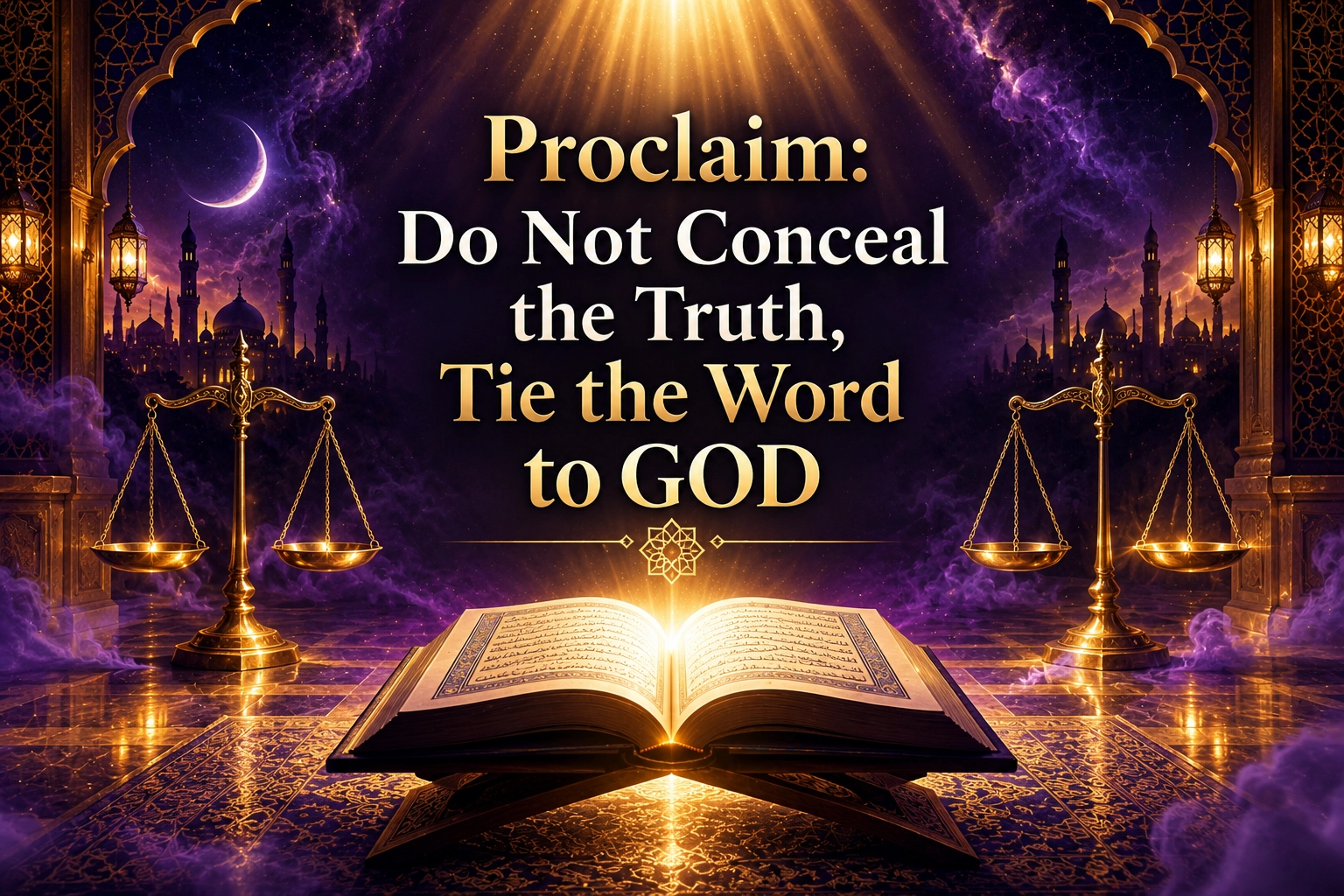
Proclaim: Do Not Conceal the Truth, Tie the Word to GOD
A personal and concise reflection on not concealing the truth, truthful speech, testimony, tawhid, justice, submission, and the limits of religious authority through Al-Baqarah 2:159-160 and the verses gathered under the theme “Proclaim.”
Read article
Quran Reflections
Turning Back on Your Heels: Preserving Your Direction After Guidance
A reflection centered on Al-Baqarah 2:143 on turning back on one's heels, sliding back after guidance, leaving the faith, casting scripture behind one's back, testimony, knowledge, justice, truthfulness, submission, and the limits of religious authority.
Read article
Quran Reflections
[2:166] Leaders and Followers: Whom Are the Leaders Following?
A 19-section Quran reflection centered on 2:166, Satan's deceptive leadership, leaders who are themselves followers, the limits of Satan's influence, religious authority, testimony, justice, monotheism, and human responsibility.
Read article