Loving GOD Alone: Loving Nothing but GOD, or Loving Nothing as if It Were GOD?
A deep Quran-centered reflection on what it means to love GOD the most, whether loving GOD alone means loving no created thing at all, and where love becomes rivalry, idolatry, attachment, or absolute devotion.

Loving GOD Alone: Loving Nothing but GOD, or Loving Nothing as if It Were GOD?
Author: Berk KÖKSAL
Date: September 26, 2026
Place: Mersin
The central purpose of this article is to reflect on the verses together with other related verses, and to consider, with sincerity and depth, what bearing witness to the oneness of GOD means in human life in terms of knowledge, justice, truthfulness, and submission.
Alongside that purpose, I want to place a more intimate question: What does it actually mean to love GOD the most?
Peace. Peace be upon you.
“Loving GOD alone” can sound like a perfect sentence of devotion. Yet if I repeat it without testing it against the verses, I may quietly make the text say more than it says.
Can a person not love a spouse? A child? Parents? A friend? A home? A living being entrusted to one’s care? If all created love were forbidden, what would it mean for 30:21 to say that GOD placed love and care in the hearts of spouses? Why would 28:56 speak of “the ones you love”? Why would 59:9 describe believers who love those who immigrated to them? Why would 3:92 speak of possessions that we love?
So the question cannot be solved merely by attacking the verb “to love.”
The deeper question is this:
What place do I give the thing I love inside my heart?
Do I love a human being, or do I turn that person into a rival source of security, loyalty, and authority beside GOD?
Do I love a blessing, or do I become so attached to the blessing that I forget its Source?
Do I love a spouse, or do I reach a point where I would abandon GOD’s measure to preserve that relationship?
Do I love a religious figure, or do I place that person’s word above GOD’s word?
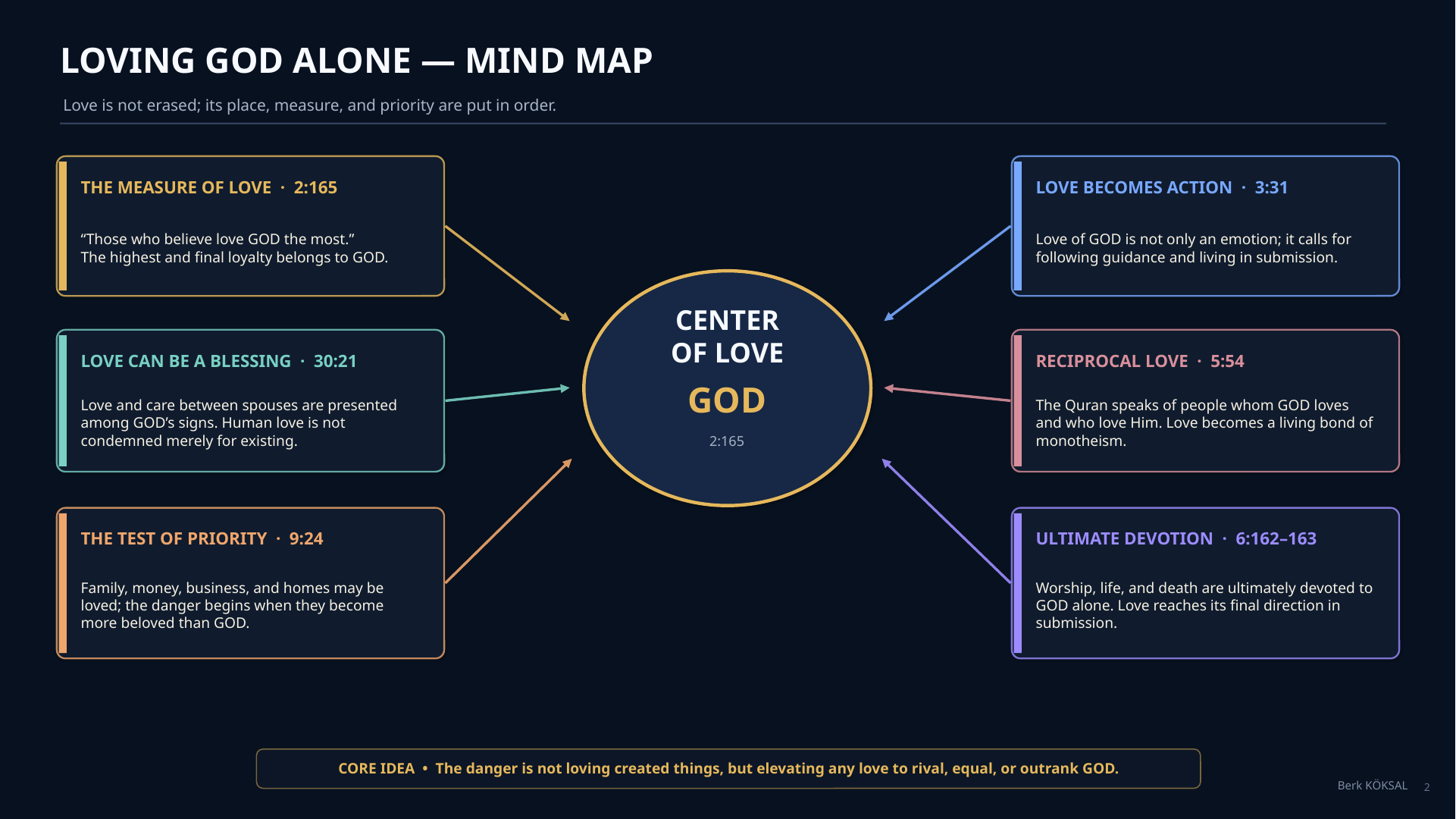
Al-Baqarah 2:165 brings love directly into the question of tawhid.
1. The Measure of Love: “Love Them as if They Are GOD”
Verse
2:165
Arabic
وَمِنَ ٱلنَّاسِ مَن يَتَّخِذُ مِن دُونِ ٱللَّهِ أَندَادًا يُحِبُّونَهُمْ كَحُبِّ ٱللَّهِ وَٱلَّذِينَ ءَامَنُوٓا۟ أَشَدُّ حُبًّا لِّلَّهِ وَلَوْ يَرَى ٱلَّذِينَ ظَلَمُوٓا۟ إِذْ يَرَوْنَ ٱلْعَذَابَ أَنَّ ٱلْقُوَّةَ لِلَّهِ جَمِيعًا وَأَنَّ ٱللَّهَ شَدِيدُ ٱلْعَذَابِ
English
Yet, some people set up idols to rival GOD, and love them as if they are GOD. Those who believe love GOD the most. If only the transgressors could see themselves when they see the retribution! They will realize then that all power belongs to GOD alone, and that GOD’s retribution is awesome.
Turkish
Ne var ki, bazı insanlar TANRI’ya rakip putlar edinirler ve onları sanki TANRI’ymış gibi severler. İnananlar ise en çok TANRI’yı severler. Haddi aşanlar azabı gördükleri zaman kendilerini bir görebilselerdi! O zaman tüm gücün yalnızca TANRI’ya ait olduğunun ve TANRI’nın azabının dehşet verici olduğunun farkına varacaklar.
Source: kuranteyit.com
Reflection on the Verse
What stops me most in this verse is what it does not say.
It does not say, “Love nothing else.”
It draws a more precise and more demanding boundary:
“love them as if they are GOD.”
The problem is not the mere existence of love. The problem is displacement.
Human beings love, miss, attach, care, feel gratitude, and experience tenderness. The verse does not declare all of these emotions to be idolatry. The danger begins when love moves a created being into a place that belongs to the Creator.
What might it mean to love someone as if that person were GOD?
The verse does not provide a psychological checklist, so I should not invent one and call it revelation. But the end of the verse reminds us that all power belongs to GOD alone. That makes me examine the powers I silently assign to those I love. Do I imagine that I cannot survive without them? That they are my final protection? That their approval matters more than truth? That I must obey them even when I know I am abandoning what is right?
The contrast in the verse is equally important:
“Those who believe love GOD the most.”
It does not say that believers love GOD and nothing else.
It says they love GOD the most.
For me, that is the basic measure of this entire reflection. Other loves are not erased, but the summit, the final allegiance, and the absolute center of love belong to GOD.
So if I use the expression “loving GOD alone,” I should use it carefully. The safer meaning is not emotional emptiness toward creation. It is never raising another love into a rival, equal, or superior position beside the love of GOD.
Verse reference: 2:165
2. Can Love Between Spouses Be One of GOD’s Proofs?
Verse
30:21 — Among His proofs is that He created for you spouses from among yourselves, in order to have tranquility and contentment with each other, and He placed in your hearts love and care towards your spouses. In this, there are sufficient proofs for people who think.
Reflection on the Verse
This verse immediately tests the idea that a believer must be unable to love anything other than GOD.
The love between spouses is not described here as a spiritual defect. It is counted among GOD’s proofs, and the verse says that love and care are placed in their hearts.
That means a religious ideal that tries to eliminate every human attachment may go beyond the life described by the verse.
Loving one’s spouse is not, by itself, a violation of tawhid.
Finding tranquility with another human being is not, by itself, a violation of tawhid.
Caring is not a violation of tawhid.
The danger appears when 30:21 is placed beside 2:165: What happens if a love that GOD placed in my heart is raised above GOD?
What happens when I forget the Source of the gift and absolutize the gift itself?
What happens when fear of losing a relationship makes me abandon what I know is right?
At that point, love can move from blessing to test.
So the task is not to become loveless. The task is to refuse the idolization of love. Loving a human being and making that person the final authority of the heart are not the same act.
Verse reference: 30:21
3. Love Does Not Mean the Power to Guide or Save
Verse
28:56 — You cannot guide the ones you love GOD is the only One who guides in accordance with His will, and in accordance with His knowledge of those who deserve the guidance.
Reflection on the Verse
This verse openly acknowledges a human reality: a person can love other people.
Yet love does not give the lover absolute power over the beloved.
No matter how intensely I love someone, I cannot place guidance inside that person’s heart. My love does not make me sovereign over the person’s ultimate direction.
This matters because love can become possession. “I love you” may quietly turn into “I must control you,” “You must become what I want,” or “Your destiny is mine to determine.”
28:56 separates love from sovereignty.
I may love.
I may want what is good.
I may speak the truth.
But guidance belongs to GOD.
This boundary can protect love from pride and from the obsession with control. I do not need to become the lord of the person I love.
Perhaps one of the conditions of loving creation correctly is learning the difference between valuing someone and possessing someone.
Love should not move me into GOD’s place.
Verse reference: 28:56
4. The Hierarchy of Love: Family, Money, Business, and Homes
Verse
9:24 — Proclaim: “If your parents, your children, your siblings, your spouses, your family, the money you have earned, a business you worry about, and the homes you cherish are more beloved to you than GOD and His messenger,** and the striving in His cause, then just wait until GOD brings His judgment.” GOD does not guide the wicked people.
Reflection on the Verse
If the command were simply “love nothing else,” the verse would not need to name parents, children, siblings, spouses, family, money, business, and cherished homes.
Instead, the criterion is comparative:
“more beloved to you than GOD…”
That wording matters.
Family can be loved.
Children can be loved.
A spouse can be loved.
A home can be cherished.
A person can care about earned wealth and worry about a business.
The crisis begins when these loves move above GOD.
It is easy for me to say, “Of course I love GOD more.” The real measure may appear when two loyalties collide.
What do I do when truth and family expectation conflict?
What happens when doing what is right threatens money or career?
What happens when the demand of someone I deeply love contradicts the measure I believe GOD has given?
The ranking of love may be revealed less by emotional warmth than by the choices I make when there is a cost.
Verse reference: 9:24
5. Being Able to Give What We Love
Verse
3:92 — You cannot attain righteousness until you give to charity from the possessions you love. Whatever you give to charity, GOD is fully aware thereof.
Reflection on the Verse
The verse does not erase love for possessions. It tests that love.
A person can love what they possess.
But righteousness is connected to the ability to give from what is loved.
One of the deepest tests of attachment is whether I can release the thing when truth, generosity, or responsibility requires it.
If I cannot let go of something, do I possess it, or does it possess me?
The verse speaks directly about possessions, and I should not pretend that it directly names every kind of attachment. Yet the moral question it raises reaches deeply into my life: Has love become ownership, fear, and slavery?
The reflections in my earlier writings on trust, wealth, and submission meet the question of love here. See the Berk KÖKSAL — Quran Reflections Archive. The recurring issue is not that created things have no value. The issue is whether I treat them as though their value were absolute.
Love can remain a blessing when it leaves my hand open.
Verse reference: 3:92
6. The World Can Be Attractive Without Being the Final Home
Verse
3:14 — Adorned for the people are the worldly pleasures, such as the women, having children, piles upon piles of gold and silver, trained horses, livestock, and crops. These are the materials of this world. A far better abode is reserved at GOD.
3:15 — Say, “Let me inform you of a much better deal: for those who lead a righteous life, reserved at their Lord, are gardens with flowing streams, and pure spouses, and joy in GOD’s blessings.” GOD is Seer of His worshipers.
Reflection on the Verse
These verses do not hide the attractiveness of worldly life.
People are drawn to children, wealth, possessions, beauty, animals, land, production, and security.
The text acknowledges that these things can appear adorned.
Then it widens the horizon. They are materials of this world, while a far better abode is reserved with GOD.
For me, the lesson is not the destruction of affection but the correction of scale.
I may love something temporary. But if I love it as though it were permanent, I place a weight on it that it cannot carry.
No spouse can be eternity.
No child can fill every spiritual emptiness.
No amount of money can become ultimate security.
No achievement can carry the total burden of identity.
Created things have limits. To demand infinity from them can become an injustice both to them and to myself.
Loving GOD the most may therefore make human love more realistic, not less human. I can love a created thing without demanding that it become the Creator.
Verse references: 3:14-15
7. Is Saying “I Love GOD” Enough?
Verse
3:31 — Proclaim: “If you love GOD, you should follow me.” GOD will then love you, and forgive your sins. GOD is Forgiver, Most Merciful.
3:32 — Proclaim: “You shall obey GOD and the messenger.” If they turn away, GOD does not love the disbelievers.
Reflection on the Verse
Love is an easy word to pronounce.
“I love GOD” takes only seconds to say.
Yet 3:31 moves love out of pure self-description and connects it to direction and following.
If love never touches conduct, then I have to ask what real weight that love has in my life.
What happens when a verse contradicts my preference?
What happens when guidance disturbs my ego?
What happens when the word of a human being and the word I recognize as revelation pull me in different directions?
Love can be more than an inner warmth. It can be trust that changes direction.
This is why I cannot use love as a spiritual slogan while protecting every habit, desire, and loyalty from its consequences.
Verse references: 3:31-32
8. How Do People Whom GOD Loves and Who Love Him Live?
Verse
5:54 — O you who believe, if you revert from your religion, then GOD will substitute in your place people whom He loves and who love Him. They will be kind with the believers, stern with the disbelievers, and will strive in the cause of GOD without fear of any blame. Such is GOD’s blessing; He bestows it upon whomever He wills. GOD is Bounteous, Omniscient.
Reflection on the Verse
Love is not left abstract here.
The verse describes people whom GOD loves and who love Him, then speaks about their character: kindness toward believers, firmness in the face of opposition, and striving without fear of blame.
This balance matters.
Love of GOD does not turn a person into a cold being who is unable to love humans.
There is kindness in the same verse.
At the same time, human approval does not become the highest law.
I can be gentle without surrendering truth.
I can love people without becoming ruled by fear of their criticism.
I can refuse cruelty without turning affection into moral weakness.
The love of GOD therefore has an ethical shape. It reaches the person’s courage, gentleness, and conduct.
Verse reference: 5:54
9. Not Only Love: To Whom Is the Whole Life Devoted?
Verse
6:162 — Say, “My Contact Prayers (Salat), my worship practices, my life and my death, are all devoted absolutely to GOD alone, the Lord of the universe.
6:163 — “He has no partner. This is what I am commanded to believe, and I am the first to submit.”
6:164 — Say, “Shall I seek other than GOD as a lord, when He is the Lord of all things? No soul benefits except from its own works, and none bears the burden of another. Ultimately, you return to your Lord, then He informs you regarding all your disputes.”
Reflection on the Verse
Here the language of exclusivity becomes unmistakable, but it is the exclusivity of absolute devotion.
Contact Prayers.
Worship practices.
Life.
Death.
All devoted absolutely to GOD alone.
This may be one of the safest ways to understand the phrase “loving GOD alone.” The Quran explicitly reserves the center of absolute devotion for GOD.
I can love a spouse without worshiping the spouse.
I can love a child without making the child my lord.
I can love a teacher without making the teacher infallible.
I can love art, music, work, home, and nature without allowing any of them to become the absolute purpose of my existence.
In Deep Reverence for GOD: Ego, Disrespect, and the Inner Reality of Crossing the Boundary, I reflected on the boundary at which human authority begins to occupy a place that belongs to GOD. The same danger can appear in emotional life. Love does not authorize me to give a created being GOD’s position.
My loves may be many.
My Lord must remain One.
Verse references: 6:162-164
10. What Does My Heart Do When GOD ALONE Is Mentioned?
Verse
39:45 — When GOD ALONE is mentioned, the hearts of those who do not believe in the Hereafter shrink with aversion. But when others are mentioned beside Him, they become satisfied.*
Reflection on the Verse
This verse exposes a private reaction of the heart.
When GOD ALONE is mentioned, do I feel that something is missing?
Do I immediately need to add, “Yes, GOD, but also this person…”?
Does the sufficiency of GOD make me uncomfortable unless another name, figure, or intermediary stands beside Him?
Tawhid can be easy on the tongue and difficult in the heart.
The heart searches for visible security: faces, names, leaders, relationships, possessions. Even in speaking about GOD, I may feel safer when another created reference is placed beside Him.
39:45 makes me watch that movement carefully.
I am not deriving a rule that no other person may ever be mentioned. The verse describes the contrast between aversion when GOD ALONE is mentioned and satisfaction when others are mentioned beside Him.
The personal question is simpler:
Can my heart be content with GOD at the center?
In Silent Remembrance: Does Remembrance Continue When the Sound Ends?, I reflected on the joy of the heart in remembering GOD. Here I face another test of the same heart: Does GOD’s name alone restore the center, or does it feel insufficient?
Verse reference: 39:45
11. Not Every Love Is Morally Equal
Verse
60:1 — O you who believe, you shall not befriend My enemies and your enemies, extending love and friendship to them, even though they have disbelieved in the truth that has come to you. They persecute the messenger, and you, just because you believe in GOD, your Lord. If you mobilize to struggle in My cause, seeking My blessings, how can you secretly love them? I am fully aware of everything you conceal, and everything you declare. Those among you who do this have indeed strayed off the right path.
Reflection on the Verse
Acknowledging human love does not mean declaring every form of love morally right.
60:1 places love and friendship inside an ethical context. The verse deals with people who reject the truth and persecute believers because of their faith, and it challenges secret love and alliance in that context.
That means “I love” is not automatically a moral excuse.
Human beings can love what harms them.
They can become loyal to injustice.
They can defend wrongdoing because the wrongdoer is beloved.
They can love a group identity so strongly that truth becomes secondary.
When love begins to silence conscience, it must be examined.
Loving GOD the most joins love to justice. I cannot call falsehood true merely to protect someone I love. I cannot hide truth because a relationship matters to me.
The intensity of emotion is not the final measure of goodness.
Verse reference: 60:1
12. If Animosity Can Become Love, Human Love Cannot Be Forbidden in Itself
Verse
60:7 — GOD may change the animosity between you and them into love. GOD is Omnipotent. GOD is Forgiver, Most Merciful.
Reflection on the Verse
This short verse gives a remarkably direct answer to the central question.
GOD may change animosity between people into love.
So human love is not, in itself, a rival to GOD.
It can even be part of a transformation that GOD brings about.
That helps me see love differently. When I love another person, I do not need to imagine that the emotion automatically competes with love of GOD. I can receive human love as blessing, responsibility, and test.
But 2:165 still remains the boundary.
Love can exist.
The beloved cannot be made a rival to GOD.
Erasing human love is not tawhid.
Refusing to deify human love can be part of tawhid.
Verse reference: 60:7
13. Is Love Only Something We Direct Toward GOD?
Verse
19:96 — Surely, those who believe and lead a righteous life, the Most Gracious will shower them with love.
Reflection on the Verse
When speaking about love of GOD, I can become preoccupied with my own claim: “How much do I love GOD?”
19:96 reverses the direction. It speaks of love being showered upon those who believe and lead a righteous life.
This protects me from turning spiritual love into a performance.
“I love GOD more than everyone.”
“My devotion is deeper.”
“My heart is more pure.”
These claims can quietly become new instruments of ego.
The verse points me back to belief, righteous life, and a love that is showered by the Most Gracious.
Love is not a spiritual badge.
It is not proof that I am superior to others.
It is certainly not a license for religious authority over others.
Verse reference: 19:96
14. “I Showered You with Love from Me”
Verse
20:39 — “Saying: Throw him into the box, then throw him into the river. The river will throw him onto the shore, to be picked up by an enemy of Mine and an enemy of his.’ I showered you with love from Me, and I had you made before My watchful eye.
Reflection on the Verse
The verse speaks of love being showered upon Moses “from Me.”
That makes love part of GOD’s activity within created life, not merely a feeling that must move only from creation toward GOD.
I should not build an entire theology from a single phrase, but the verse is enough to challenge the idea that the highest spirituality necessarily requires emotional emptiness toward created beings.
The more careful question is what kind of place the love occupies.
Can I love a person as a gift without making that person GOD?
Can gratitude remain open behind affection?
Can I love without becoming blind?
Can love increase responsibility instead of canceling judgment?
There is a vast difference between receiving a person as a blessing and turning the person into an absolute.
Verse reference: 20:39
15. Loving Others Enough to Give Them Priority
Verse
59:9 — As for those who provided them with a home and a refuge, and were believers before them, they love those who immigrated to them, and find no hesitation in their hearts in helping them. In fact, they readily give them priority over themselves, even when they themselves need what they give away. Indeed, those who overcome their natural stinginess are the successful ones.
Reflection on the Verse
59:9 does more than acknowledge human love. It describes love that becomes generosity.
Believers love those who immigrated to them and give them priority even when they themselves are in need.
That cannot be reconciled with a literal doctrine that all love of human beings is spiritually wrong.
Love of creation does not have to compete with love of GOD.
Sometimes devotion to GOD may make a person more capable of loving generously.
To love someone is not to worship them.
To want their good is not to deify them.
To sacrifice for them is not automatically to make them a lord.
If I confuse idolatry with compassion, I can turn tawhid into emotional hardness.
Tawhid does not require a petrified heart.
It requires the center and boundaries of love to remain true.
Verse reference: 59:9
16. When Idolized Love Ends with Severed Ties
Verse
2:166 — Those who were followed will disown those who followed them.* They will see the retribution, and all ties among them will be severed.
2:167 — Those who followed will say, “If we can get another chance, we will disown them, as they have disowned us now.” GOD thus shows them the consequences of their works as nothing but remorse; they will never exit Hell.
Reflection on the Verse
Immediately after 2:165 describes rival love, the text moves to followers, leaders, disowning, and severed ties.
That sequence deserves attention.
Human beings can turn beloved figures into guarantees of salvation.
“If this person accepts me, I am safe.”
“If I follow this person, I cannot be wrong.”
“This person’s status will protect me.”
But the scene described here ends with disowning and severed ties.
Love does not transfer moral responsibility.
Following another person does not hand over my accountability.
The affection I feel for a teacher, leader, family member, or spiritual figure cannot make that person responsible for my testimony and choices.
Healthy love must leave personal responsibility intact.
I may love someone deeply without hiding behind that person before GOD.
Verse references: 2:166-167; context: 2:165
17. Arabic Roots: Ḥubb, Mawadda, and the Intensity of Love
Verse
2:165 — Yet, some people set up idols to rival GOD, and love them as if they are GOD. Those who believe love GOD the most. If only the transgressors could see themselves when they see the retribution! They will realize then that all power belongs to GOD alone, and that GOD’s retribution is awesome.
30:21 — Among His proofs is that He created for you spouses from among yourselves, in order to have tranquility and contentment with each other, and He placed in your hearts love and care towards your spouses. In this, there are sufficient proofs for people who think.
5:54 — O you who believe, if you revert from your religion, then GOD will substitute in your place people whom He loves and who love Him. They will be kind with the believers, stern with the disbelievers, and will strive in the cause of GOD without fear of any blame. Such is GOD’s blessing; He bestows it upon whomever He wills. GOD is Bounteous, Omniscient.
Reflection on the Verse
In the Arabic of Al-Baqarah 2:165, the central love vocabulary comes from the root ح ب ب — ḥ-b-b. The form يُحِبُّونَهُمْ — yuḥibbūnahum is used for “they love them,” while حُبًّا — ḥubban appears as the noun “love.” The Quranic Arabic Corpus identifies both forms with the same triliteral root. Sources: Quranic Arabic Corpus — 2:165, yuḥibbūnahum and Quranic Arabic Corpus — 2:165, ḥubban.
The important feature of 2:165 is not only the root but the comparison. The idolizers love their rivals as if they are GOD, while believers are described as stronger in love for GOD. The language itself moves the question away from “whether love exists” and toward its direction, rank, and intensity.
In Ar-Rum 30:21, the word for love between spouses is مَوَدَّةً — mawaddatan, from the root و د د — w-d-d. The Quranic Arabic Corpus glosses this word as “love.” Source: Quranic Arabic Corpus — 30:21, mawaddatan.
It would be careless to build a complete theology merely from the fact that two different roots appear. Morphology does not replace context. Yet the lexical diversity is still useful: the Quranic language of love is not confined to one narrow expression.
2:165 criticizes love directed to rivals beside GOD.
30:21 presents marital love as one of GOD’s proofs.
5:54 speaks of people whom GOD loves and who love Him.
The same broad field of love can therefore appear within different moral relationships.
The linguistic lesson for me is restraint. I should not treat every appearance of “love” as though it carried the same theological conclusion. I must ask who is loved, what status is being given, what action follows, and where that love stands in relation to GOD.
Verse references: 2:165, 30:21, 5:54
18. Other Claims
Verse
2:165 — Yet, some people set up idols to rival GOD, and love them as if they are GOD. Those who believe love GOD the most. If only the transgressors could see themselves when they see the retribution! They will realize then that all power belongs to GOD alone, and that GOD’s retribution is awesome.
30:21 — Among His proofs is that He created for you spouses from among yourselves, in order to have tranquility and contentment with each other, and He placed in your hearts love and care towards your spouses. In this, there are sufficient proofs for people who think.
Reflection on the Verse
Some mystical currents in Islamic history placed the love of GOD at the center so intensely that detachment from created attachments could be described as a spiritual ideal. The tradition surrounding Rabi’a al-Adawiyya is especially associated with loving GOD without making Paradise the reward or Hell the motive. Historical accounts also caution that many details of her biography come through later legendary material. See: Encyclopedia.com — Rabiʿah al-ʿAdawiyah.
Other classical and contemporary religious approaches distinguish between natural human love and the absolute love, submission, or worship that belongs to GOD. In that framework, affection for family, spouse, neighbors, and other human beings is not automatically a contradiction of tawhid; the problem arises when such love overrides obedience, justice, or the limits placed by GOD. For one contemporary discussion of this distinction, see: Yaqeen Institute — Love and Hate for God’s Sake.
These historical interpretations do not determine the conclusion of this article. The measure remains the verses themselves.
2:165 does not say, “Believers love only GOD.” It says, “Those who believe love GOD the most,” and directs its criticism toward rivals who are loved as if they are GOD.
30:21, meanwhile, speaks positively of love and care placed between spouses.
For that reason, mystical language such as “loving no created thing” should not automatically be converted into a universal legal or theological claim that love for spouse, child, friend, or humanity is wrong. It may function as an expression of spiritual intensity within particular traditions, but turning it into an absolute rule would go beyond what these verses state.
Verse references: 2:165, 30:21
19. Conclusion: What Does Loving GOD Alone Mean?
Verse
2:165 — Yet, some people set up idols to rival GOD, and love them as if they are GOD. Those who believe love GOD the most. If only the transgressors could see themselves when they see the retribution! They will realize then that all power belongs to GOD alone, and that GOD’s retribution is awesome.
6:162 — Say, “My Contact Prayers (Salat), my worship practices, my life and my death, are all devoted absolutely to GOD alone, the Lord of the universe.
9:24 — Proclaim: “If your parents, your children, your siblings, your spouses, your family, the money you have earned, a business you worry about, and the homes you cherish are more beloved to you than GOD and His messenger,** and the striving in His cause, then just wait until GOD brings His judgment.” GOD does not guide the wicked people.
Reflection on the Verse
I return to the first question:
Does loving GOD alone mean being unable to love anything other than GOD?
From the verses considered here, I cannot honestly answer yes.
30:21 says that love and care are placed in the hearts of spouses.
28:56 speaks about people who are loved.
3:92 speaks about possessions that are loved.
59:9 describes believers loving other believers and giving them priority.
60:7 says animosity can be changed into love.
So love for a created being is not, by itself, rejected by these verses.
But 2:165 establishes a severe boundary: loving rivals as if they are GOD.
And it gives the defining contrast:
“Those who believe love GOD the most.”
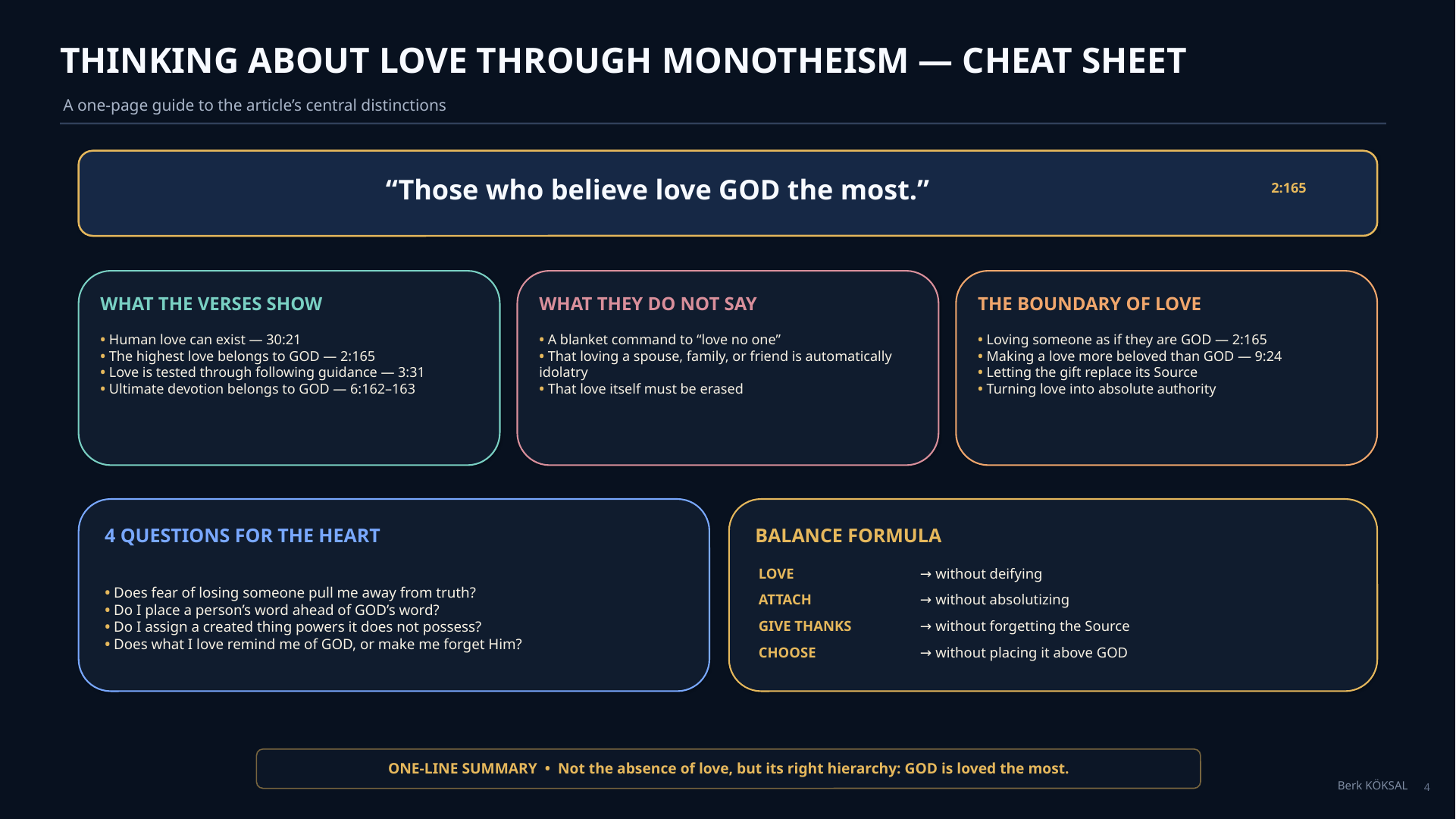
For me, this is not a tawhid that destroys love. It is a tawhid that orders love.
The greatest love belongs to GOD.
Absolute devotion belongs to GOD alone.
The final authority belongs to GOD.
Life and death are devoted to GOD.
Guidance belongs to GOD.
Created beings remain beloved, but they remain created.
That may mean I do not need to love people less. I need to love them more truthfully.
To love a spouse without demanding that the spouse become GOD.
To love a child without turning the child into an idol or an extension of my ego.
To love parents while refusing to turn love into blind obedience against truth.
To love a friend without calling the friend’s wrongdoing right.
To love a religious teacher without taking the teacher as a lord.
To love possessions while remaining able to give.
To love a home without imagining it to be eternal security.
To love art without making it the lord of life.
To care for myself without enthroning the ego above GOD’s measure.
This does not make love smaller.
It may free love from impossible expectations.
When I stop demanding that a human being become GOD for me, I can finally love that person as a human being.
I no longer need the person to save me, complete every emptiness, control destiny, guarantee eternity, or replace the Source of being.
I can love, while leaving what belongs to GOD with GOD.
Perhaps one of the most delicate tests of tawhid is exactly this:
to love without turning love into an idol.
Not to love nothing other than GOD,
but to love nothing as if it were GOD.
To place no love above the love of GOD.
To place no beloved being in GOD’s position.
And when a real choice arrives, to discover honestly who occupies the deepest center of the heart.
The sentence that remains with me is simple:
Love. But do not turn your love into an idol.
Love. But do not place the beloved in GOD’s position.
And love GOD the most.
Verse references: 2:165, 6:162, 9:24; also 3:31, 5:54, 28:56, 30:21, 39:45, 59:9, 60:7
Note
2:32 — They said, “Be You glorified, we have no knowledge, except that which You have taught us. You are the Omniscient, Most Wise.”
GOD knows best.
Source: kuranteyit.com
Discover
Related Articles

Quran Reflections
Escape from GOD: Is It Possible to Escape, Be Saved through Intercession, or Seek Help from Other Gods?
A deep Quran-centered reflection on whether it is possible to escape from GOD, whether anyone can intercede independently of GOD, whether salvation can come through other beings, and what divine authority, intercession, responsibility, and submission mean in light of the Quran.
Read article
Quran Reflections
How Can I Follow Abraham’s Path? How Can I Find the Way Abraham Found?
A reflection on Abraham’s Quranic path through monotheism, seeking truth, guidance, submission, appreciation, rejection of idolatry, and servanthood.
Read article
Quran Reflections
Being Put to Death Every Night: Sleep, the Soul, and Morning as a Resurrection
A reflection centered on Quran 39:42 about sleep, death, the soul, morning as resurrection, the appointed term, monotheism, submission, responsibility, and contemplation.
Read article