Should a Quran App Issue Rulings? The Boundary Between Tool and Authority
A reflection through Al-A'raf 7:33, An-Nahl 16:116, Al-Isra 17:36, and Al-Hujurat 49:6 on Quran apps, religious authority, the language of halal and haram, verification of information, the developer's responsibility, and the importance of a tool knowing its own limits.

Should a Quran App Issue Rulings? The Boundary Between Tool and Authority
Author: Berk KÖKSAL
Date: 09.08.2026
Location: Mersin
Verse
1:1 — In the name of GOD, Most Gracious, Most Merciful.*
Greetings. Peace be upon you.
The main purpose of this article is to consider verses together with other related verses and to express, in a sincere and thoughtful way, what bearing witness to the oneness of GOD means in human life in terms of knowledge, justice, truthfulness, and submission.
Introduction
When mixing music, a decision of only a few decibels can sometimes change how an entire work is perceived. Bringing the vocal forward magnifies the words; turning a guitar up too much can mask the other layers. There is a similar situation in software. Placing a result first, labeling a button “analysis,” or displaying one interpretation more prominently silently assigns weight in the user’s mind.
When the subject is the Quran, the responsibility for that weight becomes more serious.
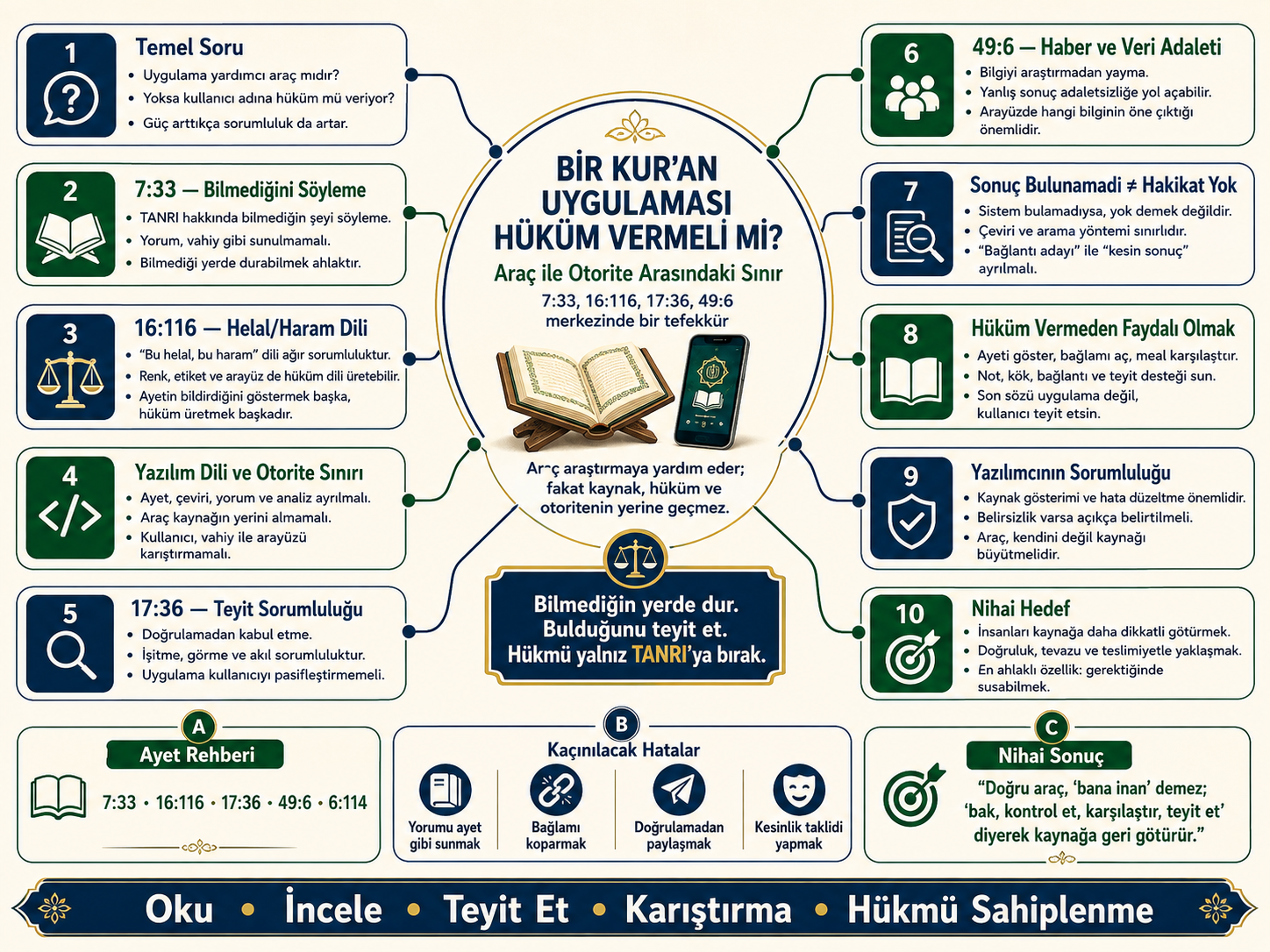
While developing Kuranteyit, I often ask myself this question: Should a Quran app remain a tool that helps research, or should it turn into an authority that issues judgments on behalf of the user?
An algorithm can find thousands of connections in seconds, but speed is not accuracy. Artificial intelligence can construct persuasive sentences, but persuasiveness is not testimony. An interface can create a feeling of certainty, but confidence on a screen does not grant authority to speak on behalf of GOD.
This question continues the same line of thought as my earlier writings on balance, consistency between word and action, the limits of Quran research with artificial intelligence, and the responsibility of verification when comparing translations. I keep returning to the same point in all of them: No matter how powerful a tool becomes, it should not replace the source or the human being’s own responsibility. All of my previous writings can be found here.
1. Not Saying About GOD What You Do Not Know
Verse
7:33
قُلْ إِنَّمَا حَرَّمَ رَبِّىَ ٱلْفَوَٰحِشَ مَا ظَهَرَ مِنْهَا وَمَا بَطَنَ وَٱلْإِثْمَ وَٱلْبَغْىَ بِغَيْرِ ٱلْحَقِّ وَأَن تُشْرِكُوا۟ بِٱللَّهِ مَا لَمْ يُنَزِّلْ بِهِۦ سُلْطَٰنًا وَأَن تَقُولُوا۟ عَلَى ٱللَّهِ مَا لَا تَعْلَمُونَ
Say, “My Lord prohibits only evil deeds, be they obvious or hidden, and sins, and unjustifiable aggression, and to set up beside GOD powerless idols, and to say about GOD what you do not know.”
Say: “My Lord prohibits only evil deeds, whether obvious or hidden, sins, unjustified aggression, setting up powerless idols beside GOD, and saying about GOD what you do not know.”
Source: kuranteyit.com
7:32 — Say: “Who prohibited the beautiful things GOD has created for His creatures and the good provisions?” Say: “Such provisions are for the believers to enjoy in this life. Moreover, the good provisions will be exclusively theirs on the Day of Resurrection.” We thus explain the revelations for people who know.
7:28 — They commit a gross sin, then say, “We found our parents doing this, and GOD has commanded us to do it.” Say: “GOD never advocates sin. Are you saying about GOD what you do not know?”
Reflection on the Verse
The warning at the end of 7:33 is the center of this article for me: not to say about GOD what we do not know. This is not merely about avoiding false information; it is an ethical boundary that requires a person not to confuse his own voice with the voice of revelation.
When an app says, “GOD has made this forbidden,” that sentence stops being ordinary interface text. If a verse states this explicitly, the app can show the verse. But a developer’s interpretation, a model’s output, or a connection produced by an algorithm cannot be presented with the same degree of certainty.
Saying, “I am not saying it; the system is,” does not remove responsibility either. A human being still decides what the system sees, what it highlights, and how confidently it speaks. For this reason, the first ethic of a Quran app may not be giving many answers, but being able to stop where it does not know.
2. Halal and Haram Produced by Language
Verse
16:116 — You shall not utter lies with your own tongues, saying, “This is lawful, and this is unlawful,” to fabricate lies and attribute them to GOD. Surely, those who fabricate lies and attribute them to GOD will never succeed.
16:115 — He only prohibits for you animals that die of themselves, blood, the meat of pigs,* and food dedicated to other than GOD. If one is forced (to eat these), without being deliberate or malicious, then GOD is Forgiver, Most Merciful.
10:59 — Say, “Have you noted how GOD sends down to you all kinds of provisions, then you render some of them unlawful and some lawful?” Say, “Did GOD give you permission to do this? Or do you fabricate lies and attribute them to GOD?”
Reflection on the Verse
16:116 brings language directly into the sphere of responsibility. The moment the statements “this is halal” and “this is haram” are attributed to GOD, they cease to be personal evaluations.
In the digital world, this claim is not made only through sentences. A red “haram” label, a green “halal” sign, or a one-line definitive result can produce the same effect. The language of software is the sum of text, color, ordering, and emphasis.
When I consider 16:115 and 16:116 together, a simple design principle emerges for me: Showing what the verse states is one thing; producing a ruling that goes beyond the verse is another. The first makes the source visible; the second risks turning the tool into a source of authority.
When a large choir sings a sentence in art, that sentence does not become more true; it only sounds bigger. Digital certainty can work the same way.
3. The Language of Software and the Boundary of Authority
Verse
3:78 — Among them are those who twist their tongues to imitate the scripture, so that you may think it is from the scripture when it is not, and they claim that it is from GOD when it is not from GOD. Thus, they deliberately fabricate lies and attribute them to GOD.
6:114 — Shall I seek other than GOD as a source of law, when He has revealed to you this book fully detailed?* Those who received the scripture recognize that it has been truthfully revealed from your Lord. You shall not harbor any doubt.
10:15 — When our revelations are recited to them, those who do not expect to meet us say, “Bring a Quran* other than this, or change it!” Say, “I cannot possibly change it on my own. I simply follow what is revealed to me. If I disobey my Lord, I fear the retribution of an awesome day.”
Reflection on the Verse
3:78 takes me directly to the boundary between interface and revelation. If a commentary, an automatic summary, or a “meaning” box beneath a verse is visually elevated to the same level as the verse, the user may no longer notice where revelation ends.
For this reason, the verse, translation, commentary, root information, and automatic connections should be clearly distinguished from one another. Their appearing on the same screen does not mean they carry the same authority.
6:114 sharpens the distinction between a research tool and a source of law. Kuranteyit can make searching, comparing, and examining easier, but it cannot replace the Quran. If even the messenger in 10:15 is told that he cannot change the revelation on his own, a software developer’s domain cannot be broader.
A producer processes sound but does not mistake the plug-in for the work itself. I need the same discipline in software: The tool facilitates the process; it does not replace the source.
4. Verification and Responsibility That Cannot Be Delegated
Verse
17:36 — You shall not accept any information, unless you verify it for yourself. I have given you the hearing, the eyesight, and the brain, and you are responsible for using them.
2:139 — Say, “Do you argue with us about GOD, when He is our Lord and your Lord? We are responsible for our deeds, and you are responsible for your deeds. We are devoted to Him alone.”
4:85 — Whoever mediates a good deed receives a share of the credit thereof, and whoever mediates an evil work incurs a share thereof. GOD controls all things.
Reflection on the Verse
17:36 places a serious limit on the desire to say, “let the app think for me.” If hearing, seeing, and using the brain are part of responsibility, then a good Quran app should not make the user passive; it should help the user see the verse, follow its context, check the source, and test what he or she accepts.
“The app said so” does not erase the individual’s responsibility. “The user wanted it” does not remove the developer’s responsibility either. 4:85 reminds us that mediation itself carries a share of responsibility.
For this reason, source attribution, error correction, release notes, and uncertainty warnings do not look like merely technical features to me. They can be digital equivalents of truthfulness. An app should not claim to be error-free, but neither should it treat its errors as insignificant.
5. News, Data, and Fairness in the Interface
Verse
49:6 — O you who believe, if a wicked person brings any news to you, you shall first investigate, lest you commit injustice towards some people out of ignorance, then become sorry and remorseful for what you have done.
17:35 — You shall give full measure when you trade, and weigh equitably. This is better and more righteous.
6:152 — You shall not touch the orphans’ money except in the most righteous manner, until they reach maturity. You shall give full weight and full measure when you trade, equitably. We do not burden any soul beyond its means. When you give testimony, you shall be absolutely equitable, even against your relatives. You shall fulfill your covenant with GOD. These are His commandments to you, that you may take heed.
Reflection on the Verse
In 49:6, the result of unverified information is not merely an intellectual mistake; it can extend into injustice. For this reason, a mismatched verse, an incomplete source, or an automated result whose confidence level is not disclosed cannot be treated as merely a software bug.
17:35 and 6:152 make me think that an interface has a scale of its own as well. Which result is at the top? Which translation is the default? Which interpretation is larger? When I raise one channel too much in a mix, the other instruments do not disappear, but they become inaudible. Constantly foregrounding one interpretation in an interface can produce a similar effect.
Fair presentation does not mean declaring all views equally correct. It means making the source, the fact that something is interpretation, and the level of confidence visible.
6. “No Results Found” Does Not Mean the Truth Is Absent
Verse
17:36 — You shall not accept any information, unless you verify it for yourself. I have given you the hearing, the eyesight, and the brain, and you are responsible for using them.
6:144 — As for the two kinds of camels and the two kinds of cattle, say, “Is it the two males that He prohibited, or the two females, or the contents of the wombs of the two females? Were you witnesses when GOD decreed such prohibitions for you? Who is more evil than those who fabricate such lies and attribute them to GOD? They thus mislead the people without knowledge. GOD does not guide such wicked people.”
6:150 — Say, “Bring your witnesses who would testify that GOD has prohibited this or that.” If they testify, do not testify with them. Nor shall you follow the opinions of those who reject our revelations, disbelieve in the Hereafter, and stray away from their Lord.
Reflection on the Verse
One of the dangerous sentences search systems can produce is “No results found.” A user may read this as “It is not in the Quran.” Yet most of the time, the system has simply failed to find a match within the translation, index, or search method it uses.
“I could not find it” and “it does not exist” are not the same sentence. The boundary between tool and authority sometimes appears precisely here.
The same principle applies to experimental thematic connections. Statistical proximity or shared words can open a door for research, but they are not proof of definitive meaning. One of the most honest sentences an app can sometimes offer is: “This is a possible connection; verify it for yourself.”
7. Being Useful Without Issuing Rulings
Verse
5:101 — O you who believe, do not ask about matters which, if revealed to you prematurely, would hurt you. If you ask about them in light of the Quran, they will become obvious to you. GOD has deliberately overlooked them. GOD is Forgiver, Clement.
6:119 — Why should you not eat from that upon which GOD’s name has been mentioned? He has detailed for you what is prohibited to you, unless you are forced. Indeed, many people mislead others with their personal opinions, without knowledge. Your Lord is fully aware of the transgressors.
6:69 — The righteous are not responsible for the utterances of these people, but it may help to remind them; perhaps they may be saved.
Reflection on the Verse
For an app not to issue rulings does not mean that it has to be useless. Being useful and being an authority are not the same thing.
An app can display a verse, provide navigation to its context, compare translations, assist with word and root research, and organize notes and connections. But while doing all of this, it should not place its own judgment before the user as the final word.
I want to develop Kuranteyit not so that people will believe me, but so that it can be transparent enough for them to question my choices as well. Perhaps its success should be measured not by how many answers it gives, but by how cleanly it leads a person back to the source.
8. On the Arabic Roots of Words
Verse
7:33 — Say: “My Lord prohibits only evil deeds, whether obvious or hidden, sins, unjustified aggression, setting up powerless idols beside GOD, and saying about GOD what you do not know.”
16:116 — You shall not utter lies with your own tongues, saying, “This is lawful, and this is unlawful,” to fabricate lies and attribute them to GOD. Surely, those who fabricate lies and attribute them to GOD will never succeed.
17:36 — You shall not accept any information, unless you verify it for yourself. I have given you the hearing, the eyesight, and the brain, and you are responsible for using them.
Reflection on the Verse
Root information is not a shortcut that replaces meaning; it is a layer of research that helps us look at the text more carefully.
The word حَرَّمَ (harrame) in 7:33 is related to the root ح-ر-م (Ha-Re-Mim). The semantic field of boundary and prohibition makes me think about how weighty a claim it is to call something “haram.” In 16:116, أَلْسِنَتُكُم (elsinetukum) is related to the root ل-س-ن (Lam-Sin-Nun), while الْكَذِبَ (el-kezib) is related to ك-ذ-ب (Kef-Zel-Be). Language is not only a means of communication; it is also a carrier of truth or falsehood.
The relation of مَسْـُٔولًا (mes’ûlen) in 17:36 to the root س-أ-ل (Sin-Hemze-Lam) also evokes the field of questioning and being questioned. Hearing, sight, and the brain are not without accountability. Still, root information alone does not issue a ruling; the word, the verse, and the context must be considered together.
Other Claims
Verse
7:33 — Say: “My Lord prohibits only evil deeds, whether obvious or hidden, sins, unjustified aggression, setting up powerless idols beside GOD, and saying about GOD what you do not know.”
16:116 — You shall not utter lies with your own tongues, saying, “This is lawful, and this is unlawful,” to fabricate lies and attribute them to GOD. Surely, those who fabricate lies and attribute them to GOD will never succeed.
17:36 — You shall not accept any information, unless you verify it for yourself. I have given you the hearing, the eyesight, and the brain, and you are responsible for using them.
Reflection on the Verse
Some approaches may argue that people cannot carry out lengthy research and that religious apps would therefore be more useful if they issued direct rulings. The practical need is understandable; but if source, interpretation, and degree of certainty become mixed together for the sake of speed, convenience can produce false confidence.
Another approach may take the idea that an app should not issue rulings to the point of saying that “nothing can be said.” What a verse states explicitly can be shown. The problem is presenting a human inference at the same level of authority as the verse.
Traditional or denominational structures assign different levels of weight to the interpretations of religious leaders and scholars. Those approaches may have their own foundations. The question here is narrower: Can software present one of those interpretations, or its own algorithmic inference, as GOD’s ruling? 7:33, 16:116, and 17:36 call me to caution at this point.
Conclusion
Verse
7:33 — Say: “My Lord prohibits only evil deeds, whether obvious or hidden, sins, unjustified aggression, setting up powerless idols beside GOD, and saying about GOD what you do not know.”
16:116 — You shall not utter lies with your own tongues, saying, “This is lawful, and this is unlawful,” to fabricate lies and attribute them to GOD. Surely, those who fabricate lies and attribute them to GOD will never succeed.
17:36 — You shall not accept any information, unless you verify it for yourself. I have given you the hearing, the eyesight, and the brain, and you are responsible for using them.
49:6 — O you who believe, if a wicked person brings any news to you, you shall first investigate, lest you commit injustice towards some people out of ignorance, then become sorry and remorseful for what you have done.
6:114 — Shall I seek other than GOD as a source of law, when He has revealed to you this book fully detailed?* Those who received the scripture recognize that it has been truthfully revealed from your Lord. You shall not harbor any doubt.
Reflection on the Verse
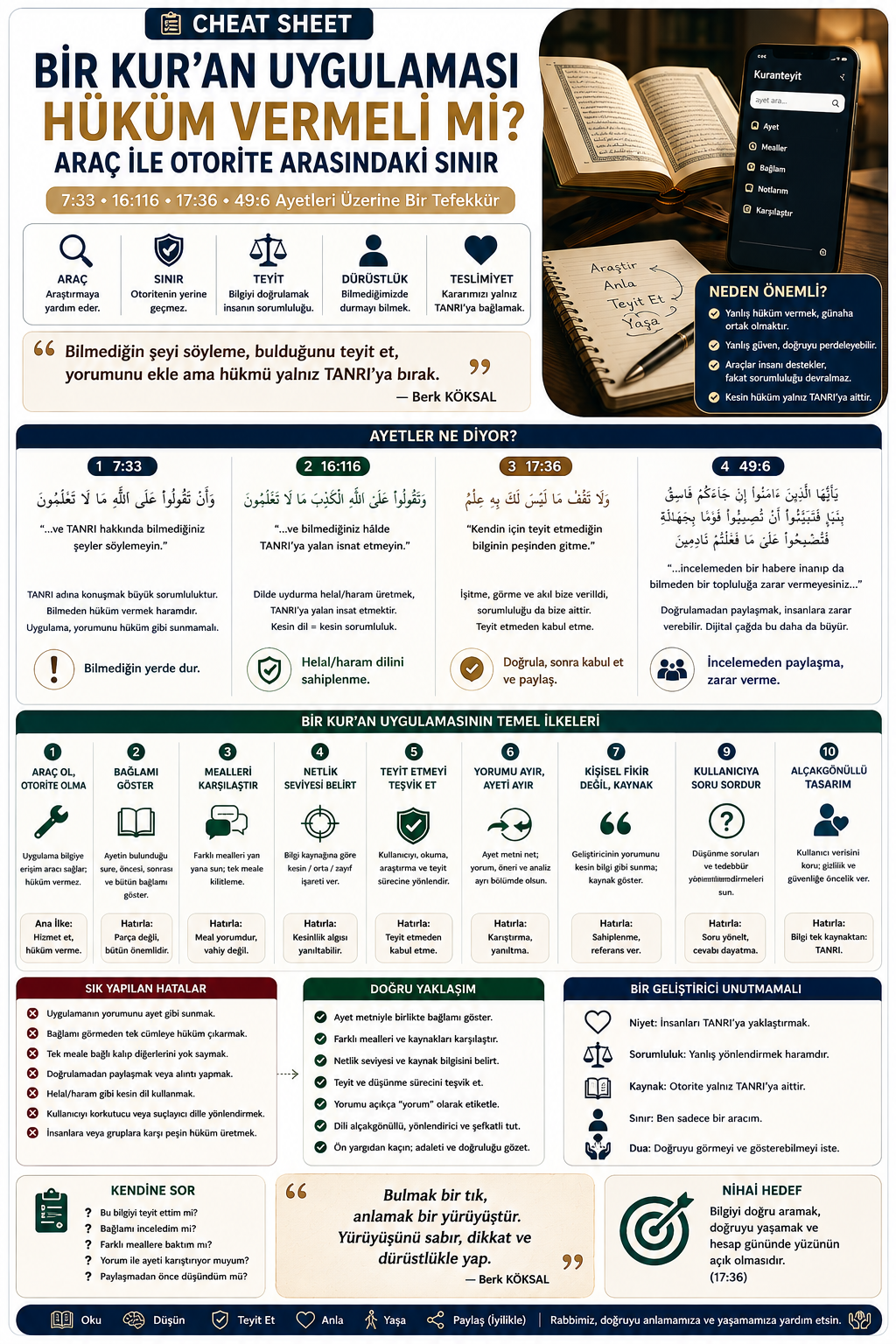
The cautious answer I can draw from these verses is this: A Quran app should not produce religious rulings in its own name. It can show, with a source, what GOD states explicitly in a verse; but it should not present the developer’s interpretation, a scholar’s opinion, an algorithmic connection, or an artificial intelligence output as the word of GOD.
A proper tool does not enlarge itself by diminishing the source. It does not tell the user, “believe me”; it leads the user back to the source by saying, “look, check, compare, verify.” If a result is experimental, it says so. If something was not found, it says only that it was not found. If it shows a translation, it does not hide the fact that it is a translation.
In music, a good arrangement sometimes means not having every instrument play constantly, but knowing where each one should be silent. The same may be true for software. Producing an answer to every question may be seen as a sign of power, but not every answer is truth. Sometimes the most ethical feature of a tool is knowing where it should remain silent.
This is the question I want to leave with myself as I continue developing Kuranteyit:
Does what I am building bring people closer to me and my choices, or does it help them look more carefully at GOD’s verses and take responsibility for themselves?
For my previous writings on the Quran, technology, art, verification, and responsibility: All my writings.
Note
2:32 — They said, “Be You glorified. We have no knowledge, except that which You have taught us. You are the Omniscient, Most Wise.”
17:36 — You shall not accept any information, unless you verify it for yourself. I have given you the hearing, the eyesight, and the brain, and you are responsible for using them.
GOD knows best.
Source: kuranteyit.com
Discover
Related Articles
Quran Reflections
Can Artificial Intelligence Explain the Quran? An Information Tool and the Responsibility of Understanding
A reflection through verses Al-Isra 17:36, Az-Zumar 39:18, Muhammad 47:24, and Al-Araf 7:33 on artificial intelligence, access to information, verification, careful study of the Quran, testimony, guidance, moral responsibility, and the limits of religious authority.
Read article
Quran Reflections
Do Not Accept Without Verifying
A reflection on verifying information, investigating reports, witnessing, justice, personal responsibility, submission, and the limits of human authority through the verses Al-Isra 17:36 and Al-Hujurat 49:6.
Read article
Quran Reflections
Finding Is One Thing, Understanding Is Another: The Verse in the Age of Search Engines
A reflection through Muhammad 47:24, Sad 38:29, Az-Zumar 39:18, and Al-Isra 17:36 on the difference between accessing a verse and understanding it in the age of search engines; keywords, context, selective reading, approximate matching, translation differences, verification, and responsibility in action.
Read article