Deep Reverence for GOD: Ego, Disrespect, and the Inner Reality of Crossing the Boundary
A reflection through verses Al-Baqarah 2:40, Al-Hujurat 49:1, Sad 38:76, Al-Furqan 25:43, and An-Nazi'at 79:40-41 on deep reverence for GOD, ego, pride, transgression, truthful speech, knowledge, privacy, submission, and the limits of human authority.

A Reflection on Verses 2:40, 49:1, 38:76, 25:43, and 79:40-41
Author: Berk KÖKSAL
Date: 05.09.2026
Location: Mersin
Verse
1:1 — In the name of GOD, Most Gracious, Most Merciful.*
Introduction
Peace. Peace be upon you.
People often look for disrespect toward GOD in words and actions that are visible from the outside. Insults, mockery, open denial, or a crude attitude toward what is sacred are easy to notice. Yet the longer I stand before the verses, the quieter question that emerges for me is this: if I say that I respect GOD while placing my own opinion ahead of His measure, making my knowledge unquestionable, or turning my ego into the final court of judgment, where has the boundary truly been crossed?
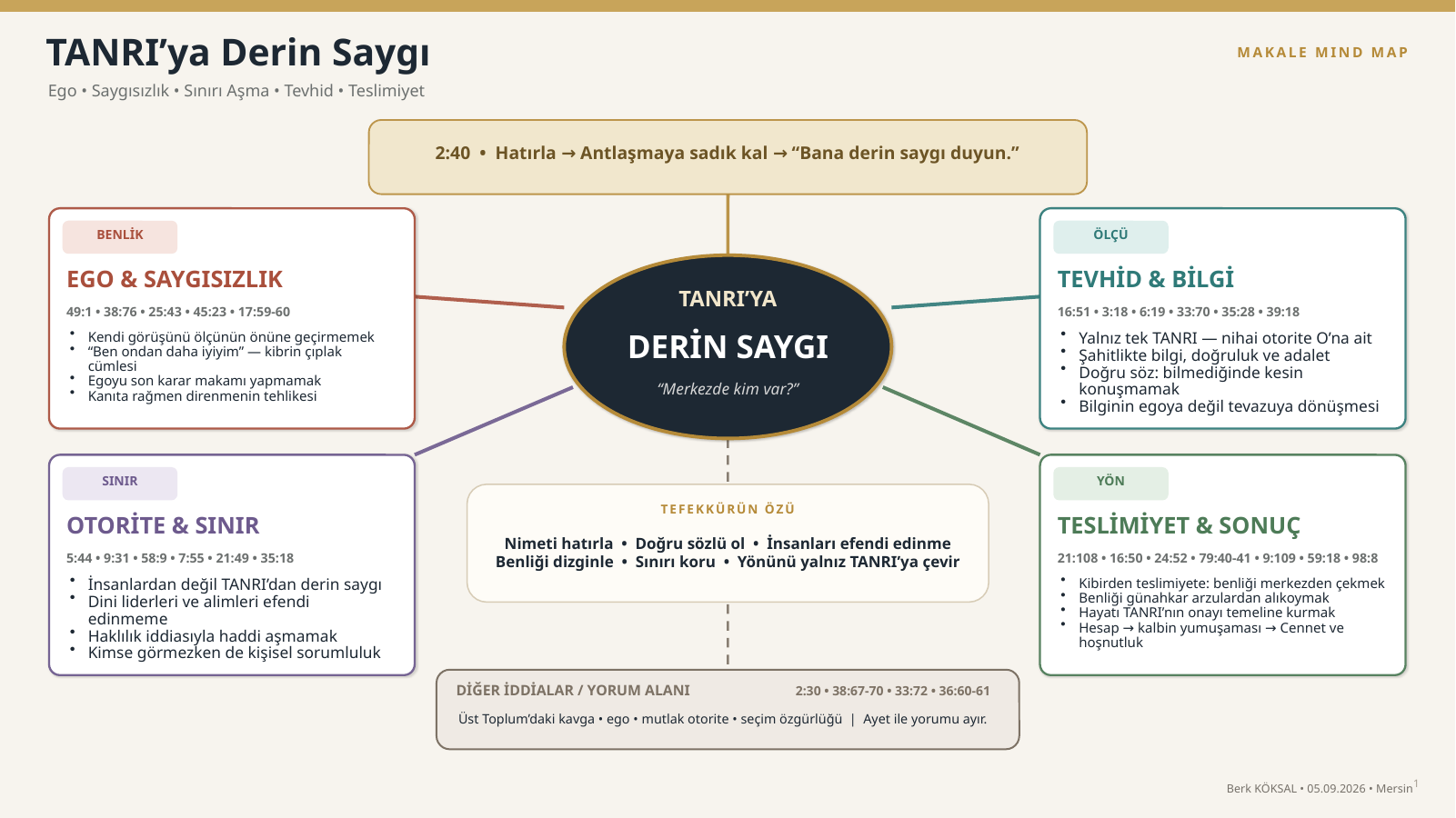
At the beginning of this reflection, 2:40 calls me to remember the blessing, fulfill my part of the covenant, and deeply revere GOD. This order is decisive for me. Deep reverence is not merely fear, trembling, or an intense spiritual feeling; it is an orientation tested through remembrance, faithfulness, and conduct. When a person forgets the source of the blessing, they may begin to enlarge their own share; when they forget their responsibility, they may begin to expand their own boundaries.
Throughout this article, the issue moves increasingly inward toward the ego. 49:1 reminds me not to place my own opinion above GOD and His messenger. In 38:76, Satan’s statement, “I am better than he,” confronts me as a short but heavy sentence of pride. While 25:43 and 45:23 show the danger that the ego can take the place of a god for a person, 79:40 places restraining the self from sinful desires beside deep reverence for the majesty of the Lord.
For this reason, the purpose of this article is not to casually declare others “disrespectful.” What I primarily want is to see the boundary within myself: When does knowledge separate from humility? When does respect for people begin to move them into GOD’s place? When does the feeling of being right give anger unlimited authority? Can I keep the same measure when no one is watching? Without confusing what the verses explicitly say with my own interpretation, I am trying to hold a single measure at the center of all these questions: to truly know GOD as GOD and not move the self into a place that belongs to Him.
Summary:
1. The First Threshold of Deep Reverence: Blessing, Covenant, and Direction
2:40
يَٰبَنِىٓ إِسْرَٰٓءِيلَ ٱذْكُرُوا۟ نِعْمَتِىَ ٱلَّتِىٓ أَنْعَمْتُ عَلَيْكُمْ وَأَوْفُوا۟ بِعَهْدِىٓ أُوفِ بِعَهْدِكُمْ وَإِيَّٰىَ فَٱرْهَبُونِ
O Children of Israel, remember My favor, which I bestowed upon you, and fulfill your part of the covenant, that I fulfill My part of the covenant, and reverence Me.
O Children of Israel, remember My favor, which I bestowed upon you. Fulfill your part of the covenant, that I may fulfill My part of the covenant. Reverence Me.
2. Where Does Disrespect Begin? Putting Your Own Opinion First
49:1 — O you who believe, do not place your opinion above that of GOD and His messenger. Reverence GOD. GOD is Hearer, Omniscient.
47:14 — Are those enlightened by their Lord the same as those whose evil works are adorned in their eyes, and who follow their own opinions?
3. The Ego's Sentence: “I Am Better Than He”
2:34 — When We said to the angels, “Fall prostrate before Adam,” they fell prostrate, except Satan; he refused, was too arrogant, and was a disbeliever.
38:74 — Except Satan; he refused and was too arrogant, unappreciative.
38:75 — He said, “O Satan, what prevented you from prostrating before what I created with My own hands? Are you too arrogant? Have you rebelled?”
38:76 — He said, “I am better than he; You created me from fire, and created him from clay.”
4. The Descent from Paradise: Warning, Desire, Disobedience, and Guidance
20:117 — We then said, “O Adam, this is an enemy of you and your wife. Do not let him evict you from Paradise, lest you become miserable.
20:120 — But the devil whispered to him, saying, “O Adam, let me show you the tree of eternity and a kingdom that never ends.”
20:121 — They ate from it, whereupon their bodies became visible to them, and they tried to cover themselves with the leaves of Paradise. Adam thus disobeyed his Lord and fell.
20:122 — Thereafter, his Lord chose him, redeemed him, and guided him.
20:123 — He said, “Go down from there, all of you. You are enemies of one another. When guidance comes to you from Me, anyone who follows My guidance will not go astray, nor suffer any misery.
5. Crossing the Boundary in the Face of Evidence: When a Sign Is Not Enough
17:59 — What stopped us from sending the miracles was that the previous generations rejected them. For example, We showed Thamud the camel, a profound miracle, but they transgressed against it. We send the miracles only to instill reverence.
17:60 — We informed you that your Lord fully controls the people, and We rendered the vision that We showed you, as well as the tree cursed in the Quran, a test for the people.* We show them solid proofs in order to instill reverence in them, but this only increases their rebelliousness.
6. When the Ego Takes the Place of a God
25:43 — Have you seen the one whose god is his own ego? Will you be his advocate?
45:23 — Have you noted the one whose god is his own ego? Consequently, GOD sends him astray, despite his knowledge, seals his hearing and his mind, and places a veil over his eyes. Who then can guide him after such a decision by GOD? Would you not take heed?
5:30 — His ego provoked him into killing his brother. He killed him and ended up with the losers.
79:40 — As for the one who reverenced the majesty of his Lord and restrained the self from sinful desires.
79:41 — Paradise will be the abode.
7. Deep Reverence for GOD, Not for People
5:44 — We have sent down the Torah,* containing guidance and light. The Jewish prophets, as well as the rabbis and priests, judged by it in accordance with what they were commanded in GOD's scripture, and to which they were witnesses. Therefore, do not reverence people; instead, reverence Me. And do not trade away My revelations for a cheap price. Those who do not judge in accordance with GOD's revelations are disbelievers.
8. The Limit of Religious Authority: The Danger of Taking People as Lords
9:31 — They have taken their religious leaders and scholars as lords* instead of GOD. Others deified the Messiah, son of Mary. They were all commanded to worship only one god. There is no god except He. Be He glorified, far above having any partners.
9. Monotheism, Witnessing, Knowledge, and Justice
16:51 — GOD has proclaimed: “Do not worship two gods; there is only one god. You shall reverence Me alone.”
3:18 — GOD bears witness that there is no god except He, and so do the angels and those who possess knowledge. Truthfully and equitably, He is the absolute god; there is no god but He, the Almighty, Most Wise.
6:19 — Say, “Whose testimony is the greatest?” Say, “GOD's. He is witness between me and you that this Quran* has been inspired to me, to preach it to you and to whomever it reaches. Indeed, you bear witness that there are other gods* beside GOD.” Say, “I do not testify as you do; there is only one god, and I disown your idolatry.”
10. Truthful Speech: The Test of Reverence in Language
33:70 — O you who believe, reverence GOD and utter only the correct words.
9:119 — O you who believe, reverence GOD and be among the truthful.
11. Knowledge and Humility: Does Knowing Inflate You or Educate You?
35:28 — Also, the people, animals, and livestock come in various colors. Thus, the people who truly reverence GOD are those who are knowledgeable. GOD is Almighty, Forgiver.
39:18 — They are the ones who examine all words, then follow the best. These are the ones whom GOD has guided; these are the ones who possess intelligence.
12. Not Transgressing: The Limit of Power and Anger
58:9 — O you who believe, if you confer secretly, do not confer to commit sin, transgression, and disobedience of the messenger. Confer to work righteousness and piety. Reverence GOD, before whom you will be summoned.
7:55 — You shall worship your Lord publicly and privately; He does not love the transgressors.
5:28 — “Even if you extend your hand to kill me, I will not extend my hand to kill you. For I reverence GOD, Lord of the universe.
13. Reverence in Privacy: Who Am I When No One Is Watching?
21:49 — They reverence their Lord even when alone in their privacy, and they are apprehensive about the Hour.
35:18 — No soul can bear the sins of another soul. If a soul that is loaded with sins implores another to bear part of its load, no other soul can bear any part of it, even if they were related. The only people to heed your warnings are those who reverence their Lord even when alone in their privacy, and observe the Contact Prayers (Salat). Whoever purifies his soul does so for his own good. To GOD is the final destiny.
14. Submission and Obedience: Removing the Self from the Center
16:50 — They reverence their Lord, high above them, and they do what they are commanded to do.
24:52 — Those who obey GOD and His messenger, reverence GOD, and observe Him; these are the triumphant ones.
21:108 — Proclaim, “I have been given divine inspiration that your god is one god. Will you then submit?”
27:31 — “Proclaiming: ‘Do not be arrogant; come to me as submitters.’ ”
15. Foundation and Accountability: What Am I Building On?
9:109 — Is one who establishes his building on the foundation of reverencing GOD and seeking His approval better, or one who establishes his building on the edge of a crumbling cliff, then falls with it into Hellfire? GOD does not guide the transgressing people.
59:18 — O you who believe, reverence GOD, and let every soul examine what it has sent ahead for tomorrow. Reverence GOD; GOD is fully Cognizant of everything you do.
16. From Trembling to Softening: The State of the Heart Before Majesty
39:23 — GOD has revealed herein the best Hadith; a book that is consistent and points out both ways (to Heaven and Hell). The skins of those who reverence their Lord cringe therefrom, then their skins and their hearts soften up for GOD's message. Such is GOD's guidance; He bestows it upon whomever He wills. As for those sent astray by GOD, nothing can guide them.
42:5 — The heavens above them almost shatter out of reverence for Him, and the angels praise and glorify their Lord and ask forgiveness for those on earth. Surely, GOD is Forgiver, Most Merciful.
13:13 — The thunder praises His glory, and so do the angels out of reverence for Him. He sends the lightning bolts, striking in accordance with His will. Yet they argue about GOD, though His power is awesome.
17. On the Arabic Roots of the Words
2:40 — O Children of Israel, remember My favor, which I bestowed upon you. Fulfill your part of the covenant, that I may fulfill My part of the covenant. Reverence Me.
18. Other Claims
2:30 — Recall that your Lord said to the angels, “I am placing a representative (a temporary god) on Earth.” They said, “Will You place therein one who will spread evil and shed blood, while we sing Your praises, glorify You, and uphold Your absolute authority?” He said, “I know what you do not know.”
38:67 — Say, “Here is awesome news.
38:68 — “That you are totally oblivious to.
38:69 — “I had no knowledge previously about the feud in the High Society.*
38:70 — “I am inspired that my sole mission is to deliver the warnings to you.”
33:72 — We have offered the responsibility (freedom of choice) to the heavens and the earth and the mountains, but they refused to bear it and were afraid of it. But the human being accepted it; he was transgressing, ignorant.*
36:60 — Did I not covenant with you, O Children of Adam, that you shall not worship the devil? That he is your most ardent enemy?
36:61 — And that you shall worship Me alone? This is the right path.
19. Conclusion
2:40 — O Children of Israel, remember My favor, which I bestowed upon you. Fulfill your part of the covenant, that I may fulfill My part of the covenant. Reverence Me.
79:40 — As for the one who reverenced the majesty of his Lord and restrained the self from sinful desires.
79:41 — Paradise will be the abode.
98:8 — Their reward at their Lord is the gardens of Eden with flowing streams; they abide therein forever. GOD is pleased with them, and they are pleased with Him. Such is the reward for those who reverence their Lord.
1. The First Threshold of Deep Reverence: Blessing, Covenant, and Direction
Verse
2:40
يَٰبَنِىٓ إِسْرَٰٓءِيلَ ٱذْكُرُوا۟ نِعْمَتِىَ ٱلَّتِىٓ أَنْعَمْتُ عَلَيْكُمْ وَأَوْفُوا۟ بِعَهْدِىٓ أُوفِ بِعَهْدِكُمْ وَإِيَّٰىَ فَٱرْهَبُونِ
O Children of Israel, remember My favor, which I bestowed upon you, and fulfill your part of the covenant, that I fulfill My part of the covenant, and reverence Me.
O Children of Israel, remember My favor, which I bestowed upon you. Fulfill your part of the covenant, that I may fulfill My part of the covenant. Reverence Me.
Source: kuranteyit.com
Reflection on the Verse
I no longer read this verse merely to understand the concept of “deep reverence.” It asks me a more fundamental question: If I truly revere GOD, what does that look like in my life?
The flow of the verse begins with remembering. Then comes fulfilling my part of the covenant. Finally, it says, “Reverence Me.” This order is very important to me. Deep reverence here does not remain merely an emotion, a shiver, or an intensity experienced in a sacred moment. It is tied to memory, faithfulness, and action.
Looking at it from the opposite direction, I begin to think that disrespect toward GOD is not merely a crude statement either. A person can avoid uttering a single insulting word about GOD and still forget what He has given, take their responsibility lightly, and fail to fulfill their part. The verse does not directly name each of these things “disrespect,” and neither should I. Yet the connection established by 2:40 clearly leads me to see reverence as a relationship with life broader than words.
Forgetting the blessing can enlarge the self. When a person begins to regard what they possess as originating from themselves, they can also become inclined to forget that they are accountable. The covenant reminds the self that it is not limitless. I have been given a sphere, but that sphere also has an Owner.
For this reason, the first movement of deep reverence for me is not to diminish myself, but to know my place correctly. To know that what GOD has given comes from GOD, to take my word seriously, and to move the center of gravity in my life from myself to Him.
Verse reference: 2:40.
2. Where Does Disrespect Begin? Putting Your Own Opinion First
Verse
49:1 — O you who believe, do not place your opinion above that of GOD and His messenger. Reverence GOD. GOD is Hearer, Omniscient.
47:14 — Are those enlightened by their Lord the same as those whose evil works are adorned in their eyes, and who follow their own opinions?
Reflection on the Verse
49:1 confronts me with a quieter form of disrespect. A person can believe in GOD, praise Him, and use religious language, yet ultimately place their own opinion above the measure.
Sometimes the ego does not say, “There is no GOD.” It says something subtler: “My understanding must be correct.” “I cannot be wrong.” “This verse must be read according to my view.” At that point, the weight of my opinion begins to become confused with the weight of revelation.
The fact that 49:1 immediately reminds us of deep reverence does not seem accidental to me. Not putting one’s own opinion first and deeply reverencing GOD meet in the same verse. This means that one form of deep reverence is also the ability to stop. Even where I think I know, I must be able to set a boundary for myself.
47:14, meanwhile, says that the deeds of those who follow their own opinions can be adorned in their eyes. The danger here is enormous. A person may awaken more easily when doing something they openly believe is wrong; what is much harder is when their own wrong appears beautiful to them.
In How Can Monotheism Be Broken by a Single Word? One GOD or the “Most Exalted of the Exalted”? I reflected on how a seemingly small change in language can carry meaning somewhere else. Here, the issue goes even deeper than language. If I make my own mind unquestionable, I may have established another authority within myself even while using the right words.
Deep reverence does not tell me, “Do not think.” On the contrary, it asks me to keep even my thought accountable before GOD.
Verse references: 49:1, 47:14.
3. The Ego’s Sentence: “I Am Better Than He”
Verse
2:34 — When We said to the angels, “Fall prostrate before Adam,” they fell prostrate, except Satan; he refused, was too arrogant, and was a disbeliever.
38:74 — Except Satan; he refused and was too arrogant, unappreciative.
38:75 — He said, “O Satan, what prevented you from prostrating before what I created with My own hands? Are you too arrogant? Have you rebelled?”
38:76 — He said, “I am better than he; You created me from fire, and created him from clay.”
Reflection on the Verse
What shakes me most in these verses is that Satan does not offer a long philosophical defense. The sentence is very short: “I am better than he.”
Sometimes the summary of the ego may really be that short.
There is a command. In response, Satan compares himself, the other, and the materials of their creation. Then he establishes his own measure of value. He places his judgment of superiority against GOD’s command.
Here I understand the word “ego” through the pride and the statement “I am better than he” used in the verse. The problem is not merely that a person loves themselves. The problem is the self growing to the point of placing its own measure ahead of GOD’s judgment.
For this reason, looking for disrespect toward GOD only in language now seems insufficient to me. There is a deeper question: When GOD’s clear measure and my ego conflict, which one withdraws?
I may consider myself smarter, more knowledgeable, cleaner, more correct, or more important than someone else. Some of these may even be measurable differences in certain areas. But Satan’s error is not simply that he makes a comparison. It is that he turns his comparison into the basis of his disobedience.
This is the real danger for me.
My knowledge, ability, achievements, religious research, the music I make, the writings I write, or the applications I develop do not grant me any special immunity before GOD. As the blessing grows, the ego may also want to turn it into its own property.
Deep reverence, however, calls me to see the blessing not as a certificate of greatness, but as a responsibility.
Verse references: 2:34, 38:74, 38:75, 38:76.
4. The Descent from Paradise: Warning, Desire, Disobedience, and Guidance
Verse
20:117 — We then said, “O Adam, this is an enemy of you and your wife. Do not let him evict you from Paradise, lest you become miserable.
20:120 — But the devil whispered to him, saying, “O Adam, let me show you the tree of eternity and a kingdom that never ends.”
20:121 — They ate from it, whereupon their bodies became visible to them, and they tried to cover themselves with the leaves of Paradise. Adam thus disobeyed his Lord and fell.
20:122 — Thereafter, his Lord chose him, redeemed him, and guided him.
20:123 — He said, “Go down from there, all of you. You are enemies of one another. When guidance comes to you from Me, anyone who follows My guidance will not go astray, nor suffer any misery.
Reflection on the Verse
Here I first see a clear warning: the enemy is identified. Then I look at Satan’s offer. Eternity and a kingdom that never ends.
The place this offer touches within the human self is deeply thought-provoking. More time. More possession. The idea of a rule without end.
Then 20:121 explicitly says that Adam disobeyed his Lord and fell. This point should not be romanticized. There is a boundary, and the boundary is crossed.
But the account does not end there.
20:122 is one of the most important verses in this section for me. Immediately after the fall come being chosen, redeemed, and guided. This does not trivialize the mistake; but neither does it turn the mistake into an identity a person must carry forever.
Deep reverence is not simply the sentence “never make a mistake.” When I make a mistake, the self has a second trap: either I minimize what I did, or in despair I declare myself completely lost. The flow of the verses shows a way different from both extremes. The disobedience is named, then the door of guidance opens.
In 20:123, the descent to earth comes together with the promise of guidance. For me, this establishes a powerful measure concerning the meaning of life: I am not here without direction. There is guidance. Therefore, my freedom does not mean unlimited sovereignty.
Respect for GOD is not never seeing the boundary; it is not forgetting who set it.
Verse references: 20:117, 20:120, 20:121, 20:122, 20:123.
5. Crossing the Boundary in the Face of Evidence: When a Sign Is Not Enough
Verse
17:59 — What stopped us from sending the miracles was that the previous generations rejected them. For example, We showed Thamud the camel, a profound miracle, but they transgressed against it. We send the miracles only to instill reverence.
17:60 — We informed you that your Lord fully controls the people, and We rendered the vision that We showed you, as well as the tree cursed in the Quran, a test for the people.* We show them solid proofs in order to instill reverence in them, but this only increases their rebelliousness.
Reflection on the Verse
I notice that people sometimes think, “If I saw a sufficiently great proof, I would definitely change.”
17:59-60 disrupts that comfortable assumption. It shows that there is no automatic relationship between the magnitude of a sign and a person’s submission. Even what is given to create deep reverence can accompany an increase in rebelliousness in some people.
This makes me think that the ego does not feed only on ignorance. Sometimes the problem is not lack of evidence. It is that I do not want to accept the conclusion to which the evidence leads me.
A person may say that something is insufficient before rejecting a truth. Then they ask for more signs. When a sign comes, they produce another reason. If the real problem is not information but the self refusing to submit, then as the external evidence increases, the internal resistance may simply change form.
The question I ask myself here is heavy: Am I asking GOD for a sign, or am I asking for confirmation of the result I want?
Deep reverence is not putting evidence on trial in the court of my ego and accepting it only if I like the outcome. Of course one must investigate, verify, and examine. But investigation and endless evasion are not the same thing.
Crossing a boundary is sometimes not a foot stepping over a physical line. It is continuing to manufacture new excuses even when the truth has become sufficiently visible.
Verse references: 17:59, 17:60.
6. When the Ego Takes the Place of a God
Verse
25:43 — Have you seen the one whose god is his own ego? Will you be his advocate?
45:23 — Have you noted the one whose god is his own ego? Consequently, GOD sends him astray, despite his knowledge, seals his hearing and his mind, and places a veil over his eyes. Who then can guide him after such a decision by GOD? Would you not take heed?
5:30 — His ego provoked him into killing his brother. He killed him and ended up with the losers.
79:40 — As for the one who reverenced the majesty of his Lord and restrained the self from sinful desires.
79:41 — Paradise will be the abode.
Reflection on the Verse
These verses take the subject of ego out of abstract psychology.
25:43 and 45:23 use a very severe expression: one’s own ego becoming one’s god. The danger here is not that a person physically prostrates before themselves. It is making one’s own desire, interpretation, and will the final court of judgment.
The phrase that especially stops me in 45:23 is “despite his knowledge.” Knowledge alone does not save. A person can possess knowledge and still the ego may refuse to leave its throne.
5:30 shows the horrifying behavioral consequence in that account. The ego provokes him to kill his brother. I cannot conclude from this verse that ego is the sole explanation for every act of violence. But in the event described by the verse, the ego is explicitly shown as the force driving the action.
79:40 looks at the same issue from another direction: deep reverence for the majesty of the Lord and restraining the self from sinful desires.
For me, the relationship between deep reverence and ego becomes clearer here. Deep reverence is not denying the self; it is not accepting every demand of the self as right.
“I want it” is one sentence.
“Therefore, it is my right” is something entirely different.
“This is what I think” is one thing.
“Therefore GOD must have said this too” is much more dangerous.
Respect for GOD is the ego knowing its boundary. When a person does not put the self in GOD’s place, they do not become smaller; they return to their true place.
Verse references: 25:43, 45:23, 5:30, 79:40, 79:41.
7. Deep Reverence for GOD, Not for People
Verse
5:44 — We have sent down the Torah,* containing guidance and light. The Jewish prophets, as well as the rabbis and priests, judged by it in accordance with what they were commanded in GOD’s scripture, and to which they were witnesses. Therefore, do not reverence people; instead, reverence Me. And do not trade away My revelations for a cheap price. Those who do not judge in accordance with GOD’s revelations are disbelievers.
Reflection on the Verse
5:44 makes an extremely clear distinction: Do not deeply revere people; instead, revere Me.
I cannot read this sentence as permission to treat people harshly. The verse does not say that people are worthless. The issue is deeper: to whom does the ultimate weight belong?
I can love a person. I can trust their knowledge. I can benefit from their experience. I can be grateful for something they taught me. But when I begin to hide a truth I know because of a person’s reaction, their weight may have moved to a different place in my heart.
Fear of social exclusion, the reaction of a religious circle, family pressure, loss of followers, loss of reputation, material loss… All of these are real. Deep reverence does not make me ignore these consequences. But it reminds me who the final measure is.
For me, one subtle form of disrespect toward GOD is also bowing before a human crowd where I should be standing before GOD.
Thinking about what people will say is human. Making what people will say heavier than what GOD has said is another matter.
The liberating side of deep reverence appears here. I do not need to challenge everyone. But neither do I need to put anyone in GOD’s place.
Verse reference: 5:44.
8. The Limit of Religious Authority: The Danger of Taking People as Lords
Verse
9:31 — They have taken their religious leaders and scholars as lords* instead of GOD. Others deified the Messiah, son of Mary. They were all commanded to worship only one god. There is no god except He. Be He glorified, far above having any partners.
Reflection on the Verse
This verse is an indispensable boundary for me when thinking about human authority.
Listening to someone knowledgeable about religion is not the same as taking that person as a lord. Learning is not the same as surrendering one’s will. Showing respect is not the same as giving a human being the final authority that belongs to GOD.
The criticism in the verse is directed not at knowledge but at displacement: instead of GOD.
Those two words change a great deal.
A scholar can make a mistake. A religious leader can be wrong. A translator can mistranslate a word. A researcher can change an earlier view when confronted with strong evidence. None of this takes them outside being human.
The problem begins the moment I place a person above the possibility of error.
The question of authority in How Can Monotheism Be Broken by a Single Word? One GOD or the “Most Exalted of the Exalted”? grows even larger here. If there is a difference between the source text and human transmission, my affection or attachment must not place the human word above the source.
I must preserve the same measure regarding Rashad Khalifa. Taking an Authorized Translation as a primary text, benefiting from a study, or finding an interpretation compelling does not give me the right to put a human being in GOD’s place. The same applies to this article itself. My reflection is not a verse.
To preserve deep reverence, the difference between the intermediary and the Source must remain open at all times.
Verse reference: 9:31.
9. Monotheism, Witnessing, Knowledge, and Justice
Verse
16:51 — GOD has proclaimed: “Do not worship two gods; there is only one god. You shall reverence Me alone.”
3:18 — GOD bears witness that there is no god except He, and so do the angels and those who possess knowledge. Truthfully and equitably, He is the absolute god; there is no god but He, the Almighty, Most Wise.
6:19 — Say, “Whose testimony is the greatest?” Say, “GOD’s. He is witness between me and you that this Quran* has been inspired to me, to preach it to you and to whomever it reaches. Indeed, you bear witness that there are other gods* beside GOD.” Say, “I do not testify as you do; there is only one god, and I disown your idolatry.”
Reflection on the Verse
16:51 gathers the direction of the article into almost a single sentence: one god, and deep reverence for Him alone.
3:18 places this oneness beside knowledge and justice. This is very important to me. Monotheism is not merely emotional devotion. Witnessing must be truthful and equitable.
I need to be even more careful when saying something in GOD’s name. Because I am no longer merely expressing an opinion; I am making a statement about GOD.
The statement in 6:19 that the greatest testimony belongs to GOD also reestablishes the human place. I bear witness; but the greatest testimony is not mine.
In The Weight of Witnessing I reflected on the relationship between word and life. Here the same issue joins with reverence. If I bear witness to the oneness of GOD while acting unjustly, hiding the truth simply because I have taken a side, or speaking with certainty where I have no knowledge, monotheism on my tongue may not have spread through my whole life.
Respect for GOD is not only prostrating to Him; it is also not bearing unjust testimony about Him.
If knowledge does not make me more truthful, more just, and more careful, I should ask whether my ego has taken possession of that knowledge.
Verse references: 16:51, 3:18, 6:19.
10. Truthful Speech: The Test of Reverence in Language
Verse
33:70 — O you who believe, reverence GOD and utter only the correct words.
9:119 — O you who believe, reverence GOD and be among the truthful.
Reflection on the Verse
The simplicity of these two verses affects me. Deep reverence and truthful speech stand side by side.
A person can describe how great their feelings toward GOD are. But if they bend the truth in everyday speech, the relationship established by the verses should disturb them.
Truthful speech is not merely avoiding an outright lie. Conveying only the part of information that serves my interest, tearing someone else’s words from their context, presenting possibility as certainty, or speaking as though I know what I do not know should also be considered within the question of truthfulness.
In Whom Does the Microphone Exalt? ZIKR RAP, Words, and Responsibility I reflected on how a powerful voice does not automatically purify intention. The same is true here for religious speech. A microphone can amplify. A headline can affect. A beautiful sentence can shake people. But the volume of a statement is not its truth.
Producing exaggerated certainties in GOD’s name while claiming to deeply revere GOD can become a contradiction in itself.
Sometimes reverence is not speaking more.
Sometimes it is being able to say, “I do not know.”
Sometimes it is conveying a truth I dislike without changing it.
Sometimes it is correcting something I previously said.
Truthful speech is one of the areas where the ego struggles most, because the ego may see admitting error as a loss. Yet from the standpoint of submission, correcting my mistake is not defeat; it is turning my direction back toward GOD.
Verse references: 33:70, 9:119.
11. Knowledge and Humility: Does Knowing Inflate You or Educate You?
Verse
35:28 — Also, the people, animals, and livestock come in various colors. Thus, the people who truly reverence GOD are those who are knowledgeable. GOD is Almighty, Forgiver.
39:18 — They are the ones who examine all words, then follow the best. These are the ones whom GOD has guided; these are the ones who possess intelligence.
Reflection on the Verse
Knowledge can enlarge a person. But in two different senses.
A person can understand more, see more connections, and make better decisions. That is genuine development.
But knowledge can also enlarge a person’s sense of their own greatness. The sentence “I know” can gradually turn into “What I say is right,” and from there into the attitude “Anyone who questions me has not understood.”
35:28 gives me another measure. It establishes a connection between knowledge and deep reverence.
In that case, it is not enough to ask only, “How much have I learned?” I must also ask, “As I learn, do I understand my place before GOD more clearly?”
39:18 speaks of examining all words and then following the best. This is not an approach that diminishes research or thought. On the contrary, it requires listening, distinguishing, and then choosing.
In Do Not Accept Without Verifying, what affected me most while reflecting on the responsibility of knowledge was this: if hearing, sight, and intelligence have been given, then using them is part of responsibility too.
But there is a thin line between investigating and absolutizing myself. When my knowledge begins to make me feel like an authority independent of GOD, knowledge can reverse its purpose.
True knowledge should teach me not only my greatness, but my limits as well.
Verse references: 35:28, 39:18.
12. Not Transgressing: The Limit of Power and Anger
Verse
58:9 — O you who believe, if you confer secretly, do not confer to commit sin, transgression, and disobedience of the messenger. Confer to work righteousness and piety. Reverence GOD, before whom you will be summoned.
7:55 — You shall worship your Lord publicly and privately; He does not love the transgressors.
5:28 — “Even if you extend your hand to kill me, I will not extend my hand to kill you. For I reverence GOD, Lord of the universe.
Reflection on the Verse
One of the real tests of deep reverence appears when a person feels powerful.
When I am weak, knowing my limit can sometimes be compulsory. When I have power, can I still restrain myself?
58:9 carries transgression all the way into private conferences. In other words, not only visible behavior but also intention and planning behind closed doors have an ethical boundary.
7:55 is brief and clear: GOD does not love the transgressors.
This statement leads me to this thought: claiming a religious purpose does not automatically cleanse the method. Believing I am right does not grant me unlimited permission to act.
In 5:28 I see a statement that preserves its limit even under threat of being killed. I am not deriving from this single event a detailed legal system to apply to every conflict. But in the example given by the verse, deep reverence for GOD is connected with not imitating the other side’s evil.
The ego speaks very easily here: “If he did it, I will do it too.” “I am right, therefore every method is lawful for me.” “I am defending GOD, so there is no limit to my harshness.”
The verses do not give this comfort.
While claiming to revere GOD, I cannot cross GOD’s boundary for the sake of my own anger.
Verse references: 58:9, 7:55, 5:28.
13. Reverence in Privacy: Who Am I When No One Is Watching?
Verse
21:49 — They reverence their Lord even when alone in their privacy, and they are apprehensive about the Hour.
35:18 — No soul can bear the sins of another soul. If a soul that is loaded with sins implores another to bear part of its load, no other soul can bear any part of it, even if they were related. The only people to heed your warnings are those who reverence their Lord even when alone in their privacy, and observe the Contact Prayers (Salat). Whoever purifies his soul does so for his own good. To GOD is the final destiny.
Reflection on the Verse
It is possible to appear reverent in a crowd.
A person can adjust their voice, their face, and their words. They can learn how one is expected to behave in a religious environment. But when no one is watching, all these external supports are withdrawn.
For this reason, the emphasis in 21:49 on “even when alone in their privacy” is very powerful for me.
To understand whether my reverence for GOD is real, I cannot look only at how I am in society. The decisions I make in front of a phone screen, when no one can hold me accountable, when I am certain no one will ever learn what I do, are also part of this relationship.
35:18 makes personal responsibility even sharper. No soul carries the burden of another.
This is also important regarding religious authority. One day, saying “I followed such-and-such person” cannot become a defense that carries the account in my place. I may learn from someone else, but I cannot hand the responsibility for my own choice entirely over to them.
Privacy is where the ego finds no stage. There is no applause. No return in reputation. No admiration from people.
Only the choice remains.
Perhaps the silence of deep reverence is heard most clearly here.
Verse references: 21:49, 35:18.
14. Submission and Obedience: Removing the Self from the Center
Verse
16:50 — They reverence their Lord, high above them, and they do what they are commanded to do.
24:52 — Those who obey GOD and His messenger, reverence GOD, and observe Him; these are the triumphant ones.
21:108 — Proclaim, “I have been given divine inspiration that your god is one god. Will you then submit?”
27:31 — “Proclaiming: ‘Do not be arrogant; come to me as submitters.’ ”
Reflection on the Verse
The question that follows the proclamation of monotheism in 21:108 is very clear: “Will you then submit?”
The transition from knowing to submission.
For me, this is one of the main currents of this article. Because the ego can theoretically accept monotheism while keeping the management of life in its own hands. Saying “GOD is one” may become easy while saying “I withdraw” becomes difficult.
27:31 sets not being arrogant and submission against each other in the same sentence.
Submission here is not loss of personality. It is not abandoning thought. It is certainly not blind attachment to people.
The fact that those who deeply revere their Lord in 16:50 do what they are commanded, and that obedience to GOD and His messenger is mentioned together with deep reverence in 24:52, shows the source of the direction.
Removing the self from the center is not giving up being human. It is not raising my own opinion to the level of divine judgment.
For this reason, I must constantly preserve the difference between obedience and taking a human being as lord. Obedience to the messenger does not establish an independent second divine center beside GOD. The warning in 9:31 already showed the danger of taking people as lords instead of GOD.
The opposite of submission is not only open rebellion. Sometimes it is appearing to submit while still leaving the final word to my ego.
Verse references: 16:50, 24:52, 21:108, 27:31.
15. Foundation and Accountability: What Am I Building On?
Verse
9:109 — Is one who establishes his building on the foundation of reverencing GOD and seeking His approval better, or one who establishes his building on the edge of a crumbling cliff, then falls with it into Hellfire? GOD does not guide the transgressing people.
59:18 — O you who believe, reverence GOD, and let every soul examine what it has sent ahead for tomorrow. Reverence GOD; GOD is fully Cognizant of everything you do.
Reflection on the Verse
9:109 asks me about the foundation before the appearance.
A building may look impressive from the outside. It may be tall, attract crowds, and be discussed by everyone. But the real question is what it is built upon.
This metaphor comes very directly into my life. An article I write, an application I develop, music I make, a religious view I defend, or a community I build may look successful from the outside. But what is the foundation?
Deep reverence for GOD and seeking His approval?
Or visibility, the desire to be proven right, ego, status, and applause?
In Balance: Mix, Mastering, and Measure in the Quran I reflected on how raising one sound too much can disrupt the whole balance. Here the same question moves into the human inner world. Ego can be one channel in the mix; but when it covers the entire piece, the center disappears.
59:18 takes me toward the future: “Let every soul examine what it has sent ahead for tomorrow.”
This sentence does not imprison deep reverence in fear of mistakes made in the past. It gives an opportunity to examine today.
If I am still alive, still able to think, still able to see my mistake, then I also have the opportunity to change what I am sending ahead for tomorrow.
For this reason, awareness of accountability is not only fear; it is a serious opportunity given to today.
Verse references: 9:109, 59:18.
16. From Trembling to Softening: The State of the Heart Before Majesty
Verse
39:23 — GOD has revealed herein the best Hadith; a book that is consistent and points out both ways (to Heaven and Hell). The skins of those who reverence their Lord cringe therefrom, then their skins and their hearts soften up for GOD’s message. Such is GOD’s guidance; He bestows it upon whomever He wills. As for those sent astray by GOD, nothing can guide them.
42:5 — The heavens above them almost shatter out of reverence for Him, and the angels praise and glorify their Lord and ask forgiveness for those on earth. Surely, GOD is Forgiver, Most Merciful.
13:13 — The thunder praises His glory, and so do the angels out of reverence for Him. He sends the lightning bolts, striking in accordance with His will. Yet they argue about GOD, though His power is awesome.
Reflection on the Verse
39:23 speaks of the bodily trembling of deep reverence, but it does not stop there. The skins shiver, then the skins and hearts soften toward GOD’s message.
For me, the measure changes precisely here.
A religious moment may make me cry. Music, a recitation, a verse, the sky, the thought of death, or a very powerful spiritual experience may shake me. I do not consider these worthless.
But what happens after the trembling?
Does my heart soften?
Do I become more truthful?
Do I admit my error more easily?
Do I behave more justly toward people?
Does my ego become quieter, or do I turn even the spiritual experience I had into a certificate of superiority?
42:5 and 13:13 make the human measure even smaller. The heavens, the angels, thunder… How great can a person see themselves in the midst of all this?
And yet at the end of 13:13 there is still the human being arguing about GOD.
This contrast shakes me. Even in the midst of cosmic greatness, the human ego can continue arguing.
Deep reverence, then, is not merely seeing greatness; it is accepting my place before the greatness I see.
Verse references: 39:23, 42:5, 13:13.
17. On the Arabic Roots of the Words
Verse
2:40 — O Children of Israel, remember My favor, which I bestowed upon you. Fulfill your part of the covenant, that I may fulfill My part of the covenant. Reverence Me.
Reflection on the Verse
Some roots in the Arabic of 2:40 help me see the movement established by the verse more closely. I do not want to use root knowledge as an independent source that produces judgments by itself; the clear meaning of the Turkish and Authorized English Translation remains primary for me.
The root ذ ك ر — Dhal-Kaf-Ra, in the expression ٱذْكُرُوا۟ (udhkurū), carries the sense of remembering. “Remember” in the Authorized English text corresponds with “hatırlayın” in the Turkish text. The first movement of the verse is memory. This makes me think about the relationship between reverence and forgetting. When I detach a blessing from its source, I begin to see myself as more independent.
The root ن ع م — Nun-Ayn-Mim, in نِعْمَتِىَ (ni’matī), opens the field of blessing and favor. It matters to me that deep reverence arises not only from threat but from remembering the good that has been given. Turning toward GOD is not merely the product of fear; it is also the result of assigning the blessing to the right source.
The root ع ه د — Ayn-Ha-Dal, in بِعَهْدِىٓ and بِعَهْدِكُمْ, carries the covenant. Reverence here is not disconnected admiration. There is responsibility. A person must live under the word they have given.
The root و ف ي — Waw-Fa-Ya, in the forms أَوْفُوا۟ and أُوفِ, carries the idea of fulfillment. Remembering turns into action. This transition is decisive for me: if reverence for GOD remains only in the heart, an incomplete picture of life emerges. Faithfulness to the covenant requires action.
Finally comes the root ر ه ب — Ra-Ha-Ba and فَٱرْهَبُونِ (farhabūnī). The Authorized English Translation says “reverence Me,” while the Turkish translation says “Bana derin saygı duyun.” Within the whole verse, this expression does not stand merely as panic or terror. Before it come blessing, remembrance, and faithfulness.
The flow these roots show me is very simple:
Remember.
Do not forget the source of the blessing.
Remain faithful to your covenant.
Give the final weight to GOD.
The ego wants to reverse this order: it takes the blessing as its own, sees the covenant as a burden, makes its own desire the measure, and eventually begins to deeply revere its own voice.
For me, the warning of 2:40 remains current precisely at this point.
Verse reference: 2:40.
18. Other Claims
Verse
2:30 — Recall that your Lord said to the angels, “I am placing a representative (a temporary god) on Earth.” They said, “Will You place therein one who will spread evil and shed blood, while we sing Your praises, glorify You, and uphold Your absolute authority?” He said, “I know what you do not know.”
38:67 — Say, “Here is awesome news.
38:68 — “That you are totally oblivious to.
38:69 — “I had no knowledge previously about the feud in the High Society.*
38:70 — “I am inspired that my sole mission is to deliver the warnings to you.”
33:72 — We have offered the responsibility (freedom of choice) to the heavens and the earth and the mountains, but they refused to bear it and were afraid of it. But the human being accepted it; he was transgressing, ignorant.*
36:60 — Did I not covenant with you, O Children of Adam, that you shall not worship the devil? That he is your most ardent enemy?
36:61 — And that you shall worship Me alone? This is the right path.
Reflection on the Verse
In Rashad Khalifa’s Appendix 7, titled Why Were We Created?, and in texts explaining the same line of thought, the “feud in the High Society” in 38:69 is interpreted within the framework of a great dispute that began as a challenge to GOD’s absolute authority. According to this approach, Satan’s fundamental problem is ego and the idea of challenging GOD’s absolute authority; the human test on earth is also understood as a field in which that earlier choice is exposed again.
It is especially important to distinguish that some details of this approach are not written one by one in the verses with the same explicitness. For example, details such as created beings being divided into certain categories, the exact position of humans in the heavenly dispute, or at what stage and how the earth was turned into a testing ground for this dispute are parts of the interpretive framework Rashad Khalifa builds across verses. It would not be right to present them as direct sentences of the verse.
But this interpretation sharpens one question in my reflection: Could the deepest form of disrespect, before uttering a crude word against GOD, be the self seeking an independent domain for itself in the face of His absolute authority?
We have already seen Satan’s statement “I am better than he” in 38:74-76. 33:72 describes the human being as transgressing and ignorant. 36:60-61 reminds us of the covenant not to worship the devil and to worship GOD alone. These verses do not have to be seen as an account that by themselves prove every detail of Rashad Khalifa’s interpretation; but they help me understand why ego, authority, choice, and submission meet in the same field of reflection.
When the account of the descent from Paradise is viewed through this framework, the most important point for me still does not change: I must stop where the verses speak clearly. Adam is warned, Satan is identified as an enemy, disobedience occurs, the fall comes, then redemption and guidance are given. Every connection I make beyond this must be known as interpretation.
This caution itself may be part of respect for GOD. Because when speaking about GOD, I must preserve the boundary between my interpretation and His explicit word.
Verse references: 2:30, 38:67, 38:68, 38:69, 38:70, 33:72, 36:60, 36:61.
19. Conclusion
Verse
2:40 — O Children of Israel, remember My favor, which I bestowed upon you. Fulfill your part of the covenant, that I may fulfill My part of the covenant. Reverence Me.
79:40 — As for the one who reverenced the majesty of his Lord and restrained the self from sinful desires.
79:41 — Paradise will be the abode.
98:8 — Their reward at their Lord is the gardens of Eden with flowing streams; they abide therein forever. GOD is pleased with them, and they are pleased with Him. Such is the reward for those who reverence their Lord.
Reflection on the Verse
When I return to 2:40, I can no longer hear the words “Reverence Me” as merely an appeal to emotion.
Before them is remembrance.
There is a covenant.
There is faithfulness.
The other verses encountered throughout this article widened this center. 49:1 told me not to place my own opinion ahead of GOD. 38:76 showed the ego’s most naked sentence: “I am better than he.” 25:43 and 45:23 showed that a person can even turn their own ego into a god. 79:40, meanwhile, opened another path: deeply reverencing the majesty of the Lord and restraining the self from sinful desire.
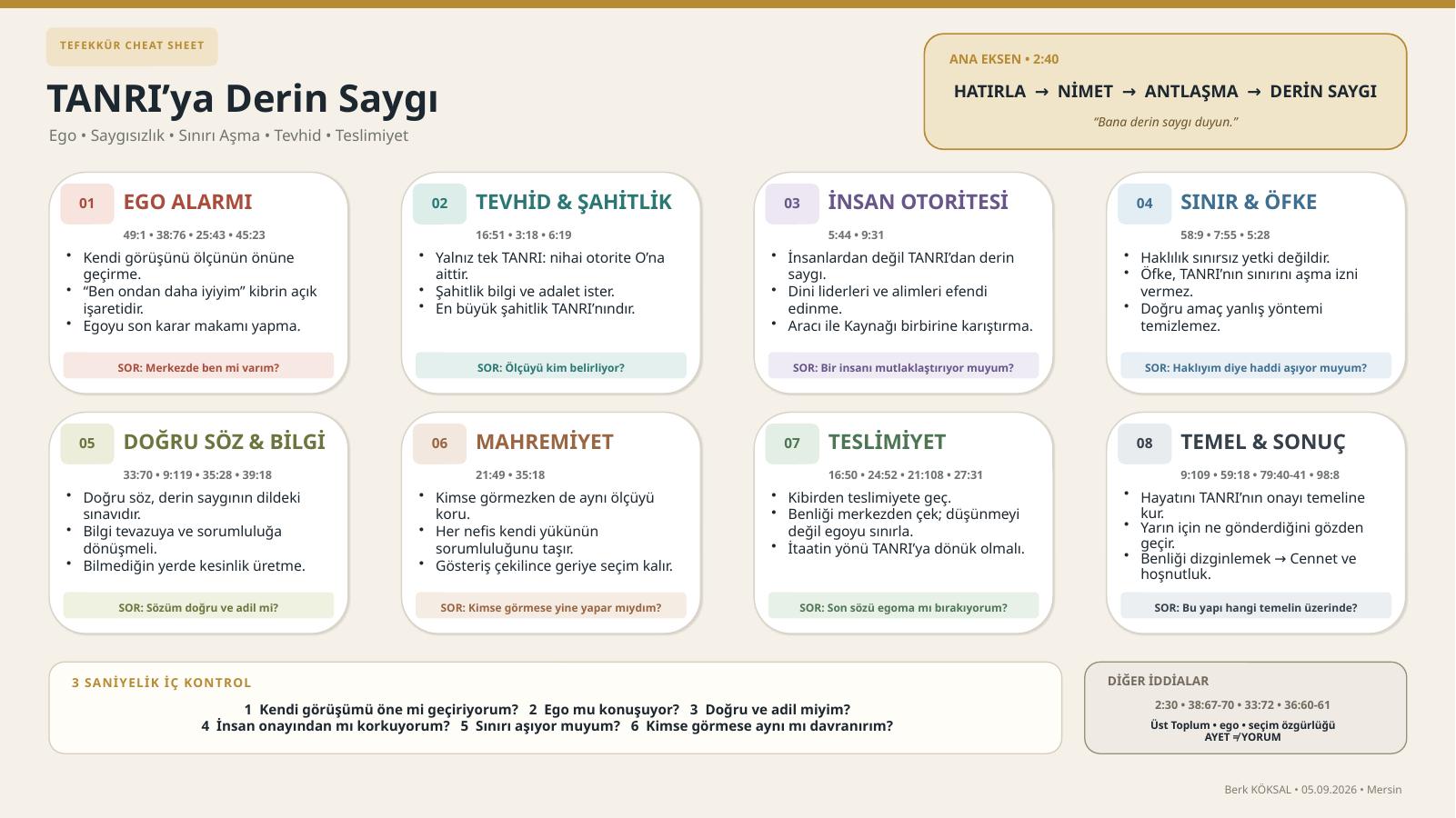
Seen this way, disrespect toward GOD for me no longer fits only under blasphemy, insult, or open denial. Without directing personal judgments at people that the verses themselves do not make, I can see a broader danger in my own life: absolutizing my opinion. Mistaking pride for righteousness. Turning knowledge into a tool of lordship. Putting people in GOD’s place. Raising my anger above the boundary. Saying the truth only in the way that serves me. Living by a different measure when no one is watching.
At the center of all of them is the same question:
Who is at the center?
Deep reverence for GOD is not a person hating themselves. Nor is it destroying the reason, ability, will, or personality given to them. It is not putting any of them in GOD’s place.
The ego may tell me, “I am better.”
Deep reverence tells me, “Know your boundary.”
The ego may tell me, “My opinion is enough.”
Deep reverence reminds me of 49:1.
The ego may tell me, “No one is watching.”
Deep reverence reminds me of 21:49.
The ego may tell me, “If you are right, you can do anything.”
Deep reverence reminds me of the boundary against transgression.
The ego may tell me, “People approve of you, so you must be right.”
Deep reverence moves the measure back to GOD.
Where I have arrived, the most dangerous form of disrespect sometimes does not present itself as disrespect. It can hide inside religious sentences, knowledge, achievements, and even anger that believes it is defending GOD.
For this reason, I see the real struggle not in diagnosing the disrespect of others, but in noticing when my own self begins to overflow into a domain that belongs to GOD.
79:40-41 gives me both the measure and the hope here. Deep reverence and restraining the self are mentioned together with Paradise.
98:8 does not close the road with fear. It speaks of an outcome in which GOD is pleased with them and they are pleased with Him.
For this reason, deep reverence is not merely withdrawing in fear.
It is returning to the right place by accepting GOD’s true greatness.
Remembering the blessing.
Remaining faithful to the covenant.
Speaking truthfully.
Making knowledge a responsibility, not pride.
Not taking people as lords.
Not placing my own opinion above revelation.
Keeping the boundary when angry.
Trying to be the same person even when alone.
And perhaps the hardest of all:
When the ego rises with “I,” reminding it again of the place where it must stand before GOD.
For me, the essence of deep reverence ultimately leads in one direction:
To truly know GOD as GOD and not put myself in His place.
Verse references: 2:40, 79:40, 79:41, 98:8.
Note
2:32 — They said, “Be You glorified. We have no knowledge except that which You have taught us. You are the Omniscient, Most Wise.”
GOD knows best.
Source: kuranteyit.com
Discover
Related Articles
Quran Reflections
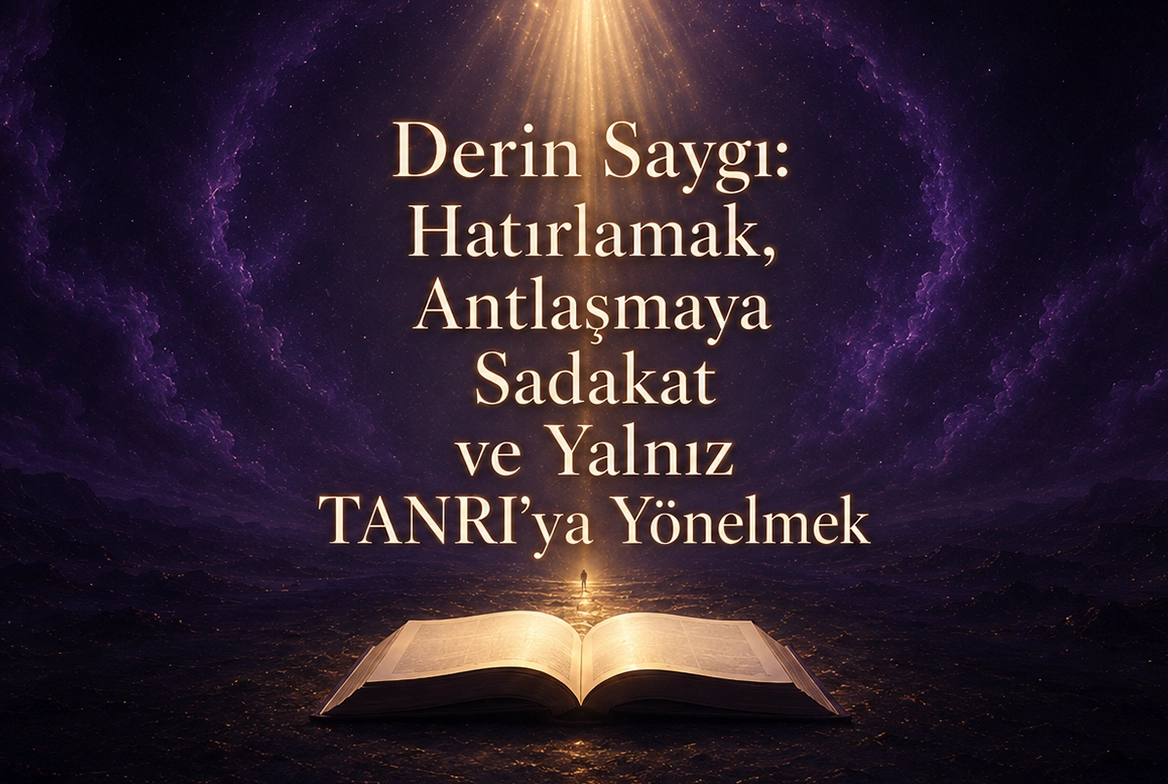
Deep Reverence: Remembering, Faithfulness to the Covenant, and Turning to GOD Alone
A comprehensive reflection centered on Al-Baqarah 2:40 on deep reverence, remembering blessings, faithfulness to the covenant, monotheism, testimony, knowledge, justice, truthful speech, submission, the limits of religious authority, inward orientation in privacy, awareness of accountability, and devotion to GOD alone.
Read article
Quran Reflections
Turning Back on Your Heels: Preserving Your Direction After Guidance
A reflection centered on Al-Baqarah 2:143 on turning back on one's heels, sliding back after guidance, leaving the faith, casting scripture behind one's back, testimony, knowledge, justice, truthfulness, submission, and the limits of religious authority.
Read article
Quran Reflections
What Did the Stones Do? A Reflection on Hell, the Dissolution of Mountains, the Development of the Self, and the Petrified Mind
A deep reflection centered on Al-Baqarah 2:24 about people and stones as the fuel of Hell; the crumbling of the mountain in the story of Moses, GOD's physical presence, the transformation of the earth, the development of the self, those who remain immobile, petrified minds, idols, and responsibility.
Read article